Introduction
Vidalia® sweet onion is a dry-bulb onion grown in southeastern Georgia as a cool-season crop, with transplanting in November and harvest the following spring. Plantings of onion in 2014 in Georgia were estimated to be 4,900 ha (Wolfe and Stubbs Reference Wolfe and Stubbs2015). The acreage is stable, because plantings are restricted by Federal Marketing Order 955 to a defined region (Boyhan and Torrance Reference Boyhan and Torrance2002). Organic Vidalia® sweet onion is a highly profitable segment of the production system that is driven by consumer demand. One of the most costly inputs is weed control (approximately $3,710 ha−1), which is achieved primarily by hand weeding (RL Torrance, University of Georgia, personal communication). Previous weed management research focused on an integrated system that relied heavily on cultivation with a tine weeder (Johnson et al. Reference Johnson, Langston, MacLean, Sanders, Torrance and Davis2012). Compared with summer solarization and a clove oil herbicide, cultivation with a tine weeder was shown to be the most consistent and cost-effective tactic. It was noted that timing of the initial cultivation was crucial and that delays in the initial cultivation would greatly reduce overall weed control. Clove oil was initially evaluated to control weeds when cultivation was delayed. However, efficacy was inconsistent on cool-season weeds, particularly cutleaf evening-primrose (Johnson et al. Reference Johnson, Langston, MacLean, Sanders, Torrance and Davis2012). Clove oil performance was slightly improved by high-volume sprayer output, but none of the adjuvants evaluated improved clove oil performance in controlling cool-season weeds (Johnson and Davis Reference Johnson and Davis2014a). Pelargonic acid was later evaluated for cool-season weed control (Johnson and Davis Reference Johnson and Davis2014b) but was also found to be ineffective in controlling cool-season weeds and preventing onion yield loss.
Another herbicide available for use in certified organic crop production is ammonium nonanoate. Ammonium nonanoate is generally nonselective, is applied POST, and quickly kills susceptible plants by cell membrane disruption (Dayan and Duke Reference Dayan and Duke2010). Common use rates range from a 6% to a 15% solution, mixed with water for spraying (Anonymous 2016). Chemically, ammonium nonanoate and pelargonic acid are similar. Pelargonic acid is a fatty acid, whereas ammonium nonanoate is formulated as a salt of the same fatty acid. In fallow studies, Webber et al. (Reference Webber, Shrefler, Branderberger, Taylor, Carrier and Shannon2011) reported that ammonium nonanoate effectively controlled several warm-season weed species.
Despite the chemical similarity between pelargonic acid and ammonium nonanoate, differences in formulation may result in improved cool-season weed control, particularly in light of research reported by Webber et al. (Reference Webber, Shrefler, Branderberger, Taylor, Carrier and Shannon2011). Furthermore, there is no information on cool-season weed control with ammonium nonanoate. Therefore, trials were initiated in 2013 to determine the effectiveness of ammonium nonanoate used in conjunction with cultivation for weed control in organic Vidalia® sweet onion production.
Materials and Methods
Field trials were conducted from 2013 through 2015 at the Vidalia Onion and Vegetable Research Center near Lyons, GA (32.018801°N, 82.220101°W). This location is in the defined region where Vidalia® sweet onion is commercially produced (Boyhan and Torrance Reference Boyhan and Torrance2002). The soil was a Tifton loamy sand (fine-loamy, kaolinitic, thermic Plinthic Kandiudults), composed of 88% sand, 6% silt, and 6% clay, with 0.5% organic matter. The experimental design was a randomized complete block, with a factorial arrangement of treatments replicated four times. One treatment factor was herbicides suitable for use in certified organic production systems. Herbicides evaluated were ammonium nonanoate (Axxe®, 40% ammonium nonanoate, BioSafe Systems, 22 Meadow Street, East Hartford, CT 06108) mixed with water to make a 4, 6, 8, and 10% solution by volume. Another herbicide approved by the Organic Materials Review Institute for use in certified organic crop production was included for comparison: d-limonene (70% d-limonene, Avenger® Weed Killer Concentrate, Cutting Edge Formulations, 3057 Summer Oak Place, Buford, GA 30518) at 14% spray solution. Herbicide treatments were applied with a CO2-pressurized tractor-mounted plot sprayer using high-volume spray tips with an orifice size suitable to produce an output of 468 L ha−1 at 414 kPa (Turbo TeeJet® 11006 tips, Spraying Systems, Wheaton, IL 60187). This was the same sprayer configuration identified in previous studies as being optimal for applying clove oil and pelargonic acid (Johnson and Davis Reference Johnson and Davis2014a, Reference Johnson and Davis2014b). Herbicide treatments were applied in late December each year to weeds ranging in size from cotyledon to 1-true leaf stage of growth. At the time of application, onion seedlings had recovered from transplanting and were approximately 15-cm tall with a bulb diameter of 10 mm.
The other treatment factor was cultivation with a tine weeder (Aerostar Tine Weeder, Einböck GmbH & CoKG, Schatzdorf 7, 4751 Dorf an der Pram, Austria). The tine weeder uses ground-driven vibrating tines that are closely spaced in multiple rows on the implement. The vibrating tines displace seedling weeds (Colquhoun and Bellinder Reference Colquhoun and Bellinder1997) and were shown to be useful for weed management in organic onion in Georgia (Johnson et al. Reference Johnson, Langston, MacLean, Sanders, Torrance and Davis2012). The tine weeder evaluated in these trials tilled a swath 1.8-m wide. Cultivation treatments were four times (4X) with the tine weeder at 2-wk intervals and a noncultivated control. The initial cultivation was made 1 wk after herbicide application, which was also 4 wk after transplanting.
Transplants of an approved cultivar for Vidalia® sweet onion production (‘Sweet Agent®,’ Seminis Vegetable Seeds, 2700 Carmino Del Sol, Oxnard, CA 93030) were grown according to National Organic Standards. Transplants were produced in seedbeds that were direct seeded in September each year. Field sites were fertilized with 13,400 kg ha−1 of composted poultry litter (average analysis of 3% N, 2% P, 3% K) in November each year and soil incorporated 8-cm deep with a power tiller. This rate of composted poultry litter was based on previous studies that determined the recommended rates for organic onion production in Georgia (Boyhan et al. Reference Boyhan, Hicks, Torrance, Riner and Hill2010). Immediately after the final seedbed preparation, onions were transplanted by hand. Plots were 1.8-m wide by 6.1-m long, with four rows centered on the seedbed and each row 30-cm apart. Within each row, onion transplants were spaced 10-cm apart to achieve the optimum combination of yield and desirable grade (Boyhan and Kelley Reference Boyhan and Kelley2008; Boyhan et al. Reference Boyhan, Torrance, Cook, Riner and Hill2009). To comply with national organic crop production standards, no synthetic pesticides were applied during these trials.
Visual estimates of onion injury compared with the nontreated control were assessed in mid-January, approximately 3 wk after herbicide treatment, using a scale of 0 to 100, where 0=no visual injury from herbicides and 100=complete onion plant mortality. Weed counts were determined mid-March of each year. Weeds were counted by species in two 0.5-m2 quadrats (0.5 by 1.0 m) randomly placed in each plot, centered over an onion row. Onion stand counts were measured midseason after the last cultivation from two random locations in each plot. Onion yields from the entire plot were measured by mechanically undercutting and lifting at physiological maturity in early May each year. After 1 wk of field-curing, roots and tops were clipped by hand, and onion bulbs were graded by size according to established standards (USDA 1995). Diseased, misshapen, and small onion bulbs were discarded during the grading process. Onion yields were recorded by grade and total yield.
Data were analyzed using a mixed-model analysis. Degrees of freedom were partitioned to test singularly and in combination the effects of herbicides and cultivation regime on weed control and onion yield parameters. Means were separated using Fisher’s protected LSD test (P≤0.05).
Results and Discussion
Due to differences in growing conditions and baseline weed densities among years, all data were analyzed separately by year. ANOVA indicated no significant interactions between the main effects of cultivation and herbicide treatment for all parameters. Therefore, all data are presented by main effects.
Cutleaf Evening-primrose
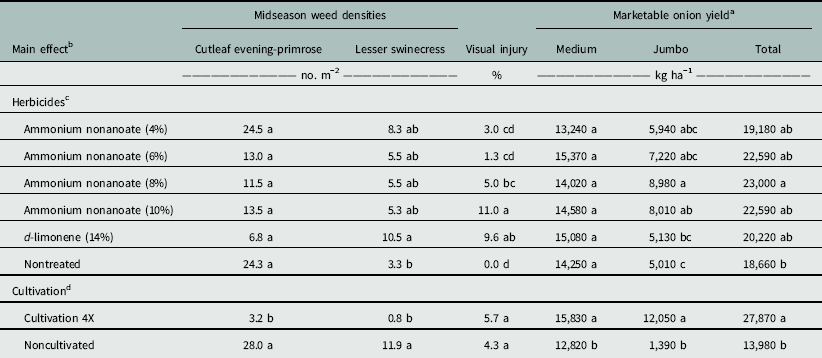
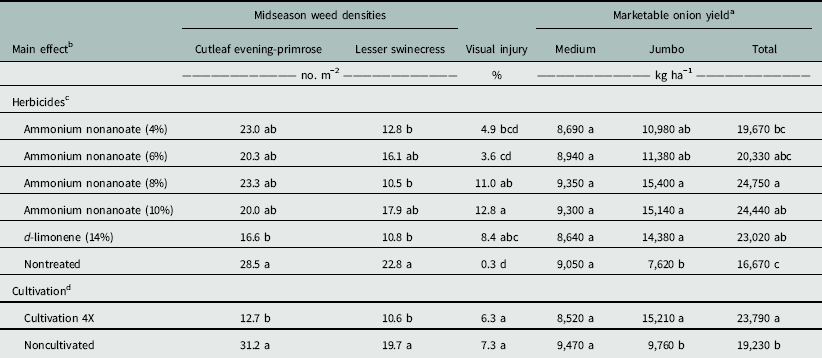
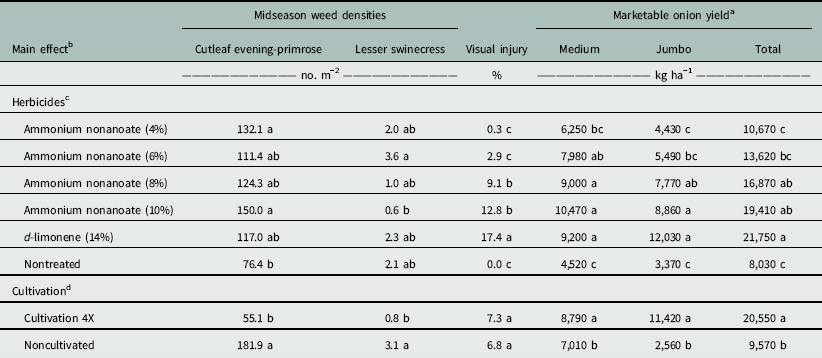
The most common weed in each year of the study was cutleaf evening-primrose, with densities ranging from 28 to 182 plants m−2. Neither ammonium nonanoate at any rate nor d-limonene affected cutleaf evening-primrose density in 2013, and there were no differences in weed density among any of the herbicide treatments and the nontreated control (Table 1). In 2014, weed control with any rate of ammonium nonanoate was poor, and cutleaf evening-primrose densities were similar to the nontreated control (Table 2). Only d-limonene reduced 2014 cutleaf evening-primrose densities compared with the nontreated control. Extraordinarily high densities of cutleaf evening-primrose were present in 2015, with densities in herbicide-treated plots ranging from 76 to 150 plants m−2 (Table 3). Cutleaf evening-primrose densities among all ammonium nonanoate rates did not differ. In fact, cutleaf evening-primrose densities were greatest when treated with the highest ammonium nonanoate rate of 10%. In 2015, no herbicide treatment reduced cutleaf evening-primrose densities compared with the nontreated control (Table 3).
Main effects of cultivation with a tine weeder and ammonium nonanoate on weed control, visual injury, and organic onion yield at Lyons, GA, in 2013.

a Medium = 5.1 to 7.6 cm in diameter; jumbo >7.6 to 9.5 cm in diameter. Onion bulbs <5.1 cm in diameter were discarded. Colossal-size bulbs (>9.5 cm in diameter) are not reported, due to few being produced in these trials, but are included in the total yield calculation.
b Within each main effect, means in a column followed by the same letter are not different according to Fisher’s protected LSD test at P<0.05.
c Herbicide treatment data are main effects combined across cultivations.
d Cultivation data are main effects combined across herbicides.
Main effects of cultivation with a tine weeder and ammonium nonanoate on weed control, visual injury, and organic onion yield at Lyons, GA, in 2014.

a Medium = 5.1 to 7.6 cm in diameter; jumbo >7.6 to 9.5 cm in diameter. Onion bulbs <5.1 cm in diameter were discarded. Colossal-size bulbs (>9.5 cm in diameter) are not reported, due to few being produced in these trials, but are included in the total yield calculation.
b Within each main effect, means in a column followed by the same letter are not different according to Fisher’s protected LSD test at P<0.05.
c Herbicide treatment data are main effects combined across cultivations.
d Cultivation data are main effects combined across herbicides.
Main effects of cultivation with a tine weeder and ammonium nonanoate on weed control, visual injury, and organic onion yield at Lyons, GA, in 2015.

a Medium = 5.1 to 7.6 cm in diameter; jumbo >7.6 to 9.5 cm in diameter. Onion bulbs <5.1 cm in diameter were discarded. Colossal-size bulbs (>9.5 cm in diameter) are not reported, due to few being produced in these trials, but are included in the total yield calculation.
b Within each main effect, means in a column followed by the same letter are not different according to Fisher’s protected LSD test at P<0.05.
c Herbicide treatment data are main effects combined across cultivations.
d Cultivation data are main effects combined across herbicides.
The main effect of cultivation with a tine weeder consistently reduced cutleaf evening-primrose densities each year of the study. Compared with the noncultivated control, cultivation with a tine weeder reduced cutleaf evening-primrose densities by 59% to 89% (Tables 1–3). It is worth noting that with the baseline weed densities present in these locations, large numbers of cutleaf evening-primrose escaped control with the tine weeder, and the surviving weeds were still numerous in cultivated plots, with densities of surviving cutleaf evening-primrose ranging from 3 to 55 plants m−2.
Lesser Swinecress
Lesser swinecress was present each year of the study, with densities ranging from 3 to 19 plants m−2. In 2013, lesser swinecress densities did not differ among ammonium nonanoate rates, with densities not differing from the nontreated control (Table 1). Additionally, lesser swinecress densities in 2013 did not differ between any rate of ammonium nonanoate and d-limonene. In 2014, results were similar. Lesser swinecress densities did not differ in 2014 among any of the ammonium nonanoate rates and d-limonene (Table 2). When compared with the nontreated control, onion treated with ammonium nonanoate at 4% and 8% and d-limonene had lower densities of lesser swinecress. In 2015, ammonium nonanoate at 10% reduced densities of lesser swinecress more than any herbicide treatment (Table 3). However, lesser swinecress densities when treated with ammonium nonanoate at 10% were not different from the nontreated control.
Cultivation with a tine weeder consistently reduced densities of lesser swinecress compared with the noncultivated control (Tables 1–3). Across the 3-yr study, cultivation with a tine weeder reduced lesser swinecress densities 46% to 93% compared with the noncultivated control.
Visual Injury
Injury from all rates of ammonium nonanoate and d-limonene was foliar necrosis and was transient. Compared with all rates, ammonium nonanoate at 10% was the most injurious treatment to onion in 2013 (Table 1). However, visual injury from ammonium nonanoate at 10% was similar to injury from d-limonene. In 2014, ammonium nonanoate rates of 8% and 10% were equally injurious to onion and similar to d-limonene (Table 2). The most injurious treatment of all herbicides in 2015 was d-limonene (Table 3). In 2015, the most phytotoxic ammonium nonanoate rates evaluated were 8% and 10%.
Onion Stand Counts
There was no effect of herbicide treatment and cultivation on midseason onion stand counts (unpublished data). The transient foliar necrosis caused by ammonium nonanoate and d-limonene did not cause onion mortality. Similarly, this indicates that cultivation with a tine weeder does not reduce onion stand.
Onion Yield
In 2013, yields of medium-sized onion were not affected by any of the herbicide treatments (Table 1), indicating that none of the natural product herbicides adequately protects onion yields from losses due to weeds. Of all herbicide treatments, the greatest yield of jumbo-sized onion in 2013 was treated with ammonium nonanoate at 8%. Jumbo-sized onion yields when treated with d-limonene or ammonium nonanoate at 4% and 6% did not differ when compared with the nontreated control. Greatest 2013 total onion yield was achieved when treated with ammonium nonanoate at 8%, while the remaining treatments had total onion yields similar to the nontreated control.
In 2014, yields of medium-sized onion were not affected by herbicides (Table 2). Greatest yields of jumbo-sized onion were with ammonium nonanoate (8% and 10%) and d-limonene, with those yields greater than the nontreated control. Jumbo-sized onion yields when treated with ammonium nonanoate at 4% and 6% were similar to the nontreated control. Similarly, total onion yields when treated with ammonium nonanoate at 4% and 6% were not different from total onion yields in nontreated control. Compared with the nontreated control, total onion yields were greatest when treated with ammonium nonanoate at 8% and 10%, along with d-limonene.
In 2015, medium-sized onion yields were increased compared with the nontreated control when treated with ammonium nonanoate at 6%, 8%, and 10%, along with d-limonene (Table 3). Jumbo-sized and total onion yields were increased compared with the nontreated control by ammonium nonanoate at 8% and 10%, along with d-limonene. Jumbo-sized onion yields when treated with ammonium nonanoate at 4% and 6% did not differ from yields in the nontreated control.
Yield of medium-sized onion was increased by cultivation with a tine weeder 2 out of 3 yr (Tables 2 and 3), but there was no cultivation effect in 2013 (Table 1). Cultivation with a tine weeder improved jumbo-sized and total onion yield each year of the study (Tables 1–3). Cultivation with a tine weeder increased total onion yield by 24% to 115% compared with the noncultivated control.
These results indicate that ammonium nonanoate does not adequately control cutleaf evening-primrose and lesser swinecress and that onion yields were not protected from losses due to weeds. The consistent lack of interaction between cultivation with a tine weeder and herbicide treatments also indicates that herbicides do not supplement cool-season weed control over cultivation alone. Onion yields reflected the degree of poor weed control. This overall finding is consistent with earlier weed control research using clove oil and pelargonic acid (Johnson and Davis Reference Johnson and Davis2014a, Reference Johnson and Davis2014b; Johnson et al. Reference Johnson, Langston, MacLean, Sanders, Torrance and Davis2012). Given the results of this research, along with the earlier studies, it is questionable whether herbicides derived from natural products, with their POST mode of action as cell membrane disrupters (Dayan and Duke Reference Dayan and Duke2010; Tworkoski Reference Tworkoski2002), will ever adequately control cool-season weeds. Extraordinary efforts were made to apply these herbicides during periods of warm temperatures to seedling weeds, which is difficult to achieve during the winter season—even in southern Georgia. Brainard et al. (Reference Brainard, Curran, Bellinder, Ngouajio, VanGessel, Haar, Lanini and Masiunas2013) reported temperature had no effect on warm-season weed control using clove oil. Based on the research to date, it is not possible to determine whether inconsistent cool-season weed control using ammonium nonanoate or any of the other previously reported natural product herbicides is due to weed tolerance, herbicide characteristics, or prevailing winter application conditions. Regardless of the reason, herbicides derived from natural sources do not adequately control cool-season weeds in organic Vidalia® sweet onion production and should not be recommended.
Cultivation with a tine weeder has been previously reported as a reliable means to control weeds in transplanted onion (Johnson et al. Reference Johnson, Langston, MacLean, Sanders, Torrance and Davis2012), and these data are in agreement. However, it is clear that despite consistent benefits of cultivation with a tine weeder, the level of weed control remains inadequate. For example, in the present research, plots cultivated with the tine weeder still had surviving cutleaf evening-primrose densities ranging from 3 to 55 plants m−2 (Tables 1–3). While those densities represent significant reductions compared with the noncultivated control, the density of surviving weeds is unacceptable. It is widely acknowledged that sole reliance on any form cultivation is inherently risky due to possible disruption by weather events and wet soil that affects overall implement performance (Cavigelli et al. Reference Cavigelli, Teasdale and Conklin2008; Porter et al. Reference Porter, Huggins, Perillo, Quiring and Crookston2003; Posner et al. Reference Posner, Baldock and Hedtcke2008). Given the limitations and risk of cultivation, along with the consistent failure of herbicides derived from natural products controlling cool-season weeds, improvements in weed management in organic Vidalia® sweet onion production will require a different approach.
Acknowledgments
We acknowledge the technical contributions of Daniel R. Evarts, whose skills made these studies possible. Appreciation is expressed to C. Randy Hill and Denny R. Thigpen at the Vidalia Onion and Vegetable Research Center for their support of this research study. We appreciate the managerial support and assistance rendered by Stephen Powell, Corrections Officer - II, Rogers State Prison, Reidsville, GA.