Introduction
Cedar species (Cedar spp.) are world-renowned ornamental and landscape trees. In China, C. deodara is widely planted across most regions and functions as a dominant urban landscape tree in many towns and cities. Over the past decade, cedar trees in several regions of China have been severely damaged by Cinara cedri Mimeur, 1936 (Hemiptera: Aphidoidea: Lachnidae). This aphid was first documented in China in Beijing in 2014 (Yu and Wang, Reference Yu and Wang2014). Subsequently, infestations of C. cedri on cedar trees were reported sequentially in Shandong, Hebei, Henan, and Shanxi provinces (Ji et al., Reference Ji, Li, Zhou and Yin2021). To date, C. cedri has spread to all 16 prefectural-level regions within Shandong Province. In Tai’an, Shandong Province, C. cedri exhibits two annual population outbreak peaks in spring and autumn. Colonies of this aphid feed in dense aggregations on host branches, directly impairing cedar health. Furthermore, the copious honeydew excreted by aphids contaminates branches and leaves of cedar trees, as well as understory surfaces, groundcover plants, and public recreational facilities such as benches beneath trees. This seriously degrades urban greening quality and municipal appearance.
In China, several reports have documented extensive needle yellowing, branch dieback, and even whole-tree mortality in pine trees infested by pine aphids (Tang, Reference Tang2003; Hu et al., Reference Hu, Xia, Yuan, Gao, Xu, Xie, Ren, Ren and Shi2006). In the spring of 2013, foliage and branches of some cedar trees in Beijing exhibited desiccation and even mortality. Yu and Wang (Reference Yu and Wang2014) identified late spring cold snaps as the primary causal factor, but also raised an important question: ‘Did the large-scale outbreak of C. cedri in the preceding autumn impair the vitality of cedar trees, thereby weakening their resistance to winter low temperatures and late spring cold snaps?’. The annual persistent infestation by C. cedri, coupled with unfavourable climatic conditions, does pose a potential risk of cedar tree mortality.
From the literature reports, the global spread of C. cedri has been relatively rapid in recent years. In Cyprus, Croatia, North Korea, Bulgaria, and Japan, the first record of C. cedri was successively documented in 2015 (Binazzi et al., Reference Binazzi, Peverieri and Roversi2015), 2017 (Landeka and Podnar, Reference Landeka and Podnar2017), 2020 (Lee et al., Reference Lee, Lee, Seo, Lee and Lee2020), 2021 (Georgiev et al., Reference Georgiev, Georgieva, Trencheva, Mirchev, Kechev, Belilov and Petrova2021), and 2022 (Nozaki et al., Reference Nozaki, Kobayashi and Shigenobu2022). In China, since the initial report of C. cedri, several studies have been conducted on its basic biological and ecological characteristics (Tian, Reference Tian2018; Ji et al., Reference Ji, Li, Zhou and Yin2021), the predatory capacity of its natural enemy, Harmonia axyridis, against it (Wang et al., Reference Wang, Zhang, Tian, Wang, Zhou and Yin2019), its chemical ecology (Yang et al., Reference Yang, Wang, Shen and Wang2023), and brief reports on its occurrence and management (Lin and Lei, Reference Lin and Lei2018; Yang et al., Reference Yang, Zhang and Sun2019). Internationally, in addition to the first-record reports, research on C. cedri has primarily focused on its endosymbiotic bacteria (Pérez-Brocal et al., Reference Pérez-Brocal, Latorre, Gil and Moya2005, Reference Pérez-Brocal, Gil, Ramos, Lamelas, Postigo, Michelena, Silva, Moya and Latorre2006; Gosalbes et al., Reference Gosalbes, Lamelas, Moya and Latorre2008; Lamelas et al., Reference Lamelas, Pérez-Brocal, Gómez-Valero, Gosalbes, Moya and Latorre2008, Reference Lamelas, Gosalbes, Manzano-Marín, Peretó, Moya and Latorre2011; Toft and Fares, Reference Toft and Fares2009; Manzano-Marín et al., Reference Manzano-Marín, Simon and Latorre2016; Martínez-Díaz et al., Reference Martínez-Díaz, Latorre and Gil2016).
Temperature is a key ecological factor governing insect development, reproduction, survival, and distribution. C. cedri overwinters in the egg stage, and the low-temperature tolerance of its eggs directly determines its overwintering survival, spring population abundance, and potential for northward range expansion. Unpredictable, sudden temperature drops in spring and autumn can also substantially affect its population dynamics. Therefore, characterising cold tolerance across different developmental stages is critical for predicting the population dynamics and geographic distribution under changing climatic conditions. Although the development and reproduction of C. cedri have been investigated under constant thermal regimes (Özder and Ozgur, Reference Özder and Ozgur2013; Ji et al., Reference Ji, Li, Zhou and Yin2021), its extreme low-temperature tolerance across life stages remains unexplored. In this study, we measured for the first time the supercooling points (SCPs) of eggs, nymphs, and adults; the lethal low temperatures of nymphs and adults; and the effects of cold acclimation (ACC) and rapid cold hardening (RCH) on their cold tolerance. These results will provide a valuable basis for forecasting the population dynamics of C. cedri under extreme climatic conditions, as well as its potential distribution, while contributing to understanding its low-temperature biology.
Materials and methods
Insects
The eggs, first-instar nymphs (hereafter referred to as nymphs), and adults of C. cedri were collected from C. deodara on the campus of Shandong Agricultural University and its surrounding areas in Tai’an, Shandong Province, China. To ensure the representativeness of the samples, aphids were obtained from a total of 10 host trees.
Eggs
Needles bearing aphid eggs were collected from cedar trees and transported to the laboratory. Eggs were carefully detached from the needles using fine insect pins. In December, both light brown and black eggs co-occur, with freshly laid eggs appearing light brown and gradually darkening to black. We hypothesise that light brown eggs (freshly laid) are in the diapause preparation phase, black eggs collected in December are in the diapause maintenance phase, and black eggs collected in March are in the diapause termination phase. Given potential differences in cold tolerance, these distinct egg groups were measured separately.
Adult fundatrices and first-instar fundatrices
In March, needles bearing overwintering eggs were collected and transported to the laboratory, where they were held in covered Petri dishes at 20 ± 1°C. Daily observations were performed to obtain newly hatched first-instar fundatrices. Meanwhile, the occurrence of C. cedri on outdoor cedar trees was continuously monitored to detect the emergence of adult fundatrices and collect samples in a timely manner.
Virginoparae
Adult and first-instar nymphal virginoparae of C. cedri were collected directly from field–grown cedar trees.
Determination of SCP
Each individual was affixed to the probe of an insect SCP measuring instrument (TA612C thermocouple thermometer, Suzhou Tasi Electronic Industry Co., Ltd, China) using Vaseline. The probes were then placed in an ultra-low temperature freezer (DW-HW50, Zhongke Meiling Low Temperature Technology Co., Ltd, China), where the temperature was reduced gradually from room temperature at a rate of 0.5°C/min. Aphid body temperatures were recorded at 1–s intervals via a computer connected to the instrument, with the manufacturer’s software used to determine SCPs. At least 20 (Sinclair et al., Reference Sinclair, Coello Alvarado and Ferguson2015) individual aphids (≥2 individuals per tree) were examined for each developmental stage.
Determination of lethal low temperature
Ten aphids (one individual per tree) were transferred into a 2 mL centrifuge tube using a fine brush as one replicate. Tubes were sealed with sealing film, and several small holes were punctured in the film using an insect pin to permit gas exchange. The tubes were then exposed to 0°C, −5°C, −7°C, −10°C, −12°C, and −15°C for 1 and 2 h, respectively. After treatment, the tubes were maintained at 20 ± 1°C for 24 h for recovery, and aphid survival was then assessed. Individuals that could crawl upon gentle prodding with a fine brush were scored as alive. Each treatment included five biological replicates, with a total of 50 aphids. Aphids of the same stage maintained at 20 ± 1°C served as a control to correct for mortality. Mortality was corrected using Abbott’s formula: corrected mortality (%) = (treatment mortality − control mortality)/(1 − control mortality) × 100.
Cold ACC
The effects of natural ACC on the cold tolerance of adults and nymphs were determined by comparing the low-temperature mortality of individuals collected in different seasons. Aphids were collected in December and May and placed into 2 mL centrifuge tubes following the procedures described in the ‘Determination of lethal low temperature’ section. Tubes containing adults were exposed to −10°C for 1 h, and those with nymphs to −7°C for 1 h. All other steps were identical to those outlined in the same section.
Rapid cold hardening
Adults were first exposed to 3°C for 2 h, followed by exposure to −10°C for 1 h, and finally transferred to 20 ± 1°C for recovery. After a 24-h recovery period, their survival status was assessed. All specific procedures were consistent with those described in the ‘Determination of lethal low temperature’ section. Adults not exposed to the 3°C pre-treatment served as the control group.
Statistical analysis
All statistical analyses were performed using SPSS 26.0. Independent-sample t-tests were used for pairwise comparisons of SCPs between the following groups: eggs of different colours collected in the same season; eggs of the same colour collected in different seasons; adult fundatrices vs. virginoparae; first-instar fundatrices vs. virginoparae; adult fundatrices vs. first-instar fundatrices; and adult virginoparae vs. first-instar virginoparae. Independent-sample t-tests were also applied to compare mortality between life stages or exposure durations at the same temperature, low-temperature mortality of the same life stage collected in different seasons, and mortality of aphids before and after RCH. One-way analysis of variance followed by Tukey’s HSD test was used to compare differences in SCPs among eggs, nymphs, and adults, and to evaluate the effects of different constant low temperatures on the mortality of adult or nymphal aphids. Normality and homogeneity of variance were verified prior to analysis, and no data transformation was required (α = 0.05). Probit analysis was conducted to estimate the temperatures causing 50% (LT50) and 99% (LT99) mortality.
Results
Supercooling capacity
The mean SCP of eggs, adults, and nymphs of C. cedri were −30.14°C, −12.89°C, and −14.21°C, respectively. The supercooling capacity of eggs was significantly greater than that of adults and nymphs (P < 0.001), and nymphs exhibited a significantly greater supercooling capacity than adults (P < 0.01) (fig. 1).
SCPs of eggs, adults and first-instar nymphs of C. cedri. Bars (mean ± SE) with different lowercase letters indicate significant differences (one-way ANOVA followed by Tukey’s HSD test, α = 0.05).

Figure 1 Long description
A bar graph showing the supercooling point (SCP) in degrees Celsius for three stages: egg, adult and first-instar nymph. The y-axis is labeled SCP (degrees Celsius) ranging from zero to negative thirty-five. The egg stage shows a value around negative thirty, labeled 'c'. The adult stage shows a value around negative thirteen, labeled 'a'. The first-instar nymph shows a value around negative fourteen, labeled 'b'.
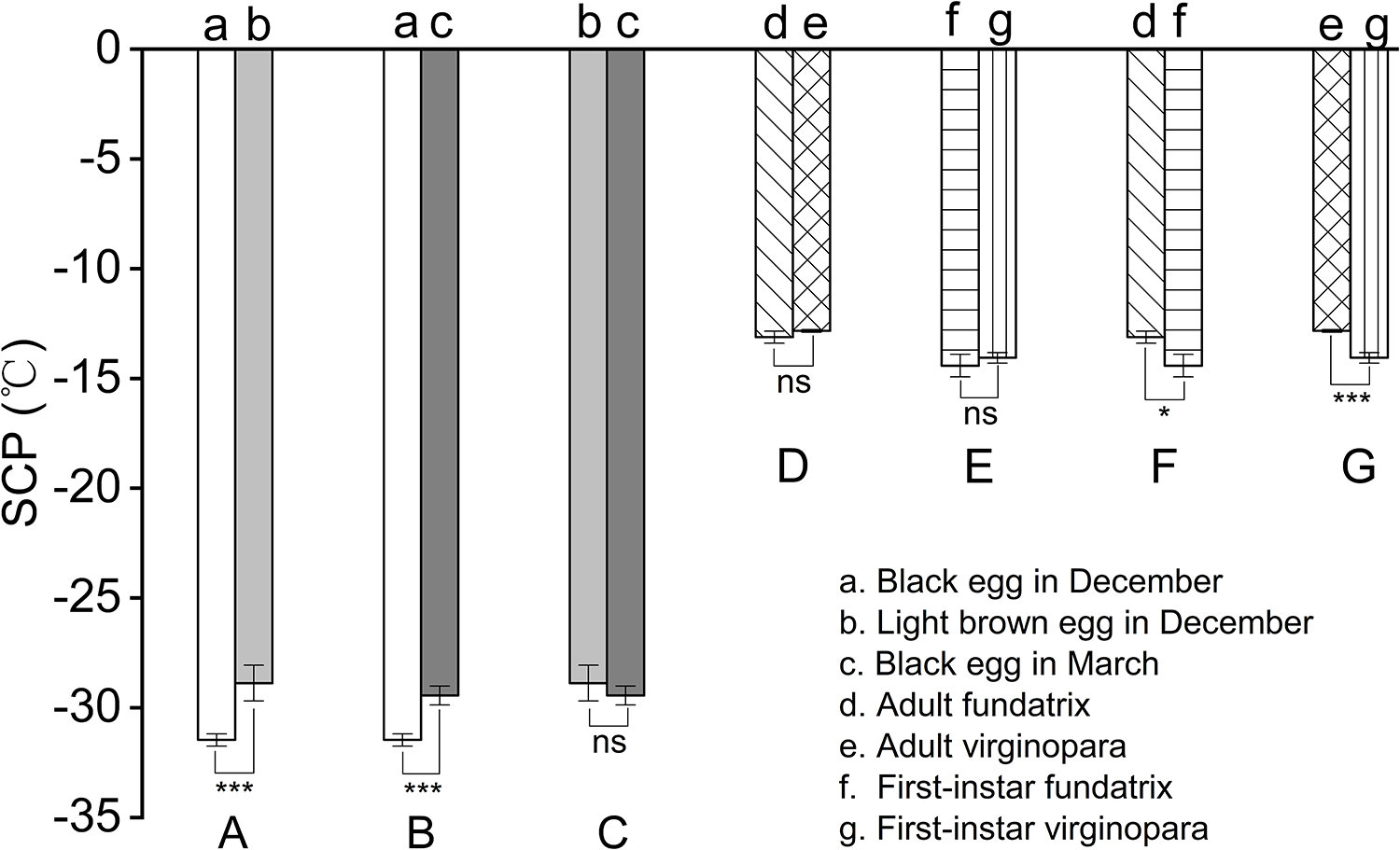
The mean SCP of black eggs collected in December was significantly lower than that of light brown eggs during the same season (P < 0.001, fig. 2A) and that of eggs collected in March of the following year (P < 0.001, fig. 2B), whereas no significant difference was detected between the latter two groups (P > 0.05, fig. 2C).
Pairwise comparisons of SCPs. ns indicates no significant difference; asterisks indicate significant differences, *P < 0.05, **P < 0.01, ***P < 0.001; independent-sample t-test, α = 0.05.

Figure 2 Long description
A bar graph comparing the supercooling point (SCP) in degrees Celsius for various egg and insect types. Bars A, B and C represent black eggs in December, light brown eggs in December and black eggs in March, respectively, with significant differences marked by asterisks. Bars D, E, F and G represent adult fundatrix, adult virginopara, first-instar fundatrix and first-instar virginopara, respectively. 'Ns' indicates no significant difference. The x-axis labels the categories and the y-axis shows SCP in degrees Celsius.
The mean SCP did not differ significantly between adult fundatrices and virginoparae in December, nor between first-instar fundatrices and virginoparae in December (P > 0.05, fig. 2D and E). However, during the same season, adults exhibited significantly higher SCP than nymphs in both December and March (P < 0.05 and P < 0.001, respectively; fig. 2F and G).
Lethal low temperature
Temperatures of −7°C and above had minimal effects on the survival of adult C. cedri. Exposure to −7°C for 1 and 2 h resulted in mortality of only a small proportion of individuals. In contrast, −10°C represented a substantial threat to adult survival, with mortality increasing sharply as exposure duration prolonged. Adult mortality was 31.09% following 1 h of exposure at −10°C, but increased to 80.36% after 2 h, with a significant difference (P < 0.001) (fig. 3A). The estimated LT50 values for adults exposed to low temperatures for 1 and 2 h were −10.28°C and −9.06°C, respectively, while the corresponding LT99 values were −13.25°C and −11.91°C, respectively (table 1).
Mortality of adult and first-instar nymphs of C. cedri following exposure to different constant low temperatures. (A) Mortality of adults after exposure for 1 and 2 h. (B) Mortality of nymphs after exposure for 1 and 2 h. (C) Mortality of adults and nymphs after exposure for 1 h. (D) Mortality of adults and nymphs after exposure for 2 h. Significant differences in mortality among different temperatures within the same life stage and exposure duration are indicated by different uppercase letters (exposure for 2 h) and lowercase letters (exposure for 1 h), respectively (one-way ANOVA followed by Tukey’s HSD test, α = 0.05). Mortality comparisons between life stages or exposure durations at the same temperature are marked with ‘ns’ (no significant difference) or asterisks (significant differences; ***P < 0.001; independent-sample t-test, α = 0.05).

Figure 3 Long description
The image A shows a graph with mortality percentage on the y-axis and temperature in degrees Celsius on the x-axis. It compares adult mortality after 1 hour and 2 hours of exposure. The mortality increases significantly at lower temperatures, with marked differences indicated by letters and symbols. The image B shows a similar graph for nymph mortality after 1 hour and 2 hours of exposure, displaying a similar trend. The image C shows a graph comparing adult and nymph mortality after 1 hour of exposure, with differences marked by letters and symbols. The image D shows a graph comparing adult and nymph mortality after 2 hours of exposure, also with differences marked by letters and symbols. Each graph highlights significant differences in mortality rates at various temperatures and exposure durations.
Estimated mortality (with 95% CI) according to probit regression

Table 1 Long description
The table measures the estimated mortality of different life stages of an organism when exposed to low temperatures for varying durations. It provides lethal temperature estimates for 50% (LT50) and 99% (LT99) mortality, along with 95% confidence intervals. Adults show a lower temperature tolerance compared to nymphs, with an LT50 of -10.28°C at 1 hour exposure, while nymphs have an LT50 of -8.00°C. At 2 hours, the LT50 for adults is -9.06°C, and for nymphs, it is -6.87°C. The LT99 values also indicate that adults require colder temperatures to reach 99% mortality compared to nymphs. These findings suggest that adults are more susceptible to cold stress than nymphs, and the confidence intervals provide a range of uncertainty around these estimates.
Nymphs of C. cedri could tolerate low temperatures of −5°C and above. At temperatures of −7°C and below, mortality increased rapidly with increasing exposure duration. Specifically, mortality increased to 98% following 2 h of exposure to −10°C, and 100% mortality was observed after 1 h of exposure to −12°C (fig. 3B). The estimated LT50 values for nymphs exposed to low temperatures for 1 and 2 h were −8.00°C and −6.87°C, respectively, while the corresponding LT99 values were −12.30°C and −9.78°C, respectively (Table 1).
Exposure to low temperatures of −7°C and −10°C for 1 and 2 h exerted significantly greater adverse effects on nymphs of C. cedri than those on adults (fig. 3C and D).
In general, adults of C. cedri exhibited substantially stronger cold tolerance than nymphs.
Effects of ACC and RCH on cold tolerance
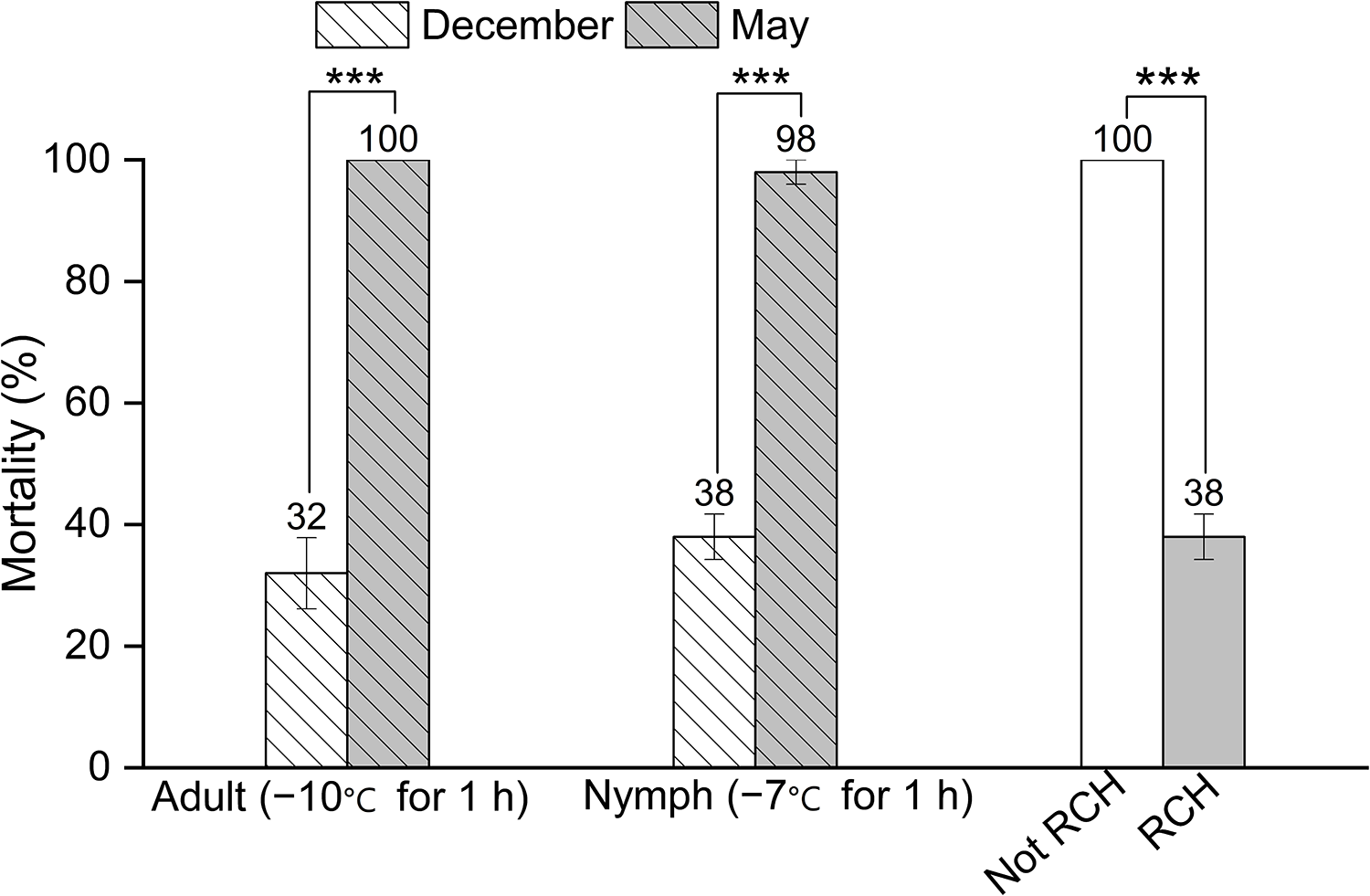
At identical low temperature conditions, the cold tolerance of adult and nymphal C. cedri collected in December was significantly stronger than that of the same developmental stages sampled in May of the following year. Specifically, the low-temperature mortality of adults and nymphs in December was significantly lower than that in May, with adult mortality decreasing by 68% (from 100% to 32%) and nymph mortality by 60% (from 98% to 38%), respectively (fig. 4).
Effects of cold acclimation and rapid cold hardening (RCH) on the cold tolerance of adult and first-instar nymphs of C. cedri. Significant differences in mortality are indicated by asterisks (***P < 0.001; independent-sample t-test, α = 0.05).

Figure 4 Long description
A bar graph showing mortality percentages for adults and nymphs under different conditions. The x-axis labels are 'Adult (minus 10 degrees Celsius for 1 hour)', 'Nymph (minus 7 degrees Celsius for 1 hour)' and 'Not RCH', 'RCH'. The y-axis represents mortality percentage from 0 to 100. For adults, December shows 32 percent and May shows 100 percent mortality. For nymphs, December shows 38 percent and May shows 98 percent mortality. For 'Not RCH', mortality is 100 percent and for 'RCH', it is 38 percent. Significant differences are indicated by three asterisks above the bars.
RCH significantly enhanced the cold tolerance of adult C. cedri. Following a 2 h pre-exposure to 3°C, the mortality of adults exposed to −10°C for 1 h decreased significantly from 100% to 38% (fig. 4).
Discussion
The SCP is a classic physiological index to reflect the freezing point of an organism’s body fluids and is usually used to indicate the cold tolerance of insects. This study revealed that among the various life stages of C. cedri, eggs had the lowest SCP, averaging −30.14°C, significantly lower than that of adults (−12.89°C) and nymphs (−14.21°C), suggesting that eggs might possess greater cold tolerance, a finding that aligns well with the species’ biology. C. cedri overwinters in the egg stage; accordingly, its eggs would be expected to exhibit significantly stronger cold tolerance than non-overwintering stages. However, it is important to note that the SCP does not always directly correlate with cold tolerance (Sinclair et al., Reference Sinclair, Coello Alvarado and Ferguson2015). The cold tolerance of insects is classified into five strategies: freeze-tolerant, freeze-avoiding, chill-tolerant, chill-susceptible, and opportunistic-survival (Bale, Reference Bale1993). Chill-tolerant, chill-susceptible, and opportunistic-survival species suffer mortality from chill injury at subzero temperatures well above their SCP without internal ice formation. Freeze-avoidant insects maintain body fluids in a supercooled state and die only when ice formation occurs at the SCP, while freeze-tolerant species can survive ice formation in body tissues. Therefore, for freeze-tolerant and freeze-avoidant insects, the SCP does represent an important physiological threshold or lower lethal limit, respectively, but it does not for chill-tolerant, chill-susceptible, and opportunistic-survival species (Bale, Reference Bale1993; Sinclair et al., Reference Sinclair, Coello Alvarado and Ferguson2015). Following the methods outlined in Sinclair et al. (Reference Sinclair, Coello Alvarado and Ferguson2015) for determining cold tolerance strategies, we conducted preliminary assessments on adults and eggs of C. cedri. Inter-individual variation was observed in adults: some exhibited chill-susceptible, some were freeze-tolerant, and the possibility of freeze-avoidance could not be excluded (data not included in this study). For eggs, however, the assessment was unsuccessful, as eggs tend to lose viability after prolonged detachment from the host tree, making it impossible to determine whether mortality resulted from low-temperature exposure. Therefore, the currently available SCP data alone are insufficient to accurately determine the low-temperature tolerance limit of different life stages of C. cedri.
When mortality increases with exposure to progressively lower temperatures, cold hardiness can be effectively represented by LT50 (or LT90) values (Bale, Reference Bale1993). In C. cedri, the mortality of adults and nymphs rose as temperature decreased. Under constant low-temperature laboratory conditions, the estimated LT50 values for adults and nymphs after 1 h of exposure were −10.28°C and −9.06°C, respectively, and after 2 h were −8.00°C and −6.87°C, respectively. Thus, adults exhibit stronger cold tolerance than nymphs, even though the SCP of nymphs (−14.21°C) is lower than that of adults (−12.89°C). This also indicates that the SCP is not a reliable predictor of cold tolerance for the active stages of C. cedri.
RCH enhances ectotherm cold tolerance within minutes to hours of chilling and is considered an adaptive response to diurnal temperature fluctuations, whereas ACC improves low-temperature performance over days to weeks of exposure, typically as a response to seasonal cooling (Lee, Reference Lee1989; Teets et al., Reference Teets, Gantz and Kawarasaki2020). In the present study, the RCH preconditioning temperature (3°C) was selected based on meteorological records (2018–2024) from Tai’an. March represents the occurrence period of the first generation of C. cedri, during which the minimum average low temperature is approximately 3°C. A 2 h preconditioning at 3°C significantly enhanced the cold tolerance of adult C. cedri, reducing mortality at −10°C (1 h) from 100% to 38%. Similar RCH effects have been reported in other aphid species, for example, preconditioning at 0°C for 1–3 h significantly increased survival in the Russian wheat aphid, Diuraphis noxia (Kurdjumov), when subsequently exposed to −11.9°C (its LT80) (Saeidi et al., Reference Saeidi, Moharramipour and Mikani2017), and the grain aphid Sitobion avenae (Fabricius) nymphs exhibited enhanced cold tolerance (survival increasing from 26% to 96%) following a 2 h pre-exposure to 0°C (Powell and Bale, Reference Powell and Bale2005). These findings suggest that RCH may be a common and adaptive physiological strategy in aphids, allowing them to cope with sudden diurnal temperature changes without warning in spring and autumn. The cold tolerance of adult and nymphal C. cedri collected in December was significantly higher than that of individuals sampled in May, suggesting that cold tolerance is gradually enhanced via low-temperature acclimation in response to declining ambient temperatures during autumn. The underlying physiological mechanisms of RCH and ACC of C. cedri and the duration of the protective effect following RCH under natural conditions need to be investigated in future studies.
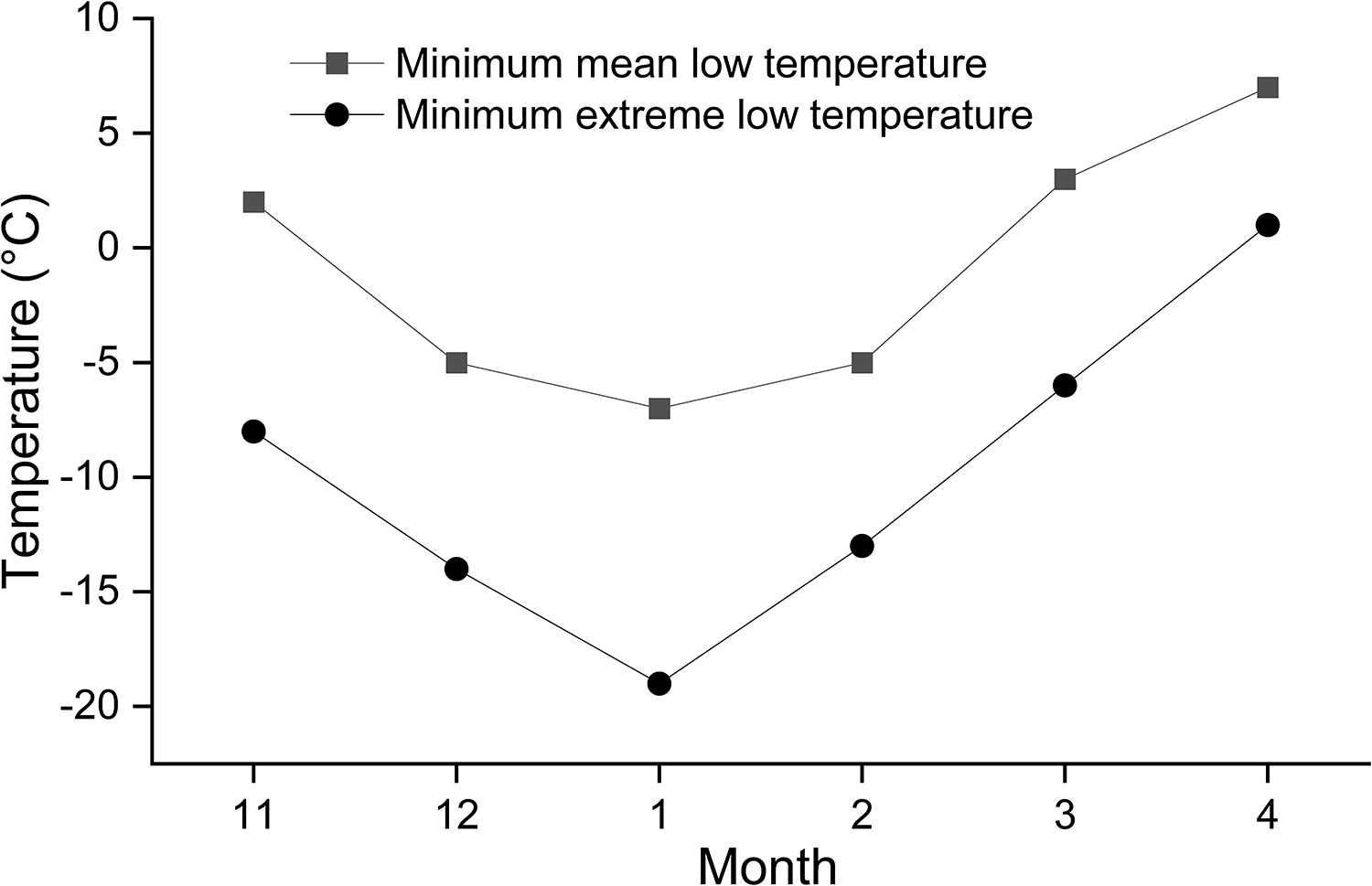
Recent years have witnessed an increased frequency of extreme climatic events, characterised by abrupt temperature fluctuations. Understanding the low-temperature tolerance of insects is therefore critical for forecasting population dynamics under fluctuating climatic regimes. Field observations in our sampling site (Tai’an) showed that the overwintering eggs of C. cedri began to hatch in late March, and the active aphids could survive until December or even early and middle of January. During late autumn and early spring, active aphids are potentially exposed to disruptive climatic events, including frost and late spring cold snaps. From 2018 to 2024, the extreme lowest temperatures recorded in late autumn (November) and early spring (March) at the study site were −8°C and −6°C, respectively (fig. 5). Combining the estimated LT₅₀ values, the RCH and ACC capabilities of C. cedri, and the potential buffering effect of natural microhabitats, it can be inferred that acute low temperatures within recorded historical minima are unlikely to cause high mortality under short exposure. A previous study reported that on 5 December 2012, an extreme minimum temperature of −7°C in Beijing resulted in mortality of only a small proportion of C. cedri individuals, whereas abundant aphids remained alive on host branches (Yu and Wang, Reference Yu and Wang2014). In addition, our investigations in Tai’an indicated that C. cedri maintained relatively stable annual infestations on unsprayed cedar trees since its first discovery in 2016. Both of these observations support our inference. However, caution should be exercised when extrapolating the present findings to predict the population dynamics of C. cedri under extreme low-temperature conditions in the field, given the following limitations of this study: a) the present study was conducted under constant laboratory temperatures; b) exposure was limited to only 1–2 h; c) no repeated freeze-thaw cycle; d) no long-duration cold exposure, and e) no sublethal reproductive impacts measured.
Minimum mean low temperature and minimum extreme low temperature from November to April in Tai’an, Shandong Province, China, during 2018–2024.

Figure 5 Long description
A line graph showing temperature in degrees Celsius on the y-axis and month on the x-axis. The graph displays two lines: one for minimum mean low temperature and another for minimum extreme low temperature. The minimum mean low temperature line starts at approximately 0 degrees Celsius in November, decreases to around minus 10 degrees Celsius in January and rises to about 5 degrees Celsius in April. The minimum extreme low temperature line starts at about minus 5 degrees Celsius in November, drops to nearly minus 20 degrees Celsius in January and increases to around 0 degrees Celsius in April.
In C. cedri, the mean SCP of nymphs was significantly lower than that of adults. A pattern of significantly increasing SCP with developmental age has been documented in numerous aphid species, including Elatobium abietinum (Walker) (Powell, Reference Powell1974), Aphis fabae Scopoli (O’Doherty, Reference O’Doherty1986), S. avenae (F.) (Knight et al., Reference Knight, Bale, Franks, Mathias and Baust1986), Myzus persicae (Sulzer) (Bale et al., Reference Bale, Harrington and Clough1988), D. noxia Mordvilko (Butts, Reference Butts1992), Acyrthosiphon pisum (Harris), Aulacorthum solani Kaltenbach, Megoura crassicauda Mordvilko (Asai et al., Reference Asai, Yoshida, Honda and Tsumuki2002), Aphis glycines Matsumura (McCornack et al., Reference McCornack, Carrillo, Venette and Ragsdale2005), Brevicoryne brassicae L. (Saeidi et al., Reference Saeidi, Moharramipour and Barzegar2012), and S. avenae (Fabricius) (Xu et al., Reference Xu, He, Yu and Wu2020). Several hypotheses have been proposed to explain this ontogenetic trend. One view holds that smaller individuals contain fewer ice-nucleating agents or impurities, thereby reducing potential ice nucleation sites and resulting in lower SCPs. An alternative perspective attributes the pattern to a positive relationship between body water content and ice nucleation temperature (McCornack et al., Reference McCornack, Carrillo, Venette and Ragsdale2005). However, interspecific variation exists, and the SCP did not differ significantly between nymphs and adults in some aphid species, such as Sipha maydis Passerini (Taylor et al., Reference Taylor, Hayashida, Hoback and Armstrong2023) and D. noxia (Mordvilko) (Armstrong and Nielsen, Reference Armstrong and Nielsen2000). Accordingly, further investigation is warranted to clarify the key determinants of supercooling capacity in insects.
Diapause serves as a key overwintering strategy in numerous insect species (Teets et al., Reference Teets, Marshall and Reynolds2023). Diapausing individuals generally exhibit enhanced cold tolerance relative to their nondiapausing counterparts. For example, diapausing adults of Halyomorpha halys (Stal) showed lower SCPs and higher survival after acute cold exposure than nondiapausing adults (Cira et al., Reference Cira, Koch, Burkness, Hutchison and Venette2018). Similarly, diapausing larvae of Eurytoma plotnikovi Nikol’skaya with lower SCP exhibited substantially greater survival at low temperatures compared with nondiapausing larvae with higher SCP (Mohammadzadeh et al., Reference Mohammadzadeh, Borzoui and Izadi2017). Diapause was once regarded as a state of developmental arrest, but it is now recognised as a dynamic physiological programme comprising distinct phases, including the preparation, maintenance, and termination phases (Koštál, Reference Koštál2006). The present study indicated that the mean SCP of black eggs collected in December was significantly lower than that of both light brown eggs sampled during the same season and black eggs collected in March, with no significant difference detected between the latter two. This was in line with the hypothesis proposed in the ‘Materials and methods’ section, namely that the light brown eggs may represent the diapause preparation phase, the black eggs collected in December and March the maintenance phase and termination phase, respectively, with the maintenance phase exhibiting the strongest supercooling capacity. The hypothesis is consistent with the dynamic nature of diapause development (Koštál, Reference Koštál2006), as the maintenance phase of diapause is typically associated with the highest cold tolerance in overwintering insects, a pattern that is compatible with our finding that December black eggs (hypothesised maintenance phase) had the lowest SCPs, although whether the low SCP directly corresponds to superior cold tolerance requires further verification. However, direct evidence, including metabolic rate, gene expression and cryoprotectant levels, is required to verify the diapause status of eggs at each developmental phase.
Overwintering survival of overwintering eggs is crucial for predicting the infestation severity in the following spring and the potential invasion area of C. cedri. Unfortunately, the low-temperature tolerance limits of overwintering eggs of this aphid were not determined in the present study, which represents a key research priority for future investigations.
In conclusion, this study constitutes the first report on the low-temperature biology of C. cedri. Results demonstrated that the eggs exhibited the strongest supercooling capacity among all life stages of C. cedri, followed by the first-instar nymphs. Active aphids were capable of tolerating low temperatures as low as −5°C. Adults displayed greater cold tolerance than nymphs. The estimated 1– and 2–h LT₅₀ values were −10.28°C and −9.06°C for adults, and −8.00°C and −6.87°C for nymphs, respectively. Both ACC and RCH significantly enhanced the cold tolerance of this aphid. Based on these data and the potential buffering effect of natural microhabitats, acute low temperatures near the historical minima recorded in Tai’an, Shandong Province, appear unlikely to cause high mortality under short exposure (1–2 h). However, due to insufficient data on overwintering eggs, reliable prediction of winter low-temperature impacts on spring population dynamics and potential range expansion to colder regions remains challenging.
Financial support
This work was supported by the Science and Technology Project of Taishan Scenery and Scenic Spot Area Management Committee (2022TSGS002).
Competing interests
The authors declare none.