1 Introduction
Non-autonomous or random dynamical systems provide flexible mathematical models to analyse a wide range of forced and noisy phenomena. They have been identified as an important direction going forward in the study of chaotic systems [Reference Young26]. One of the obstacles in the investigation of the long-term properties of such systems stems from the difficulty in identifying concrete examples for which the available theoretical results apply. This work uncovers scenarios where ergodic-theoretical tools can be used to establish results related to the thermodynamic formalism and decay of correlations for random dynamical systems, without imposing requirements such as transitivity or covering, which are often difficult to verify in this context.
For autonomous (time-homogeneous) finite-state Markov chains and systems whose dynamics can be encoded by them, such as shifts of finite type and systems with a Markov partition, one can use normal forms for reducible matrices [Reference Gantmacher12, Vol. 2] to analyse the dynamics using irreducible components as building blocks. In sharp contrast, there is no available decomposition of non-autonomous (random) systems into transitive or irreducible components. For instance, Buzzi [Reference Buzzi6, §0.2] noted difficulties in decomposing one-dimensional piecewise expanding random systems into pathwise irreducible components, and hence in the search for decompositions that could play the role of normal forms in this setting. Accordingly, the study of decay of correlations and Ruelle–Perron–Frobenius-type results in the random setting has so far relied on stronger hypotheses, such as mixing and/or covering conditions [Reference Atnip, Froyland, González-Tokman and Vaienti1–Reference Buzzi6, Reference Dragičević, Froyland, González-Tokman and Vaienti10, Reference Horan14, Reference Kifer15, Reference Mayer and Urbański19, Reference Mayer, Urbański and Skorulski20, Reference Stadlbauer, Suzuki and Varandas24]. Similar assumptions appear in the investigation of memory loss in time-dependent systems [Reference Demers and Liverani7, Reference Gupta, Ott and Török13, Reference Mohapatra and Ott21, Reference Ott, Stenlund and Young22, Reference Stenlund, Young and Zhang25].
In this work, we exhibit new examples of random dynamical systems for which invariant measures (relative equilibrium states) with exponential decay of correlations can be constructed. We do not impose transitivity assumptions—so neither topological mixing nor covering conditions are assumed—but instead require that the random maps and random potentials satisfy a contracting-type condition, on average; see Definition 4.2 for details. Naturally, when such results hold, one expects to obtain a one-dimensional top equivariant direction for the (random) transfer operator. Indeed, under mild extra assumptions, we also show that the multiplicative ergodic theorem of Froyland, Lloyd and Quas [Reference Froyland, Lloyd and Quas11] applies in this setting and yields a unique random Ruelle–Perron–Frobenius decomposition and further information. Our approach builds on the concept of a contracting potential, introduced in the autonomous setting by Liverani, Saussol and Vaienti [Reference Liverani, Saussol and Vaienti17], but we work with random cones of functions, conveniently defined in terms of (essential) infimum and variation. This work may also be regarded as a generalization, complementary to [Reference Atnip, Froyland, González-Tokman and Vaienti1], of the work of Liverani and Maume-Deschamps [Reference Liverani and Maume-Deschamps16] to the random setting. Furthermore, our approach allows us to prove results for both open and closed settings simultaneously, in a concise manner.
Our main results may be summarized as follows. See §2 for the allowed class of random open (and closed) maps, Definition 4.2 for the notion of strongly contracting potential and §6.1 for precise statements and proofs. For the related random Ruelle–Perron–Frobenius-type decomposition, see Theorem 6.6. Throughout this work,
 $\operatorname {\mathrm {Einf}}(f)$
is the essential infimum of f with respect to the Lebesgue measure.
Main Theorem. Let
 $\mathcal {L}_\omega $
be the transfer operator associated to a random strongly contracting potential for a random open (or closed) map of the interval
 $\{(T_\omega ,H_\omega )\}_{\omega \in \Omega }$
(or
 $\{T_\omega \}_{\omega \in \Omega }$
), driven by an ergodic, invertible, probability-preserving transformation
 $\sigma : (\Omega , m) \to (\Omega , m)$
. Then, there exist equivariant families,
 $\{q_\omega \}_{\omega \in \Omega }$
and
 $\{\nu _\omega \}_{\omega \in \Omega }$
, of bounded variation functions and probability measures respectively given by
 $$ \begin{align*} q_\omega={}\lim_{n\to\infty}\frac{\mathcal{L}_{\sigma^{-n}\omega}^{(n)} 1}{ \operatorname{\mathrm{Einf}}(\mathcal{L}_{\sigma^{-n}\omega}^{(n)} 1)} \quad \text{and} \quad \nu_\omega (\cdot) =\lim_{n\to\infty}\frac{\operatorname{\mathrm{Einf}}_{} (\mathcal{L}_{\omega}^{(n)} (\cdot))}{\operatorname{\mathrm{Einf}}(\mathcal{L}_{\omega}^{(n)} 1)}, \end{align*} $$
such that
 $\mathcal {L}_\omega q_\omega = {\unicode{x3bb} ^{-}_\omega } {q}_{\sigma \omega }$
and
 $\nu _\omega (\cdot ) = \unicode{x3bb} ^{+}_{\omega } \nu _{\sigma \omega }(\mathcal {L}_\omega (\cdot ))$
, with
 $\int \log \unicode{x3bb} _{\omega ^+}\,dm= \int \log \unicode{x3bb} _{\omega ^-}\,dm$
. The multipliers
 $\{\unicode{x3bb} ^{\pm }_\omega \}_{\omega \in \Omega }$
also satisfy equations (5.2) and (5.7). (It will be shown that
 $\unicode{x3bb} _{\omega ^-}= { \nu _\omega (q_\omega )\unicode{x3bb} _{\omega ^+} }/{ \nu _{\sigma \omega }(q_{\sigma \omega })}$
, see equation (6.4).) Define
 $\mu _\omega $
by
 $\int f \,d\mu _\omega := {\int f q_\omega \,d\nu _\omega }/{\nu _\omega (q_\omega )}$
. Then,
 $$ \begin{align*} \int f \,d\mu_{\sigma \omega} = \int f \circ T_\omega \,d\mu_\omega, \end{align*} $$
and
 $\{\mu _\omega \}_{\omega \in \Omega }$
yields the unique relative equilibrium state for the system. Furthermore, there exist
 $0<r<1$
and a measurable, tempered
 $C_\omega>0$
such that for every
 $f\in L^1(\nu _\omega )$
,
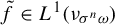 $\tilde {f}\in L^1(\nu _{\sigma ^n\omega })$
and
 $h \in BV$
,
 $$ \begin{align*} &| \mu_{\sigma^{-n}\omega}(f\circ T^{(n)}_{\sigma^{-n}\omega} \cdot h) - \mu_{\omega}(f)\mu_{\sigma^{-n}\omega}(h)| \leq C_\omega\|f\|_{L^1(\nu_{\omega})} \|h\|_{BV} r^n, \quad \text{and}\\ &| \mu_\omega(\tilde{f}\circ T^{(n)}_\omega \cdot h) - \mu_{\sigma^n\omega}(\tilde{f}) \mu_{\omega}(h)| \leq C_\omega\|\tilde{f}\|_{L^1(\nu_{\sigma^n\omega})} \|h\|_{BV} r^n. \end{align*} $$
(A function
 $a:\Omega \to \mathbb R$
is tempered if for m-almost every (a.e.)
 $\omega \in \Omega $
,
 $\lim _{|n|\to \infty } (1/n) \log |a(\sigma ^n\omega )|=0$
. Equivalently, for every
 $\varepsilon>0$
, there exists
 $A_\omega>0$
such that for every
 $n\in \mathbb N$
,
 $a(\sigma ^n\omega )\leq A_\omega e^{\varepsilon |n|}$
.)
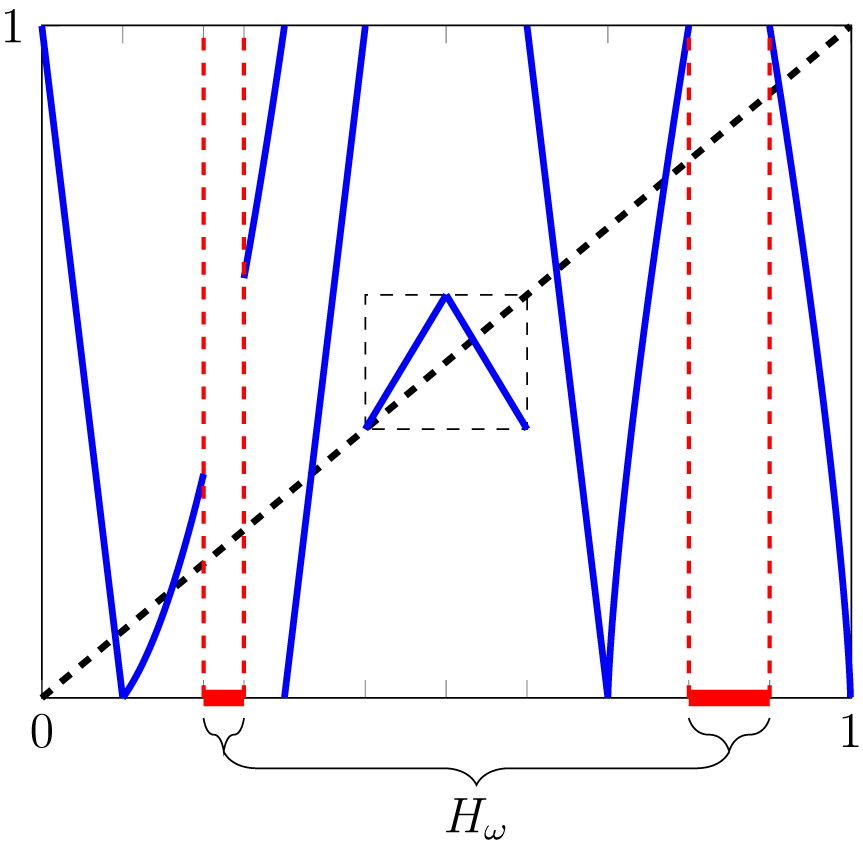
In §7.2, we show that our results indeed apply to non-transitive, non-mixing and non-covering maps; see Figure 1 and Example 7.5. This is not a trivial example because, depending on the potential, the random invariant measures may or may not be supported inside the invariant interval around 1/2. As a special case, we also show (Lemma 7.9) that when the geometric potential
 $-\log |T^{\prime }_\omega |$
is strongly contracting, the random map is in fact covering. In particular,
 $-\log |T^{\prime }_\omega |$
is not strongly contracting in Example 7.5. Our results also apply to open and closed random intermittent maps (§7.3), and allow us to investigate escape rates for random open systems (§7.4).
A non-transitive open map.

In contrast to previous works requiring the identification of a (random) conformal measure first, our approach decouples the construction of equivariant densities,
 $q_\omega $
, and conformal measures,
 $\nu _\omega $
, and builds these dual objects in a symmetric fashion. In short, densities depend on the past, while measures depend on the future. An extra element arising in the random setting is that, unlike in the autonomous case, the forward and backward multipliers
 $\unicode{x3bb} _{\omega ^\pm }$
arising from these constructions are not necessarily equal, and so the densities may not be normalized with respect to the conformal measures. Thus, to find a (random) invariant measure
 $\mu _\omega $
, one should normalize: that is,
 $\mu _\omega ={q_\omega \nu _\omega }/{\nu _\omega (q_\omega )}$
.
This work complements previous works of the authors [Reference Atnip, Froyland, González-Tokman and Vaienti1, Reference Atnip, Froyland, González-Tokman and Vaienti2], where they have developed a general thermodynamic formalism for random open and closed dynamical systems, without the strongly contracting assumption of this work, but imposing covering-type conditions. The present approach also incorporates the use of a random family of cones, a strategy previously used in [Reference Kifer15], the references therein and recently in [Reference Stadlbauer, Suzuki and Varandas24]. Finally, it is worth pointing out that while we have aimed for simple and checkable assumptions for our main results, generalizations could be sought in various directions. For instance, one could relax the one-step full-branch condition to a k-step (or perhaps even random) full-branch condition.
2 Notation and setting
The following notation will be used throughout the paper. Let
 $I\subset \mathbb R$
be a compact interval. For
 $Z\subset I$
, we denote by
 $\operatorname {\mathrm {Einf}}_Z (f)$
the essential infimum of f on Z, with respect to the Lebesgue measure. We also write
 $\operatorname {\mathrm {Einf}}(f)$
instead of
 $\operatorname {\mathrm {Einf}}_{I} (f)$
, and define
 $\operatorname {\mathrm {Einf}}_{\emptyset } (f)=0$
. Similar conventions apply to the essential supremum
 $\operatorname {\mathrm {Esup}}_Z(f)$
. Let the variation of f on Z be
 $\text {var}_{Z}(f)={\sup _{x_0<\cdots <x_k, \, x_j\in Z}}\sum _{j=0}^{k-1} \lvert f(x_{j+1})-f(x_j)\rvert $
and
 $\mathrm {var}(f):=\mathrm {var}_{I}(f)$
. Let
 $BV\subset L^\infty (\mathrm {Leb})$
be the set of (equivalence classes of) functions of bounded variation on I, with norm
 $\|f\|_{BV}:={\inf _{\tilde {f}=f \ \text {Leb almost everywhere}}} \text {var}_{I}(\tilde {f})+\|f\|_\infty $
, where
 $\|f\|_\infty := \operatorname {\mathrm {Esup}}(f)$
. It follows from Rychlik [Reference Rychlik23] that
 $BV$
is a Banach space, and that if f is a function of bounded variation, then it is always possible to choose a representative of minimal variation. From now on, we will work with such representatives, and will no longer distinguish between functions of bounded variation and their equivalence classes in
 $BV$
. Furthermore, we recall that two functions of bounded variation
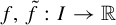 $f, \tilde {f}:I \to \mathbb R$
coincide Lebesgue almost everywhere if and only if the values of f and
 $\tilde {f}$
differ in an at most countable set. Thus, if two
 $BV$
functions coincide Lebesgue almost everywhere, then they are also equivalent with respect to any other non-atomic measure.
Let
 $$ \begin{align*}T_1, T_2, \ldots: I \to I\end{align*} $$
be a countable collection of maps such that for each
 $j\in \mathbb N$
, there exists a finite partition of
 $I \pmod {\text {Leb}}$
such that
 $T_j$
is monotonic and continuous on each atom. Let
 $$ \begin{align*}H_1, H_2, \ldots \subset I\end{align*} $$
be such that for each
 $j\in \mathbb N$
,
 $H_j\subset I$
is a (possibly empty) finite union of intervals, called holes. Assume that for every
 $j \in \mathbb N$
, there is at least one full branch of
 $T_j$
completely contained in
 $X_j:=I\setminus H_j$
. (This assumption rules out the possibility of periodicity, and is used to control infima in our arguments.) Consider weights of bounded variation
 $$ \begin{align*}g_1, g_2, \ldots :I \to \mathbb R^+, \quad j=1,2,\ldots,\end{align*} $$
with associated potentials
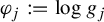 $\varphi _j:=\log g_j$
.
Let
 $(\Omega , m)$
be a complete probability space, and
 $\sigma :(\Omega , m)\to (\Omega , m)$
be an ergodic, invertible, probability-preserving transformation, called the driving system. Let
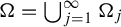 $\Omega =\bigcup _{j=1}^\infty \Omega _j$
be an (at most) countable partition of
 $\Omega $
into measurable sets. For each
 $\omega \in \Omega _j$
, let
 $T_\omega =T_j, H_\omega =H_j, X_\omega =X_j, g_\omega =g_j$
. These assumptions ensure the quantities involved in the definition of strongly contracting potential (Definition 4.2) are measurable. We refer to
 $\{(T_\omega ,H_\omega )\}$
as a random open map, and to
 $\{T_\omega \}$
(or
 $\{(T_\omega , \emptyset ) \}$
) as a random closed map.
For each
 $\omega \in \Omega $
and
 $n\in \mathbb N$
, let
 $T_\omega ^{(n)}:=T_{\sigma ^{n-1}\omega } \circ \cdots \circ T_{\sigma \omega } \circ T_\omega $
,
 $T_\omega ^{(0)}:=Id$
, and
 $g_\omega ^{(n)}:=g_{\sigma ^{n-1}\omega } \ldots g_{\sigma \omega } g_\omega $
. Let
 $\mathcal {Z}_{\omega }^{(n)}$
be the monotonicity partition of
 $T_\omega ^{(n)}$
, and
 $\mathring {\mathcal {Z}}_{\omega }^{(n)}$
be the coarsest partition of the survivor set
 $X_{\omega ,n}:=\bigcap _{j=0}^{n-1} (T_{\omega }^{(j)})^{-1} (X_{\sigma ^j\omega })$
into intervals, such that for each
 $Z\in \mathring {\mathcal {Z}}_{\omega }^{(n)}$
, there exists
 $Z'\in \mathcal {Z}_{\omega }^{(n)}$
such that
 $Z\subset Z'$
. We split
 $\mathring {\mathcal {Z}}_{\omega }^{(n)}$
into
 $\mathring {\mathcal {Z}}_{\omega ,f}^{(n)}$
and
 $\mathring {\mathcal {Z}}_{\omega ,p}^{(n)}$
, corresponding to the full and non-full (or partial) branches of
 $T_\omega ^{(n)}|_{X_{\omega ,n}}$
. That is,
 $Z\in \mathring {\mathcal {Z}}_{\omega ,f}^{(n)}$
if and only if
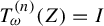 $T_\omega ^{(n)}(Z)=I$
. A collection of intervals
 $Z_1, \ldots , Z_k \in \mathring {\mathcal {Z}}_{\omega ,p}^{(n)}$
is said to be a collection of contiguous non-full intervals for
 $T_\omega ^{(n)}$
(or, more precisely, of
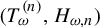 $(T_\omega ^{(n)}, H_{\omega ,n})$
, where
 $H_{\omega ,n}:=I\setminus X_{\omega ,n}$
) if there is no element of
 $\mathring {\mathcal {Z}}_{\omega ,f}^{(n)}$
in between them; that is, if the convex hull of
 $\bigcup _{j=1}^k Z_j$
does not contain any element of
 $\mathring {\mathcal {Z}}_{\omega ,f}^{(n)}$
. (This condition has been considered in [Reference Liverani and Maume-Deschamps16, §6].) We denote by
 $b_{\omega ,f}^{(n)}$
the cardinality of
 $\mathring {\mathcal {Z}}_{\omega ,f}^{(n)}$
and by
 $\xi _{\omega }^{(n)}$
the largest number of contiguous non-full (or partial) intervals for
 $T_\omega ^{(n)}$
.
The transfer operator for the random (open or closed) map
 $\{(T_\omega , H_\omega )\}_{\omega \in \Omega }$
with potential
 $\{\log g_\omega \}_{\omega \in \Omega }$
, acting on
 $f\in BV$
is defined by

where
 $ T_{\omega ,Z}^{-1}:T_\omega (Z)\to Z $
is the inverse of
 $T_\omega |_Z$
. (In the following, we will exclude the sub-index
 $\omega \in \Omega $
from the notation, and write e.g.
 $\{\log g_\omega \}$
.) Its n step iteration,
 $\mathcal {L}_{\omega }^{(n)}f:=\mathcal {L}_{\sigma ^{n-1}\omega } \circ \cdots \circ \mathcal {L}_{\sigma \omega } \circ \mathcal {L}_\omega $
, is given by

where
 $ T_{\omega ,Z}^{-n}:T_\omega ^{(n)}(Z)\to Z $
is the inverse of
 $T_\omega ^{(n)}|_Z$
.
3 Basic estimates
The estimates in this section generalize arguments developed in [Reference Liverani and Maume-Deschamps16].
3.1 Infimum estimates
A direct estimate yields, for every
 $\omega \in \Omega $
,
 $f\in \mathrm {BV}$
and
 $n\in \mathbb N$
,
 $$ \begin{align*} \sum_{Z\in \mathring{\mathcal{Z}}_{\omega,f}^{(n)}} \operatorname{\mathrm{Einf}}_Z|f| &\leq b_{\omega,f}^{(n)} (\mathrm{var}(f) + \operatorname{\mathrm{Einf}}(|f|) ). \end{align*} $$
By comparing the infimum over
 $Z\in \mathring {\mathcal {Z}}_{\omega ,p}^{(n)}$
with the infimum over its closest full-branch neighbour, one gets
 $$ \begin{align} \sum_{Z\in \mathring{\mathcal{Z}}_{\omega,p}^{(n)}} \operatorname{\mathrm{Einf}}_Z|f| &\leq 2\xi_{\omega}^{(n)} \bigg(\mathrm{var}(f)+\sum_{Z\in\mathring{\mathcal{Z}}_{\omega,f}^{(n)}}\operatorname{\mathrm{Einf}}_Z|f| \bigg). \end{align} $$
Furthermore, if
 $f\geq 0$
,
 $$ \begin{align} \operatorname{\mathrm{Einf}}({\mathcal{L}_{\omega}^{(n)}f}) &\geq \sum_{Z\in \mathring{\mathcal{Z}}_{\omega,f}^{(n)}} \operatorname{\mathrm{Einf}}_Z (g_{\omega}^{(n)} f ) \geq \operatorname{\mathrm{Einf}}_{X_{\omega,n}}(g_{\omega}^{(n)}) \sum_{Z\in \mathring{\mathcal{Z}}_{\omega,f}^{(n)}} \operatorname{\mathrm{Einf}}_Z f\nonumber\\ &\geq b_{\omega,f}^{(n)} \operatorname{\mathrm{Einf}}_{X_{\omega,n}}(g_{\omega}^{(n)}) \operatorname{\mathrm{Einf}} (f). \end{align} $$
3.2 Variation estimates and Lasota–Yorke inequality
For every
 $\omega \in \Omega $
,
 $f\in \mathrm {BV}$
and
 $n\in \mathbb N$
, we have

For each
 $Z\in \mathring {\mathcal {Z}}_{\omega }^{(n)}$
, we have

An inductive argument starting from the bound
 $\mathrm {var}(f h)\leq \mathrm {var}(f)\|h\|_\infty + \mathrm {var}(h)\|f\|_\infty $
, and considering that
 $T_\omega ^{(n)}$
is monotonic on Z, yields
 $$ \begin{align*} \mathrm{var}_Z(g_\omega^{(n)}) \leq \|g_\omega\|_\infty^{(n)} \sum_{j=0}^{n-1} \frac{\mathrm{var}(g_{\sigma^j\omega})}{\|g_{\sigma^j\omega}\|_\infty}, \end{align*} $$
where
 $\|g_\omega \|_\infty ^{(n)}:=\prod _{j=0}^{n-1}\|g_{\sigma ^j\omega }\|_\infty $
. Let
 $\tilde {S}_{n,\omega }(g):=\sum _{j=0}^{n-1} ({\mathrm {var}(g_{\sigma ^j\omega })}/{\|g_{\sigma ^j\omega }\|_\infty })$
. Therefore, equation (3.3) yields

Thus,
 $$ \begin{align*} \mathrm{var}({\mathcal{L}^{(n)}_{\omega} f}) &\leq (3+3 \tilde{S}_{n,\omega}(g)) \lVert g_{\omega}\rVert ^{(n)}_{\infty}\mathrm{var}(f)\\[5pt]&\quad+ (2+3\tilde{S}_{n,\omega}(g)) \lVert g_{\omega}\rVert ^{(n)}_{\infty} \bigg(\sum_{Z\in\mathring{\mathcal{Z}}_{\omega,f}^{(n)}}\operatorname{\mathrm{Einf}}_Z|f|+\sum_{Z\in\mathring{\mathcal{Z}}_{\omega,p}^{(n)}}\operatorname{\mathrm{Einf}}_Z|f|\bigg). \end{align*} $$
Grouping as in equation (3.1), one gets
 $$ \begin{align*} \mathrm{var}(\mathcal{L}_{\omega}^{(n)}f)&\leq (3+3 \tilde{S}_{n,\omega}(g)) (1+2\xi_{\omega}^{(n)}) \lVert g_{\omega}\rVert ^{(n)}_{\infty}\mathrm{var}(f) \\[5pt] &\quad+(2+3\tilde{S}_{n,\omega}(g)) (1+2\xi_{\omega}^{(n)}) \lVert g_{\omega}\rVert ^{(n)}_{\infty} \sum_{Z\in\mathcal{Z}_{\omega,f}^{(n)}}\operatorname{\mathrm{Einf}}_Z|f|. \end{align*} $$
Furthermore, if
 $f\geq 0$
, equation (3.2) implies
 $$ \begin{align} \mathrm{var}(\mathcal{L}_{\omega}^{(n)}f)&\leq (3+3 \tilde{S}_{n,\omega}(g)) (1+2\xi_{\omega}^{(n)}) \lVert g_{\omega}\rVert ^{(n)}_{\infty} \bigg( \mathrm{var}(f) + \frac{\operatorname{\mathrm{Einf}}({\mathcal{L}_{\omega}^{(n)}f}) } { \operatorname{\mathrm{Einf}}_{X_{\omega,n}}(g_{\omega}^{(n)}) } \bigg). \end{align} $$
4 (Strictly) invariant cones and strongly contracting potentials
Given
 $a>0$
, we consider the cones
 $$ \begin{align*} \mathcal{C}_{a} = \{ f\in \mathrm{BV}: f> 0, \mathrm{var}(f)\leq a \operatorname{\mathrm{Einf}} (f) \}\subset \mathrm{BV}. \end{align*} $$
This is a positive, convex cone with non-empty interior. Also,
 $\mathcal {C}_{a} \cup \{0\}$
is closed. Let
 $\preceq _{a}$
be the partial order induced by
 $\mathcal {C}_{a}$
. That is,
 $f\preceq _{a} g$
if and only if
 $f-g \in \mathcal {C}_{a}\cup \{0\}$
. Then,
 $(\mathrm {BV},\preceq _{a})$
is integrally closed. (
 $(V, \preceq )$
is integrally closed if for every
 $\alpha _n \to \alpha \in \mathbb R$
,
 $f, g \in V$
such that
 $0\preceq f,g$
and
 $\alpha _n f\!\preceq g$
,
 $\alpha f\!\preceq g$
.) In addition, every
 $f\in \mathrm {BV}$
may be written as
 $f=f_1-f_2$
such that
 $f_1, f_2\in \mathcal {C}_{a}$
, for instance, by choosing
 $f_1=f+c, f_2=c$
for sufficiently large
 $c>0$
.
The inequalities in equations (3.2) and (3.4) yield the following.
Lemma 4.1. If
 $f\in \mathcal {C}_{a}$
and
 $n\in \mathbb N$
, then
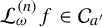 $\mathcal {L}_{\omega }^{(n)}f \in \mathcal {C}_{a'}$
, with
 $$ \begin{align} a'= (3+3 \tilde{S}_{n,\omega}(g)) (1+2\xi_{\omega}^{(n)}) \frac{ \lVert g_{\omega}\rVert ^{(n)}_{\infty}}{\operatorname{\mathrm{Einf}}_{X_{\omega,n}}(g_{\omega}^{(n)})} \bigg( \frac{a}{b_{\omega,f}^{(n)} } + 1 \bigg) =: c_{\omega,n} a + d_{\omega,n}. \end{align} $$
The next definition will be key for our arguments, as it allows for the construction of an invariant family of random cones, using ideas going back to Kifer [Reference Kifer15]; see also [Reference Stadlbauer, Suzuki and Varandas24].
Definition 4.2. We say
 $\{\log g_\omega \}$
is a (random) strongly contracting potential for the random (open or closed) map
 $\{(T_\omega , H_\omega )\}$
if
 $\log \#\mathring {\mathcal {Z}}_{\omega }, \log \|g_\omega \|_\infty , \log \operatorname {\mathrm {Einf}}(g_{\omega }), ({\mathrm {var}(g_{\omega })}/ {\|g_{\omega }\|_\infty }) \in L^1(m)$
and there exists
 $n_*>0$
such that
 $\int \log c_{\omega ,n_*} \,dm<0$
, where
 $c_{\omega ,n}$
is defined in equation (4.1).
Remark 4.3. This condition is related to, but more restrictive than, the definitions of contracting potential in [Reference Liverani, Saussol and Vaienti17] (autonomous setting) and [Reference Atnip, Froyland, González-Tokman and Vaienti2, Definition 2.15], [Reference Atnip, Froyland, González-Tokman and Vaienti1, (Q1)] (random setting). However, [Reference Atnip, Froyland, González-Tokman and Vaienti1, Reference Atnip, Froyland, González-Tokman and Vaienti2, Reference Liverani, Saussol and Vaienti17] also require a covering condition, which is not required in this work. In [Reference Stadlbauer, Suzuki and Varandas24], the authors investigate random (closed) non-uniformly expanding
 $C^1$
maps with
 $C^1$
potentials satisfying a contracting-like condition. In Remark 7.4, we show that in the one-dimensional setting, this condition is more restrictive than that of Definition 4.2.
Lemma 4.4. Assume
 $\{\log g_\omega \}$
is a random strongly contracting potential for the random (open or closed) map
 $\{(T_\omega , H_\omega )\}$
. Then, there exists
 $n_*\in \mathbb N$
,
 $0<\gamma <1$
and a family of cones
 $(\mathcal {C}_{a_\omega })_{\omega \in \Omega }$
which is invariant under
 $\mathcal {L}_{\omega }^{(n_*)}$
and satisfies
 $\mathcal {L}_{\omega }^{(n_*)}\mathcal {C}_{a_\omega } \subset \mathcal {C}_{\gamma a_{\sigma ^{n_*}\omega }}$
. Furthermore,
 $a_\omega $
may be chosen as in equation (4.2), and therefore it may be assumed to be tempered.
Proof. The hypotheses ensure there exists
 $n_*\in \mathbb N$
such that
 $\int \log c_{\omega ,n_*} \,dm<0$
, where
 $c_{\omega ,n_*}$
is defined in equation (4.1). Thus, one can find
 $0<\gamma <1$
such that
 $\int \log c_{\omega ,n_*} d\,m=:\log \tilde {\gamma }<\log \gamma <0$
. Then, it follows that the twisted cohomological equation
 $\gamma a_{\sigma ^{n_*}\omega }=c_{\omega ,n_*} a_{\omega } + d_{\omega ,n_*}$
has a measurable, m-almost surely finite solution given by
 $$ \begin{align} a_\omega= \sum_{j=0}^\infty \gamma^{-j-1} d_{\sigma^{-j-1}\omega,n_*} \prod_{k=1}^j c_{\sigma^{-k}\omega,n_*}, \end{align} $$
where, for convenience, we let
 $\Pi _{k=1}^0 c_{\sigma ^{-k}\omega ,n_*}:=1$
.
The fact that
 $a_\omega $
is m-almost surely finite and tempered is a consequence of the integrability assumptions in Definition 4.2, combined with sub-multiplicativity of
 $1/\operatorname {\mathrm {Einf}}(g_{\omega }^{(n)})$
. Indeed, notice that
 $b_{\omega ,f}^{(n)}, \xi _{\omega }^{(n)} \leq \prod _{j=0}^{n-1}\#\mathring {\mathcal {Z}}_{\sigma ^j\omega }$
. Hence,
 $d_{\omega ,n_*}$
is log-integrable, where
 $d_{\omega ,n_*}$
is defined in equation (4.1). Hence, there exists
 $\varepsilon>0$
satisfying
 $e^{2\varepsilon }\tilde {\gamma }\le \alpha \gamma $
for
 $0<\alpha <1$
and a tempered measurable function
 $D_\omega $
such that
 $d_{\sigma ^{-j-1}\omega ,n_*}\leq D_\omega e^{\varepsilon j}$
. Similarly, there is a tempered measurable function
 $C_\omega $
such that
 $\prod _{k=1}^j c_{\sigma ^{-k}\omega ,n_*}\leq C_\omega e^{j\varepsilon } \tilde {\gamma }^j$
. Therefore, substituting into equation (4.2), we get that
 $ a_\omega \leq C_\omega D_\omega / (\gamma -e^{2\varepsilon } \tilde {\gamma }) \leq C_\omega D_\omega /(\gamma (1-\alpha )) $
is tempered. It is straightforward to verify that
 $\mathcal {L}_{\omega }^{(n_*)}\mathcal {C}_{a_\omega } \subset \mathcal {C}_{\gamma a_{\sigma ^{n_*}\omega }}$
.
4.1 Contraction of projective metric
In the setting of Lemma 4.4, let
 $\preceq _\omega $
be the partial order induced by
 $\mathcal {C}_{a_\omega }$
. That is,
 $f\preceq _\omega g$
if and only if
 $f-g \in \mathcal {C}_{a_\omega }\cup \{0\}$
. Let
 $\Theta _{\omega }$
be the Hilbert (projective) pseudo metric on
 $\mathcal {C}_{a_\omega }$
, given by
 $$ \begin{align*} \Theta_\omega(f,h):=\log\frac{\rho_\omega(f,h)}{\tau_\omega(f,h)}, \end{align*} $$
where
 $f,g \in \mathcal {C}_{a_\omega }$
,
 $\tau _\omega (f,h):=\sup \{\unicode{x3bb}>0: \unicode{x3bb} f\preceq _\omega h\} \text { and } \rho _\omega (f,h):=\inf \{\mu > 0: \mu f\succeq _\omega h\} $
; the distance is infinite if the numerator is
 $\infty $
or the denominator is 0.
Lemma 4.5. Assume
 $0<\gamma <1$
and
 $f\in \mathcal {C}_{\gamma a_\omega }$
. Then,
 $$ \begin{align} \Theta_\omega(f,1)\leq \log \frac{1+\gamma (a_\omega+1)}{1-\gamma}=:\Delta_\omega/2. \end{align} $$
Thus, the diameter of
 $\mathcal {C}_{\gamma a_\omega }$
as a subset of
 $\mathcal {C}_{a_\omega }$
is at most
 $\Delta _\omega <\infty $
.
Proof. Let
 $f\in \mathcal {C}_{\gamma a_\omega }$
. First,
 $\unicode{x3bb} \preceq _\omega f$
if and only if
 $\unicode{x3bb} \leq \operatorname {\mathrm {Einf}} (f)$
and
 $\mathrm {var}(f)=\mathrm {var}(f-\unicode{x3bb} ) \leq a_\omega \operatorname {\mathrm {Einf}}(f-\unicode{x3bb} )$
. This happens if
 $\unicode{x3bb} \leq (1-\gamma )\operatorname {\mathrm {Einf}} f$
. Also,
 $f \preceq _\omega \mu $
if and only if
 $\|f\|_\infty \leq \mu $
and
 $\mathrm {var}(f)=\mathrm {var}(\mu -f)\leq a_\omega \operatorname {\mathrm {Einf}}(\mu -f)$
. Since
 $\mathrm {var}(f)\leq \gamma a_\omega \operatorname {\mathrm {Einf}}(f)$
and
 $\|f\|_{\infty }\leq (1+\gamma a_\omega )\operatorname {\mathrm {Einf}}(f)$
, this happens if
 $\mu \geq (\gamma +1+\gamma a_\omega )\operatorname {\mathrm {Einf}}(f)$
. Thus, we conclude that
 $ \Theta _\omega (f,1)\leq \log ({1+\gamma (a_\omega +1)})/({1-\gamma }), $
as claimed.
Lemma 4.6. Under the hypotheses of Lemma 4.4, there exists
 $0<\vartheta <1$
such that for every
 $k\geq 0$
, and m-a.e.
 $\omega \in \Omega $
,
 $$ \begin{align} \Theta_{\omega}(\mathcal{L}_{\sigma^{-n_*l}\omega}^{n_*l} f,\mathcal{L}_{\sigma^{-n_*(l+k)}\omega}^{n_*(l+k)} h) \leq \Theta_{\sigma^{-ln_*}\omega}( f,\mathcal{L}_{\sigma^{-kn_*}\omega}^{kn_*} h) \vartheta^l , \end{align} $$
for every sufficiently large l (depending on
 $\omega $
), every
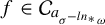 $f\in \mathcal {C}_{a_{\sigma ^{-ln_*}\omega }}$
and every
 $h\in \mathcal {C}_{a_{\sigma ^{-n_*(l+k)}\omega }}$
.
Proof. Lemma 4.4 implies
 $\mathcal {L}_{\sigma ^{-n_*l}\omega }^{(n_*)}\mathcal {C}_{a_{\sigma ^{-n_*l}\omega }, \sigma ^{-n_*l}\omega } \kern1.2pt{\subset}\kern1.2pt \mathcal {C}_{\gamma a_{\sigma ^{-n_*(l-1)}\omega }}$
and Lemma 4.5 implies
 $\operatorname {\mathrm {diam}} (\mathcal {L}_{\sigma ^{-n_*l}\omega }^{(n_*)}\mathcal {C}_{a_{\sigma ^{-n_*l}\omega }} ) \leq \Delta _{\sigma ^{-n_*(l-1)}\omega }$
, where
 $\Delta _\omega $
is as in equation (4.3). Let
 $\varepsilon>0$
and
 $D \in \mathbb R$
be such that
 $m(\{\omega \in \Omega : \Delta _\omega \leq D\})>1-\varepsilon /n_*$
. Recall the projective metric is weakly contracted by
 $\mathcal {L}_\omega ^{(n_*)}$
for m-a.e.
 $\omega \in \Omega $
, and, once the diameter of the image is finite, it is strictly contracted by a factor of
 $\tanh ({D}/{4})$
whenever
 $\Delta _{\omega }<D$
. Hence, by ergodicity of
 $\sigma $
, equation (4.4) holds for sufficiently large l, provided
 $\vartheta>\!(\tanh ({D}/{4}))^{1-\varepsilon }$
.
Remark 4.7. For simplicity and clarity of presentation, we assume from now on that
 $$ \begin{align*}n_*=1.\end{align*} $$
[Reference Atnip, Froyland, González-Tokman and Vaienti1, Reference Atnip, Froyland, González-Tokman and Vaienti2] address the possibility of
 $n_*>1$
in a related setting.
5 Construction of equivariant densities and conformal measures
In this section, we construct equivariant densities and conformal measures for the random map
 $\{(T_\omega , H_\omega )\}$
with strongly contracting potential
 $\{\log g_\omega \}$
. We point out that these constructions are completely decoupled, in contrast to the standard approach of establishing the existence of conformal measures first, and using them to build the densities. (See Remark 5.3 for further details on this comparison.)
Note that the norm
 $\|f\|_\infty $
is compatible with
 $\preceq _\omega $
. That is, for all
 $f,h\in BV$
, if
 $-f\preceq _\omega h \preceq _\omega f$
, then
 $\|h\|_{\infty }\leq \|f\|_{\infty }$
. Also, the function
 $\operatorname {\mathrm {Einf}}: \mathcal {C}_{a_\omega } \to \mathbb R_+$
is homogeneous and
 $\preceq _\omega $
-preserving. Hence, as in [Reference Liverani, Saussol and Vaienti17, Lemma 2.2], for every
 $f, h \in \mathcal {C}_{a_\omega }$
such that
 $\operatorname {\mathrm {Einf}} f=\operatorname {\mathrm {Einf}} h>0$
, we have
 $$ \begin{align} \| f-h\|_{\infty}\leq (e^{ \Theta_{\omega}(f,h)}-1) \min (\|f\|_{\infty}, \|h\|_{\infty}). \end{align} $$
5.1 Equivariant densities
In this section, we show the following.
Lemma 5.1. Assume
 $\{\log g_\omega \}$
is a strongly contracting potential for the random (open or closed) map
 $\{(T_\omega , H_\omega )\}$
, and
 $a_\omega $
is as in equation (4.2). Then, the following hold.
-
(i) For each
 $f\in \mathcal {C}_{1}$
, the sequence
${{}\mathcal {L}_{\sigma ^{-n}\omega }^{(n)} f}/{ \operatorname {\mathrm {Einf}}(\mathcal {L}_{\sigma ^{-n}\omega }^{(n)} f)}$
is Cauchy with respect to
$\|\cdot \|_\infty $
. Hence, the following limit exists:
$ q_\omega ^f:= \lim _{n\to \infty }({{}\mathcal {L}_{\sigma ^{-n}\omega }^{(n)} f}/{ \operatorname {\mathrm {Einf}}(\mathcal {L}_{\sigma ^{-n}\omega }^{(n)} f)})$
. Furthermore,
$ \operatorname {\mathrm {Einf}} (q_\omega ^f)=1 {\text { and }} \mathrm {var}(q_\omega ^f)\leq \gamma a_\omega .$
In addition,
$\mathcal {L}_\omega q_\omega ^f=\unicode{x3bb} _{\omega ^f} q_{\sigma \omega }^f$
, with
$\unicode{x3bb} _{\omega ^f}=\operatorname {\mathrm {Einf}}(\mathcal {L}_\omega q_\omega ^f)$
.
-
(ii) The functions
$q_\omega ^f$
and multipliers
$\unicode{x3bb} _{\omega ^f}$
are independent of f. Call them
$q_\omega $
and
$\unicode{x3bb} ^{-}_{\omega }$
, respectively. Then,
$\mathcal {L}_\omega q_\omega = \unicode{x3bb} ^{-}_{\omega } q_{\sigma \omega }$
, (5.2)
$$ \begin{align} q_\omega= {}\lim_{n\to\infty}\frac{\mathcal{L}_{\sigma^{-n}\omega}^{(n)} 1}{ \operatorname{\mathrm{Einf}}(\mathcal{L}_{\sigma^{-n}\omega}^{(n)} 1)},\quad \unicode{x3bb}^{-}_{\omega}= \lim_{n\to\infty}\frac{\operatorname{\mathrm{Einf}}(\mathcal{L}_{\sigma^{-n}\omega}^{(n+1)} 1)}{ \operatorname{\mathrm{Einf}}(\mathcal{L}_{\sigma^{-n}\omega}^{(n)} 1)}=\operatorname{\mathrm{Einf}} (\mathcal{L}_\omega q_\omega). \end{align} $$











Proof. To show (i), first note that equation (4.2) implies
 $a_\omega \geq 1$
. Thus,
 $\mathcal {C}_{1}\subset \mathcal {C}_{a_\omega }$
for m-a.e.
 $\omega \in \Omega $
. Let
 $f_n:={{}\mathcal {L}_{\sigma ^{-n}\omega }^{(n)} f}/{ \operatorname {\mathrm {Einf}}(\mathcal {L}_{\sigma ^{-n}\omega }^{(n)} f)}$
. Using equation (5.1), we have, for
 $m>n\geq 1$
,
 $$ \begin{align} \|f_n -f_m\|_\infty \leq (e^{\Theta_{\omega}(f_n,f_m)}-1) \|f_n\|_\infty. \end{align} $$
Since
 $f_n \in \mathcal {C}_{\gamma a_\omega }$
and
 $\operatorname {\mathrm {Einf}} f_n=1$
, then
 $\|f_n\|_\infty \leq 1+ \gamma a_\omega $
. However, by equation (4.4), for sufficiently large n,
 $\Theta _{\omega }(f_n,f_m)\leq \Delta _{\sigma ^{-n+1}\omega } \vartheta ^{n}$
, where
 $\Delta _\omega $
is as in equation (4.3) and
 $\vartheta <1$
is as in Lemma 4.6. Since
 $a_\omega $
is tempered, so is
 $\Delta _\omega $
, and equation (5.3) tends to 0 exponentially as
 $n\to \infty $
. Hence, the following limit exists in
 $L^\infty $
:
 $$ \begin{align*} q_\omega^f&:= \lim_{n\to\infty}\frac{{}\mathcal{L}_{\sigma^{-n}\omega}^{(n)} f}{ \operatorname{\mathrm{Einf}}(\mathcal{L}_{\sigma^{-n}\omega}^{(n)} f)}. \end{align*} $$
Also,
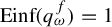 $\operatorname {\mathrm {Einf}} (q_\omega ^f)=1$
and
 $\mathrm {var}(q_\omega ^f)\leq \limsup \mathrm {var}(f_n)\leq \gamma a_\omega $
. Since
 $$ \begin{align*} 0<\operatorname{\mathrm{Einf}} g_\omega \leq \frac{\operatorname{\mathrm{Einf}}(\mathcal{L}_{\sigma^{-n}\omega}^{(n+1)} f)}{ \operatorname{\mathrm{Einf}}(\mathcal{L}_{\sigma^{-n}\omega}^{(n)} f)} \leq \|\mathcal{L}_\omega f_n\|_\infty \leq \|\mathcal{L}_\omega1\|_\infty(1+\gamma a_\omega)<\infty, \end{align*} $$
we have that there must be a sequence
 $(n_k)_{k=1}^\infty $
such that
 ${\operatorname {\mathrm {Einf}}(\mathcal {L}_{\sigma ^{-n_k}\omega }^{(n_k+1)} f)}/{ \operatorname {\mathrm {Einf}}(\mathcal {L}_{\sigma ^{-n_k}\omega }^{(n_k)} f)}$
converges to some value, say
 $\unicode{x3bb} _{\omega ^f}$
, as
 $k\to \infty $
. Now, since we can write
 $$ \begin{align} \mathcal{L}_\omega q_\omega^f &= \lim_{k\to\infty}\frac{{} \mathcal{L}_{\sigma^{-n_k}\omega}^{(n_k+1)} f}{\operatorname{\mathrm{Einf}}(\mathcal{L}_{\sigma^{-n_k}\omega}^{(n_k+1)} f)}\frac{\operatorname{\mathrm{Einf}}(\mathcal{L}_{\sigma^{-n_k}\omega}^{(n_k+1)} f)}{ \operatorname{\mathrm{Einf}}(\mathcal{L}_{\sigma^{-n_k}\omega}^{(n_k)} f)}\nonumber\\ &= q_{\sigma\omega}^f \lim_{k\to\infty}\frac{\operatorname{\mathrm{Einf}}(\mathcal{L}_{\sigma^{-n_k}\omega}^{(n_k+1)} f)}{ \operatorname{\mathrm{Einf}}(\mathcal{L}_{\sigma^{-n_k}\omega}^{(n_k)} f)}=:\unicode{x3bb}_{\omega^f} q_{\sigma\omega}^f, \end{align} $$
we must have that
 $\unicode{x3bb} _{\omega ^f} = \lim _{n\to \infty }({\operatorname {\mathrm {Einf}}(\mathcal {L}_{\sigma ^{-n}\omega }^{(n+1)} f)}/{ \operatorname {\mathrm {Einf}}(\mathcal {L}_{\sigma ^{-n}\omega }^{(n)} f)})$
and does not depend on the particular sequence
 $(n_k)$
. Furthermore, the normalization of
 $q_\omega ^f$
implies that
 $\unicode{x3bb} _{\omega ^f}=\operatorname {\mathrm {Einf}}(\mathcal {L}_\omega q_\omega ^f)$
.
To show (ii), we show there exists
 $q_\omega \in BV$
such that
 $q_\omega =q_\omega ^f$
for every
 $f\in \mathcal {C}_{1}$
. Indeed, for
 $f, h\in \mathcal {C}_{1}$
, we have for every
 $n\in \mathbb N$
,
 $$ \begin{align} \|q_\omega^f-q_\omega^h\|_\infty \leq (e^{\Theta_{\omega}(q_\omega^f,q_\omega^h)}-1) \|q_\omega^f\|_\infty \leq (e^{\Theta_{\omega}(\mathcal{L}_{\sigma^{-n}\omega}^{(n)} q_{\sigma^{-n}\omega}^f,\mathcal{L}_{\sigma^{-n}\omega}^{(n)} q_{\sigma^{-n}\omega}^h)}-1) \|q_\omega^f\|_\infty. \end{align} $$
By equation (4.4),
 $\Theta _{\omega }(\mathcal {L}_{\sigma ^{-n}\omega }^{(n)} q_{\sigma ^{-n}\omega }^f,\mathcal {L}_{\sigma ^{-n}\omega }^{(n)} q_{\sigma ^{-n}\omega }^h)\leq \Delta _{\sigma ^{-n+1}\omega } \vartheta ^{n-1}$
for sufficiently large n, and
 $\|q_\omega ^f\|_\infty \leq 1+\gamma a_\omega $
. Using once again that
 $\Delta _\omega $
is tempered, we conclude that the right-hand side of equation (5.5) tends exponentially fast to 0 as
 $n\to \infty $
. Thus,
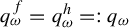 $q_\omega ^f=q_\omega ^h=:q_\omega $
. Hence, equation (5.4) implies that
 $\unicode{x3bb} _{\omega ^f}$
is also independent of f, call it
 $\unicode{x3bb} ^{-}_{\omega }$
. Thus, equation (5.2) holds.
5.2 Equivariant conformal measures
In this section, we show the following.
Lemma 5.2. Assume
 $\{\log g_\omega \}$
is a strongly contracting potential for the random (open or closed) map
 $\{(T_\omega , H_\omega )\}$
. Then, for each
 $f\in \mathcal {C}_{1}$
, the sequence
 ${\operatorname {\mathrm {Einf}}(\mathcal {L}_{\omega }^{(n)} f)}/{\operatorname {\mathrm {Einf}}(\mathcal {L}_{\omega }^{(n)} 1)}$
is Cauchy. Its limit,
 $$ \begin{align} \nu_\omega(f):=\lim_{n\to\infty}\frac{\mathcal{L}_\omega^{(n)} f}{\mathcal{L}_\omega^{(n)} 1} =\lim_{n\to\infty}\frac{\operatorname{\mathrm{Einf}}(\mathcal{L}_{\omega}^{(n)} f)}{\operatorname{\mathrm{Einf}}(\mathcal{L}_{\omega}^{(n)} 1)}, \end{align} $$
defines a positive linear functional which can be extended by linearity to
 $BV$
, and to a non-atomic probability measure with support contained in
 $X_\omega $
. Furthermore,
 $\nu _\omega $
satisfies
 $\nu _{\sigma \omega }(\mathcal {L}_\omega f)=\unicode{x3bb} ^{+}_{\omega } \nu _\omega (f)$
, where
 $$ \begin{align} \unicode{x3bb}^{+}_{\omega}=\lim_{n\to\infty}\frac{\operatorname{\mathrm{Einf}}_{} (\mathcal{L}_{\omega}^{(n+1)} 1)}{\operatorname{\mathrm{Einf}}_{}(\mathcal{L}_{\sigma\omega}^{(n)} 1)}= \nu_{\sigma\omega}(\mathcal{L}_\omega 1). \end{align} $$
Proof. We begin by showing that there exists
 $C_\omega>0$
such that for every
 $f\in \mathcal {C}_{1}$
,
 $$ \begin{align} \unicode{x3bb}_{\sigma^n\omega}^{-,(k)} (1 -\ C_\omega r^n) \leq \frac{\operatorname{\mathrm{Einf}}_{} (\mathcal{L}_{\omega}^{(n+k)} f)}{\operatorname{\mathrm{Einf}}_{}(\mathcal{L}_{\omega}^{(n)} f)} \leq \unicode{x3bb}_{\sigma^n\omega}^{-,(k)} (1 +\ C_\omega r^n), \end{align} $$
where
 $\unicode{x3bb} _{\omega }^{-,(k)}:=\unicode{x3bb} _{\omega ^-} \unicode{x3bb} _{\sigma \omega }^-\cdots \unicode{x3bb} _{\sigma ^{k-1}\omega }^-$
,
 $\unicode{x3bb} _{\omega ^-}>0$
is as in equation (5.2) and
 $\vartheta <r<1$
, with
 $\vartheta $
is as in Lemma 4.6. To see this, we argue as in §5.1. Thus, there exists
 $C_\omega>0$
such that
 $$ \begin{align} \bigg\| \frac{ \mathcal{L}_{\omega}^{(n)} f}{\operatorname{\mathrm{Einf}}(\mathcal{L}_{\omega}^{(n)} f)}- q_{\sigma^n\omega}\bigg\|_\infty \!<\! C_\omega r^n. \end{align} $$
Hence,
 $$ \begin{align*} \frac{\operatorname{\mathrm{Einf}}_{} (\mathcal{L}_{\omega}^{(n+k)} f)}{\operatorname{\mathrm{Einf}}(\mathcal{L}_{\omega}^{(n)} f)}&= \operatorname{\mathrm{Einf}}_{} \mathcal{L}_{\sigma^n\omega}^{(k)} \bigg( \frac{ \mathcal{L}_{\omega}^{(n)} f}{\operatorname{\mathrm{Einf}}(\mathcal{L}_{\omega}^{(n)} f)}\bigg) \\[5pt] &\leq \operatorname{\mathrm{Einf}}_{} ( \mathcal{L}_{\sigma^n\omega}^{(k)} ( q_{\sigma^n\omega} (1+ \ C_\omega r^n) ) ) =\unicode{x3bb}_{\sigma^n\omega}^{-,(k)} (1+ \ C_\omega r^n), \end{align*} $$
where in the next to last step, we have used that
 $\operatorname {\mathrm {Einf}}_{} q_{\sigma ^n\omega }=1$
. The lower bound in equation (5.8) is obtained similarly.
Next we show that the limit
 $\lim _{n\to \infty }({\mathcal {L}_\omega ^{(n)}f}/{\mathcal {L}_\omega ^{(n)}1})$
exists. To that end, we first note that for each
 $k\geq 1$
, we can write
 $$ \begin{align} &\bigg\|\frac{\mathcal{L}_\omega^{(n+k)}f}{\mathcal{L}_\omega^{(n)}f} - \unicode{x3bb}_{\sigma^n\omega}^{-,(k)}\frac{q_{\sigma^{n+k}\omega}}{q_{\sigma^n\omega}}\bigg\|_\infty\nonumber\\[5pt] &\quad= \bigg\|\frac{\mathcal{L}_\omega^{(n+k)}f}{\operatorname{\mathrm{Einf}}\mathcal{L}_\omega^{(n+k)}f}\frac{\operatorname{\mathrm{Einf}}\mathcal{L}_\omega^{(n+k)}f}{\operatorname{\mathrm{Einf}}\mathcal{L}_\omega^{(n)}f}\frac{\operatorname{\mathrm{Einf}}\mathcal{L}_\omega^{(n)}f}{\mathcal{L}_\omega^{(n)}f}-\unicode{x3bb}_{\sigma^n\omega}^{-,(k)}\frac{q_{\sigma^{n+k}\omega}}{q_{\sigma^n\omega}}\bigg\|_\infty, \end{align} $$
and using equations (5.8), (5.9), and the fact that
 $\operatorname {\mathrm {Einf}}_{} q_{\sigma ^n\omega }=1$
, we see that the right-hand side of equation (5.10) goes to zero (exponentially fast).
Thus, we have
 $$ \begin{align*} \limsup_{n\to\infty}\bigg\|\frac{\mathcal{L}_\omega^{(n)}f}{\mathcal{L}_\omega^{(n)}1}-\frac{\mathcal{L}_\omega^{(n+k)}f}{\mathcal{L}_\omega^{(n+1)}1}\bigg\|_{\infty}\le \sup |f|\limsup_{n\to\infty}\bigg(\frac{\mathcal{L}_\omega^{(n)}f}{\mathcal{L}_\omega^{(n+k)}f}\frac{\mathcal{L}_\omega^{(n+k)}1}{\mathcal{L}_\omega^{(n)}1}-1\bigg)=0. \end{align*} $$
Thus, the sequence
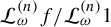 ${\mathcal {L}_\omega ^{(n)}f}/{\mathcal {L}_\omega ^{(n)}1}$
is Cauchy, and must converge to some function. To see that this limiting function is constant, we let
 $(x_n)$
and
 $(y_n)$
be sequences in
 $[0,1]$
. Using Lemma 4.6 and the definition of
 $\Theta _\omega $
, we have
 $$ \begin{align*} \bigg|\frac{\mathcal{L}_\omega^{(n)}f}{\mathcal{L}_\omega^{(n)}1}(x_n)-\frac{\mathcal{L}_\omega^{(n)}f}{\mathcal{L}_\omega^{(n)}1}(y_n)\bigg| &= \bigg|\frac{\mathcal{L}_\omega^{(n)}f}{\mathcal{L}_\omega^{(n)}1}(y_n)\bigg|\cdot \bigg|\frac{\mathcal{L}_\omega^{(n)}f}{\mathcal{L}_\omega^{(n)}1}(x_n)\frac{\mathcal{L}_\omega^{(n)}1}{\mathcal{L}_\omega^{(n)}f}(y_n)-1\bigg| \\[5pt] &\leq \sup|f|\cdot\limsup_{n\to\infty}|\exp(\Theta_{\sigma^n\omega}(\mathcal{L}_\omega^{(n)}f, \mathcal{L}_\omega^{(n)}1)) -1| \\[5pt] &\leq \sup|f|\cdot\limsup_{n\to\infty}|\exp(\Theta_{\omega}(f, 1)\vartheta^n) -1| = 0. \end{align*} $$
Therefore, the sequence
 ${\mathcal {L}_\omega ^{(n)}f}/{\mathcal {L}_\omega ^{(n)}1}(x_n)$
must converge to some constant value, which we denote by
 $\nu _\omega (f)$
.
Positivity and linearity of
 $\nu _\omega $
are clear. Since
 $\mathcal {C}_{1}$
has non-empty interior,
 $\nu _\omega $
can be extended by linearity to
 $BV$
. Since
 $|\nu _\omega (f)|\leq \|f\|_\infty $
and
 $\nu _\omega (1)=1$
, by the Riesz representation theorem,
 $\nu _\omega $
gives rise to a probability measure
 $\tilde \nu _\omega $
, with
 $\operatorname {\mathrm {supp}}(\tilde \nu _\omega )\subseteq X_\omega $
. Now, since it follows from equation (5.9) and the triangle inequality that
 $\| { \mathcal {L}_{\omega }^{(n)} f}/{\operatorname {\mathrm {Einf}}(\mathcal {L}_{\omega }^{(n)} f)}- { \mathcal {L}_{\omega }^{(n)} 1}/{\operatorname {\mathrm {Einf}}(\mathcal {L}_{\omega }^{(n)} 1)}\|_\infty \to 0$
(exponentially fast), and since both terms are bounded below by 1, we must have that
 $$ \begin{align*} \lim_{n\to\infty}\frac{ \mathcal{L}_{\omega}^{(n)} f}{ \mathcal{L}_{\omega}^{(n)} 1} = \lim_{n\to\infty}\frac{\operatorname{\mathrm{Einf}}(\mathcal{L}_{\omega}^{(n)} f)}{\operatorname{\mathrm{Einf}}(\mathcal{L}_{\omega}^{(n)} 1)} = \nu_\omega(f). \end{align*} $$
If
 $Z\in \mathring {\mathcal {Z}}_{\omega }^{(k)}$
, then
 $T_\omega ^{(k)}|_Z: Z \to I$
is injective, so

. Thus,

Since
 $\{\log g_\omega \}$
is strongly contracting, Kingman’s subadditive ergodic theorem ensures the upper bound approaches 0 as
 $k\to \infty $
. Thus,

. Hence,
 $\nu _\omega $
is non-atomic, and standard approximation arguments ensure that for every
 $J\subset I$
,

, so we also write
 $\nu _\omega $
to refer to the measure
 $\tilde \nu _\omega $
.
For the final claim, we have
 $$ \begin{align*} \begin{split} \nu_{\sigma\omega}(\mathcal{L}_\omega f)&=\lim_{n\to\infty}\frac{\operatorname{\mathrm{Einf}}_{} (\mathcal{L}_{\omega}^{(n+1)} f)}{\operatorname{\mathrm{Einf}}_{}(\mathcal{L}_{\sigma\omega}^{(n)} 1)} \\[5pt] &= \lim_{n\to\infty}\frac{\operatorname{\mathrm{Einf}}_{} (\mathcal{L}_{\omega}^{(n+1)} f)}{\operatorname{\mathrm{Einf}}_{}(\mathcal{L}_{\omega}^{(n+1)} 1)} \frac{\operatorname{\mathrm{Einf}}_{} (\mathcal{L}_{\omega}^{(n+1)} 1)}{\operatorname{\mathrm{Einf}}_{}(\mathcal{L}_{\sigma\omega}^{(n)} 1)}= \nu_\omega(f) \nu_{\sigma\omega}(\mathcal{L}_\omega 1).\\[-1.9pc] \end{split} \end{align*} $$
Remark 5.3. The construction of conformal measures here may be regarded as a random version of that in [Reference Liverani, Saussol and Vaienti17]. However, the densities constructed in [Reference Liverani, Saussol and Vaienti17] differ from ours in the normalization. If we denote their densities by
 $\tilde {q}_\omega $
, they are normalized so that
 $\nu _\omega (\tilde {q}_\omega )=1$
. As it can be deduced from the upcoming equation (6.4), this choice ensures that their corresponding multipliers,
 $\tilde {\unicode{x3bb} }_\omega $
, satisfy
 $\tilde {\unicode{x3bb} }_\omega =\unicode{x3bb} _{\omega ^+}$
.
6 Main results
6.1 Equilibrium states and exponential decay of correlations
In this section, we show the following.
Theorem 6.1. Assume
 $\{\log g_\omega =:\varphi _\omega \}$
is a strongly contracting potential for the random (open or closed) map
 $\{(T_\omega , H_\omega )\}$
. Let
 $\unicode{x3bb} ^\pm _\omega $
,
 $q_\omega $
and
 $\nu _\omega $
be as in §§5.1 and 5.2. Then,
 $\int \log \unicode{x3bb} _{\omega ^+}\,dm= \int \log \unicode{x3bb} _{\omega ^-}\,dm=:\Lambda _1$
. (We will show in Theorem 6.6 that
 $\Lambda _1=\lim _{n\to \infty }(1/n) \log \|\mathcal {L}_\omega ^{(n)}\|_{\mathrm {BV}}$
for m-a.e.
 $\omega \in \Omega $
.) Define the probability measures
 $\mu _\omega $
by
 $\int f \,d\mu _\omega := {\int f q_\omega \,d\nu _\omega }/{\nu _\omega (q_\omega )}$
. Then,
 $$ \begin{align} \int f \,d\mu_{\sigma \omega} = \int f \circ T_\omega \,d\mu_\omega. \end{align} $$
Furthermore, there exist a tempered
 $C_\omega>0$
and
 $0<r<1$
such that for every
 $f\in L^1(\nu _\omega )$
,
 $\tilde {f}\in L^1(\nu _{\sigma ^n\omega })$
and
 $h \in BV$
,
 $$ \begin{align} &| \mu_{\sigma^{-n}\omega}(f\circ T^{(n)}_{\sigma^{-n}\omega} \cdot h) - \mu_{\omega}(f)\mu_{\sigma^{-n}\omega}(h)| \leq C_\omega\|f\|_{L^1(\nu_{\omega})} \|h\|_{BV} r^n, \quad \text{and} \end{align} $$
 $$ \begin{align} &| \mu_\omega(\tilde{f}\circ T^{(n)}_\omega \cdot h) - \mu_{\sigma^n\omega}(\tilde{f}) \mu_{\omega}(h)| \leq C_\omega\|\tilde{f}\|_{L^1(\nu_{\sigma^n\omega})} \|h\|_{BV} r^n. \end{align} $$
In fact, equations (6.2) and (6.3) hold for any choice
 $r>\vartheta $
, with
 $\vartheta $
as in Lemma 4.6.
Remark 6.2. The quantity
 $\Lambda _1$
in Theorem 6.1 is called the maximal Lyapunov exponent of the cocycle generated by
 $\{\mathcal {L}_\omega \}$
in the context of multiplicative ergodic theory; and the expected pressure, denoted by
 $\mathcal {E} P(\varphi )$
, in the thermodynamic formalism approach. The proof of Theorem 6.6 will show that the second Lyapunov exponent of the cocycle satisfies
 $\unicode{x3bb} _2\leq \tanh ({D}/{4})$
, with the notation of Lemma 4.6. This bound is related to the upper bound of [Reference Horan14].
We extend the notion of invariant measures corresponding to punctured potentials introduced in [Reference Demers and Todd8] to the random setting. Let
 $\mathcal {P}_{T,m}^H(I)$
denote the collection of T-invariant probability measures
 $\eta $
on
 $\Omega \times I$
with marginal m on
 $\Omega $
, such that its disintegration
 $\{\eta _\omega \}$
satisfies
 $\eta _\omega (H_\omega )=0$
for m-a.e.
 $\omega \in \Omega $
.
Definition 6.3. We say that a measure
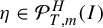 $\eta \in \mathcal {P}_{T,m}^H(I)$
is a relative equilibrium state for the random map
 $\{(T_\omega , H_\omega )\}$
with potential
 $\{\varphi _\omega \}$
if
 $$ \begin{align*}\mathcal{E} P(\varphi)=h_\eta(T)+\int_{\Omega \times I} \varphi \,d\eta,\end{align*} $$
where
 $h_\eta (T)$
denotes the entropy of T with respect to
 $\eta $
.
The proof of the next result follows similarly to the proof of Theorem 2.23 in [Reference Atnip, Froyland, González-Tokman and Vaienti2] (see also Remark 2.24, Lemma 12.2 and Lemma 12.3).
Theorem 6.4. Assume
 $\{\log g_\omega =:\varphi _\omega \}$
is a strongly contracting potential for the random (open or closed) map
 $\{(T_\omega , H_\omega )\}$
. Then, the random measure
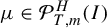 $\mu \in \mathcal {P}_{T,m}^H(I)$
with disintegration
 $\{\mu _\omega \}$
produced in Theorem 6.1 is the unique relative equilibrium state for
 $\{\varphi _\omega \}$
. It satisfies the following variational principle:
 $$ \begin{align*} \Lambda_1= \mathcal{E} P(\varphi) = h_\mu(T)+\int_{\Omega \times I} \varphi \,d\mu = \sup_{\eta\in\mathcal{P}_{T,m}^H(I)} h_\eta(T)+\int_{\Omega \times I} \varphi \,d\eta. \end{align*} $$
Remark 6.5. The same conclusions hold for the random invariant measures
 $\{\mu _\omega \}$
in the random open setting of [Reference Atnip, Froyland, González-Tokman and Vaienti1].
Proof of Theorem 6.1
To show
 $\int \log \unicode{x3bb} _{\omega ^+}\,dm= \int \log \unicode{x3bb} _{\omega ^-}\,dm$
, we prove that for m-a.e.
 $\omega \in \Omega $
,
 $$ \begin{align} \frac{ \nu_\omega(q_\omega)\unicode{x3bb}_{\omega^+} }{ \nu_{\sigma\omega}(q_{\sigma\omega})\unicode{x3bb}_{\omega^-}}=1. \end{align} $$
Indeed,
 $$ \begin{align*} \nu_\omega(q_\omega) &= \lim_{n\to\infty}\frac{\operatorname{\mathrm{Einf}}_{} (\mathcal{L}_{\omega}^{(n)} q_\omega)}{\operatorname{\mathrm{Einf}}_{}(\mathcal{L}_{\omega}^{(n)} 1)}= \lim_{n\to\infty}\frac{\unicode{x3bb}_{\omega^-} \operatorname{\mathrm{Einf}}_{} (\mathcal{L}_{\sigma\omega}^{(n-1)} q_{\sigma\omega})}{\operatorname{\mathrm{Einf}}_{}(\mathcal{L}_{\sigma\omega}^{(n-1)} (\mathcal{L}_\omega 1))}=\frac{\unicode{x3bb}_{\omega^-} \nu_{\sigma\omega}(q_{\sigma\omega})}{\unicode{x3bb}_{\omega^+}}. \end{align*} $$
Next we show equation (6.1). In view of Lemmas 5.1 and 5.2,
 $$ \begin{align*} \int f \,d\mu_{\sigma\omega} &= \frac{1}{ \nu_{\sigma\omega}(q_{\sigma\omega})}\int f \cdot q_{\sigma \omega} \,d\nu_{\sigma\omega} = \frac{1}{ \nu_{\sigma\omega}(q_{\sigma\omega})\unicode{x3bb}_{\omega^-}} \int f \ \cdot \mathcal{L}_\omega (q_\omega) \,d\nu_{\sigma\omega}\\[3pt]&= \frac{1}{ \nu_{\sigma\omega}(q_{\sigma\omega})\unicode{x3bb}_{\omega^-}} \int \mathcal{L}_\omega (f\circ T_\omega \cdot q_\omega) \,d\nu_{\sigma\omega}\\&= \frac{\unicode{x3bb}_{\omega^+}}{ \nu_{\sigma\omega}(q_{\sigma\omega})\unicode{x3bb}_{\omega^-}} \int f\circ T_\omega \cdot q_\omega \,d\nu_\omega \\[5pt]&= \frac{ \nu_\omega(q_\omega)\unicode{x3bb}_{\omega^+} }{ \nu_{\sigma\omega}(q_{\sigma\omega})\unicode{x3bb}_{\omega^-}} \int f\circ T_\omega \,d\mu_\omega. \end{align*} $$
Then, equation (6.1) follows from equation (6.4).
For the second part of the theorem, notice that for every
 $h\in BV$
,
 $(h+c_{h}) q_{\sigma ^{-n}\omega }\in \mathcal {C}_{\sqrt {\gamma } a_{\sigma ^{-n}\omega }}$
for
 $ c_{h} = ({1 + 2\sqrt {\gamma }})/({\sqrt {\gamma }-\gamma })\|h\|_{BV}$
. (We do not claim this choice of
 $c_h$
is optimal.) This follows from basic properties of variation, and the facts that
 $a_{\sigma ^{-n}\omega }\geq 1, q_{\sigma ^{-n}\omega } \in \mathcal {C}_{\gamma a_{\sigma ^{-n}\omega }}$
. Furthermore, the invariance property in equation (6.1) implies that the left-hand side of equation (6.2) is unchanged if h is replaced by
 $h+c$
for any
 $c\in \mathbb R$
. In the case of
 $c=c_{h}$
, the corresponding right-hand side changes in that
 $\|h\|_{BV}$
must be replaced by
 $\|h\|_{BV}+ c_{h} \leq (1+({1 + 2\sqrt {\gamma }})/({\sqrt {\gamma }-\gamma }))\|h\|_{BV}$
. Thus, to show equation (6.2), we will assume, without loss of generality, that
 $h q_{\sigma ^{-n}\omega }\in \mathcal {C}_{\sqrt {\gamma } a_{\sigma ^{-n}\omega }}$
. (However, we should keep this assumption in mind at the end of the proof, where apparently only
 $\|h\|_\infty $
is relevant, and not
 $\|h\|_{\mathrm {BV}}$
.)
Using Lemma 5.2 repeatedly and equation (6.4) in the last step yields
 $$ \begin{align} \mu_{\sigma^{-n}\omega}(f\circ T^{(n)}_{\sigma^{-n}\omega} \cdot h) &= \frac{1}{\nu_{\sigma^{-n}\omega}(q_{\sigma^{-n}\omega})} \int f\circ T^{(n)}_{\sigma^{-n}\omega} \cdot h q_{\sigma^{-n}\omega} \,d\nu_{\sigma^{-n}\omega}\nonumber\\[5pt] &= \frac{1}{\nu_{\sigma^{-n}\omega}(q_{\sigma^{-n}\omega}) \unicode{x3bb}^{+,(n)}_{\sigma^{-n}\omega}} \int \mathcal{L}_{\sigma^{-n}\omega}^{(n)} (f\circ T^{(n)}_{\sigma^{-n}\omega} \cdot h q_{\sigma^{-n}\omega} )\,d\nu_{\omega}\nonumber\\[5pt] &= \frac{1}{\nu_{\sigma^{-n}\omega}(q_{\sigma^{-n}\omega}) \unicode{x3bb}^{+,(n)}_{\sigma^{-n}\omega}} \int f \cdot \mathcal{L}_{\sigma^{-n}\omega}^{(n)} ( h q_{\sigma^{-n}\omega} )\,d\nu_{\omega}\nonumber\\[5pt] &= \frac{1}{\unicode{x3bb}^{-,(n)}_{\sigma^{-n}\omega}\nu_{\omega}(q_{\omega})} \int f \cdot \mathcal{L}_{\sigma^{-n}\omega}^{(n)} ( h q_{\sigma^{-n}\omega} )\,d\nu_{\omega}. \end{align} $$
However,
 $$ \begin{align} \mu_{\sigma^{-n}\omega}(h)&=\frac{\nu_{\sigma^{-n}\omega}(h q_{\sigma^{-n}\omega})}{\nu_{\sigma^{-n}\omega}(q_{\sigma^{-n}\omega})}= \lim_{k\to\infty}\frac{\operatorname{\mathrm{Einf}}_{}(\mathcal{L}_{\sigma^{-n}\omega}^{(n+k)}( h q_{\sigma^{-n}\omega}))}{\operatorname{\mathrm{Einf}}_{}(\mathcal{L}_{\sigma^{-n}\omega}^{(n+k)}(q_{\sigma^{-n}\omega}))}\nonumber\\[5pt] &=\frac{\nu_{\omega}(\mathcal{L}_{\sigma^{-n}\omega}^{(n)}(h q_{\sigma^{-n}\omega}))}{\nu_{\omega}(\mathcal{L}_{\sigma^{-n}\omega}^{(n)}(q_{\sigma^{-n}\omega}))} =\frac{\nu_{\omega}(\mathcal{L}_{\sigma^{-n}\omega}^{(n)}(h q_{\sigma^{-n}\omega}))}{\unicode{x3bb}^{-,(n)}_{\sigma^{-n}\omega}\nu_{\omega}(q_{\omega})}. \end{align} $$
Combining equations (6.5) and (6.6), we get
 $$ \begin{align} |\mu&_{\sigma^{-n}\omega}(f\circ T^{(n)}_{\sigma^{-n}\omega} \cdot h) - \mu_{\omega}(f)\mu_{\sigma^{-n}\omega}(h)| \nonumber\\[5pt] &= \frac{|\nu_\omega (f \cdot \mathcal{L}_{\sigma^{-n}\omega}^{(n)} ( h q_{\sigma^{-n}\omega}) - \mu_\omega(f)\mathcal{L}_{\sigma^{-n}\omega}^{(n)}(h q_{\sigma^{-n}\omega}) )|}{\unicode{x3bb}^{-,(n)}_{\sigma^{-n}\omega}\nu_{\omega}(q_{\omega})}\nonumber\\[5pt] &= \frac{|\nu_\omega (\mathcal{L}_{\sigma^{-n}\omega}^{(n)} ( h q_{\sigma^{-n}\omega})(f -\mu_\omega(f)))|}{\unicode{x3bb}^{-,(n)}_{\sigma^{-n}\omega}\nu_{\omega}(q_{\omega})}\nonumber\\ &\leq \frac{ \operatorname{\mathrm{Einf}}(\mathcal{L}_{\sigma^{-n}\omega}^{(n)}(h q_{\sigma^{-n}\omega})) |\nu_\omega (q_\omega (f -\mu_\omega(f)))|}{\unicode{x3bb}^{-,(n)}_{\sigma^{-n}\omega}\nu_{\omega}(q_{\omega})}\nonumber\\[5pt] &\quad + \frac{3 \|q_\omega\|_\infty \| {}\mathcal{L}_{\sigma^{-n}\omega}^{(n)}(h q_{\sigma^{-n}\omega})- \operatorname{\mathrm{Einf}}(\mathcal{L}_{\sigma^{-n}\omega}^{(n)}(h q_{\sigma^{-n}\omega})) q_{\omega} \|_\infty \|f\|_{L^1(\nu_{\omega})} } {\unicode{x3bb}^{-,(n)}_{\sigma^{-n}\omega}\nu_{\omega}(q_{\omega})}, \end{align} $$
where we have used that
 $|\nu _\omega (f -\mu _\omega (f))|\leq 3 \|q_\omega \|_\infty \|f\|_{L^1(\nu _{\omega })}$
in the last line. Since
 $\nu _\omega (q_\omega (f -\mu _\omega (f)))=0$
, it only remains to bound the last term. Lemmas 4.5 and 4.6, as well as the fact that
 $q_{\sigma ^{-n}\omega }, h q_{\sigma ^{-n}\omega }\in \mathcal {C}_{\sqrt {\gamma } a_{\sigma ^{-n}\omega }}$
, show that for sufficiently large
 $n\in \mathbb N$
,
 $$ \begin{align*} \Theta_{\omega}(\mathcal{L}_{\sigma^{-n}\omega}^{(n)}( h q_{\sigma^{-n}\omega}),\mathcal{L}_{\sigma^{-n}\omega}^{(n)}(q_{\sigma^{-n}\omega}) ) &\leq \Theta_{\sigma^{-n}\omega}(h q_{\sigma^{-n}\omega}, q_{\sigma^{-n}\omega}) \vartheta^n\\[5pt] &\leq 2\log\bigg( \frac{1+\sqrt{\gamma} (a_{\sigma^{-n}\omega}+1)}{1-\sqrt{\gamma}} \bigg) \vartheta^n, \end{align*} $$
where equation (4.3) has been used in the final step. Combining with equation (5.1) yields
 $$ \begin{align*} \| &{}\mathcal{L}_{\sigma^{-n}\omega}^{(n)}(h q_{\sigma^{-n}\omega})- \operatorname{\mathrm{Einf}}(\mathcal{L}_{\sigma^{-n}\omega}^{(n)}(h q_{\sigma^{-n}\omega})) q_{\omega} \|_\infty \\[5pt] &\leq (e^{\Theta_{\sigma^{-n}\omega}(h q_{\sigma^{-n}\omega}, q_{\sigma^{-n}\omega}) \vartheta^n}-1 ) \operatorname{\mathrm{Einf}}(\mathcal{L}_{\sigma^{-n}\omega}^{(n)}(h q_{\sigma^{-n}\omega})) \|q_{\omega}\|_{\infty}. \end{align*} $$
Hence, using the elementary estimate
 $|e^x-1|\leq 3x$
for
 $0\leq x \leq 1$
, equation (6.7) implies that for sufficiently large n,
 $$ \begin{align} &|\mu_{\sigma^{-n}\omega}(f\circ T^{(n)}_{\sigma^{-n}\omega} \cdot h) - \mu_{\omega}(f)\mu_{\sigma^{-n}\omega}(h)| \nonumber\\[5pt] &\quad\leq \frac{9\log( ({1+2\sqrt{\gamma} a_{\sigma^{-n}\omega}})/({1-\sqrt{\gamma}}) ) \vartheta^n \operatorname{\mathrm{Einf}}(\mathcal{L}_{\sigma^{-n}\omega}^{(n)}(h q_{\sigma^{-n}\omega})) \|q_{\omega}\|^2_{\infty} \|f\|_{L^1(\nu_{\omega})} } {\unicode{x3bb}^{-,(n)}_{\sigma^{-n}\omega}\nu_{\omega}(q_{\omega})}\nonumber\\[5pt] &\quad\leq 9\log\bigg( \frac{1+2\sqrt{\gamma} a_{\sigma^{-n}\omega}}{1-\sqrt{\gamma}} \bigg) \frac{\|q_{\omega}\|^2_{\infty}} {\nu_{\omega}(q_{\omega})} \|f\|_{L^1(\nu_{\omega})} \|h\|_{\infty} \vartheta^n\nonumber\\[5pt] &\quad=: C^{\prime}_{\sigma^{-n}\omega} \frac{\|q_{\omega}\|^2_{\infty}} {\nu_{\omega}(q_{\omega})} \|f\|_{L^1(\nu_{\omega})} \|h\|_{\infty} \vartheta^n, \end{align} $$
where in the last inequality, we have used the fact that
 $$ \begin{align*} \operatorname{\mathrm{Einf}}(\mathcal{L}_{\sigma^{-n}\omega}^{(n)}(h q_{\sigma^{-n}\omega}))\leq \|h\|_{\infty} \operatorname{\mathrm{Einf}} \mathcal{L}_{\sigma^{-n}\omega}^{(n)}(q_{\sigma^{-n}\omega})=\|h\|_{\infty} \unicode{x3bb}^{-,(n)}_{\sigma^{-n}\omega}.\end{align*} $$
Since
 $a_\omega $
is tempered,
 $C^{\prime }_\omega $
is tempered and since
 $\nu _\omega (q_\omega )\geq 1$
and by Lemma 5.1,
 $\|q_\omega \|_\infty \leq 1+ \gamma a_\omega $
, equation (6.2) holds for any
 $r>\vartheta $
, with
 $\vartheta $
as in Lemma 4.6, and some tempered
 $C_\omega $
.
The proof of equation (6.3) follows from replacing
 $\omega $
with
 $\sigma ^n\omega $
in equation (6.8), and using temperedness.
6.2 Multiplicative ergodic theory and random Ruelle–Perron–Frobenius decomposition
Under mild extra assumptions, the multiplicative ergodic theorem of [Reference Froyland, Lloyd and Quas11] applies to cocycles of random maps with strongly contracting potentials, providing uniqueness of the measures
 $\mu _\omega $
from Theorem 6.1 and further information.
Theorem 6.6. Assume
 $\{\log g_\omega \}$
is a strongly contracting potential for the random (open or closed) map
 $\{(T_\omega , H_\omega )\}$
. In addition, suppose
 $\Omega $
is a Borel subset of a separable complete metric space, m is a Borel probability measure and
 $\sigma $
is a homeomorphism. Then, there is a unique, measurable random Ruelle–Perron–Frobenius-type decomposition for the cocycle generated by
 $\{\mathcal {L}_\omega \}$
. That is, for m-a.e.
 $\omega \in \Omega $
, there exists a unique (measurable) tuple
 $(\psi _\omega , \nu _\omega , \unicode{x3bb} _\omega )$
with
 $\psi _{\omega }\in \mathrm {BV}$
,
 $\nu _{\omega }\in \mathrm {BV}^*$
, the dual space of
 $\mathrm {BV}$
and
 $\unicode{x3bb} _{\omega }\in \mathbb C\backslash \{0\} $
such that
 $$ \begin{align} \nu_\omega(1)=1, \quad \mathcal{L}_{\omega}(\psi_{\omega})=\unicode{x3bb}_{\omega}\psi_{\sigma\omega} \quad\text{and}\quad \nu_{\sigma\omega}(\mathcal{L}_{\omega}(f))=\unicode{x3bb}_{\omega}\nu_{\omega}(f), \end{align} $$
for all
 $f\in \mathrm {BV}$
, which also satisfies the following. Let
 $Q_{\omega }:\mathrm {BV}\to \mathrm {BV}$
be defined by
 $\unicode{x3bb} _{\omega }^{-1}\mathcal {L}_{\omega }(f)=\nu _{\omega }(f) \psi _{\sigma \omega }+Q_{\omega }(f)$
. Then,
 $$ \begin{align} Q_{\omega}(\psi_{\omega})=0, \quad \lim_{n\to\infty} \frac{1}{n}\log \|Q_\omega^{(n)}\|_{\mathrm{BV}}<0 \quad \text{and} \quad \nu_{\sigma\omega}(Q_{\omega}(f))=0 \end{align} $$
for all
 $f\in \mathrm {BV}$
, where
 $Q_\omega ^{(n)}:=Q_{\sigma ^{n-1}\omega } \circ \cdots \circ Q_{\sigma \omega }\circ Q_\omega $
.
Furthermore,
 $$ \begin{align} \Lambda_1=\!\int\! \log\unicode{x3bb}_\omega \,dm =\! \lim_{n\to\infty} \frac{1}{n}\log \operatorname{\mathrm{Einf}}(\mathcal{L}_{\omega}^{(n)}1) =\! \lim_{n\to \infty}\frac1n \log\|\mathcal{L}_\omega^{(n)}\|_{\mathrm{BV}} {\kern-1pt}\quad\text{for }m\text{ a.e. }\omega{\kern-1pt}\in{\kern-1pt}\Omega. \end{align} $$
Proof of Theorem 6.6
Let
 $\omega \in \Omega $
. Connecting with the notation of §5, let
 $\unicode{x3bb} _\omega =\unicode{x3bb} _{\omega ^+}$
and
 $\psi _\omega =q_\omega /\nu _\omega (q_\omega )$
. Then, the only condition in equations (6.9) and (6.10) that is not straightforward to derive from Lemmas 5.1 and 5.2 is
 $\lim _{n\to \infty } ({1}/{n})\log \|Q_\omega ^{(n)}\|_{\mathrm {BV}}<0$
. To show this, we first observe, by induction, that
 $$ \begin{align} Q_\omega^{(n)}(f)=(\unicode{x3bb}_\omega^{(n)})^{-1} \mathcal{L}_\omega^{(n)} (f-\nu_\omega(f)\psi_\omega)=(\unicode{x3bb}_\omega^{(n)})^{-1} \mathcal{L}_\omega^{(n)} (f)-\nu_\omega(f) \psi_{\sigma^n\omega}. \end{align} $$
Next, using the notation of Lemma 4.4 and Theorem 6.1, assume
 $f\in \mathcal {C}_{\sqrt {\gamma }}$
and let
 $h_n={\nu _{\sigma ^{-n}\omega }(q_{\sigma ^{-n}\omega }) f}/{q_{\sigma ^{-n}\omega }}$
. Then, recalling that
 $\operatorname {\mathrm {Einf}}(q_{\sigma ^{-n}\omega })=1$
, we get that
 $\|h_n\|_\infty \leq \|q_{\sigma ^{-n}\omega } \|_\infty \|f\|_{\infty }$
. Also,
 $h_n q_{\sigma ^{-n}\omega }=\nu _{\sigma ^{-n}\omega }(q_{\sigma ^{-n}\omega })f \in \mathcal {C}_{\sqrt {\gamma }}\subset \mathcal {C}_{\sqrt {\gamma }a_{\sigma ^{-n}\omega }}$
. Recalling equation (6.4) and writing the right-hand side of equation (6.7) with the choice
 $(h,f)=(h_n,1)$
, yields, as in equation (6.8),
 $$ \begin{align} &\frac{ \| \mathcal{L}_{\sigma^{-n}\omega}^{(n)}(h_n q_{\sigma^{-n}\omega})- \operatorname{\mathrm{Einf}}(\mathcal{L}_{\sigma^{-n}\omega}^{(n)}(h_n q_{\sigma^{-n}\omega})) q_{\omega} \|_\infty } {\unicode{x3bb}^{-,(n)}_{\sigma^{-n}\omega}\nu_{\omega}(q_{\omega})}\nonumber\\[3pt] &\quad=(\unicode{x3bb}^{(n)}_{\sigma^{-n}\omega} )^{-1} \| \mathcal{L}_{\sigma^{-n}\omega}^{(n)}(f)- \operatorname{\mathrm{Einf}}(\mathcal{L}_{\sigma^{-n}\omega}^{(n)}(f)) q_{\omega} \|_\infty\nonumber\\[3pt] &\quad\leq C_\omega \|h_n\|_{\infty} \vartheta^n \leq C_\omega \|q_{\sigma^{-n}\omega} \|_\infty \vartheta^n \|f\|_{\infty}. \end{align} $$
Observe that
 $$ \begin{align*}&(\unicode{x3bb}^{(n)}_{\sigma^{-n}\omega} )^{-1} \operatorname{\mathrm{Einf}}(\mathcal{L}_{\sigma^{-n}\omega}^{(n)}(f)) q_{\omega} -\nu_{\sigma^{-n}\omega}(f) \psi_{\omega}\\[5pt] &\quad= \frac{ \operatorname{\mathrm{Einf}}(\mathcal{L}_{\sigma^{-n}\omega}^{(n)}(f))}{\unicode{x3bb}^{(n)}_{\sigma^{-n}\omega}} \nu_\omega\bigg(q_{\omega} -\frac{\mathcal{L}_{\sigma^{-n}\omega}^{(n)}(f)}{ \operatorname{\mathrm{Einf}}(\mathcal{L}_{\sigma^{-n}\omega}^{(n)}(f))}\bigg) \psi_{\omega}.\end{align*} $$
Note also that for any
 $r>\vartheta $
, there exists
 $D_\omega>0$
such that
 $\|q_{\omega } -{\mathcal {L}_{\sigma ^{-n}\omega }^{(n)}(f)}/ \operatorname {\mathrm {Einf}}(\mathcal {L}_{\sigma ^{-n}\omega }^{(n)} (f)) \|_\infty \leq D_\omega r^n$
, by equation (5.3). Recalling that
 $\unicode{x3bb} ^{(n)}_{\sigma ^{-n}\omega }=\nu _\omega (\mathcal {L}_{\sigma ^{-n}\omega }^{(n)}(1))\geq \operatorname {\mathrm {Einf}} (\mathcal {L}_{\sigma ^{-n}\omega }^{(n)}(1))$
, we get
 $$ \begin{align} \|(\unicode{x3bb}^{(n)}_{\sigma^{-n}\omega} )^{-1} \operatorname{\mathrm{Einf}}(\mathcal{L}_{\sigma^{-n}\omega}^{(n)}(f)) q_{\omega} -\nu_{\sigma^{-n}\omega}(f) \psi_{\omega}\|_\infty \leq D_\omega \| \psi_{\omega}\|_\infty r^n \|f\|_\infty. \end{align} $$
The triangle inequality applied to equations (6.13) and (6.14), combined with equation (6.12), shows that
 $\lim _{n\to \infty } ({1}/{n})\log \| Q_{\sigma ^{-n}\omega }^{(n)}f\|_\infty <0$
.
Since the limit in Lemma 5.1(i) satisfies
 $q_\omega ^f\in \mathrm {BV}$
, then
 $\lim _{n\to \infty } ({1}/{n})\log \|\mathcal {L}_{\sigma ^{-n}\omega }^{(n)}f\|_{\mathrm {BV}}=\lim _{n\to \infty } ({1}/{n})\log \operatorname {\mathrm {Einf}}(\mathcal {L}_{\sigma ^{-n}\omega }^{(n)}f)=\lim _{n\to \infty } ({1}/{n})\log \|\mathcal {L}_{\sigma ^{-n}\omega }^{(n)}f\|_{\infty }$
. Thus, equation (6.12) and the previous paragraph yield, for every
 $f\in \mathcal {C}_{\sqrt {\gamma }}$
,
 $$ \begin{align} \lim_{n\to\infty} \frac{1}{n}\log \|Q_{\sigma^{-n}\omega}^{(n)}f\|_{\mathrm{BV}}=\lim_{n\to\infty} \frac{1}{n}\log \|Q_{\sigma^{-n}\omega}^{(n)}f\|_\infty<0. \end{align} $$
Since every
 $f\in \mathrm {BV}$
may be written as
 $f=f_1-f_2$
such that
 $f_i\in \mathcal {C}_{\sqrt {\gamma }}$
, and the growth rate of a sum is bounded above by the largest of the terms’ growth rates, then
 $\lim _{n\to \infty } ({1}/{n})\log \| Q_{\sigma ^{-n}\omega }^{(n)} f\|_{\infty }<0$
holds for every
 $f\in \mathrm {BV}$
. Thus,
 $\lim _{n\to \infty } ({1}/{n})\log \|Q_{\sigma ^{-n}\omega }^{(n)}\|_{\mathrm {BV}}<0$
.
Finally, Kingman’s sub-additive ergodic theorem implies that
 $\lim _{n\to \infty } ({1}/{n})\log \|Q_{\omega }^{(n)}\|_{\mathrm {BV}}=\lim _{n\to \infty } ({1}/{n})\log \| Q_{\sigma ^{-n}\omega }^{(n)}\|_{\mathrm {BV}}$
, so
 $\lim _{n\to \infty } ({1}/{n})\log \|Q_{\omega }^{(n)}\|_{\mathrm {BV}}<0$
, as claimed. In fact, our arguments show that
 $\lim _{n\to \infty } ({1}/{n})\log \|Q_{\omega }^{(n)}\|_{\mathrm {BV}}\leq \log \vartheta $
, for any
 $\vartheta>\tanh ({D}/{4})$
, as in Lemma 4.6.
The multiplicative ergodic theorem [Reference Froyland, Lloyd and Quas11] ensures uniqueness of a (measurable) equivariant splitting, which in the present context translates into uniqueness of the tuple
 $(\psi _\omega , \nu _\omega , \unicode{x3bb} _\omega )$
. Furthermore, the theorem shows that
 $ \Lambda _1=\int \log \unicode{x3bb} _\omega \,dm = \lim _{n\to \infty }(1/n) \log \|\mathcal {L}_\omega ^{(n)}\|_{\mathrm {BV}}, $
for m-a.e.
 $\omega \in \Omega $
.
7 Examples
7.1 Sufficient conditions for strongly contracting potentials
In this section, we present conditions to ensure a random potential is strongly contracting. Assume
 $$ \begin{align*}\log \#\mathring{\mathcal{Z}}_{\omega}, \log \|g_\omega\|_\infty, \log \operatorname{\mathrm{Einf}}(g_{\omega}), \frac{\mathrm{var}(g_{\omega})}{\|g_{\omega}\|_\infty} \in L^1(m).\end{align*} $$
Since
 $1/\operatorname {\mathrm {Einf}}(g_{\omega ,n})$
and
 $1/b_{\omega ,f}^{(n)}$
are sub-multiplicative, Kingman’s subadditive ergodic theorem implies that the following limits exist and are m-almost everywhere constant,
 $$ \begin{align*} -\varphi^-&:=\lim \frac{1}{n}\log (1/\operatorname{\mathrm{Einf}}_{X_{\omega,n}}(g_{\omega}^{(n)})),\quad \beta_f:=\lim \frac{1}{n}\log b_{\omega,f}^{(n)}. \end{align*} $$
In addition, they coincide with the limits of the respectively decreasing and increasing sequences
 $$ \begin{align*} \bigg(-\varphi^{-}_n&:= \int -\frac{1}{n}\log \operatorname{\mathrm{Einf}}_{X_{\omega,n}}(g_{\omega}^{(n)}) \,dm \bigg)_{n\in\mathbb N}, \quad \bigg(\beta_{f,n}:=\int \frac{1}{n}\log b_{\omega,f}^{(n)} \,dm \bigg)_{n\in\mathbb N}. \end{align*} $$
Furthermore,
 $\|g_\omega \|_\infty ^{(n)}$
is multiplicative, so by Birkhoff’s ergodic theorem, the limit
 $\varphi ^+:=\lim ({1}/{n})\log \|g_\omega \|_\infty ^{(n)}$
exists, and is m-almost everywhere equal to
 $\int \log \|g_\omega \|_\infty \,dm$
. Recalling that
 $\tilde {S}_{n,\omega }(g)=\sum _{j=0}^{n-1} ({\mathrm {var}(g_{\sigma ^j\omega })}/{\|g_{\sigma ^j\omega }\|_\infty })$
, Birkhoff’s ergodic theorem implies
 $\lim ({1}/{n})\log (1+ \tilde {S}_{n,\omega }(g))=0$
.
The following bound on
 $\xi _\omega ^{(n)}$
may be considered a random generalization of [Reference Liverani and Maume-Deschamps16, Lemma 6.3]; see [Reference Atnip, Froyland, González-Tokman and Vaienti1, Proposition 15.3] for a proof.
Proposition 7.1. [Reference Atnip, Froyland, González-Tokman and Vaienti1]
The following inequality holds for
 $\xi _{\omega }^{(n)}$
, the largest number of contiguous non-full intervals for
 $T_\omega ^{(n)}$
:
 $$ \begin{align*} \xi_{\omega}^{(n)} \leq n \prod_{j=0}^{n-1} (\xi^{(1)}_{\sigma^j\omega}+2). \end{align*} $$
Synthesizing the previous discussion, we get the following.
Example 7.2. Assume
 $\log \#\mathring {\mathcal {Z}}_{\omega }, \log \|g_\omega \|_\infty , \log \operatorname {\mathrm {Einf}}(g_{\omega }), ({\mathrm {var}(g_{\omega })}/{\|g_{\omega }\|_\infty }) \in L^1(m).$
Then,
 $\{\log g_\omega \}$
is a random strongly contracting potential for the random (open or closed) map
 $\{(T_\omega , H_\omega )\}$
if any of the following conditions hold.
-
(1) Case
$n_*=1$
:
$$ \begin{align*}&\int \log \|g_\omega\|_\infty -\log \operatorname{\mathrm{Einf}}(g_\omega) +\log (3) +\log \bigg(1+ \frac{\mathrm{var}(g_{\omega})}{\|g_{\omega}\|_\infty}\bigg) +\log (1+2\xi^{(1)}_{\omega})\\&\quad-\log b_{\omega,f} \,dm <0.\end{align*} $$
-
(2) Either
$\int \log \|g_\omega \|_\infty - \log \operatorname {\mathrm {Einf}}(g_\omega ) + \log (2+\xi _{\omega }^{(1)})- \log b_{\omega ,f} \,dm <0;$
or, slightly more generally,
$$ \begin{align*} \int \log \|g_\omega\|_\infty \,dm-\varphi^- +\int \log (2+\xi^{(1)}_{\omega})\,dm - \beta_{f} <0. \end{align*} $$
-
(3) There exist
$K,\xi \geq 1$
such that
$ \xi _\omega ^{(n)}\leq K\xi ^n$
for m-a.e.
$\omega \in \Omega $
and every
$n\in \mathbb N$
, and
$$ \begin{align*} \int \log \|g_\omega\|_\infty - \log\operatorname{\mathrm{Einf}}(g_\omega) \,dm+\log \xi - \beta_{f} <0. \end{align*} $$





Remark 7.3. Roughly speaking, Example 7.2(1) corresponds to having, on average, potentials with small logarithmic amplitude and controlled variation, and open maps with few contiguous non-full branches and lots of full branches. For constant potentials with no (pairs of) contiguous non-full branches, this condition simplifies to
 $\int \!\log b_{\omega ,f} \,dm>\log (9).$
Remark 7.4. Example 7.2(3) allows us to compare our setting with the one-dimensional setting of [Reference Stadlbauer, Suzuki and Varandas24], which deals with
 $C^1$
potentials
 $\varphi _\omega =\log g_\omega $
and
 $C^1$
local diffeomorphisms
 $T_\omega $
satisfying a condition called (P). In that setting, the maps do not have discontinuities, so
 $\xi _\omega ^{(n)}=0$
, and the condition in Example 7.2(3) reduces to
 $ \int \! \|\varphi _\omega \|_\infty - \operatorname {\mathrm {Einf}}(\varphi _\omega ) \,dm-\beta _{f} <0$
. Condition (P) may be written as
 $\int \! \|\varphi _\omega \|_\infty - \operatorname {\mathrm {Einf}}(\varphi _\omega ) + \log (1+ \|D\varphi _\omega \|_\infty \operatorname {\mathrm {diam}}(I)) \,dm<- \int \! \log ({A_\omega }/{b_{\omega ,f}}) \,dm$
, where, in the notation of [Reference Stadlbauer, Suzuki and Varandas24],
 $A_\omega =\sigma _\omega ^{-1}p_\omega + L_\omega q_\omega \geq 1$
. Since
 $\beta _f\geq \int \! \log b_{\omega ,f} \,dm$
, the notion of strongly contracting potential is more general than condition (P) in this case.
7.2 Non-transitive systems and a covering criterion
The following example shows that our results are applicable to non-transitive systems.
Example 7.5. Consider interval maps
 $T_\omega :I\to I$
as in Figure 1, where the (possibly empty) left interval of the hole
 $H_\omega $
is positioned within the given branch. Then,
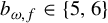 $b_{\omega ,f}\in \{5, 6\}$
,
 $\xi _\omega ^{(1)}=2$
and
 $\int \log (2+\xi _{\omega }^{(1)})- \log b_{\omega ,f} \,dm \leq \log 4 - \log 5 <0$
. Thus, Example 7.2(2) ensures the constant potential
 $\log g_\omega =0$
is strongly contracting, provided
 $\log \|T^{\prime }_\omega \|_\infty , \log \operatorname {\mathrm {Einf}}|T^{\prime }_{\omega }|, {\mathrm {var}(|T^{\prime }_{\omega }|)}/{\|T^{\prime }_{\omega }\|_\infty } \in L^1(m)$
. In this case, it also follows from Definition 4.2 that
 $-t\log |T^{\prime }_\omega |$
is strongly contracting for sufficiently small
 $t>0$
.
Remark 7.6. The map of Figure 1 is not topologically transitive. In fact, when the
 $T_\omega $
have a (common) Markov partition, the corresponding transition matrices have a (non-random) absorbing set corresponding to the branches within the invariant interval around 1/2.
Remark 7.7. If a map
 $T_\omega $
has an invariant interval
 $J\subsetneq I$
, as in Figure 1, and
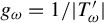 $g_\omega =1/|T^{\prime }_\omega |$
, then
 $$ \begin{align*} \log \|g_\omega\|_\infty +\log (2+\xi^{(1)}_{\omega}) \geq 0 \quad \text{and} \quad \log \operatorname{\mathrm{Einf}}(g_\omega)+\log b_{\omega,f} \,dm <0. \end{align*} $$
Indeed, the first inequality comes from two facts: (i) if N is the number of monotonic branches of
 $T_\omega |_J$
, then
 $N\leq 2+\xi ^{(1)}_{\omega }$
, as all except for possibly the leftmost and rightmost branches of the invariant interval are non-full; and (ii)
 $\operatorname {\mathrm {Einf}}_{x\in J} |T_\omega '(x)| \leq N$
. The second inequality follows from
 $\operatorname {\mathrm {Esup}}_{x\in I} |T_\omega '(x)|> {b_{\omega , f}}$
.
In particular, if all maps
 $\{T_\omega \}$
have a common invariant interval, then the geometric potential
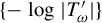 $\{-\log |T^{\prime }_\omega |\}$
is not strongly contracting. This is in agreement with the fact that such a system has at least one non-fully supported random invariant measure absolutely continuous with respect to Lebesgue measure.
To show a stronger result in this direction, we introduce a notion of covering in the random (closed) setting, due to Buzzi [Reference Buzzi6], and show it is satisfied in wide generality, provided the potential
 $-\log |T_\omega '|$
is strongly contracting.
Definition 7.8. A random map
 $\{T_\omega \}$
is called covering if for every open interval
 $J\subset I$
, there exists
 $M_\omega (J)\in \mathbb N$
such that

In the context of this work, equation (7.1) is equivalent to
 $T_\omega ^{(M_\omega (J))}(J)=I$
.
Lemma 7.9. Consider a random map
 $\{T_\omega \}$
and assume the random potential
 $-\log |T_\omega '|$
is strongly contracting. Furthermore, assume
 $\Omega $
is a Borel subset of a separable complete metric space, m is a Borel probability and
 $\sigma $
is an homeomorphism. Then,
 $\{T_\omega \}$
is covering.
Proof. Let
 $\mathrm {Leb}$
denote the normalized Lebesgue measure on I. A simple but crucial observation is that in this case,
 $\nu _\omega (f)=\int f d\mathrm {Leb}$
, where
 $\nu _\omega $
is as in §5.2. Indeed,
 $\int \mathcal {L}_\omega f d\mathrm {Leb}=\int f d\mathrm {Leb}$
holds by the change of variables formula and hence
 $f\mapsto \int f d\mathrm {Leb}$
is an equivariant functional (in fact, it is invariant by all
 $\mathcal {L}_\omega $
, and
 $\unicode{x3bb} _{\omega ^+}=1$
). Theorem 6.6 ensures uniqueness of the equivariant conformal measure, so
 $\nu _\omega (f)=\int f d\mathrm {Leb}$
.
Now we show the random map is covering. Let
 $J\subset I$
be an open interval. Then,
 . In particular, there exists
 $M>0$
such that
 , as needed.
7.3 Random intermittent maps
For
 $0<\gamma <1$
, consider the Manneville–Pomeau map
 $f_\gamma : [0,1] \to [0,1]$
, given by
 $$ \begin{align*}f_\gamma(x)=\begin{cases} x(1+2^\gamma x^\gamma) \quad &0\leq x < \frac12,\\ 2x-1 \quad &\frac12\leq x \leq 1. \end{cases}\end{align*} $$
This is a class of intermittent maps, with a neutral fixed point at 0, which have been investigated as a model of non-uniformly hyperbolic behaviour since the work of Liverani, Saussol and Vaienti [Reference Liverani, Saussol and Vaienti18]. More recently, Demers and Todd have investigated open and closed intermittent maps with geometric potentials
 $-t \log |f^{\prime }_\gamma |$
in [Reference Demers and Todd9]. The next example shows a family of strongly contracting geometric potentials for random intermittent maps.
Example 7.10. For
 $j=1,2,\ldots, $
let
 $\gamma _j \in (0,1)$
. Let
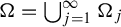 $\Omega =\bigcup _{j=1}^\infty \Omega _j$
be an (at most) countable partition of
 $\Omega $
into measurable sets, and for each
 $\omega \in \Omega _j$
, let
 $T_\omega =f_{\gamma _j}$
. Let
 $0\leq t<{\log 2}/{\log 3}\approx 0.63$
. Then, the geometric potential
 $\{\log g_\omega :=-t \log |T^{\prime }_\omega |\}$
is strongly contracting for
 $\{T_\omega \}$
. Indeed, we note that for all
 $0{\kern-1pt}<{\kern-1pt}\gamma {\kern-1pt}<{\kern-1pt}1$
, we have
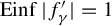 $\operatorname {\mathrm {Einf}} |f_\gamma '|=1$
and
 $\|f_\gamma '\|_\infty < 3$
. Furthermore,
 $\xi ^{(n)}_\omega =0, b^{(n)}_{\omega ,f}=2^n$
for all
 $n\in \mathbb N$
. Thus, Example 7.2(3) (with
 $K=\xi =1$
) yields the claim, since
 $\mathrm {var}(\log |T^{\prime }_\omega |)\in L^1(m)$
and
 $$ \begin{align*} \int \log \|g_\omega\|_\infty - \log\operatorname{\mathrm{Einf}}(g_\omega) \,dm+\log \xi - \beta_{f} \leq 0+t\log 3+0-\log2 <0.\end{align*} $$
The following example treats random intermittent maps with holes.
Example 7.11. Let
 $\Omega =\bigcup _{j=1}^\infty \Omega _j$
be an (at most) countable partition of
 $\Omega $
into measurable sets, and for each
 $\omega \in \Omega _j$
, let
 $T_\omega =T_j:I:=[0,1] \to [0,1]$
be a piecewise smooth map with a hole
 $H_\omega =H_j$
satisfying the following conditions:
-
(i)
$T_\omega (0)=0$
and
$T^{\prime }_\omega (0)=1=\operatorname {\mathrm {Einf}}_{I}|T^{\prime }_\omega |$
; -
(ii)
$\|T^{\prime }_\omega \|_\infty \leq K_\omega $
, with
$\log K_\omega \in L^1(m)$
; -
(iii)
$\mathrm {var}(\log |T^{\prime }_\omega |)\leq v_\omega $
, with
$v_\omega \in L^1(m)$
; -
(iv)
$(T_\omega , H_\omega )$
has at most two contiguous non-full branches, for instance, this happens if
$T_\omega $
only has full branches and
$H_\omega $
consists of a single interval; and -
(v)
$(T_\omega , H_\omega )$
has
$b_{\omega ,f}$
full branches, and
$\beta := \int \log b_{\omega ,f} \,dm> \log 4 + t_0 \int \log K_\omega \,dm$
, for some
$0\leq t_0<1$
. (Note that
$K_\omega \geq b_{\omega , f}$
.)









Then, for every
 $0\leq t \leq t_0$
, the geometric potential
 $\{\log g_\omega :=-t \log |T^{\prime }_\omega |\}$
is strongly contracting for
 $\{(T_\omega , H_\omega )\}$
. Indeed, Example 7.2(2) yields the claim, since
 $$ \begin{align*} &\int \log \|g_\omega\|_\infty - \log\operatorname{\mathrm{Einf}}(g_\omega) + \log (2+\xi_{\omega}^{(1)})\\ &\quad- \log b_{\omega,f} \,dm\leq 0+t\log K_\omega \,dm + \log 4 - \beta<0.\end{align*} $$
7.4 Random open systems and escape rates
The following example, similar to [Reference Atnip, Froyland, González-Tokman and Vaienti1, §13], relates the maximal Lyapunov exponent of open and closed systems to the escape rate of a conformal measure through the holes.
Example 7.12. Assume
 $\{\log g_\omega \}$
is a strongly contracting potential for the random closed map
 $\{T_\omega \}$
. Assume
 $(H_\omega ^\varepsilon )_{0<\varepsilon \leq \varepsilon _0}$
is an increasing family of holes for each
 $\omega \in \Omega $
. That is,
 $H_\omega ^\varepsilon $
is a finite union of intervals, and
 $\emptyset :=H_\omega ^0\subset H_\omega ^{\varepsilon '} \subset H_\omega ^{\varepsilon }$
for
 $\varepsilon '<\varepsilon $
. Let
 $b_{\omega ,f}^{\varepsilon }$
be the number of full branches of
 $\{(T_\omega ,H_\omega ^\varepsilon )\}$
and
 $\xi _{\omega }^{\varepsilon }$
be the largest number of contiguous non-full intervals for
 $\{(T_\omega ,H_\omega ^\varepsilon )\}$
. Suppose there exist
 $b_\omega , \xi _\omega>0$
such that for every
 $\varepsilon \geq 0$
,
 $b^\varepsilon _{\omega ,f}\geq b_\omega $
and
 $\xi ^\varepsilon _\omega \leq \xi _\omega $
, and assume
 $$ \begin{align*}\int \log \|g_\omega\|_\infty- \log\operatorname{\mathrm{Einf}}(g_\omega) + \log (2+\xi_{\omega})- \log b_{\omega} \,dm <0.\end{align*} $$
Then, for each
 $0<\varepsilon \leq \varepsilon _0$
,
 $\{\log g_\omega \}$
is a strongly contracting potential for the random open map
 $\{(T_\omega ,H_\omega ^\varepsilon )\}$
. Let
 $\nu ^\varepsilon _\omega $
and
 $q^\varepsilon _\omega $
be the conformal measures and equivariant densities from Theorem 6.1, respectively, and let
 $\Lambda ^\varepsilon $
the maximal Lyapunov exponent (expected pressure). Then
 $\varepsilon \mapsto \Lambda ^\varepsilon $
is non-increasing. Indeed, if
 $\varepsilon '<\varepsilon $
, because of the monotonicity of the holes, for every
 $\omega \in \Omega , n\in \mathbb N$
, we have
 $\operatorname {\mathrm {Einf}}(\mathcal {L}_{\omega }^{\varepsilon ',(n)}1)\geq \operatorname {\mathrm {Einf}}(\mathcal {L}_{\omega }^{\varepsilon ,(n)}1)$
. Since
 $\Lambda ^\varepsilon =\lim _{n\to \infty } (1/n) \log \operatorname {\mathrm {Einf}}(\mathcal {L}_{\omega }^{\varepsilon ,(n)}1)$
,
 $\varepsilon \mapsto \Lambda ^\varepsilon $
is non-increasing.
Furthermore, for
 $0\leq \varepsilon '<\varepsilon $
,
 $\Lambda ^{\varepsilon '}-\Lambda ^\varepsilon $
gives the escape rate of the measure
 $\nu ^{\varepsilon '}$
through
 $\{H_\omega ^\varepsilon \}$
. That is,
 $-\lim (1/n) \log \nu _\omega ^{\varepsilon '}(X^\varepsilon _{\omega ,n})=\Lambda ^{\varepsilon '}-\Lambda ^\varepsilon $
, where
 $X^\varepsilon _{\omega ,n}$
is the
 $n-$
step survivor set for
 $\{(T_\omega ,H_\omega ^\varepsilon )\}$
. Indeed,

Lemma 5.1 implies that
 $\lim _{n\to \infty }(1/n) \log \|{\mathcal {L}_{\omega }^{\varepsilon ,(n)}1}/{\operatorname {\mathrm {Einf}}(\mathcal {L}_{\omega }^{\varepsilon ,(n)} 1)}-q^\varepsilon _{\sigma ^n(\omega )}\|_\infty <0$
. Since
 $\nu ^{\varepsilon '}_{\sigma ^n(\omega )}$
is a probability measure,
 $\operatorname {\mathrm {Einf}} q^\varepsilon _{\sigma ^n(\omega )}=1$
and
 $\|q^\varepsilon _{\sigma ^n\omega }\|_\infty $
is tempered, then
 $\lim _{n\to \infty }(1/n) \log \nu ^{\varepsilon '}_{\sigma ^n(\omega )}(q^\varepsilon _{\sigma ^n(\omega )})=0$
. Thus,
 $$ \begin{align*}\lim_{n\to\infty}\frac1n\log \nu_\omega^{\varepsilon'}(X^\varepsilon_{\omega,n})= \lim_{n\to\infty}\frac1n\log \operatorname{\mathrm{Einf}}(\mathcal{L}_{\omega}^{\varepsilon,(n)} 1) - \lim_{n\to\infty}\frac1n \log\unicode{x3bb}^{\varepsilon',(n)}_\omega= \Lambda^\varepsilon-\Lambda^{\varepsilon'},\end{align*} $$
as claimed.
Acknowledgment
The authors are partially supported by an ARC Discovery Project.