Introduction
The capitalist epithumè enumerates the objects of desire that are worthy of pursuit and the affects born from their pursuit. (Lordon Reference Lordon and Ash2014:50)
A few years ago, I was invited to the University of Stockholm to give a talk about my work on elite discourse. It was spring break and my husband was working in London at the time; the only way to make the trip possible was to take my then thirteen- and eleven-year-old sons with me. My Swedish colleagues were very supportive of this circumstance and helped book us into a suitable room. Given the topic of my talk, I was amused to learn that we were to be in an Elite hotel, a large national chain in Sweden. Eventually, the day came when we arrived in Stockholm and made our way to the hotel, pausing to take a quick family snapshot at the entrance and beneath the impressive black flag with its large ‘E’ and four embedded stars. We checked in and made our way up to the room. Within seconds of shuffling into the room, my oldest son declared with genuine disappointment, “But this isn't elite!”. I immediately pressed him for an explanation. The room, he told me, was far too small—just not big enough. It appeared that, as a newly formed teenager, my son already had a clear sense of elite status and its semiotic-material association with spatiality. In that moment, however, he was having a life-lesson encounter with the disingenuous language games of marketers and other people of commerce. Without realizing it, he was also tangibly experiencing the ideological force of the floating signifier.
Against this kind of banal, domestic backdrop, my article is grounded in two academic truths about language: words do not hold meaning, and words really matter. In this regard, Irvine (Reference Irvine1989), amongst others, is well known for establishing that words are never mere representations but always fully material in their economic and political effects. We not only speak words but we trade in them, constantly leveraging and bartering them for raw monetary gain. All of which is made possible because, as Bourdieu (Reference Bourdieu and Thompson1991) famously observed, there are endless exchanges to be made between symbolic and economic capitals. These are the substantive realities of all language use, but there are domains where the trading between words and wealth seems all the more fierce, all the more profitable. One such domain is the international airline industry and, specifically, the configuration and marketing of passenger services or ‘classes’. This is a world of high overheads and slim profit margins. It is also a world where every ounce of stuff costs, and this makes the seeming weightlessness of words invaluable.
In this spirit, I want to focus on a particular case of language-use, a very contemporary language game deployed in the service of aggressive status-marking and profit-making. Here, we find meaning slipping and sliding about all over the place, and, for all its frivolity and apparent harmlessness, having clearly material consequences. The case in point is premium, used as a commercially driven tactic for social sorting, self-regulation, and, ultimately, for hegemonic ordering. In the first part of my analysis, I demonstrate how this word is ubiquitous: attached to any number of goods and services, and persuading people into an easy sense of distinction and superiority. The force of this word occurs most vividly in the strategic, elaborately orchestrated rhetorics of so-called Premium Economy which is the second part of my analysis. This is where we find airlines discursively producing (or fabricating) a status tangibly—but not too visibly—distinct from Economy class while also maintaining separation from more prestigious (and expensive) Business Class.
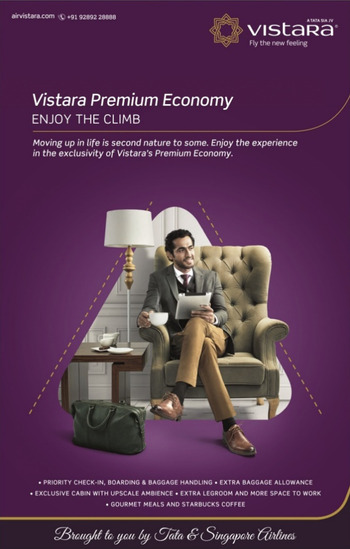
To ground things a little, one striking example of these premium and specifically Premium Economy language games appears in Figure 1.Footnote 1 Against a stylized rendition of the archetypal image of social hierarchy (a pyramid), this domestic Indian airline invites prospective passengers to ‘enjoy the climb’. Upward mobility is explicitly naturalized (‘moving up in life is second nature to some’) and presented as both enjoyable and largely effortless. Premium, we are told towards the bottom of the advertisement, is a matter of ‘exclusivity’ and ‘priority’; it also means being ‘upscale’, and having both ‘extra’ and ‘more’. This last point will later be shown to be key.
Airline advertisement, Times of India, November 2017.

In seeking to explain the slippery yet material consequences of these kinds of language games, I follow the better-known interventions of Foucault (e.g. Reference Foucault and Sheridan1977) and especially Bourdieu (e.g. Reference Bourdieu and Nice1984). However, I also bring to my critique the critical insights of an economist: Lordon (Reference Lordon and Ash2014). In dissecting the language of elitism, I am therefore concerned with the ways language, either as a single word or as part of a wider semiotic formation or orchestration, is deployed as a resource for disciplining (Foucault) and seducing (Bourdieu) people, but also, in Lordon's terms, for enlisting or enslaving them. Through my analysis of premium I want to show how language is thereby deployed in the service of desire—or, more accurately, in the discursive production of desire. In this regard, Lordon's centering of affect and, specifically, desire as being at the very heart of the social order (see quote above) is very compelling. In his complementary reading of both Spinoza and Marx, Lordon argues that capitalism is grounded not only in the exploited labour of workers (this it surely is), but also in the readiness of the managerial, professional, or bourgeois classes to strive willingly for their own subjugation. All of which is ultimately an expression of what Bourdieu & Wacquant (Reference Bourdieu and Wacquant1992) called symbolic violence.
In my own work, I have come to recognize desire—and the affective, psychic aspects of status—to be necessary for explaining some of the ‘more-than-representational’ workings of contemporary class privilege (Thurlow Reference Thurlow2016; cf. Lorimer Reference Lorimer2005). Learning to desire is always essential to the reproduction of privilege (Kenway Reference Kenway, Maxwell, Deppe, Krüger and Helsper2018), just as we are effectively taught to find pleasure—joy, even—in inequality. Indeed, the crux of Lordon's (Reference Lordon and Ash2014:15) thesis is that desire must be understood not as the ‘pull’ of preexisting objects but rather as the force which produces the objects; that is, pushing them into being. This is what Spinoza (Reference Spinoza and Parkinson1677/2000:IIIp9s) means when he writes, ‘We neither strive, nor will, neither want nor desire anything because we judge it to be good; on the contrary, we judge it to be good because we strive for it, will it, want it, and desire it’. Thus, people value as desirable only that which they have learned already to desire, and, in these terms, both premium and Premium Economy are quintessential sites of learning.
Elite discourse, post-class ideologies, and floating signifiers
Before moving into the empirical detail of my article, I want briefly to locate my argument in the wider context of elite discourse studies and to set down some of my critical, theoretical, and analytical starting points. In this regard, I begin with the principle that elite discourse is less a matter of what elite people say or do, but more about the way elitist claims to status, distinction, and superiority are taken up in everyday contexts and in the mouths of ordinary speakers—regardless of their wealth or political clout (see Thurlow & Jaworski Reference Thurlow and Jaworski2017a for more on this). In these terms, eliteness is understood to be an identification or positioning rooted in material privilege as a ‘class-driven, class-making praxis’ (Kenway, Fahey, Epstein, Koh, McCarthy, & Rizvi Reference Kenway, Fahey, Epstein, Koh, McCarthy and Rizvi2017:200), and which depends on its being constantly articulated through covert appeals or overt claims to distinction, excellence, superiority, and, following Bourdieu (Reference Bourdieu and Nice1984), good taste. This approach to ‘studying up’ inevitably entails looking in front of oneself as much as it does looking ahead of, or above, oneself. I am therefore invested in the workings of eliteness and privilege only because of what this reveals about contemporary class formations and the maintenance of inequality. Furthermore, my investment is both scholarly and personal: I am also trying to make sense of my own complicit role in the manufacture and maintenance of privilege/inequality. At odds with my scholarly ego, I acknowledge that I am actually more of the problem than the solution.
One of the defining features of elite discourse nowadays is that it is a key site for the production of what I have been choosing to call post-class ideologies (Thurlow Reference Thurlow2016)—a structurally unfounded cultural discourse of inclusivity and access for all. Many people are still encouraged to believe that class is no longer a barrier or obstacle, and that, in true neoliberal fashion (Dardot & Laval Reference Dardot, Laval and Elliot2013; Chun Reference Chun and Preece2015), prosperity and social mobility are matters of entrepreneurial self-determination. (I consider the tenacity of neoliberal capitalism towards the end of the article.) In this context, elite or even super-elite status is nowadays something into which many people are invited to imagine themselves. Following Khan (Reference Khan2012), people are persuaded to think of themselves as privileged rather than entitled, and to feel good about their privilege because it is something they have worked for, something they have earned (see Mapes Reference Mapes2018 on the ‘pioneer spirit’ myth in elite food practices). However, as with the ideologies of postracism and postfeminism (Gallagher Reference Gallagher2003; McRobbie Reference McRobbie2009), the appearance of access and inclusion belies the political-economic exclusions inevitably at work. It only seems as if structural inequalities and injustices have been overcome, and privilege remains as exclusionary and unattainable as ever—arguably even more so (see OECD 2018). What is real, though, are the rhetorics of status and distinction deployed relentlessly for producing and maintaining an aspirational, and evidently profitable, yearning. And a sense of ‘because I'm worth it’ possibility.
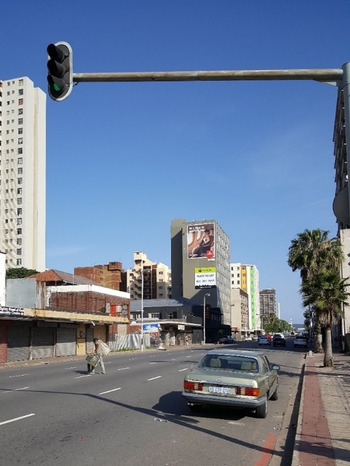
Importantly, the aspirational but inherently disingenuous rhetorics of elite status keep rippling out across wider and wider terrains, hailing more and more people, seeking always to persuade them that privilege is both desirable and achievable (see Thurlow & Jaworski Reference Thurlow and Jaworski2017b; Jaworski & Thurlow Reference Jaworski and Thurlow2017). Under these pretences of possibility, markers of luxury, distinction, and superiority backdrop themselves in the lives of ordinary people. A case in point is the slice of South African life shown in Figure 2, which is drawn from my own fieldwork. In one of the more run-down parts of Durban, I came across a homeless man shuffling across a street, past a parked Mercedes Benz, and beneath a huge billboard advertising Emirates airline's Business-class service: ‘You've arrived the moment you board’. Such are the tactless rhetorics and distasteful juxtapositions of contemporary class formations.
Street scene, downtown Durban, October 2016.

These aspirational rhetorics are not only ubiquitous, they are also powerfully multisensory and multimodally realized (Thurlow Reference Thurlow and Rippl2015; also Thurlow & Jaworski Reference Thurlow, Jaworski, Cavanaugh and Shankar2017c). This, I argue, is key to the success of post-class ideologies—their ability to take hold, to get inside our minds and under our skin. It is certainly the tendency to toggle backwards and forwards between modalities (e.g. the verbal and visual and haptic) which makes claims to distinction or status feel more substantial than they usually are. Language undoubtedly remains a central resource or strategy for producing and circulating notions of eliteness. This is precisely where my focus is now, a linguistic phenomenon—a strategic language game—at the heart of elite discourse and post-class ideologies: the floating signifier. As an example of the kinds of floating signifiers that concern me, I start with ‘elite’ itself. I have shown before (Thurlow & Jaworski Reference Thurlow and Jaworski2017b) how this word seems to be everywhere. It certainly crops up in some perfectly incongruous places such as the urinal in Figure 3. As Jaworski and I (2017b:16) argue, ‘it does not matter so much whether someone really intends elite as a serious claim to superiority or exclusivity; what is ideologically significant is the persistent use of the word as a generalized, unspecified index of prestige, good taste and distinction’.
Urinal, Rio de Janeiro, 2017 (courtesy of Joe Comer).

My approach to floating signifiers in this article follows the classic work of Lévi-Strauss (Reference Lévi-Strauss1950/1987:63–64) who explains that they work by ‘represent[ing] an undetermined quantity of signification, in itself void of meaning and thus apt to receive any meaning’.Footnote 2 From Hall (Reference Hall1997:8), however, we learn also that floating signifiers (in his case, ‘race’ and ‘gender’) end up being more concrete and more substantial than the notions (or ‘undetermined qualities of signification’) they represent. In Hall's words: ‘Their meaning… can never be finally fixed, but is subject to the constant process of redefinition and appropriation’. However—and this is key, says Hall—floating signifiers have very real and sometimes terrible consequences. Indeed, as Laclau & Mouffe (Reference Laclau and Mouffe1985) propose, these seemingly loose, vacuous terms are fully hegemonic in their potential, with different communities struggling—fighting, even—to stabilize and fix their meaning. Besides, as Laclau & Mouffe also note, floating signifiers are never entirely free-floating anyway; they always have a partial fixation, carrying with them an influential set of what social semioticians would call meaning potentials. This is key to understanding the inherent post-class ideologies at work in the floating signifier premium. To this end, I start with the first of two analytic moves, one which establishes the semantic-cultural field for my second more in-depth analysis.
Premium: The domestication of privilege
Within the even broader field of eliteness, and in addition to elite, excellent, distinctive, superior, and tasteful themselves, a number of allied signifiers are often deployed nowadays, including exclusive, stylish, elegant, luxurious, boutique, tailored, discerning, and, indeed, premium. The point is precisely that these are ‘just’ words—ostensibly cheap words (cf. Irvine Reference Irvine1989)—which have neither legal protection nor any measurable or objective clarity. These terms are inevitably used interchangeably, tautologically, and mutualistically. Technically speaking, premium denotes higher or exceptional quality or amount and, thus, superiority; it may also—but by no means always—indicate a higher price (see below). For the most part, however, premium appears to slide about freely as a convenient marker of distinction and prestige. To this end, I offer the plates below.


This initial analytic intervention is informed partly by the multiplicities and mobilities surfaced through a semiotic landscape approach (Jaworski & Thurlow Reference Jaworski and Thurlow2010), one which is also rooted in a kind of multi-sited, ‘guerrilla’ fieldwork. Briefly speaking, multi-sited ethnography is a well-established methodology for tackling global capitalism (see Marcus Reference Marcus1995). (I have likewise begun exploring the sociolinguistic potential of commodity chain analyses as an allied approach; Thurlow Reference Thurlow2019.). Here, however, I also borrow the somewhat more unorthodox notion of guerrilla ethnography (cf. Mariampolski Reference Mariampolski2006) to account for a sporadic, opportunistic approach to semiotic landscapes and ‘real-world’, situated semiotic practices. (For a similar approach see Jaworski Reference Jaworski2015.) It is in this way, that I document how premium, as both word and practice, appears to be repeatedly and widely instantiated.
Emerging through my own admittedly privileged mobilities, these thirty-one snapshots manifest a discursive formation, which, as otherwise singular isolated actions, may have stayed largely unnoticeable or unremarkable. This grounded perspective has added empirical significance for those discourse analysts who have long been concerned with establishing the connection between language and neoliberal/global capitalism (e.g. Fairclough Reference Fairclough1999). Each occurrence of premium is no doubt inflected with local resonances and situated specificities (e.g. Mooncakes in Hong Kong, chocolates in Switzerland, coffee in Melbourne). We nonetheless have first-hand evidence of ‘words on the loose’, of language as global rather than local practice. Indeed, premium has all the qualities of Jaworski's (Reference Jaworski2015) ‘globalese’; as such, it is also how the ‘global semioscape’ (Thurlow & Aiello Reference Thurlow and Aiello2007; cf. Appadurai Reference Appadurai1990) comes to be constituted: that more informal, often banal plane of cultural circulation of images, practices, and aesthetic ideals.
The workings of premium are tightly allied to the kinds of status- and boundary-marking associated with elite mobilities, such as the South African Airways business-class lounge {1} or the hierarchical ordering of Tren Italia's train carriages {2}. Even just driving by car in the USA, one can elect to fill the tank with premium petrol {3}. On arriving in Washington DC meanwhile, passengers are explicitly sorted in this way {4}. Along with a gold-metalic wrapper, premium is perhaps predictably deployed in the packaging of chocolates {8 & 9} and especially ‘high-end’ chocolates {10}. From my own experience, it is not hard to imagine many Swiss people arguing that Swissness is inherently premium. And this is the point: what therefore is the point of premium? Things certainly become even less clear when one really starts to keep an eye out for the word.
In many ways, the performative power of premium is most intriguing when it comes attached to, and is claimed by, a host of even more pedestrian products: like my local beer {15}, my ginger-beer {16}, my locally bought South African cider {17}, my Indian beer bought in Sweden {18}, or my German beer bought in Hong Kong {19}. Rather than me pursuing premium, it has felt at times as if the word is chasing me. At the start of recent lecture in Bern, a student hung his jacket up and I spotted yet another premium {5}. I have recently found myself facing the possibility of a premium haircut while flying out of Hong Kong airport {6}, having earlier that day spotted the chance for some premium Mooncakes {7}. It certainly seems that everything and anything may declare itself to be premium: my olive oil {20} or Greek olives {21} in Switzerland, my coffee in Melbourne {22}, my tomatoes in Auckland {23}, my crab cakes in Washington DC {24}, my chutney in Hong Kong {25}, or my wine in Seattle {26}. In Bern, my ‘down-market’ barber sells premium hair products {31}. In Durban, I can buy premium bandages {13} and hand-towels {14}; in Malta, premium cigarettes {10}; and in Auckland, premium candles {12} for the dinner table. My children have become accustomed to my excitement at discovering premium and have become quite adept at finding it themselves: on their jeans {27}, our plastic storage containers {28}, their puzzle {29}, or their ice creams {30}. None of these household encounters are without consequence; ‘premium power’ asserts itself—and is deeply enculturated—at the level of everyday domestic life.
Premium is manifestly a slippery rhetoric, partly because it slides about all over the place but also because its uses are so patently disingenuous. It is certainly hard to imagine that premium retains any pulling-power given this kind of over-use. Applied in these otherwise willy-nilly ways, however, distinction and prestige are persistently presented as not only desirable but also as easily attainable. This is a world of apparently ‘affordable luxury’—a place where a packet of premium tomatoes costs only NZ$6.49 {23} or a bag premium Swiss chocolates can be had 50% off at CHF14.95 {9}. However ridiculous (i.e. playful or foolish) this language game is, it is the essence of, and the essential conceit of, post-class ideologies. Through the domestication of premium-ness, privilege is ostensibly democratized. In writing about the ideological workings and the hegemonic force of the floating signifier elite, Jaworski and I (2017b:16) argue that these ‘word-things’ also work reiteratively and normatively also to persuade people that superiority, whether expressed as elite or premium, is a status to be sought after, to be desired. As such, people are trained constantly (although not necessarily easily or completely) to seek added value and advantage over others, aspiring always for something better than ‘ordinary’ and better than ‘the rest’. To be sure, these language games really do work; marketers, behavioral economists, and consumer researchers know this only too well (see below). Speaking of which, I turn now to Premium Economy as a way to get inside the rhetorical workings of premium by looking at how it takes shape as part of a more contextualized ‘nexus of practice’ (Scollon Reference Scollon2001) or ‘semiotic assemblage’, which Pennycook (Reference Pennycook2017) describes as the ways people, communicative resources, and objects come together in particular moments and places.
Premium Economy: The rhetorics of extraction, excess, and comparison
One of the most spectacular, elaborately orchestrated cases of premium is to be found in the marketing of international airlines. This is a site where the less benign force of premium is exposed—its raw economics and its sharp competitive edges. Here we find not the sorting of tomatoes, but rather the explicit sorting of people. Indeed, this is the real reason for looking at Premium Economy. In teasing out the organizing principles and discursive strategies of Premium Economy, I mean to figure out the political-economic logics of premium more generally, making better sense of the ways this pervasive floating signifier is nowadays being fixed, loaded, and made fully material.
Premium Economy is a practice which Veblen (Reference Veblen1899/1994) would have found quite obvious judging from his famous treatise on conspicuous consumption. On board the modern aeroplane, we witness the values, practices, and stuff of the privileged, dominant classes being asserted as powerful markers of status, prestige, and distinction—demanding attention from the less privileged. Once again, eliteness is not neatly located in otherwise obviously or spectacularly elite spaces or elite people (Thurlow & Jaworski Reference Thurlow and Jaworski2017b); instead, it seeps outwards (or, on the plane, backwards and downwards) and across a wider, ostensibly less privileged demographic.Footnote 3 Promoting its newly launched Premium Economy service in 2015, Singapore airlines touted it as a ‘whole new class’. In the lexicon of flying, class is treated as something to be fabricated at will. At the very least, status and distinction are thus confirmed as not only materially structured—for they surely are—but also as being relationally, social-psychologically, and discursively accomplished. Premium Economy is a tangible materialization of the in-between world of upward and downward social comparison.
Premium Economy was initiated in 1991 by Eva Air (Taiwan), but is a service now offered in one form or another by at least forty or more international airlines, at the time of writing. The decision to launch a Premium Economy service is itself a powerful marketing strategy, a way for airlines to promote themselves as cutting edge and as big players. (This partly explains the service more unusually being offered by a domestic carrier like Vistara; Figure 1.) Not wholly unlike other classes, there is no standardized labelling for Premium Economy. Many airlines use the term Premium Economy, while others opt for something a little more elaborate like Eva's Elite Class or Aerolinas Argentina's Club Economy. United Airlines offers simply Economy Plus, which, as I show below, gets closer to the semantic, psychological, and economic truth of Premium Economy. In 2018, Virgin Atlantic rebranded its service as just Premium in a sleight-of-hand attempt to disassociate it from Economy altogether.
The nature and scale of different Premium Economy services is likewise completely unregulated and therefore very variable. Airlines may, for example, offer a separate cabin, ‘upgraded’ meals, headphones, so-called amenities, welcome drinks, greater legroom, seat pitch/width, and so on. One of the airline industry's language games is to deploy the now well-established cachet of international Premium Economy services to much more modest domestic services; for example, American Airlines’ Main Cabin Extra entails little more than extra legroom. Ultimately, everything hinges on a skillfully balanced material-semiotic fabrication of difference; Premium Economy is thereby a quintessential act of classist boundary-marking and boundary-making.
At this point, it is worth noting that the demographic hailed and/or secured by Premium Economy services is not easy to discern, but is generally considered to be quite broad.Footnote 4 One industry insider (from the design company responsible for Singapore Airlines’ top-rated Premium Economy service) talks about targeting a demographic that is ‘slightly more youthful than business class and first class, or the family orientated demographic of economy class’. Elsewhere, a representative from the design company charged with ‘refreshing’ EVA Air's Premium Economy so-called amenity kit explained that they had in mind an ‘extremely dynamic demographic—they are young business individuals who are up and coming’. It is this somewhat unctuous but otherwise vague marketing-style which is perhaps most revealing. In the case of Singapore Airlines, the objective is apparently to persuade passengers into believing Premium Economy is ‘The place to be. A place that [has] its own status’. They should also ‘feel rewarded by all [the] extra features that Singapore Airlines has given [them]’. The fact is, Premium Economy is extremely profitable (see below), so while airlines certainly want to have Business-class customers ‘buying down’, they mostly want Economy-class customers ‘buying up’.
For getting inside the workings of Premium Economy, I pulled together a corpus of promotional materials from the websites of over forty different airlines offering some kind of premium economy. My procedure for analysing this corpus has not been strictly content-analytic, but nonetheless affords a broad perspective on the consistent, patterned nature of different Premium Economy services in different countries. In this regard, I highlight three major discursive strategies or rhetorics: extraction, excess, and comparison. These are the apparently persuasive, normative claims made about the premium-ness of Premium Economy. As such, it seems fair to say they are indicative also of the ideological-material force of premium too. In the context of my wider Lordon-inspired critique, one might think of these rhetorics as techniques for obedience training and enlistment.
Rhetoric 1: The economics of extraction
The fact is that, just as anyone can declare anything to be premium, the same applies to Premium Economy. In this regard, it is a language game par excellence. But there is a raw economics too. Particularly since the large-scale ‘global’ recession of 2008, airlines have taken the chance to (re)capture a suddenly declining Business Class market with many companies cutting back their travel allowances and perks. Although, as I indicated above, the ratio between business and leisure travelers in Premium Economy continues to be more skewed toward the second. In marketing terms, the pricing models are compelling (see Hugon-Duprat & O'Connell Reference Hugon-Duprat and O'Connell2015). While Premium Economy is 1.6 times more costly than Economy to produce, it is 2.3 times more profitable. In fact, Hugon-Duprat & O'Connell (Reference Hugon-Duprat and O'Connell2015) argue that Premium Economy might even be the most profitable cabin. This is undoubtedly one manifestation of the extractionary logic underpinning Premium Economy: the extraction of profit. There are, however, at least two other equally material processes of extraction.
A report commissioned by the World Bank (Bofinger & Strand Reference Bofinger and Strand2013) suggests that, based on ratio of space to seat/passenger, and with all other things being more or less equal, Business- and First-class passengers may have a carbon footprint that is, respectively, three and nine times greater than that of an Economy-class passenger. It seems obvious that Premium Economy follows suit. When it comes to natural resources (i.e. fossil fuels), therefore, class status and privilege are again quite concretely matters of extraction. The extractionary logic of Premium Economy can feel even more immediate, more ‘pressing’ for some people when it comes to their embodied experiences. Typically, Hugon-Duprat & O'Connell (Reference Hugon-Duprat and O'Connell2015) say, a Premium Economy seat occupies at least 23% more space than an Economy one, although some 48% less than a Business Class one. In August 2017, Australian airline Qantas announced that it was effecting a ‘major cabin upgrade’ in order to ‘improve passenger comfort on long-haul flights’ and to ‘meet increased customer demand for premium cabins’. (See below for a similarly grand announcement by British Airways in June 2019.) At the heart of this strategic marketing initiative was a reconfiguration of their seating to increase ‘premium seating by 27%’ by creating six more Business Class seats and twenty-five Premium Economy seats. Amongst other things, however, this expansion necessitated the removal of thirty Economy-class seats and a ‘rearrangement’ of the workstations for flight attendants. Material and social space are therefore quite literally extracted from elsewhere—in this case, at the expense of poorer passengers and workers.
Given these processes of monetary, ecological, and social extraction, Premium Economy is exposed as a quintessentially neoliberal project, one grounded in a friendly, innocuous spin on ‘accumulation through dispossession’ (Bockman Reference Bockman2012). It is likewise an on-the-ground realisation of Wacquant's (Reference Wacquant2012) ‘Centaur state’, which is to say, liberal at the top (i.e. for some) and punitive at the bottom (i.e. for many). Like all privilege, the price of premium is evidently paid only partly by ‘premium’ customers. In raw economic terms, airlines are clearly getting more bang for their buck; the trick is to persuade customers that they do too. This is where language comes in very handy.
Rhetoric 2: The performance of (lexical) excess
Premium Economy is structured by an undeniable material economy rooted in market-driven considerations. Profit margins are, however, notoriously slim, and so money is only generated by keeping costs as small as possible. One of the cheapest resources available to airlines—one with the lowest fossil-fuel burn—is words. Throughout the promotion of Premium Economy, copious ‘copy’ is generated for fixing the meaning of premium-ness. Airlines need to work hard to make premium meaningful, especially given the stiff competition from olives, crab cakes, and tomatoes! A good example of the lexical excess commonly deployed is to be found in the slightly re-ordered list in extract (1) where Eva Air's Elite Class (the world's first Premium Economy) offers a stream of purple promises. I have underlined some of the more telling (and typical) features.
(1) The purple prose of Elite Class
The cabin is simply yet stylishly laid out with a refreshingly elegant color palette that matches your taste. / Our extraordinary collection of inflight amenities include a pillow and blanket set and travel sized toiletries for each individual passenger, plus products from Canadian aromatherapy brand ESCENTS. / … delectable food is served with select red/white wines, prestigious beers or non-alcoholic drinks to quench your thirst … / The … exclusive chinaware set also indulges you in a visual and gastronomic feast at a height of 30,000 feet. … / Your private space in the cozy, spacious Elite Class features a high efficiency, exquisitely modern seat that guarantees total relaxation …
While it all sounds like an excess of stuff, mostly this is an excess of words, and particularly of adjectives. There is the ‘stylish’, ‘elegant’ design of the cabin which, sycophantically, matches ‘my’ taste; a supposedly ‘private’ space which is somehow simultaneously ‘cozy’ and ‘spacious’; some toiletries, a pillow, and a blanket which is‘extraordinary’ but also individualized (‘individual’); and then there is the ‘delectable’ food accompanied by ‘prestigious’ beers and served on ‘exclusive’ chinaware—an indulgent (‘indulges’), ‘gastronomic feast’.
One possible explanation for this compulsion for words lies in Premium Economy's being a space of such relational and status ambiguity. This finds a parallel in Wolfson's (Reference Wolfson1986) ‘Bulge Theory’ of middle-class speech behavior and social distance. Airlines are, after all, making it all up as they go along—this ‘whole new class’. Furthermore, the discursive staging and promotion of Premium Economy necessitates a kind of alchemy realized in the constant slippage between, or mixing of, material benefits or services and those that are purely or largely symbolic such as notions of ‘style’, ‘elegance’, ‘exclusivity’, and ‘indulgence’ (cf. Thurlow & Jaworski Reference Thurlow and Jaworski2006). It only works as an assemblage and, like all Gestalts, the whole appears somehow greater than the sum of its parts. Single anything out, and it looks a little absurd, a little less meaningful and worthy. Without all of the ornate lexical framing, we are also left with little more than a pillow, a blanket, some toiletries, a plate, some food, a drink, and—perhaps most important of all—a seat. Although even the seat, it seems, requires lexical fluffing.
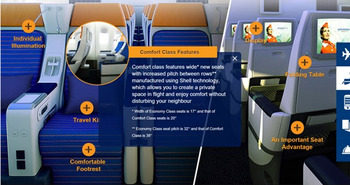
In extract (1), we learn that ‘Elite Class features a high efficiency, exquisitely modern seat that guarantees total relaxation’. (Presumably, this is a guarantee with no legalistic weight.) Seating, as I have already shown, is the economic foundation of Premium Economy's costing model; not surprisingly, therefore, it is at the promotional heart of things too.Footnote 5 Along with food (see Thurlow Reference Thurlow2019), seating is the central preoccupation of contemporary air travel—that is, its recline, width, foot-rests, head-rests, and lighting. The internet is awash with blogs, websites, and magazines dedicated to evaluating airlines on this basis alone. Space is a total fetish—in both the sense of an obsession but also in the Marxist sense of a commodity fetish: the value of things and material stuff overshadows (or erases) a concern for relationship and for any human/social consequences (again, see extraction above). All of which must, however, be emphatically narrated to passengers, as in the visual extract in Figure 4 from Areoflot's online promotional materials. In short, this excessively detailed narration of seating appears to be a ploy for legitimating the otherwise costly—for passengers—premise of Premium Economy (cf. Tannen Reference Tannen1989), all of which otherwise rests on some fairly specious, unsubstantiated claims and largely fictitious comparisons.
Extract from Aeroflot's ‘Comfort Class’ online promotional materials.

Rhetoric 3: The psychology of (downward) comparison
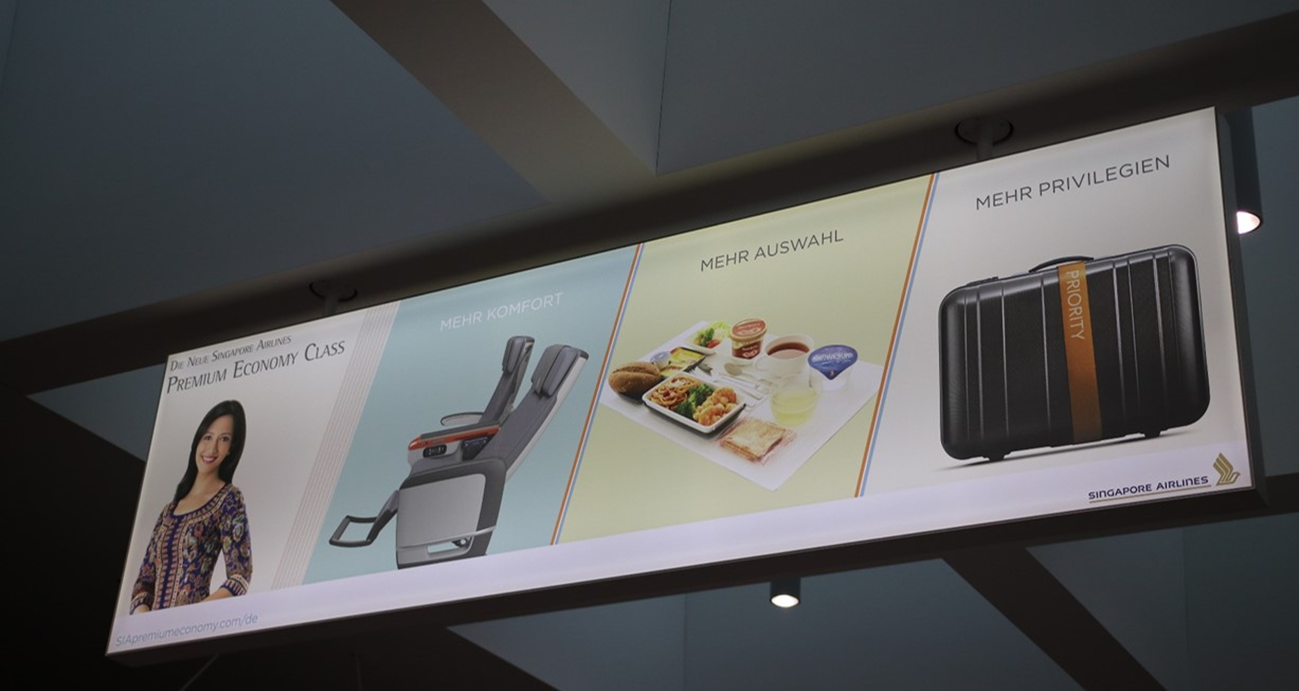
For all its lexical and adjectival excess, the organization and promotion of Premium Economy rests on a core grammatical feature and a related social-psychological phenomenon. When all is said and done, airlines are stuck having to manage a rhetorically complex—precarious, even—balancing act of distinction. (I take up the precarity of status again shortly.) Airlines can never produce too much, but must also not produce too little. They cannot be seen to ‘trash’ Economy class, but they can definitely not be seen to be encroaching into the exclusive terrain of the similarly profitable Business Class. Whatever is on offer in Premium Economy must only be ‘Business-Class-lite’—or very lite. It can only ever really be ‘economy-plus’ (recall United Airlines’ service). Rather honestly, Cathay Pacific has described its Premium Economy as just an ‘enhancement to the Economy Class experience’. For this reason precisely, everything typically boils down to a language of comparison. Sometimes quite explicitly so. A Chinese-language advertisement from Finnair simply states, ‘Add a little extra to your flight’. (Again, recall the Main Cabin Extra service.) In an advertisement from Lufthansa, meanwhile, Premium Economy is summed up as: ‘More space. More service. More than happy’. Singapore Airlines has it both ways, using ‘Extra comfort. Extra choices. Extra privileges’ in one print advertisement but then, at the time of launching its Premium Economy for the Swiss market, used a visually unequivocal German-language poster at Zurich airport (Figure 5) with different but consistently comparative terms: ‘More comfort, more choice, more privileges’. In these cases, it is never fully clear what comfort, choice or privileges might mean, how they might be experienced and assessed in practice. For Premium Economy, however, this is beside the point. All these airlines really ever have to offer is the promise of more. It also seems that is all it takes.
Advertisement, Zurich airport, November 2017 (courtesy of Tizian Dahler).

Marketers and consumer researchers know only too well how the psychology of comparison—particularly downward comparison can bear fruit (i.e. profit). For example, customers can be persuaded to pay more simply because something is more expensive. This is what is known as price-quality signalling or just ‘prestige’ or even, not coincidentally, ‘premium’ pricing (Vigneron & Johnson Reference Vigneron and Johnson2004). In setting prices higher like this, marketers make their product or service feel more premium. Consumer researchers likewise know that people will behave differently—that is, they will part with more of their money—when they feel they have more than others or when they feel better than or more favourably positioned than others. These effects of downward comparison are demonstrated nicely in a study by Zhou & Soman (Reference Zhou and Soman2003) on queuing behaviour. Titled ‘Looking back’, the study revealed how customers were more likely to persevere as long as they knew there were more people behind them in the queue. In other words, knowing that others are worse off, appears to give people hope. This may also help explain the less-than-subtle, unavoidable sideways comparisons generated by ‘classed’—and sometimes differentially carpeted—check-in lines at airports. The same goes for the so-called ‘walk of shame’ by Economy-class passengers obliged to walk through Business-class and then Premium-Economy-class cabins; an exposure to inequality which, as one study (DeCelles & Norton Reference DeCelles and Norton2016) has shown, can indeed trigger anger and resentment. This brings me nicely to a more general reflection on the ‘violent’ ramifications of premium.
The ‘joyful’ violence of premium (and the precarity of status)
Symbolic violence consists then properly speaking in the production of a double imaginary, the imaginary of fulfilment, which makes the humble joys to which the dominated are assigned appear sufficient, and the imaginary of powerlessness, which convinces them to renounce any greater ones to which they might aspire. (Lordon Reference Lordon and Ash2014:109–10)
Premium Economy is a revealing, worthy site of investigation for at least two reasons. First, this is a fairly recent phenomenon and, as such, it inherently speaks of or points to something particular about our historical, political, economic, and cultural moment. Second, and just as premium is ubiquitous, Premium Economy seems to have really taken hold with more and more airlines jumping on the bandwagon—not just major international ones but also domestic ones (recall Figure 1), but also railway companies (see image {2} in the semiotic landscape montage). This tells us at least three things: that the marketing works, that the aspirational desires can be produced, and that people are indeed susceptible to the appeal in the first place.
In the final reckoning, I have come to understand premium in general and Premium Economy in particular as examples of what Bourdieu (Reference Bourdieu and Nice1984) would call the ‘velvet glove’ of power—specifically, in the way advertising imposes needs and inculcates desire. The seemingly frivolous, innocuous but highly performative rhetorics of premium and Premium Economy function thereby as forms of symbolic violence (Bourdieu & Wacquant Reference Bourdieu and Wacquant1992)—the way in which language is deployed as a resource for controlling people through seduction and enchantment. This is animated by post-class ideologies (Thurlow Reference Thurlow2016) with their manipulative, self-serving illusions of access and inclusivity. It certainly seems, from what I have shown here, that the floating signifier premium and the orchestrated practices of Premium Economy present status and prestige to people as something akin to a lifestyle choice. Upward mobility and (elite) status are merely something we have to choose. This neoliberal mindset is epitomized in a completely sincere statement by a young entrepreneur, Jeff Rosenthal, who was interviewed for a 2018 newspaper article about so-called Millennial elites.Footnote 6 As Rosenthal explained, ‘Elitism, the way I would define it, is obtainable. All that stands between you and being elite is your own investment in yourself’. It is no coincidence, perhaps, that this is the younger, ‘up-and-coming’ demographic sought by airlines for their Premium Economy services.
To use a largely overlooked but equally useful notion from Bourdieu, a floating signifier like premium, and especially in the ways it is fixed by airlines, is how the illusio is both created and played out (Bourdieu & Wacquant Reference Bourdieu and Wacquant1992; Bourdieu Reference Bourdieu and Nice1997/2000). This is a game which we are playing with ourselves and with others—a game that gets into our heads and under our skin, functioning, says Bourdieu, quite viscerally.Footnote 7 And ‘premium power’ hinges on the production of aspirational desires and a willingness to be both figuratively and literally captivated. Or, in Lordon's (Reference Lordon and Ash2014) terms, to be enlisted and enslaved. As such, we find swathes of people—not just ‘Millennial elites’—making themselves obedient to elitist rhetorics in these and other ways. For this to happen, says Lordon, we must learn to recognize, desire, and accept ‘humble joys’—like a premium tomato or a little extra legroom, perhaps? Through the everyday emplacements of premium and in the seductive ‘because you're worth it’ marketing of Premium Economy, people are instructed in the ways of status-making, in the logics of social comparison and, ultimately, in the ordinariness of elitism.
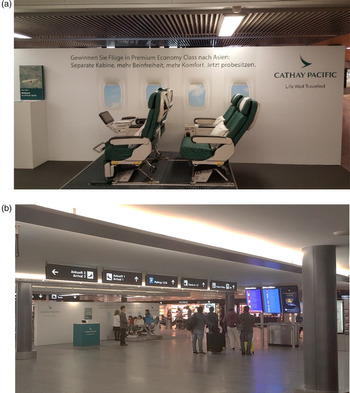
With instruction in mind, I turn to the second of my domestic vignettes as further evidence of ‘premium power’ at work. Returning from a Premium Economy trip of my own, I came across a marketing stand at Zurich airport (see Figure 6) where Cathay Pacific was promoting its own new Premium Economy service on Zurich–Hong Kong flights. Trying not to be too obvious (or unethical), I stood for a while watching this family being hailed, literally and otherwise, and being gradually drawn in. The dad (I assumed) looked a little self-conscious and unconvinced, and wandered off. The mother and her daughters, however, allowed themselves to be schooled. Eventually, as I prepared to walk away and leave them in peace, mother and at least one daughter were buckled up for the ride. This guerilla-ethnographic snippet is a story about the art of seduction. It is, as Bourdieu (Reference Bourdieu and Nice1984) observed, how privilege is transferred from generation to generation, from class to class, and how social order is maintained. Not only must people be willing to be taught, they must also teach others. This is the stuff of habitus, but it is also the stuff of symbolic violence. As I have been arguing elsewhere (Thurlow Reference Thurlow2016), if we fail to address the desirous impulses of status, the euphoria of distinction, and the seemingly harmless (or ‘humble’) means by which they are inculcated, we seriously misrecognize the hegemonic intransigence of privilege/inequality. Instead, we merely continue to make ourselves (and others) susceptible, compliant, and obedient to it all. Which is not to say that symbolic violence is necessarily comprehensive or total in its exercise.
The ‘consent’ that was once given keeps getting diluted and can at any moment fall apart as a result of new affections … that generate new affects. (Lordon Reference Lordon and Ash2014:104)
Cathay Pacific marketing stand, Zurich airport, November 2016.

Lordon complicates his understanding of the humble joys by acknowledging what he later calls the ‘veil of joyful affects’ and the possibility of the veil's being pulled back to release disappointment and disillusion. There is, he says, a ‘backdrop of sad affects that always muddles its promise of joyful ones’ (2014:100–101). With direct reference to the affective economies of flying, I have myself written reflexively about the interplay of joy and disappointment, and the almost inevitable ways the lived experience of Premium Economy falls short of its hyped-up promotion (Thurlow Reference Thurlow2016:493–95; see also the epilogue below). As Lordon notes, in these moments of realisation (and perhaps self-recognition), the desires that have been inculcated start to dissipate and must be hurriedly, busily renewed or reconfigured. Airline marketers are in fact past masters at managing the joyful-sadness of passenger desire through their endless (re)inventions of aspiration. This may be accomplished through the fabrication of ‘tiers within tiers’ in their loyalty schemes (Thurlow & Jaworski Reference Thurlow and Jaworski2006, Reference Thurlow, Jaworski, Cavanaugh and Shankar2017c) or through the promise of additional features or new flourishes—however cosmetic and cheap they may actually be (see British Airways overhaul below in extract (2)). This is, of course, the original, fundamental rationale behind the fabrication of Premium Economy itself.
In keeping with Lordon's invocation of Spinoza on desire, Cameron & Kulick's (Reference Cameron and Kulick2003) treatise on language and sexuality offers some unexpectedly useful insights into the fabricatedness of status and the Sisyphean quest for distinction at the heart of premium. The expression of (erotic) desire, they argue, inevitably depends on conventionalized codes or established semiotic systems which are both quotable and iterable. In other words, people only recognize something as desirable because they have previously been told as much, or have come to associate it as such. This has important ramifications, as Cameron & Kulick note with particular reference to the female orgasm: ‘if something is repeatable, it also becomes available for misuse and forgery’ (Reference Cameron and Kulick2003:128). Indeed, telling the difference between a real and fake orgasm can be almost impossible because both are achieved through the same communicative resources. The trick, therefore, is to offer up a desirous performance that is both credible and convincing for as long as possible or is necessary.
These erotic principles resonate strongly in the status games of premium and, more generally, the semiotic machinations of privilege. Status-making is always precarious because, like Cameron & Kulick's orgasms, it hinges on the interplay between the need to believe a given performance is real (or sincere or authentic) and the suspicion that it might not be. For the sake of enjoyment there is also always a need to disavow one's knowledge that false/fake status can actually be materialized through the same semiotic resources as any ostensibly real status, or some form of tangible distinction. It is this which no doubt creates such anxiety about status (cf. De Botton Reference De Botton2004) which, in turn, helps explain the state of ‘relaxation in tension’ (Bourdieu Reference Bourdieu and Nice1984:131, Reference Bourdieu and Thompson1991:84) so characteristic of the bourgeois habitus. Cameron & Kulick's thinking, although still referring to sex, is again informative when they write that ‘stylized performances… provoke anxiety because they threaten to bring to conscious awareness the iterative structure of sexuality that needs to stay repressed in order for it to “pass” as sexuality, which is supposed to be “natural”, authentic and spontaneous’ (Reference Cameron and Kulick2003:130). Perhaps it is less surprising that the frisson of status—an arguably all-too-human tendency (Anderson, Hildreth, & Howland Reference Anderson, Hildreth; and Howland2015)—is shot through with disappointment.
As I hope to have shown in the course of my two analytic moves above, much the same conundrum arises in the stylized performances of distinction and superiority associated with premium labelling and with the staging of Premium Economy. Inevitably, these language games provoke anxiety because they unavoidably point also to the constructed nature of it all. It is hard to keep pretending—not quite so easily or simply anyway—that one's status is about some innate or hard-earned capacity (cf. Khan Reference Khan2012), a self-evident or disinterested ranking, or any kind of genuine deference or respect. If a status like premium can be so easily fabricated, and the fabrication so obviously revealed, how is one ever to believe in its realness or, more to the point, its deservedness? Notwithstanding, it is the precarity of status—its anxious affects and the sadness of its humble joys—which also helps keep people fully aspirational, always looking for something better. Or, at least, something better than the rest.
Epilogue
We are, so they say, living in ‘interesting’ times. Many progressive certainties undoubtedly appear unsettled and complicated. The election of the 45th US-American president has surely muddled the long-standing social meanings of eliteness. Here was an undeniably elite—and indescribably entitled—man ploughing his way into the public sphere and into office under the guise of being nonelite and even anti-elite. This in itself is a stark reminder of the slipperiness (or shiftiness) of so-called empty signifiers as well as their susceptibility to cooption and strategic ‘filling’. Eliteness, like premium status, is confirmed as something patently relative, and elite, like premium, is exposed as little more than a language game, although one with dreadful consequence.
It is important, however, that we not allow ourselves to be too distracted by the shenanigans of presidents, CEOs, or other oligarchs of the so-called 1%. We must certainly call out their lies and self-serving obfuscations, but we must also recognize the wider ramifications of the same language games being played closer to home. We are all of us—anyone reading this article, at least—unavoidably caught up in the same language games; haplessly or not, but as beneficiaries of one degree or another (cf. Robbins Reference Robbins2017). To start, I acknowledge that I myself am certainly located in the global 10%; in fact, I am no longer surprised to learn that I am close to the global 1% even.Footnote 8 I am certainly coming to terms with the fact that I am someone who is the likely target of premium and someone who is readily enchanted by the comparative allure of Premium Economy.
Post-class ideologies emerge as a quintessentially neoliberal logic and rhetoric. Following Harvey's (Reference Harvey2005) well-known take on neoliberalism, this way of thinking about the economic, structural realities of class hinges on notions of individual freedom, self-determination, and ‘rising tide’ mythologies of upward mobility. This way of thinking is also usually quite disingenuous (e.g. rendering social status a matter of lifestyle choice) and often self-serving (i.e. a perspective easily held by already better-off people). It is certainly true that the core political economy of neoliberalism has been in a state of crisis (see Kotz Reference Kotz2018), most especially since 2007/2008, with many on the left heralding its demise (e.g. Mouffe Reference Mouffe2018) just as right-wing populist movements have been vocal in calling for its deconstruction. In a time of state-mandated austerity measures, the exposure of corporate fraud and deepening economic inequalities, it certainly seems that the ‘promise’ of neoliberalism has been exposed as false.Footnote 9 However, other commentators are less optimistic, less certain that neoliberalism has indeed run its course—not even as a political economy, and certainly not as a cultural formation (see Crouch Reference Crouch2011; Mirowski Reference Mirowski2014). While the legitimacy of neoliberalism is certainly under question, its power appears less obviously or straightforwardly diminished. In these terms, austerity is neoliberalism through the backdoor; the rhetorics of competitiveness and enterprise continue unabated, and the sway of the market over politics and over social life is far from dissipated. For someone like Davies (Reference Davies2017:26), the neoliberal status quo may have become unsettled but it has not been really shaken, not least because ‘economic techniques themselves become imbued with a quasi-sovereign form of authority—that is, they become ritualised and rhetorically powerful’.
It is in this context of tension and instability—both apparent and real—that the logics and rhetorics of post-class ideology endure. To be clear, this is not to apologise for neoliberalism nor is it to completely discount voices of optimism and discontent; it is certainly not to deny the possibility, likelihood even, of neoliberal capitalism's demise (see Kotz Reference Kotz2018). My arguably more cynical position in this article and elsewhere in my work on elite discourse is taken partly for empirical-critical reasons: while the political economy may indeed be burning (slowly), marketers and other people of commerce appear to be fiddling more busily than ever. This is quite apparent in the case of Premium Economy which has been the focus of my second, more in-depth analysis.
(2) BA press release, June 2019
British Airways is rolling out the next phase of its investment in its premium economy … New amenity kits using material from recycled plastic bottles will be introduced … More comfort will be delivered through a stylish new quilt and cushion with the herringbone design that is synonymous with the pattern that runs throughout the airline's First cabin.
The continued, often substantial economic investments in Premium Economy are striking. British Airways has, for example, only recently overhauled its service as part of a $8 billion ‘investment scheme’.Footnote 10 Tellingly, as seen in extract (2) the enactment is as much symbolic as it is material (cf. Thurlow & Jaworski Reference Thurlow and Jaworski2006)—a tactical matter of sustainably sourced ‘amenity kits’ and blankets with a ‘herringbone design’ as a scaled-down version of the real thing (Featherstone Reference Featherstone, Birtchnell and Caletrío2014). It is, one notes, the blanket design here not the actual weave. These kinds of explicit, upward comparisons reveal nicely the ‘halo effect’ deployed in so much airline marketing (Cheverton Reference Cheverton2004:115):Footnote 11 Economy-class (and presumably Premium Economy-class) services are perceived by customers to be fancier simply by association with the more extravagantly out-fitted and aggressively promoted First- or Business-class services. Across the international airline industry, significant investments continue to be made in shoring up the profitability of so-called premium passengers and expanding the reach of premium.
Perhaps it is in the face of structural crisis and the concomitant need to regroup that the rhetorics of neoliberalism—its linguistic and communicative expression—become more necessary, more valuable than ever? What is almost as striking as the raw economics of these marketing strategies is that they are so enthusiastically taken up and circulated by the news media (cf. Jaworski & Thurlow Reference Jaworski and Thurlow2017).Footnote 12 The intensified production of Premium Economy is happening in spite of the growing suspicions of some passengers: ‘You are simply getting a higher quality economy product, often for a substantially higher price’.Footnote 13 In keeping with Lordon's later observations, there may indeed be moments of resistance where passengers’ feelings of indignation and discontent bubble to the surface. In the case of Premium Economy, however, these ‘seditious passions’ (Lordon Reference Lordon and Ash2014:135) seem to be too isolated, too repressed, or too easily subdued to resist ‘premium power’.
In some ways, it is as if so-called austerity never happened—certainly not for some or even many people—except that tightened corporate purse-strings is what has partly put pressure on Business Class services and driven the turn to even more profit-generating Premium Economy services. In an equally obfuscatory move, international airlines have been increasingly turning away from First Class services. While this may at first sight appear to be a cutback, the reality is that plutocratic passengers are opting for private jets instead (Economist 2019) and airlines' resources are merely being diverted to even more lavish Business Class services such as the trend for fully enclosed ‘suites’.Footnote 14 Once again, and as I have argued before (Thurlow Reference Thurlow2016), the airplane presents itself as an epitomic, synechdocal site for the study of contemporary class formations and, it seems, the machinations of neoliberal capitalism. Super-elite passengers have not gone, they have merely gone underground. As the slightly time-worn French saying goes, plus ça change, plus c'est la même chose.