Introduction
Studies on the reproduction of Forficula auricularia Linnaeus (Dermaptera: Forficulidae) have shown similarities closely linked with climatological conditions between adventive North American and native European populations. In Canada, females from the Montréal (Québec, Canada) area are exposed to a cold temperate climate and produce only one brood per year (Tourneur and Gingras Reference Tourneur and Gingras1992), while those from the Vancouver (British Columbia, Canada) area are submitted to a mild temperate climate and produce two (Lamb and Wellington Reference Lamb and Wellington1975) or exceptionally three broods (Beall Reference Beall1932) per year. The egg-laying regimes observed in the Montréal and Vancouver populations are also present among European populations submitted to similar climatic conditions (Vancassel Reference Vancassel1984). Females exposed to a Mediterranean climate normally produce three broods per year but will sometimes produce four or more broods in the laboratory (Lenfant and Sauphanour Reference Lenfant and Sauphanour1992).
In this species, only the basal follicle of the ovariole enters vitellogenesis during a reproductive cycle. Observations made in laboratory have confirmed that the germarium is no longer active at imaginal moult (Tourneur Reference Tourneur1999a). The fixed number of oocytes sets the maximum number of broods that can be produced (Vancassel Reference Vancassel1984). In the case of the Montréal population, this limit is 6.1±1.1 (Tourneur Reference Tourneur1999b).
During each reproductive cycle, previtellogenic follicular atresia due to trophocyte nuclear fusion (two fusions during a reproductive cycle) use up three oocytes for each egg produced. This decreases the number of broods than can be produced by each female (Tourneur Reference Tourneur1999b). Therefore, at most two broods can be produced in the Montréal area. Assuming this phenomenon is also present among populations producing two or more broods, females from Vancouver area would be expected to have six, exceptionally nine oocytes per ovariole at imaginal moult, and those from southern France, nine to 12 or even 15 per ovariole.
Given these considerations, this study sought to establish whether developmental constraints that evolved in ancestral populations explained the variation in reproductive traits expressed in populations across different climatic zones. More specifically, it pursued the following objectives:
a) establish the number of oocytes per ovariole at imaginal moult and the theoretical maximum number of broods that can be produced by each of the studied populations;
b) determine if previtellogenic follicular atresia occurs in populations from mild temperate and Mediterranean climates (Vancouver and San Francisco, respectively);
c) establish the number of broods produced by each of the studied populations under laboratory conditions;
d) determine under laboratory conditions the chronology of the successive oogenesis cycles, the female life expectancy, and the duration of ovarian activity;
e) explain how F. auricularia egg-laying regimes vary across cold-temperate, mild-temperate, and warm-temperate climates.
Material and methods
Earwig collecting and conditions of captivity
Earwigs were collected in three geographical areas. San Francisco (California, United States of America), campground neighbouring this city (37.621, −122.379, 5 m), early June 1991; as this area is submitted to a Mediterranean-type climate, the probability of an egg-laying regime of more than two broods was considered high. Vancouver (British Columbia, Canada), University of British Columbia campus (49.197, −123.182, 2 m), mid-July 1991. Montréal (Québec, Canada), Deux-Montagnes, 20 km northeast of Montréal (45.542, −73.932, 27 m), early August 1991. Earwigs collected in California and British Columbia were maintained under ambient conditions during travel and, as those from Montréal, kept in Mason jars (Mason Jars Company, Erie, Pennsylvania, United States of America) in groups of 20–30 individuals and fed ad libitum carrots and bee-collected pollen. At the onset of the laboratory study (9 October 1991), mating pairs of field collected individuals of unknown age were isolated in 10 cm Petri dishes containing a thin layer of moist sand.
Variation of the number of oocytes
For the first experiment, 150 Montréal, 125 Vancouver, and 125 San Francisco pairs were formed and fed until first oviposition. All pairs were kept at 6±1 °C in incubator for two weeks, and then placed in a dark incubator at 10±1 °C for the remaining duration of the experiment. The pairs were observed once a week with the dates of egg laying, hatching, and death were recorded. The food was replaced and the substrate moisture was restored once a week. The food source and the male were removed upon production of a first egg clutch. After hatching, the larvae were removed to induce a new vitellogenesis cycle, and the females were refed. The few females that died before producing a first egg clutch were eliminated from the samples.
To determine the number of oocytes in the ovarioles, the ovaries of five females from each population were removed weekly in August and September and bi-monthly from then on until the termination of the experiment. The ovaries were fixed in Bouin’s fluid, stained with Feulgen and Rossenbeck’s nuclear reagent (Hould Reference Hould1984) and mounted for further examination. In total, 139 Montréal, 107 Vancouver, and 108 San Francisco ovaries were thus treated. As this method used to color in toto the ovaries is considered the best method to reveal the presence of DNA, it was possible to correlate the quality (intensity) of the coloration with an appreciation of the level of DNA and, consequently, with the ovary activity. Hence, this procedure provided a roundabout useful indication of the physiological state (activity) of the ovary.
Reproductive cycle length, egg-laying latencies, egg-care periods, and female life expectancy
For the second experiment, all pairs of unknown aged adults (64 Montréal, 53 Vancouver, and 140 San Francisco) were fed at the onset of the experiment. Every observations and procedures made in experiment 1 were carried out, except ovary removal. The purpose of this experiment was to determine the female life expectancy, egg-laying latencies, and egg-care periods (eggs were not removed after each egg-laying event) occurring during the different reproductive cycles. The egg-laying latency was defined as the number of days between the onset of the experiment and the production of the first egg clutch and between the consecutive ones. Female life expectancy was defined as the number of days between the onset of the experiment and death.
Statistical analyses
Among and between each population, follicular atresia (number of lost oocytes per ovariole at each step of the oogenesis), number of oocytes per ovariole at imaginal moult, egg-laying latency, female life expectancy, and length of the reproductive cycles were compared using Kruskal–Wallis and parametric one-way analysis-of-variance tests for multiple and two-by-two comparisons. All statistical tests were performed with Statistix 10 Analytical Software (Tallahassee, Florida, United States of America).
Identification and voucher specimens
The identification of the specimens was done using the taxonomic keys of Borror and DeLong (Reference Borror and DeLong1964), and Albouy and Caussanel (Reference Albouy and Caussanel1990). Subsequently, the identification of the specimens from Montréal and Vancouver was confirmed by molecular analysis and crossings between strains (Wirth et al. Reference Wirth, Le Guellec, Vancassel and Veuille1998; Tourneur Reference Tourneur2017). Unfortunately, voucher specimens for this study were discarded. However, slide preparations of the ovaries will be deposited in the Canadian National Collection of Insects, Arachnids, and Nematodes (Ottawa, Ontario, Canada).
Results
Frequency distribution of oocytes per ovariole
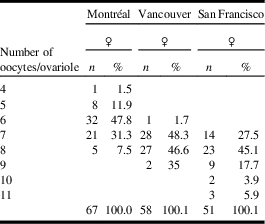
Females from the Montréal, Vancouver, and San Francisco populations had an average of 6.4±0.8, 7.5±0.6, and 8.2±1.1 oocytes per ovariole, respectively. Among the females from Montréal, 13.4% had four to five oocytes per ovariole, and 86.6% had six to eight oocytes per ovariole (Table 1). All Vancouver females had at least six oocytes per ovariole, and 3.5% of them had nine oocytes per ovariole. All the females from San Francisco had at least six oocytes per ovariole, and 27.5% of them had nine to 11 oocytes per ovariole.
Frequency distribution of number of oocytes per ovariole at imaginal moult.

Note: Mean (oocytes/female) (X): Montréal: 6.4±0.8, Vancouver: 7.5±0.6, San Francisco: 8.2±1.1.
At imaginal moult, Montréal females had significantly less oocytes per ovariole (X=5.8±0.4) than those from the two other studied populations (F=33.2; P⩽0.001). Similarly, Vancouver females had fewer oocytes per ovariole than those from San Francisco (F=8.2; P⩽0.05).
Previtellogenic follicular atresia
The mean number of oocytes per ovariole between September 1991 and the production of a first egg clutch decreased from a mean of 3.3±0.8 to 2.2±0.6 among the Montréal females (number of dissected females: n f =22 and n f =18/number of ovarioles examined: n o =703 and n o =533), from 5.0±1.4 to 3.2±0.6 among the Vancouver females (n f =23 and n f =29/n o =417 and n o =700), and from 4.5±1.0 to 3.2±1.0 among the San Francisco females (n f =23 and n f =30/n o =741 and n o =567). These numbers amount to a mean loss of 1.1, 1.8, and 1.3 oocyte per ovariole, respectively.
The mean number of oocytes per ovariole following the production of a second egg clutch was 1.0±0.3 among the Vancouver females (n f =22/n o =458) and 1.2±0.5 among the San Francisco females (n f =30/n o =458). These numbers translate into a mean loss of 2.2 and 2.0 oocytes per ovariole, respectively.
Finally, among the San Francisco females (n f =4/n o =76), the mean number of oocytes per ovariole dropped to 0.1±0.3 after the production of a third egg clutch. This represents an additional loss of 1.1 oocyte per ovariole.
The losses of oocytes per ovariole following the production of a first egg clutch were significant among females from Montréal (F=25.8; P⩽0.001), Vancouver (F=52.8; P⩽0.001), and San Francisco (F=19.5; P⩽0.001). Losses were also significant after the production of a second egg clutch among Vancouver (F=12.5; P⩽0.001) and San Francisco (F=7.5; P<0.05) females. The loss of oocytes per ovariole following the production of a third egg clutch by San Francisco females was also significant (F=12.8; P<0.05). Furthermore, the monthly mean reduction in the number of oocytes did not differ between the three studied populations (t=0.31; P>0.05), indicating a similar reduction rate for each.
Physiological state of the ovaries
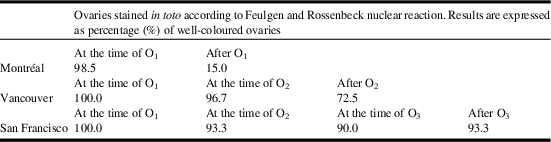
Up to the choriogenesis associated with the first oviposition (Table 2), 98.5–100% of the ovaries obtained from the three studied populations were markedly stained, with the trophocyte nuclei dark red, a sign of an important level of DNA and intense ovarian physiological activity. However, a few weeks later only 15% of the ovaries sampled for the Montréal females were feebly stained, and by January, none were stained or thought to be, which denoted a lack of DNA and of ovarian activity. In contrast, coloration of the ovaries sampled from the Vancouver and San Francisco females remained good until the end of the experiment, with 72.5% and 93.3% of the ovaries correctly stained, respectively; these consistent high rates suggested the presence of a significant level of DNA and of ovarian activity in the vast majority of females.
Physiological state of the ovaries.

Note: O1, O2, and O3=Oviposition 1, 2, and 3=first, second, and third reproductive cycles.
Reproductive cycles and related characteristics
The mean egg-laying latency (Table 3) for the first reproductive cycle was 56.2±4.2 days (n=23), 84.8±11.6 days (n=63), and 93.2±19.2 days (n=72) days among the Montréal, Vancouver, and San Francisco females, respectively. For the second reproductive cycle, the mean egg-laying latency was 111.9±21.6 days (n=21) and 99.1±23.5 days (n=42) among the Vancouver and San Francisco females, respectively. For the third reproductive cycle, the mean egg-laying latency was 101.8±10.2 days (n=5) among the San Francisco females.
Oogenesis of Forficula auricularia; egg-laying latency and egg incubation periods (X±standard error).

Note: Chronology of the different reproductive cycles.
The mean egg-laying latency for the first reproductive cycle varied among the studied populations (t=58.3; P⩽0.001), being shorter among the Montréal females than among the Vancouver (t=46.1; P⩽0.001) and San Francisco females (t=47.0; P⩽0.001). However, no difference was observed between the Vancouver and San Francisco females, whether for the first reproductive cycle (t=6.2; P>0.05) or the second (t=7.4; P>0.05). Similarly, no difference was observed between San Francisco females second and third reproductive cycles (t=0.03; P>0.05).
Female life expectancy
Female life expectancy after the onset of the experiment was 137. 7±62.1 days among the Montréal population (n=50), 300.3±83.3 days among the Vancouver population (n=48) and 281.6±101.3 days among the San Francisco population (n=122). Life expectancy differed significantly between the three populations (t=79.8; P⩽0.001), being significantly shorter among Montréal females than among Vancouver females (t=54.4; P⩽0.001) and San Francisco females (t=54.2; P⩽0.001). However, no significant difference in life expectancy was observed between Vancouver and San Francisco females (t=2.0; P>0.05).
Duration of the reproductive cycles
Montréal female first and unique reproductive cycle (egg hatching) was completed 54.8±4.1 days after the first oviposition and extended over a total of 111.0±8.3 days following the onset of the experiment (Table 3). The two reproductive cycles of the Vancouver females and the first two reproductive cycles of the San Francisco females were completed 194.5±37.1 days and 181.0±43.2 days after the first oviposition and extended over a total of 279.3±48.7 days and 274.2±63.1 days following the onset of the experiment, respectively. The third San Francisco female reproductive cycle was completed 320.1±61.3 days after the first oviposition and extended over total of 413.3±68.6 days following the onset of the experiment.
Monthly mean temperatures for Montréal, Vancouver, and San Francisco
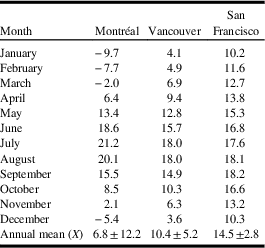
An examination of the monthly mean temperatures for the Montréal area (Table 4) reveals not only a long frost period (mean temperature of −6.2 °C from December to March) typical of a cold temperate climate but also a high annual thermal amplitude of 30.9 °C (−9.7 °C in January to 21.2 °C in July) due to the continental position of the region. On the opposite, climatic conditions of the San Francisco area are characteristic of a Mediterranean climate, with a small annual thermal amplitude of 8.0 °C (10.2 °C in January to 18.2 °C in September) and monthly temperatures never plunging below 10.0 °C. Vancouver area mean thermal values are intermediary, the region being free of any frost period and showing a medium thermal amplitude of 12.1 °C (3.6 °C in December to 17.5 °C in June) typical of a mild oceanic temperate climate.
Monthly mean temperatures in °C (1981–2010).

Discussion
Previtellogenic follicular atresia occurs in both the Vancouver and San Francisco populations, as previously observed in the Montréal population (Tourneur Reference Tourneur1999b). This observation also suggests that previtellogenic follicular atresia occurs at the same rate of two nuclear fusions per reproductive cycle, hence the need of a minimum of three oocytes per egg produced. However, previtellogenic follicular atresia does not play a significant role in the egg-laying patterns of the females. Except for 13.4% of the Montréal females which had four to five ovarioles per ovary and were therefore restricted by atresia to a single brood, previtellogenic follicular atresia did not impede all Vancouver and San Francisco females with more than six oocytes per ovariole at the imaginal moult to produce two broods, and even a third one by the latter. Yet, follicular atresia does not explain why 86.6% of the Montréal females with six to eight oocytes per ovariole produced only one brood. Similarly, only 58.2% of the Vancouver females produced only one brood even if 100% of them had at least six oocytes per ovariole, and none of 3.5% of the Vancouver females with nine oocytes per ovariole produced three broods although they theoretically could (Beall Reference Beall1932). Likewise, among the San Francisco females, 100% had seven oocytes and more per ovariole, but 37.3% produced only one brood; moreover, even if 27.5% of the San Francisco females had nine to 11 oocytes per ovariole and could theoretically produce three broods, as observed by Lenfant and Sauphanour (Reference Lenfant and Sauphanour1992), only 9.8% of them did so.
The disparity between the number of egg batches a female can theoretically produce (in spite of follicular atresia) and does indeed produce may be partly the result of a poor-quality diet, as observed by Bourez (Reference Bourez1984) and Tourneur and Gingras (Reference Tourneur and Gingras1992). It may also be due to the animal protein-free diet to which earwigs were submitted to, as observed by Berleur et al. (Reference Berleur, Gingras and Tourneur2001), before and after they were collected. Indeed, diet quality in the wild varied according to the habitat earwigs were collected from, and during the experiments, earwigs were kept exclusively on a vegetarian diet. Finally, the possibility that this disparity might have been driven in part by additional laboratory conditions not matching natural conditions in the wild (e.g., female fasting, egg care, and ideal temperature conditions for ovarian maturation) was also considered but quickly dismissed, as all three studied populations were exposed to similar conditions in the laboratory.
Reproductive cycles and related characteristics
The reproductive cycles and related characteristics (egg-laying latency, female life expectancy, and physiological state of the ovaries) seemed closely linked with the successful production of one, two, or three broods by the females. During the hypogeal phase of each reproductive cycle, females fast and provide maternal care consisting mainly of egg grooming, regulation of egg temperature, and moving of the eggs for protection against killing frosts. Females do not assist with the hatching of eggs. Maternal care ends with nymph dispersal from the nest (Lamb and Wellington Reference Lamb and Wellington1974; Lamb Reference Lamb1976; Boos et al. Reference Boos, Meunier, Pichon and Kölliker2014).
Egg-laying latency does not explain the absence or presence of multiple egg-laying regimes. Differences were observed between the three studied populations only during the first reproductive cycle, egg-laying latency being significantly shorter among the Montréal females than among the Vancouver and San Francisco females (56 days versus 85 and 93 days, respectively). No difference in egg-laying latency was observed during the subsequent reproductive cycles between the Vancouver and San Francisco populations (100 and 116 days, respectively).
Hatching of the first brood produced by the Montréal females during their first reproductive cycle (RC1) occurred 111 days (Table 3) after the beginning of the experiment (RC1 egg-laying latency+RC1 egg incubation), and the mean longevity of the females did not exceed 138 days. None of the females succeeded in completing a new vitellogenesis during these 27 additional days of life. Moreover, ovarian activity decreased rapidly thereafter (lack of DNA) and was probably totally inhibited by January.
The total time elapsed between the beginning of the experiment and the hatching of the second brood produced by the Vancouver females was 279 days (RC1 and RC2 egg-laying latencies+RC1 and RC2 egg incubations), and the mean longevity of the females was 300 days. Strangely, although these additional 21days of life did not allow completion of a third vitellogenesis, the intensity of the ovarian activity did not show any slowdown (follicle nuclei were always dark red), and some females with an extremely long longevity would have been able to produce a third egg batch, as previously observed by Beall (Reference Beall1932) in British Columbia.
Although the San Francisco females needed an average of 413 days to produce three successive broods (RC1, RC2, and RC3 egg-laying latencies+RC1, and RC2 and theoretically RC3 egg incubations), their mean longevity did not exceed 282 days. However, 9% of the females with a mean longevity superior to 426 days did succeed in producing a third brood and caring for it. As noted in the Vancouver population, the intensity of the ovarian activity did not slowdown, and females with an exceptionally long longevity could have produced an additional brood, as Lenfant and Sauphanour (Reference Lenfant and Sauphanour1992) had previously observed among females with an exceptional long longevity.
In comparison with those prevailing in the Vancouver and San Francisco areas, weather conditions in the Montréal area (Table 4) are particularly restricting and harsh, with a deeper demarcation of temperature between seasons that is of importance. For the females, the challenge to produce a viable progeny takes the form of a real time-trial opposing the needed time to produce a successful brood and life expectancy. The mid-October first nocturnal frosts compel the females to burrow themselves in the ground and force them to fast for about a month before the first oviposition (end of November, Table 4). At a few degrees above the freezing point, the egg incubation (and egg-care period) lasts between 23 and 26 weeks (Gingras and Tourneur Reference Gingras and Tourneur2001), hence submitting the females to a minimal fasting period of six months. Throughout this period females must avoid the deadly frost by moving their eggs not only along a horizontal thermal gradient, as observed by Bourgouin (Reference Bourgouin1995), but also, likely, along a vertical one, while maintaining them free of any biocide fungi. Furthermore, to reproduce successfully, they must keep their developing eggs at sufficiently low temperatures to delay hatching until the frost barrier is lifted (Gingras and Tourneur Reference Gingras and Tourneur2001). As the rapid first oogenesis reduced their fasting period accordingly (of about a month) and the low temperatures extended their longevity by slowing down their metabolism and hence their ovarian activity, most females survived until first brood hatching or a little longer. The reduction of the ovarian activity that occurs a few days after the production of the first brood cannot be seen as a setback as it only impedes the production of a likely climatologically unsuccessful second egg batch (Tourneur Reference Tourneur2017).
Under the more favourable weather conditions that prevail in the Vancouver area, females can produce two viable broods. They rarely have to face light frost conditions that would compel them to burrow in the ground shortly before oviposition. Therefore, during each reproductive cycle, they are forced to fast only for a short egg-care period that rarely exceeds the 37–41 days incubation period observed in the laboratory at 10 °C and can readily feed between each reproductive cycle. The favourable climatic conditions coupled with the sustained ovarian activity and a mean life expectancy of around 300 days enable Vancouver females to successfully produce two broods.
The weather conditions are even more favourable year-round for the females living in the San Francisco area (except during dry periods) and permit the production of multiple viable broods. Females are forced to stay underground and to fast only for short periods of around a month and a half at a time to care for their eggs, but they can feed each time thereafter to start a new reproductive cycle. However, despite these favourable conditions and their extended ovarian activity, most females do not live long enough (their mean life expectancy being around 280 days) to produce three broods. As successful completion of a such an egg-laying regime requires more than 400 days, only a few females with an exceptional life longevity of 400–500 days are able to successfully complete three reproductive cycles.
Conclusion
Among the three North American populations of F. auricularia studied, the biological characteristics of the egg-laying pattern were found to be closely linked with climatic conditions. Among the studied factors, only the follicular atresia occurring after the imaginal moult was not restrictive (even though the unfunctional germarium does not permit the production of new oocytes). It did not prevent the females from producing the maximum number of broods they could theoretically have under the prevailing climatic conditions, i.e., a single brood under the cold temperate climate of Montréal, two broods under the mild temperate climate of Vancouver, and three broods under the Mediterranean climate of San Francisco.
However, factors affecting the physiological activity of the ovaries and the life expectancy of the females played a key role in the production of one, two, or three broods. With their short period of ovarian activity (fertility) and egg-laying latency, the females living in the Montréal area can only produce a single brood, the cold temperate climate of Montréal impeding the successful production of a second brood. Under such conditions, a short period of ovarian activity and egg-laying latency represent particularly useful characteristics. The briefness of the ovarian activity period allows the reallocation of all the energy reserves necessary for survival during the long egg-care period imposed by the winter climatic conditions, and early oviposition reduces by one month the female fasting period, hence increasing their survival rate until hatching of the eggs.
Females with a long period of fertility were able to produce multiple broods, i.e., two broods under mild temperate climate of Vancouver and three broods under the Mediterranean climate of San Francisco. For those females, a long and sustained period of oogenesis activity and a long-life expectancy, coupled with successive short fasting periods interspersed with feeding periods, represent adaptive characteristics to milder climates conditions conducive to the existence of multi-brood cohorts.
Acknowledgements
First and foremost, I would like to thank my wife Noelle Tourneur, who for years endured thousands of confined live earwigs in our motorhome and helped me relentlessly throughout my experiments and career. I am indebted to Dr. Gilles Boiteau, whose helpful comments improved earlier drafts, and I am particularly grateful to Pierre de Tonnancour whose English proficiency, comments, and suggestions greatly improved the quality of the last version of the manuscript. Many thanks are also extended to Claire Cole for her assistance with software applications in finishing touches to the manuscript, and to two anonymous reviewers for their comments and suggestions.