Introduction
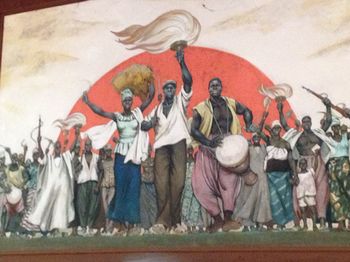
Upon entering the Palais du Peuple in Conakry, Guinea, visitors to the monumental political and cultural venue might notice a mural set back in the upper atrium. The mural (Figure 1) features images of Guinean citizens striding resolutely forward, arms triumphantly aloft, clutching torches, farming tools, machine guns. A trio of individuals leads in the foreground: a woman holding a bundle of crops over her head, a man tapping on a jembe hand drum slung to his side, and, in between, another man in a worker's cap raising high a blazing torch. With their simple, markedly local clothing, the group represents everyday working Guinean people – farmers, labourers, market traders, schoolchildren, musicians. Their faces are resolute and serious, suggesting a common cause or task. Behind these figures and providing a vivid backdrop to the scene rises the curve of an enormous red sun.
Mural at the Palais du Peuple, Conakry. The mural was painted by an anonymous group of Chinese artists.

While the Palais in Conakry is often buzzing with activity – concerts, exhibitions, legislative meetings – few people stop to remark on the mural today. Yet this painting serves as perhaps the most striking visual reminder of the long history of relations between Guinea and China and the influence of Mao's Great Proletarian Cultural Revolution on Guinean cultural politics. Built by the Chinese in 1967, the Palais and its Chinese-painted mural presaged Guinea's own Cultural Revolution launched the following year. The Socialist Cultural Revolution in Guinea defined a generation of Guinean policies, ideology and cultural production, giving a new language and new sense of urgency to the post-independence period. Today, the Revolution, as the entire post-independence regime is referred to locally, continues to reverberate in Guinean public life. While the Palais mural is one of very few material remnants of the Guinean Revolution, the moment lives on through conversations and political commentary, music and performance, and memories and stories that circulate among both old and young.
In this article, I explore this question of materiality, focusing not on the art or artifacts of the Guinean Cultural Revolution but rather on the embodied experiences of people who lived it. The Revolution was global in its outlook – pan-socialist, pan-Africanist, in dialogue with Mao's China, intertwined with Cold War geopolitics. Yet it was felt and enacted intimately, made both grandiose and routine through the bodies and everyday actions of Guinean citizens. As I discuss, this was done in part through torture and violence, but also through a wide range of practices of movement including public spectacle, gesture and performance. But while regimes can make their subjects move and act in various ways, how are those movements experienced by ordinary people, and how are they remembered over time? In the mural at the Palais, revolutionary ideologies seem to have created revolutionary bodies, as expressed through the stances, the clothes and the expressions of the figures depicted. This depiction reflects the regime's aims, in line with Maoist ideas, to transform individual selves in order to create a new society. What we see is a model of how to be revolutionary. While its vision is collective, unified and outward-looking, however, the embodied practices used to create revolutionary subjects in Guinea were experienced – and are remembered today – not as globally oriented or pan-socialist, but as culturally intimate and personal, deeply entangled with mixed feelings of pleasure and pain.
Moreover, for Guinean citizens, the Sino-Guinean friendship was yet another phase of embodied politics, in which movement, gesture and dance had long been mobilized as means of social and political transformation. As I show, the body was already a locus for ideas of liberation and modernization in twentieth-century discourse and representations. From the late colonial era, bodies were imagined as sites of international diplomacy and encounter, as reflected by earlier ideas around West African dance. By the late 1960s, Mao's China provided yet another model for creating new subjects through embodied practices, such as performance exchanges and revolutionary gestures. In the mural, China is implicitly figured as Guinea's guide, lighting the path forward from the violence of European colonialism. For both nations, diplomatic and cultural ties established through their shared revolutions were vital to forging global alliances and alternatives to the West, and to showcasing their own country's status on the international stage. They needed each other's cooperation. But despite the mobilization of dance and other cultural practices, this relationship was never really cemented beyond the level of policy and ideology. Chinese aesthetic practices did not take root in Guinea, nor did any greater affective solidarity between the two countries.
Whether or not each regime was genuinely invested in building artistic and cultural links between their two populations is an open question.Footnote 1 Yet, as we see here, efforts to make Guineans become revolutionary did have other consequences. What happens when control of bodies is attempted through dance and other aesthetic practices, or when it is entangled with feelings of collectivity and pride? How does the body register and remember the excess of meanings and feelings these forms generate? How can we account for both the painful and the pleasurable? In this article, I explore the role of physical movement, from political gestures to dance, to consider some of these contradictions in the Guinean revolution and Guinea–China relations. I begin by briefly providing the historical context of dance diplomacy and related ideas of the body in mid-twentieth century African nationalist ideology, and I introduce the Guinean dance troupe Les Ballets Africains. I then show how embodied experiences, such as performance exchanges and the circulation of dancers and official delegations, cultivated Guinea's relationship with China; and how practices of movement and dance were inwardly experienced within Guinea during its own Cultural Revolution. Within a longer history of dance diplomacy, cultural exchanges between Guinea and China were relatively unexceptional mobilizations of the body. But within Guinea, the overall use of embodied practices to create revolutionary bodies involved and is remembered today for its mixed legacies of both the painful and the pleasurable.
Embodied encounters
In her 1985 book The Body in Pain, Elaine Scarry describes how the human action of making entails two phases: making-up and making-real – in other words, imagining something and giving that imagined something a material form. As Scarry argues, in moments of ideological crisis or shift, the human body itself may serve as this means to ‘make real’, to substantiate the ideology in question. The body's ‘sheer material factualness’, as she writes, makes it a site in which ideology and power are seen, heard and felt (Scarry Reference Scarry1985: 14). Scarry's analysis helps us understand the ways in which movement and dance figured in Guinean and West African foreign relations from the late colonial era onwards.Footnote 2 The bodies of citizens were sites to realize ideas and aspirations about the place of postcolonial societies and selves in a global context. By the 1960s, movement, gesture and dance were incorporated into a set of revolutionary exigencies, in conversation with Mao's China. Yet decades before these Cultural Revolutions, West African bodies were already part of geopolitical relations. In this section, I briefly discuss the ways in which embodied practices – and dance in particular – served to articulate these ideas, before then turning to a discussion of this process through Guinea–China cultural exchanges.
The ‘African body’ has been much analysed and fetishized by Euro-American observers. From Saartjie Baartman in the early 1800s to Aamito Lagum in 2016 (Rosman Reference Rosman2016), African bodies have long been scrutinized through the lens of racism and violence. As the examples of both women illustrate, it is the body that is seen to symbolize and encompass an imagined, unbridgeable difference between Africa and the West. The ‘African body’ is taken by its very surface as incontrovertible proof of difference. Yet the body has also long been a site for cross-cultural encounter, from tourist-oriented performance to state-sponsored dance diplomacy. While essentialized notions of African bodies were fundamental to the colonial project, they also have their own particular history within francophone West Africa as an instrument in these projects. Statesmen, scholars and artists in the region at times mobilized the idea of difference to foster a sense of distinctive identities and culture that existed apart from and against colonialism and the colonial powers. At the same time, ideas of difference, both physical and cultural, served to encourage foreign observers and spectators to dabble in and consume West African art and performance, even while dehumanizing its performers. Representations of West African dance in the early twentieth century show how the body was already an ambiguous meeting point, setting the stage for the later institution of dance diplomacy.
African bodies in motion
In 1939, the poet and future president of Senegal, Léopold Senghor, famously (or rather, infamously) declared that ‘emotion is Black, while reason is European’.Footnote 3 Senghor's statement sought to acknowledge an African essence that stood in contrast to that of Europe, all while still allowing that ‘[u]nderneath the differences [there are] more essential similarities’. In a study on visual art in post-independence Senegal, Elizabeth Harney notes the interplay between psychology and physiology in Senghor's thought – the fact of Blackness as a marker of physical distinction, but also as shaping what he understood as a particular sensuality, expression and emotive way of being (Reference Harney2004: 40). The Black body designated not just ‘outer appearance [but also] inner constitution’ (ibid.). As Harney observes, rhythm in particular was a key referent in his work, suggesting a particular, African mode of experience and expression (ibid.: 46). For Senghor, rhythm was the critical metaphor that captured African motion and emotion.
In a more material form, these acts and modes crystalized into dance, which, as Hélène Neveu Kringelbach argues, was for Senghor the ‘quintessential African art’ (Reference Neveu Kringelbach2013: 39). Senghor himself argued that ‘[f]or the Black African, dance is the most natural way of expressing an idea, an emotion’ (quoted in ibid.: 38). Dance was the form in which ‘Black African’ physiology and ways of being were most intimately brought together.Footnote 4 Against the backdrop of late colonialism, however, many intellectuals across the Black Atlantic castigated Senghor for these views. To critics such as Frantz Fanon and Sékou Touré, Senghor's essentialisms seemed to genuflect to colonial imaginaries of race and biological determinism, in which Black people were consigned to inferior positions vis-à-vis the West (Dave Reference Dave2009). Senghor's formulations were seen to accept and accommodate racist European categories, which sought to separate Black from white and engender racial hierarchies. In a recent analysis, Souleymane Bachir Diagne counters that Senghor never insisted on a ‘pure essentialism’ but rather a strategic one (Reference Diagne and Jeffers2007: 190).Footnote 5 On the other hand, writers such as Francesca Castaldi suggest that Senghor's emphasis on rhythm and dance, on African bodies in motion, served to reinforce perceptions of racial difference, based not just on culture but also on biology (Reference Castaldi2006: 54).Footnote 6
Such articulations of difference were also linked to questions of consumption. Senghor's concern was not just to instil a sense of cultural identity for African people, but to showcase that identity and artistry to the world. And while this showcasing aimed to redress racist representations of Africans as ahistorical and animalistic, it also succeeded in accommodating Western fascination with the African body. While African bodies have long represented objects of curiosity and fear for Euro-American audiences, these audiences have also long demanded that they be held on display.
An important precursor here is the wave of modernist, orientalist dance that swept 1920s Paris and fused traditional and folk representations from the East with modern European forms, including Diaghilev's Ballets Russes and Uday Shankar's representations of Indian dance. In the ‘negrophilia’ wave, for example, avant-garde artists and bohemian audiences flocked to consume Black culture and Black bodies on view. As James Clifford has noted, surrealism and ethnography were intertwined projects at the time, both concerned with provocations and encounters as a means to new understandings of the world (Reference Clifford1981).Footnote 7 In negrophilia, this search found a site of synthesis for inquiry, analysis and aesthetic experience. African art and dance were means to subvert the seeming reality of European life by presenting another way of being. Of course, for the viewing public, the exhilaration and illusion of escape was also made possible here.Footnote 8 While Picasso and other visual artists investigated African sculpture, the moment is perhaps best exemplified by Josephine Baker's roaring success on the Parisian stage in the Revue Nègre, in which she was seen to incarnate the stereotype of the Black body dancing with wild abandon and sensuality.
Senghor himself wished to counter the racist stereotype of African sensuality and amorality, and rather to emphasize local artistry and expression. As president of Senegal, he created the National Ballet to cultivate this sensibility, and to display it to others. From the beginning, the National Ballet was international in its aims, using the broader idioms of European performance to reframe local dance for foreign audiences. As Harney notes, difference was thus commodified (Reference Harney2004). Under the figure of Senghor, the politics of African dance on the European stage were ambiguous. Castaldi argues that inserting Black dance into white spaces was in itself an act of ‘defiant protest’ (Reference Castaldi2006: 51), while Harney suggests that it was more of an accommodation. These dual possibilities were further explored in neighbouring Guinea as late- and postcolonial national dance evolved across multiple fronts.
Les Ballets Africains de Guinée
In Guinea, dance and percussion troupes, more commonly known through appropriation of the term ‘ballet’, accompanied the new nation's entry onto the world stage (Cohen Reference Cohen2016: 651). The best known of these is Les Ballets Africains (later, Les Ballets Africains de la République de Guinée), a troupe formed by the Guinean choreographer, dancer, poet and playwright Fodéba Keita (Cohen Reference Cohen2012). As a young man and later a teacher in colonial French West Africa, Keita was active in organizing music and performance groups in his home region. By the 1930s, Keita had secured a place to study law in Paris. As Neveu Kringelbach notes, it was there that he met other African students and performers, including Léopold Senghor and Féral Benga, a dancer who had performed with Josephine Baker in the 1920s (Reference Neveu Kringelbach2013: 35). By the late 1940s, Keita had established a new group of his own, the Théâtre Africain de Keita Fodéba, which later became the Ballets Africains.Footnote 9
Soon after Guinea's independence in 1958, the Ballets Africains was nationalized and became a state troupe. Yet it has always maintained a unique status due to its earlier history, with performances continuing in the West under Guinea's revolutionary regime, unlike other national troupes that performed mainly in socialist countries (Dave Reference Dave2019).Footnote 10 Founded in Europe, from its outset the group looked well beyond the borders of West Africa, and through the 1950s it toured in Europe, North and South America, and parts of the Middle East. Keita, like Senghor, wished to use performance as a means to promote African cultural identity, not just locally but globally. Building on growing foreign interest in African dance, the Ballets Africains succeeded in capturing the imagination of many Euro-American audiences who enthusiastically received their performances (Cohen Reference Cohen2012).
Keita's choreography involved compiling and adapting elements of dance traditions from Guinea and the broader region, and re-presenting them within the idioms of European stage performance. Movements, rhythms, masks and songs were amalgamated and often woven into larger narratives and themes, while the dancers and musicians themselves represented not just various corners of West Africa but of the Black Atlantic more broadly.Footnote 11 The Ballets Africains’ performances were – and still are – known for ecstatic drumming and dancing, usually starting with slower, more melodic pieces and working up to a spectacular percussive crescendo, with drummers sometimes leaping onto their instruments or balancing on calabash gourds as they play.
The dances themselves are markedly effusive, not just in their energy and fast pace, but also in the use of the body itself. The repertoire includes an enormous variety of dances, including local acrobatics traditions from the highlands region of Guinea, which involve leaps and tumbling deriving from nyamakala performers of the Fulbe ethnic group, as well as numerous masked dances from the upper coast and south-western forest region, notably the Guerze niamou (gnamou) mask and the Baga nimba mask.Footnote 12 A closer look below at one of the most popular dances in nationalist and post-nationalist choreography – dundunba, from the Maninka ethnic group – reveals some of the ways in which the body figures in Guinean ballet performance.
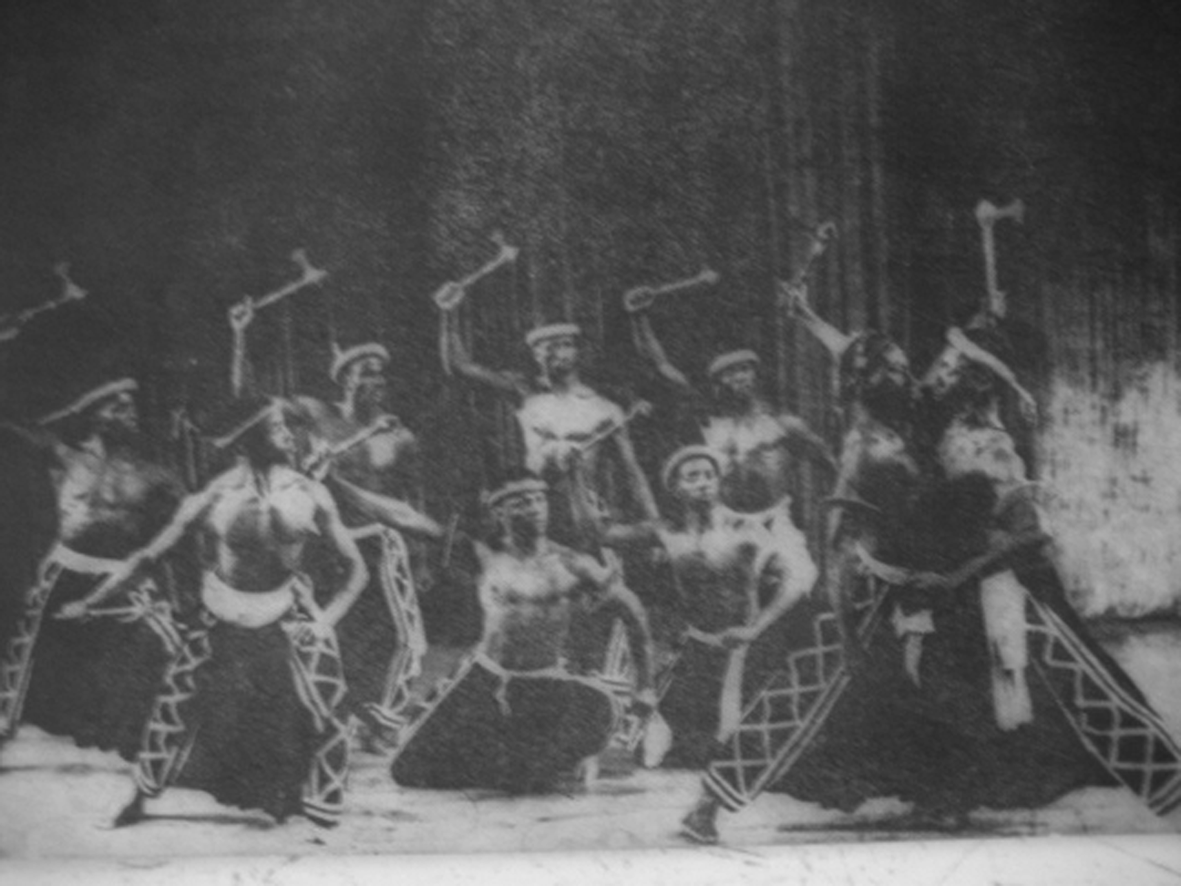
Dundunba is a dance from Kourroussa in north-west Guinea, corresponding to a rhythm of the same name played on an ensemble of hand drums. It is commonly known as the dance of strong men and is rooted in competitions among men's age associations. Older accounts of the dance note that it was accompanied by whipping, with older men whipping younger men as they seek to join the older group (Charry Reference Charry2000: 220). In addition to whipping each other, men would also bump their chests to assert themselves in the competition, as illustrated in Figure 2. While dundunba originated as a Maninka male dance, today it is performed by both men and women and by dancers from different ethnicities (Cohen Reference Cohen2016). In performance, the dancer walks in a circle in wide, exaggerated steps. In the dance's most energetic section, the dancer slightly bends at the waist while stamping on the ground, often with alternating steps. The arms are held parallel to the ground at ninety-degree angles, with the elbows pushing up and down in a pumping motion. The dancer may also pirouette on one heel with the other leg extended out. The variations of these core steps are infinite, and, as Adrienne Cohen notes, dancers today are prized for their virtuosic and innovative improvisations (Reference Cohen2016: 656).
The national dance troupe Ballet Djoliba performing dundunba at the 1969 Pan-African Cultural Festival in Algiers. Source: Photograph reprinted courtesy of the National Archives of Guinea.

In this and other dances, aesthetic value is closely related to ideas about projection and distribution – qualities that Cohen describes in relation to ‘excess’ and Soso notions of ‘bigness’ (Reference Cohen2019). As she writes, ‘dancers are instructed by their teachers to increase the volume of their movements – to “make their moves big”’ (ibid.). As Hamidou Bangoura, the director of the Ballets Africains, notes, movements involved here are also about projecting the body outwards,Footnote 13 which is of course mirrored and expanded further by the accompanying, explosive drumming. Projection is a central aesthetic in much Guinean performance, with voices, instruments and bodies valued for expanding out into the surrounding space (Dave Reference Dave2019).
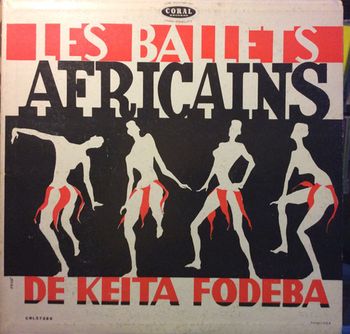
In addition to these expansive movements, the Ballets Africains also made direct appeals to European imaginaries of African exuberance, abandon and pleasure. For example, the group consciously cultivated evocations of sensuality through accompanying imagery and text. One Ballets Africains album cover from the late 1950s (Figure 3), for example, features a stylized print with the silhouettes of female dancers, posed and dressed remarkably similarly to Josephine Baker in Paul Colin's famous prints from Le Tumulte Noir.
Album cover for Les Ballets Africains de Keita Fodéba, released by Coral Records (CRL 757280), a subsidiary of Decca Records (year unknown).

This packaged and choreographed ebullience, however, sat in a complicated relationship with the brutal regime of discipline, containment and control that engineered it. The post-independence regime in Guinea nationalized the Ballets Africains and saw the troupe's work as an important means to promote the new state and export its ideology – in Scarry's terms, to make real its power on an international stage. In doing so, it actively supported the consumption of ideas of African effusiveness and pleasure overseas, including in Europe and North America. Yet dance was also reframed as a militant art form that served to promote ideological rigour to revolutionary socialism. Starting in the 1960s, dance was central to cultural exchanges with socialist allies such as China, involving performers and cultural bureaucrats touring each other's countries. At the same time, it existed within the parameters of an ever-increasing project of control over the bodies of Guinean citizens at home.
Disciplining bodies
In the decade following independence in 1958, Guinea embarked on a revolutionary socialist regime, which sought to instil a new ethos of work, collectivity and nationalism, and, inevitably, to attempt the total consolidation of the ruling elite's power. In August 1968, the country officially declared a Guinean Cultural Revolution that was heavily, though not solely, influenced by Maoist ideology and practice. These ties between Guinea and China shaped not just political and trade relations, but also cultural policies and ideologies of revolutionary art and performance in the new nation.
As scholars have documented, China actively used dance and performance as tools of soft diplomacy in the twentieth century. Emily Wilcox has written about the role of Chinese dance diplomacy in East Asian relations in the 1950s and 1960s, when ‘ideals about respect and cooperation played out through the movements of human bodies’ (Reference Wilcox2017). Anna Stirr has detailed the circulation of Maoist performance in Nepal since the 1960s (Reference Stirr2013), while Tasaw Lu has noted the more recent recirculation of Maoist revolutionary music and performance among Burmese Chinese groups since the 1990s (Reference Lu2016). In Guinea, Chinese dance troupes frequently performed in the 1960s and 1970s, but particular dance movements did not become absorbed within local revolutionary choreography as they did in other Cultural Revolution contexts. Nonetheless, the Guinean regime channelled Chinese ideas about self-cultivation and transformation through the body and its movements.Footnote 14
The Sino-Guinean friendship
Guinea became the first country in sub-Saharan Africa to establish diplomatic relations with the People's Republic of China, in October 1959. As the country's first president Sékou Touré sought to position Guinea on the world stage, Cold War politics created a shifting ground of alliances in which Eastern and Western power blocs assiduously courted the emerging postcolonial states. Independence meant a temporary rupture of ties between Guinea and France, but Touré maintained good relations with both the Soviet Union and the United States in the first years following independence.Footnote 15 Ties with the USSR subsequently diminished, however, as Touré moved closer to Mao's China.Footnote 16 One reason for this shift was Chinese emphasis on anti-imperialism and freedom from Western influence, rather than on the domestic adoption of communist policies, as the Soviets wished (Friedman Reference Friedman2015: 83). Touré, in fact, never fully embraced communism as an ideology, and his ruling party was never a communist political party. Rather, his ideology was crafted from various influences, ranging from Marxist-Leninism to African nationalism. Yet it was Mao who provided much of the rhetorical and symbolic vocabulary that shaped Touré's rule over the next two decades.
In China and Africa, David H. Shinn and Joshua Eisenman note that the two geographical entities have been in contact through trade since at least the Tang dynasty (618–917). The relationship has particularly intensified since the establishment of the PRC, however, and more specifically after the 1955 Asian-African Conference in Bandung, Indonesia (Shinn and Eisenman Reference Shinn and Eisenman2012: 17, 34). It was at this point that China became invested in exporting its ideology and political-economic model to the African continent. Yet much of this support was rhetorical rather than material.
Interestingly, China was not primarily concerned with fomenting socialist revolution in the newly independent African states, seeing Africa as not yet ready for this stage in history (Friedman Reference Friedman2015: 84). Rather, China's main concern was with extending its influence and establishing itself as a revolutionary model. Shinn and Eisenman also note that China was hampered by the failure of Mao's Great Leap Forward in the early 1960s, and by the Great Proletarian Cultural Revolution (GPCR) later in the decade. Both campaigns created manifold domestic distractions for the country, which reduced its capacity to invest abroad. For instance, China withdrew many of its foreign ambassadors following the 1966 launch of the GPCR because of heightened vigilance and concern with ideological adherence at home.Footnote 17 The GPCR thus served to isolate China from much of the world and to temporarily curtail its plans for ideological expansion (Shinn and Eisenman Reference Shinn and Eisenman2012: 39).
Yet China's ties with a handful of African countries, including Guinea, remained relatively stable and close throughout this time (Ogunsanwo Reference Ogunsanwo1974: 213). In the Guinean case, Sékou Touré, from early on in his rule, had demonstrated openness to Chinese influence and solidarity with militant, anti-imperialist struggle. China was sufficiently persuaded of his ideological allegiance, and continued to maintain support to his regime throughout the 1960s and 1970s. One of the first acts between the two countries upon establishing diplomatic relations in 1959 was the signing of a Treaty of Friendship relating to cultural cooperation. In September 1960, Touré also became the first African head of state to travel to Beijing, where he met with Mao Zedong and declared himself ready to apply Maoist ‘lessons … to the actual conditions of the Africa struggle’ (quoted in Ogunsanwo Reference Ogunsanwo1974: 77). Over the next few years, Guinea and China signed a 1966 agreement on economic and technical cooperation, including provisions for a US$6 million trade loan, while the Chinese built a hydroelectric power station in northern Guinea and invested in plans for a railway connecting Guinea and Mali (ibid.: 215). The Guinean party newspaper Horoya also details numerous governmental visits between Guinea and China, leading up to the signing of a commercial protocol in 1968.
As noted, infrastructure projects in Guinea included the magnificent Palais du Peuple, which was designed by a team of Chinese architects and constructed in 1966–67. At the official opening ceremony for the new Palais, Sékou Touré praised the ‘selfless and worthy behaviour of the Chinese representatives and experts who have always enjoyed the highest respect and admiration of our people, our working class in particular. We salute the political, economic and moral significance of this disinterested aid given to us by the People's Republic of China’ (quoted in Ogunsanwo Reference Ogunsanwo1974: 214).
Although perhaps not attesting to the people's ‘highest respect and admiration’, one rumour that still circulates in Guinea holds that the site of the Palais lies on the former home of a powerful spirit, the gbassikolo, whom the Chinese killed before starting construction.Footnote 18 The story suggests a spiritual aspect of Chinese power and authority. Another popular rumour I heard many times, which relates to a more material power, is that the Chinese not only drew up the plans for the Palais but continue to guard them tightly to this day. Thus, as the rumour goes, in order to do so much as change a lightbulb in the building, Guineans must consult with the Chinese government. Less remarked by most Guinean people is the fact that the red sun in the Palais's mural is a direct visual reference to Mao himself, one long used in Chinese art (Jiang Reference Jiang2010: 52). In these ways, the building, as well as the rumours surrounding it, symbolize China's presence in post-independence Guinea. The Palais and its mural were intended to serve as both a gift and a reminder, and while it is very much seen as a Guinean structure today, the stories surrounding it attest to the fact that Chinese intervention has not gone unnoticed.Footnote 19
Beyond technical and military aid, much of this intervention took the form of soft power, through which ties of solidarity could be formed through affective and aesthetic links. Accounts in Horoya describe visits by Chinese performance troupes during the 1960s and early 1970s, including a 1967 performance by a visiting Chinese troupe, The Dawn, that featured sung homages in Soso, Maninka and Mandarin to Sékou Touré and Mao Zedong.Footnote 20 As one government official stated at a Chinese embassy reception at the end of the tour: ‘The Chinese artists’ stay in Guinea has been for Guinean people and artists an inexhaustible source of experiences; a sense of mobilization, of education that imparts so many activities in the mobilization against imperialism, and for the edification of the people's happiness.’Footnote 21 The ties here between art and ideology are clear, as is the sense that Guineans are to learn from Chinese examples.
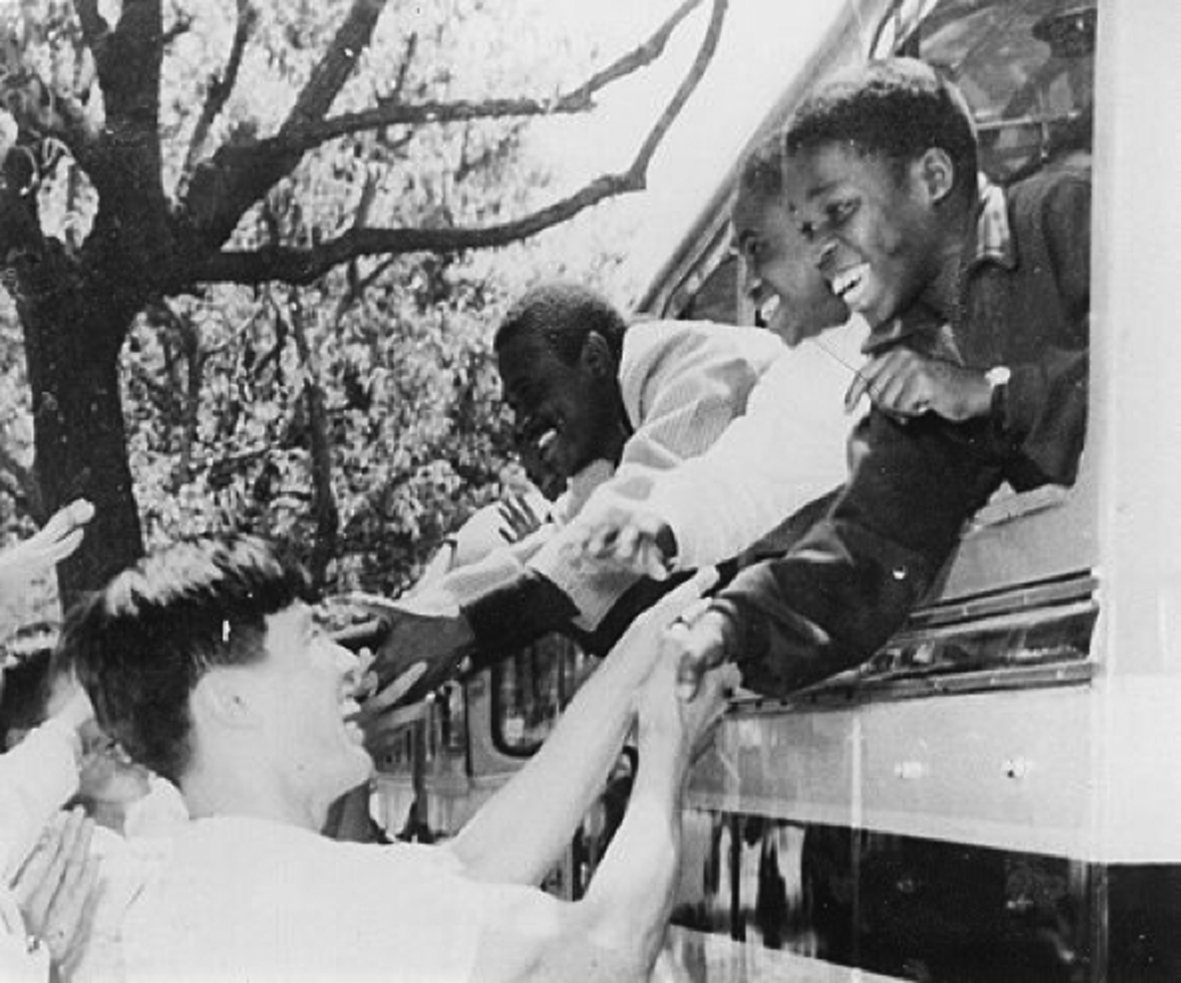
Guinean musicians were similarly called on to perform for visiting Chinese dignitaries. One former revolutionary musician recounted to me that the great Guinean vocalist Sory Kandia Kouyaté, alongside the national dance band Kélétigui et Ses Tambourinis, once performed a praise song to Mao Zedong in Mandarin.Footnote 22 Additionally, Guinean troupes visited China as part of diplomatic missions; these included the national Ballet Djoliba's visit in 1965, as seen in Figure 4.
Ballet Djoliba during a tour of China in 1965. Source: Photograph reproduced with permission of Mamady Keita and the Tam Tam Mandingue Djembe Academy.

China also lent technical expertise to artistic production. Throughout the 1960s and 1970s, Touré was concerned with modernizing Guinean traditions to make them more ‘methodical’ and ‘rational’.Footnote 23 In practice, this process meant bureaucratizing art and music by subjecting them to continual official oversight, a system that Mao had previously instituted in China (Yu Run Reference Yu Run1991: 122). This also entailed the standardization of instruments and the application of music theory concepts from Europe. Within an anti-imperial context, this latter point is a contradiction that had long been reconciled by Mao himself. As he stated in a 1956 speech to Chinese musicians: ‘We must master all good things from foreign countries and then apply them and, in the process, develop them.’Footnote 24 In the early 1970s, Touré invited Chinese and Korean musicologists to teach the solfeggio system to local musicians.Footnote 25 Moreover, as he stated in a 1972 speech, ‘thanks to … the People's Republic of China, our instruments have been studied and remade in a way to facilitate their industrial fabrication … We have already cooperated with the People's Republic of China in producing the creation, with a better form of presentation, of certain musical instruments.’Footnote 26
Despite these many exchanges and acts of assistance, however, there is little audible or visible influence of Chinese aesthetics or style on Guinean music or dance. Cultural exchanges with Cuba in the 1960s led to an enormous amount of dance and musical reshaping, with Cuban rhythms fitting into an aesthetic feedback loop that was already well established across the Black Atlantic. Chinese aesthetics and forms were entirely foreign and new to Guinean performers, however, and as one Guinean musician said to me about Chinese music, ‘You can't dance to it.’Footnote 27 Chinese sounds could not be so easily inserted into existing Guinean songs.
Movements, however, offered a different type of adaptability. Revolutionary dance in Guinea did not actively incorporate Maoist movements, and despite parallels between aesthetic ideas about strength (see Lu Reference Lu2016), neither choreographers and dancers nor the state highlighted such connections or made them explicit. Nonetheless, Chinese performances in Guinea did have some artistic impact. While the Eight Model Works are usually held as the paradigmatic forms of Maoist performance, dancers and audience members I have spoken with from the Guinean Revolution were more particularly impressed by Chinese acrobatics, with its athletic leaps, tumbling and balancing. Within China, this form predated Mao's regime but was enthusiastically embraced by it and incorporated into revolutionary opera for its popular appeal (Mittler Reference Mittler2012: 61). Through cultural exchanges, acrobatics was also actively exported. Some members of the Ballet Djoliba, for example, spent six months learning Chinese acrobatics as part of their 1965 visit.Footnote 28 While acrobatics already played an important part in Guinean ballet performance, through local Fulbe nyamakala traditions, Chinese acrobatics added new types of tumbling and balancing to their routines.
Moreover, Guinean performance borrowed from Maoist revolutionary stagecraft. One such practice involved suspending enormous portraits of the Supreme Leader of the Revolution (as Touré was known) as a backdrop to any artistic production, or holding smaller poster portraits on stage or during marches.Footnote 29 Other elements of Maoist choreography included the incorporation of synchronized movements and salutes during the singing of revolutionary songs, or the use of outstretched hands in staged performances, as a reference to the future (and its leader). Touré was also influenced by Mao's emphasis on collectivity rather than individuality in the arts. As the composer Mao Yu Run writes, Mao embraced ‘group composition’ over the work of individual artists, who were considered primarily as technicians (Reference Yu Run1991: 113). Under his rule, there were only two voices allowed in Mao's China: that of the leader himself, and that of ‘one billion people singing in unison’ in his praise (ibid.: 112). Similarly, in Guinea, Touré insisted on collective performance, with no individual artists or stars allowed to compete with him for fame and recognition (Dave Reference Dave2019: 25–6). As one cultural administrator remarked to me, what Guinea seemed to have learned foremost from Maoism was the art of the personality cult.Footnote 30
What is the purpose of soft power? Is it simply a backdrop to more important exchanges of money, weapons, cement and steel? Shinn and Eisenman (Reference Shinn and Eisenman2012) describe cultural exchanges as one way in which China could exert its influence ‘on the cheap’. For Touré, his abiding concern was decolonization from Europe and asserting his own power and authority. China provided a useful alternative model and modernity to Europe, but he seems not to have been overly concerned with directly adapting Maoist aesthetics, choreography or songs. Moreover, when I asked former revolutionary musicians about Chinese influences in their practice, most chafed at the suggestion – at the idea that their music was anything other than Guinean. As one artist stressed to me, ‘No, no, no, there wasn't any influence. We created a path for our own music, for Guinean music.’Footnote 31 Yet Touré did understand that, through culture and performance, ideology is translated into daily life. Just as Mao acknowledged the mutual interdependence of ‘artistic power’ alongside political ideology,Footnote 32 Touré also saw that art matters to ordinary people. Chinese forms did not so much influence artistic aesthetics in Guinea, but they did provide a model of how to be revolutionary, a model that the Touré regime paid close attention to as it developed its Revolution within Guinea.
Becoming militant in Touré's Revolution
On 2 August 1968, Touré officially declared the start of the Socialist Cultural Revolution in Guinea. Touré's declaration demonstrated loyalty to the Chinese model and reinforced friendly relations between the two countries.Footnote 33 Yet despite these ties, it is difficult to describe the Guinean Cultural Revolution as a Maoist movement. Rather, the Guinean Revolution was a continuation and intensification of Touré's own brand of ideological rule, primarily emphasizing cultural identity and independence from Europe rather than agrarian transformation.
Throughout his rule, Touré's concern was less with material markers of progress and development and more with moral and cultural struggles (Straker Reference Straker2009: 136).Footnote 34 Unlike in Julius Nyerere's Tanzania or Kwame Nkrumah's Ghana, Touré's Guinea did not prioritize rapid agricultural transformation or massive land relocation projects. Touré continually emphasized ‘progress’ and ‘modernization’ in his rhetoric but his focus was more on social engineering (McGovern Reference McGovern2013: 161), rather than infrastructural and economic transformation. Jay Straker notes that both the Guinean and Chinese examples involved ‘revolutions-within-revolutions’, the launching of Cultural Revolutions within what were already revolutionary regimes (Reference Straker2009). Since the early 1960s, Touré had already been using the term ‘revolution’ to refer to his regime.Footnote 35 As with his Chinese counterpart, however, the Guinean president increasingly saw a need to purge ‘counter-revolutionaries’ and any enemies of the regime. The launching of the Guinean Cultural Revolution allowed for a tightening of ideology, a renewed insistence on conformity and a zealous push for total control over the regime's subjects.
One integral way in which such attempts at domination were exercised was through a regime of movement, in which the body became a key site for radical social change and control. To be a militant, as adherents to Touré's Revolution were known, one had to submit one's body to a range of practices involving gesture, mobility and displacement. These practices were central to a regime of state-inflicted violence and pain. As Scarry notes in her work on the body, ‘Physical pain … obliterates all psychological content, painful, pleasurable, and neutral’ (Reference Scarry1985: 34). It is at this moment and through this process that pain is transformed into power. I discuss below three important ways in which the body served as the means to produce revolutionary subjects through the infliction of pain and violence in Guinea.
First, the regime contained and controlled bodies in the most abusive and violent ways, through arbitrary imprisonment, torture and death. Many political prisoners were held at the infamous Camp Boiro in Conakry, a military barracks in the centre of the capital city. In this facility, thousands of Guineans are reported to have been tortured and killed during the 1960s and 1970s. In particular, the regime periodically uncovered ‘counter-revolutionary plots’ against it and reacted harshly by rounding up dissidents and suspected traitors for incarceration. This practice became so common that many in Guinea refer to the ‘permanent plot’ against which Touré's actions were cast. The party newspaper Horoya often detailed accusations against various plotters. In fact, in one issue in 1969, the only article not about a plot against Touré was a piece on the benefits of Chinese acupuncture. The Guinean filmmaker Moussa Diakité was one victim of this repression, with his arrest and imprisonment in a 1971 purge following a failed Portuguese invasion of Guinea the previous year. The attack represented something of a vindication for Touré's vigilant rhetoric, and led to an intensification of violent state repression in the country (Arieff and McGovern Reference Arieff and McGovern2013: 200). In this atmosphere, Diakité recalled hearing nightly radio broadcasts naming the accused for a period of six months after the attempted invasion. After being rounded up in the arrests, Diakité spent a year in Camp Boiro where he was subjected to torture and hard labour. Upon his release, he promptly left Guinea for Europe.Footnote 36
It was also at Camp Boiro that Fodéba Keita, the founder of the Ballets Africains, was imprisoned and executed following his arrest in 1969.Footnote 37 Upon Guinean independence, Keita had become a government minister and over the next ten years, perhaps in a sign of Touré's restless paranoia, held a succession of seemingly arbitrary posts. In a perverse irony, Keita himself as Minister of Defence had overseen the construction of Camp Boiro and was involved in many detention cases there before his own fall from grace. By his own later admission, these cases often involved fabricated plots of treason (Kaba Reference Kaba1998).Footnote 38 Touré was perpetually suspicious of those close to power, and, by the late 1960s, suspected Keita of trying to depose him. He was also well aware of the recent military coups in neighbouring Mali and Ghana, and the overthrow of his close ally Kwame Nkrumah. By 1969, Keita was named as a participant in a plot to overthrow the president, and Touré promptly arrested, imprisoned and executed his former friend.Footnote 39
In recent years, survivors of Camp Boiro as well as the family members of victims have collected and recounted the stories and experiences of the detainees there. One account of Fodéba Keita's death includes details of the room itself in which he eventually died, Cell No. 72, occupying the far end of a long building with iron doors in which those sentenced to death were placed. As Scarry notes in her reflections on bodies in pain and the built environment, ordinarily a room is a means by which to enlarge the body, by creating shelter around it. The act of imprisonment, however, makes impossible this impulse to project oneself beyond one's body. Moreover, the room itself becomes a weapon of torture (Scarry Reference Scarry1985: 39). This was the case in Camp Boiro, as prisoners were held indefinitely, unsure of their fates and subject to beatings and starvation. And having confined and mutilated the bodies of prisoners, the regime at times publicly hung corpses from a nearby bridge so that its power would be made real for onlookers as well.
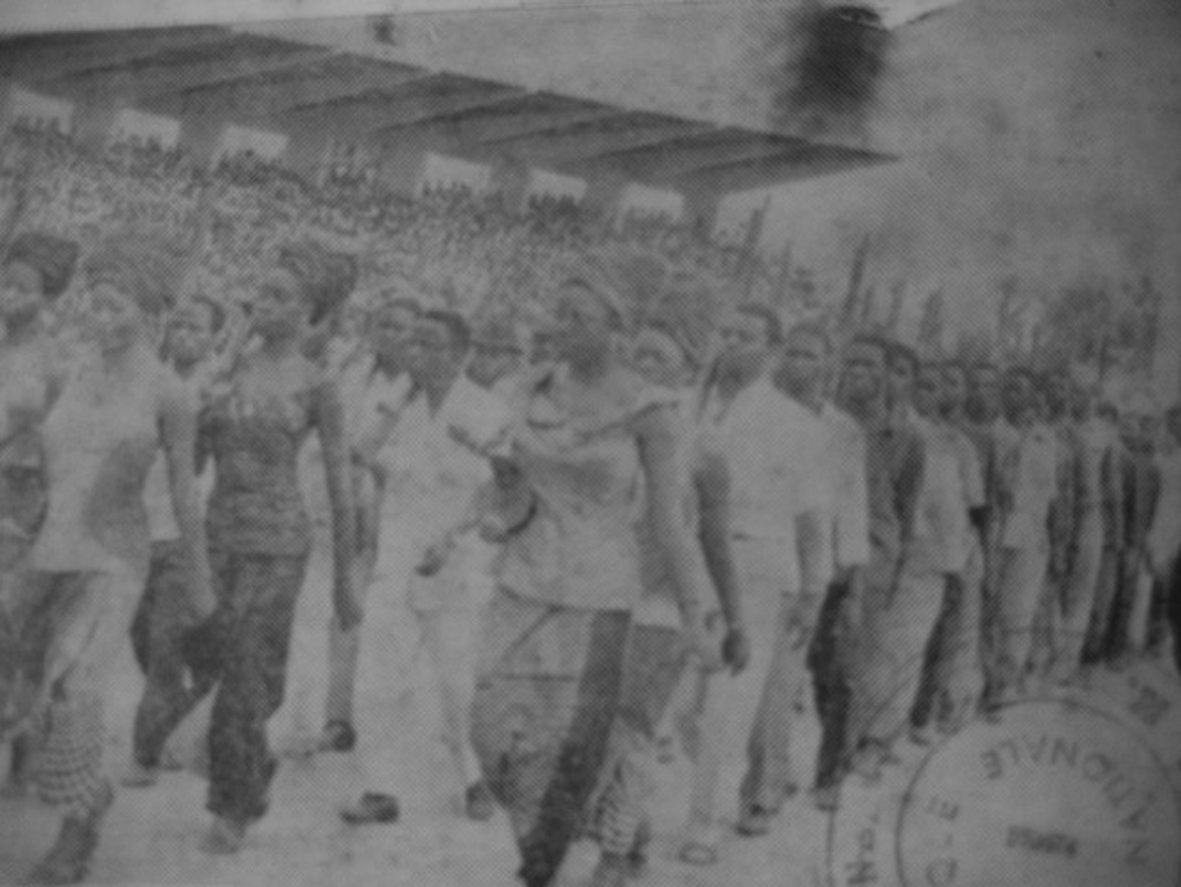
In addition to state-sponsored violence, a second way in which the revolutionary regime used the body as a site for subject making was by dictating myriad practices of movement in public space. As has been noted in political anthropology, coercive regimes work hard at devising ways to keep bodies busy (Verdery Reference Verdery1996; Wedeen Reference Wedeen1999).Footnote 40 In Guinea, exhausting street choreography became an important part of official celebrations. Citizens were made to line the street for hours on end to show support for the president, or were expected to flock to the national stadium whenever he spoke there, often having to listen to his speeches for hours at a time. Figure 5 shows a photograph from Horoya on the Cultural Revolution's first anniversary celebrations in 1969, with choreographed marching in the national stadium as thousands of spectators look on. Often, hundreds of schoolchildren or young women were called on to perform spectacles of synchronized movements and marching at such events.
Celebrations to mark the first anniversary of the Cultural Revolution at the national stadium in Conakry in 1969. Source: Photograph reprinted with permission of the Guinean National Archives.

In addition, there was also a visual vocabulary of micro-movements that accompanied these displacements. One such movement was a revolutionary salute and its variants – a raising of a clenched fist into the air, or a sharp rise and fall of the right arm with hand open. These gestures frequently punctuated public speeches by Touré, with the president's words echoed by the audience in a clipped call and response. Dancers from the era also recall incorporating these movements into their choreography, particularly at the beginning or end of a piece as they saluted the president or other dignitaries present.Footnote 41
Another key gesture was the waving of white handkerchiefs as a sign of loyalty to the state. The white handkerchief was a favourite accessory of the president, who was rarely seen without one (Dave Reference Dave2019). The wearing of white clothes identical to those of the president more generally also became de rigueur in Touré's Guinea as an act of loyalty and conformity.Footnote 42 In part, the insistence on white corresponded to Islamic associations of white with purity – and, indeed, moral guidelines on dress and behaviour were one way in which the regime sought to control its subjects’ bodies (McGovern Reference McGovern2013: 148). Beyond Islam, however, many rumours further attributed spiritual powers to Touré, his signature choice of colour, and his handkerchief. One account claims that those in private audience with the president would never look directly at the handkerchief for fear of being hypnotized by it (Emvana Reference Emvana2005: 168). Whether spiritually rooted or not, the parroting back of this gesture served as an everyday visual reminder of conformity to the president's will. Interestingly, it also remains a common practice in Guinea today at public ceremonies. At performances I have attended featuring the head of state or other senior political leaders (or occasionally even at private parties), white tissues are sometimes distributed to the spectators beforehand. Despite, or perhaps because of, its historical references, the waving of the white handkerchief at these moments is often accompanied by a sense of celebration and joy, as it evokes an earlier, albeit greatly contested, moment of national pride.
Third, in addition to the practices already mentioned, the regime's attempts to control the body were also entangled in dance and aesthetics. Like the waving of the white handkerchief, many of these practices created mixed legacies and evoke mixed memories today. Following independence, the regime cultivated a network of dance troupes, extending from the Ballets Africains, Ballet Djoliba and Ballet de l'Armée at the national level down to federal and local ballets in every region, town and urban neighbourhood. These dance troupes would perform choreographed dances at public ceremonies and local and national arts festivals, amalgamating practices from throughout the country such as those mentioned earlier. The model of the national ballets provided a template that federal and local dance and percussion groups were able to elaborate further through the incorporation of different regional movements, rhythms, instruments, masks and songs.
Alongside this national artistic project, however, was a violent campaign to stamp out cultural identity and difference in the nation's peripheries. In 1961, Touré waged a ‘Demystification Programme’ aimed at erasing spiritual practices and controlling bodies from the forest and coastal regions. These areas, long framed as the savage Other to the modernist national project, were to be brought into the centre and within state authority (McGovern Reference McGovern2013: 152). Mike McGovern argues that demystification was the first of many purges in Guinea, aimed at ‘purifying’ the nation through a radical break from the past and at consolidating power in the centre (ibid.: 125). In contrast to other regions in Guinea, many inhabitants of the upper coast and south-western forest regions practise indigenous religions, which were seen as representing sources of power and authority outside the state. Demystification involved public bonfires to destroy masks and other sacred objects from these regions. Initiation rituals, dances and other practices were banned, and spiritual authorities were publicly beaten and humiliated, and at times arrested and tortured (ibid.: 171). Furthermore, dances and sacred objects were appropriated within the existing structure of the ballets, and these ritual objects and practices were made public and re-presented as national art. As a cultural administrator from the forest region told me, however, the national representations of these dances were often distortions, divorced as they were from local knowledge.Footnote 43
In addition to the appropriation of rhythms, movements and objects, many young people were also moved from the periphery to the centre in this process. The structures of national culture meant that officials would recruit local dancers and performers to the various ballets and ensembles of the era. The effects of this movement were multiple, however. On the one hand, young people were sometimes made to leave their families and home villages for new, unfamiliar areas. On the other hand, such displacements offered possibilities for discovery and encounter. For some dancers, the period offered seemingly paradoxical opportunities for freedom and mobility alongside forced displacement and recruitment (Cohen Reference Cohen2018: 277–8). The Ballets Africains dancers were the most mobile, profiting from their historical status and able to travel throughout the world regardless of political alliances. Indeed, many of these dancers and choreographers now reside permanently in Europe and North America. For others, mobility was more restricted. The Ballet Djoliba, for example, was subject to tighter state control and its members mainly performed at politically oriented festivals or during cultural exchanges with socialist allies, such as the 1965 China trip. Yet dancers that I have met from both troupes today remember with enormous pride their experiences travelling overseas to perform and represent their country.
On a more everyday level, dance ensembles were also an important means to instil personal and public discipline and keep bodies busy. Former dancers from the various revolutionary troupes recount the hours of gruelling training that they underwent every day in practice, the weeks of formal competition, the forced separations from their families and homes, and the abuse by disciplinary taskmasters.Footnote 44 Yet despite this state-induced suffering, these ways in which the regime used bodies to make itself felt and real, former dancers also remember this punishing training with great pride. In interviews, former dancers spoke proudly of the fact that they would have to rehearse until late each night, or that their bodies were pushed and punished to make them dance. They were deeply engaged in their practices of collective expression and their feeling of being modern, of having new experiences, and of being of service to the newly independent state. In my conversations with revolutionary dancers and choreographers, they often contrast their (enforced) dedication with what they see as the directionless youth of today, who they say have no cause or discipline to motivate them. Many today lament that, with the end of the Revolution, much has been lost. Like the waving of the white handkerchief today, the stories around revolutionary movement and dance defy a single interpretation.
Diplomacy through bodies in Guinea today
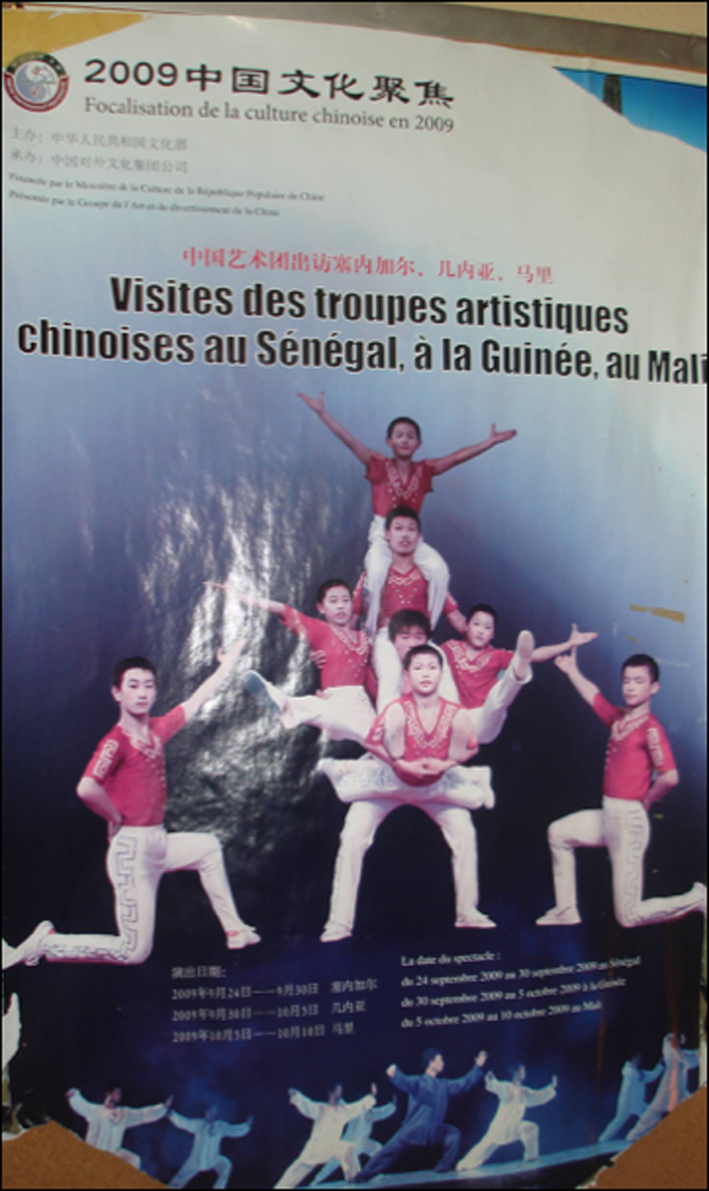
As certain movements and gestures from the revolutionary past continue to circulate in Guinea today, what do they tell us about the legacies of dance diplomacy and ideology through movement? This question has been brought into relief with the resurgence of Chinese investment in Guinea over the past decade. In the post-Cold War moment of the 1980s and 1990s, cultural exchange between China and Guinea declined greatly, but, by the late 2000s, both sides were once again highlighting dance exchange as a sign of close relations. Through Chinese sponsorship, the Ballets Africains returned to China in 2009, for example, where they performed in Shanghai at the World Festival of Music. That same year, a Chinese national dance troupe was scheduled to perform in Guinea in late September and early October (Figure 6). These performances were part of the group's tour through Guinea, Mali and Senegal, and were funded by the Chinese Ministry of Culture.
Poster announcing the Chinese dance troupe tour of West Africa in 2009.

In Guinea, the announcement of the performances coincided with news that China would invest in the largest bauxite mining operation in Guinea to date. For the ruling military regime at the time, this announcement represented a financial lifeline and was widely hailed in the state-run press. China was similarly investing in projects in Senegal and Mali, and the tour suggested the revival of earlier attempts at artistic diplomacy alongside more traditional forms of international exchange.
A few days before the planned concert, however, the military junta in Guinea brutally cracked down on a pro-democracy rally in the capital city. Soldiers killed more than 150 unarmed protesters in a bloody massacre that left the country stunned by the violence. While China had been assiduously courting the military regime to secure its mining rights, its support suddenly drew anger and criticism both within Guinea and overseas. In this atmosphere, the Chinese government was put on the defensive and fell silent about its intentions to invest in the country and support the regime. In the end, the mining deal eventually proceeded after a temporary and respectful delay, but the performance by the Chinese dance troupe was quickly and quietly cancelled.
Conclusion
Chinese intervention in Guinea today is increasingly met with mixed reviews, as gleaming hotel construction projects and Martian mining sites dot the landscape, but few ordinary people see a resulting improvement in their lives.Footnote 45 While the revolutionary period similarly saw investment without improvement, what is distinct about the current moment is that both states seem largely unconcerned with suggesting that affective ties are being built. Instead, the focus is explicitly on hard rather than soft power, with few attempts to mask extraction and economics through art and ideology.
Perhaps this present reality underlines the failures or deceptions of the earlier Sino-Guinean friendship in its claims to create solidarity. The body was mobilized and presented as a site of cross-cultural encounter and participation and as a means of reaching outwards. In fact, however, revolutionary practices and regimes of movement were primarily intended for control and the imposition of a personality cult. The body was useful in this regard. As Scarry argues, the body substantiates power, makes real the regime because of the pain it incontrovertibly feels. ‘The physical pain is so incontestably real that it seems to confer its quality of “incontestable reality” on that power that has brought it into being’ (Reference Scarry1985: 27). Regimes are realized through the exigencies they place on human bodies, in the performances that bodies are constantly mandated to perform. While Maoist choreography and aesthetics had little direct artistic influence in Guinea, the examples here show other ways in which the body was required to submit to and endure countless demands in order to fulfil the state's revolutionary exigencies.
Building further from Scarry's argument, however, we can consider both the painful and the pleasurable. In revolutionary socialism, power was often ‘made real’ through the human body. Yet if pain substantiates the regime, what about pleasure? A few years ago, I attended a performance at the Guinean Palais du Peuple that featured female dancers who had been part of a nationalist celebration in the early 1960s. On the evening of the performance, a group of thirty or forty older women took the stage to sing and dance a song they had first performed in 1963 when Guinea had helped found the Organization of African Unity. Now fifty years later their performance was quiet and still, characterized by gentle swaying from side to side with little other choreography. The only discernible movement was towards the end of the piece when the performers turned to a photograph of the current president – prominently displayed in a continuing nod to Maoist stagecraft. The performers then offered an approximation of a revolutionary salute, before slowly filing off stage to a smattering of applause. Yet their emotion and pride were palpable, both during the performance and when I spoke to some of them later. One of the women wiped her eyes as she told me how she had performed revolutionary dance and song as a young girl. ‘We were the pride of the country,’ she said quietly, her voice trailing off.
Mao Yu Run writes: ‘The scar imprinted on the innermost ring of our souls through long years of suffering caused by Mao's absolute autocratic rule are [sic] deep-rooted and indelible’ (Reference Yu Run1991: 123). Yet, as Mittler shows, Cultural Revolution art continues to circulate and have meaning for Chinese people today. As she asks, why do people enjoy art that ‘for many of them conjures up painful memories, memories of torture and violence … of madness and even death?’ (Reference Mittler2012: 8). In Guinea, the violence and exhaustion of the revolutionary past have not been forgotten, but nor has the fact that they existed alongside moments of great pride and pleasure. While the regime instrumentalized bodies to exhibit discipline and enact its ideology, revolutionary subjects felt and experienced more than what was officially mandated. Over time, it is not the body in pain that is remembered, whether that of torture victims or exhausted and overworked dancers. Or rather, the body in pain is remembered through additional layers of pride, pleasure and nostalgia; through memories of effusiveness and openness alongside those of containment and closing.