

1 Introduction
As of June 2017 the European Union’s REACH (Registration, Evaluation, Authorisation and Restriction of Chemicals) Regulation has been in force for ten years. One unique feature of REACH is the conduct of benefit-cost analysis (BCA) by producers and users of hazardous chemicals within its regulatory regime.Footnote 2 Specifically, REACH allows firms under its authorisation title to continue the use of a Substance of Very High Concern (SVHC), if they demonstrate that risks arising to human health and the environment are appropriately managed, the socio-economic benefits of the continued use outweigh the associated risks, and no suitable alternative exists for the use applied for.Footnote 3 In order to obtain a time-limited authorisation of a specific use, firms have to submit an application to the European Chemicals Agency (ECHA). ECHA’s scientific committees evaluate the application in terms of the above three requirements and forward a corresponding opinion to the European Commission, which will then together with EU member states decide whether, under what conditions and for how long to authorize a particular use.
Shifting the burden of proof of chemical safety to industry is a novel feature in European chemicals regulation that has made the REACH authorisation process a “living lab” of applied BCA. Indeed, all of the 120 applications for authorisation made so far include some kind of BCA for assessing the socio-economic impacts of continued use.Footnote 4 In this paper, we first give a brief overview of the historic development of chemicals regulation in the EU culminating in the REACH regulation and its authorisation regime. We then outline what information applicants are expected to submit to support their claim that the socio-economic benefits of continued use of a substance outweigh the health and environmental risks involved. We proceed by discussing several methodological issues which we have encountered when reviewing these BCAs. The paper concludes with some reflections on how BCA has informed regulatory decisions on SVHC use in the EU, as well as a number of concrete suggestions of how BCAs submitted as part of applications for authorisation may be improved.
2 Chemicals regulation in the EU
One of the cornerstones of EU environmental policy, as stated in Article 191 of the Treaty on the Functioning of the European Union, is to achieve a “high level of protection” for its citizens. To ensure the achievement of protection, the Treaty establishes four principles underpinning EU environmental policy – precaution, prevention, controlling pollution at source, and the polluter-pays principle – which are all relevant for chemicals policy and have become constituents of EU chemicals legislation.
Before 2008, EU chemicals legislation was based on four legislative acts: the 1967 Dangerous Substances Directive, the 1976 Marketing and Use Directive, the 1988 Dangerous Preparations Directive, and the 1993 Existing Substances Regulation. Although BCA was not formally required under these pieces of legislation, there was an expectation that the advantages and disadvantages of proposed risk reduction options should be considered. Furthermore, there was an obligation for the European Commission (based on Article 191 of the Treaty) to calculate the potential benefits and costs of (lack of) action in preparing its policy on the environment. However, the extent and level of any assessment that was undertaken in this respect varied greatly depending on whether or not a regulatory action was considered to fall under the legal basis of Environment Title of the Treaty.
In 1998, the European Commission noted that regulatory processes were lengthy and resource-intensive, legislation was not properly enforced, essential knowledge was lacking regarding the inherent properties of existing chemicals, and the differentiated treatment of existing and new chemicals (with notification requirements applying only to new ones) was impeding innovation (Bourguignon, Reference Bourguignon2015). As a consequence, and in response to the 2002 World Summit on Sustainable Development, the EU’s 6th Environmental action programme committed to ensure that, by 2020, “chemicals are only produced and used in ways that do not lead to a significant negative impact on health and the environment” while “recognizing that the present gaps of knowledge on the properties, use, disposal and exposure of chemicals need to be overcome”.Footnote 5
In order to implement these goals, the EU’s Regulation on the Registration, Evaluation, Authorisation and Restriction of Chemicals (EC No. 1907/2006), widely known as the REACH Regulation, was adopted in 2006 and has been implemented since to “ensure a high level of protection of human health and the environment, including the promotion of alternative methods for assessment of hazards of substances, as well as the free circulation of substances on the internal market while enhancing competitiveness and innovation”.Footnote 6 The novelty of REACH is that it places responsibility on industry for demonstrating the safe use of chemicals, thereby reversing the burden of proof (Bergkamp, Reference Bergkamp2013). Using both hazard-based standards (based on the intrinsic properties of a substance) and risk-based standards (based on the potential for exposure of humans and the environment to a substance), REACH applies to all substances throughout their life cycle (i.e. from manufacturing to disposal) and imposes obligations on all actors in the relevant supply chain (Hansen & Blainey, Reference Hansen and Blainey2006). However, it provides for a number of exemptions based on various rationales such as minimum risk, lack of necessity, overlap with other EU legislation, or reduction of burdens on R&D.
As is apparent from its full name, REACH comprises four regulatory regimes. Registration requires firms to disclose information on all substances they manufacture, import or use. Registered substances may be subject to compliance checks by means of dossier or substance evaluation. If, based on this information or for another reason, an EU Member State or the European Commission have a concern about a substance, they may conduct a risk management options analysis to identify regulatory options.Footnote 7 One such option under REACH is the inclusion of a substance on the Candidate List under the authorisation regime – a system that requires the use of a specific substance to be authorized. Once a substance is on the Candidate List, it may be prioritized for inclusion in Annex XIV of REACH (the so-called Authorisation List), providing a date from which point onward the substance can no longer be used unless the use is approved by a time-limited authorisation.Footnote 8 REACH has also expanded the provisions of previous European legislation for managing chemicals risks through an EU wide restriction of substances or substance uses which may entail conditions for or prohibition of the manufacture, use or placing on the market.Footnote 9 Proposals for restriction provide information on the risk reduction potential, the technical and economic feasibility of substitutes and the economic impact of the restriction. Thus, all restriction proposals include either elements of, or a full BCA.
3 Requirements on socio-economic information for REACH authorisations
The focus in the remainder of this paper is on BCAs conducted by firms seeking authorisation for a specific substance use. These may be manufacturers, importers or downstream users of a substance on the Authorisation List, and they shall be granted an authorisation for the specific use of a substance, if they demonstrate that the risk to human health and the environment is “adequately controlled” (for substances with a threshold of effect); alternatively, they may be granted an authorisation if they demonstrate that the socio-economic benefit of continuing the use of the substance outweighs the risk and there are no suitable chemical or technological substitutes available. It is in the latter case that applicants submit, together with their chemical safety report and analysis of alternatives, an assessment of the socio-economic impacts in order to demonstrate that the conditions for an authorisation are met.
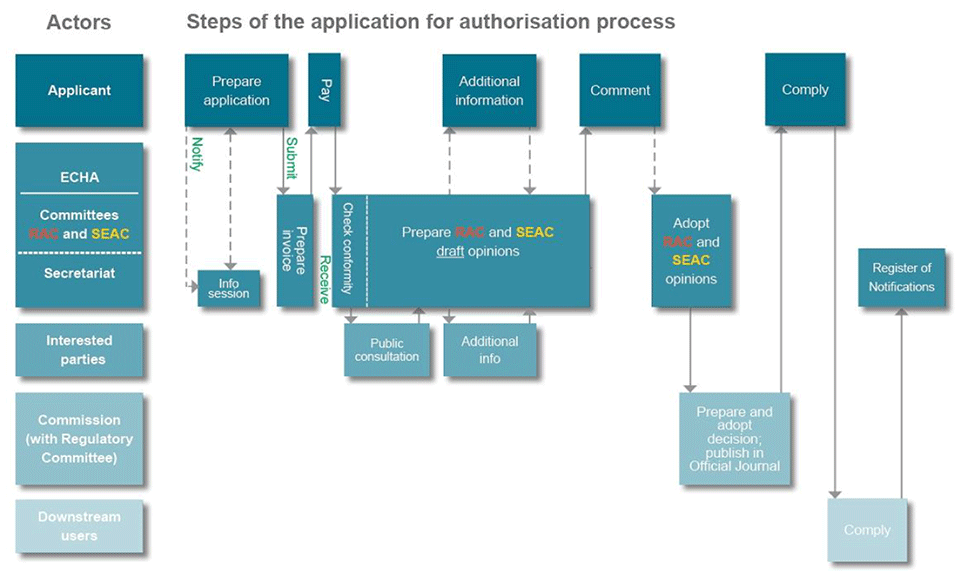
Upon payment of an administrative fee, ECHA launches a public consultation on the application in order to give third parties the opportunity to submit information on possible alternative substances or technologies regarding the substance use applied for. Based on the application and taking into account the outcome of the public consultation, ECHA’s scientific committees draft an opinion on each application, in which they evaluate the risk to human health and the environment associated with the use, the appropriateness and effectiveness of risk management measures in place, the availability and suitability of alternatives as well as the soundness of the BCA and its conclusions. The draft opinions are then sent to the applicant for comments before the committees adopt their final opinions, based on which the European Commission together with the EU member states decide whether and under what conditions to authorize the particular use applied for. Figure 1 illustrates the authorisation process from the submission of the application to the final decision.
Schematic illustration of the REACH authorisation process. Source: ECHA.

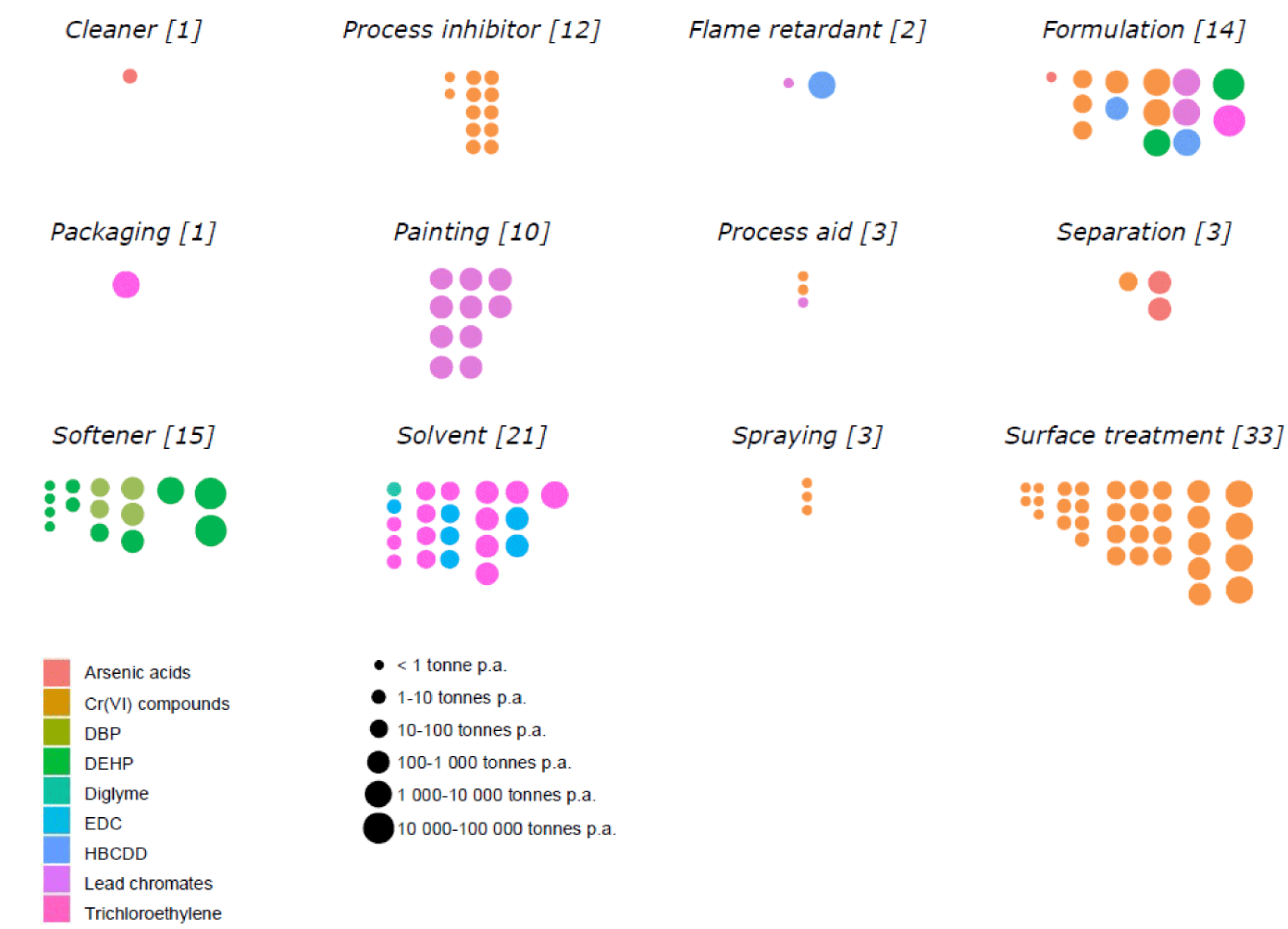
Overview of uses applied for and evaluated by ECHA’s scientific committees by the end of 2016. Source: ECHA.

As of February 2018, applications for 196 uses of 24 substances had been submitted to ECHA and 181 uses had been evaluated. The European Commission has decided on roughly one third of the applications, generally following the advice and recommendations given by ECHA’s scientific committees in their opinions. Figure 2 gives an overview of the substance groups, use categories, and annual volumes applied for and evaluated by the end of 2016.
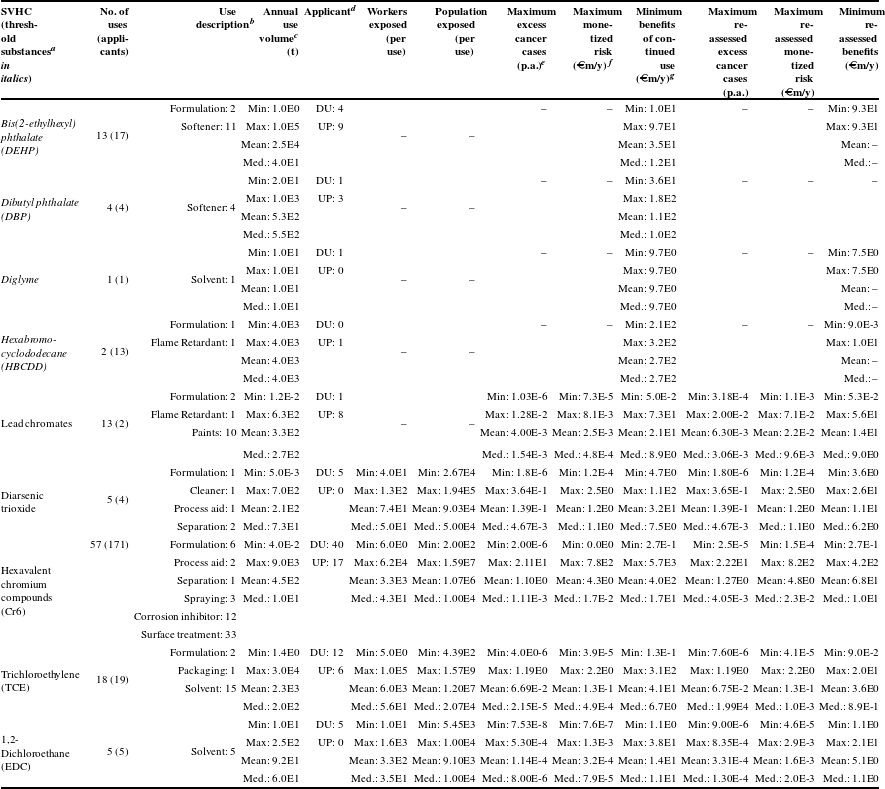
In Table 1, we summarize the key socio-economic information contained in the original applications as well as the outcome of the scrutiny undertaken by ECHA’s scientific committees.Footnote 10 As is apparent from the benefits and monetized risks reported in the table, the Committees did not accept a significant fraction of welfare implications ascertained by applicants. This said, it is important to note that the applicant has to demonstrate that the benefit of continued use outweigh the risks; in clear-cut cases this may be done by monetizing only some of the expected impacts on the supply chain. Likewise, the scientific committees are not tasked with providing their own BCA; they solely evaluate whether or not the assessment provided by the applicant is technically sound and appropriate in demonstrating that benefits outweigh risks. In certain cases, it is therefore possible that the actual impacts of a denied authorisation on the relevant supply chain would be larger than estimated by the applicant.
Summary of SVHC uses applied for and evaluated by ECHA’s scientific committees at the end of 2016. Source: ECHA.

Table notes: – indicates that data was not relevant or incomplete;
 $^{a}$
Substances for which a DNEL for humans can be determined;
 $^{b}$
Categorization based on brief use description submitted by applicants;
 $^{c}$
Where applicants indicated ranges (e.g. 1–10 tonnes p.a.), maximum use volumes are reported;
 $^{d}$
Specifies role of applicant(s) in the supply chain: downstream user (DU), upstream manufacturer, only representative, importer or formulator (UP).
Two further remarks on the BCAs submitted as part of applications for authorisation are in order. First, we use the term BCA to refer to the quantitative part of socio-economic analyses submitted to support applications for REACH authorisation. Depending on the intrinsic properties of a specific substance it is sometimes not possible to quantify the risk associated with its continued use. Therefore, the socio-economic analysis may instead focus on the cost-effectiveness of emission control measures (e.g. for substances that are persistent, bioaccumulative and toxic), consist of a break-even analysis (e.g. for threshold substances where the threshold is not met), or assess the population attributable fraction of mortality or morbidity cases expected from the use.
Second, it is important to define what exactly benefits and costs refer to in the context of REACH authorisations. Whilst BCA textbooks typically equate benefits with negative externalities that are reduced or avoided through a regulatory action, the REACH authorisation title specifically requires that the benefits of continued use of a hazardous substance outweigh the harms associated with it. Therefore, the term benefit refers to the economic surplus of continuing versus ceasing the use for which the application was made.Footnote 11 The term cost then refers to the monetized risks of continuing the use of a substance.
4 Common shortcomings in BCAs submitted as part of applications for authorisation
The REACH authorisation regime is, as far as we know, the first regulatory system in the world wherein firms may apply for the continued use of hazardous chemicals. The burden for the applicant is to prove that it is socially beneficial for the EU to allow a time-limited continuation of the substance use. In the EU, this line of thinking has been completely new for firms and their consultants. Whilst a small number of applications (for very specific uses) have been made “textbook perfect”, some methodological issues have appeared over and again in BCAs submitted as part of applications for REACH authorisation.Footnote 12 In order to describe these issues in a structured way we adapt the ten points that Dudley et al. (Reference Dudley, Belzer, Blomquist, Brennan, Carrigan, Cordes, Cox, Fraas, Graham, Gray, Hammitt, Krutilla, Linquiti, Lutter, Mannix, Shapiro, Smith, Viscusi and Zerbe2017) suggest in their Consumer’s Guide to Regulatory Impact Analysis to our context, and give illustrative examples for problems encountered under each point.Footnote 13
4.1 Identification of impacts to consider
Many of the BCAs reviewed failed to answer fundamental questions. Why is a BCA done and what is its objective? Whose benefits and whose costs count? What is a real welfare impact and what is a distributional impact? We observed that applicants often adopted a tunnel view, focusing on the regulatory impacts to themselves instead of assessing the impacts on the market(s) they operate in. Indeed, BCAs were often done mechanically without demonstrating why, on balance, it is socially beneficial to continue the use of a substance. Certainly, applicants estimated the impacts that a nonauthorisation would have on them, but only some of them assessed what would be the – presumably negative – impacts on their supply chain, and even fewer assessed what would be the – presumably positive – impacts on their direct competitors. Thus, one important finding of our review is that firms had difficulties in describing the societal impacts related to their use of SVHC.
4.2 Options appraisal
In many BCAs the options appraisal was incomplete. In particular, many applicants had discarded managerial options in their analysis of alternatives and therefore ignored the possibility of sourcing or contracting out certain production steps, or of replacing high-exposure production processes by safer ones. Instead, they concentrated on somewhat unrealistic production shutdown scenarios even in cases where these would clearly represent an inferior option from the applicant’s point of view.Footnote 14 Where applicants did consider the use of alternative substances or technologies, they typically ignored the possibility of risk through (regretful) substitution. Yet omissions in conducting a full options appraisal to identify the applicant’s best response to a nonauthorisation carry over into the analysis of the socio-economic impacts of the regulatory decision, thereby biasing the results of the BCA.
Applicants often had difficulties to analyze realistically and thoroughly what would be the net regulatory impacts on them, the markets they operate in, and on human health and the environment. It is hard to tell whether this was due to strategic behavior, myopia or simply an inability of the analyst to establish what would really happen if no authorisation was granted. Based on evidence gathered in a recent technical report (ECHA, 2017) which suggests that significant overstating of benefits and/or underreporting of risks was confined to a limited number of applications, one might conclude the latter is the culprit.
4.3 Baseline appraisal
Most of the BCAs reviewed have predicted the expected loss in producer surplus based on their current sales, revenues and profits.Footnote 15 Path dependence suggests that, in the absence of any better information, current state is the best indicator for a firm’s future productivity. However, time horizons analyzed in applications for REACH authorisations are often 10 to 20 years and forecasts of market trends, profitability and development of substitutes over such long periods are necessarily blurred. A commendable way to address the uncertainty introduced by long time horizons is to make different assumptions on the substitutability, the profitability and other key variables affecting forecasted surpluses and to compare the results obtained under different baseline scenarios. However, this was seldom done.
A related problem is due to the nature of partial equilibrium analysis. Indeed, most applicants have not included any spillover effects of a regulatory constraint to them on other market actors. This may be useful in that it illustrates how the nonauthorisation of a specific substance use might affect the applicant and its supply chain. However, one needs to bear in mind that a nonauthorisation would have general equilibrium implications (Just, Hueth & Schmitz, Reference Just, Hueth and Schmitz2004), not least on a firm’s direct competitors (who might use the same substance more safely) and the suppliers of alternatives (who offer similar products or services without using the substance applied for). Depending on the market situation consumers may also suffer a welfare loss, e.g. when products need to be replaced more often or lose specific qualities that can only be achieved through the substance use applied for or if prices rise due to stifling competition.
Whilst we understand the practical difficulties for individual applicants to assess such general equilibrium effects, it occurs to us that in the BCAs reviewed these wider welfare effects have been largely ignored, thereby limiting the meaningfulness of the conclusions reached. This said, we acknowledge the narrow focus on firm-specific impacts in many of the authorisations requested thus far, which makes the conduct of a computational general equilibrium analysis pointless.Footnote 16
4.4 Aggregation of impacts
Obscuration of effects is a pertinent problem, particularly in so-called upstream applications in which the chemicals manufacturer or importer applies for a single umbrella authorisation which may cover a wide range of uses by hundreds or even thousands of downstream users of the substance. For example, ECHA has received upstream applications for the use of hexavalent chromium to chrome plate components of airplanes, cars and machinery, among others. The chrome plating is done by hundreds of small and medium sized enterprises across the EU which source the substance through a handful of importers of chromium salts. The dispersed uses imply that both the benefits and risks are incurred by many different actors and some of them are socially more beneficial than others – think of safety-critical airplane engine parts versus decorative parts used in household appliances.
It is easy to see that the part-specific welfare implications are very heterogeneous and the conclusions that can be drawn based on average assumptions, or based on aggregate impacts, may vastly differ from those obtained by a part-by-part analysis (however, impractical that might be).Footnote 17 This is conceptually similar to other policy contexts, wherein the decision maker needs to determine the optimal amount of a public good or service (Just et al., Reference Just, Hueth and Schmitz2004). We hence conclude that, whilst allowing broad use applications may provide a cost-effective and least administratively burdensome way of operating the REACH authorisation regime. There is a limit to what activities can be encompassed under a single “umbrella use” as to not obscure the benefit-risk trade-off. This observation pertains particularly to the scarce information available to upstream applicants. The encountered lack of knowledge about the actual substance uses by the downstream users impeded the conduct of a proper analysis of alternatives and limited the conclusiveness of any BCA based thereupon.
A similar “upstream” problem arises on the risk assessment side, although for different reasons. Indeed, the risks quantified and taken forward for establishing the social cost of continued substance use are typically based on reasonable worst-case assumptions about the exposure occurring at a specific workplace. They may, therefore, overestimate the actual welfare impacts of authorisation. As in some of the upstream applications it was not possible to obtain exposure information for each and every site potentially covered by the authorisation, the BCAs instead measured everything by the same yardstick of risk. Especially in the case of large upstream applications covering the substance use of possibly hundreds of downstream users across the EU, the pursuit of such a worst-case approach will not result in a realistic estimate of the expected welfare burden of these uses.
Yet another problem relates to the assumed path independence of applications for authorisation for the same use and substance. Applicants have submitted their applications on the assumption of estimating impacts ceteris paribus. Yet the reality is that the marginal benefits and costs of each application are unlikely to be a linear function of the use volume of a substance (and hence on the number of corresponding applications applied for). For example, the marginal application may well have nonmarginal consequences in terms of threshold health effects or market competition effects. In this respect then, whilst BCA calls for appropriate marginal analysis to be undertaken, it is unclear how this ties in with the reality of the REACH authorisation regime which calls for the equal treatment of each (marginal) application and under which applicants also assess impacts as though theirs is the average application.
Further related issues here concern the optimal level of regulation in terms of the timing or trajectory of substitution of a substance by any one applicant. Applications have typically paid insufficient attention to changes in benefits and costs over the analytical time horizon, often implicitly (and sometimes explicitly) assuming that net benefits are nominally constant. The upshot of such analysis is that substitution would optimally be deferred to the Greek calends! More appropriate consideration of the timing when benefits and costs accrue, e.g. in terms of new investments in technology, may yield net benefits to society which are maximized whilst ensuring substitution trajectories in keeping with the overall aim of REACH to progressively reduce the use of SVHC.
We conclude that most applications have not explicitly addressed what would determine the temporal scope of their analysis. Instead they have typically assessed net benefits over the review period for which they were seeking an authorisation.Footnote 18 And yet, considerations of substitution will typically involve investments whose lifetime will rarely coincide with the review period being sought.
4.5 Uncertainty assessment
Uncertainty is ubiquitous in BCAs assessing the impacts of hazardous chemicals. Ideally such a BCA would provide the probability distributions underlying the most important components of benefits and costs. In the absence of this, measures of central tendency should be used to assess aggregate expected net benefits. The extent to which applications have been successful in providing estimates on this basis has been rather mixed. Several uncertainties pertaining to the quantification of the benefits of continued substance use have already been addressed in Section 4.3. Here, we repeat that it is especially difficult to gauge the knock-on effects of a nonauthorisation on the supply chain and the consumers affected, as these will depend on the type of product or service produced with the particular substance use. The best BCAs reviewed have tried to estimate these impacts and some of them have even incorporated a sensitivity analysis by making varying assumptions on the likelihood and severity of impacts on the supply chain.
Looking at the complex mechanisms through which chemicals exposure may harm humans and the environment, it is not surprising that any quantification of harm assessed in the BCAs reviewed has uncertainties. These occur on several levels and for various reasons. With respect to the exposure assessments undertaken in authorisation applications, these are based on the standard practice used in risk assessment which seeks to assess “reasonable worst-case” estimates of individual exposures, whereas population-based estimates are required for BCA. Even though attempts to appropriately measure and model exposures are made, there are many uncertainties related to the extent and duration of exposure. Where exposures were measured: were these static or personal measurements and what form of representative time averaging was used? Where exposures were modeled: what operational conditions were assumed to be in place and what was the size of population assumed to be exposed? Many of the BCAs reviewed have relied on default assumptions made for the purpose of undertaking risk assessment rather than disease burden estimation, with the consequence that the overall outcome may be realistic or overestimated without offering information on the level of error.
Alongside the uncertainties related to exposure are concerns regarding the estimation of excess lifetime risk of diseases such as lung cancer. These uncertainties derive from the fact that estimates are typically based on linear extrapolation using exposure time periods that may be beyond the time frame of exposures observed in the real world. Nonetheless, applicants have assumed that exposures are linearly separable in order to derive disease burden estimates for the analytical timeframes prevalent in the applications. For some of the substances applied for (e.g. chromium trioxide compounds) dose–response relationships are uncertain to be linear in the low concentration range (see e.g. ECHA, 2013), so that linear extrapolation into these exposure levels may result in an overestimation of impacts.Footnote 19
Although some of the BCAs reviewed have acknowledged these various types of uncertainties, it is only the most comprehensive ones that have undertaken a sensitivity analysis to assess the robustness of the overall benefit-cost conclusion to a (limited) set of modifications in modeling parameters. Many applications have either ignored the uncertainties or dismissed possible events/outcomes as never occurring without providing further evidence to back their claim. In some authorisation cases there was even ignorance or scientific disagreement over the quantitative physical effects associated with a chemicals exposure such that monetized estimates of disease burden could not be established. In such cases, applicants have resorted to break-even analyses to support their claim that benefits outweigh risks. Generally speaking, this approach has proven useful, albeit in some cases the epidemiological evidence was so inconclusive that it was difficult for the scientific committees to draw any meaningful conclusion.
4.6 Transparency
One of the two essential conditions for an authorisation is that there are no suitable substitutes available. Whilst in REACH suitability of substitutes is circumscribed as a combination of availability, technical and economic feasibility, it does not provide a clear definition of these concepts. The applicant’s information monopoly with regard to the market potential of alternatives, investment costs, prices of raw material, etc. opens the doors for overstating some analytical inputs and downplaying others.
On the benefit side, substitutes assessed in the BCAs reviewed were frequently presented as being either of inferior quality, thus leaving the firm without any chance to maintain their current market share, or as too expensive. In consequence, firms often asserted that they would shut down their EU operations if not granted an authorisation. For an outside reviewer, these claims were difficult to verify simply because they lack the technical knowledge and know-how of the market the applicant is competing in. Because of this information asymmetry it was in many cases hard to judge whether any particular impact was accurately valued or exaggerated in an attempt to tip the balance toward the applicant. In order to limit strategic behavior of applicants, all applications for authorisation were subject to a public consultation and providers of alternatives had the opportunity to challenge applicants with regard to the suitability of substitutes, e.g. by presenting competing production technologies to ECHA’s scientific committees.
On the risk side, important input values are often based on exposure measurements done by the applicants themselves and with little possibility for the outside reviewer to verify that they were done at exposure hotspots and all available measurements were actually reported. To reduce the leeway for misreporting, ECHA has issued extensive guidance on how chemicals safety reports ought to be conducted and how exposure to a substance may be converted either into excess lifetime risk (for carcinogens) or into risk characterization ratios that compare observed exposure levels to predicted no-effect concentrations (PNECs) or derived no-effect levels (DNELs). Whilst it is important to bear in mind that many concepts in chemicals risk assessment are based on reasonable worst-case assumptions and may therefore be incompatible with the rationale of BCA to weigh expected impacts against each other (Gray & Cohen, Reference Gray and Cohen2012), the provision of such default relationships has certainly made the risk assessments more consistent and comparable among each other by providing a benchmark against which an individual application can be evaluated.
4.7 Benefit assessment
As discussed in Section 4.1, one observation pertaining to virtually all of the BCAs reviewed is that applicants have had difficulties in adequately quantifying the welfare economic impacts of authorisation. A fraction of them did seek to explain what exactly would happen to them in case they would not be granted an authorisation. They struggled, however, in explaining how this would affect other actors including their suppliers, customers, and competitors. As a consequence, most applicants asserted losses in revenue, value added or operational profit as the impact of them ceasing the use of the substance applied for. What they should have quantified instead is the induced change in aggregate producer surplus, because a surplus loss to them is likely to entail a surplus gain to other market players (Just et al., Reference Just, Hueth and Schmitz2004).
We realize that applicants might not have been well prepared for conducting a fully fledged welfare assessment, and partially this might be related to the paucity of advice in regulatory guidance documents (e.g. in ECHA, 2011). As Cochrane (Reference Cochrane2014, p.65) notes, the behavioral, microeconomic and macroeconomic responses to regulatory interventions – businesses scaling down or closing, markets moving to less expensive alternatives, prices changing – are hard-to-quantify effects. In the long run, it may usefully be assumed that any regulation-induced reshuffling of producer surpluses will be welfare neutral; in the short run and until supply and demand reequilibrate, there is likely to be a frictional cost induced by the regulatory intervention and this is what applicants should assess as economic impact. Similarly, job losses induced by a nonauthorisation will likely be of temporary nature since labor resources will be shifted gradually to other productive uses even if frictional unemployment may occur (Haveman & Weimer, Reference Haveman and Weimer2015).
There is no rule without exceptions. A negative authorisation decision may have long-term welfare consequences, for instance if the applicant operates in a market of imperfect competition in which case ceasing the substance use applied for is likely to entail a consumer surplus loss (e.g. through higher prices, lower quality, or less quantity supplied); or if the applicant’s best response to the regulation is to relocate their business out of the EU in which case the global welfare impact might be limited, but the EU would be negatively affected. How credible such relocation scenarios are in a world in which health and safety regulations become stricter even in developing countries is another question, however.
With regard to the benefit assessment we therefore conclude that several applicants overstated the welfare economic impacts of authorisation. This is due to the fact that they did not take into account how the authorisation decision would affect other actors and hence ignored the opportunity gains of competitors.
4.8 Cost assessment
In monetizing the externalities of chemical exposures, nearly all of the BCAs reviewed have made use of the impact-pathway methodology to assess disease burden associated with the hazard properties for which a substance is proposed to require authorisation in the first place. In light of scientific uncertainty and lack of data, the health impact assessments conducted in applications for authorisation has focused on those endpoints for which the substance was placed on the Authorisation List. In practice, applications have rarely attempted to include health outcomes beyond those for which suitable dose–response relationships were identified by ECHA’s Committee for Risk Assessment. A related problem has concerned the lack of accepted dose–response relationships, particularly for substances displaying threshold effects. In such cases, applicants have resorted to making qualitative arguments or else to adapting top down approaches for estimating disease burden based on epidemiological and population attributable fractions, with all of the associated uncertainties.
Turning to the health endpoints associated with exposure to substances on the Authorisation List, these include, but are not limited to various forms of cancer, cardiovascular and pulmonary diseases, dermal diseases, infertility and developmental toxicity, obesity, etc. Evidence of people’s willingness-to-pay (WTP) for avoiding or reducing the risk of suffering some of these endpoints is still scarce and needs to be improved. As a first step into this direction ECHA commissioned a valuation study to establish WTP values for several health endpoints associated with chemicals exposure (ECHA, 2016).
Whilst many applicants have used these WTP values, some have monetized quality-adjusted life years (QALY) losses associated with specific health endpoints. Whereas doing so enables the analyst to assess the expected health impacts of the continued use of a substance, one can generally not expect the results of the QALY approach to match those obtained with the WTP approach, since monetizing QALY losses requires relatively strong assumptions with regard to both the immediacy of the disease burden and the age-independence of the money equivalent of a QALY (Robinson & Hammitt, Reference Robinson and Hammitt2013).
Latency periods are yet another important issue in valuing health impacts from chemicals exposure. Whilst some of the relevant endpoints are the immediate result of exposure (e.g. acute dermal or pulmonary diseases), others manifest themselves only after decades (e.g. lung cancer). To further complicate matters, a typical worker subject to chemicals exposures from any specific use will have, in all likelihood, already been exposed over the course of their working life. This prompts several questions with regard to incorporating latency periods into applied BCA (Rheinberger & Hammitt, Reference Rheinberger and Hammitt2014), and how these affect the actual valuation of health endpoints (McDonald et al., Reference McDonald, Chilton, Jones-Lee and Metcalf2016). In the BCAs reviewed latency issues were widely ignored or mentioned as a side remark only. Instead, many applicants assumed that the risks to human health would materialize immediately resulting in overestimates of the costs (i.e. the monetized health impacts) of authorizing the substance use.
4.9 Distributional aspects
One concern of applied BCA relates to the handling of distributional aspects (Robinson, Hammitt & Zeckhauser, Reference Robinson, Hammitt and Zeckhauser2016). Apart from the general equilibrium effects discussed in Section 4.2, distributional aspects in the context of the REACH authorisation regime are mostly linked to the proper setting of the spatial boundaries of analysis. Indeed, various methodological questions came up in the BCAs reviewed with regard to spatial boundaries. In several cases, applicants had claimed that, without authorisation, they would have to relocate production to outside the EU, implying that any economic value generated by them would be lost to the EU. If and where substantiated, such claims have raised thorny questions with regard to the relevant scope of BCA. Should one count in the loss in surplus of an EU firm which relocates their manufacturing to Asia to serve the EU market beyond the REACH Regulation? What about firms that repatriate their surplus gains into the EU? How should one handle the potential harm to non-EU workers and how should that be traded off against the opportunity gain these workers face?
Answering these questions requires prioritizing the impacts according to their economic bearing. For the REACH authorisation regime impacts on the EU and its citizens are of primary concern. Whilst it is undisputed that cancers and other diseases associated with chemicals exposure are a burden to humanity no matter where they occur, it is important for a proper BCA of transboundary externalities to lay out who has standing (Gayer & Viscusi, Reference Gayer and Viscusi2016). As the applicants seek to compare the economic impacts of the continued use of SVHC to its health and environmental impacts, they should have defined the scope of their analysis in such a way that the political jurisdiction reaping the benefit from a hazardous activity matches the jurisdiction whose members will have to bear the associated cost. Clearly, such an accounting of impacts is challenging in a world in which there are only limited borders for assets and capital. Nonetheless, applicants claiming that relocation would be their best response to a denied authorisation should have provided not only an assessment of the economic consequences of relocating but also an indication of what this would mean in terms of the total burden of disease in Europe vs. elsewhere.
4.10 Symmetrical treatment
A consistent treatment of a stream of benefits and costs requires a symmetric discounting regime. Whilst the basic tenets of discounting seem clear to most applicants, some of them have suggested using different rates for discounting the economic impacts (i.e. the opportunity costs arising to an applicant if they could no longer use the substance) and the health impacts to workers and the general population associated with the substance use. This begs several theoretical questions with regard to the monetization of health impacts. As Gravelle and Smith (Reference Gravelle and Smith2001) note, if health impacts are measured in QALYs (or other life-year measures) and the money equivalent of a QALY is assumed to increase over time, then it may be theoretically valid to discount QALY losses expected from an authorisation decision at a lower rate to account for the increase in future value. However, if they are monetized – as is typically done in BCA – the same discount rate should apply as for health impacts as for any other impacts that are measured in monetary terms in order to avoid inconsistencies. Some applicants have even used a temporal scope for the benefit assessment that differs from the one used for the cost assessment.
Related to the debate about proper discounting is the question of the proper temporal boundaries of analysis. In the BCAs reviewed most applicants settled for practical reasons on a time frame that reflected the period after which their authorisation – if granted – would be up for review (assuming the applicant would apply for renewal). Whilst this might be deemed a pragmatic choice of temporal boundaries, it implies that impacts that would have happened in the years after the review period are essentially deemed irrelevant. Sometimes, applicants claim that they would have to replace an existing machine or build a new plant if they cannot continue to use a SVHC. It is then even more important to have a close look at the temporal boundaries set since machinery gets replaced and new plants are built irrespective of the authorisation decision. Therefore, welfare relevant impacts on the applicant are those related to the premature replacement of production capital which they would face if not granted an authorisation.
Overall, it can be concluded that applicants have tried to present the benefits and costs of authorisation symmetrically. However, as discussed in the section above, they have had methodological and practical difficulties in doing so.
5 Discussion and way forward
Although BCA has been used in policy analysis for decades, its application to assess whether or not the use of specific hazardous chemicals should be authorized is fairly recent. The REACH Regulation is unique in that BCA reasoning is incorporated directly into the legislative framework and to be performed by the regulated industry.Footnote 20 Based on the experiences from the REACH authorisation system, we have considered how BCA has been conducted in practice and offer for suggestions for improvement in future applications.
In our review of the BCAs submitted in support of REACH applications for authorisation we find that the majority of applicants have more or less thoroughly assessed what their benefit of authorisation (i.e. the opportunity cost of ceasing the substance use) would be. However, there was a tendency – particularly in the first set of applications received – to overstate the welfare implications of authorisation. This may relate to applicants’ lack of understanding of the social welfare perspective adopted by the regulator or to difficulties in specifying what would be their best response if no authorisation was granted. Moreover, some applicants may have behaved strategically in the hope of maximizing their chances of being authorized by claiming excessively large impacts.
On the positive side of the scorecard, applicants have demonstrated that they have developed a sound understanding of the health impacts associated with the continued use of hazardous substances. To this end, the substance-specific dose–response relationships proposed by ECHA’s Committee for Risk Assessment have helped applicants and provided some level of consistency across the applications. In the same vein, the provision of reference WTP values for health endpoints of relevance by ECHA’s Committee for Socio-economic Analysis has reduced the potential for disagreement over the appropriateness of input values used.
In summary, our review suggests that a learning process is taking place amongst the various stakeholders involved in EU chemicals legislation. This learning is addressing the methodological and practical shortcomings that we have identified. Hence, we conclude that the decentralized use of BCA has been a partial success. However, there remains room for further improvements in particular with regard to the following points.
(i) Through learning, improvements in the practice and accuracy of the BCAs undertaken by applicants is likely to continue. Information asymmetries between applicant and regulator warrant further study as this is likely to continue to provide cover for strategic behavior. Encouragement of more engaged interaction by competitors during the public consultation phase of the application process would provide additional scrutiny and challenge to applicants;
(ii) Some methodological issues would need further attention. These relate first and foremost to distributional aspects in applied BCA, e.g. regarding how losses in producer surplus by one actor (the applicant) compare to the potential gains by another (the provider of the alternative) and what impact business customers and consumers have on how the regulatory-induced redistribution of surplus would be valued from the societal point of view;
(iii) More practical guidance for applicants should be developed to make the applications methodologically more uniform and expedite the authorisation process, whilst not excessively burdening applicants. In this respect, the documents on how ECHA’s scientific committees intend to evaluate particular issues (e.g. the social costs of unemployment, recommended WTP values, etc.) have improved the transparency and efficiency of the application process.Footnote 21 The next step for applicants to enhance their BCAs would be a better options appraisal and with it an improved analysis of alternative substances and technologies;
(iv) Relatedly, there seems to be a need for better guidance on how to acknowledge and present uncertainties in exposure data and how to use statistical approaches to characterize uncertainties in a probabilistic way (e.g. through the conduct of Monte Carlo simulations or the use of Bayesian methods to integrate modeled and measured exposure data). Such guidance should emphasize the aggregate impact of multiple uncertainties and express the latter in terms of consequences for the BCA conclusion;
(v) Finally, it seems crucial that decision makers and analysts align their expectations about the role of BCA within the REACH regulatory system. In that vein, establishing among all the interested parties how the results of BCA are used in guiding the decision making would seem especially useful.