Introduction
Neuropsychological research has made a valuable contribution to the understanding of psychiatric disorders by providing predictors of the course of illness and indicating optimal methods of treatment. Neuropsychological tests can also improve understanding of the relationship between cognitive impairments and clinical symptoms (Keefe, Reference Keefe1995). There is growing evidence to suggest that the eating disorders (EDs) anorexia nervosa (AN), bulimia nervosa (BN) and EDs not otherwise specified (EDNOS) are characterized by particular neuropsychological profiles (Lena et al. Reference Lena, Fiocco and Leyenaar2004; Zakzanis et al. Reference Zakzanis, Campbell and Polsinelli2010). Research into the cognitive profile of subjects with EDs has revealed impairments in specific executive functions, including attention (Ranseen & Humphries, Reference Ranseen and Humphries1992; Dobson & Dozois, Reference Dobson and Dozois2004), cognitive flexibility (Tchanturia et al. Reference Tchanturia, Harrison, Davies, Roberts, Oldershaw, Nakazato, Stahl, Morris, Schmidt and Treasure2011; Tchanturia, Reference Tchanturia2012) and inhibition (Southgate, Reference Southgate2005; Rosval et al. Reference Rosval, Steiger, Bruce, Israel, Richardson and Aubut2006; Galimberti et al. Reference Galimberti, Martoni, Cavallini, Erzegovesi and Bellodi2012). There is also a great deal of evidence to support the presence of visuospatial impairments and weak central coherence in ED groups (Lopez et al. Reference Lopez, Tchanturia, Stahl, Booth, Holliday and Treasure2008a, Reference Lopez, Tchanturia, Stahl and Treasureb). Moreover, a recent meta-analysis found that subjects with AN score higher than the normative population on the National Adult Reading Test (NART) and the Wechsler Intelligence Scales (Lopez et al. Reference Lopez, Stahl and Tchanturia2010). There are, however, conflicting findings, with some studies finding no differences or improved executive functioning in ED samples (Pieters et al. Reference Pieters, Sabbe, Hulstijn, Probst, Vandereycken and Peuskens2003; Gillberg et al. Reference Gillberg, Rastam, Wentz and Gillberg2007; Galderisi et al. Reference Galderisi, Bucci, Mucci, Bellodi, Cassano, Santonastaso, Erzegovesi, Favaro, Mauri, Monteleone and Maj2011). There is also a paucity of evidence relating specifically to the BN and EDNOS subtypes. It is possible that the differences observed are present prior to onset, and may contribute towards development of an ED. However, the opposite, that cognitive impairment follows onset of an ED, cannot be ruled out. Deficits observed in clinical studies might be a secondary effect of other features of the disorder, such as low nutritional intake, whereas continued impairments observed in subjects who have recovered from an ED could be long-term effects or scars of the disorder.
One method of investigating cognition prior to onset of a disorder is to investigate the cognitive profile of individuals who are at a higher risk of developing that disorder. This high-risk method has been used to assess the cognitive development of individuals at enhanced risk for schizophrenia (Byrne et al. Reference Byrne, Hodges, Grant, Owens and Johnstone1999; Cosway et al. Reference Cosway, Byrne, Clafferty, Hodges, Grant, Abukmeil, Lawrie, Miller and Johnstone2000; Patel et al. Reference Patel, Wheatcroft, Park and Stein2002) and depression (Claes et al. Reference Claes, Robinson, Muehlenkamp, Vandereycken and Bijttebier2010). Both AN and BN are more common in relatives of probands than in the relatives of non-eating-disordered individuals (Holland et al. Reference Holland, Sicotte and Treasure1988; Strober et al. Reference Strober, Freeman, Lampert, Diamond and Kaye2000; Ben-Dor et al. Reference Ben-Dor, Laufer, Apter, Frisch and Weizman2002); indeed, research suggests that there is a 7–12-fold increase in the prevalence of an ED in first-degree relatives of probands in comparison to controls (Strober et al. Reference Strober, Lampert, Morrell, Burroughs and Jacobs1990; Lilenfeld et al. Reference Lilenfeld, Kaye, Greeno, Merikangas, Plotnicov, Pollice, Rao, Strober, Bulik and Nagy1998). Female children of women with an ED are also at increased risk of disturbance (Patel et al. Reference Patel, Wheatcroft, Park and Stein2002; Field et al. Reference Field, Javaras, Aneja, Kitos, Camargo, Taylor and Laird2008). Research has been conducted investigating the cognitive profile of women with AN, in comparison to their siblings. The results reveal a comparable level of rigidity, which is suggestive of reduced cognitive flexibility between probands and their sisters in comparison to healthy controls with no personal or family history of an ED (Holliday et al. Reference Holliday, Tchanturia, Landau, Collier and Treasure2005; Roberts et al. Reference Roberts, Tchanturia and Treasure2011). These studies implicate impaired executive functioning as an intermediate phenotype of AN. Intermediate phenotypes, in the context of mental illness, are heritable traits that are on the pathway between genetic vulnerability and the development of a psychological disorder (Rasetti & Weinberger, Reference Rasetti and Weinberger2011). For ED, where clinical presentation is complex and heterogeneous, the identification of intermediate phenotypes is particularly useful in the search for vulnerability genes. To be conclusive, however, risk factor studies conducted in the ED field ideally need to be conducted with samples who are young enough not to have developed any eating concerns (Lee et al. Reference Lee, Stewart, Striegel-Moore, Lee, Ho, Lee, Katzman and Lam2007) and, like other first-degree relatives, the children of mothers with an ED are also at higher risk of developing ED concerns and behaviours (Field et al. Reference Field, Camargo, Taylor, Berkey, Roberts and Colditz2001).
The present research is the first study to investigate the neuropsychological profile of children at high risk of developing an ED who are young enough not to have developed any ED cognitions or symptoms. We aimed to investigate the neuropsychological profile of children at high risk for an ED, in comparison to children who are not. In particular, we aimed to determine whether cognitive development, specifically intelligence, working memory (WM), attention and inhibition, were impaired in children at high risk. Given that both males and females could share intermediate phenotypes that mediate risk, we included both genders in our analyses. Based on previous literature, our hypotheses were that the children of women reporting AN would show comparatively high intelligence (Lopez et al. Reference Lopez, Stahl and Tchanturia2010) and poorer performance on measures of attention (Ranseen & Humphries, Reference Ranseen and Humphries1992; Dobson & Dozois, Reference Dobson and Dozois2004) and inhibition (Galimberti et al. Reference Galimberti, Martoni, Cavallini, Erzegovesi and Bellodi2012). Because of the paucity of evidence for BN groups, a directional hypothesis for the children of women with BN or AN + BN could not be made, although we hypothesized that differences would be observed.
Method
Sample
The Avon Longitudinal Study of Parents and Children (ALSPAC; Golding, Reference Golding2004) is a longitudinal and prospective, population-based study of women (who were enrolled during pregnancy) and the child that they were pregnant with at the time. Women were eligible if they lived in the study area of Avon at the time of pregnancy and if their expected date of delivery was between 1 April 1991 and 31 December 1992: 14 663 women were enrolled. Following this, data were obtained by postal questionnaire on 14 472 women, and the children who were still alive at age 12 months have been followed since, with data collected through questionnaires, in addition to physical, behavioural and psychological tests. Women were excluded from this study if they had a multiple birth (n = 199), if they had not completed the questionnaire on psychological well-being at 12 weeks' gestation (n = 2019), or if they had reported a history of any other psychiatric problems (other than an ED) as part of their response to this questionnaire (n = 1166). Children were excluded if they did not attend testing sessions assessing IQ and attention at age 8 years (n = 4887), or WM and inhibition at age 10 years (n = 4896). The final sample size for each analysis was dependent upon data being available on both exposure and outcome and varies for each cognitive assessment.
Exposure
At 12 weeks' gestation, the mothers completed a questionnaire about their health. All women were asked whether they had ever (in the past or recently) had AN and/or BN. Of the women who responded, 446 reported a history of lifetime ED: 171 AN, 194 BN and 81 both AN and BN. Given evidence that the latter group was distinct from the former two (low body mass index with a high prevalence of purging behaviours over lifetime) (Micali et al. Reference Micali, Treasure and Simonoff2007b), it was kept as a separate exposure group.
Outcomes
Cognitive assessment of children
Intelligence and global cognitive function
Intelligence and cognitive function were assessed at age 8 using a short form of the Wechsler Intelligence Scale for Children, 3rd UK edition (WISC-III; Wechsler et al. Reference Wechsler, Golombok and Rust1992). All of the 10 subtests were considered individually, along with the summary scores: Performance IQ (PIQ), Verbal IQ (VIQ) and Full-scale IQ (FIQ). In addition, three out of the four available factor-based index scores for the WISC-III were calculated: the Verbal Comprehension Index (VCI), the Perceptual Organization Index (POI) and the Freedom from Distractibility Index (FDI). The fourth factor-based index score was unavailable as it requires the result of an optional subtest, the symbol search, which was not administered. The children were also assessed on their short-term storage capacity using a forwards and backwards digit span task.
Attention
Attention was assessed at age 8 using three subtests from the Tests for Everyday Attention for Children (Manly et al. Reference Manly, Anderson, Nimmo-Smith, Turner, Watson and Robertson2001). Selective attention was measured using the Sky Search task, which assessed the child's ability to selectively attend to stimuli while filtering out irrelevant and distracting information. Divided attention was measured using the Sky Search Dual Task Measure, which assessed the child's ability to effectively divide attention across two tasks. Attentional control was measured using the Opposite Worlds task, which assessed the child's ability to inhibit prepotent verbal responses. Details of the administration and scoring of these tasks can be found in the study that originally described and validated these tasks (Manly et al. Reference Manly, Anderson, Nimmo-Smith, Turner, Watson and Robertson2001).
WM
WM capacity was assessed at 10 years of age using the counting span task (Case et al. Reference Case, Kurland and Goldberg1982), a computer-based task that simultaneously assesses the processing and storage components of WM. Details of administration and scoring can be found in Case et al. (Reference Case, Kurland and Goldberg1982) The computer program automatically calculated two final scores: the global score, which indicates the number of trials that the child responded to correctly; and the span score, which is based on the number of sets that were correctly recalled, weighted by the number of screens within each set.
Inhibition
Inhibition was assessed at 10 years of age using the stop-signal paradigm (Logan, Reference Logan, Dagenbach and Carr1994), which specifically assesses an individual's ability to stop a behavioural response that has already been initiated (Williams et al. Reference Williams, Ponesse, Schachar, Logan and Tannock1999). In this instance the task was administered and scored according to the procedure outlined in Handley et al. (Reference Handley, Capon, Beveridge, Dennis and Evans2004), which meant that the child's performance could be assessed by the number of stop-signal trials that they correctly responded to. There were two conditions in this task: an easy condition where the stop-signal was played 250 ms before the child's mean response time, and a difficult condition where the stop-signal was played 150 ms before the child's mean response time.
Data analysis
All variables were checked for inconsistencies/outliers using tabulations, graphs and plots. Values that were inconsistent with the relevant assessment were treated as missing values. The distribution of variables was inspected for normality. Three outcome variables from the stop-signal task were not normally distributed (and could not be transformed); they were therefore transformed into binary variables using the bottom centile as a cut-off.
The association between the mother's ED status and the child's neuropsychological profile was explored using linear and logistic regression. Confounders that could potentially influence outcomes, as indicated by evidence in the literature, were initially tested in univariate models, and included in the multivariate analysis if they met criteria for confounding. Additional analyses were carried out by including maternal education as a covariate in a third model, given that this variable is potentially a mediator of effects. All results from measures of executive functioning (attention, WM and inhibition) were additionally co-varied for child Full-scale IQ in a fourth model. SPSS version 18 (SPSS Inc., USA) was used for all analyses along with a significance level of p ⩽ 0.05.
Missing covariate data
Multiple random imputation was used to deal with missing covariate data. All predictor and outcome variables were used as predictors in the imputation model. Missing data were imputed for maternal education, marital status, child ethnicity and family income at both ages 8 and 10. In addition, a very small percentage of data was imputed for age of child at time of testing, and parity, at age 8. All analyses were run on both complete case and imputed datasets for comparison and differences were negligible. Because complete case analysis is thought to suffer from more chance variation, and multiple imputation is assumed to correct any bias, only results based on multiple imputation are presented.
Attrition
Overall attrition (i.e. children not attending face-to-face assessments) was predicted by a range of sociodemographic factors. A significantly greater proportion of children who attended the relevant assessments at ages 8 and 10 were female, white, did not have siblings, came from families with a higher income and had parents who were married. Children who attended assessments also had mothers who were older and more highly educated. These variables were included as confounders accordingly.
Additional missingness of specific outcomes was dealt with by testing the role of relevant sociodemographic variables as predictors of missing outcome data, by estimating the odds of having missing data across each cognitive assessment. Missingness was predicted in at least one assessment by parity, gestational age, child ethnicity and marital status. These variables were also included as confounders accordingly.
Maternal AN was also predictive of missing data at age 8. A sensitivity analysis was performed using multiple random imputation to impute the missing outcome variables at age 8, and the data were reanalysed to check for any differences. The differences were small and we concluded that the results would not be biased.
Selective attrition
Selective attrition across index groups was tested for using logistic regression, by estimating the odds of each group having missing data at ages 8 and 10. Children of women with BN were less likely to have attended assessment sessions at age 8 [odds ratio (OR) 0.74, 95% confidence interval (CI) 0.56–0.98, p = 0.04]. No other differences were found (see Supplementary Table S1).
Ethical approval
The study was approved by the ALSPAC Law and Ethics Committee and the Local Research Ethics Committees.
Results
Sociodemographics
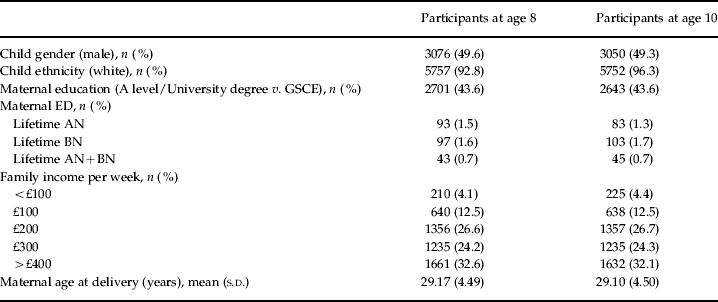
Maternal sociodemographic and child data were compared across index groups for the sample assessed at age 8 (intelligence and attention) and the sample assessed at age 10 (WM and inhibition; Table 1). Maternal education was associated with maternal lifetime ED, with a higher percentage of women reporting AN or AN + BN being educated to A level or degree standard. No other differences were found across index groups.
Sociodemographic characteristics of children assessed at age 8 and age 10

ED, Eating disorder; AN, anorexia nervosa; BN, bulimia nervosa; s.d., standard deviation.
Intelligence and global cognition
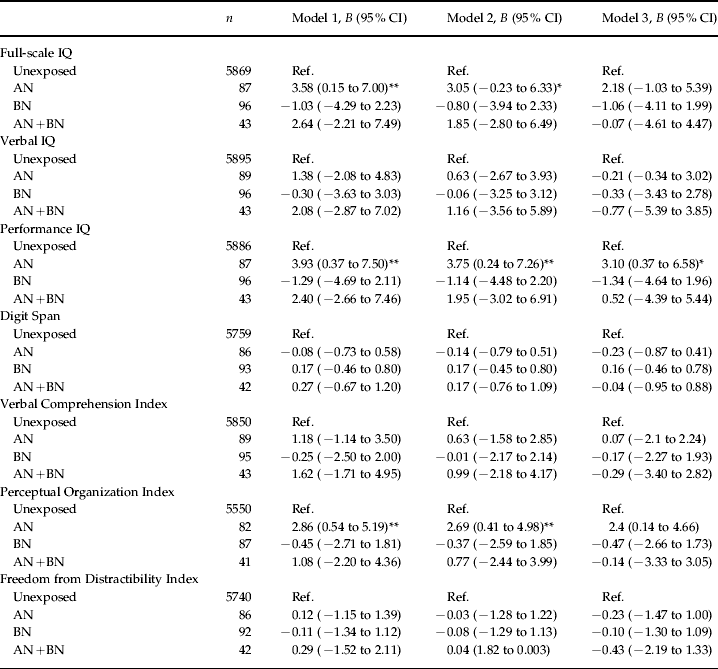
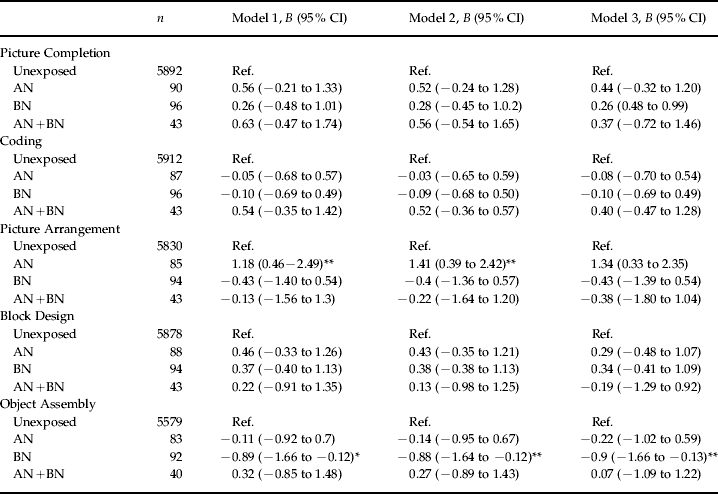
The children of AN mothers showed higher full-scale IQ (B = 3.58, 95% CI 0.15–7.00, p = 0.04) and performance IQ (B = 3.93, 95% CI 0.37–7.5, p = 0.03) scores in comparison to the children of unexposed mothers. Maternal education was found to mediate the relationship between maternal AN and full-scale IQ (B = 2.18, 95% CI −1.03 to 5.39, p = 0.18) and to a lesser extent performance IQ (B = 3.10, 95% CI −0.37 to 6.58, p = 0.08). With regard to WISC subtest scores, the children of AN mothers showed comparatively high Picture Arrangement scores (B = 1.34, 95% CI 0.33–2.35, p = 0.01) whereas the children of BN mothers showed comparatively low Object Assembly scores (B = − 0.9, 95% CI −1.66 to −0.13, p = 0.02). The children of AN mothers also showed significantly higher scores in the POI (B = 2.4, 95% CI 0.14–4.66, p = 0.04). No other differences were found between the children of ED mothers and the children of unexposed mothers, as shown in Tables 2 and 3, and Supplementary Table S2.
Linear regression of children's IQ and global cognition scores: comparisons of exposed and unexposed groups (B coefficients and 95% confidence intervals)
ED, Eating disorder; AN, anorexia nervosa; BN, bulimia nervosa; CI, confidence interval.
Model 1 adjusted for child age and gender, and tester. Model 2 (fully adjusted model) adjusted for child age and gender, tester, family income and maternal age at delivery. Model 3 adjusted for child age and gender, tester, family income, maternal age at delivery and maternal education.
* p ⩽ 0.1, ** p ⩽ 0.05.
Linear regression analysis of children's performance IQ subtest scores: comparisons of exposed and unexposed groups (B coefficients and 95% confidence intervals)
ED, Eating disorder; AN, anorexia nervosa; BN, bulimia nervosa; CI, confidence interval.
Model 1 adjusted for child age and gender, and tester. Model 2 (fully adjusted model) adjusted for child age and gender, tester, family income and maternal age at delivery. Model 3 adjusted for child age and gender, tester, family income, maternal age at delivery and maternal education.
* p ⩽ 0.1, ** p ⩽ 0.05.
Attention
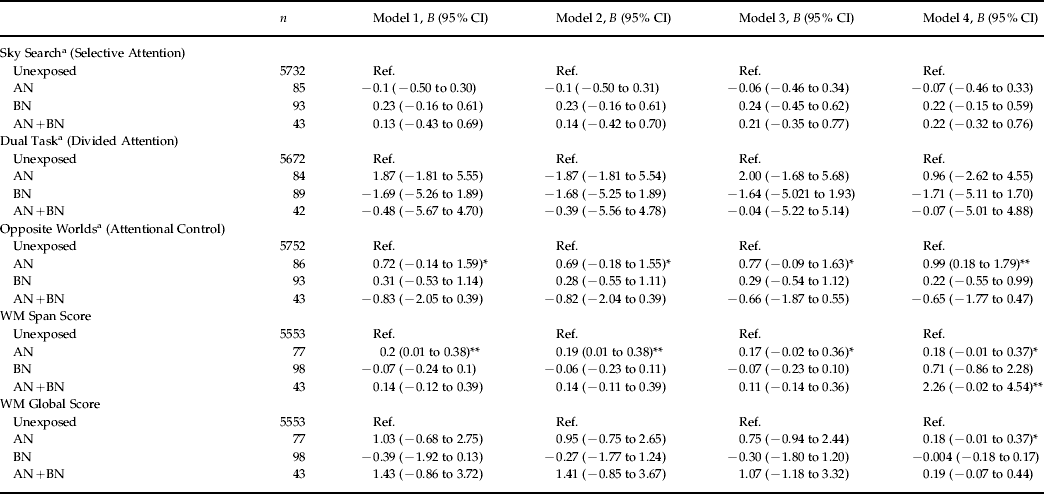
There was weak evidence that the children of AN mothers took longer to complete the attentional control task than the children of unexposed mothers in the fully adjusted model (B = 0.77, 95% CI −0.09 to 1.63, p = 0.08), and this changed when co-varying for child IQ (B = 0.99, 95% CI 0.18–1.79, p = 0.02). No group differences were found in performance on the selective or divided attention tasks, as shown in Table 4.
Linear regression analysis of children's attention and working memory (WM) scores: comparisons of exposed and unexposed groups (B coefficients and 95% confidence intervals)
ED, Eating disorder; AN, anorexia nervosa; BN, bulimia nervosa; CI, confidence interval.
Model 1 adjusted for child age and gender, and tester. Model 2 (fully adjusted model) adjusted for child age and gender, tester, family income and maternal age at delivery. Model 3 adjusted for child age and gender, tester, family income, maternal age at delivery and maternal education. Model 4 adjusted for child age and gender, tester, family income, maternal age at delivery, maternal education, and child IQ.
a Scores measuring attention account for time taken to complete the task, therefore a higher score indicates poorer performance.
* p ⩽ 0.1, ** p ⩽ 0.05.
WM
The children of AN mothers showed slightly better WM span scores in the fully adjusted model (B = 0.19, 95% CI 0.01–0.38, p = 0.08), and when co-varying for child IQ (B = 0.18, 95% CI −0.005 to 0.37, p = 0.06). The children of AN + BN mothers also showed better global WM scores when co-varying for child IQ (B = 2.26, 95% CI −0.02 to 4.54, p = 0.05). No other differences in WM performance were found between the children of exposed and unexposed mothers (see Table 4).
Inhibition
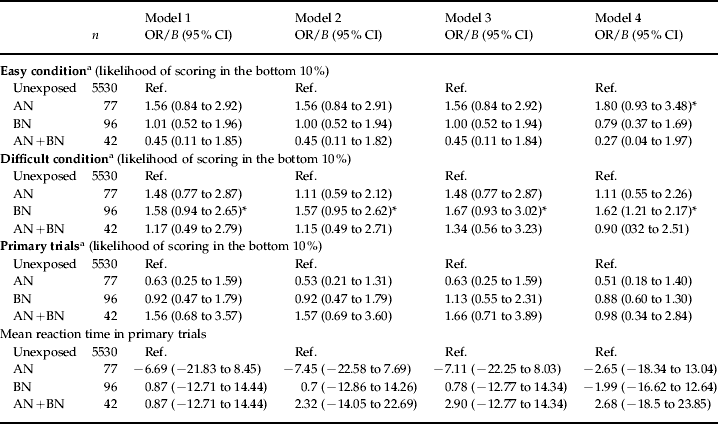
Maternal exposure to BN trended towards being predictive of children scoring in the bottom 10%, in the difficult condition of the stop-signal task, both in the fully adjusted model (OR 1.67, 95% CI 0.93–3.02, p = 0.1) and when co-varying for child IQ (OR 1.62, 95% CI 1.21–2.17, p = 0.1). In the easy condition of the stop-signal task, there was weak evidence that maternal AN was predictive of children scoring in the bottom 10%, when co-varying for child IQ (OR 1.8, 95% CI 0.93–3.48, p = 0.08; Table 5).
Linear and logistic regression analysis of children's inhibition scores: comparisons of exposed and unexposed groups (odds ratios/B coefficients and 95% confidence intervals)
a Inhibition scores in bold indicating the likelihood of scoring in the bottom 10% are the results of logistic, rather than linear, regression. The results indicate the likelihood of each group scoring in the bottom 10% in comparison to controls.
Model 1 adjusted for child age and gender, and tester. Model 2 (fully adjusted model) adjusted for child age and gender, tester, family income and maternal age at delivery. Model 3 adjusted for child age and gender, tester, family income, maternal age at delivery and maternal education. Model 4 adjusted for child age and gender, tester, family income, maternal age at delivery, maternal education, and child IQ.
* p ⩽ 0.1, ** p ⩽ 0.05.
Discussion
The aim of this study was to investigate the neuropsychological profile of children who are at high risk of developing an ED, in comparison to children who are not. Overall, our results show that the children of AN women have high full-scale and performance IQ, increased WM capacity and decreased attentional control, in comparison to the children of unexposed mothers. There is also some evidence that the children of AN women and BN women have decreased behavioural inhibition.
As predicted, the children of AN mothers showed comparatively high full-scale IQ scores, with high-performance IQ making the main contribution to this. Of note, performance IQ is considered to be the most heritable in childhood, in comparison to verbal IQ and full-scale IQ, and is representative of problem-solving ability (van Soelen, Reference van Soelen2011). The children of AN mothers also showed comparatively high scores in the POI, which is of particular interest because it represents the ability to interpret and organize visually perceived materials. Existing research suggests that individuals with AN have impaired visuospatial abilities and weak central coherence (Lopez et al. Reference Lopez, Tchanturia, Stahl and Treasure2008b). Our findings suggest that the opposite is true in the children of women with AN, and this could be due to several possible reasons. Research in this area has concentrated on clinical groups whereas we have investigated a general population cohort; it is possible that impairments in visuospatial processing are only associated with an extreme AN phenotype. It is also possible that the impairments observed in clinical groups are not present prior to onset of the disorder, and are a consequence of the illness rather than a predisposing factor. The children of AN women also showed particularly high Picture Arrangement subtest scores, indicating good non-verbal ability and social interpretation skills. The children of BN women showed decreased Object Assembly subtest scores, suggesting comparatively poor visual organizational ability and visual motor coordination. Current research in the field is conflicting, with some evidence of similar difficulties in ED groups (Jones et al. Reference Jones, Duncan, Brouwers and Mirsky1991; Lask et al. Reference Lask, Gordon, Christie, Frampton, Chowdhury and Watkins2005; Gillberg et al. Reference Gillberg, Rastam, Wentz and Gillberg2007) and non-clinical samples with bulimic disturbance (Thompson & Spana, Reference Thompson and Spana1991), and also negative findings revealing no impairments (Ranseen & Humphries, Reference Ranseen and Humphries1992; Galderisi et al. Reference Galderisi, Bucci, Mucci, Bellodi, Cassano, Santonastaso, Erzegovesi, Favaro, Mauri, Monteleone and Maj2011).
In contrast to previous research (Ohrmann et al. Reference Ohrmann, Kersting, Suslow, Lalee-Mentzel, Donges, Fiebich, Arolt, Heindel and Pfleiderer2004; Kemps et al. Reference Kemps, Tiggemann, Wade, Ben-Tovim and Breyer2006), the high-risk groups in this study showed no impairment in WM. In fact, the children of AN women showed higher WM span scores, a difference that was only partially mediated by maternal education and child IQ. The children of women with AN and BN also showed higher global WM scores when adjusting for IQ. Research has shown that differences in WM performance become non-significant when preoccupying thoughts about food and body shape are controlled for in subjects with AN (Kemps et al. Reference Kemps, Tiggemann, Wade, Ben-Tovim and Breyer2006) and in dieting individuals (Green & Rogers, Reference Green and Rogers1998), suggesting that WM impairment in AN could be secondary to the disorder. Our findings lend support to this research by indicating that impaired WM may not be present in high-risk subjects. If this is the case it is unlikely that WM impairment would increase the risk for developing an ED, but may contribute to maintenance of the disorder.
The children of AN women took longer than the children of unexposed women to complete the attentional control task, partially supporting our hypothesis. Contrary to our expectations, no other differences were seen between the children of exposed and unexposed mothers on any other measures of attention. The act of attending to any stimuli varies as a result of (i) that which requires attention and (ii) the surrounding environment in which an individual is required to attend; that is whether the individual is required to attend to more than one stimuli simultaneously, whether it is necessary to switch between different stimuli, or whether attending to a stimuli also necessitates the inhibition of other distracting stimuli. As a result, attention cannot be regarded as a single construct (Manly et al. Reference Manly, Anderson, Nimmo-Smith, Turner, Watson and Robertson2001). Poor performance on the attentional control task used in this study is thought to indicate a decreased ability to inhibit a well-learned prepotent response. This deficit in attentional control could translate into an inability to inhibit the pathological (food, shape and weight related) thoughts and behaviours common to AN. In addition, the lack of ability to inhibit a prepotent response could contribute to the deficit in cognitive flexibility, for which there is a great deal of evidence in the literature (Tchanturia et al. Reference Tchanturia, Harrison, Davies, Roberts, Oldershaw, Nakazato, Stahl, Morris, Schmidt and Treasure2011; Tchanturia, Reference Tchanturia2012).
The children of BN women showed a trend towards decreased behavioural inhibition. This group was 57–67% more likely than controls to score in the bottom 10% in the difficult condition of the stop-signal task, and this difference trended towards statistical significance. Of note, in the easier condition of the stop-signal task there was a trend towards the children of women with AN showing decreased behavioural inhibition in comparison to the children of unexposed women when we additionally co-varied for IQ. Children of women with AN were 80% more likely than controls to score in the bottom 10%, although 95% CIs crossed 1. There is conflicting evidence in the literature regarding behavioural inhibition in EDs. Studies have found evidence both for and against the presence of decreased inhibition in AN and BN groups (Rosval et al. Reference Rosval, Steiger, Bruce, Israel, Richardson and Aubut2006; Kemps & Wilsdon, Reference Kemps and Wilsdon2009; Galimberti et al. Reference Galimberti, Martoni, Cavallini, Erzegovesi and Bellodi2012). Of interest, this specific type of behavioural/motoric inhibition has been associated with binge eating behaviours particularly, suggesting that using the AN/BN diagnosis may be a limitation when conducting research on this construct (Rosval et al. Reference Rosval, Steiger, Bruce, Israel, Richardson and Aubut2006).
Our findings suggest that comparatively high IQ, decreased attentional control and decreased behavioural inhibition could be intermediate phenotypes between genetic predisposition and ED psychopathology. It is encouraging that the neuropsychological profile of our high-risk groups contrasts with the profile of individuals at high risk for other disorders, such as schizophrenia or obsessive–compulsive disorder (OCD), as this suggests that our findings are likely to be specific to the development of an ED rather than the development of psychological problems in general. Research into the neuropsychological profile of individuals at high risk for schizophrenia has shown low IQ scores (Full-scale IQ = 98.48) in comparison to controls (Full-scale IQ = 105.15), and comparatively poor performance on all measures of memory (Byrne et al. Reference Byrne, Hodges, Grant, Owens and Johnstone1999). Similarly to our high-risk groups, however, individuals at high risk for schizophrenia took longer than controls to complete an attentional control task where inhibition of prepotent responses is required. Impaired motor inhibition, again assessed using the stop-signal task, has also been observed in patients with OCD (Chamberlain et al. Reference Chamberlain, Fineberg, Blackwell, Robbins and Sahakian2006) and in the unaffected first-degree relatives of patients with OCD (Chamberlain et al. Reference Chamberlain, Fineberg, Menzies, Blackwell, Bullmore, Robbins and Sahakian2007). This suggests that impaired motor inhibition could be an underlying trait in both AN and OCD, two disorders that are often speculated to be part of the same spectrum (Bellodi et al. Reference Bellodi, Cavallini, Bertelli, Chiapparino, Riboldi and Smeraldi2001; Altman & Shankman, Reference Altman and Shankman2009), and that present clinically through an inability to inhibit particular pathological behaviours.
Strengths and limitations
This is the first study to investigate cognitive function in children at high risk of developing an ED; however, the study has strengths and limitations. The strengths of the study include its use of a large cohort sample, and the data on the children were collected prospectively. This allows causal inferences to be made. Our findings are a particularly important addition to the neuropsychological research conducted with BN subjects, which is currently very contradictory (Tchanturia et al. Reference Tchanturia, Harrison, Davies, Roberts, Oldershaw, Nakazato, Stahl, Morris, Schmidt and Treasure2011). A limitation of this study is that information on exposure, that is on EDs in the mother, was obtained from self-report. There is evidence that self-report measures such as those used in this study are just as good a screener as more commonly used measures (Keski-Rahkonen et al. Reference Keski-Rahkonen, Sihvola, Raevuori, Kaukoranta, BuliK, Hoek, Rissanen and Kaprio2006); moreover, the prevalence of ED in this sample is comparable to that found in epidemiological studies of women (Micali et al. Reference Micali, Simonoff and Treasure2007a). Missingness at age 8 was predicted by ED exposure, but sensitivity analyses showed that this was unlikely to result in biased estimates. A final limitation is that it was not possible at this stage to explore the effect of psychological disorders in the children, although this will be an important aspect to consider in future research.
Conclusions
Our findings suggest that the high IQ, decreased attentional control and decreased behavioural inhibition found in clinical ED samples are present in high-risk subjects, whereas impairments in WM do not seem to be present. Although differences between groups were small from a clinical perspective, this is to be expected in a high-risk study. Further research is required to confirm our findings, but clarification of the neuropsychological profile of those at high risk of developing an ED is important in relation to the identification of vulnerable individuals (and therefore preventative efforts) and to our understanding of which neuropsychological profiles are linked to susceptibility for ED and which ones might be a scar of these disorders.
Supplementary material
For supplementary material accompanying this paper visit http://dx.doi.org/10.1017/S0033291712002188.
Acknowledgements
We are grateful to all the families who took part in this study, the midwives for their help in recruiting the families, and the whole ALSPAC team, which includes interviewers, computer and laboratory technicians, clerical workers, research scientists, volunteers, managers, receptionists and nurses. The UK Medical Research Council (MRC) and the Wellcome Trust (Grant ref. 092731) and the University of Bristol provide core support for ALSPAC. We thank Dr K. Northstone for her help with the data and K. Tchanturia for her helpful comments.
This work was produced by Dr N. Micali under the terms of a Clinician Scientist Award issued by the National Institute for Health Research (NIHR). The views expressed in this publication are those of the author(s) and not necessarily those of the National Health Service (NHS), the NIHR or the Department of Health. This project was funded by WellChild.
Declaration of Interest
None.