INTRODUCTION
Species definition is not an easy task, when considering the more than 27 known species concepts (Wilkins, Reference Wilkins2011). Among them, the morphospecies concept has been one of the most applied since it is based on the use of observable morphological features. It has been used for centuries as the main diagnostic procedure for delimitation of species in taxonomic studies (Cook et al., Reference Cook, Edwards, Crisp and Hardy2010). This approach is based on looking for phenotype or shape differences among groups of individuals in order to delimitate and discriminate species. Morphological differences can be based on both meristic (countable) and morphometric (measured) traits in what are defined as shape differences. Shape can be assessed by the taxonomic point of view, in a more subjective way, or can be mathematically expressed by combination of measurements in what has been known as morphometric analysis (Zelditch et al., Reference Zelditch, Swiderski, Sheets and Fink2004).
Morphometry has been used to delimitate morphospecies or similar taxa complementing the morphological observations and contributing to clarify taxonomic problems (Martin et al., Reference Martin, Britayev, San Martín and Gil2003; Lattig et al., Reference Lattig, San Martín and Daniel2007). In polychaetes, despite being soft-bodied animals and thus more suitable to measurement errors (Costa-Paiva et al., Reference Costa-Paiva, Paiva and Klautau2007), this approach was also successfully applied on delimitation and diagnosis of some species leading to a more accurate taxonomic assessment (Ford & Hutchings, Reference Ford and Hutchings2005; Garraffoni & Camargo, Reference Garraffoni and Camargo2006; Glasby & Hsieh, Reference Glasby and Hsieh2006; Costa-Paiva & Paiva, Reference Costa-Paiva and Paiva2007; Occhioni et al., Reference Occhioni, Brasil and Araújo2009).
The species Perinereis ponteni Kinberg (Reference Kinberg1866) and P. anderssoni Kinberg (Reference Kinberg1866) were considered synonymous by Hartman (Reference Hartman1948, Reference Hartman1959) because they occur in sympatry along the Western Atlantic (Lana, Reference Lana1984; de León-González & Solis-Weiss, Reference De León-González and Solis-Weiss1998; de León-González, Reference De León-González1999; Amaral et al., Reference Amaral, Nallin, Steiner, Forroni and Gomes–filho2013; de León-González & Gothel, Reference De León-González and Goethel2013). Although they are considered as distinct species by some authors (Santos, Reference Santos1996; Santos & Lana, Reference Santos and Lana2000; Steiner, Reference Steiner2000; Santos & Steiner, Reference Santos, Steiner, Amaral, Rizzo and Arruda2006; Ipucha et al., Reference Ipucha, Santos, Lana and Sbalqueiro2007; de Léon-Gonzalez & Gothel, Reference De León-González and Goethel2013), these two species have been treated as synonymous even in recent reports and databases (Espinosa et al., Reference Espinosa, Díaz and Liñero-Arana2007; WORMS, Reference Read and Fauchald2014).
These species co-occur on the same rocky shores and intertidal zone environments (Lana, Reference Lana1984; Santos & Steiner, Reference Santos, Steiner, Amaral, Rizzo and Arruda2006) and probably exploit the same food resources. Furthermore, these species are very abundant on rocky shores, a highly vulnerable environment. Thus, clarification of the taxonomy of the group members is not only desirable from a systematic point of view, but it will also facilitate reconciling species names with the considerable biological literature available for the family Nereididae.
The criteria used by Santos & Steiner (Reference Santos, Steiner, Amaral, Rizzo and Arruda2006) to distinguish both species and that were used for a prior identification of these species at the outset of the study were: P. anderssoni possesses fewer number of paragnaths on area I in the proboscis than P. ponteni; P. ponteni possesses one paragnath on area V while P. anderssoni possesses three; P. anderssoni presents notopodial ligule longer and wider in median and posterior body chaetigers than P. ponteni; in P. anderssoni notopodial cirri extends beyond the apex of the notopodial ligules in the anterior region of the body, while in P. ponteni it is shorter.
Despite the widespread occurrence of these species along the Atlantic coast, a quantitative assessment of the morphological variability of their populations is lacking and would allow the validity of P. anderssoni and P. ponteni as different species to be tested. Thus, the present study compared P. anderssoni and P. ponteni populations from different regions in the Brazilian coast through morphometric analyses to evaluate their taxonomic status.
MATERIALS AND METHODS
Sampling
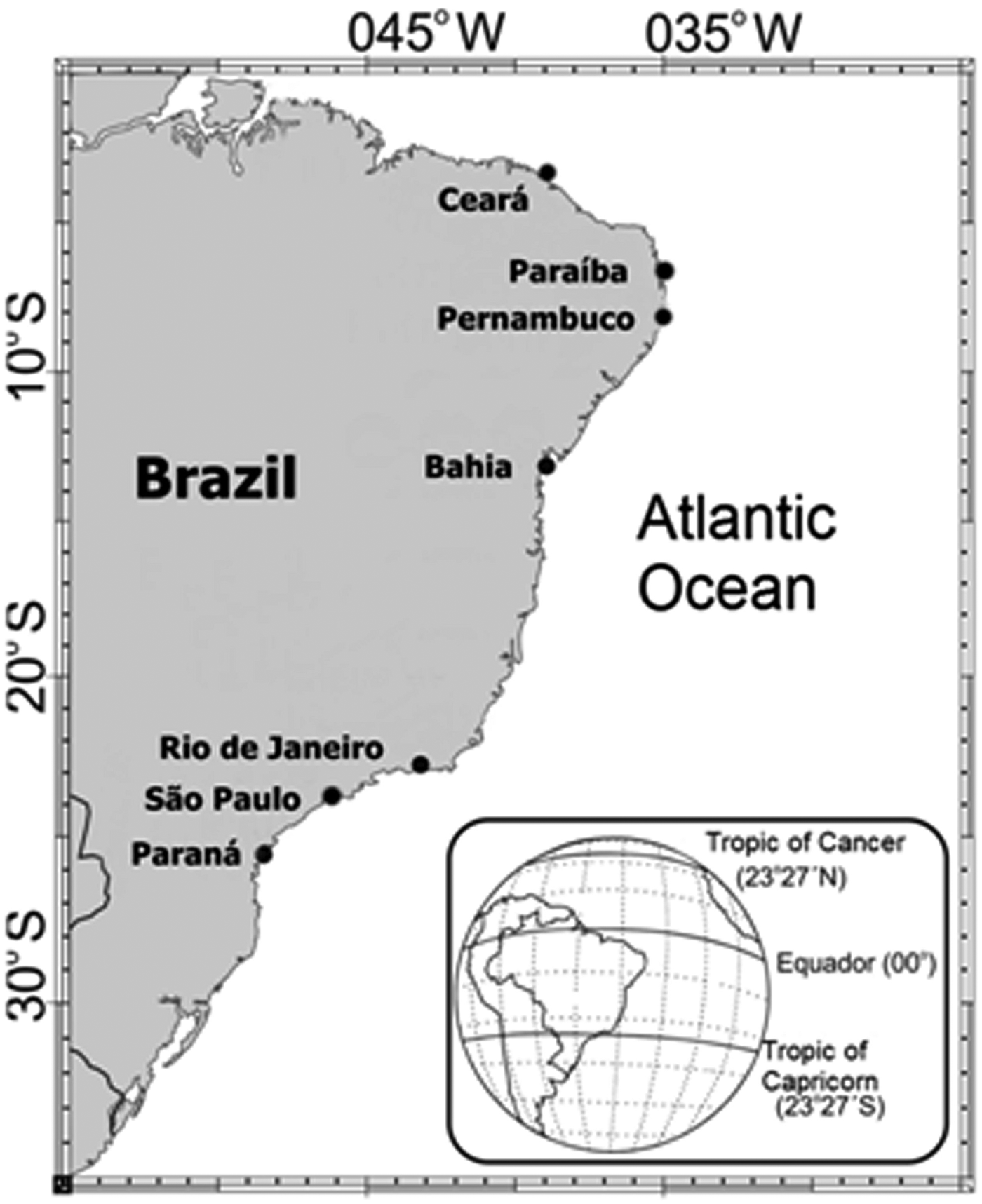
A total of 498 specimens from 14 populations, distributed from the north-eastern to the southern Brazilian coast, were analysed (Figure 1).
Location of collection sites for the studied populations of P. anderssoni and P. ponteni along the Brazilian coast (modified from Clímaco Reference Clímaco2013).

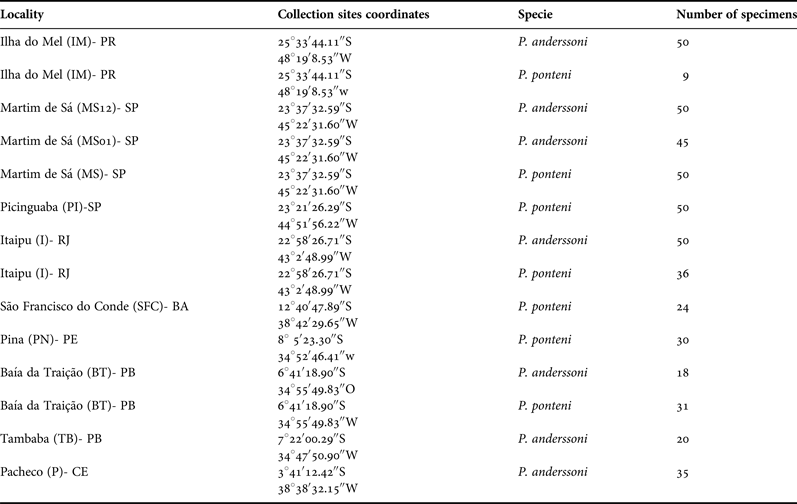
The collection sites were Ilha do Mel-Paraná (PR), Martim de Sá and Picinguaba-São Paulo (SP), Itaipu-Rio de Janeiro (RJ), São Francisco do Conde-Bahia (BA), Pina-Pernambuco (PE), Baía da Traição and Tambaba-Paraíba (PB), Pacheco-Ceará (CE) (Table 1).
Data of collection sites for the studied populations of P. anderssoni and P. ponteni along the Brazilian coast.
CE, Ceará; PB, Paraíba; PE, Pernambuco; BA, Bahia; RJ, Rio de Janeiro; SP, São Paulo; PR, Paraná.
All specimens were collected in the intertidal region through scraping the existing coverage on hard substrates. Specimens were anaesthetized with menthol, subsequently fixed in formalin, and transferred to 70% alcohol after 72 h, with the exception of specimens from the São Francisco do Conde, which were fixed in 95% ethanol.
Morphometric analyses
The following variables were evaluated: total length (TL); total number of chaetigers (NC); postero-dorsal tentacular cirri length (PDTC); prostomium width (PW); prostomium length (PL); peristomium width (PEW); width of the 10th chaetiger with and without parapodia (WP10 and W10); width of the 15th chaetiger with and without parapodia (WP15 and W15); jaw length (JL); number of maxillary teeth (MT); notopodial and neuropodial cirri lengths (DC and VC), notopodial and neuropodial ligules length (DLI and VLI), notopodial and neuropodial lobes length (DLO and VLO) from the 10th, 30th and 45th chaetigers; and the number of paragnaths in Areas I to VII–VIII of the proboscis (AI, AII, AIII, AIV, AV, AVI, AVII–VIII).
Morphometric measurements were initially converted to millimetres, and outlier individuals were excluded. Normality and homoscedasticity were tested in the data using the Shapiro–Wilks and Levene tests, respectively. Individuals were observed, described and measured with the aid of compound (Olympus CX31) and stereoscopic (Olympus SZ51) microscopes, coupled to a digital camera (Sony 13MP).
The morphometric variables were statistically evaluated using linear regression and CVA (Canonical Variable Analysis). The meristic variables were statistically evaluated using ANOVA applied to number of paragnaths of the proboscis per Area, SIMPER and PERMANOVA applied for the number of paragnaths in all Areas of proboscis. Statistical analyses were performed with the aid of the statistical programs R environment (R Core Team, 2012), PRIMER 6.0 (Clarke & Gorley, Reference Clarke and Gorley2006) and Statistica 7.0 (2004).
RESULTS
The linear regression analysis, applied on each of the 14 populations (seven of each species) and on each species, indicated that the width of the 10th chaetiger without parapodia (Linear regression, r 2 = 0.76, Tstatistic = 25.79, P < 0.0001) was the best character to estimate total body length in P. anderssoni; the width of the 15th chaetiger with parapodia (Linear regression, r 2 = 0.65, Tstatistic = 17.98, P < 0.0001) was the best character to estimate total body length in P. ponteni.
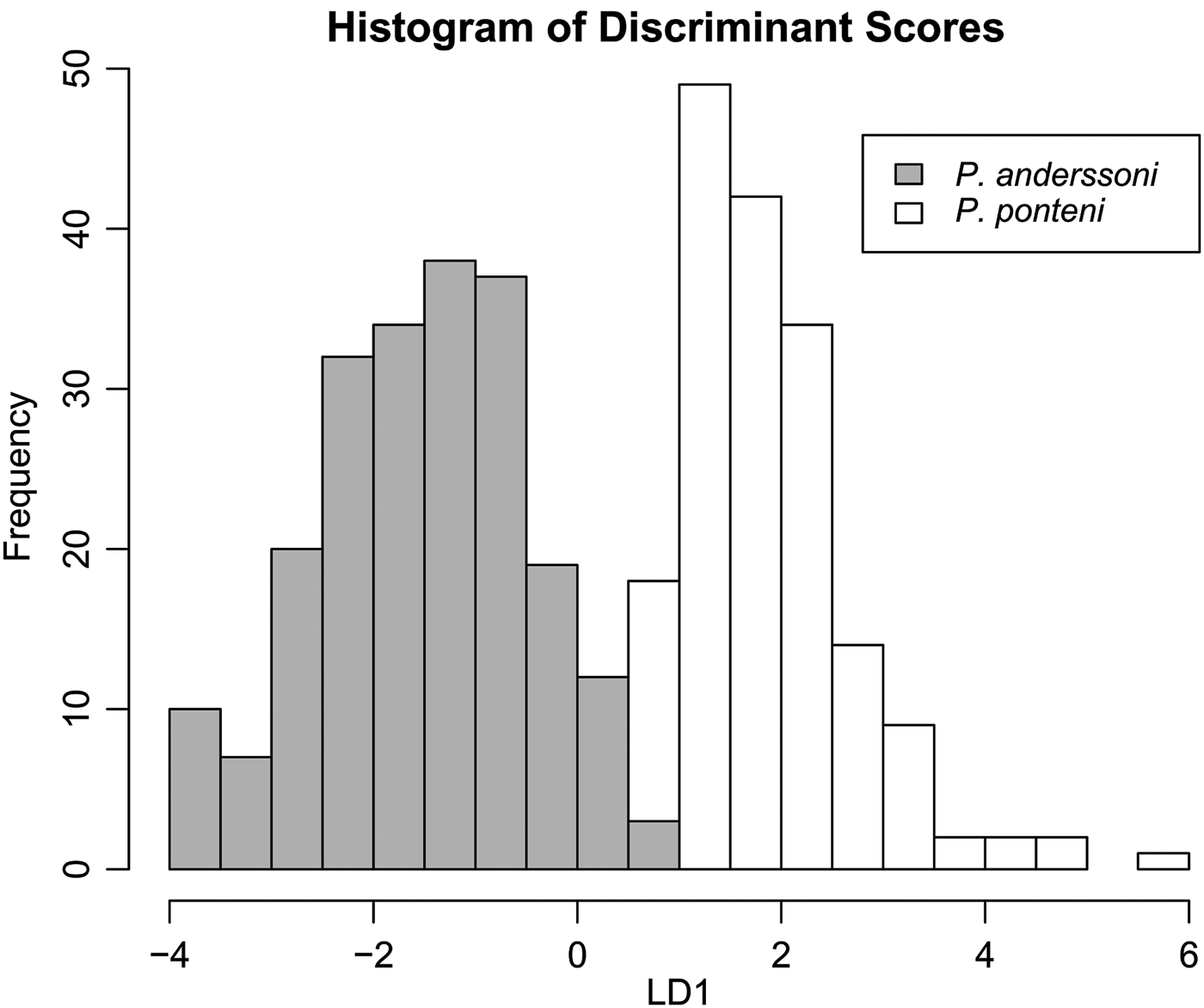
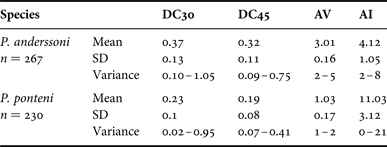
According to the CVA analysis, P. anderssoni and P. ponteni differed in shape significantly. In a first analysis, grouping 14 populations of both species (seven localities of each species), the canonical variable 1 (CV1) explained 45% of the variation found between species. Out of all measured variables, CV1 closely correlated with the notopodial cirri length from chaetigers 30 (r = −0.56) and 45 (r = −0.56). The notopodial ligule length, in the 45th chaetiger, was the only variable that positively correlated with CV1 (Figure 2 and Table 2).
Histogram of discriminant function on the studied species of P. ponteni and P. anderssoni.
Main discriminant variables of shape for P. anderssoni and P. ponteni.
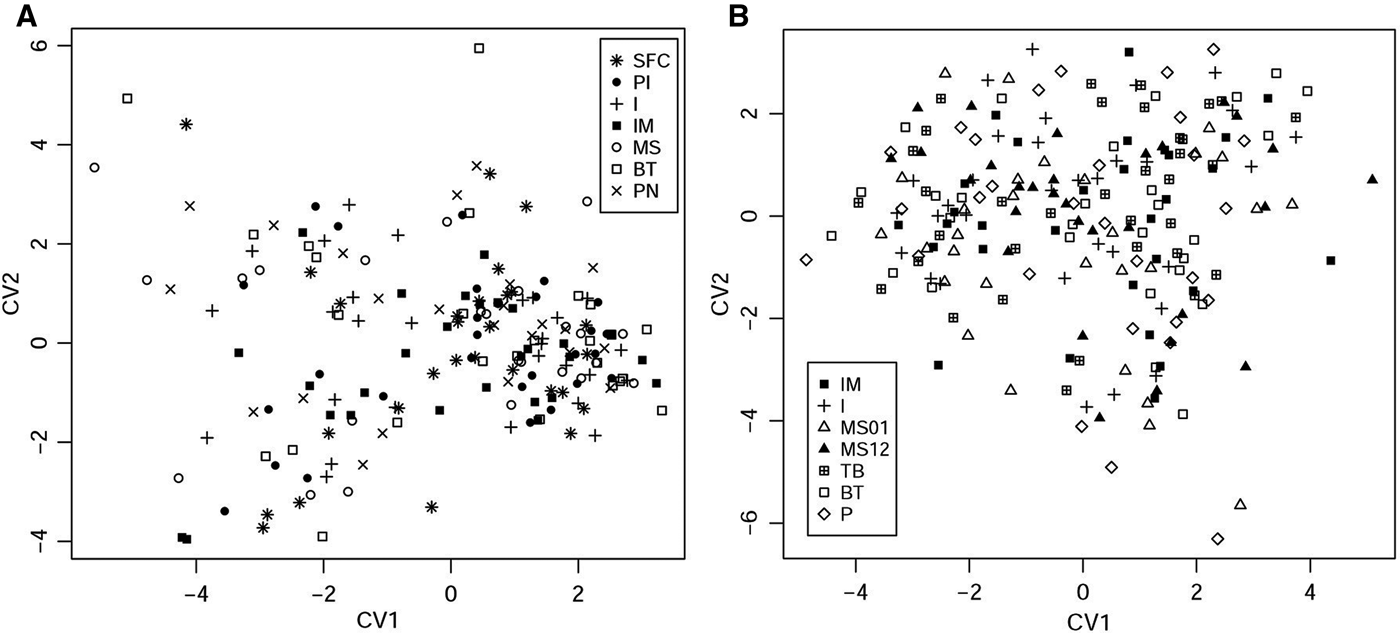
Among-population variation was also observed both for P. ponteni and P. anderssoni. In P. ponteni, CV1 explained 44% of the among-populations variation, CV2 explained 25% and CV3 explained 14%. CV1 closely correlated with the notopodial ligule length from chaetigers 30 and 10 (r = 0.77) and 45 (r = 0.79). CV2 closely correlated with total body length (r = −0.59) and number of chaetigers (r = −0.36). All variables correlated positively with CV1 (Figure 3).
Canonical variables analysis (CVA) on the studied populations: (A) of Perinereis ponteni; (B) of Perinereis anderssoni. IM, Ilha do Mel; I, Itaipu; MS, Martim de Sá; TB, Tambaba; BT, Baía da Traição; P, Pacheco; SFC, São Francisco do Conde; PI, Picinguaba; PN, Pina.
For P. anderssoni, CV1 explained 37% of the among-populations variation, CV2 explained 27%, and CV3 explained 19%. Out of all measured variables, CV1 closely correlated with the notopodial cirri length from chaetigers 30 (r = 0.77) and 10 (r = 0.75). CV2 closely correlated with the neuropodial lobe length in the 10th chaetiger (r = 0.35) and width of the 15th chaetiger without parapodia (r = 0.29). All variables, except number of chaetigers and postero dorsal tentacular cirri length, were positively correlated with CV1 (Figure 3).
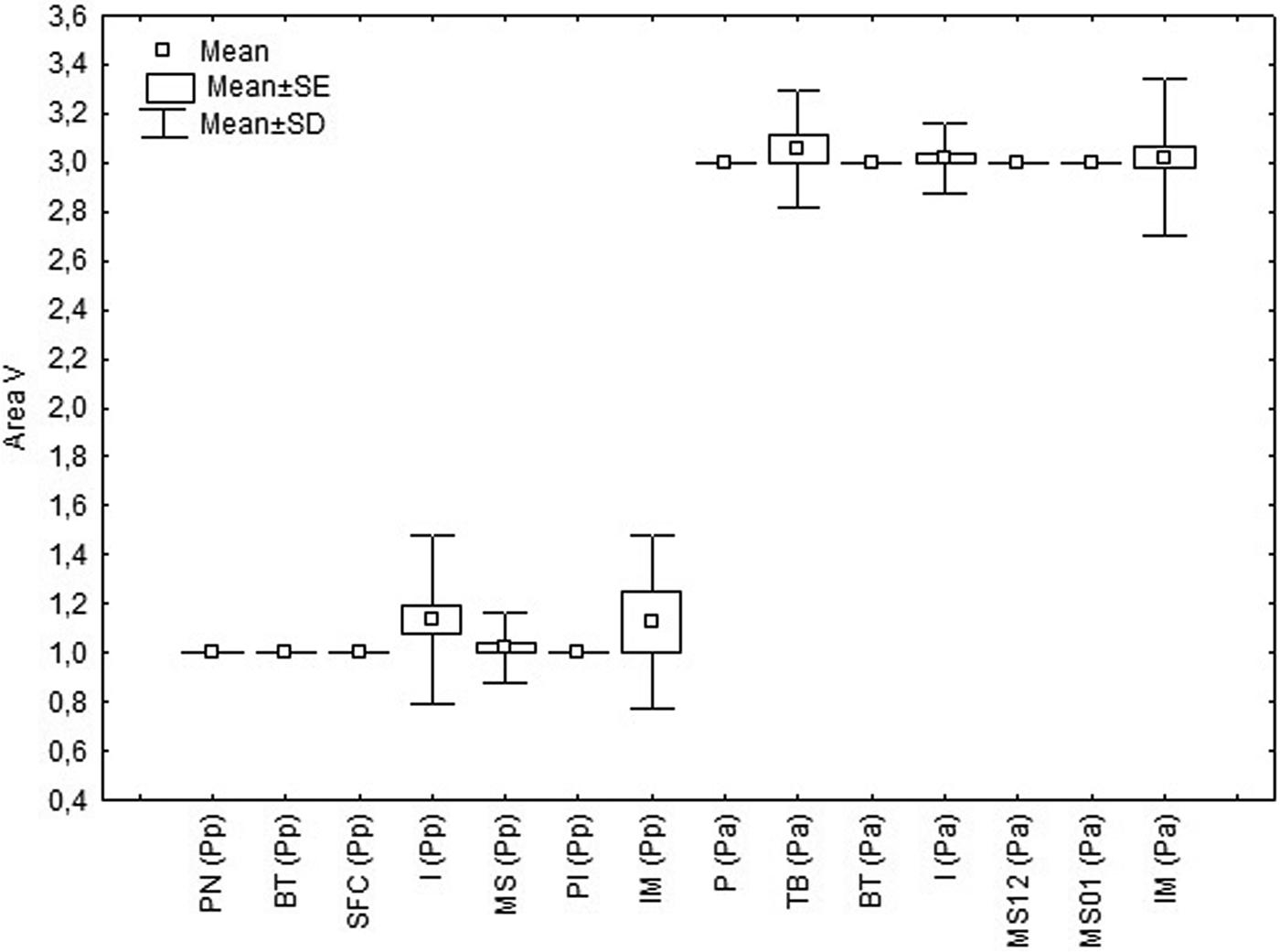
When analysing the species P. anderssoni and P. ponteni together, the number of paragnaths of all eight proboscis Areas revealed significant interspecific differences, with, as expected, the number of paragnaths of Area V, one of the criteria used in prior species classification, being the most significant to discriminate the species (ANOVA, F (13) = 1340.47, P < 0.0001) (Figure 4). Perinereis ponteni possessed higher number of paragnaths in Areas I, II and VI of the proboscis, and maxillary ring; P. anderssoni possessed more paragnaths in Areas III, IV, V and VII–VIII of the proboscis. Conversely, populations of P. ponteni showed significant differences in number of paragnaths of all Areas, except in Area VI, in the proboscis (ANOVA, F (6) = 1.54, P = 0.17); the highest number of paragnaths, considering the mean of all Areas, were observed in Ilha do Mel, and the lowest in Picinguaba. The number of paragnaths of all Areas were statistically different among P. anderssoni populations, except Area V of the proboscis (ANOVA, F (6) = 0.35; P = 0.91); the highest values of numbers of paragnaths, considering the mean of all Areas of the proboscis, were observed in Ilha do Mel and Pacheco, and the lowest values in Martim de Sá.
Analysis of variance (ANOVA) of paragnaths numbers in Area V, in the proboscis, in P. anderssoni (Pa) and P. ponteni (Pp) populations. IM, Ilha do Mel; I, Itaipu; MS, Martim de Sá; TB, Tambaba; BT, Baía da Traição; P, Pacheco; SFC, São Francisco do Conde; PI, Picinguaba; PN, Pina.
In qualitative terms, and for both species, the Area VI has bar-shaped paragnaths and in the other Areas paragnaths are conical. Area I has triangular arrangement, Area VI has two bars and Area VII–VIII paragnaths in rows in both species. In P. anderssoni specimens, paragnaths have the following arrangements: triangular in Area II, circular in Area III, rectangular in Area IV, T form in Area V. In P. ponteni specimens, paragnaths have the following arrangements: trapezium in Area II, arc in Area III, triangular in Area IV, one conical paragnath in Area V.
The PERMANOVA analysis indicated significant differences between the two species (PERMANOVA, F (1) = 199.02; P < 0.0001) and also among geographic regions (P. anderssoni: PERMANOVA, F (6) = 10.22, P < 0.0001; P. ponteni: PERMANOVA, F (6) = 6.82, P < 0.0001).
The SIMPER analysis demonstrated that the number of paragnaths of Area IV contributed the most to the similarity between populations, both in P. anderssoni and P. ponteni; the number of paragnaths of Area I contributed the most to the dissimilarity (24.69%) between two species.
DISCUSSION
Although Perinereis ponteni and P. anderssoni have been considered synonymous for some authors (Hartman, Reference Hartman1948, Reference Hartman1959; Espinosa et al., Reference Espinosa, Díaz and Liñero-Arana2007; WORMS, Reference Read and Fauchald2014), the morphometric analyses performed in this study clearly differentiated the two species, as suggested earlier, from morphological analysis (Santos & Steiner, Reference Santos, Steiner, Amaral, Rizzo and Arruda2006) and cytogenetics (Ipucha et al., Reference Ipucha, Santos, Lana and Sbalqueiro2007). Little is known about the reproductive biology and population dynamics of these species. Peixoto (Reference Peixoto2013) suggests that P. anderssoni larvae are lecithotrophic, but nothing has been described for P. ponteni. Ben-Eliahu (Reference Ben-Eliahu1987) suggests that the proportions between parapodial structures, complemented by meristic data and measurements, allow for a better understanding of morphological variability in nereidid populations. Similarly, Costa-Paiva & Paiva (Reference Costa-Paiva and Paiva2007) were able to discriminate closely related species in the genus Eunice based on the lengths of antennae and anterior body region. Glasby & Hsieh (Reference Glasby and Hsieh2006) also discriminated species in the P. nuntia Savigny, Reference Savigny and De Lamarck1818 species group (P. mictodonta, P. nuntia, P. shikueii and P. wilsoni) in Taiwan and adjacent coastal waters based on paragnath numbers and arrangement and the ratio between dorsal cirrus length and dorsal ligule in the anterior and posterior parapodia.
Paragnaths have been widely used to quantify variation within and among Nereididae populations and species (Ben-Eliahu, Reference Ben-Eliahu1987; Glasby & Hsieh, Reference Glasby and Hsieh2006; Bakken et al., Reference Bakken, Glasby and Wilson2009). In a study conducted with the species Hediste diversicolor Müller, Reference Müller1776 (Garcia-Arberas & Rallo, Reference Garcia-Arberas and Rallo2000), the paragnaths numbers of Areas I and III of the proboscis contributed the most to among-population variation; whereas in a study with Neanthes succinea Leuckart, Reference Leuckart, Frey and Leuckart1847, resurrected by Sato (Reference Sato2013), from the Brazilian coast (Clímaco, Reference Clímaco2013) Areas III, IV, V and VII–VIII were reported as the most important in order to separate populations. Here, the number of paragnaths of Areas I, II, III, IV, V and VII–VIII of the proboscis contributed most to among-population variation in P. ponteni; and the number of paragnaths of Areas I, II, III, IV, VI and VII–VIII contributed most to among-population variation in P. anderssoni. Moreover, the paragnaths differ from arrangement between species. Nevertheless, it was suggested that the use of the number of paragnaths as a taxonomic character may be inappropriate because its intra-specific variability could result from phenotypic plasticity as a response to different environments, biotic constraints or differences in gene expression (Wilson, Reference Wilson1993; Garcia-Arberas & Rallo, Reference Garcia-Arberas and Rallo2000; Maltagliati et al., Reference Maltagliati, Camilli, Lardicci and Castelli2001).
Many studies described inter-population variation based on number of paragnaths of Areas of proboscis trying to associate variation with size, sex and different habitat conditions, such as sediment type, seasonal fluctuations in salinity, diet differences and dominant mode of feeding (Barnes & Head, Reference Barnes and Head1977; Barnes, Reference Barnes1978; Gillet, Reference Gillet1986, Reference Gillet1990; Wilson, Reference Wilson1993; Garcia-Arberas & Rallo, Reference Garcia-Arberas and Rallo2000; Maltagliati et al., Reference Maltagliati, Massaro, Cossu and Castelli2006). Barnes (Reference Barnes1978), for example, did not find a correlation between paragnaths numbers and salinity and sediment. Gillet (Reference Gillet1986) attributed variation found in Nereis diversicolor Müller, Reference Müller1776, to ecological factors, especially the sediment. However, in 1990, the same author discarded salinity as the cause of variation and concluded that granulometry could not be considered to be a determining factor. Also, number of paragnaths is not related either to size or sex (Barnes & Head, Reference Barnes and Head1977; Clímaco, Reference Clímaco2013). Nevertheless, the relation between number of paragnaths and environmental differences is beyond the scope of this study. However, the similarities of our collecting sites, being intertidal regions on similar hard substrates and salinity, could explain the absence of differentiation among-population within-species. Our results indicate that the number and arrangement of paragnaths demonstrate a pattern of variation that effectively differs and could be used to discriminate these two Perinereis species. These differences are more significant than the differences observed between geographic regions, thus making them useful morphological markers.
The discrimination among geographic populations within each species was very tenuous. The lack of geographic distinction was also reported for H. diversicolor across 14 sites in Europe (Maltagliati et al., Reference Maltagliati, Massaro, Cossu and Castelli2006) and for P. ponteni on the Brazilian coast (Silva, Reference Silva2014). In contrast, Clímaco (Reference Clímaco2013) was able to demonstrate a geographic separation, based on paragnaths, for N. succinea from the northern/north-eastern and south-eastern/southern regions. The same pattern of southern/northern differentiation was reported for P. anderssoni by Silva (Reference Silva2014), based on a phylogeographic analysis.
The morphometric analyses performed in this study allowed the recognition and separation of P. anderssoni and P. ponteni and demonstrated that these species really belong to distinct taxa, with notopodial cirri length from chaetigers 30 and 45 and the number of paragnaths in Areas I and V being the most useful morphological and morphometric markers for discrimination of these two Perinereis species. Perinereis ponteni showed little variation among-populations, which suggests there is a single species for the Brazilian coast. This distinction was confirmed by the restricted among-population variability within each species, even when populations that are geographically very distant from each other were considered.
ACKNOWLEDGEMENTS
We thank André Santos, Ricardo Krul, Wilson Franklin and José Roberto Botelho de Souza for the assistance with sample collection, and to Cristiana Sette and João Miguel de Matos Nogueira for providing the specimens from Bahia and Paraíba, respectively.
FINANCIAL SUPPORT
We are grateful to CAPES (Coordenação de Aperfeiçoamento de Pessoal de Nível Superior) for the financial support to MCLC. PCP was supported by grants from CNPq (476427/2011-8) and FAPERJ (E26/110.365/2012) and fellowship from CNPq (306386/2011-9).