Introduction
Major depressive disorder (MDD) is a leading disease burden worldwide (Abajobir et al., Reference Abajobir, Abate, Abbafati, Abbas, Abd-Allah, Abdulkader and Zuhlke2017; Whiteford et al., Reference Whiteford, Degenhardt, Rehm, Baxter, Ferrari, Erskine and Vos2013). MDD is episodic in nature, and epidemiological studies have consistently found that youth and young adults have a higher prevalence of MDD compared to older people (Kessler et al., Reference Kessler, Amminger, Aguilar-Gaxiola, Alonso, Lee and Üstün2007, Reference Kessler, Berglund, Demler, Jin, Koretz, Merikangas and Wang2003; Patten et al., Reference Patten, Williams, Lavorato, Wang, McDonald and Bulloch2015). Clearly, preventing the first onset of MDD in the population and improving the prognosis of MDD, particularly in youth and young adults, is critical for reducing the disease burden associated with MDD.
Self-efficacy is widely considered a pivotal factor in the development and prognosis of depression. Self-efficacy is an individual's perception about his or her abilities to execute behaviors necessary to produce specific performance attainments (Bandura, Reference Bandura1986). There are several possible mechanisms, through which self-efficacy plays a role in the development of depression. First, a person's perception of coping abilities affects the arousal threshold and the abilities to tolerate emotional threats such as depression and anxiety (Ehrenberg, Cox, & Koopman, Reference Ehrenberg, Cox and Koopman1991). Second, a lack of self-efficacy can lead to inability to meet the expected standards of others, limited control over negative thoughts, hindered development of supportive social networks, and anticipatory apprehension when faced with challenging situation (Muris, Reference Muris2002). Third, when faced with a stressor, individuals with low self-efficacy tend to give in easily, attribute failure to internal qualities, and experience elevated anxious and depressive symptoms (Cutrona & Troutman, Reference Cutrona and Troutman1986). Self-efficacy may also influence the prognosis of depression. First, self-efficacy may enhance the belief that one's effort will lead to a positive outcome through improved willingness to persist with difficult therapeutic and/or self-management activities (Seligman, Reference Seligman1975). Second, depressed individuals with low self-efficacy tend to ruminate about their perceived deficiencies or inabilities to accomplish a goal, thereby further increasing the severity of depression and hindering the prognostic process (Strecher, McEvoy DeVellis, Becker, & Rosenstock, Reference Strecher, McEvoy DeVellis, Becker and Rosenstock1986). Therefore, it is posited that re-establishment of self-efficacy could play an important role in the return of functional abilities and has implications for therapeutic interventions.
Despite the theoretical plausibility, and that numerous cross-sectional studies have reported a significant association between low levels of self-efficacy and depressive symptoms, there are few longitudinal studies on this topic. A 2-year longitudinal study by Bandura et al. found that higher levels of self-efficacy lead to lower levels of depressive symptoms in middle adolescence (Bandura, Caprara, Barbaranelli, Gerbino, & Pastorelli, Reference Bandura, Caprara, Barbaranelli, Gerbino and Pastorelli2003). In a Japanese workplace cohort, Taneichi et al. reported that male employees in the fourth quartile group of self-efficacy scores had a significantly lower risk of developing a physician diagnosed mood disorder over 1.8 years, but that significantly low risk was not observed in women (Taneichi et al., Reference Taneichi, Asakura, Sairenchi, Haruyama, Wada and Muto2013). On the contrary, a 2.5-year prevention study using randomized controlled trial design reported that self-efficacy did not predict subsequent depressive symptoms; however, depressive symptoms predicted subsequent levels of academic and emotional self-efficacy in Dutch adolescents (Tak, Brunwasser, Lichtwarck-Aschoff, & Engels, Reference Tak, Brunwasser, Lichtwarck-Aschoff and Engels2017). Existing literature reveals several knowledge gaps, including: (1) there is a paucity of longitudinal studies on the relationship between self-efficacy and depression, and the results are inconsistent; (2) previous studies have been focusing on depressive symptoms, rather than depressive disorder; and (3) few studies have explicitly examined the impact of self-efficacy on the prognosis of MDD. To fill the knowledge gaps, the objectives of this analysis were to investigate the impact of self-efficacy on the first onset of MDD and on the persistence or recurrence of MDD overall and by sex in a large sample of Chinese first-year university students.
Methods
Study population
We conducted a longitudinal study in a sample of first-year university students from April 2018 to October 2020. Participants were recruited from Jining Medical University with the main campus in Jining, and a satellite campus in Rizhao, and Weifang Medical University in Shandong province, P.R. China. Shandong province is located in the north – central part of China, and is at the upper-middle level in terms of economic development and socioeconomic status, compared to other provinces in China. The students of Jining Medical University and Weifang Medical University came from over 25 provinces and regions, with approximately 60% from Shandong province. The geographic areas of their family residence were also diverse, including large and middle urban cities, rural counties, and villages.
Data collection
The baseline cohort was established in 2018. There were 9928 first-year students on the three campuses in 2018. All students were invited to participate. Among them, 8079 (81.4%) agreed to participate and provided baseline data from April 2018 to October 2018 (T0). The first annual follow-up survey was conducted from April 2019 to October 2019 (T1), and 7550 participants (93.5%) participated in the follow-up survey. The second annual follow-up assessment was conducted between September and October 2020 (T2). Because of coronavirus disease 2019 (COVID-19), 5373 of the original cohort (66.5%) completed the assessment.
Data collection at T0 and T1 occurred in the libraries on the three campuses, using a computer-assisted self-administration system with the same voice instruction of each question. Logical checks and jumps were embedded in the survey system. The number of computers in the libraries used for survey included 50 in Weifang, 50 in Rizhao, and 265 in Jining. Participants were grouped, and assigned a specific time to complete the survey. Six trained investigators (one in Weifang, one in Rizhao, and four in Jining) were available onsite to answer questions from participants each time. After the participants completed the survey and submitted all their answers, the data were directly uploaded to the local server. Due to the impact of COVID-19, the follow-up study at T2 was conducted via the online survey (www.wjx.cn, e.g. ‘The SurveyStar’, Changsha Ranxing Information Science and Technology Co., Changsha, China) which was used to assess participants’ mental health status in the past year. Before data collection, the research team and the developers of the Chinese Composite International Diagnostic Interview (CIDI) provided 1-day online training to 181 lay investigators regarding study background, data collection procedures, the use of CIDI, potential questions participants may have, and the standardized answers. Each investigator was responsible for one class with 40–60 student participants, and used standardized instruction. Informed consent information was sent to all participants with a quick response code (QR code) or a website link by each investigator of selected classes. After scanning the QR code or clicking the website link to read the informed consent information, participants would first decide whether they would continue this survey. Only those who chose ‘Yes’ would be taken to the questionnaire page. Then, participants would be asked to complete the questionnaire independently. The questionnaires were anonymous to ensure the confidentiality of participants and the reliability of results. However, all participants must submit their unique ID number which was generated at baseline survey (T0). For quality control, the physical address of each smart phone or computer was accepted only once and it would be denied when participants answered the questionnaire and uploaded more than once. Informed consent was obtained before data collection. No financial incentive was provided for participation. This study was approved by the Health Research Ethics Committee of Jining Medical University.
Measurements
MDD was measured by an adapted version of the Composite International Diagnostic Interview (CIDI-3.0) (Huang et al., Reference Huang, Xie, Lu, Xu, Dang, Li and Chi2010; Kessler & Üstün, Reference Kessler and Üstün2004), based on the DSM-IV criteria. The CIDI is a validated fully structured diagnostic interview designed to be administered by trained lay interviewers. The sensitivity and specificity of CIDI-3.0 for MDD was 71.1% and 89.0%, and the test–retest reliability was 0.74 (Huang et al., Reference Huang, Xie, Lu, Xu, Dang, Li and Chi2010). In this study, the lifetime MDD was measured at T0; MDD in the past 12 months was assessed at T1 and T2. MDD was defined as meeting the diagnostic criteria of major depressive episode without history of a manic or hypomanic episode.
GSE was assessed by using a 10-item GSE scale (Schwarzer & Jerusalem, Reference Schwarzer, Jerusalem, Weinman, Wright and Johnston1995) which was translated into Chinese by Zhang and Schwarzer (Reference Zhang and Schwarzer1995). For each question, possible responses are: (1) not at all true, (2) hardly true, (3) moderately true, and (4) completely true. The total GSE scores range from 10 to 40, with a higher score indicating higher self-efficacy. The recent validation study showed that the Chinese version of GSE has good internal consistency (α = 0.87), and test–retest reliability (r = 0.83) (Wang, Hu, & Liu, Reference Wang, Hu and Liu2001). In this study, the internal consistency of the GSE was excellent (α = 0.91).
Covariates include sex, age, rural/urban family residence, family structure (whether the family had one child or more than one child), campus sites, and severity of depression. Severity of depression was measured by the 9-item Patient Health Questionnaire (PHQ-9). The PHQ-9 scores each of the nine depressive symptoms from ‘0’ (not at all) to ‘3’ (nearly every day) with total scores ranging from 0 to 27. The PHQ-9 has excellent internal reliability (Cronbach's α = 0.89) (Kroenke & Spitzer, Reference Kroenke and Spitzer2001). Positive and negative coping were measured by using the Chinese Simple Coping Questionnaire (SCQ) (Xie, Reference Xie1998) which contains 20 questions adopted from Way of Coping Questionnaire (Folkman & Lazarus, Reference Folkman and Lazarus1985). Answer to each question is rated on a 4-point Likert scale (0 = never, 1 = rarely, 2 = sometimes, 3 = always). A higher score of positive coping sub-scale indicates better coping skills; a higher score of negative coping indicates more negative coping behaviors. The Cronbach's α of the SCQ was 0.90 (Xie, Reference Xie1998). Rumination was measured by the Chinese version Nolen-Hoeksema Rumination Response Scale (RRS) which contains 22 questions (Han & Yang, Reference Han and Yang2009). Each question may have an answer ‘1 = never, 2 = sometimes, 3 = often, 4 = always’. The RRS had good internal consistency (0.90) in the evaluation study (Han & Yang, Reference Han and Yang2009).
Statistical analysis
The analyses were conducted overall and by sex using STATA 16.0 (STATACorp, 2019). To estimate the association between GSE and the first onset of MDD, we excluded participants who reported a lifetime MDD at baseline. The associations between baseline GSE and the 1-year and 2-year risks of first onset of MDD were estimated using the STATA syntax of ‘xtlogit’ for random effect multilevel logistic regression modeling. The random effect multilevel logistic regression modeling takes consideration of the effects of both individual differences and time over the follow-up period (repeated measures), as well as missing outcome data under the assumption of missing at random (Rabe-Hesketh & Skrondal, Reference Rabe-Hesketh and Skrondal2008). This assumption was likely to be met as the completers and non-completers at T2 did not differ in campus sites, rural/urban residence, family structure, coping, rumination, and baseline depression and anxiety scores. In the analyses, GSE, PHQ-9, coping and rumination scores were analyzed as continuous variables.
Among participants with a lifetime MDD at baseline, the occurrence of MDD over the follow-up period can be either the persistence of an ongoing episode or recurrence of a new episode. To investigate the impact of GSE on the prognosis of MDD, participants who reported lifetime MDD were included and followed for 2 years. Again, random effect multilevel logistic regression modeling was used to estimate the associations between baseline GSE and the persistence/recurrence of MDD.
We estimated the crude (unadjusted) associations between GSE scores, first onset of MDD, and persistent/recurrent MDD. We examined potential effect modification between GSE and sex, baseline age, rural/urban status, family composition, campus sites, and baseline PHQ-9 scores. The adjusted associations were estimated controlling for the effects of sex, baseline age, rural/urban status, family composition, campus sites, PHQ-9 scores, positive and negative coping and rumination scores. The backward selection method was used to remove non-significant variables. GSE and variables that were significantly associated with 1-year and/or 2-year risk were kept in the final models. The statistical significance level was set at p < 0.05.
Results
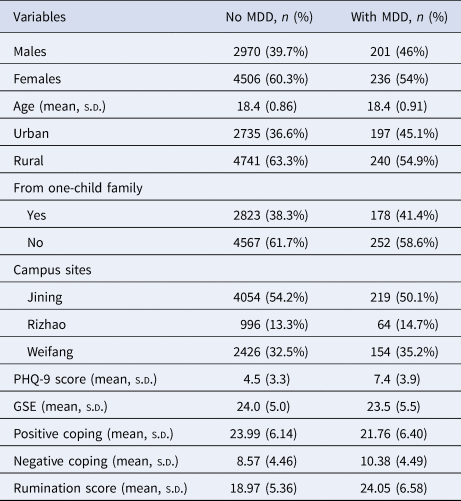
At baseline, 7476 participants did not have a lifetime MDD and 437 reported a lifetime MDD. The baseline characteristics of the participants with and without a lifetime MDD are shown in Table 1. As the participants were from two medical universities, there were more females than male students. About half of the sample was recruited from the Jining campus, and over 60% of the students came from rural areas. Participants without a lifetime MDD had a higher mean score of positive coping and lower mean scores of negative coping and rumination than those with a lifetime MDD.
Baseline characteristics of the participants without a lifetime MDD

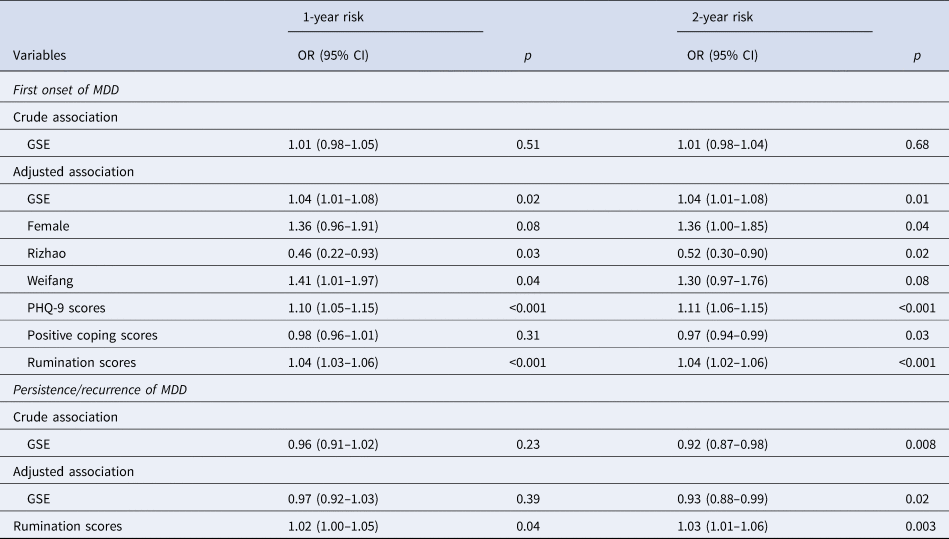
In the longitudinal analysis, participants without a lifetime MDD at baseline were included (n = 7476). The data showed that GSE scores were not associated with the 1-year and 2-year risks of MDD (Table 2). There was no evidence that GSE interacted with other selected variables in relation to the risk of first onset of MDD (online Supplementary Table S1). The random effect multivariate logistic regression modeling showed that baseline GSE was positively associated with the 1-year and 2-year risks of MDD [adjusted odds ratio (OR) 1.04, 95% confidence interval (CI) 1.01–1.08]. Females, participants with higher PHQ and rumination scores, were more likely to have had MDD over 2 years compared to others; those located in the Rizhao campus and those with higher positive coping scores were less like to have had MDD compared to their counterparts (Table 2). Age, rural/urban residence, and family structure were not significantly associated with 1-year or 2-year risk of MDD, therefore, were not included in the final model.
Associations between baseline GSE and 1-year and 2-year risks of first onset and persistence/recurrence of MDD

To investigate the impact of GSE on persistence/recurrence of MDD, students with a lifetime MDD at baseline were included (n = 437). Random effect logistic regression modeling showed that GSE scores were not significantly associated with 1-year risk of recurrent/persistent MDD; GSE scores were significantly associated with the 2-year risk of persistent/recurrent MDD (crude OR 0.92, 95% CI 0.87–0.98; adjusted OR 0.93, 95% CI 0.88–0.99) (Table 2). Other selected variables were not significantly associated with the risk of recurrent/persistent MDD, except for baseline rumination scores which was positively associated with the recurrent/persistent MDD (Table 2). There was no evidence that GSE interacted with other selected covariates in relation to the persistence/recurrence of MDD (online Supplementary Table S1).
Discussion
Data from this 2-year longitudinal study revealed that participants with higher GSE scores were less likely to have had recurrent/persistent MDD. However, the effect was not statistically significant over the 1-year period. On the contrary, multivariate analysis showed that participants with higher GSE scores were more likely to have developed the first onset of MDD.
Findings from longitudinal studies on the impact of self-efficacy on depression have not been consistent. Bandura and colleagues found that higher levels of self-efficacy lead to lower levels of depressive symptoms in middle adolescence (Bandura et al., Reference Bandura, Caprara, Barbaranelli, Gerbino and Pastorelli2003). In a Japanese workplace cohort, Taneichi et al. reported that the inverse association between self-efficacy and depression was sex specific (Taneichi et al., Reference Taneichi, Asakura, Sairenchi, Haruyama, Wada and Muto2013). However, a Dutch prevention trial in adolescents found that self-efficacy did not predict subsequent depressive symptoms (Tak et al., Reference Tak, Brunwasser, Lichtwarck-Aschoff and Engels2017). The findings of our study differed from previous studies in terms of the direction of the association. There are notable methodological differences between previous longitudinal studies and ours. First, the outcome of our study is the first onset of MDD assessed by a fully structured diagnostic interview based on the DSM-IV criteria, not depressive symptoms. Low self-efficacy may have an immediate impact on depressive symptoms (Tak et al., Reference Tak, Brunwasser, Lichtwarck-Aschoff and Engels2017); it may not have a significant impact on the first onset of MDD, or such a significant impact may take a long time to emerge. Second, our study population was first-year university students who were born and grew up during the time when China experienced fast economic development. Cultural and economic differences may contribute to the discrepancies in the results. Third, a majority of the students were 18 years or younger at baseline. They were still in a sensitive developmental period in which they experienced rapid and profound changes in social, emotional, and academic changes, and tried to develop confidence in their own ability to deal with the challenges in these domains. Their self-efficacy was still developing and was unstable during the study period. Youth at this stage may be overly confident (Stankov, Morony, & Lee, Reference Stankov, Morony and Lee2014) with under-developed coping ability, and the mismatch between overconfidence and actual coping ability may precipitate the development of depression and other mental health problems when they encounter life stressors (Hoven et al., Reference Hoven, Lebreton, Engelmann, Denys, Luigjes and van Holst2019). Future studies in youth and young adult populations are needed to replicate these findings.
Intervention studies on mental disorders have found that treatment outcomes are generally better among individuals with higher self-efficacy (Brenninkmeijer, Lagerveld, Blonk, Schaufeli, & Wijngaards-de Meij, Reference Brenninkmeijer, Lagerveld, Blonk, Schaufeli and Wijngaards-de Meij2019; Kavanagh & Wilson, Reference Kavanagh and Wilson1989). High self-efficacy may improve people's willingness to persist with self-management activities (Seligman, Reference Seligman1975); depressed individuals with low self-efficacy are more likely to ruminate about their inabilities to deal with stress (Strecher et al., Reference Strecher, McEvoy DeVellis, Becker and Rosenstock1986), leading a higher risk of recurrence of depressive episode. The findings about the association between GSE and the risk persistent/recurrence of MDD are consistent with the theoretical basis and empirical evidence. This finding has important implications that restoring self-efficacy through interventions in this population may prevent recurrence and early recovery of MDD. However, the data of this study showed that the protective effect of GSE on persistent/recurrent MDD was not significant over 1 year. The non-significant effect over 1 year may be due to type II error. Alternatively, the protective effect of self-efficacy may take more than 1 year to emerge. More studies are needed to further delineate the relationship between GSE and the risk of persistent/recurrent MDD.
This study has several limitations. First, the data were collected by self-report. Therefore, reporting and recall biases are possible. Also the CIDI was completed by computer-assisted self-administration, which may incur intentional and/or unintentional biases in reporting. However, the scoring algorithm for MDD was run by a team member who was blinded to participants’ names after data collection was completed. This may help minimize the bias related to the mode of CIDI administration. Second, although we reached a high response rate of 93.5% at the first annual follow-up, the 2-year response rate was 66.5% because of the pandemic. Lost-to-follow-up may incur selection bias which may either overestimate or underestimate the results of our study. However, to certain extent, the use of random effect multilevel logistic regression modeling which considered the effect of censorship may have minimized the impact of attrition. Third, self-efficacy was measured at baseline only. As the construct of self-efficacy may change over time, future studies should collect self-efficacy data at all follow-up assessments, and analyze it as a time-varying variable. Finally, this study was conducted in first-year students in two Chinese medical universities, cautions should be taken to interpret the results and to generalize the results to populations in different age groups and different regions and countries.
The first year at university can be extremely challenging for several students. The onset of MDD may have a considerably negative impact on their subsequent educational attainment, academic performance, and participation in workforce. Self-efficacy has long been considered a pivotal factor in the etiology and prognosis of depression. Our longitudinal study provided evidence that high self-efficacy is associated with a low risk of persistence or recurrence of MDD in females. We encourage more longitudinal studies on this topic, particularly on the relationship between self-efficacy and first onset of MDD, so that we can have a better understanding about the etiology of MDD and formulate effective interventions in this population.
Supplementary material
The supplementary material for this article can be found at https://doi.org/10.1017/S0033291721003238
Acknowledgements
This study was funded by the Natural Science Foundation of China (Grant number: 81901391); the Natural Science Foundation of Shandong Province (Grant number: ZR2019MH095); Undergraduate Innovation and Entrepreneurship Training Program (Grant number: cx2019112), and Taishan Scholars Program of Shandong Province (Grant number: tsqn201909145). All of these funders had no role in the design and conduction of this study.
Author contributions
YL and JLW contributed to the study design. DBL, GLL, JZ, SY, XL, and YL conducted the survey quality control, data collection, and logical check. JLW analyzed the data and wrote this manuscript. All authors reviewed and approved the manuscript.
Conflict of interest
None.
Ethical standards
This study was approved by the Medical Research Ethics Committee of Jining Medical University, Jining, China.