Introduction
Traditionally, Acacia Miller has been recognised as a broadly circumscribed, morphologically variable pantropical genus of about 1500 species (Lewis et al., Reference Lewis, Schrire, Mackinder and Lock2005). More recently, molecular studies have shown that Acacia sensu lato is polyphyletic and comprises at least five distinct genera: Acacia sensu stricto, Acaciella Britton & Rose, Mariosousa Seigler & Ebinger, Senegalia Rafinesque and Vachellia Wight & Arnott (Miller et al., Reference Miller, Grimes, Murphy, Bayer and Ladiges2003; Seigler et al., Reference Seigler, Ebinger and Miller2006; Miller & Seigler, Reference Miller and Seigler2012). Consequently, many species previously accommodated within Acacia sensu lato have been transferred to one of the other four genera, and in the majority of cases a new combination within the appropriate genus has been published. Several such new combinations were made for former Acacia sensu lato species native to Socotra, Republic of Yemen (Ragupathy et al., Reference Ragupathy, Seigler, Ebinger and Maslin2014), but the authors overlooked the need for a new combination for Acacia pennivenia Schweinf., a Socotran endemic species. We make that combination here and designate a lectotype. This combination is required for the recently revised IUCN Red List assessments of trees and endemic species of the Arabian Peninsula and reassessments of selected taxa for the Socotra (also spelled Soqotra) Archipelago.
Materials and Methods
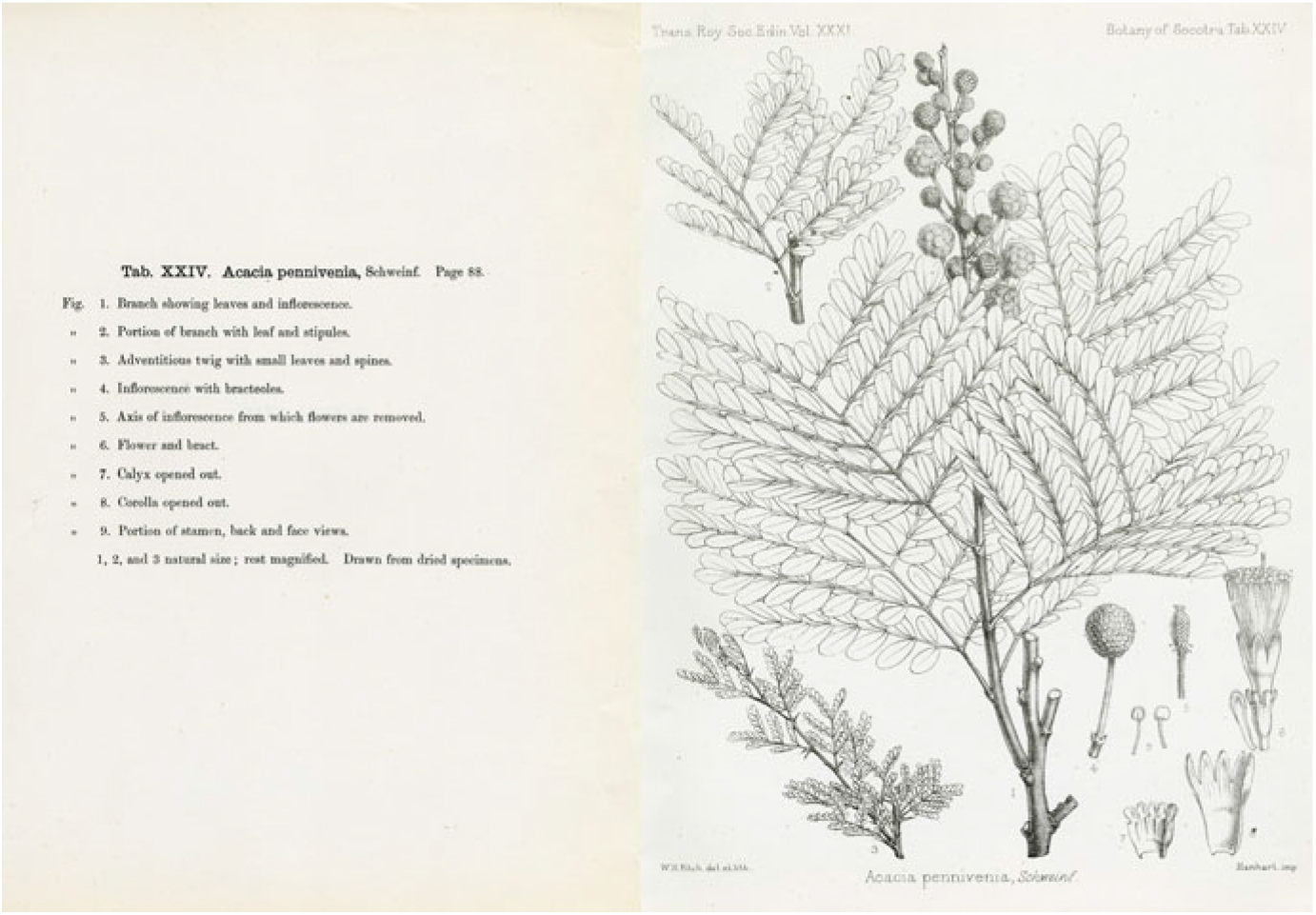
Data regarding this species have been collated from published and unpublished data sets held by the Centre for Middle Eastern Plants at the Royal Botanic Garden Edinburgh (RBGE). Anatomical measurements are derived from herbarium holdings at RBGE (E). Morphological terminology follows Hickey & King (Reference Hickey and King2000). Estimates of the extent of occurrence (EOO) and area of occupancy (AOO) of each species were made using GeoCAT (Bachman et al., Reference Bachman, Moat, Hill, de La Torre, Scott, Scott and Peney2011). Distribution maps and GeoCAT calculations are based on occurrence data derived from herbarium specimen collection localities and from field observations. We include a line drawing of the taxon first presented by Balfour (Reference Balfour1888). An updated description of the species is provided below.
Nomenclature and Taxonomy
Vachellia pennivenia (Schweinf.) F.L.Anderson & Knees, comb. nov. – Acacia pennivenia Schweinf., Proc. Roy. Soc. Edinb. 12: 404 (1884). – Type: Socotra, Wadi Digal, 23 iv 1881, Schweinfurth 519 (lecto K [K000244273], designated here). Figs. 1, 2.
Line drawing of Vachellia pennivenia (as Acacia pennivenia) reproduced from Botany of Socotra, t. 24 (Balfour, Reference Balfour1888).
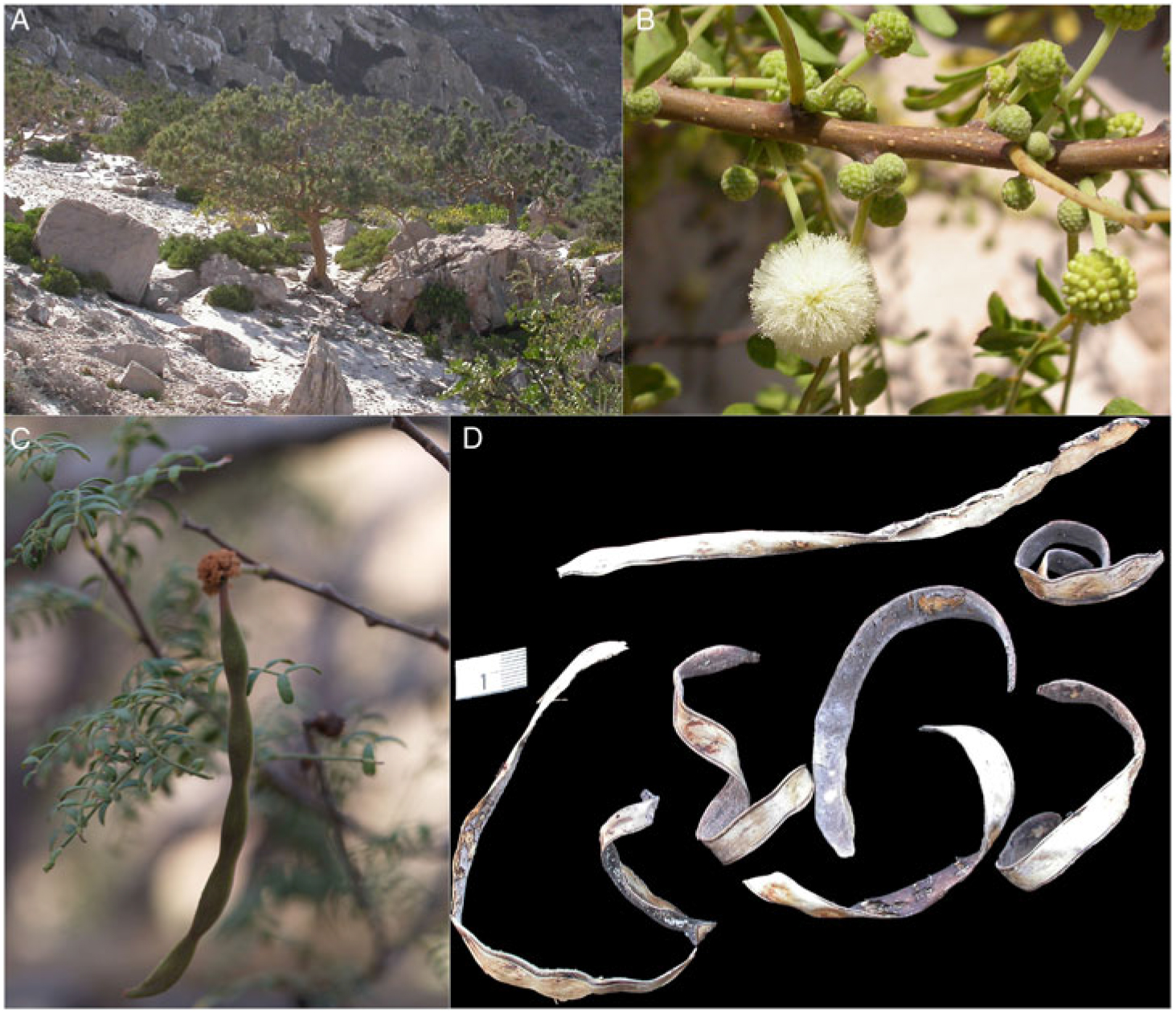
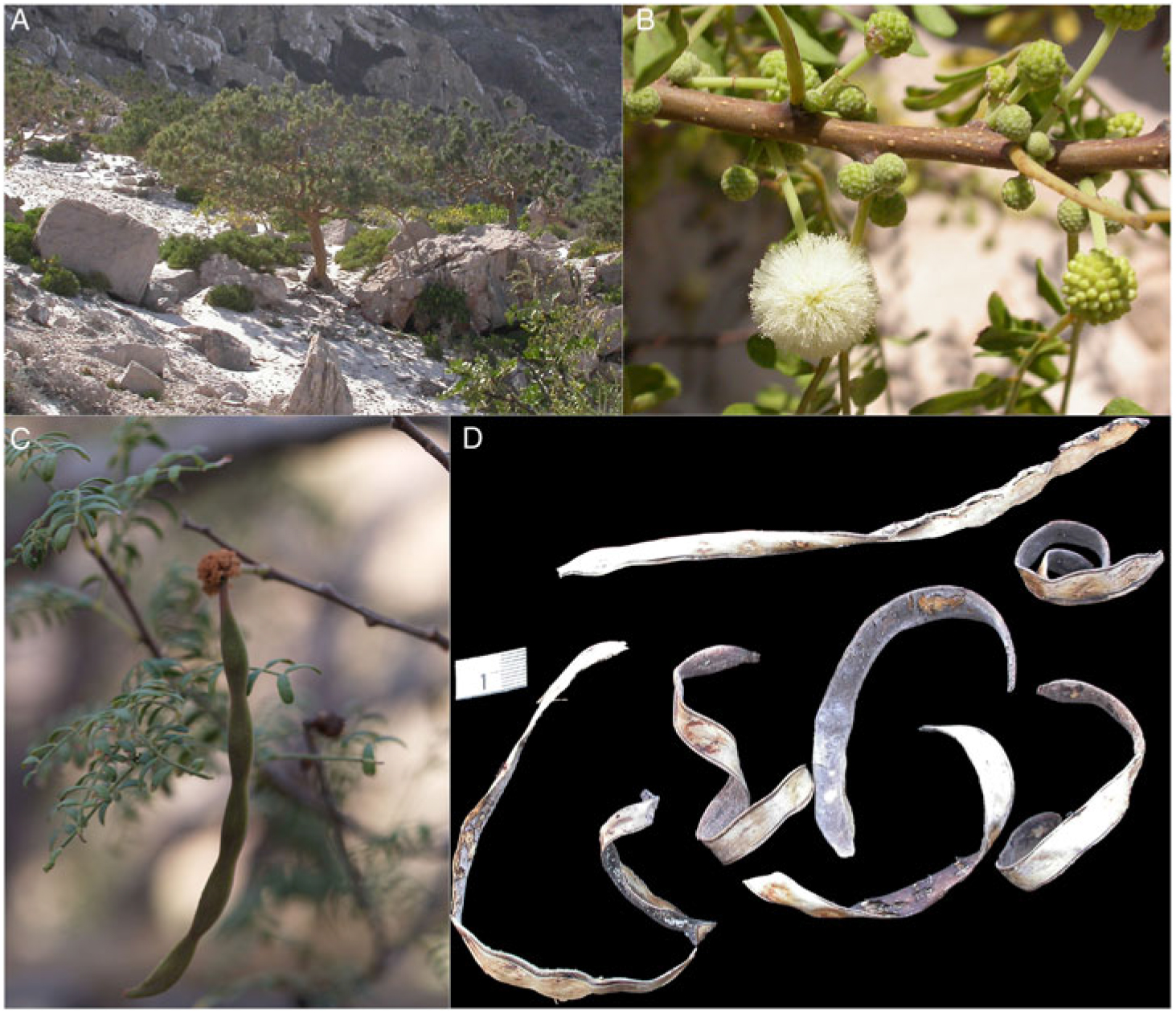
Vachellia pennivenia. A, Habitat and habit; B, inflorescences at various stages of development; C, immature pod; D, fallen pods. (Photographs: A and D, Lisa Banfield; B, Anthony Miller; C, Petr Maděra.)
Tree to 5 m. Bark rough, brown, with pale yellow lenticels, branchlets finely striate, tawny brown or grey to purplish brown when immature, glabrous to pubescent, with scattered rusty brown to pale yellow ovate lenticels, c.1 mm long. Stipular spines in pairs or absent, c.1.5–3mm long, straight, tawny brown, pubescent with rusty grey hairs. Leaves bipinnate, glabrescent to shortly pubescent along the petiole, rachis and rachillae; petiole (5–)12–35(–40) mm long, flattened, grooved, rusty brown to grey-green with prominent dark red midrib on underside, particularly evident in dried material; rachis 8–26(–35) mm long, flattened, grooved, grey-green with prominent dark red-purple midrib on underside; glands when present single, circular, 0.5–1 mm in diameter, rusty orange, occasionally at the point of insertion of the top pair of pinnae or rarely on the rachillae at the point of insertion of the top pair of leaflets; pinnae usually 2 pairs (rarely 3), grey-green with darkened midrib along underside of rachilla; leaflets 6–11 pairs, oblanceolate, 6–16 × 2–4.5 mm, opposite or subopposite, shortly puberulous at base, particularly on underside, base variable, apex rounded to abruptly acute, occasionally mucronulate, rugose, yellow or grey-green above, yellow or grey-green below, midvein purplish black often with reddish secondary veins. Inflorescence an axillary cluster of pedunculate heads. Flowers in heads 4.5–11 mm in diameter, creamy white to pale yellow; peduncle 10–20 mm; involucel within the lower 2/3 of the peduncle; calyx 1–2 mm long; corolla 2–3 mm long; stamen filaments 2.5–4.5 mm long. Pods unknown from herbarium collections but see notes below.
Habitat. Occurs in a variety of habitats throughout Socotra, but mostly as a component of drought deciduous woodland at lower elevations and less commonly in semi-evergreen woodland above 500 m. In places it may be codominant with Croton socotranus Balf.f. and Jatropha unicostata Balf.f. It is often found on rocky slopes and gravel in the unique succulent shrubland of Socotra with Dendrosycios socotrana Balf.f. and Adenium obesum (Forssk.) Roem. & Schult. Fig. 2A.
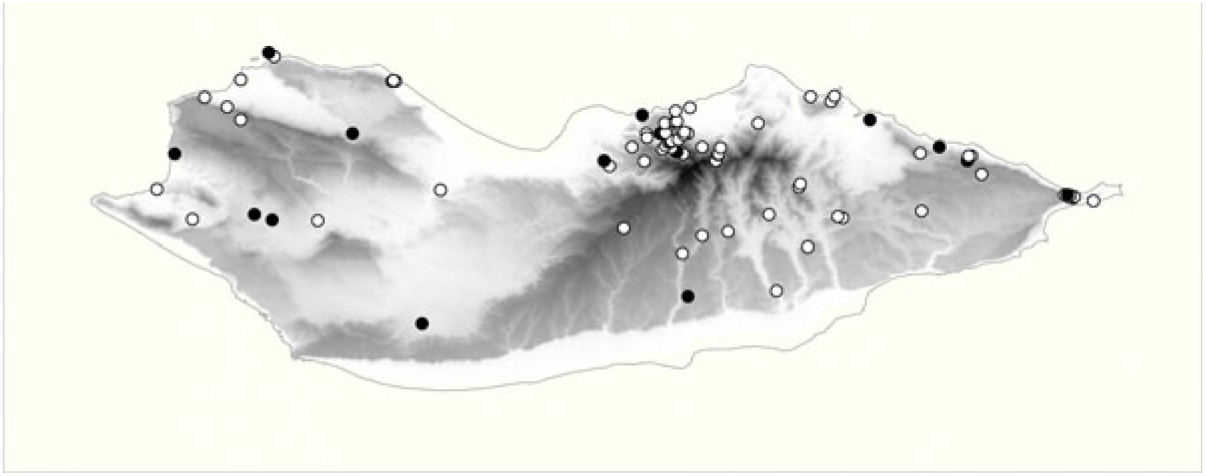
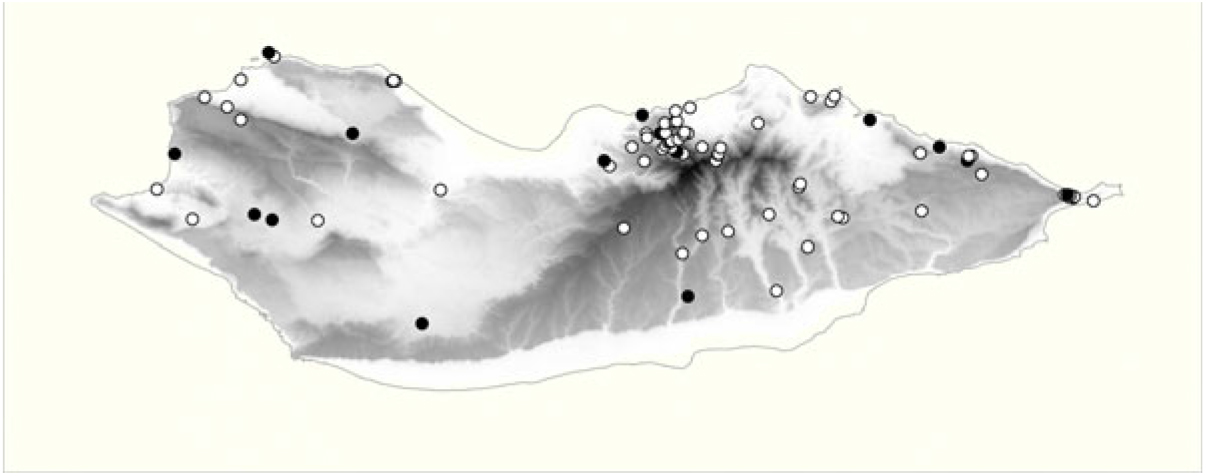
Distribution. Socotra, Republic of Yemen (endemic). Fig. 3.
Distribution of the endemic Socotran species Vachellia pennivenia. Closed circles, localities based on herbarium records; open circles, localities based on field observations.
Field characters. Leaves may be succulent or not in appearance. Typically 2 pairs of pinnae, rarely 3. Stipular spines short, sometimes absent. Distinct but unspecified odour on cutting twigs. Flower heads white or cream-coloured.
Balfour (Reference Balfour1888) provisionally recorded the presence of an Entada species on Socotra. He described the putative Entada species as “a beautiful and graceful tree of which our material is too fragmentary to permit identification” and cited a single voucher Balfour, Cockburn & Scott 635. No specimen has been traced and the identity of the taxon remains uncertain. However, Balfour (Reference Balfour1888) also noted that the taxon had some resemblance to Acacia pennivenia Schweinf. and shared the same local name of tomhor. No species of Entada has since been recorded from the island, and Miller & Morris (Reference Miller and Morris2004) concluded that it is likely that Balfour’s plant was in fact Acacia pennivenia.
In 2008, during fieldwork in Socotra near Irisal (Fig. 2A), pods were seen on the ground in the close vicinity of individuals of Vachellia pennivenia (L. Banfield, Al Ain Wildlife Park & Resort, Abu Dhabi, personal communication). Banfield’s photograph (Fig. 2D) shows pods that are linear, compressed and up to about 15 × 0.7 cm. These may represent the first record of mature pods of Vachellia pennivenia. We have since seen a photograph of a developing pod, taken by Petr Maděra on Socotra in 2009, and this is now reproduced here (Fig. 2C).
The species is common in the succulent shrubland of Socotra, and it is noted that the leaves seem to develop thickening and succulence with age. This is a trait shared by several of the plants that grow in this community and is probably an adaptation to desiccation caused by the extremely drying winds of the summer monsoon. This observed succulence is not a feature generally found in Acacia sensu lato or Vachellia.
Conservation
Vachellia pennivenia is assessed here as Least Concern (LC) under the criteria version 3.1 of the IUCN (IUCN, 2012). At just under 3000 km2, the estimated EOO of this species falls within the Endangered (EN) threshold of less than 5000 km2 for criterion B1, as does the estimated AOO, at only 244 km2 for a threshold of less than 500 km2. However, we do not consider Vachellia pennivenia to warrant placement within a threatened category, because current evidence indicates that the species does not fulfil the other conditions. Namely, (a) Vachellia pennivenia is not severely fragmented, occurring widely across the island (see Fig. 3), and as such the known potential threats are unlikely to apply across the entire range, (b) no continuing decline in population has been observed, and (c) extreme fluctuations in any of the listed categories do not usually apply to long-lived tree species.
Previously, Vachellia pennivenia (as Acacia pennivenia) was listed as Vulnerable (VU D2) by Oldfield et al. (Reference Oldfield, Lusty and MacKinven1998), using criteria version 2.3, and as Near Threatened (NT) by Miller & Morris (Reference Miller and Morris2004), also using criteria version 2.3. In their justification, Miller & Morris (Reference Miller and Morris2004) described Vachellia pennivenia as abundant but regularly lopped for livestock fodder and browsed in dry periods. It was noted that should livestock numbers increase greatly, or a succession of drought years occur, then this species could become increasingly threatened. Concerns expressed by Miller & Morris (Reference Miller and Morris2004) about the impact of droughts remain, but conversely, data gathered in the interim period show that Vachellia pennivenia is more widely distributed than previously thought and occurs in a more diverse range of habitats, with no reports of sustained decline in any of those habitats.
Consequently, based on our current data and understanding of threats, we consider the conservation status of Vachellia pennivenia to be Least Concern (LC).
Author Orcid
Felicity Anderson 0000-0001-8778-6779
Acknowledgements
We are grateful to the RBGE Sibbald Trust for funding the first author (F.A.). We would also like to thank Barbara Mackinder for advice on the nomenclature, as well as Lisa Banfield, Anthony Miller and Petr Maděra for the use of their photographs. The RBGE is supported by the Scottish Government’s Rural and Environmental Science and Analytical Services Division.