Flavour is probably the most important characteristic of cheese quality. For this reason, cheese flavour compounds have been the subject of numerous scientific investigations (for review see Molimard & Spinnler, Reference Molimard and Spinnler1996; Fox & Wallace, Reference Fox and Wallace1997; Sablé & Cottenceau, Reference Sablé and Cottenceau1999; Curioni & Bosset, Reference Curioni and Bosset2002). More than 600 volatile compounds have been identified in different cheese varieties and many have been related to particular odour and aroma notes (Curioni & Bosset, Reference Curioni and Bosset2002).
The starter culture enzymes catalyze the metabolic pathways involved in the generation of flavour compounds (Smit et al. Reference Smit, Smit and Engels2005). Particularly, a correct pattern of proteolysis is essential for the development of the characteristic flavour of hard and semi-hard cheeses (Singh et al. Reference Singh, Drake and Cadwallader2003). The oligopeptide transport system (Opp) plays a crucial role in milk peptide utilization (Kunji et al. Reference Kunji, Mierau, Hagting, Poolman and Konings1996). Lactococcus lactis AMP2I was designed to express a mutant oligopeptide binding protein (OppA), in which the aspartyl residue at position 471 was replaced by arginine (Picon et al. Reference Picon, de Torres, Gaya and Nuñez2005). When this mutant strain was used as cheese starter, a higher production of several free amino acids was recorded in comparison with the production by the isogenic strain Lc. lactis AMP1I expressing wild-type OppA (Picon et al. Reference Picon, Gaya and Nuñez2007). Most amino acids can be further converted to potent flavour compounds such as aldehydes, alcohols and carboxylic acids (Smit et al. Reference Smit, Smit and Engels2005). In the present study, volatile compounds in cheeses made with Lc. lactis AMP2I and Lc. lactis AMP1I were compared, to test the hypothesis that a different oligopeptide transport system in isogenic strains of starter bacteria can modify the volatile compound profile of cheese.
Materials and methods
Lactococcal strains and growth conditions
Lc. lactis AMP1I is a Lc. lactis MG1363-derivative that lacks oppA and contains plasmids pAMP31, with the oppA gene and an erythromycin-resistant marker, and pLP712, with the genes for proteinase and lactose utilization (Picon et al. Reference Picon, de Torres, Gaya and Nuñez2005). Lc. lactis AMP2I is isogenic to strain AMP1I but contains plasmid pAMP31(D471R) instead of pAMP31 (Picon et al. Reference Picon, de Torres, Gaya and Nuñez2005). Plasmid pAMP31(D471R) codes for an OppA protein in which the aspartyl residue at position 471 was replaced by arginine (Picon et al. Reference Picon, Kunji, Lanfermeijer, Konings and Poolman2000). All Lc. lactis strains were inoculated from frozen stocks into M17 broth (Difco, Detroit, MI, USA) with 5 μg erythromycin (St. Louis, Mo, USA) per ml and were grown at 30°C prior to inoculation in 10% reconstituted skim milk.
Cheese manufacture
Small Hispánico cheeses of approximately 250 g were manufactured in duplicate from 2 l pasteurised whole milk (total viable counts under 100 cfu ml−1) in the Food Technology Department pilot plant. Milk at 31°C with 0·2 g CaCl2/l added was inoculated with 1% of a fresh Lc. lactis culture in sterile milk. Lc. lactis AMP1I was used as starter culture for control cheese, and Lc. lactis AMP2I for experimental cheese. After 20 min, 1 ml/l of a fresh 10% (w/v) solution of Chy-Max (Christian Hansen, Hørsholm, Denmark) was added and milk was held at 31°C for 40 min to clot. The rest of manufacture and ripening procedures were as described by Picon et al. (Reference Picon, Gaya and Nuñez2007).
Microbiological analyses
Cheese samples (5 g) were homogenised in a Stomacher in 45 ml of a 20 g sodium citrate/l solution for microbiological analysis. Decimal dilutions were prepared in sterile 1 g peptone/l aqueous solution. Lactococci counts were determined in duplicate on M17 agar (Biolife, Milano, Italy), after incubating at 30°C for 48 h. Erythromycin resistant bacterial counts were determined in duplicate on M17 agar supplemented with 5 μg erythromycin/ml, after incubating at 30°C for 48 h.
Chemical analyses
All chemicals were of reagent grade and obtained from commercial sources. Cheese pH was measured in duplicate using a penetration electrode (Xerolyt 52-32, Crison, Barcelona, Spain). Dry matter was determined (in triplicate) by the official method of the AOAC (Reference Williams1984). Volatile compounds were determined in duplicate by dynamic headspace gas chromatography as described by Fernández-García et al. (Reference Fernández-García, Carbonell and Nuñez2002). Cheese pieces wrapped in aluminium foil were vacuum packed and frozen at −40°C until analysis. An automatic dynamic headspace apparatus (Purge and Trap, HP 7695, Agilent, Palo Alto, CA), equipped with a Vocarb 4000 trap (Tekmar, Mason, Ohio), connected to a gas chromatograph-mass spectrometer (HP 6890 – MSD HP 5973, Agilent) was used for the analysis of volatile compounds. Frozen samples (10 g) were homogenized in an analytical grinder (IKA Labortechnik, Staufen, Germany) with 20 g Na2SO4 and 30 μl of an aqueous solution containing 0·5 mg cyclohexanone/ml as internal standard (IS). Aliquots of 3 g were subjected to He purge. Compound identification was carried out by injection of authentic standards, by spectra comparison using the Wiley275 Library (Wiley & Sons Inc., New York, USA), and/or by calculation of linear retention indices (LRI) relative to a series of alkanes injected together with some of the samples. The sums of abundances of characteristic ions for each compound were used for semi-quantitation. Results were expressed as percentages of the abundance of the internal standard peak.
Statistical analysis
Statistical analysis was performed by means of the SPSS Win 8.0 software. Analysis of variance was carried out using lactococcal strain and time of ripening as main effects. Comparison of means was performed with the Tukey′s test. Pearson correlation coefficients were calculated between the volatile compound abundances determined in this study and the free amino acids concentrations determined in cheeses made in a previous experiment using the same strains and manufacturing conditions (Picon et al. Reference Picon, Gaya and Nuñez2007). Principal component analysis (PCA) with Varimax rotation was performed with selected volatile compounds. The selected compounds are those appearing in Fig. 1.
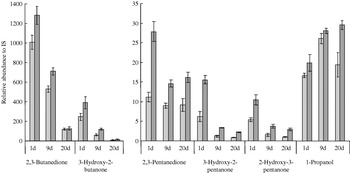
Bar graph showing the abundances (mean±standard error) of diketones, hydroxy-ketones and 1-propanol in control and experimental cheeses at different stages of ripening.  Control cheeses;
 Experimental cheeses.

Results
Bacterial counts and pH
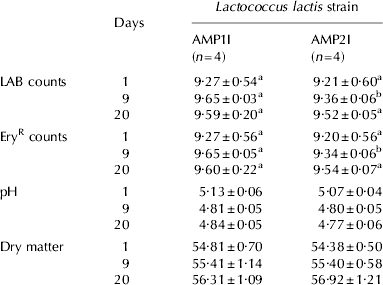
Bacterial counts in the presence or absence of erythromycin were identical, proving that all bacteria found in any of the cheeses came from the added starter. No significant differences in bacterial counts were recorded between experimental and control cheeses after 1 and 20 d ripening (Table 1), although bacterial counts were significantly (P<0·05) lower in 9 d-old experimental cheese than in the respective control cheese.
Bacterial counts (log cfu g−1), pH values and dry matter (%) during ripening of cheeses made with Lactococcus lactis strains AMP1I (control) and AMP2I (experimental)
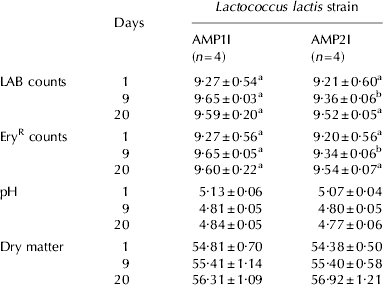
a,b Values (mean±sd) followed by the same superscript letter within the same row are not significantly different (P<0·05)
Analysis of variance showed no significant differences between cheeses in pH values, which decreased with cheese age (Table 1).
Volatile compounds
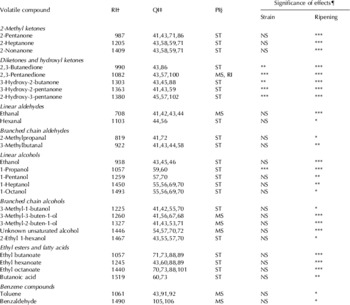
Relative abundances of seven aldehydes, ten ketones, seventeen alcohols, five esters, two volatile fatty acids, eight hydrocarbons, four terpenes, one sulphur compound and eight benzene compounds were determined in cheeses after 1, 9 and 20 d ripening. Table 2 lists the volatile compounds which were significantly affected by either ‘lactococcal strain’, ‘time of ripening’, or both factors. Chromatographic indices, ions used for quantitation and significance of the effects are also shown.
Volatile compounds identified in the headspace of control and experimental cheeses, significantly affected by any of the effects, lactococcal strain used as starter and time of ripening

† RI, Retention indexes
‡ QI, Ions used for quantification
§ PI, Peak identification: ST, comparison of spectra and retention time with authentic reference substances; RI, comparison of RI with bibliographic data; MS, tentatively identified by spectra comparison using Wiley 275 library
¶ NS, non significant; *, P<0·05; **, P<0·01; ***, P<0·001
Volatiles identified which did not show significant effects: 2-propanone, 2-butanone, heptanal, nonanal, decanal, 1-butanol, 1-hexanol, 2-propanol, 2-butanol, 2-pentanol, 2-methyl-2-propanol, 2-methyl-1-propanol, hexanoic acid, methyl acetate, ethyl acetate, pentane, hexane, octane, decane, 1,3-pentadiene, 3,7-dimethyl octene, undecane, dodecane, α-pinene, β-pinene, camphene, limonene, thiobismethane, ethyl benzene, p-xylene, m-xylene, o-xylene, acetophenone and naphtalene
Ketones and aldehydes
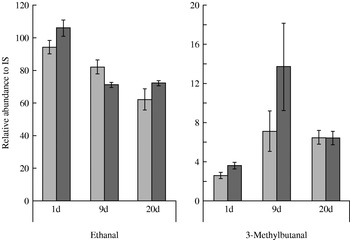
The use of Lc. lactis AMP2I favoured the formation of significantly (P<0·01) higher levels of the vicinal diketones 2,3-butanedione (diacetyl) and 2,3-pentanedione, and of their reduction products 3-hydroxy-2-butanone (acetoin), 3-hydroxy-2-pentanone and 2-hydroxy-3-pentanone (Table 2; Fig. 1). Lc. lactis AMP2I also favoured the formation of significantly higher levels of ethanal and branched chain aldehydes in 1 d-old cheese, although no significant differences were found afterwards. In the case of 3-methylbutanal, higher levels in experimental than in control cheese were observed only until d 9 (Fig. 2). Other ketones and aldehydes were not influenced by the lactococcal strain used as starter culture (Table 2).
Bar graph showing the abundances (mean±standard error) of ethanal and 3-methylbutanal in control and experimental cheeses at different stages of ripening.  Control cheeses;
 Experimental cheeses.

Methyl ketones 2-heptanone and 2-nonanone increased, while diketones and hydroxy ketones decreased significantly (P<0·001) with ripening time.
Alcohols, fatty acids and esters
Among these groups of compounds, only 1-propanol levels increased significantly (P<0·001) with the use of Lc. lactis AMP2I (Table 2; Fig. 1). Ripening time had a positive significant effect on the levels of primary alcohols with uneven carbon atom number (1-propanol, 1-pentanol and 1-heptanol; P<0·05), on those of the unsaturated alcohols 3-methyl-3-buten-1-ol and 3-methyl-2-buten-1-ol (P<0·001), as well as on butanoic acid (P<0·01) and most ethyl esters (P<0·001) (Table 2).
Hydrocarbons, terpenes, sulphur compounds and benzene compounds
The use of Lc. lactis AMP2I had no significant effect on any of these groups of compounds. Hydrocarbons tended to decrease and benzene compounds tended to increase during early ripening, but differences were not statistically significant (data not shown).
Principal component analysis (PCA)
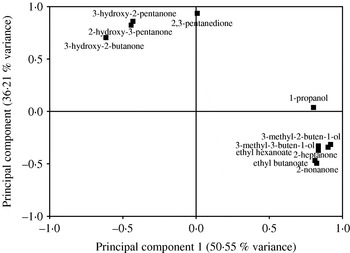
Principal components 1 (PC1) and 2 (PC2) explained 50·55% and 36·21% of the variance respectively. Figure 3 represents the loading plot of the correlation coefficients of the variables in the plane defined by the two PCs, showing two differentiated groups of variables. 2-Methyl ketones, 1-propanol, unsaturated alcohols and ethyl esters occupy the right side of the plane due to their high positive correlation with PC1. A second group of variables, including 2,3-pentanedione, 3-hydroxy-2-butanone, 3-hydroxy-2-pentanone and 2-hydroxy-3-pentanone occupy the upper left side of the plane with high positive correlation coefficients with PC2 and negative correlation coefficients with PC1.
Loading plot of the volatile compounds in the rotated space determined by the principal components.

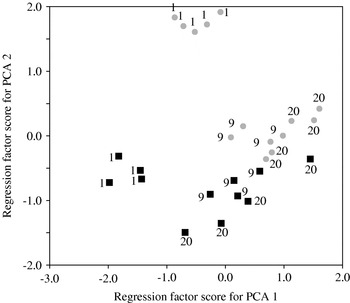
Figure 4 shows the loading plot of the factor scores extracted by the PCA for each cheese sample. Control cheeses occupied the lower part of the plane whereas experimental cheeses were found at the upper part.
Loading plot of the factor scores of the cheese samples in the plane defined by principal components. ■ Control cheeses;  Experimental cheeses. Numerical values in the figure correspond to days of ripening.

Discussion
Since Lc. lactis AMP2I is a genetically modified organism and the plasmid from which OppA is expressed has an antibiotic marker, sensory evaluation of a cheese made with this strain is precluded. In this case, headspace gas chromatography is a useful tool to determine the effect of this strain on cheese aroma.
The plots of the correlation coefficients of the variables extracted in the PCA (Fig. 3) and that of the calculated sample factor scores (Fig. 4) distribute volatile and cheese samples in two well-defined groups. PC1 could be designated as ‘ripening time’, the more mature cheeses occupying the right part of the plane (Fig. 4) due to their higher contents in 2-methyl-ketones, esters, 1-propanol and unsaturated alcohols (according to Fig. 3). This is not an unexpected result since methyl-ketones, 2-heptanone and 2-nonanone, and ethyl esters are proven potent odourants, essential for the aroma of many cheese varieties (Curioni & Bosset, Reference Curioni and Bosset2002). The unsaturated alcohols 3-methyl-3-buten-1-ol and 3-methyl-2-buten-1-ol have been repeatedly observed in Spanish cheese varieties (Fernández-García et al. Reference Fernández-García, Carbonell and Nuñez2002; Garde et al. Reference Garde, Carbonell, Fernández-García, Medina and Nuñez2002). Although the abundance of 1-propanol was significantly higher in experimental cheese, this compound was more strongly correlated with ripening time than with the lactococcal strain.
PC2 could be named ‘lactococcal strain’. The effect of Lc. lactis AMP2I seemed to be limited to the formation of diketones, diacetyl, 2,3-pentanedione and the hydroxy-ketones. Diacetyl, with a buttery and vanilla-like odour, is a key aroma component of many cheese varieties. This molecule has been generally associated with citrate metabolism (Molimard & Spinnler, Reference Molimard and Spinnler1996; Curioni & Bosset, Reference Curioni and Bosset2002), although Ramos et al. (Reference Ramos, Jordan, Cogan and Santos1994) and Ott et al. (Reference Ott, Germond and Chaintreau2000) have suggested that threonine could be a precursor of diacetyl via activated acetaldehyde in the metabolism of lactic acid bacteria. Kieronczyk et al. (Reference Kieronczyk, Skeie, Langsrud, Le Bars and Yvon2004) postulated that some Lactobacillus strains can form diacetyl from aspartate.
The diketone 2,3-pentanedione, whose odour resembles that of diacetyl, is presumably linked to amino acid catabolism, and its reduction in cheese would produce 3-hydroxy-2-pentanone and 2-hydroxy-3-pentanone, and subsequently 2,3-pentanediol, in the same manner as acetoin and 2,3-butanediol are produced from diacetyl (Ott et al. Reference Ott, Germond and Chaintreau2000). These authors demonstrated that a Lb. delbrueckii Lac− strain was able to form 2,3-pentanedione from labelled threonine, via 2-ketobutyrate and 2-aceto-hydroxybutyrate, which suggested an interconnection between vicinal diketone formation and branched chain amino acid biosynthesis. Moreover, 2,3-pentanedione has been recently identified as a product of L-methionine degradation (via α-ketobutyrate) in the genus Brevibacterium (Arfi et al. Reference Arfi, Landaud and Bonnarme2006). In a previous work (Picon et al. Reference Picon, Gaya and Nuñez2007), we found that the majority of free amino acids were at higher concentrations in experimental cheese made with Lc. lactis AMP2I than in cheese made with Lc. lactis AMP1I. Subjecting the concentrations of free amino acids published by Picon et al. (Reference Picon, Gaya and Nuñez2007) to regression analysis with the relative abundances of volatile compounds found in the present study, significant correlations were observed between threonine and 2,3-pentanedione (r=0·72; P<0·001), 3-hydroxy-2-pentanedione (r=0·73; P<0·001) or 2-hydroxy-3-pentanedione (r=0·75; P<0·001). Although these results must be taken cautiously, they support the hypothesis that diketones could also originate from threonine in Lc. lactis AMP2I. Diketones and hydroxy ketones do not maintain high levels in mature cheese (Fernández-García et al. Reference Fernández-García, Carbonell and Nuñez2002), since they are probably reduced to 2,3-butanediol and 2,3-pentanediol, which are not easily detectable under our analytical conditions.
Other key volatile compounds originating from the degradation of amino acids are ethanal from threonine (Lees & Jago, Reference Lees and Jago1976), 2-methylpropanal derived from valine, and 3-methylbutanal derived from leucine, the three of them repeatedly identified as potent odorants in different cheese varieties (Curioni & Bosset, Reference Curioni and Bosset2002). In the present work, ethanal, like 2,3-pentanedione, was significantly correlated with the threonine content (r=0·70; P<0·001), 2-methylpropanal with the valine content (r=0·59; P<0·01) and 3-methylbutanal with the leucine content (r=0·45; P<0·05). As early as day 1, threonine, valine and leucine were at significantly higher concentrations in cheese made using Lc. lactis AMP2I as lactic culture than in cheese made using its isogenic strain Lc. lactis AMP1I (Picón et al. Reference Picon, Gaya and Nuñez2007). This was also true for the aldehydes ethanal, 2-methylpropanal and 3-methylbutanal, derived respectively from those amino acids. The modification of the oligopeptide transport system resulted in changes in the amino acid pool of the cheese which, in turn, brought about a different volatile profile.
The use of the mutant strain could have an implication at the sensorial level, given the low detection thresholds of diketones, especially 2,3-butanedione. However, more investigation is needed in cheeses with longer ripening times, and including an aroma sensorial test.
Conclusions
We can conclude that the use of the mutant strain Lc. lactis AMP2I as starter culture modified the profile of volatile compounds in real cheese, by enhancing the formation of diketones, hydroxy-ketones, and, to a narrower extent, of branched chain aldehydes and 1-propanol. The correlations found seem to link the formation of these compounds to the higher levels of specific amino acids, namely threonine, valine and leucine.
The authors thank Ana Rivas for her help with the chromatographic analyses.