Introduction
Sapphire has attracted enormous attention in mechanical, optics, and information applications due to its high mechanical strength, good light transmission, and stable chemical properties [Reference Oksenberg, Sanders, Popovitz-Biro, Houben and Joselevich1, Reference Montagne, Pathak, Maeder and Michler2, Reference Chen, Liu, Ge, Ma, Abbas and Zhou3, Reference Chambers, Droubay, Jennison and Mattsson4, Reference Tseng, Yen, Thomas and Tsai5]. In particular, sapphire has been undoubtedly the most widely used substrate material for photonic devices, especially light-emitting diodes (LED) [Reference Lin, Jariwala, Bersch and Xu6, Reference Shih, Wei and Wu7]. The demand for an ultrasmooth surface layer and high material removal rate (MRR) to enhance the surface quality of sapphire is increasing with the rapid development of technology. However, due to sapphire’s high hardness and strong chemical inertness, it is difficult to meet the above requirements. Currently, chemical mechanical polishing (CMP) has been increasingly recognized as the only widely accepted technology that combines both chemical and mechanical properties [Reference Jin-Hyung, Hao, Yi, Jea-Gun and Ungyu8, Reference Galvin, Griffin and Browne9]. It can not only realize the global planarization of the device surface, but also eliminate the device damage. Therefore, it has many potential applications in the fields of optics, semiconductors, and hard disks.
CMP depends on many factors such as abrasives, polishing time, polishing speed, and additives [Reference Krishnan, Nalaskowski and Cook10, Reference Abaneshwar, George and Li11], but abrasives are the most important factor which influences the surface planarization. To improve the MRRs), researchers have studied various types of abrasives such as colloidal silica [Reference Chen, Li, Qin and Chen12, Reference Zhang, Liu, Song and Hu13], α-alumina [Reference Shi, Pan, Zhou, Xu, Zou and Gong14, Reference He15], ceria [Reference Luo, Lu and Xu16], and nanodiamond [Reference Ahn, Yoon, Baek and Kim17] in recent decades. Colloidal silica shows excellent dispersion stability and great promise for mechanical wear when size and concentration are appropriate [Reference Park, Cho and Ahn18]. However, it easily undergoes gelling, which is a challenge for polishing. CeO2 abrasive can be used for polishing precision glass and dielectric layers of very-large-scale integrated circuits (VLSI) owing to its high chemical activity and moderate hardness [Reference Hassanzadeh-Tabrizi, Mazaheri, Aminzare and Sadrnezhaad19, Reference Abiade, Choi and Singh20]. But its viscosity is high and particles are easily adsorbed on the surface of wafer, which makes postcleaning difficult. α-Alumina acts as an abrasive with a fatal weakness of causing serious scratches, which is also an existing problem for nanodiamond particles [Reference Lei, Jiang and Chen21].
Recent advances in composite particles including physical and chemical composite abrasives provide new opportunities to obtain good surface quality and high MRR by mixing more than two abrasive types. Compared with pure abrasives, mixed abrasives have been proved efficient in getting ideal MRR, but their dispersibility is poor and they are easily flocculated [Reference Xu, Lu and Xu22, Reference Lu, Lee, Gorantla, Babu and Matijevic23]. Chemical composite abrasives are multiphase materials that consist of two or more different physical or chemical substances, including inorganic–inorganic [Reference Liu and Lei24, Reference Alliaume and Charpentier25, Reference Chen, Zuo, Li and Chen26, Reference Peedikakkandy, Kalita, Kavle, Kadam, Gujar, Arcot and Bhargava27], organic–inorganic [Reference Chen, Mu and Chen28, Reference Lei, Wang, Zhang, Fei, Liu and Song29, Reference Yang, Lind and Trogler30], and inorganic–organic structures [Reference Coutinho, Mudhivarthi, Kumar and Gupta31, Reference Chaudhuri and Paria32, Reference Penta, Dandu Veera and Babu33]. Although chemical composite abrasives result in lower surface roughness and fewer scratches than pure single-material systems under the same condition, they, however, have not fully satisfied the polishing requirements, and until now, it is difficult to realize the expectation of high removal rates and damage-free surfaces.
The development of polyelectrolytes has provided a highly affordable, practical, and potential approach for application in the fields of medicine, cosmetics, textiles, wastewater treatment, food, and filtration [Reference Zhou, Li, Wei, Hao, Chi, Liu and Wu34, Reference Martins, De, Garcia, Kipper and Martins35, Reference Ryan, Mengistie, Gabrielsson, Lund and Muller36, Reference Yang, Chen, Zou, Yang, Long and He37, Reference Haver and Nayar38, Reference Wang, Ji, Zhang, Li and Wang39]. As a polymer with many ionizable groups in the side chain or backbone, polyelectrolytes have obvious advantages over nonionic polymers due to high hydrophilicity and stability.
For the first time, we described a novel method to prepare a polyelectrolyte–abrasive nanosystem with both high removal efficiency and good planarization. First, a new kind of polymer electrolyte was prepared. The nanoparticle (α-alumina) was milled and silica was coated on it to obtain Al2O3/SiO2 composite abrasive. Then, the Al2O3/SiO2 composite nanoabrasive was modified with different polyelectrolytes, resulting in the final polyelectrolyte–Al2O3/SiO2 nanosystems. The nano-α-alumina acts as a core with excellent polishing effect. The silica acts as a bifunctional molecule. It links with α-alumina via covalent linkage, which decreases direct contact during polishing and thus decreases depth of scratches. At the same time, the silica adsorbs to the polyelectrolyte via electrostatic interactions with high MRR. In addition, the polyelectrolyte–Al2O3/SiO2 nanoparicles possess fine dispersibility in the long term. To the best of our knowledge, this is the first report on the application of polyelectrolyte–Al2O3/SiO2 composite abrasives in CMP.
Results and discussion
Characterization of polyelectrolyte–Al2O3/SiO2
SEM and TEM images
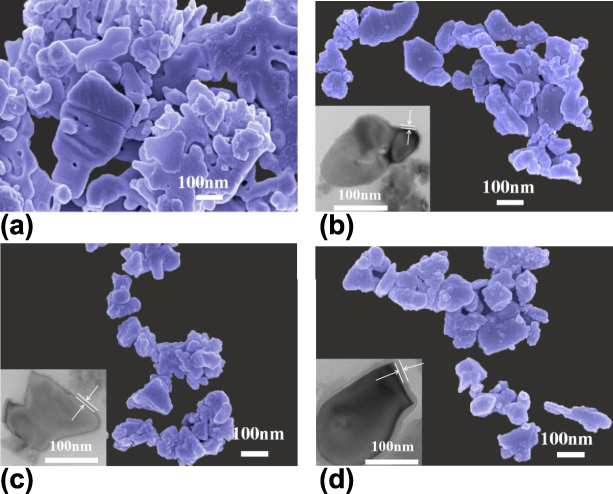
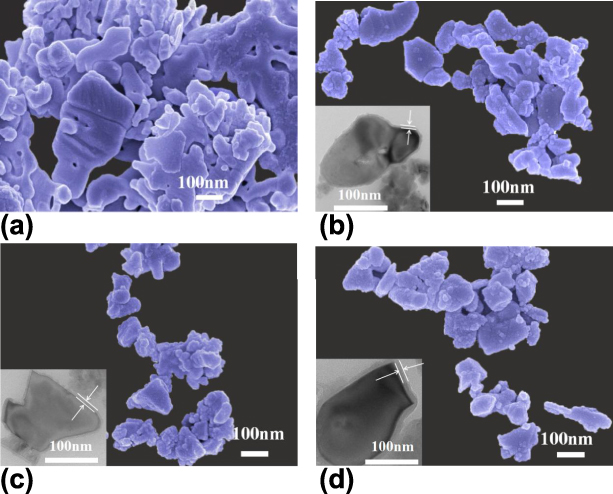
Scanning electron microscopy (SEM) and transmission electron microscopy (TEM) were used to analyze the morphology and structure of pure alumina, and Al2O3/SiO2 composite particles before and after modifying with polyelectrolytes. The results are shown in Fig. 1. Interestingly, the morphology of the samples before and after modifying is different. As shown in Fig. 1(a), pure alumina particles agglomerate intensively. The SEM image of Al2O3/SiO2 composite particles in Fig. 1(b) shows irregular and fine particles. Figures 1(c) and 1(d) present the morphology of Al2O3/SiO2 composite abrasives with different polyelectrolytes. The modified abrasives are small nanoparticles with a diameter of 100–200 nm. Furthermore, the dispersibility is better. At the same time, a well-defined 8-nm-thick SiO2 shell structure can be seen in TEM images of the particles.
SEM and TEM images of (a) pure Al2O3, (b) Al2O3/SiO2, (c) 0.5 wt% PAMAC–Al2O3/SiO2, and (d) 0.5 wt% PSMAZ–Al2O3/SiO2 abrasives.
Fourier transform infrared (FT-IR) spectra
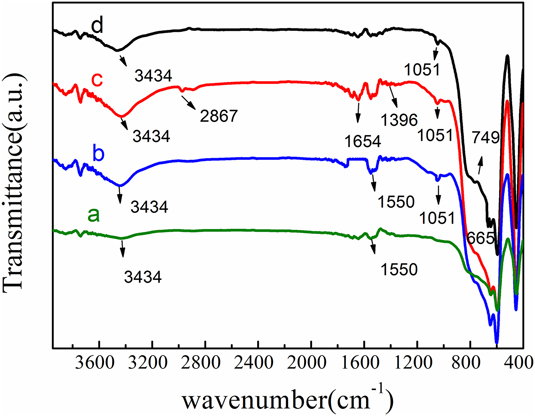
FTIR spectra of pure alumina particles and Al2O3/SiO2 composite particles, and surface modification of composite particles with polyelectrolytes were measured to characterize the functional groups. As shown in Fig. 2(a), the intense peak at 3434 cm−1 is due to bending vibrations of O–H. The weak stretching mode at 1550 cm−1 indicates the existence of Al–O groups. Compared with pure alumina, the peak at 1051 cm−1 appears in the spectra of Figs. 2(b)–2(d), which is ascribed to the characteristic bending vibration of Si–O–Si. That is to say, the silicon oxide coating is linked with alumina. Figure 2(c) shows a characteristic band at 1396 cm−1 owing to the symmetric bending mode of the +N–CH3 functional group. The band at about 1654 cm−1 is assigned to stretching vibrations of –NR+, which belongs to PAMAC. In addition, it is worth noting that the peak at 2867 cm−1 belongs to the stretching vibration of methylene group. In the case of PSMAZ–Al2O3/SiO2 in Fig. 2(d), adsorption band is present at 749 cm−1. It can be assigned to stretching vibrations of Zn–O–Si bond. The band at 665 cm−1 is assigned to stretching vibrations of Si–O–Mg. The above results suggest that the polyelectrolytes are attached to Al2O3/SiO2 composite abrasive.
FT-IR spectra of (a) pure Al2O3, (b) Al2O3/SiO2, (c) 0.5 wt% PAMAC–Al2O3/SiO2, and (d) 0.5 wt% PSMAZ–Al2O3/SiO2.

Zeta potential
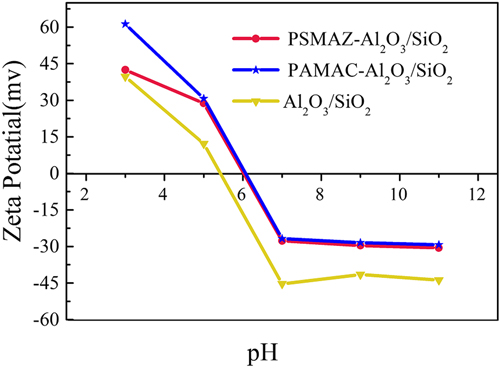
To further understand the mechanism of polyelectrolytes’ association with abrasives dispersed in water, zeta potentials of Al2O3/SiO2 composite abrasives in the absence and presence of 0.5 wt% PAMAC and PSMAZ were measured as a function of pH (Fig. 3). Without polyelectrolytes, the isoelectric point (IEP) of Al2O3/SiO2 composite particles is around 5.5. After adding PAMAC and PSMAZ to the polishing slurry, the charge has altered over the entire range of 3–11. The IEP of slurry shifts to around 6, and the magnitude of the zeta potential is increased. Taking pH 9 as an example, the zeta potential of the Al2O3/SiO2 abrasive is −43 mV, and it decreases to −29.8 mV and −28.6 mV, respectively, for the PAMAC–Al2O3/SiO2 and PSMAZ–Al2O3/SiO2 compared with pure Al2O3/SiO2 abrasive. This can be attributed to the electrostatic adsorption of cationic groups of polyelectrolytes. The silanol groups of Al2O3/SiO2 abrasive surface can form ion–dipole bonds with the positive charges on the polyelectrolyte [Reference Liu, Gilbert Min and Ducker40].
Zeta potential of Al2O3/SiO2 dispersions with and without polyelectrolyte.

CMP performances
The polishing experiments were performed using a UNIPOL-1502 polishing equipment (Shenyang Kejing Instrument, Co., Ltd., Shenyang, China). Sapphire was polished for 2 h by supplying slurries at 160 mL/min, the load between sapphire substrate and polishing pad was 6 kg, and the rotating speed was 60 rpm. The mass of the sapphire substrates before and after polishing was measured thrice using an analytical balance, and the average of the three values was reported. The following formula was used to calculate the MRR:
 $${\rm{MRR}} = {{\Delta m \times {{10}^6}} \over {\rho \pi {R^2}t}}\quad ,$$
where MRR is the material removal rate (μm/h), Δm is the mass change of sapphire wafer (g), R is the radius of sapphire wafer (mm) (25 mm), t is the polishing time (h), and ρ is the density of sapphire wafer (g/cm3).
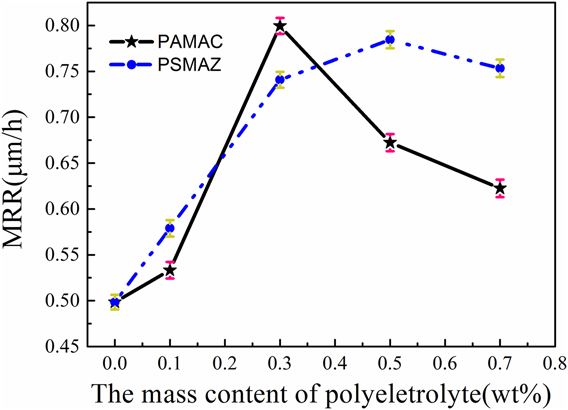
Figure 4 shows MRRs of sapphire wafer using 5 wt% alumina dispersions and alumina/silica dispersions with the polyelectrolytes at pH 9. Two slurries with varying mass content of polyelectrolytes, i.e., 0.1, 0.3, 0.5, 0.7%, were tested.
Effect of mass content of polyelectrolyte on MRR (the measurement values are repeated for 3 times).

With pure alumina slurry, MRR of sapphire wafer was 0.5 μm/h. MRR of modified Al2O3/SiO2 abrasives increased dramatically with an increase in the mass contents of polyelectrolyte additives, indicating that the composite abrasives are more effective than pure alumina particles. As for PAMAC, it enhanced MRR of sapphire wafer slowly when added with 0.1 wt% polyelectrolyte. When 0.3 wt% PAMAC was added to the slurry, MRR of sapphire substrate reached the highest value of 0.83 μm/h showed a noticeable decrease to 0.67 μm/h with increasing PAMAC concentration to 0.5 wt%. This striking decrease resulted from the superabundant content of polyelectrolyte additives, leading to the flocculation of composite particles and thus poor polishing effect. The introduction of PSMAZ also resulted in an increase in MRR. MRR attained a maximum value at 0.5 wt% and then essentially saturated above a PSMAZ concentration of 0.7 wt%. In total, modified composite abrasives can improve the MRR. This may be attributed to the better combination of composite abrasives’ chemical effect and mechanical effect than that of pure alumina abrasives.
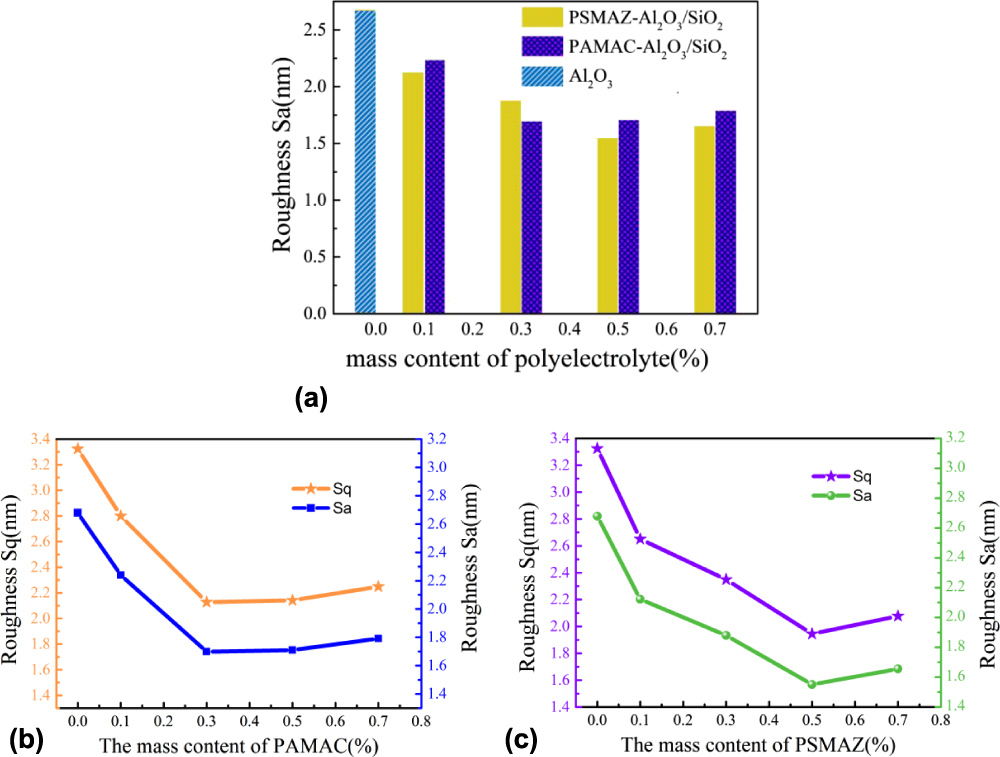
To further study the effect of polyelectrolyte–Al2O3/SiO2 abrasives on the planarization of sapphire substrates, the average roughness (R a) and topographical micrographs were characterized. Before polishing, the roughness was as high as 3.5 nm. The bar chart in Fig. 5(a) illustrates R a of sapphire at all mass contents of polyelectrolytes from 0.1 to 0.7% compared to pure Al2O3 abrasive.
(a) Effect of mass content of polyelectrolytes on R a, and the effect of mass content of (b) PAMAC, (c) PSMAZ on R a.
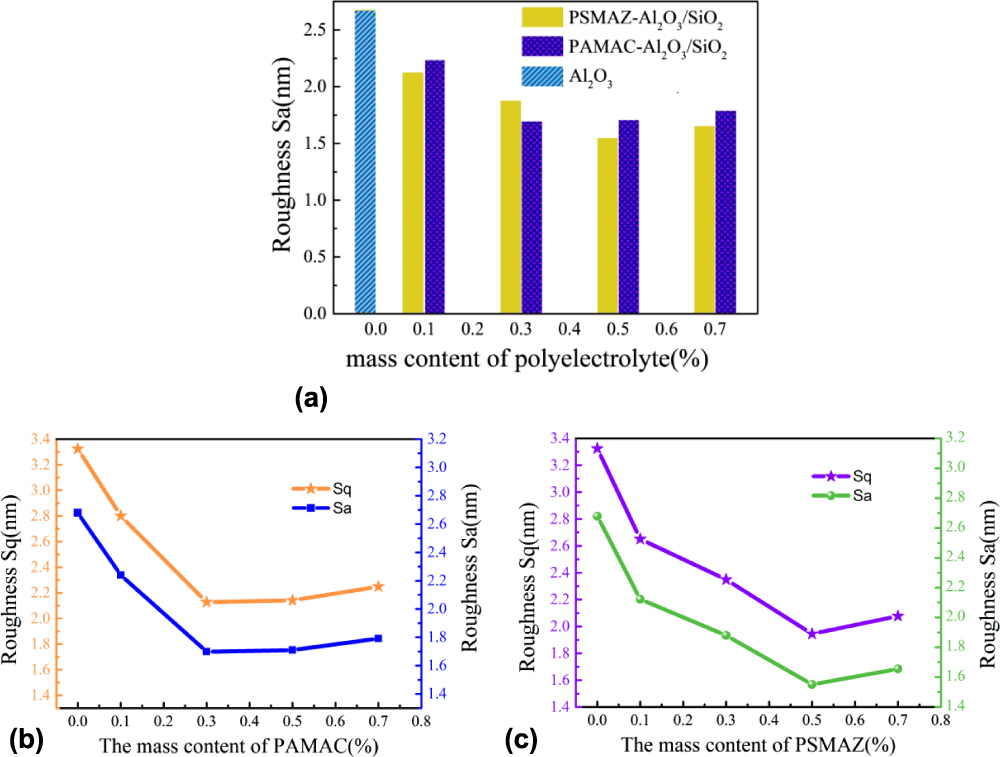
As can be seen from Figs. 5(b) and 5(c), R a of the sapphire wafer reached 2.68 nm after polishing with the Al2O3 abrasives. R a values of the sapphire wafer polished by polyelectrolyte–Al2O3/SiO2 composite abrasives were lower than that of pure Al2O3 abrasive under the same testing conditions, which illustrates that modified composite abrasives are more effective in reducing the roughness of the sapphire wafer than pure Al2O3 particles. With the increase in the mass content of polyelectrolytes, the roughness values of the sapphire wafer decreased gradually, attaining a minimum 1.69 nm at 0.3 wt% PAMAC and 1.55 nm at 0.5 wt% PSMAZ. This may be attributed to the combination of chemical effect and mechanical effect between abrasives and wafer when the content is optimal. The softer products of solid-state chemical reactions are easily removed when the polyelectrolyte additives are used. In other words, many rough peaks of the initial wafer are removed, so the surface planarization is high and roughness decreases gradually. Beyond 0.5 wt% content of polyelectrolytes, R a values of wafer increase, because too much amount of polyelectrolyte results in lower flocculation of abrasives.
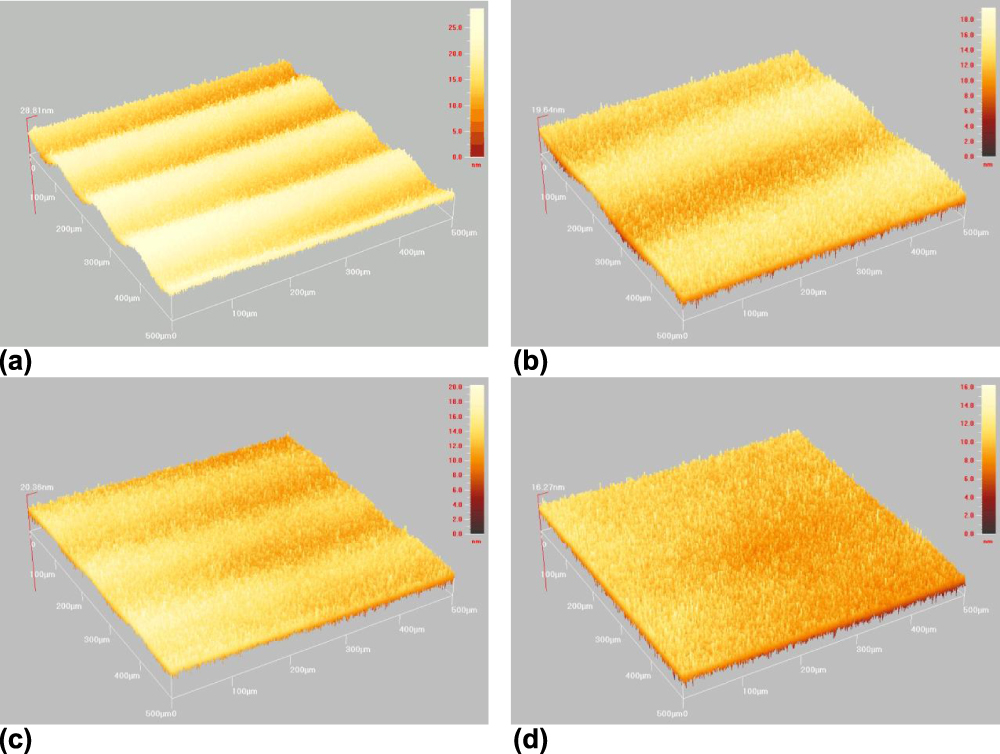
Topographical micrographs of sapphire surfaces polished by different polyelectrolyte–Al2O3/SiO2 abrasives were analyzed so as to get more details about the degree of roughness. Figure 6 shows the surface morphology of the sapphire wafer before and after polishing using 5 wt% Al2O3/SiO2 abrasives at pH 9 with the mass content of 0.5 wt% polyelectrolytes. Before polishing [Fig. 6(a)], the surface had an R a as high as 3.50 nm. After polishing with pure alumina [Fig. 6(b)], R a decreased to 2.68 nm and the topography fluctuation was reduced. Furthermore, polyelectrolyte–Al2O3/SiO2 [Figs. 6(c) and 6(d)] decreased the surface grooves owing to the soft shell introduced into the alumina abrasive. At the same time, little scratches on the sapphire wafer can be observed, showing a better surface planarization.
Surface profiles of sapphire wafer: (a) before polishing, (b) after polishing with Al2O3 abrasives, (c) 0.5 wt% PAMAC–Al2O3/SiO2 abrasives, (d) 0.5 wt% PSMAZ–Al2O3/SiO2 abrasives.

Mechanism discussion
Synthesis mechanism of Al2O3/SiO2 composite abrasives with polyelectrolyte
Active silicic acid solution obtained by passing sodium silicate solution through the cation exchange resin is prone to self-polymerization when pH attains 9. Researchers reported that silicic acid has two forms in the subacid solution, namely H3SiO4− and H4SiO4. They can interact with each other to form dimer as the following equation:
 $$$$
The dimer is then continuously polymerized to form silica.
 $$$$
When the silicic acid solution was added to the slurry containing alumina, due to the high specific surface area and large specific surface energy of alumina, there were multiple hydroxyl functional groups on its surface that are easy to bond with silanol groups by condensation reaction. That is to say, silicon oxide can be coated on the surface of alumina through a chemical bond [Reference Hanada and Soga41].
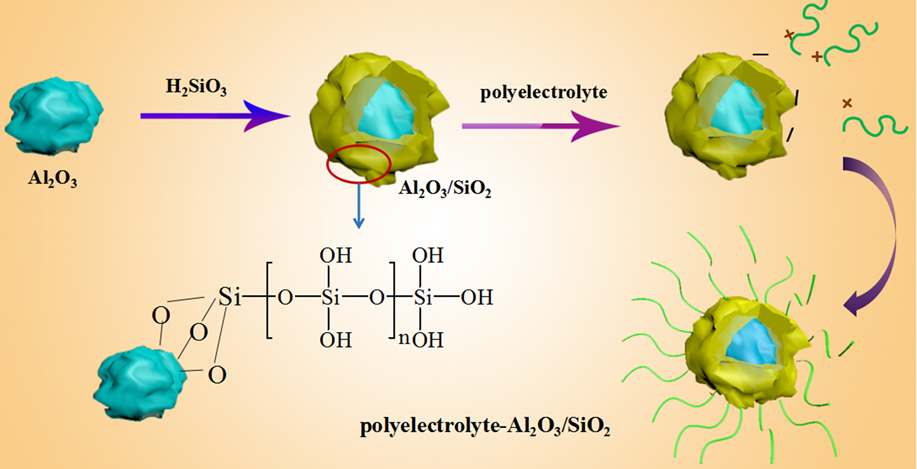
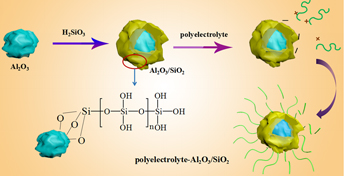
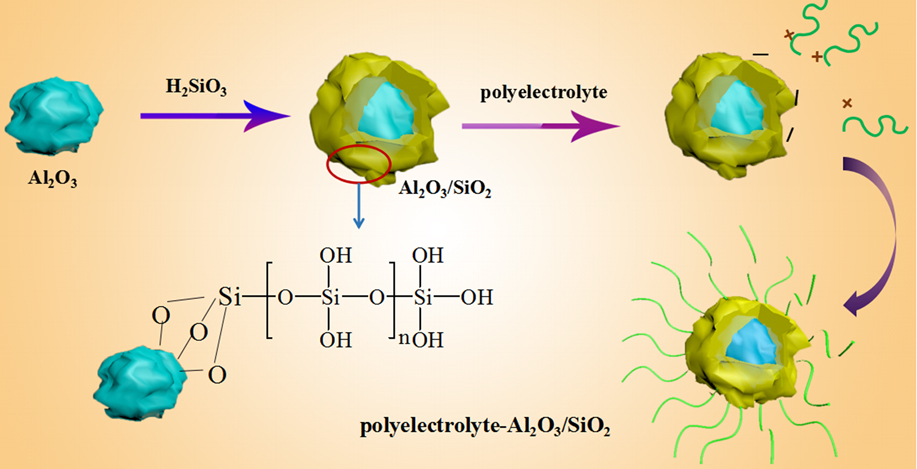
The isoelectric point (IEP) of Al2O3/SiO2 was around 5.5, which means that in our experiment (pH = 9) the surface of particles is negatively charged. The silica-coated alumina containing a variety of silanol groups (Si–O–H) can ionize to produce negative charges (Si–O−) which can act as the polyelectrolyte counterion, adsorbing polyelectrolytes strongly. The synthesis procedure is shown in Fig. 7. With the increase in concentration in the system, the number of polyelectrolyte molecules adsorbed on the surface of the Al2O3/SiO2 particle increased, which may result from the increase in ionic strength by ions brought along with the polyelectrolyte [Reference Messing, Hirano and Hausner42]. The polyelectrolyte can screen long-range electrostatic repulsions and the adsorption conformation changes to a multipoint adsorption so as to accommodate more molecules. As a result, segments can approach more closely with decreased mobility. When the adsorption equilibrium was reached, the adsorption conformation of polyelectrolyte tended to be stable [Reference Schwarz and Schönhoff43, Reference Li and Tripp44, Reference Penta, Veera and Babu45].
Synthesis process of polyelectrolyte–Al2O3/SiO2 nanoabrasives.
CMP mechanism
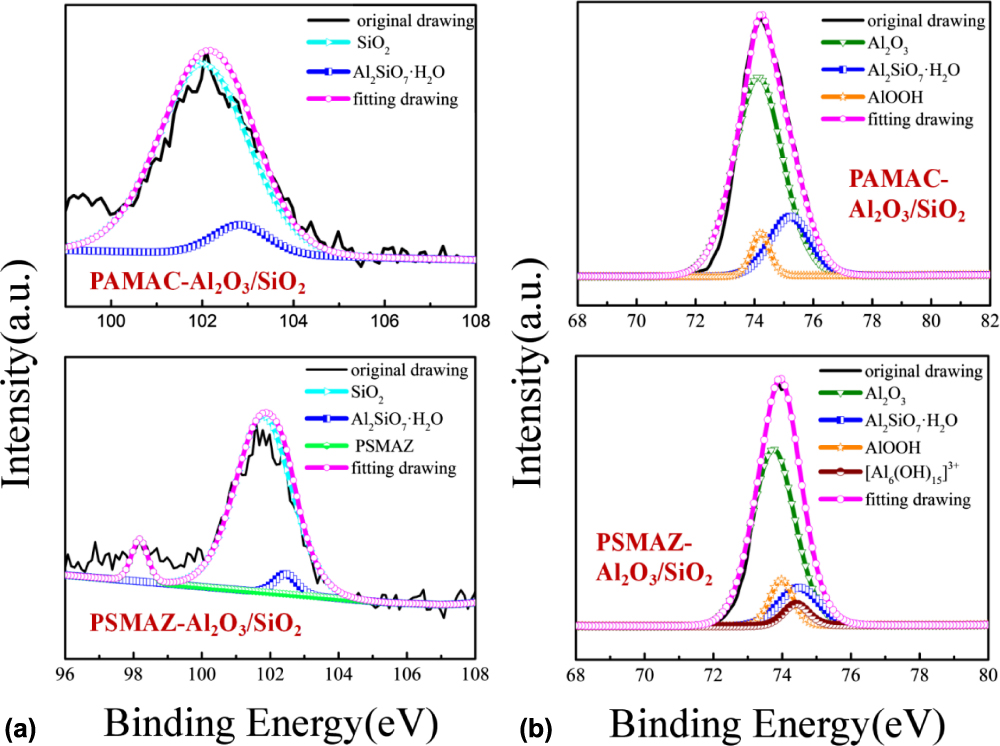
CMP is a complex surface process that includes chemical corrosion and mechanical abrasion [Reference Lee, Lee and Jeong46]. Based on the above aspects, XPS was used to explore the chemical polishing mechanism of composite abrasives in sapphire CMP. The slurry containing 0.5 wt% polyelectrolyte–Al2O3/SiO2 composite abrasives after polishing was centrifuged. The solid precipitation was washed several times with pure water and dried in an oven at 80 °C. The element existence form of samples was characterized by XPS to testify the chemical effect mechanism occurred in CMP process. Figure 8 shows the XPS spectra of the element in modified Al2O3/SiO2 composite abrasives after polishing. The peak of Si2p of PAMAC-Al2O3/SiO2 and PSMAZ-Al2O3/SiO2 in Fig. 8(a) can be fitted into two peaks and three peaks, respectively, corresponding to SiO2 from abrasives at the binding energy of 102.4–103.8 eV, Al2Si2O7·H2O at 102.10–102.70 eV, and polymeric aluminum magnesium zinc silicate (PSMAZ) at 98.18 eV, respectively [Reference Pitts, Thomas, Czanderna and Passler47]. Figure 8(b) shows the Al2p binding energy region of PAMAC–Al2O3/SiO2 and PSMAZ–Al2O3/SiO2. The peaks at the 73.90–74.10 eV, 73.78–74.08 eV, and 74.48–75.18 eV correspond to AlOOH, Al2O3, and Al2Si2O7·H2O separately [Reference Barr48]. And the peak at 74.38 eV may correspond to the hydroxyl complex in PSMAZ. Above results prove that Al3+ in the slurry exists in the form of Al2Si2O7·H2O after polishing. On the basis of the above analysis and discussion, we could demonstrate that there is a solid chemical transformation reaction between sapphire wafer surface and composite abrasives except for mechanical abrasion during CMP. A formation mechanism could then be proposed according to the following equations:
XPS narrow scan spectra of elements in polyelectrolyte–Al2O3/SiO2 abrasive (a) Si 2p and (b) Al 2p after polishing.

Firstly, the hydration reaction occurs between the surface of sapphire wafer and water.
 $${\rm{A}}{{\rm{l}}_{\rm{2}}}{{\rm{O}}_{\rm{3}}} + {{\rm{H}}_{\rm{2}}}{\rm{O\ }} = 2{\rm{AlOOH}}\quad .$$
Next, composite abrasives react with AlOOH to form Al2Si2O7·H2O as follows:
 $$2{\rm{Si}}{{\rm{O}}_{\rm{2}}} + 2{\rm{AlOOH}} = {\rm{A}}{{\rm{l}}_2}{\rm{S}}{{\rm{i}}_2}{{\rm{O}}_{\rm{7}}} + {{\rm{H}}_{\rm{2}}}{\rm{O}}\quad .$$
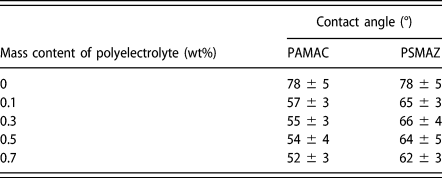
The mechanical effect accounts for an important role in CMP. When the abrasive contacts the sapphire wafer and the pad simultaneously, abrasive wear and adhesive wear are the main material removal processes during CMP. A goniometer was used to study the mechanical effect. Before the test, the polished sapphire wafer was washed with DI water and dried in an air jet. Each contact angle was an average of 9–10 measurements at different locations. A drop of DI water was dropped on the surface of the sapphire wafer polished by PAMAC–Al2O3/SiO2 and PSMAZ–Al2O3/SiO2 abrasives. The results are shown in Table I. The contact angle is about 78° with Al2O3/SiO2 abrasive. With an increasing mass content of PAMAC and PSMAZ, the water drop spreads out quickly and the contact angle decreases gradually to ∼52° and ∼62°, indicating that the wafer becomes more hydrophilic. From the experimental results, we can conclude that there is better interaction between the polyelectrolyte and the surface of sapphire wafer. This will increase the number of effective abrasives during CMP process.
Contact angle of a water drop on polished wafer at pH 9 with different mass contents of polyelectrolytes.

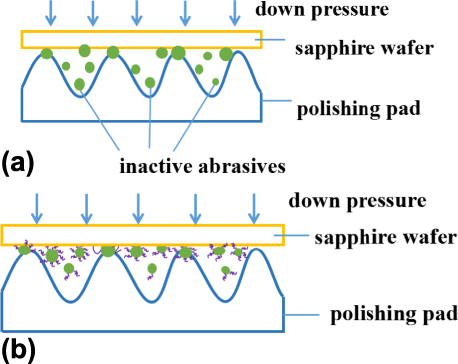
On the basis of the above experiment and the model proposed by Zhao et al. [Reference Zhao and Chang49], we discussed the material removal mechanism using a microcontact and wear model. As is shown in Fig. 9(a), when using Al2O3 nanoparticles for polishing, the particle is easily embedded in the polishing pad. Only a small amount of abrasive interacts with the wafer surface, and MRR is low. After the polyelectrolyte adsorbs on the Al2O3/SiO2 particle, the polyelectrolyte is easily deformed so that it can make large contact with the wafer, leading to quite substantial adhesion, which means the increase in effective particles [Fig. 9(b)]. This can be explained as follows [Reference Kramer, Estel, Schmitt and Jacobasch50]:
 $${\rm{MR}}{{\rm{R}}_{{\rm{mass}}}} = {\rho _{\rm{w}}}N{\overline {{\rm{Vol}}} _{{\rm{removed}}}} + {C_0}\quad ,$$
where ρw is the density of the wafer material, N is the number of active abrasive particles,  ${\overline {{\rm{Vol}}} _{{\rm{removed}}}}$ is the volume removed by a single abrasive in unit time, and C 0 is the material removal due to chemical etching.
Schematic of (a) Al2O3 abrasive/wafer and (b) polyelectrolyte–Al2O3/SiO2 abrasive/wafer microcontact during CMP.

That is to say, the addition of polyelectrolyte results in an increase in the number of effective particles, leading to better combination of chemical and mechanical effects, which improves the MRR.
When the polyelectrolyte–Al2O3/SiO2 particle moves over the sapphire wafer during CMP process, the penetration depth of the abrasive into the wafer is less than that of the pure Al2O3 particle. This can be attributed to the softer SiO2 shell that acts as a cushion on the hard sapphire, which can decrease the excessive mechanical damage due to pure particles. Hence, the scratching is reduced and surface becomes smoother. In summary, polyelectrolyte–Al2O3/SiO2 abrasives can improve MRR and decrease roughness effectively by chemical corrosion and mechanical wear, meeting the expectation of high efficiency and small damage on the surface of sapphire substrates.
Conclusions
In conclusion, we have successfully prepared a novel polyelectrolyte–Al2O3/SiO2 nanoparticle using a facile strategy for a better performance in CMP. The silica acting as a bifunctional molecule can link α-alumina via condensation reactions and adsorb polyelectrolytes with positive charge. MRR is 30% higher than that of pure abrasives. SiO2 acting as a soft shell has a lower R a on the surface of sapphire, which is about 1.5 nm in CMP, resulting from shallower penetration depth on the sapphire substrates’ surface. The above aspects are critical for attaining high removal rates and realizing a damage-free surface. In addition, the polyelectrolyte–Al2O3/SiO2 nanoparticle displays excellent dispersibility. Therefore, these characteristics of the polyelectrolyte–composite nanoabrasives will encourage the potential applications of CMP in the fields of medicine, microdevices, and aerospace.
Materials and experimental section
Materials
α-Alumina (α-Al2O3, analytical reagent), cation exchange resin, aluminum sulfate octadecahydrate (Al2(SO4)3·18H2O, analytical reagent), zinc sulfate heptahydrate (ZnSO4·7H2O, analytical reagent), magnesium sulfate heptahydrate (MgSO4·7H2O, analytical reagent), sodium hydroxide (NaOH, analytical reagent), hydrochloric acid (HCl, analytical reagent), sodium hexametaphosphate ((NaPO3)6, analytical reagent), and poly(alkyldimethylammonium chloride) ((C8H16NCl)n) were purchased commercially from Sinopharm Chemical Reagent Company, Shanghai, China, and used as received. Sodium silicate (Na2SiO3) was purchased from JiNan DeWang Chemical Industry Company, Jinan, China. c-Axis (001) sapphire (Jiangsu HaoHan Sapphire Science and Technology Company, Taizhou, China) was used for polishing tests.
Synthesis of Al2O3/SiO2 abrasive
Al2O3/SiO2 abrasive was synthesized by the following two steps. First, 5 wt% α-alumina and 0.1 wt% sodium hexametaphosphate were added to a certain amount of deionized (DI) water under continuous stirring. Subsequent addition of 3 wt% NaOH was used to adjust pH between 9 and 10. Then, the mixture was kept ultrasonic for 30 min and milled for 2 h in a vibratory mill containing ZrO2 balls (the diameter is 2 mm) as abrasives to disperse the alumina. Next, the Al2O3/SiO2 composite abrasive was prepared by mixing active silicic acid and α-Al2O3. Active silicic acid was acquired by passing 8 wt% sodium silicate (Na2SiO3) solution through the cation exchange resin. Next, a certain amount of the prepared alumina dispersion was taken in a four-necked flask and heated to 100 °C. Then, 2.5 wt% silicic acid was added dropwise to the α-alumina dispersion under continuous stirring with a SiO2/Al2O3 mass ratio of 5%. At the same time, the temperature of the system was kept at 100 °C and 0.1 wt% NaOH solution was used to adjust pH to 10. Evaporating speed of water and feeding speed of the solutions were controlled to keep the reaction liquid volume in the four-necked flask constant. Finally, the mixed solution was cooled to room temperature, and Al2O3/SiO2 composite abrasive was obtained.
Synthesis of PSMAZ
Polymeric magnesium aluminum zinc silicate (PSMAZ) was synthesized according to the following procedure. Sodium silicate solution 0.4 M was added dropwise to a solution of hydrochloric acid (0.05 mol) under stirring, and then pH was adjusted to approximately 5 with sodium hydroxide or hydrochloric acid. Next, the liquid mixture was stirred for 1 h at room temperature to improve polymerization reactions. Then, 0.02 mol aluminum sulfate (Al2(SO4)3), 0.01 mol zinc sulfate (ZnSO4), and 0.08 mol magnesium sulfate (MgSO4) were added to the system and aged for more than 24 h to increase the degree of polymerization.
Synthesis of polyelectrolyte–Al2O3/SiO2 abrasives with poly(alkyldimethylammonium chloride) (PAMAC) and PSMAZ
Polyelectrolytes (PAMAC or PSMAZ) and pure water were mixed in 1:10, followed by the addition of Al2O3/SiO2 abrasives with continuous stirring at room temperature and aged for 6 h. Then, a series of different contents of polyelectrolyte–Al2O3/SiO2 composite abrasives were prepared, containing 0.0 wt%, 0.1 wt%, 0.3 wt%, 0.5 wt%, 0.7 wt% (mass ratios of polyelectrolyte versusSiO2) of above polyelectrolyte additives, respectively.
Preparation of polishing slurry
Before polishing, pH of the prepared solutions were adjusted to 9, and then 3.0 wt% sodium hexametaphosphate was added as dispersant. Finally, the mixtures were filtered with a 10-μm-pore filter to obtain polishing slurries.
Characterization
The particles were characterized by Fourier-transform infrared spectroscopy (AVATAR370 FT-IR infrared spectrophotometer, Thermo Nicolet Corporation, Madison, Wisconsin), which were collected on KBr pellets with a resolution of 4 cm−1 in the range of 4000–400 cm−1. The morphology and microstructure of the abrasives were characterized by a field emission scanning electron microscope (SEM, JSM7500F, JEOL Ltd., Tokyo, Japan) with 15 kV and a transmission electron microscope (TEM, JEM2010F, JEOL Ltd., Tokyo, Japan) operated at 120 kV. Potential analyzer (ZETA SIZER3000HS, Malvern Instruments Ltd., Worcestershire, U.K.) was used to measure ξ potentials of particles. X-ray photoelectron spectroscopy (XPS, ESCALAB250Xi, Thermo Fisher Scientific (China) Co., Ltd., Shanghai, China) was carried out to analyze the compositions of the polished products, using Al Kα radiation as the excitation source, the reference of which was C1s (283.4 eV). Topographical micrographs, average roughness (R a), and root mean square (RMS) roughness of abrasives were analyzed by Ambios Xi-100 surface profiler (Ambios Technology Inc., San Francisco Bay Area, State of California) with the numerical aperture of 0.30 and the measure area of 500 × 500 μm.
Highlights
(i) A novel polyelectrolyte–Al2O3/SiO2 composite particle was successfully synthesized for the first time.
(ii) The formation mechanism of the novel abrasive was discussed in detail.
(iii) The silica acting as a bifunctional molecule can link α-alumina via chemical bond and adsorb polyelectrolytes by electrostatic adsorption.
(iv) The composite abrasive exhibited both high MRR and good planarization quality on the sapphire.
(v) A microcontact and wear model was used to discuss the polishing mechanism.
Acknowledgment
We are grateful for the financial support from the National Natural Science Foundation of China (Grant No. 51475279).