Introduction
All extraterrestrial (ET) signals from hypothetical civilizations may be categorized into two discrete classes according to their intent to communicate: (1) intentional or deliberate signals that are purposely sent towards Earth (i.e. the receiver); and (2) unintentional or inadvertent signals that are involuntarily and accidentally directed towards the Earth's position. The first class implies intention to communicate, while the latter represents so-called leakage or leaked signals analogous to our own radio, TV or radar (Horvat Reference Horvat2006; Loeb & Zaldarriaga Reference Loeb and Zaldarriaga2007; Forgan & Nichol Reference Forgan and Nichol2011).
Since the start of Project Ozma in 1960 Search for Extraterrestrial Intelligence (SETI) and Communication with Extraterrestrial Intelligence (CETI) experiments were designed to find microwave radio and optical signals intentionally sent from ET civilizations (Drake Reference Drake1961; Wilson Reference Wilson2001). The wish for interstellar communication was either assumed or the probability of finding a transmitting civilization was expected to average out in the large dataset involved. Detection and verification of an intermittent, let alone unique, signal is difficult or even impossible.
Very important aspect of SETI searches is the synchronicity problem that considers prospects of simultaneous transmissions of ET signals and reception by our receivers. This requirement is embedded in all contemporary SETI programmes and a positive outcome is necessary for successful detection of ET messages if they do exist (Shostak Reference Shostak2011a, Reference Shostakb). The synchronicity problem is aligned with the technology used on both sides of the communication channel. If actors at the transmitting and receiving end do not use the same communication method and determining parameters of the method, they cannot detect each other or exchange information regardless of a possible continuous or omni-directional use of their communication devices.
In this paper, we use geometric probability to model prospects of the technological synchronicity between N∈ℕ∪{0} civilizations that leak signals. Our model leads to the following conclusions. If we assume SETI projects have a good chance of making a detection in the next few decades (Tarter Reference Tarter2001; Shostak Reference Shostak2003) then either (i) our neighbourhood is populated with a large number of technology compatible civilizations in the leakage scenario or this scenario is wrong and (ii) advanced civilizations intentionally broadcast greeting messages across the Galaxy. As a completely alternative speculation (iii) both communication scenarios are wrong (leakage and intentional) and advanced civilizations are in effect frugal emitting extremely low-level or unidirectional signals that may be undetectable by our present or projected near-future receivers (Benford et al. Reference Benford, Benford and Benford2010). However, neither scenario precludes advanced civilizations from monitoring signals made by our current level of technology.
Technological synchronicity problem
The technological synchronicity problem is defined as an independent, accidental and simultaneous possession or use of compatible technologies, including those for interstellar communication, among two or more civilizations. From this we can identify two subtypes of the problem. The first type is the possession synchronicity that is defined around possession or knowledge of a technology. The second type is the technological usage synchronicity problem that deals with the application and practical use of a particular technology. By definition the usage should include the possession problem: it is not possible to use a technology without first having it and knowing how to apply it. Therefore, the period of a technology possession is as long or longer than the period of its usage. This makes the possession synchronicity problem more relaxed than the application, i.e. usage, problem. For example, the possession period of bronze artefacts is ∼5300 years, but the usage period was just ∼2000 years as the metal smelting technology jumped from bronze to iron (Harding Reference Harding2000). On the other hand, radio has been first applied for long-range signalling in 1895 by Guglielmo Marconi who based his work on previous achievements by Nikola Tesla and other researchers like Heinrich Hertz (Vujic et al. Reference Vujic, Marincic, Ercegovac and Milovanovic2001; Harkins Reference Harkins2008). Approximately 120 years later we are still actively using radio which makes its possession and usage periods equal. Although the knowledge of a particular technology can be very long, it may be rendered obsolete relatively quickly because of the discovery of superior technologies. This incessant process is governed by the rate of civilization's technological advancements.
So far persistent technological progress of our civilization is an incontestable fact. The global technological progress may be estimated directly with the rate of inventions or indirectly through representative correlates and dependent values such as the world population growth, food consumption and energy use, and also the number of granted patents, per capita income, etc. (Cohen Reference Cohen1995; Kurzweil Reference Kurzweil2001; Korotayev Reference Korotayev2005). Our rate of development, although often heterogeneous, over sufficiently long periods has so far been non-stagnant and positive. The pool of technologies at the civilization's disposal has been increasing steadily. Furthermore, there are some indications that in the recent times our technological progress is accelerating and growing exponentially (Kurzweil Reference Kurzweil2001). We cannot predict with certainty where this process will finally lead to. The rate of progress might reach a certain threshold (also called technological singularity) after which it will change so profoundly that it cannot be fully comprehended at this point. In addition, hypothetically, a different kind of barrier may exist that prevents, or at least significantly prolongs, development of technologies for interstellar communication better than microwave radio. Both opposing scenarios should be taken into account in modelling the synchronicity problem.
According to the Copernican principle, there is nothing special about our civilization or its location in the Galaxy. If we recognize this rule to be correct then our civilization is not a fluke or a statistical outlier and may be used as a statistically representative template in modelling other hypothetical ET civilizations. Therefore, we can assume that ET societies also have significant technological progress, at least over long time scales, and that the technological synchronicity problem is ubiquitous and inherent to the interstellar communications.
Geometric probability model
The synchronization of any two time intervals can be successfully described with mathematical models based on geometric probability. This can be exploited for explicit description of the simultaneous use of compatible technologies for signalling over interstellar distances.
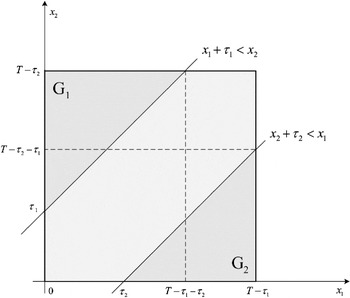
Our geometric probability model describes temporal synchronization between two mutually independent random events: emitting of a signal by the sender S and monitoring for a signal by the receiver R. These events are represented with two random variables: X 1 and X 2. The first variable X 1 represents the moment when S begins signalling and the second variable X 2 is the moment when R begins to listen. There are also two intervals (τ1 and τ2) that are constants. These intervals are the periods during which S is signalling and R is monitoring for signals, respectively. Therefore, S is signalling during interval [x 1, x 1+τ1] and R is monitoring during [x 2, x 2+τ2].
The detection will not take place if and only if S stops emitting before R starts listening, or if S starts emitting after R stopped listening (Fig. 1). These rules can be written as

Absence of detection between a signal receiver R and two emitters S1 and S2. Any other configuration would lead to synchronization between R and Si.

In any other case there will be at least some overlapping between these two intervals and the signal from S could be detected. This is exactly the event we are interested, i.e. it represents the technological synchronicity between a single sender–receiver pair. Because we assume that S and R will occur within well-defined intervals

Thus, the total sample space is

The positive synchronization event A between one sender and one receiver is determined by inversing inequalities (1) that define event spaces G 1 and G 2 through their respective measures of geometric spaces m(G 1) and m(G 2), as well as the measure of the total sample space m(Ω) (Fig. 2). In a plane space that we use here the measure is represented by a two-dimensional area that can be derived geometrically. Union (∪) of two or more sets represents their joint sample space, while intersection (∩) is their common area.
Probability space of random variables signalling start X 1 and reception start X 2.

Therefore, if (T−τ1−τ2)>0


Note that (T−τ1−τ2)⩽0⇒P(A)=1 because (G 1∪G 2)∩Ω=∅.
This model can be extended so that it takes into account S1, … ,SN devices that emit signals and one receiving device R. This is a more realistic and pragmatically applicable model. We define events A i,i=1, …, N, where A i represents device R receiving a signal sent by device S i,i=1, …, N. The synchronization event A is positive if at least one S i has received a signal from R. The receiver can be synchronized and overlapping with one or more transmitters. Therefore, A is realized if any of the events A 1, …, A N is also realized: A=A 1∪ … ∪A N. The probability P(A) is derived from the Sylvester formula that is also sometimes called the inclusion–exclusion principle (Klain & Rota Reference Klain and Rota1997):

This formula describes a joint intersection of A i, i=1, …, N} events. If A 1 and A 2 are two finite sets then |A 1∪A 2|=|A 1|+|A 2|−|A 1∩A 2|, for three finite sets |A 1∪A 2∪A 3|=|A 1|+|A 2|+|A 3|−|A 1∩A 2|−|A 1∩A 3|−|A 2∩A 3|+|A 1∩A 2∩A 3|, and so on. The annotation |A i| describes the cardinality of the set A i, i.e. the probability of the event A i. Therefore, the Sylvester formula is used to describe the probability of a cumulative synchronization event A that is composed of N singular synchronization events each between a single sender–receiver pair.
Events A i and A j are mutually independent, thus P(A iAj)=P(A i)P(A j) and we can write

Furthermore

Generally, for every k synchronization events, k={1, …, N}

When we include this equation into (6) we obtain

For a given T, τ1 and τ2, we want to assess N so P(A) is larger than a certain threshold (e.g. at least 0.95). The model is used to narrow the least possible number of ET civilizations if the probability of synchronization and its member variables are presupposed ad hoc.
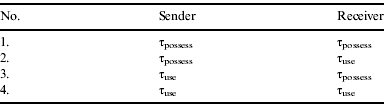
Furthermore, since the basic synchronization problem occurs between a single receiver R and a single sender S, and it is divided into two sub-problems (possession and usage) there are 22 discrete combinations that can occur with the sender–receiver pair (Table 1). Both sender and receiver may be using or possessing the same technology, but sender may be possessing and the receiver using it and vice versa. This is important not only in developing technology interaction models, since the possessing side is intuitively more advanced, but also in developing models.
Possible combinations in technology synchronization for a single sender–receiver pair. Two actors and two discrete technology synchronization types give 22 different combinations that have effects on the probability of their accidental concurrency

In order to compute the series (10), we developed our own software based on Microsoft.NET 4.0 framework. The application was written in C# object-oriented computer language using MAPM library (MAPM) to computationally express very large numbers with arbitrary precision. Several heuristic optimizations and memory versus speed trade-offs were necessary to limit the duration of the algorithm's execution.
Applying the figures
By definition, during the technology possession period a civilization has a particular technology at its disposal but does not necessary have to use it. The possession period can be defined as τpossess=t possessend−t possessbegin, where t possessbegin and t possessend are the instances of technology acquisition and discontinuation of possession, respectively. We will assume that civilizations have mutually independent technical development which makes the acquisition equivalent to the invention of a technology. In this model, civilizations develop technologies on their own without information about technological state of others. Also, barring adverse social events such a retrograde society development, we can assume that t possessend occurs with the death of a civilization.
If a civilization possesses a particular piece of technology during nearly its entire lifetime t possessend≫t possessbegin, we can say that the technology is indigenous to that civilization. As could be intuitively expected, the synchronicity with older and more advanced civilizations depends only on the Mankind's technological development – they have the technology already and we have to catch up. The same trend can be observed even with our own microwave radio technology. The technology acquisition moment of radio is t possessbegin=2×10⁵−1.2×10²≈2×10⁵. Using Gott's delta t argument (Gott Reference Gott1993), we can say with five sigma confidence that the expected lifetime of the Mankind is ∼8×10⁶. Therefore, the possession period for radio technology is τpossess=8×10⁶−2×105=7.8×10⁶≈8×10⁶.
In this analysis, Gott's argument is very helpful, because it puts minimal prior requirements on the temporal variables in the model, but nevertheless it should be used carefully in view of its limitations. The argument rests on the assumptions that a population has uniform distribution and that a choice of a specific individual within the population is random. The chosen individuals (τpossess and τuse) do not in any way provide information about the population size (the maximum values of τpossess and τuse). Since its publication the argument has provoked numerous critiques – for example that the expected size of the population has to be infinite (see also Landsberg & Dewynne Reference Landsberg and Dewynne1997; Sober Reference Sober2003; Lesliea Reference Lesliea2008). However, if taken together with the mediocrity principle the delta t argument is useful, since it yields a statistically significant estimation and does not require extensive research in exobiology with actual determination of as yet unknown variables τpossess and τuse. It should also be noted that Gott's argument will give an upper bound in the technology usage and the highest probability of the synchronization. But if a civilization follows an exponential technological growth usage of individual technologies will be shortened, which means that the delta t argument actually favours the technological synchronization.
In modelling the possession, synchronization T represents a larger period within which civilizations can be born. At the most T is equal to the age of the Milky Way galaxy (∼13.2×10⁹), but in line with the concept of the Galactic habitable zone (GHZ) (Lineweaver et al. Reference Lineweaver, Fenner and Gibson2004) T=4×10⁹−8×10⁹.
In the first analysis, we assess the possession synchronization probability with exactly one ET civilization using equation (5) and inserting τ1=τ2=τpossess. The chances of synchronization are very slim: T=4×10⁹→p=0.004, T=8×10⁹→p=0.002 and T=13.2×10⁹→p=0.0012. Therefore, even if the lifespan of two Galactic civilizations is on average 8×10⁶ years, there is just ∼0.12−0.4‰ probability of their concurrent possession of the same technological advancements. The likelihood of the synchronization can be increased if civilizations live longer or if the age distribution for the complex life that may inhabit our Galaxy is smaller, i.e. if τpossess is larger or T smaller, respectively.
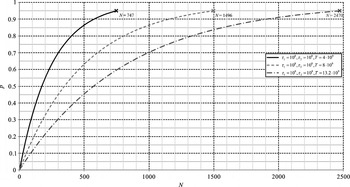
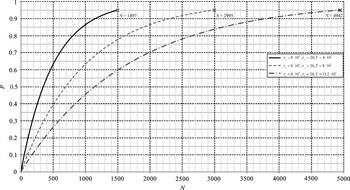
In the second analysis of the technological possession synchronization by using equation (10), we will determine the least number of ET civilizations necessary for p⩾0.95 with different representative values of T, τ1 and τ2. The results are shown in Fig. 3. We see that since the prerequisites for the complex life have been met, only N=747−1496 civilizations similar to our own (τ1=τ2=108) should have been formed in the whole Galaxy to get p⩾0.95 in the technological possession synchronicity. In the absolute worst case T=13.2×10⁹ no more than N=2470 civilizations are necessary.
The least number N of Earth-like civilizations that have to coexist with the human race to achieve at least one synchronicity in any technology (τ1=τ2=8×10⁶, T={4×109,8×109,13.2×109}).

The simultaneous use of a technology is a very similar but more bounded problem than the possession. It is also more important for SETI since we can expect to receive a signal only from those civilizations that actively use compatible set of communication technologies.
Applying the delta t argument, we may assume with 95% confidence that our civilization will use microwave radio technology for τuse=123−4800 years in total. For the laser and fibre optical communications which were invented, although not immediately used, ∼50 years ago there is also 95% confidence that they will be used for up to τuse≈2000 years.
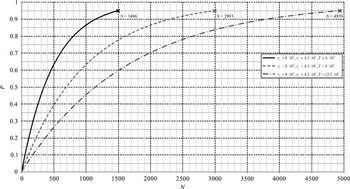
In the third analysis (Fig. 4), we are comparing Earth-like civilizations which simultaneously possess and use microwave radio technologies τ1=108, τ2=τuse=4.3×10³ with T={4×109,8×109,13.2×109}. This represents the human race during the entire projected usage of radio with civilizations that possess and possibly use it until their death. The number of such ET societies needed to achieve very high probability of synchronization is N=1496−2993 and N=4939 in the worst case.
The least number N of Earth-like civilizations necessary to achieve at least one technological synchronicity τ1=8×10⁶ during our expected usage of microwave radio τ2=4.3×10³ with T={4×109,8×109,13.2×109}.

More interesting is the fourth analysis (Fig. 5) where we are investigating the likelihood of synchronization with advanced Earth-like civilizations (τ1=108) in the next couple of decades (τ2=20). Results of the previous and this analysis are very similar because in both cases τ1−τ2≈τ1. Only N=1497 civilizations had to be created in the Galaxy during the last T=4×10⁹ years to get over 95% probability that at least one of them will co-exist with us in the next 20 years.
The least number N of Earth-like civilizations necessary to achieve at least one technological synchronicity τ1=8×10⁶ in the next τ2=20 years with T={4×109,8×109,13.2×109}.

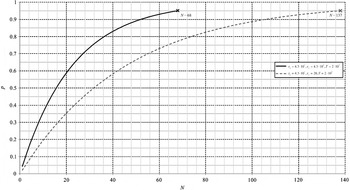
The last three models presuppose that our and other hypothetical civilizations were created approximately at the same time T=2×10⁵ years ago. In Fig. 6, the usage of microwave radio is exclusively compared τ1=τ2=τuse=4.3×10³. We see that only N=68 is enough for the targeted probability p⩾0.95. This is remarkable because only a handful of similar civilizations in the Galaxy are enough to get an opportunity to engage in the interstellar messaging with microwave radio.
The least number N of ET civilizations born in the last T=2×10⁵ years that are required for at least one technological usage synchronicity τ1=4.3×10³ during our expected usage of microwave radio τ2=4.3×10³ and in the next τ2=20 years.

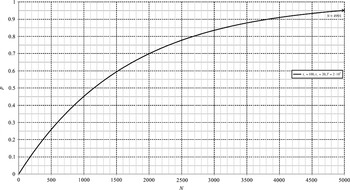
The two models that are the most directly useful to CETI calculate the probability of synchronization p with an Earth-like civilization actively using microwave radio in the next 20 years. In Fig. 6, ET societies are using radio to the maximum τ1=τuse=4.3×10³, τ2=20 and just N=138 ET civilizations in the Galaxy are enough for p⩾0.95 in this case. Finally, the last model (Fig. 7) simulates rapid progress and quick rejection of radio technology τ1=100, τ2=20. Here as many as N=4991 are necessary, which indicates a strong dependence between N and τ1 confirming it is difficult to synchronize with a civilization that is radio-loud only for a short period.
The least number N of ET civilizations born in the last T=2×10⁵ years with short technology usage period τ1=100 (exponential development) required for at least one synchronicity in the next τ2=20 years.

Discussion
The technological synchronicity only provides an initial opportunity for CETI. It does not guarantee that interstellar messaging will take place or that the signals will be detected. However, on the basis of the results obtained from our model we can conclude that the technological synchronicity is not a rare event if many ET civilizations do exist in the Galaxy, or they have very long lifespan and intentionally use technologies that are compatible with our stage of development. Another circumstance that might support synchronization is the bounded technological development curve.
In the definition of the geometric probability model (see ‘Geometric probability model’), we assumed that sender S and receiver R are independent of each other. But by the very nature of the GHZ theory creation of civilizations is clustered and not completely uniform throughout the Galaxy (spatially) or during the Galaxy's development timeline (temporally). However, this does not interfere with the initial postulate of S–R independence since civilizations could be created at the same (cosmological) instant, but have different progress curves. The only requirement on the technological synchronization is that S and R invent their technologies independently of each other, or in other words, that they do not come into any sort of contact or exchange information before their technological synchronization is asserted. If these conditions are met then the developed model is valid. Indeed, the mathematical model in this paper can be used to assert the probability of technological synchronization within any time frame – in the last three developed models in the section ‘Applying the figures’, we assumed concurrently created and young civilizations, while other model's instances have uniform temporal distribution within several billion years.
As has been suggested (Forgan Reference Forgan2011) spatial and temporal coincidence of civilizations’ inception and development paths is important for their synchronization and possible contact. These factors certainly confine the simpler model adopted in this paper and act as filters in the probability function. Intuitively, one should expect to see ‘bursts’ of higher synchronization probability within certain time periods and Galaxy regions suitable for generation of life and development of advanced civilizations. However, this argument should be correlated with the GHZ hypothesis or, even more generally, the evolution of habitable planets.
On the other point, the finite speed of light and large distances involved in CETI imply a possibility that R might receive a microwave radio message from S when actually the sending civilization has broken the established synchronization. This should be noted when considering the model presented in the paper, but ultimately it does affect the estimated number of civilizations N necessary for the statistically significant probability of technological synchronization. The finite speed of transmitting messages entails a mixed clique of technologically synchronized ET civilizations where at a specific point in time some either do not exist any more, have superior set of technologies or even receded to a more primitive technological status because of a cosmic cataclysm or some destructive conflict. The number of civilizations N incorporates all these civilizations.
If we assume that a microwave radio contact (or optical, neutrino, etc.) with ET civilizations will be established in the next 20 or so years we should adopt at least one of the following two hypotheses: (1) either there are plenty of relatively juvenile civilizations randomly distributed in the Galaxy at or near our own stage of the technological development and their leaked microwave radio emissions are detectable from Earth, or (2) other civilizations, although possibly more advanced than us, are actively seeking contact and flooding space with intentional messages, i.e. ‘greetings’. In the latter case, these civilizations may target specific planets that are good candidates for the development of the complex life (Shostak Reference Shostak2011b). The first hypothesis implies three likely possibilities: (1) our civilization and a majority of others in the Galaxy were created approximately at the same time and have similar development curves, (2) civilizations have a short life-span, but the sentient life is not sparse and many new radio-capable civilizations are created regularly, and finally, (3) there is a kind of technological barrier beyond microwave radio and optical technology that does not allow a more efficient or faster-than-light messaging across interstellar distances, in effect stalling the development of communication technologies at or near our current level of progress.
Civilizations that only inadvertently leak signals should be closer to our stage of development than more advanced civilizations that have better technologies and can muster enough resources to continuously send strong intentional signals. In the cosmological timescales, we are at the beginning of the interstellar communication age so there is a lesser chance that we can find another civilization identical to our own. Indeed, if we currently co-exist with other ET civilizations, it is likely that they are either at a lower or higher development stage than us.
Furthermore, the minimum required number of advanced civilizations engaged in the deliberate messaging scenario is relatively low but could actually be much higher than what can be deduced strictly mathematically since the will to actively seek contact, as in the Messaging Extraterrestrial Intelligence (METI) effort (Zaitsev Reference Zaitsev2011), is optional. This is why the actual number of civilizations in the Galaxy could actually be much higher if SETI does discover an intentional signal. On the other hand, the microwave radio leakage is by definition involuntary and unintentional. Therefore, the number of ET civilizations could be more accurately predicted along this scenario.
We can also deduce that the cumulative duration of SETI projects is insignificant when compared with the larger timescales related to progress and development of civilizations. Consequentially, if we are not technologically synchronized at a particular moment in time with another ET civilization than several decades more or less of SETI effort will not make a statistically significant change. In this respect, we can say that SETI implements a static census of the technologically comparable ET civilizations and is oblivious to their dynamical changes.
Finally, it is obvious that the technological synchronicity is a reflective property between two civilizations. Earth is not only a receiver but also a transmitter. Since in the discussion we assumed that there are N≫0 civilizations in the Galaxy, we can also presume that other ET civilizations do potentially exist that could be using microwave radio-communication technologies for detection of Earth's signals. As was mentioned before, if τpossess>0, τuse>0 (they can use radio) and τpossess≫τuse is expected statistically, then such civilizations will likely be more advanced than us.
Conclusion
We have seen that the technological synchronicity is a multifaceted problem, but it is also important to SETI as a prerequisite for detection of ET signals. We have divided the synchronicity problem into two classes: a more general class of the synchronous possession of technologies and the class that is more interesting to the SETI/CETI effort – the synchronous usage of technologies. These classes of problems were analysed with our mathematical model based on geometric probability with the goal of ⩾95‰ probability of ET signal reception in the next couple of decades.
In the context of positive detection along the leakage scenario, we should expect to find a large number of technologically similar civilizations and the intentional signalling allows for a much smaller number of more advanced civilizations. This would make detection of a deliberate and information-rich message more likely but only if ET civilizations are indeed using this resources for this effort.
Furthermore, we saw that only a handful of ET civilizations (N⩾138−4991) living in the Galaxy right now are enough to get a fair opportunity of an accidental technological synchronization, yet so far no interstellar signal has been detected. This represents a kind of conundrum and only deepens the Fermi paradox. It can be explained by a small real number of ET civilizations, distance from Earth or their radio quietness that may come from frugality or prudence.
Apart from detecting interstellar signals along either scenario, equally intriguing outcome of the contemporary SETI effort would be a null result. But even in the case of negative detection a well-designed SETI experiment would be an important and scientifically valid because it bounds or excludes different hypotheses on the sentient life and CETI in general.
Pragmatically speaking, the synchronicity problem will certainly play an important role in determining the chances of contact by modern large radio-telescopes such as Low-Frequency Array (LOFAR), Mileura Widefield Array Low Frequency Demonstrator (MWA LFD) and Square Kilometer Array (SKA) (Kassim Reference Kassim2004; Bowman et al. Reference Bowman2007; Dewdney et al. Reference Dewdney2009; see http://www.lofar.org/; & http://www.skatelescope.org/). The possession and usage of the same technologies determines the actual number of potential CETI targets.
Acknowledgements
The authors wish to thank their colleagues at University of Zagreb and Croatian Astronomical Society for their cooperation and also an anonymous referee whose comments have greatly improved this paper.