Introduction
Family as a social institution play a key role in human life, and family relationships remain the most intense and enduring of all interpersonal and social bonds. Family structure is cyclical and dynamic like from an extended family, after the marriage of a child, a nuclear family is formed and then after the wedding of their children, the extended family again appears (Goode, Reference Goode1964). Though contemporary families have new and varied structures, the family members have respective roles in their inter-personal relationships governed by social norms (Ratra et al., Reference Ratra, Kaur and Chikkara2006). The family/household structure often shapes individual behaviour and health to a great extent. Social relationships, found in close families, decrease the chances of the onset of chronic disease, disability, mental illness, and death (George and Durham, Reference George and Durham2016). In the absence of people showing concern for their well-being, people living only with a spouse or in a nuclear family had higher physical and mental ill-health probabilities than their extended family counterparts (Turagabeci et al., Reference Turagabeci, Nakamura, Kizuki and Takano2007).
Maternal health care (MHC) services utilisation has been a subject of continuing scientific interest in India due to its implication for maternal and child morbidity and mortality. The MHC is deemed to be influenced by many household level factors. Evidence suggests that the health outcomes of young married Indian women from nuclear households are not better than their counterparts from patrilocal extended families (Allendorf, Reference Allendorf2013). Moreover, irrespective of the type of family, the quality of women’s relationships with husbands and in-laws influenced the use of MHC services in Madhya Pradesh, central India (Allendorf, Reference Allendorf2010). The presence/absence of in-laws in the household again contributes to the health care utilisation of women in general and MHC in particular (Simkhada, Porter and van Teijlingen, Reference Simkhada, Porter and Van Teijlingen2010). The role of mother-in-law (MIL) influencing daughter-in-laws’ health-seeking behaviour has also been an enduring debate due to the former’s advantageous position in the household. Literature often portrays the MIL as an experienced woman with dominance in MHC decision-making (Allendorf, Reference Allendorf2010; Allendorf, Reference Allendorf2013; Kumar, Bordone and Muttarak, Reference Kumar, Bordone and Muttarak2016; Raju and Ann, Reference Raju and Ann2000; Saikia and Singh, Reference Saikia and Singh2009). The MIL’s desired number of children is positively associated with women’s preferred family size, though often intermediated by the women’s education in Bihar, eastern India (Kumar, Bordone and Muttarak, Reference Kumar, Bordone and Muttarak2016). The MIL is further found to impact maternal health by restricting the autonomy of the daughter-in-law, especially in patriarchal set-ups (Anukriti et al., Reference Anukriti, Herrera-Almanza, Pathak and Karra2020; Bloom, Wypij and Das Gupta, Reference Bloom, Wypij and Das Gupta2001).
Family power dynamics, including the existing gender inequities, have reduced women’s ability to seek health care for sexual and reproductive health concerns (Regmi, Smart and Kottler, Reference Regmi, Smart and Kottler2010), thus putting them at risk of adverse health outcomes. A study in north India found that women with greater freedom of movement have a higher likelihood of utilising antenatal care services and safe delivery care (Bloom, Wypij and Das Gupta, Reference Bloom, Wypij and Das Gupta2001). However, Besides vast regional differences (Kolenda, Reference Kolenda1987), the family structure is rapidly transitioning in India (Kapadia, Reference Kapadia1986). The percentage of young married women residing in nuclear households has increased during 1992-2016, although most continue to live in non-nuclear households (International Institute for Population Sciences - IIPS/India and ICF, 2017). Several socio-economic factors such as educational, occupational, legal and demographic factors such as population growth, migration and urbanisation have been affecting the family structure in India. Additionally, regulation of sexual behaviour and reproduction, which was often considered a primary function of the family, continues to decline. Enhanced women’s status, usually due to modern education and economic independence, a decline in the patriarchal mindset, increased age at marriage, and a host of supply-side avenues, have favoured young women’s increased healthcare utilisation. The factors above are also perceived to reduce the influential role of in-laws, specifically, MIL in daughter-in-law’s health-seeking. Thus, it is imperative to do an in-depth analysis to assess the association of household structure and, more specifically, the presence of MIL with MHC utilisation using recent representative data in India. Family and household have theoretical difference but has been used interchangeably in the present study.
Methods
Data
The study used data from the fourth round of the National Family Health Survey (NFHS), 2015-16. The NFHS-4 is a nationally representative survey of 601,509 households that provides information for various monitoring and impact evaluation health and nutrition indicators. The survey’s sampling design was a stratified two-stage sample with an overall response rate of 98 per cent. The Primary Sampling Unit (PSUs), i.e., the survey villages in rural areas and Census Enumeration Blocks (CEBs) in urban areas, were selected using probability proportional to size (PPS) sampling. Trained research investigators gathered the data using computer-assisted personal interviewing (CAPI). Only those respondents who gave voluntary consent were interviewed in the survey. The survey was approved by the Institutional Review Board of the involved Institutes, and the datasets are available at https://www.dhsprogram.com for broader use in social research. For the present analysis, the sample of women aged 15-49 years who have given birth during the last five years preceding the survey (n=184,641) was considered.
Outcome variables
The outcome variables used in this study were full-antenatal care (ANC), institutional delivery, and postnatal care (PNC). Full-ANC was constructed with the standard form provided in NFHS-4, i.e., four or more ANC visits, at least one tetanus toxoid (TT) injection, and consumption of iron-folic acid (IFA) tablets/syrup for a minimum of 100 days. Full-ANC was categorised as “yes” for those who received it and “no” for those who did not. Women who had delivered their last child in any health institution (i.e., public or private or NGO) were considered institutional delivery. Women who had a postnatal check-up within 24 hours of their delivery (for institutional delivery) or within 12 hours of their delivery (for home delivery) were considered as received PNC.
Predictor variables
The primary predictor variable used in the analysis was household structure. The household structure was categorised into three groups (1) Nuclear household: defined as households comprised of a married couple or a man or a woman living alone or with unmarried children with or without unrelated individuals; (2) Non-nuclear household without MIL: defined as household comprised of the married couple and other family members except MIL; (3) Non-nuclear household with MIL: defined as household comprised of a married couple and other family members including MIL.
To assess the adjusted effect of household structure on MHC utilisation, selected socio-economic and demographic characteristics of the women such as current age (15-19, 20-24, 25-29, 30-34, 35-39, 40-49), years of schooling (no education, less than ten years of schooling, more than ten years of schooling), parity (1st, 2nd, 3rd, 4th and more), mass-media exposure (yes, no), wealth quintile (poorest, poorer, middle, richer, richest), religion (Hindu, Muslim, Others), social group (Scheduled caste-SC, Scheduled tribe- ST, Other Backward Classes- OBC, Non-SC/ST/OBC), place of residence (rural, urban), and geographical region (north, central, east, northeast, west, south) were included in the analysis. Additionally, the number of ANC visits (no visit, less than four times and four and more times) was used as a predictor variable for institutional delivery and PNC. Place of delivery (health institutions, others) was included as the predictor variable only for PNC. Women with any exposure to television/radio/newspapers were considered to have mass media exposure. The wealth quintile is a measure of a household’s living standard and was calculated using data on the household’s ownership of selected assets, materials used for housing construction, and types of water access and sanitation facilities. These included socio-economic and demographic variables are well-established factors of MHC utilization (Alemayehu et al., Reference Alemayehu, Gebrehiwot, Medhanyie, Desta, Alemu, Abrha and Godefy2020; Barman et al., Reference Barman, Roy, Zaveri, Saha and Chouhan2020; Pandey and Karki, Reference Pandey and Karki2014; Shahabuddin et al., Reference Shahabuddin, De Brouwere, Adhikari, Delamou, Bardaj and Delvaux2017).
Statistical analysis
Bivariate analysis was conducted to understand the individual association between the predictors and outcome variables. Then Chi-square test was performed to test the significance of the relationship between the variables included in the analysis. Binary logistic regression was used to check the adjusted effects of the predictor variables on MHC utilisation. The regression model’s outcome variables were categorised into binary, i.e.,1= yes, 0= no. The list of variables included for regression analysis was finalised after checking multicollinearity among the predictor variables. The VIF (Variable Inflation Factors) test was done to check multicollinearity. All the predictor variables included in the model had a VIF score below two, ruling out multicollinearity. In all the analyses, weights were used to restore the representativeness of the sample. The analyses were done through STATA (version 13) with a significance level of 5%.
Results
MHC utilisation by household structure and socio-demographic factors
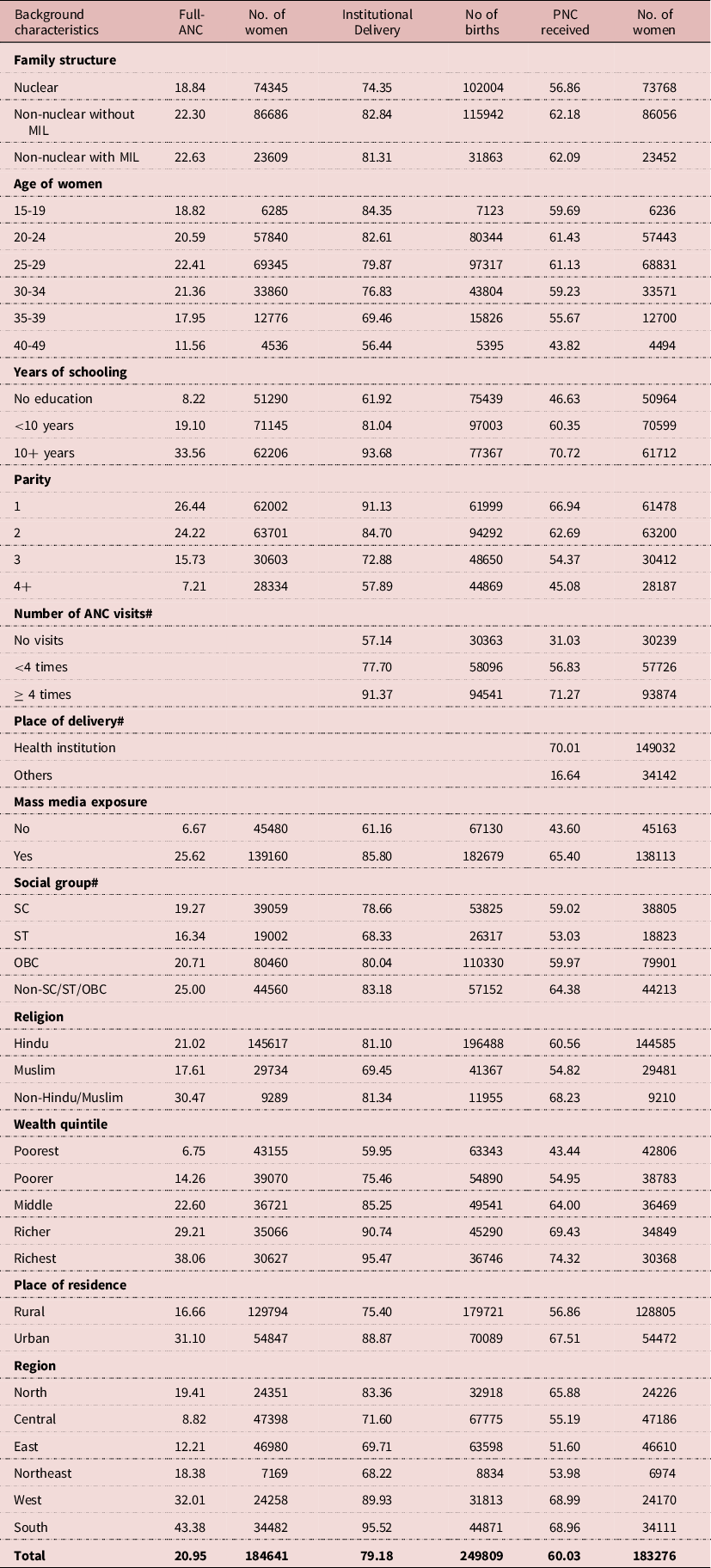
Table 1 presents the utilisation of full-ANC, institutional delivery, and PNC among women aged 15-49 by household structure and socio-demographic factors. Of the women, 21% had full-ANC, 79% had institutional delivery, and 60% had PNC. A lower percentage of the women living in nuclear households utilised full-ANC services than those from non-nuclear households. For example-19% of women living in the nuclear household had full-ANC compared with 23% of those from non-nuclear households with MIL and 22% of those from non-nuclear households without MIL. Seventy-four per cent of the women from nuclear households had institutional delivery compared with more than 80% of women from non-nuclear households. Fifty-seven per cent of the women from nuclear households had PNC than 62% of their counterparts from non-nuclear households.
Full-ANC, institutional delivery and postnatal care among women aged 15-49 years by socio-economic and demographic characteristics, India, 2015-16

# May not add to total due to missing cases
A relatively higher percentage of younger women availed full-ANC, institutional delivery, and PNC than older women. Women with ten or more years of schooling received full-ANC more than four times (34%) than women with no education (8%). For institutional delivery, the corresponding figures were 94% and 62%, respectively, and for PNC, 71% and 47%. The utilisation of the MHC services declined with increasing parity of the women. Of the women with 4+ ANC visits, 91% had institutional delivery, and 71% availed PNC against 57% and 31% of those without ANC visits. Seventy per cent of the women with institutional delivery availed PNC than 17% among women with non-institutional deliveries. The utilisation of MHC services was found much higher among women exposed to mass media, from Non-SC/ST/OBC category, was Non-Hindu/Muslim, and from the urban area than their respective counterparts. MHC utilisation further increased with the economic status of the women.
Determinants of MHC Utilisation
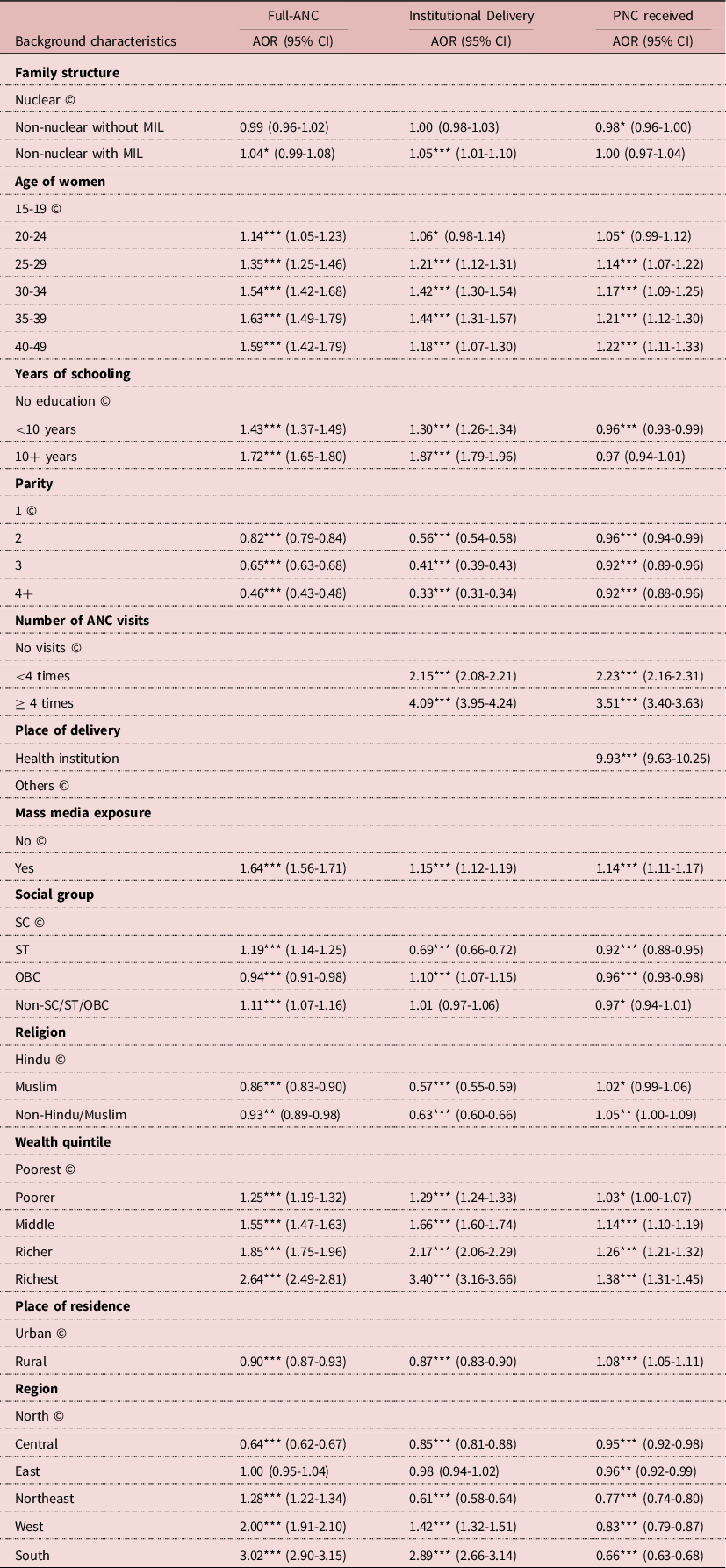
Table 2 presents the result of logistic regression of factors affecting MHC utilisation. Adjusting the effects of socio-demographic and economic characteristics, women from non-nuclear households with MIL had significantly higher odds of full-ANC (OR = 1.04, CI = 0.99-1.08) and institutional delivery (OR= 1.05, CI=1.01- 1.10) than their counterparts from nuclear households. Women from non-nuclear households without MIL had lower chances of PNC (OR =0.98, CI=0.96-1.00) than women from nuclear households. The likelihood of MHC utilisation increased with the increasing age of the women and decreased with higher parity of the women. Compared to women with no education, women with 10+ years of education had a 72% (OR = 1.72, CI = 1.65-1.80) more chance of having full-ANC and 87% (OR = 1.87, CI = 1.79-1.96) more likelihood of institutional delivery. The women with four or more ANC visits had more than four times (OR = 4.09, CI = 3.95-4.24) higher chance to have an institutional delivery and more than three times (OR = 3.51, CI = 3.40-3.63) higher chance to have PNC as against the women without any ANC visit. The women who delivered in a health institution had ten times (OR = 9.93, CI = 9.63-10.25) higher odds of utilising PNC against women with non-institutional delivery. The women with mass-media exposure had respectively 64%, 15%, and 14% more chance to have a full-ANC, institutional delivery, and PNC as against women without any mass-media exposure. Compared to SC women, ST and Non-SC/ST/OBC had higher odds of full-ANC; OBC women had higher chances of institutional delivery; ST, OBC and Non-SC/ST/OBC had lower odds of PNC. Compared with Hindus, Muslims and Non-Hindu/Muslims had a lower probability of full-ANC and institutional delivery but a higher probability of PNC. Compared to poorest women, richest women had more than 2 times (OR = 2.64, CI = 2.49-2.81), more than 3 times (OR = 3.40, CI = 3.16-3.66) and 1.3 times (OR = 1.38, CI = 1.31-1.45) higher chance to have full-ANC, institutional delivery and PNC. Rural women had 10% (OR = 0.90, CI = 0.87-0.93) and 13% (OR = 0.87, CI = 0.83-0.90) less chance to full-ANC and institutional delivery whereas 8% (OR = 1.08, CI = 1.05-1.11) higher chances of PNC compared to urban women. The women of the south region had three times higher chances to have full-ANC, 2.9 times more chances of institutional delivery and 34% lower odds of PNC than their counterparts from the north.
Adjusted Odds Ratio (AOR) of socio-economic and demographic predictors of full-ANC, institutional delivery and postnatal care, India, 2015-16

© Reference category, *p<0.10; **p<0.05; ***p<0.01.
Discussion
The household structure, in general, had a fragile association with a woman’s use of MHC services in India. Specifically, the presence of MIL had a weak association with DIL’s utilisation of MHC services, viz. full-ANC, institutional delivery and PNC. A relatively higher probability of full-ANC among women staying in households with MIL conforms to past studies (Allendorf, Reference Allendorf2013; Matsumura and Gubhaju, Reference Matsumura and Gubhaju2001). Women in non-nuclear households probably get more support in household work besides guidance on the importance of ANC. They thus are in a better position to avail themselves of the ANC services. As found in an earlier study (Speizer et al., Reference Speizer, Lance, Verma and Benson2015), this study also found that women residing in a non-nuclear household with MIL are more likely to deliver in health institutions than those from nuclear households. However, the difference between the rate at which the women in different household types used institutional delivery services was minimal. Another past study (Allendorf, Reference Allendorf2013) revealed that Indian extended families were more advantageous in delivery assistance than nuclear families. Evidence also suggests that the relationship between the MIL and DIL is shaped by shifting physical, social and economic dependencies and future expectations, sometimes leading to DIL appeasement by MIL (Vera-Sanso, Reference Vera-Sanso1999). Women from a non-nuclear household without MIL were also found to have lower PNC, perhaps owing to a higher percentage lacking assistance from family for PNC.
Nevertheless, this study’s findings of no or weak association between the presence of MIL and DIL’s MHC utilisation contradicts many past studies in India and abroad, which often portrays the MIL as a barrier. A qualitative study in Nepal found that MIL has a strong, often negative influence on ANC uptake (Simkhada, Porter and van Teijlingen, Reference Simkhada, Porter and Van Teijlingen2010). Dominating MIL has also been a barrier to institutional delivery in Nepal (Shrestha et al., Reference Shrestha, Banu, Khanom, Ali, Thapa, Stray-Pedersen and Devkota2012). A similar inverse association between the presence of MIL and institutional delivery was revealed in another study in Mali (White et al., Reference White, Dynes, Rubardt, Sissoko and Stephenson2013). Family members, including MIL’s unwillingness for institutional delivery, have also been found as the reason for home delivery in another study in West Bengal, India (Gorain et al., Reference Gorain, Barik, Chowdhury and Rai2017).
An earlier study using NFHS-2 data assessed the association between the presence of in-laws with MHC services utilisation of the DIL (Saikia and Singh Reference Saikia and Singh2009). It classified the household structure into three categories, i.e. viz., nuclear households, joint households with in-laws and joint households without in-laws. In contrast, the specific aim of this study was to understand the role of MIL in DIL’s utilisation of MHC services; thus, the household structure was classified into three categories: nuclear household, non-nuclear with MIL and non-nuclear without MIL. The outcome variables used in this analysis were full-ANC, institutional delivery and postnatal care; however, the earlier study considered antenatal visits in the first trimester and safe delivery besides use or non-use of contraception and BMI as the outcome variables. This study found that women from a non-nuclear household with MIL had a relatively higher chance of full-ANC than their counterparts from nuclear households, although the association is weak. However, the earlier study revealed that the odds of first trimester ANC were higher among women from nuclear households than those from joint households. The study found a relatively higher chance of institutional delivery among women from non-nuclear households with MIL than the earlier study that found a higher probability of safe delivery among nuclear households. The earlier study indicates the dynamics of household type and DIL’s health-seeking behaviour in 1998-99. This study’s finding relates to 2015-16, thus presenting the current scenario and indicating the changing dynamics between MIL and DIL over time. The full-ANC is also a more robust indicator than the antenatal visit in the first trimester. Again, the earlier study did not capture the association between household structure and PNC, which this paper has covered.
The outcome variables are also found to be significantly associated. The utilisation of full-ANC was a significant determinant of institutional delivery, and women with full-ANC and institutional delivery had higher chances of seeking PNC. Many past studies also found similar results (Barman et al., Reference Barman, Roy, Zaveri, Saha and Chouhan2020; Mishra and Retherford, Reference Mishra and Retherford2008; Rai, Singh and Singh, Reference Rai, Singh and Singh2012; Shahabuddin et al., Reference Shahabuddin, De Brouwere, Adhikari, Delamou, Bardaj and Delvaux2017; Thind et al., Reference Thind, Mohani, Banerjee and Hagigi2008), while a few studies have not assessed this association (Allendorf, Reference Allendorf2013; Saikia and Singh, Reference Saikia and Singh2009). Additionally, in conformity with earlier studies, this study also found age, education, parity, caste, place of residence, religion, wealth status, mass-media exposure, and the region as significant factors associated with MHC services utilization (Alemayehu et al., Reference Alemayehu, Gebrehiwot, Medhanyie, Desta, Alemu, Abrha and Godefy2020; Barman et al., Reference Barman, Roy, Zaveri, Saha and Chouhan2020; Chaka et al., Reference Chaka, Abdurahman, Nedjat and Majdzadeh2019; Pandey and Karki, Reference Pandey and Karki2014; Rai, Singh and Singh, Reference Rai, Singh and Singh2012; Shahabuddin et al., Reference Shahabuddin, De Brouwere, Adhikari, Delamou, Bardaj and Delvaux2017; Singh, Singh and Singh, Reference Singh, Singh and Singh2021; Thind et al., Reference Thind, Mohani, Banerjee and Hagigi2008; Zhou et al., Reference Zhou, Zhou, Yang, Ji, Ghose and Tang2020).
There are several strengths of this study. It is the first study to analyse the role of household structure in utilising MHC services holistically as against past studies assessing only some components of MHC services. Secondly, this study uses the recent large-scale, nationally representative data of NFHS-4 with a robust sampling design; thus, the results are contemporary and relevant. Thirdly, the role of MIL in MHC utilisation is analysed with great importance. There are some limitations also. Firstly, this study is based on cross-sectional data, and hence inferences drawn on the causal association between the predictor and outcome variables should be carefully studied. Again, other socio-cultural factors may influence the utilisation of MHC services, which could not be considered in this study due to a lack of data.
The household structure and, more precisely, the presence of MIL had a very weak association with a woman’s use of MHC services in India. The weak association between the presence of MIL and DIL’s MHC utilisation is a notable change from the earlier literature often portraying the former as a barrier.
Funding
This research received no specific grant from any funding agency, commercial entity, or not-for-profit organisation.
Conflicts of Interest
The authors have no conflicts of interest to declare.
Ethical Approval
The NFHS-4 was approved by the Institutional Review Board of the Institutions involved, and the datasets are available at https://www.dhsprogram.com for broader use in social research. The authors assert that all procedures contributing to this work comply with the ethical standards of the relevant national and institutional committees on human experimentation and with the Helsinki Declaration of 1975, as revised in 2008.