

Istanbul today offers very different shopping experiences, ranging from the Grand Bazaar founded in the fifteenth century – one of the largest covered markets in the world – to the Cevahir shopping mall, the second largest in Europe. The Grand Bazaar offers the consumer more than 3,000 shops, distributed according to product categories along 64 streets, with a total gross area of around 300,000 square metres. In contrast, the Cevahir mall, which opened in Şişli at the end of 2005, has a total gross area of around 420,000 square metres, hosting more than 340 shops on 10 floors, as well as providing parking for 2,500 cars.
Contemporary Istanbul has more mega malls than any other European city, and these modern malls have much in common with the Grand Bazaar, similarly offering a wide range of goods in separate shops organized along “streets”.Footnote 1 The most obvious difference is that whereas the Grand Bazaar is planned horizontally, the modern malls are multi-storeyed; they might therefore be characterized as vertical bazaars.Footnote 2
Almost a century ago, in 1912, Alfred Wiener compared bazaars with Western department stores, which first began to appear in the 1860s and 1870s, first in European and then in American cities.Footnote 3 They too offered a varied assortment of goods under the same roof; like contemporary malls, they did this on multiple floors. But, as Wiener stressed, the most fundamental difference between bazaars (we should add malls) and department stores is to be found in the way both were managed. Each store in the Grand Bazaar has its own proprietor, whereas the department store is owned by one person or a group of persons. The Grand Bazaar, and malls such as Cevahir, employ several thousand workers; yet they do not form a united workforce under a single management. Whether 50 or 5,000 employees work in a department store, they all report to one management.Footnote 4
Another characteristic that distinguishes bazaars from Western department stores is that some of the latter operate branches nationally and internationally. Since the last quarter of the nineteenth century, some Western department stores had run a dense network of branches covering many important Ottoman cities, including Beirut, Cairo, Istanbul, Izmir, and Thessalonica. Their cosmopolitan populations, comprising Europeans, Levantines, Armenians, Greeks, Jews, and an ever-growing number of Muslim “bourgeoisie” with an inclination to Western-style consumer behaviour, were the target of those enterprises. Although none of those enterprises is active today, some survived until the 1950s, and we can still find contemporary witnesses who remember them.Footnote 5 In cities such as Cairo, Thessalonica, and Istanbul, a few of their buildings still exist, testifying to their former greatness.Footnote 6
This study focuses on two aspects: the employees and the spatial distribution of Western department stores in Istanbul. The location, along with the personnel, was an important pillar of the department store’s innovative retail system. This becomes clear if we consider its most important business features.Footnote 7 Those were: a central location within urban areas; low rent (multi-storey premises); low product prices (low calculated prices for high-quality goods); low increases in prices; high sales, high stock turnover; large variety of goods, categorized and arranged openly in various departments (no obligation to buy); different sales floors and checkouts; and a high number of sales personnel and staff.
One of the main aims of department stores was to attract as many customers as possible and to offer them cheap goods in a highly appealing manner. The low prices were possible owing to high stock turnover.Footnote 8 This strategy has had a deep influence on the “traditional” retail store. With their abundance and variety of goods, department stores squeezed many retail traders out of the market.Footnote 9 Further, they aroused dissent among Western and Ottoman society alike; department stores were not only innovative in their marketing, they became public places where men and women could stroll through the world of goods and consumption. One might even argue that, with them, the clear distinction between private and public began to disintegrate.Footnote 10
The situation that prevailed when Western department stores entered the Ottoman urban market was replete with challenges. To approach the ethnically, culturally, and linguistically mixed customer pool, department stores had to widen their marketing by using all the available media that those different groups used. Likewise, the question of location was crucial since, for example, Muslim female customers would not easily visit branches located in Western districts. To attract them, stores had to be located in easily accessible areas; also, special rooms and personnel had to be provided.Footnote 11 Western department stores were reconciled to such factors for their businesses in Istanbul. Whereas the choice of location clearly shows that they established themselves equally in Western and “Muslim” districts alike, the situation was somewhat different in terms of personnel.
This study seeks to present some basic data on the workforce of Western department stores active in Istanbul between the years 1889 and 1921. Those stores have not, it would seem, attracted much interest among scholars, which is surprising if we consider that department stores active in the Ottoman Empire might have had several hundred employees.Footnote 12 Who were those employees, working on “the frontline of consumption” as Bill Lancaster put it?Footnote 13 It is not easy to find out, since we lack the first-hand sources and business archives which would otherwise have allowed us to gain some insight into the day-to-day business, the staff, and organizational structure. One is obliged therefore to consider a wide range of sources which, although “secondary”, nonetheless help us to understand the economic, social, and cultural importance of those businesses. One of the most interesting sources on employees is the so-called Annuaire Oriental yearbook (hereafter AO).Footnote 14 Since we lack rosters for department stores active in Istanbul, the AO helps us to analyse – if only partly – employees over a period of around thirty years. Moreover, the listings allow us to differentiate between the sex, job type, length of employment, and even the domicile of the employees.Footnote 15 With additional sources such as personal letters and the contemporary Ottoman press, we are able partly to compare the income of those employees within the broader context of European department stores and the urban Ottoman workforce. To analyse spatial distribution, besides the AO advertisements in the multilingual local press were highly informative.
Choice of location: between the Grand Rue de Pera and the Grand Bazaar
Despite what many Western observers claimed, the AO and the advertisements in the Ottoman press clearly show that department stores were located not only in the Western districts of the capital.Footnote 16 It is true that, from the second half of the nineteenth century, Galata/Pera became an important shopping centre and the famous Grand Rue de Pera (today’s Istiklal Caddesi) and its side streets had the highest density of Western stores.Footnote 17 But the old city (Stamboul) too was a prominent location for such enterprises and their branches. There was often assumed to be a clear-cut separation between the modern districts of the city, where an “accurate business system” was to be found, and the old city, with its Great Bazaar, which was described as “cramped quarters of native merchants”.Footnote 18
For Henry Otis Dwight, for instance, crossing the Galata Bridge must have meant leaving modernity and entering backwardness. Yet, Western department stores did not follow such simplified categories in their choice of location. When looked at in terms of business, it was profitable to apply a successful concept (high turnover – low prices) in various areas. The close location to the Bazaar not only provided easy access to retailers and traders; the stream of pedestrians must also have been an incentive. Furthermore, the close proximity to the port (Eminönü-Karaköy) provided another benefit in terms of logistics and distribution. Finally, in Stamboul, besides the Grand Bazaar and Western department stores we also find Muslim department stores with “orientalized” facades adorning their multi-storey premises and a range of goods similar to that offered by their Western rivals. The world of business was much more fluid and hybrid than some observers of the Ottoman capital have suggested (see Figure 1).
Department stores and shopping malls according to location.

Before returning to the question of location in the last part of this study, I want to present data on the employees of Western department stores. First, I will discuss their number, ethnic composition, and sex ratio. I will then try to trace the different job types, the duration of employment, as well the earning capacities and career paths that were possible in department stores. The final section discusses the spatial distribution of employees’ homes.
For the purpose of the present study, I checked the index of names and addresses given in the AO for the years 1889/1890, 1909, 1914, 1915, and 1921; this yielded more than 120,000 names in total.Footnote 19 I considered only those department stores employing a large number of the names listed in the index; those were A. Mayer, Baker, Bazar Allemand, Bon Marché, Orosdi Back [hereafter EOB], S. Stein, and Tiring. A. Mayer, S. Stein, Orosdi Back, and Tiring were of Austrian-Jewish origin; Bazar Allemand of German origin; Bon Marché of Italian, and Baker of British origin.Footnote 20 The data in the AO do not allow one to calculate the total number of employees; also, the stores analysed do not cover all those active in Istanbul.Footnote 21 Still, the data do provide us with invaluable information on employees at Western department stores. The total number of people working in the businesses listed above amounts to approximately 1,400 for the years 1889 to 1921. Counting every person only once, regardless of whether they appear in more than a single AO volume, we arrive at 561 employees. These data reflect only tentatively all the employees of the stores chosen. Using the EOB department store as an example, we can clarify this assumption, for we do have reliable data for EOB for the years 1908/1909 and 1920/1921.Footnote 22 Comparing those data with the figures given in the AO for these years, we get the figures which appear in Table 1.
EOB employees

Sources: AO; Louis Salmon, Letters (LS); Moore, “Some Phases of Industrial Life” (LM).
Around 1907, EOB was regarded as “certainement les établissements le plus important de notre ville”, as Ernest Griaud, secretary-general of the French chamber of commerce in Istanbul, put it.Footnote 24 This five-storey building was without doubt the greatest department store in the city, situated not in the Western-style districts of Galata or Pera but in Stamboul (Bahçekapı), and it had more staff than other comparable businesses. With their two- or three-storey premises, S. Stein, Tiring, Baker, and Bon Marché came next. Presumably, the total number of employees must have been perhaps 30 per cent higher than that indicated in the AO, although we do not possess any reliable data to confirm that for certain;Footnote 25 a survey of working conditions among employees in Istanbul around 1920 corroborates this assumption though.Footnote 26 Accordingly, the AO provides the data on the number of department store employees as shown in Table 2.
Employees according to the AO (1889–1921)

Sources: AO 1889, 1909, 1914, 1915, and 1921.
Compared with the number of employees working in urban French or American department stores, the Ottoman data seem very low. The Parisian department stores Bon Marché, Louvre, and Printemps each had between 1,000 and 3,000 employees by the end of the nineteenth century. In 1912, Bon Marché had a staff of 4,500.Footnote 27 Clearly, some of them were as large as industrial firms.Footnote 28 Even department store branches in provincial towns, such as Bordeaux, might have had several hundred employees.Footnote 29 Yet, we have to set these businesses in the context of local Ottoman conditions. Firstly, department stores such as EOB, Tiring, and S. Stein had several other branches within the Ottoman Empire besides those in Istanbul, as well as a considerable number of branches and production facilities in Europe.Footnote 30 Moreover, as in Europe, Ottoman retail trade generally consisted of small businesses (petty traders) with few employees.Footnote 31 In terms of numbers of employees, the department stores in Istanbul probably compared favourably even with most urban factories. For instance, around 1920 only a few factories had several hundred workers employed permanently in the capital.Footnote 32
We are able to personalize most of those employees on the basis of the information given in the AO. That source allows us to indentify the names, gender, domiciles, and job types of those registered. In a few cases, we are even able to follow their moves and career paths. Information on salaries is not given, of course, but for EOB we can draw on the data given in the letters written by one of its employees, Louis Salmon.Footnote 33 Though it gives names, the AO does not give any indication of nationality or ethnicity. Attempts to determine the ethnicity of employees on the basis of their names is problematic, as Peter Mentzel has argued in his article on the ethnic division of labour on the Ottoman railroad,Footnote 34 but it is not impossible, and several studies have used the technique. Scholars including Edhem Eldem, Ayhan Aktar, Lorans Tanatar Baruh, and Oliver Jens Schmitt have used the method to assign ethnicity to individuals.Footnote 35 Accordingly, I have followed the same methodology and tried to assign the 561 names in my sample to the following ethnic or national categories: Armenian, Greek, Jewish, Levantine/European, and Muslim. Though it would be more correct to group Armenians, Greeks, and Jews, as well as Muslims, into a single category, “Ottoman”, for my purpose I will present each of them separately. Table 3 shows the number of employees according to their ethnicity.
Employees according to ethnicity (1889–1921)

*AM: A. Mayer; GB: Baker; BA: Bazar Allemand; BM: Bon Marché; EOB: Orosdi Back; SS: S. Stein; TI: Tiring.
Sources: AO 1889, 1909, 1914, 1915, and 1921.
The cumulative data indicate that a majority of employees were Greek, followed by Levantines/Europeans and Jews. As was the case in many other foreign companies, department stores employed a considerable number of Ottoman citizens, who might sometimes exceed 50 per cent of the total workforce. Surprisingly, except at EOB, Armenians seem to have been employed less frequently in department stores.Footnote 36 Even more striking is the fact that among the 561 employees, only 3 could be identified as Muslims from their names, all of them working for EOB.Footnote 37 However, one photograph taken of EOB staff in around 1900–1910 depicts around 30 workers/servants, and most probably of Muslim origin. The photograph has on the back the inscription Bekçi – Hamallar. Those workers are not mentioned in the AO, nor are the approximately 40 children who, according to another photograph, were assembling umbrellas in 2 ateliers (şemsiye fabrika) on the top floor of the EOB building.Footnote 38
The ladies’ paradise: male-dominated world
Beginning in 1889/1890 the AO lists the names of a few female employees; altogether, before 1920 we have the names of six women, who could be assigned Levantine or Jewish ethnicity. It might be surprising that department stores, which are generally thought of first and foremost as tending to the needs of women and considered a “world of women”,Footnote 39 should employ mainly male workers; (Au Bonheur des Dames was the title Zola gave to his novel about Bon Marché). Yet, even in the shops in France, male employees dominated the scene; it was not until around 1914 that the gender imbalance changed in favour of women.Footnote 40 Apparently, the situation in Istanbul was the same, for four of the six women are listed for the first time in the AO for 1914. As mentioned above, we have to assume the proportion of female employees was higher. The survey of Istanbul department stores carried out by Laurence Moore in 1920 clearly indicates that, starting from 1914, more and more women were hired, first Jews, then Greeks. Only after World War I did Muslim women begin to occupy positions formerly occupied by men.
According to Moore, the gender ratio in the thirteen stores situated in Galata and Pera was 427 men to 270 women (38.7 per cent female), whereas in the 6 stores situated in traditional Istanbul it was 358 men to 80 women (18.3 per cent female).Footnote 41 With just 25 women out of a total of 250 employees, EOB, which is included among the latter 6 stores, was well below the average.Footnote 42 Moore informs the reader that Greek women were initially resistant to working in department stores and that only the war provoked a change in their attitude.Footnote 43 Women were generally engaged as cashiers and accountants, a practice that seems to have become common by 1920, not least because women worked for lower wages. As for Muslim women, Moore quotes the opinion of Muslim proprietors: “In the Turkish stores, the proprietors spoke more highly of the service of the women; women were said to be more conscientious and honest than men, and almost their equal in ability, although their experience in the business world had been so short.”Footnote 44
“Workers employed on the frontline of consumption”:Footnote 45 job types in western department stores
In department stores, customer service was at their core; therefore, salesmen and saleswomen, as well as sales assistants, were crucial in the various departments of the stores. The majority of the individuals listed (450), designated as “employee”, probably worked in customer service. The remaining 108 could be assigned to four categories of job types, as Table 4 illustrates.Footnote 46
Job types in department storesFootnote *

* Note: Job types given in bold could be found in all department stores (only in the case of Tiring were “cutters” not listed).
Sources: AO 1889, 1909, 1914, 1915, and 1921.
Positions such as those of cashier and accounting clerk were held mainly by Ottoman Greeks and Armenians. Greeks, Jews, and Levantines are listed as tailors and couturiers. Office jobs and higher management positions were held by Europeans and/or European Jews, depending on the department store.
Again, the EOB case may exemplify the occupational distribution according to ethnicity. Table 5 overleaf clearly shows that, according to the relationship between job type and ethnicity, there were variations among department stores. Greeks working for EOB are listed mainly as “employee”, whereas more Armenians than in other department stores were deployed in middle-ranking positions. In A. Mayer, S. Stein, and Tiring, high proportions of Jews were employed. The top jobs were also occupied by Jews, who, unlike the majority, came from Austria.
EOB: Job types according to ethnicity/nationality (1908/1909)

*Note: One “Chef du Rayon” not listed in the AOs but mentioned by Louis Salmon is added here.
Sources: Louis Salmon, Letters, AO 1909.
Income of employees: comparison of salaries
The AO does not provide data on income; we must therefore rely on other sources. Wage ledgers might have existed for department stores, but unfortunately not a single one has been discovered so far. Fortunately, personal letters from Louis Salmon, an employee of the Istanbul branch of EOB, give us interesting hints on the income situation. Since we have no comparable information on other department stores, the data given do not allow any generalizations. Wage data for other sectors and data on department stores and other businesses with clerks in western Europe nevertheless help us to get a clearer picture.
On 22 September 1908, 165 EOB employees declared a strike, which lasted about two weeks.Footnote 47 Their main demand was a wage increase (20, 30, and 40 per cent, depending on income level). In letters to his parents during the strike, Louis Salmon provides us with the income levels presented in Table 6. I have contrasted those data with figures provided by Mentzel, who extracted them from a ledger listing 669 salaried employees at the Ottoman Anatolian Railroad Company (CFOA). The ledger was compiled in August 1908 and includes employees with relatively high incomes, who, according to Mentzel, “by the standards of late Ottoman society” had very well-paid jobs.Footnote 48
Income level at EOB (1908) and CFOA (1908)

Sources: Louis Salmon, Letters, Mentzel, “The ‘Ethnic Division of Labor’ ”, p. 224.
EOB employees were highly paid compared not only with other Ottoman employees of the period; even in relation to salaries of employees in European department stores (London, Paris, and Hamburg), EOB salaries appear to have been well above average.Footnote 49 Whereas skilled workers in Europe could earn much more than clerks, the EOB and CFOA cases indicate that the Ottoman situation could differ in this respect.
According to Donald Quataert, unskilled coalfield workers earned about 6 kuruş a dayFootnote 50 (22 lira per annum), and a baker’s yearly income in 1908 was about 50 lira (14 kuruş a day, assuming he worked every day). Between 1900 and 1913, employees of companies such as Şirket-i Hayriye, Ziraat Bankası, and the Tobacco Régie received annually between 55 and 72 lira (15–20 kuruş a day). The annual income of lower-level civil servants from 1900–1909 varied between 240 and 1,000 lira, according to their rank; in the middle and upper echelons of the civil service, incomes could be between 2,400 and 5,160 lira,Footnote 51 which considerably exceeded those of most salaried employees, except the general directors of EOB.Footnote 52
Louis Salmon himself was in management; after joining the Istanbul branch of EOB in 1908, he worked his way up to the top, becoming branch director in Thessalonica in 1914. Through his letters to his parents, we can observe how his wages grew steadily. He received around 14 lira monthly in his first year, 18.4 in 1910, 27 lira two years later, and, finally, in 1914, almost 38 lira a month.Footnote 53
Comparison of monthly income, 1900–1914 (in lira).
Note: All figures have been translated into lira. The following exchange rates – which remained relatively stable for the sample period – were used: £1 = 5 US$ = 20 Deutschmarks = 25 French francs = 1 lira = 100 kuruş (1 kuruş = 40 para). See Charles Issawi (ed.), The Economic History of Turkey, 1800–1914 (Chicago, IL, 1980).
Sources: Lancaster, The Department Store; Hosgood, “ ‘Mercantile Monasteries’ ”, Peterson, Commercial Assistants, Miller, Bon Marché, Vedat Eldem, Osmanlı İmparatorluğu’nun iktisadi şartları hakkında bir tetkik (2nd edn, Ankara, 1994), pp. 143, 153, and Louis Salmon, Letters.

Career paths: from employee to executive
Unfortunately, we have little information on the hiring procedures of department stores. In response to the two-week strike mentioned earlier, EOB tried to replace some of the strikers. To do so, it used local newspapers to recruit new workers and received 150 applications. Given the quick response – 100 came for job interviews – it might have been normal practice to hire employees through announcements in the local press.Footnote 54 Moreover, the hiring probably depended also on personal contacts. Louis Salmon was hired through his father, Felix Salmon, who worked for thirteen years as general manager for EOB Paris. Louis received in-company training, starting at the age of eighteen in EOB’s branch in Manchester (1901), followed by training in Hamburg (1904), and finally, from 1908, after his military service, he continued his employee training in the Istanbul branch. There, he worked in all departments, eventually working his way up to management.Footnote 55
The AO entries indicate that local employees too could improve their occupational positions. George Meimaridis, for instance, is registered in 1914 as an employee at Baker; by 1921 his occupational title had changed: he was now responsible for clearing goods for Baker (dédouaner). In 1909, Jules Bernard began his career at Bon Marché as an employee; six years later, he became cashier. His colleague, Pierre Louis Bocagnano, who joined in 1889, had a more impressive career: in 1914, he became executive director of the store. Dom Bocagnano, probably a relative, rose within twelve years from being an employee to being cashier. The entries for EOB list four individuals who started out as employees and became accountants or accountants who became chief accountants.
Interestingly, we also find career paths suggesting downward occupational mobility. Pierre Terdjiman seems to have lost his position as accountant between 1909 and 1914 and was demoted to EOB employee. Other entries suggest that relatives worked in different enterprises, and, for some, switching stores was a career option.Footnote 56 For instance, Léon Bornstein worked as chief cashier at S. Stein between 1889 and 1913. But in the AO for 1914 and 1915 he is listed as an executive of the A. Mayer department store. Finally, in 1921, he again switched employer, moving to Tiring as a cashier.
Although the AOs do not mention the unskilled workers (hizmetçi, kapıcı, bekçi), those workers were part of the department store staff. As already mentioned, EOB employed around thirty carriers and janitors. It is highly probable that for the majority the opportunity for advancement was limited; yet the memoirs of Georg Mayer, director of the A. Mayer department store in the early Republican period, provides an example that is interesting in two ways. Firstly, it seems department stores recruited their unskilled workers among Anatolian families, partly over several generations. Secondly, in the case of the servant (hizmetçi) Has[s]an, we see an unskilled worker who managed to teach himself how to read and write and who gradually rose to positions with more responsibility. He was, for instance, head of the store’s own parcel service and was later responsible for clearing goods at customs. We learn that he finally managed to bring his family to Istanbul, where his children could attend school and, later, even university.Footnote 57
Working conditions: customer-friendly and disciplined
Regardless of career paths, some department stores apparently provided their employees with different models of earnings and social security, including performance-related profit sharing, annual sales commission, temporary continuation of salary, and pensions.Footnote 58 Yet this form of employee social security should not hide the fact that the organization of department stores was highly hierarchical and similar to the patriarchal organizations of their European counterparts. Again, the letters of Louis Salmon give us some clues as to working conditions. According to the written demands of the striker that Salmon refers to in one of his letters, the ethnically mixed staff (and most probably unskilled workers) claimed religious holidays according to their own rites (Armenian, Greek Orthodox, Jewish, and Muslim). Further, employees worked between ten and twelve hours a day. As in Europe and America, a reduction in working hours was one of their demands during the wave of strikes in 1908.Footnote 59
Another interesting request relates to dismissals, which often seem to have been immediate and unfair. The strikers accepted dismissals on grounds only of theft or lack of discipline. Salmon’s description of his daily work reveals that he too was subjected to rigid discipline. We may assume that, as at the Ottoman branches of European stores, “written and unwritten” laws existed, non-compliance with which would be punished by fines or even dismissal.Footnote 60 A well-groomed appearance and, above all, accuracy were essential. Further, employees were expected to be customer-friendly and confidently multilingual.Footnote 61 Immediately after his arrival, Louis Salmon, who had already mastered English and German by the time he joined the Istanbul branch, was asked by the director Leopold Back to begin Turkish courses, which he did.Footnote 62 Even if working conditions in Istanbul seem to have been very similar to those experienced by American and European employees, the willingness of Ottoman department workers to show solidarity with the working class and call for a strike is something that distinguishes them clearly from their counterparts elsewhere.Footnote 63
Duration of employment in years (1889–1921)

Sources: AO 1889, 1909, 1914, 1915, and 1921.
Duration of employment
Nevertheless, most male employees seem to have held secure positions, for more than 40 per cent of the persons listed worked at the same department store for between 5 and 7 years, and around 20 per cent for 12 years. Although 150 individuals appear in just one issue of AO, we also find 18 who must have worked for 20 or even more than 30 years. We even have a few rare cases which suggest that it was not impossible to work more than 50 years at the same establishment.Footnote 64 Working for department stores usually meant a secure position.
Employee’s domicile: from ethnic district to the fashionable Pera quarter
It is striking that a majority of the 108 qualified staff (i.e. non-sales) lived in Pera. By the end of the nineteenth century, living in Pera was considered highly expensive, and for many it was a prestigious place to stay.Footnote 65 Those who could climb the occupational ladder would often change their domicile (for instance from Galata to Pera or from Haskeuy to Pera). However, several individuals in senior positions moved from Pera to other districts, such as Ferikeuy, or just a few blocks within their former districts (R. Baghtché 28, Ferikeuy to R. Baghtché 56, Ferikeuy or from R. Hamam 68, Pancaldi to R. Hamam 44, Pancaldi). All but one executive had a domicile either in Pera or in Galata.
Generally, the AO entries reveal a connection between the domicile and ethnic background of employees. Many employees lived in the same districts in which their ethnic group had lived for generations. Pera was the quarter most favoured by Greeks, Levantines, and Europeans. Table 8 lists all employees according to their domicile.
Employees according to domicile and ethnicity (1889–1921)

*Notes: The district names are given as in the AO. Today, some of those places have different names: Chichli = Şişli; Djoubali = Cibali, Tatavla = Kurtuluş, Makrikeuy = Bakırköy, Psamatia = Samatya, Phanar = Fener, San Stefano = Yeşilköy, and Scutari = Üsküdar.
A: Armenian; G: Greek; J: Jewish; L/E: Levantine/European; TM: Turkish Muslim.
Sources: AO 1889, 1909, 1914, 1914, and 1921.
Edhem Eldem’s study of Ottoman banks’ customer registers provides a similar ethnic-based domicile pattern.Footnote 66 According to the AO, during the late nineteenth century, Galata, a traditional business district, was inhabited predominantly by Jews. Riva Kastoryano has shown that by then Galata was regarded as a transit quarter to the more prestigious Pera, where at least 36 Jews lived.Footnote 67 Abraham Galanté’s assumption that at the end of the nineteenth century traditional Jewish districts such as Balat, Hasköy, and Haydarpaşa had already been vacated in favour of Galata and Pera seems to be confirmed by the data.Footnote 68 Only 2.6 per cent of the 190 Greeks had their domicile in Galata; besides Pera, they lived mostly in Tatavla (21), Balat (12), and Phanar (12), followed by Psamatia and Makrikeuy. More than half of Europeans/Levantines resided in Pera, followed by Galata (10), Feriköy, and Pancaldi. Only 27 per cent of Armenian employees lived in Pera; the rest were distributed equally across Coum Capi, Pancaldi, Makrikeuy, Scutari, Psamatia, Galata, and Ortakeuy.
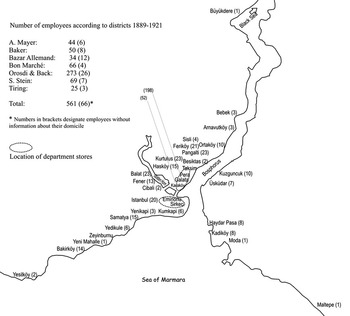
Although the almost 500 employees lived in a total of over 28 districts, the great majority – between 60 and 80 per cent – were concentrated in just 4 districts, according to their ethnic group. Finally, the data clearly show that the majority of employees had their own homes (see Figure 3). This contrasts with department stores in Europe, where many employees had accommodation in the store itself. The living-in system for employees, which was common in England, seems not to have been in use in Istanbul.Footnote 69 Yet again, Georg Mayer’s memoirs are revealing in this respect, for he mentions Turkish servants who were accommodated in the store.Footnote 70
Number of employees according to domicile.
Conclusion: from department stores to mega malls
Western department stores played an important role in Istanbul’s retail trade in the late nineteenth and early twentieth centuries. They were important economic actors and employed hundreds of local citizens. Socially and culturally, as well as architecturally, they left deep traces in the urban web of the Middle East. For the history of consumption and the modernization of shopping, they form a sort of link between the “traditional bazaar” and the postmodern mega mall. Department stores were inspired by the bazaar concept and, as the examples presented here show, they were not restricted only to the Western-style districts of Istanbul but were also active in districts traditionally associated with the bazaar. Therefore, spatially, there was probably no such clear-cut separation of modern and traditional business. Population, easy accessibility, easy transportation, and distribution played decisive roles in the choice of location within the capital.
The workforce was equally highly mixed, dominated by Ottoman citizens, even though Muslims were, apparently, hardly ever employed as sales personnel before 1914. In most stores, the majority of workers were Greek, Armenian, or Jewish. The question of why Muslims apparently worked mostly in minor positions (hizmetçi, bekçi, hamal) is not easy to answer. We observe a similar situation in comparable enterprises active in Istanbul selling consumer goods.Footnote 71 This might be interpreted as some sort of ethnic-based hiring policy; but, as yet, that remains just a hypothesis.
In the case of women, Ottoman department stores did not differ much from Western ones. It was only from 1914 onwards that female employees equalled male employees in number. Nevertheless, women were important to Muslim customers, as were special rooms, for they allowed the stores to offer culturally and religiously sensitive services.
The personnel management of Istanbul’s department stores shows great similarities to that of European and American ones. Patriarchal structures – based on the family business origins of the enterprises – and severe discipline were important features on both sides.
The incomes of employees seem to have been well above the average for unskilled workers and favourable even when compared with the salaries offered by European department stores. Most executives of European or American department stores were probably not afraid of strike calls; in 1908 at least, the situation in Istanbul (and Thessalonica) was slightly different. One possible reason might be the relative distance between workplace and domicile. Whereas employees in Europe often lived within the department store, where they were subject to a “welfare system” and social control, most Ottoman employees had their own homes. According to the data, most employees lived in more or less ethnically homogenous districts within a radius of 5–15 kilometres of their workplace. The social impact of each ethnic community might have been of more relevance than the impact of the department stores, which implies that the staff did not form a conscious body of employees detached from workers, as was the case in Europe.Footnote 72 This may explain the willingness of the Ottoman employees to strike with the workers.
Western department stores seemingly bridged the spatial gap between traditional and modern districts by operating branches on both sides and working with local traders and manufacturers alike. The choice of location was as much a part of their marketing as the intensive advertising and promotional activities designed to appeal to all potential customers. Today, Western department stores, both on the Istiklal Caddesi (the former Grand Rue de Pera) and in the old town (Stamboul), have been replaced by other foreign and/or local enterprises. In addition to the Istiklal Caddesi, which today offers consumer goods in the lower- and middle-price segment, many more shopping districts have developed which appeal to well-off consumers (Bağdat Caddesi, Osmanbey, and Nişantaşı). The famous Grand Rue de Pera lost its appeal to the bourgeois flâneur a long time ago. Furthermore, since the 1990s, mega malls have been erected – first in suburban areas, which could be reached by car, and then, with the developing transport network, in districts easily accessible by metro (see Figure 1). Their location seems also to depend on the income level of the neighbourhood rather than factors such as population density. The Grand Bazaar outlived the department store and coexists with these new vertical bazaars of postmodernity, the mega malls. The latter now attract not just millions of consumers, but, increasingly, researchers as well.Footnote 73



