



Childhood trauma, also referred to as childhood adversities, includes preventable and potentially traumatic events during childhood and adolescence.Reference Guinn, Ottley, Anderson, Oginga, Gervin and Holmes1 Childhood trauma has emerged as a global public health concern, with a minimum of 50% of individuals worldwide experiencing at least one type of childhood trauma.2 Approximately 6% of children aged 0–10 years and 19% of those aged 11–17 years have endured multiple types of childhood trauma.Reference Radford, Corral, Bradley, Fisher, Bassett and Howat3 Recent studies have identified associations between childhood trauma and subsequent lifelong risk of depression, primarily through changes in brain structure and poorer neurodevelopmental functions.Reference Rod, Bengtsson, Budtz-Jørgensen, Clipet-Jensen, Taylor-Robinson and Andersen4
Existing research has predominantly focused on the associations between childhood trauma and depression within specific age groups. A longitudinal cohort study revealed that experiencing childhood trauma increased the risk of depression by 19% among adolescents and young adults.Reference Mason, Emery, Friedman, Hanson, Johnson and Neumark-Sztainer5 Xiang and Wang found that childhood trauma was associated with a higher incidence of major depressive disorder in later life among participants aged 51 years and older.Reference Xiang and Wang6 However, there is a lack of systematic investigation regarding the impact of childhood trauma on the risk of depression across different life stages.
In addition, exposure to childhood trauma has been found to increase individuals’ susceptibility to encountering adverse adulthood experiences (AAEs). Although both childhood trauma and AAEs are widely known to be associated with risk of depression, few studies have investigated the combined impacts of childhood trauma and AAEs on subsequent mental health. Most studies have primarily focused on childhood trauma or AAEs alone, or on the differences in risk of depression associated with different types of trauma. However, there is limited evidence exploring the interaction and joint associations of childhood trauma and AAEs with depression. A US longitudinal study emphasised that shared experiences of childhood trauma and AAEs were associated with depression, suggesting potential cumulative detrimental effects of traumatic events.Reference Stern and Thayer7 The findings of one cross-sectional study indicated a significant and independent associations of childhood trauma and AAEs with non-suicidal self-injury, without any observed interactions between the two factors.Reference Chen, Li, Liu and Liu8
To address this knowledge gap, we aimed to investigate the independent associations of childhood trauma and AAEs with age at onset for depression in a large prospective cohort study. We further explored the joint associations of childhood trauma and AAEs with depression onset from a life course perspective.
Method
Study design and population
The UK Biobank (UKB) is an ongoing study that recruited over 500 000 participants aged 37–73 years from 22 assessment centres in the UK between 2006 and 2010. Participants provided information on sociodemographics, lifestyles, health conditions and family history through touch-screen questionnaires and face-to-face interviews during the baseline recruitment process. All participants provided written informed consent and formally agreed to link their data to national electronic health-related data-sets.Reference Fry, Littlejohns, Sudlow, Doherty, Adamska and Sprosen9 The UKB has received approval from the Northwest Multicentre Research Ethics Committee (no. R21/NW/0157).
Information on childhood trauma and AAEs was collected through an online mental health questionnaire from 2016 to 2017. As presented in Supplementary Fig. 1, 148 096 participants who completed the baseline survey and online mental health questionnaires on childhood trauma and AAEs were initially included. Exclusions were first implemented for participants with missing covariates and those previously diagnosed with depression before the age of 16 years. A total of 118 164 participants were included in the analysis of childhood trauma and its impact on the onset of depression. Subsequently, 11 278 participants with a history of depression under the age of 45 years were further excluded. Finally, an analysis was conducted on 106 820 participants to examine the associations between AAEs and the onset of depression, as well as the joint effect of childhood trauma and AAEs on depression.
Childhood trauma and adverse adulthood experiences
In accordance with previous literature about childhood trauma that established significant implications for health,Reference Yang, Cao, Li, Zhang, Ma and Zhang10 childhood trauma in this study was identified using the Childhood Trauma Screener, a condensed version of the Childhood Trauma Questionnaire, consisting of five questions pertaining to neglect or abuse occurring before 16 years of age. These items included: (a) someone to take the child to a doctor when needed; (b) felt loved as a child; (c) sexually molested as a child; (d) physically abused by family as a child; and (e) felt hated by family member as a child. Participants’ responses were assessed on a 5-point Likert scale ranging from ‘never’, ‘rarely’, ‘sometimes’ and ‘often’ to ‘very often’, and subsequently dichotomised. If any type of abuse/neglect was reported, it was scored as 1, otherwise, a score of 0 was assigned (Supplementary Table 1). The cumulative score for all five items ranged from 0 to 5, with childhood trauma scores categorised as high (4 to 5), medium (2 to 3) and low (0 to 1), reflecting the number of traumas experienced in childhood.
An equivalent screener measuring AAEs (age 16 years and above) was adapted from the Crime Survey for England and Wales.Reference Khalifeh, Oram, Trevillion, Johnson and Howard11 The items included are: (a) physical violence by partner or ex-partner as an adult; (b) sexual interference by partner or ex-partner without consent as an adult; (c) belittlement by partner or ex-partner as an adult; (d) been in a confiding relationship as an adult; and (e) able to pay rent/mortgage as an adult. Responses to each indicator were dichotomised and summed to generate a cumulative AAE score for each individual, ranging from 0 to 5 (Supplementary Table 2). Participants were further classified into three groups based on the cumulative number of AAEs: 0–1 (low), 2–3 (medium) and 4–5 (high). The assessment of childhood trauma or AAE has been extensively employed in previous studies.Reference Chuong, Adams, Kwong, Haley, Amador and McIntosh12
Ascertainment of incident depression
UK Biobank has constructed a first-occurrence data-set (category ID: 1712) by employing algorithms that integrate clinical codes with predefined inclusion and exclusion criteria to identify cases of depression within our study population. As a multisource data-set, the diagnosis of depression was systematically retrieved from various sources, including self-reported medical conditions, primary care records, hospital in-patient records and death registers according to ICD-10 codes F32–33.Reference Jiang, Geha, Rosenblatt, Wang, Fu and Foster13 We categorised the age of depression onset into three distinct groups: early adulthood (16–45 years), middle adulthood (46–64 years) and late adulthood (≥65 years) for the analysis between childhood trauma and age at onset of depression. Two age groups, middle adulthood (46–64 years) and late adulthood (≥65 years), were used for analyses between AAEs and onset age of depression. Participants were followed from their baseline assessment date until either a diagnosis of depression or the end of the follow-up period on 1 April 2023. The onset date of depression was determined as the earliest recorded date, regardless of sources.
Ascertainment of covariates
Covariates included gender (female or male), ethnicity (White or Black and minority ethnic), education attainment (college or university, and other degrees), body mass index (BMI, kg/m2 [weight in kilograms divided by height in metres squared]), Townsend Deprivation Index (TDI), smoking status (current or non-current), drinking frequency (daily or not), sleep score, self-reported physician-diagnosed health conditions (cardiovascular diseases, diabetes, hypertension), social isolation and loneliness, survival status of mother and father (alive or deceased), number of siblings (0, 1, 2 or ≥3) and family history of depression (yes or no).
TDI is a composite index of deprivation that considers unemployment, absence of car and property ownership and household overcrowding; higher values indicate lower socioeconomic status. Smoking status was classified as current smoker (current) and non-smoker (never or previous). Drinking frequency was categorised by those who drank every day or almost every day, and those who did not. Assessment of sleep score encompassed chronotype, sleep duration, insomnia, snoring and excessive daytime sleepiness, using a scoring system ranging from 0 (poorer) to 5 (healthier). Social isolation was assessed based on three questions, including the frequency of family visits (1 point for the response of fewer than once per week), leisure/social activities (1 point for the response of ‘none of the above’) and living alone (1 point for the response of ‘0’). Thus, a comprehensive social isolation score ranging from 0 to 3 was generated. An individual was classified as socially isolated if they scored 2. Loneliness was defined according to whether they felt lonely (1 point for the response of ‘yes’) and how often they confided in others (1 point for the response of ‘never or almost never’). In the total score, ranging from 0 to 2, the individual was defined as lonely if they scored 2. The number of siblings means the set of adopted and biological sisters/brothers, categorised into four levels as 0, 1, 2 or ≥3. A family history of depression was recognised based on the presence of at least one verified record of depressive illness in a relative.
Statistical analysis
Baseline characteristics stratified by childhood trauma/AAE scores were summarised as mean ± s.d. for continuous variables and n (%) for categorical variables; group comparisons used Kruskal–Wallis (continuous) and χ 2 tests (categorical).
We calculated lifetime risk for incident depression at different ages using a modified Kaplan–Meier analysis with age as the timescale, which adjusted for competing risk of death from other causes.Reference Seshadri, Wolf, Beiser, Au, McNulty and White14 In the main analysis, participants contributed information on incidence of disease and death free of disease for each age attained during follow-up. Lifetime risk estimates were calculated at 0–80 years of age for low, medium and high childhood traumas. Based on baseline depression status, remaining lifetime risk was calculated for the first occurrence of depression at 40–80 years of age for low, medium and high AAEs.
Cox proportional hazard regression models were used to estimate the hazard ratio and 95% CIs of depression associated with childhood trauma and AAE levels (categorized as low, medium and high), with low scores serving as the reference group. Three models were estimated, and model 1 was adjusted solely for gender. Model 2 was further adjusted for ethnicity, educational attainment, BMI, TDI, smoking status, drinking status, sleep score, history of cardiovascular diseases, hypertension and diabetes. Model 3 was additionally adjusted for social isolation, loneliness, mother and father survival status, number of siblings and family history of depression.
Subsequently, we examined the joint associations of childhood trauma and AAEs by stratifying their scores into three categories: low (participants reporting 0–1 type of childhood trauma or AAE), medium (2–3 types of childhood trauma or AAEs) and high (4–5 types of childhood trauma or AAEs). Participants were then categorised into nine groups based on their combined childhood trauma and AAE status, with the reference group being those with low scores for both childhood trauma and AAEs. Moreover, to explore potential variations in different subgroups, we conducted subgroup analyses by age (≤60 and >60 years, the latter defined as elders by the World Health Organization),15 gender (female and male), educational attainment (college or university, and other degrees) and TDI (low, medium and high socioeconomic status), and incorporated an interaction term to examine potential variations in the associations across stratification factors.
Several sensitivity analyses were performed to test the robustness of the findings. First, we used multiple imputations by the chained equations method to impute missing data on covariates with ten imputations and repeated the main analysis. Second, landmark analyses were performed following exclusion of depression cases that occurred within the initial 2 or 4 years of enrollment, to minimise the potential influence of reverse causality. Third, the main analyses were replicated using two groups of childhood trauma and AAE scores, employing a 5-point scale to categorise adverse experiences as either high (participants reporting 3 to 5 types of childhood trauma or AAEs) or low (participants reporting 0 to 2 types of childhood trauma or AAEs).
All analyses were conducted using STATA 16 statistical software for Windows (StataCorp LLC, College Station, TX, USA; https://www.stata.com/products/windows/) and R software (version 4.1.3 for Windows, R Core Team, Vienna, Austria; https://cran.r-project.org). Statistical significance was set as P < 0.05 (two-sided test).
Results
Baseline characteristics of participants
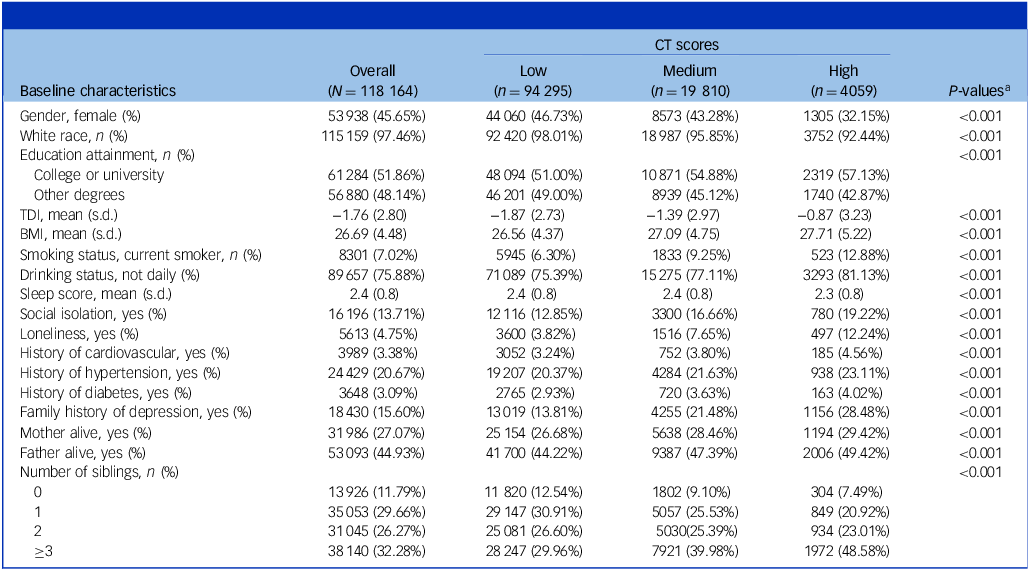
Among a total of 118 036 participants who were free of depression during childhood (aged 16 years and below), 53 881 (45.6%) were female and 115 159 (97.46%) were White individuals (Table 1). At baseline, out of the total participants, 4052 had experienced high childhood trauma, 19 779 had experienced medium childhood trauma and 94 205 had experienced low childhood trauma. Compared with those with low childhood trauma scores, participants with medium or high scores demonstrated higher levels of educational attainment, increased deprivation, increased social isolation and elevated levels of loneliness. The baseline characteristics stratified by AAE scores were aligned with the population distribution based on childhood trauma scores (Supplementary Table 3).
Baseline characteristics of participants according to childhood trauma scores

Table 1 Long description
The table presents baseline characteristics of participants categorized by childhood trauma scores, divided into low, medium, and high trauma groups. It includes data on gender, race, education attainment, various health metrics, and social factors. The table has 21 rows and 6 columns, including headers. Column headers are Baseline characteristics, Overall, Low, Medium, High, and P-values. Row labels include gender, race, education attainment, TDI, BMI, smoking status, drinking status, sleep score, social isolation, loneliness, history of cardiovascular issues, history of hypertension, history of diabetes, family history of depression, mother alive, father alive, and number of siblings. Each row provides specific percentages or counts for each category. Notable trends include higher educational attainment and increased levels of social isolation and loneliness in participants with higher trauma scores.
CT, childhood trauma; TDI, Townsend deprivation index; BMI, body mass index.
a. The P-values of categorical and continuous variables were obtained using Pearson’s χ 2 test and Kruskal–Wallis rank sum test, respectively.
Low refers to a score range of 0–1 on the CT scale, medium to a score of 2–3 and high to a score of 4–5.
Sleep score assessment encompasses chronotype, sleep duration, insomnia, snoring and excessive daytime sleepiness, utilising a scoring system ranging from 0 (poorer) to 5 (healthier).
Social isolation was assessed based on three questions, including the frequency of family visits, leisure/social activities and living alone. An individual was classified as socially isolated if they scored 2 from a total score ranging from 0 to 3.
Loneliness was defined according to ‘whether they feel lonely’ and ‘how often you confide in others’; an individual was defined as lonely if they scored 2.
A family history of depression was characterised by the presence of depressive disorders in first-degree relatives, including parents or siblings.
Childhood trauma, AAEs and lifetime risk of depression
The remaining lifetime risk for a 45-year-old individual with low childhood trauma of developing depression was 3.9%, whereas the findings were 8.01 and 13.3% for medium and high childhood trauma, respectively (Supplementary Fig. 2). Lifetime risks of depression were attenuated with increasing age, by 8.0, 15.0 and 22.9% at age 65 years in low, medium and high childhood trauma participants respectively. In the cross-cohort comparison, the lifetime risk of depression at age 65 years was lower in populations exposed to AAEs than in those exposed to childhood trauma, with rates of 4.2, 7.8 and 14.6% in low, medium and high AAE populations, respectively.
Associations between childhood trauma and age of depression onset
In the sub-cohort of childhood trauma throughout the lifespan, a total of 5165 depression events were documented during early adulthood, 5660 during middle adulthood and 1512 during late adulthood. In the multivariable-adjusted models, compared with low childhood trauma, high childhood trauma was associated with higher risk of depression across the lifespan, with hazard ratios of 2.35 (95% CIs: 2.12–2.59) in early adulthood, 1.86 (95% CIs: 1.67–2.07) in middle adulthood and 1.68 (95% CIs: 1.32–2.13) in late adulthood (Table 2). Significant associations between childhood trauma scores and incident depression onset were observed in all age groups: early adulthood (hazard ratio 1.28, 95% CIs: 1.25–1.30), middle adulthood (hazard ratio 1.20, 95% CIs: 1.18–1.23) and late adulthood (hazard ratio 1.19, 95% CIs: 1.14–1.24). The findings revealed that childhood trauma has a more detrimental effect on the early onset of depression than on later stages across the lifespan.
Association between childhood trauma and age of depression onset

Table 2 Long description
The table presents data on the association between childhood trauma and the age of depression onset across different stages of adulthood. It is divided into three main sections: Early adulthood (16-45 years), Middle adulthood (46-64 years), and Late adulthood (65 years and above). Each section includes data for low, medium, and high childhood trauma scores, with corresponding events and hazard ratios (HR) for three models. The table has 12 rows and 13 columns. Column headers include Events and HR (95% CI) for Model 1, Model 2, and Model 3. Row labels include Low, Medium, High, P for trend, and Per one increase in CT score. Notable trends include higher hazard ratios for high childhood trauma scores across all adulthood stages, with the highest ratios observed in early adulthood. The data indicates a significant association between childhood trauma scores and the onset of depression in all age groups.
CT, childhood trauma; HR, hazard ratio; CI, confidence interval; ref., reference.
Low refers to a score range of 0–1 on the CT scale, medium to a score of 2–3 and high to a score of 4–5.
Model 1 was adjusted for age (timescale) and gender.
Model 2 was further adjusted for ethnicity, education attainment, body mass index, Townsend deprivation index, smoking status, drinking status, sleep score, history of cardiovascular diseases, history of hypertension and history of diabetes.
Model 3 was further adjusted for social isolation, loneliness, survival status of mother and father, number of siblings and family history of depression.
Associations between AAEs and age of depression onset
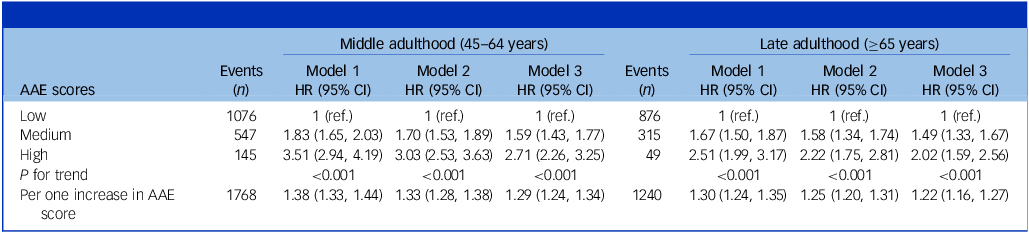
In the sub-cohort of AAEs through the lifespan, a total of 1768 and 1240 depression events were documented during middle and late adulthood, respectively. In the multivariable-adjusted models, compared with low AAEs, high AAEs were associated with higher risk of depression across the lifespan, with hazard ratios of 2.71 (95% CIs: 2.26–3.25) in middle adulthood and 1.59 (95% CIs: 1.43–1.77) in late adulthood (Table 3). Each unit increase in the AAE scores was significantly associated with an increased risk of depression onset at any age: 29% (hazard ratio 1.29, 95% CIs: 1.24–1.34) and 22% (hazard ratio 1.22, 95% CIs: 1.16–1.27). These findings suggest that AAEs have a more detrimental effect on the early onset of depression than on later stages across the lifespan.
Association between adverse adulthood experiences and age of depression onset

Table 3 Long description
The table presents data on the association between adverse adulthood experiences (AAE) scores and the onset of depression in middle adulthood (45-64 years) and late adulthood (65 years and older). It includes events, hazard ratios (HR), and confidence intervals (CI) for low, medium, and high AAE scores, as well as the P value for trend and the hazard ratio for a one-unit increase in AAE score. The table has 6 rows and 12 columns. Column headers include Events (n), Model 1 HR (95% CI), Model 2 HR (95% CI), Model 3 HR (95% CI), and P for trend for both middle and late adulthood. Row labels include Low, Medium, High AAE scores, and Per one increase in AAE score. Notable trends include higher hazard ratios for high AAE scores compared to low AAE scores in both middle and late adulthood, indicating a higher risk of depression onset with increased adverse experiences.
AAE, adverse adulthood experience; HR, hazard ratio; ref., reference.
Low refers to a score range of 0–1 on the AAE scale, medium to a score range of 2–3 and high to a score of 4–5.
Model 1 was adjusted for age (timescale) and gender.
Model 2 was further adjusted for ethnicity, education attainment, body mass index, Townsend deprivation index, smoking status, drinking status, sleep score, history of cardiovascular diseases, history of hypertension and history of diabetes.
Model 3 was further adjusted for social isolation, loneliness, survival status of mother and father, number of siblings and family history of depression.
Joint analyses of childhood trauma and AAEs on depression
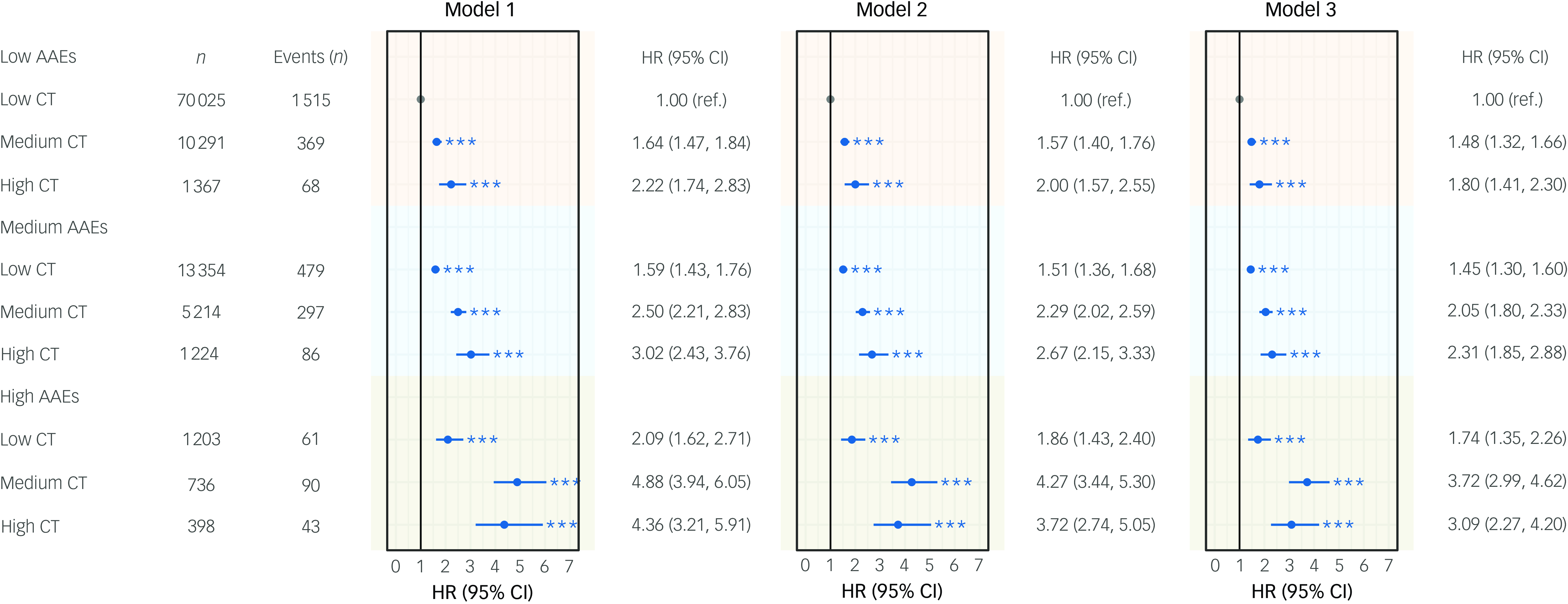
A total of 3008 participants experienced incident depression during the lifetime period. We conducted a joint analysis of childhood trauma and AAEs on incident depression. In the fully adjusted model, we found that high childhood trauma was associated with a 80% (hazard ratio 1.80, 95% CIs: 1.41–2.30) higher risk of lifetime depression compared with low childhood trauma among individuals with low AAE, and high AAEs were associated with 74% hazard ratio 1.74, 95% CIs: 1.35–2.26) higher risk of lifetime depression compared with low AAEs among individuals with low childhood trauma, suggesting the approximately equivalent detrimental effect of childhood trauma and AAEs on risk of lifetime depression (P > 0.05). Compared with those with low AAE and low childhood trauma, the adjusted hazard ratio for participants exposed to both high AAEs and high childhood trauma was 3.09 (95% CIs: 2.27–4.20). Moreover, we found no statistically significant interactions between the three levels for childhood trauma and AAE scores (Fig. 1 and Supplementary Table 4).
The combined effects of childhood trauma (CT) and adverse adulthood experiences (AAEs) on lifetime depression. HR, hazard ratio; CI, confidence interval; ref., reference. The effects of CT and AAEs on depression were analysed based on multiple covariates-adjusted Cox regression. Using low levels of CT and AAEs as reference groups, data is presented as HR and 95% CI. Model 1 was adjusted for age (timescale) and gender. Model 2 was further adjusted for ethnicity, education attainment, body mass index, Townsend deprivation index, smoking status, drinking status, sleep score, history of cardiovascular diseases, history of hypertension and history of diabetes. Model 3 was further adjusted for social isolation, loneliness, survival status of mother and father, number of siblings and family history of depression. ***P < 0.001, **P < 0.01, *P < 0.05.

Effect modification and sensitivity analyses
The results stratified by gender, educational attainment and TDI are presented in Supplementary Tables 5–10. A statistically significant association was observed between childhood trauma scores and incident depression among early adulthood females and males (P for interaction = 0.03). Specifically, the association between high childhood trauma scores and depression onset was found to be stronger among female participants (hazard ratio 2.78, 95% CIs: 2.29–3.38) than male participants (hazard ratio 2.24, 95% CIs: 1.99–2.51) in early adulthood. No statistically significant interactions were observed between AAEs scores and age of depression onset when stratified by gender, educational attainment or TDI group. The first sensitivity analysis yielded results consistent with those of the main findings, which imputed for missing covariates by chained equations (Supplementary Tables 11–13). Furthermore, when we excluded those diagnosed with depression in the first 2 or 4 years, evidence for these associations was largely strengthened, and similar joint associations were observed between high AAEs and medium childhood trauma (Supplementary Tables 14–19). With the use of alternative definitions for high and low scores of childhood trauma and AAEs, the results were similar, suggesting that high childhood trauma had the highest risk of depression onset in early adulthood (Supplementary Tables 20–22).
Discussion
This study utilises UK Biobank longitudinal data to investigate depression onset age following childhood trauma and AAEs, assessing both individual and combined impacts with a unique focus on cumulative risk effects. We found that exposure to childhood trauma or AAEs was associated with increased risk of depression onset across various life stages, and higher risk of depression onset was found in earlier adulthood than later across the lifespan. Furthermore, a joint effect was observed between childhood trauma and AAEs on incident depression; childhood trauma and AAEs exhibited similarly significant effects on risk of depression, suggesting that these contribute equally to lifetime depression. Taken together, our findings highlight the importance of paying attention to traumatic events at any life stage and implementing timely intervention strategies following such events to mitigate the risk of lifetime depression.
Despite consistent results regarding childhood trauma and depression in various studies, there are limited studies investigating the impacts of childhood trauma on the age of depression onset. Moreover, previous studies have revealed associations between childhood trauma and depression within specific age groups, including older adults, middle-aged people and adolescents,Reference Spiegler, Su, Li, Wolfson, Meng and Schmitz16,Reference Kobrinsky and Siedlecki17 but there is limited evidence regarding the impacts of childhood trauma on incident depression from a life-course perspective, comparing the onset of depression among early, middle and late adulthood in general populations. Following the inclusion of various life-course populations, this study found positive associations of childhood trauma and AAEs with depression onset at any age, with the strongest associations between childhood trauma and increased risk in early adulthood. A similar strongly positive relationship was noted between AAEs and depression onset in middle adulthood. This finding is consistent with a previous case-control study based on small sample populations, which indicated a significant negative correlation between adversity and age.Reference Lenze, Xiong and Sheline18 A retrospective study using data from the Ulm Gene Brain Behavior Project also supports our findings, demonstrating significant associations between stressful life events and early-onset depression.Reference Sanwald, Widenhorn-Müller, Schönfeldt-Lecuona, Montag and Kiefer19 The current study built upon previous research by elucidating the associations of childhood trauma and AAEs with the age of depression onset while considering populations across various life courses. Even though the potential efficacy of interventions aimed at addressing childhood trauma or AAEs for mental well-being has yet to be established through extensive randomised clinical trials, the potential reversibility of childhood trauma or AAEs consequences in adults has received attention. The findings highlight the necessity of integrating standardised childhood trauma screening into paediatric and primary care to enable early identification of high-risk youth, coupled with trauma-informed interventions targeting critical developmental windows. For early adulthood populations exhibiting the strongest childhood trauma–depression links, cognitive flexibility training and social rhythm therapies could mitigate neurodevelopmental vulnerabilities.Reference Croft, Heron, Teufel, Cannon, Wolke and Thompson20 Furthermore, the strongest associations between childhood trauma, AAEs and the onset of depression were observed in early adulthood. Therefore, these measures need to be integrated into health policy reforms, such as the establishment of lifelong health records for combined childhood traums/AAE exposures and the development of individualised intervention pathways across developmental stages, to systematically reduce the risk of early-onset depression.
The exact mechanism underlying the associations of childhood trauma or AAEs with age of depression onset remains unclear, which can be explained in several ways. Childhood trauma may exert a detrimental influence on social functioning throughout one’s lifetime, including loneliness, social networks and partner status. These factors can disrupt the delicate balance of mental health in the short term and increase vulnerability to depression, thereby predisposing individuals to experiencing depression at an earlier age. Additionally, childhood trauma is believed to induce changes in hippocampus and amygdala volume, reduction in grey matter volume and thickness,Reference Drobinin, Van Gestel, Helmick, Schmidt, Bowen and Uher21 physiological system ageing or early puberty.Reference Colich and McLaughlin22 These alterations serve as prominent indicators of biological ageing during early development, and subsequently predict the onset of depression. Therefore, the findings revealed in our studies are plausible from both a physiological and social perspective. Nonetheless, additional evidence is required to fully clarify the underlying mechanism.
Additionally, the research underscored a substantial combined influence of childhood trauma and AAEs on the risks of depression. Notably, individuals with higher childhood trauma scores demonstrated a stronger link between AAEs and incident depression, underscoring the critical importance of focusing on adverse experiences for adults, especially among participants who are more susceptible to AAEs because of previous exposure to childhood trauma. The above results are in line with a National Longitudinal Study of Adolescent to Adult Health, which revealed that the joint effects of childhood trauma and AAEs are associated with increased risks of depression, compared with those exposed to only one adversity.Reference Stern and Thayer7 Accordingly, considering the joint effect of childhood trauma and AAEs, it is imperative to adopt a comprehensive life-course health strategy. For instance, early-life interventions could emphasise prenatal care and support for parental mental health to mitigate intergenerational trauma. During adulthood, mental health policies and accessible community-based therapies should target stressors associated with AAEs. By integrating early intervention strategies throughout the lifespan, clinicians and policymakers can disrupt the trajectory from cumulative trauma to depression, thereby aligning with a proactive and comprehensive approach to mental health care. However, a population-based sample from the Health and Retirement Study found that childhood trauma and AAE were independently associated with elevated C-reactive protein, without interaction between childhood and adulthood trauma exposure.Reference Lin, Neylan and Epel23 Notably, other studies have demonstrated a link between heightened C-reactive protein and depression. These potential differences in results render it inconclusive to definitively assert the interaction effects between childhood trauma and AAEs on depression onset, which may be attributed to various variables, research design and sample considerations. Further exploration is required to fully clarify the complex relations between childhood trauma and AAEs on the development of depression. Moreover, although this study integrated multisource data to capture depression-related outcomes, the unique circumstances of untreated populations warrant further attention. These individuals may avoid treatment due to disease stigmatisation or insufficient social support,Reference Gao, Geng, Jiang, Huang, Zheng and Belsky24 underscoring the need for future public health interventions to foster inclusive environments that help patients overcome healthcare access barriers.
The strengths of this study include the simultaneous consideration of childhood trauma and AAEs, a large population size and comprehensive collection of information on various covariates. However, some limitations still exist. First, participants in the UKB cohort exhibited healthier lifestyles and higher socioeconomic status compared with the general UK population, which may limit the generalisability of our findings regarding whole-life course adversity and age of onset of depression. Second, there might be recall bias in assessing childhood trauma and AAEs due to data derived from the 2016–2017 mental health questionnaire; this could potentially lead to an underestimation of trauma incidence. Nevertheless, previous studies have confirmed good agreement between retrospective and prospective measures of childhood trauma, with excellent psychometric properties and temporal stability.Reference Meinck, Neelakantan, Steele, Jochim, Davies and Boyes25 Third, we leveraged the ‘first occurrence’ data-set, which was developed using algorithms provided by UKB. This data-set was systematically constructed by integrating data from multiple sources, including self-reported medical conditions, primary care records, hospital in-patient data and death registry records (https://biobank.ndph.ox.ac.uk/showcase/refer.cgi?id=593). Patient Health Questionnaire-9 was not employed to identify depression in this study, because it was utilised within the UKB cohort for approximately 150 000 participants between 2016 and 2017. Finally, our study is observational in nature; although we were able to establish a prospective association between full life-course adversity and age at onset for depression, causality remains ambiguous.
In summary, exposure to childhood trauma may be associated with an increased risk of depression across various stages of the life course, particularly for early-onset depression. Additionally, exposure to AAEs is significantly associated with increased risk of depression among individuals who have experienced childhood trauma. Our results suggest that solely paying attention to childhood trauma might not substantially mitigate the risk of depression later in life, and additional strategies for tackling AAEs may also be necessary. Implementing a comprehensive life-course health strategy, aimed at focusing on both childhood and adulthood stressors, could potentially contribute to mitigating depression. However, further research is required to validate these conclusions.
Supplementary material
The supplementary material is available online at https://doi.org/10.1192/bjp.2025.10301
Data availability
The data that support the findings of this study are available from the UKB project site, subject to registration and application process. Further details can be found at https://www.ukbiobank.ac.uk.
Acknowledgments
This study was conducted using UKB (application no.79095). We thank the participants of UKB and members of the survey, development and management teams of this project.
Author contributions
X.W. conducted the analysis, interpreted the results and wrote the first draft of the manuscript. C.X. and Z.C. were responsible for conceiving and designing the study, interpreting the results and securing funding. T.D. made critical revisions to the manuscript for important intellectual content. All authors have read and approved the final version of the manuscript and agreed with the order of presentation of the authors. C.X. is the guarantor of this work.
Funding
This study was supported by the National Natural Science Foundation of China (no. 72204071), Zhejiang Provincial Natural Science Foundation of China (no. LY23G030005) and the Scientific Research Foundation for Scholars of HZNU (no. 4265C50221204119).
Declaration of interest
None.
Ethics approval and consent to participate
The studies involving human participants were reviewed and approved by NHS National Research Ethics Service (no. NW/0382). Patients/participants provided their written informed consent to participate in this study.





eLetters
No eLetters have been published for this article.