INTRODUCTION
The Irish dairy industry will undergo considerable change in the future because of changes in European Union (EU) Common Agricultural Policy (Hennessy & Thorne Reference Hennessy and Thorne2006). The challenge for Irish dairy farmers is to increase the competitiveness of their business through innovation, lowering costs and increasing productivity (Shalloo et al. Reference Shalloo, Dillon, Rath and Wallace2004). This issue relates to all facets of the dairy enterprise, including cull cow enterprises.
The profitability of a dairy herd is directly influenced by the actions of the dairy farmer. The decisions that the farmer makes are predominantly based on economic considerations, rather than biological considerations (Van Arendonk Reference Van Arendonk1985) and are directed towards the maximization of total profit on the farm. Agricultural production decision-making is becoming more complex, due in part to increased competition caused by the globalization of agriculture and the need to adopt more sustainable farming practices (Rogers et al. Reference Rogers, Fitzgerald, Carr, Covey, Thomas and Looper2004). This has greatly increased the need to manage the way information is combined and implemented when making farm decisions. Decision support systems (DSSs) are an integrated computerized approach to assisting the user in solving complex problem or decision-making on the dairy farm. The DSS typically have quantitative output and place emphasis on the end user for final problem solving and decision making (Newman et al. Reference Newman, Lynch and Plummer2000). DSSs allow users to organize, set priorities, visualize potential management decisions and evaluate the outcomes of those decisions, and integrate research disciplines. An example is the use of computer modelling of animal production strategies to evaluate the effects of tactical and strategic alternatives in implementing genetic breeding programmes (Bourdon Reference Bourdon1998; Kinghorn Reference Kinghorn, Abbass and Towsey1999). The results account for animal merit, variance in merit, prevailing feed and marketing conditions, and options for multiple pathways to multiple product end points (Newman et al. Reference Newman, Lynch and Plummer2000), enabling well-informed decision making and in due course improving farm efficiency.
There has been a move towards the development of more integrated models for beef finishing strategies. Naazie et al. (Reference Naazie, Makarechian and Hudson1997) developed a beef efficiency model that combines three sub-models: (1) growth and feed intake, (2) herd structure, and (3) enterprise efficiency. Crosson et al. (Reference Crosson, O'Kiely, O'Mara and Wallace2006) evaluated beef strategies using a linear programming model for Irish-based beef finishing strategies. This model was designed as a research tool, providing information on optimum finishing strategies for beef farmers under alternative market conditions. The Decision Evaluator for the Cattle Industry (DECI; Jenkins & Williams Reference Jenkins and Williams1998) is a herd inventory model that has been developed as a DSS for industry use. The models developed for DECI are based on the studies of Sanders & Cartwright (Reference Snders and Cartwright1979), Notter et al. (Reference Notter, Sanders, Dickerson, Smith and Cartwright1979) and Bourdon & Brinks (Reference Bourdon and Brinks1987). These models developed guidelines for systems of beef production and are being implemented at commercial level in Ireland (Crosson et al. Reference Crosson, O'Kiely, O'Mara and Wallace2006) and internationally. There is a dearth in research of this nature for cull cow beef finishing systems. There is a necessity to provide DSS that will provide information to help the decision-making process of cull cow finishing farmers under volatile market conditions.
It has been reported that age (Minchin et al. Reference Minchin, Buckley, Kenny, Monahan, Shalloo and O'Donovan2009 a, in press) and live weight (Minchin et al. Reference Minchin, Buckley, Kenny, Keane, Shalloo and O'Donovan2009 b) have major implications for the biological performance of cull cows; however, the effect of these variables on profitability has not been previously reported. Variability in input costs and output prices such as concentrate price, initial carcass value and final carcass value affect the financial feasibility of different finishing strategies, and introduce complexity into the evaluation of optimum finishing strategies. Any tool that is developed to assess the financial feasibility of different finishing strategies should be able to take account of this variability in the form of stochastic budgeting (Smith Reference Smith1994; Lien Reference Lien2003; Shalloo et al. Reference Shalloo, Dillon, Rath and Wallace2004). Stochastic budgeting (unlike a more straightforward sensitivity analysis) takes into account the probability of occurrence of a certain outcome as well as the actual effect of the outcome which adds to the decision-making process.
Livestock sales account for 0·08 of total sales on dairy farms, and may provide potential for growth especially with the downward pressures on milk prices and milk output restrictions in the form of milk quotas. It has been reported that large proportions (0·78) of dairy cows are slaughtered in sub-optimal condition between September and December at the end of lactation without prior finishing (Minchin et al. in press). Therefore, it is possible for dairy farmers to increase their revenue from cull cow finishing, but there is a requirement for a DSS tool to determine if such increases in revenue would also increase farm profit.
The objective of the current study was to develop, validate and describe a DSS for cull cow finishing strategies that could be used by agricultural extension officers to help dairy farmers make decisions on:
1. Profitability of cull cow finishing strategies
2. Economically optimum finishing strategy
(i) Effect of cull cow age on profitability
(ii) Effect of variation in input and output variables on the stochastically dominant finishing strategy
MATERIALS AND METHODS
Production study details
The data for the DSS are based on a study that evaluated seven finishing strategies across two separate experimental years and reported by Minchin et al. (Reference Minchin, Buckley, Kenny, Monahan, Shalloo and O'Donovan2009 a, in press).
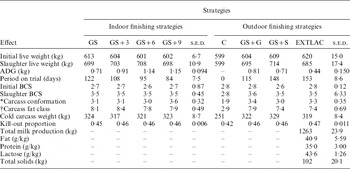
Year (1): 68 spring calving Holstein-Friesian dairy cows on completion of their final lactation were randomly assigned to four feeding strategies (FS): ad libitum grass silage (GS), GS+3 kg concentrate (GS+3), GS+6 kg concentrate (GS+6) and GS+9 kg concentrate (GS+9). Live animal, carcass and meat quality characteristics were measured. There was a linear (P<0·001) increase in average daily gain (ADG) (kg/day) for the first three dietary strategies, GS (0·71), GS+3 (0·91), GS+6 (1·14) with no additional response to the final increment, GS+9 (1·15). Cows on the GS+9 strategy (84 days) finished on average 12, 25 and 38 days earlier than the GS+6, GS+3 and GS strategies.
Year (2): 56 spring calving Holstein-Friesian dairy cows were randomly assigned to four experimental FS. The experiment was split into two periods: over-wintering period (OWP) and spring-finishing period (SFP). The FS were: a control group (C) slaughtered on day zero; and three dietary strategies, two of which were dried off pre-experiment and one with the extended lactation concept applied; ad libitum grass silage (GS+G); 0·75 grass silage and 0·25 straw (GS+S) and grass silage plus 6 kg concentrate dry matter (DM) cow/day and milked twice daily (EXTLAC). Subsequent to the OWP (84 days) cows were turned out to pasture (SFP). Live animal, carcass and meat quality characteristics were measured. Over the entire experimental period, ADG was lower (P<0·001) for the EXTLAC (0·44) strategy compared with the GS+G (0·81) kg/day and GS+S (0·71), respectively. The GS+G strategy finished 33 and 38 days (P<0·001) earlier than the GS+S and EXTLAC strategies, respectively.
All animals are assumed to be finished to target requirements (TARGET) in relation to meat quality criteria. TARGET was based on achieving: cold carcass weight ⩾272 kg, carcass conformation class ⩾3 and carcass fat class ⩾7. Failure to achieve either carcass weight, carcass conformation class or carcass fat class by one increment resulted in a decrease in payment of approximately €/kg 0·04, 0·04 and 0·13, respectively, assuming other criteria were achieved. Failure to achieve all three criteria resulted in a 42% reduction in carcass value (DAF 2006).
One control treatment (C) and seven finishing scenarios were simulated (GS, GS+3, GS+6, GS+9, GS+G, GS+S and EXTLAC) with three age categories (⩽2 lactations, 3–6 lactations and ⩾7 lactations). It was assumed in the analysis that experimental initiation date of 17 and 18 December corresponded to the date when the majority of cull cows are available at the end of lactation under Irish seasonal grass-based systems. The strategies employed resulted in differing days to slaughter, hence slaughter occurred at differing times of the year. Therefore, seasonal price adjustments were included in the analysis.
Design of DSS
The DSS was used to simulate a farm model, integrating biological data for each FS. The model integrates purchase price, sale price, feed, housing, land and labour costs. Land area and housing costs were treated as an opportunity cost within the model. A charge on a weekly basis for housing allowed the capture of associated costs with longer finishing strategies and the alternative possibilities available for housing and land following this enterprise. Variable costs (fertilizer, veterinarian fees, silage (including a reseeding charge to cover pasture renewal) and concentrate) and fixed costs (labour, machinery maintenance and running costs, farm maintenance, car, telephone, electricity, insurance and depreciation) were based on current prices (Teagasc 2008). The machinery and labour costs were calculated based on the above categories and were included in the model as a contractor charge to feed and spread slurry at €40/100 cows/day. The values for meat and milk price were obtained from projections from the Food and Agricultural Policy Research Institute – Ireland Outlook 2007 (Binfield et al. Reference Binfield, Donnellan, Hanrahan and Westhoff2008).
Risk analysis
Stochastic simulation was included in the DSS model using the computer software @Risk (Palisade Reference Palisade2006), which executes a Monte Carlo risk assessment (also called Monte Carlo uncertainty assessment). This process specifies a probability distribution for each sensitivity parameter, draws a set of those parameters, and repeats the conventional analysis for multiple draws (Phillips & Maldonado Reference Phillips and Maldonado1999; Petersen Reference Petersen2000; Phillips Reference Phillips2000). A sufficiently large number of simulations were run (n=10 000) with the same input distributions, so that the probability distribution functions of the outputs were adequately described (Isukapalli et al. Reference Isukapalli, Roy and Georgopoulos1998).
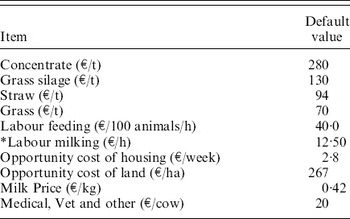
Stochastic budgeting was used to model the influence of variation in cull cow purchase price, carcass selling price, milk price and concentrate cost. The milk price and concentrate cost input distributions were developed using 10 years of historical data (CSO 2008). The computer program Bestfit (Palisade Reference Palisade2006) was used to create empirical probability distributions for cull cow price. For cow selling price, data from a number of meat factories in Ireland for the months of December, March, April and May for 2000 to 2008 were included. These were included in the model for each finishing strategy based on the days to slaughter for each of the finishing strategies. The Bestfit program selected the normal distribution for December carcass value, Beta general distribution for March sell value, logistic distribution for April and May sell values. For both milk price and concentrate costs, the extreme value distribution was selected as the optimum. All distributions were selected using the Chi Square test statistic and were visually assessed to ensure that the visual appearance was correct. The feeds offered (grass, grass silage, straw and concentrate) were determined by the Moorepark Dairy Systems Model (MDSM) (Shalloo et al. Reference Shalloo, Dillon, Rath and Wallace2004), milk production, live weight change (Jarrige Reference Jarrige1989) and body condition score (BCS) change (Lowman et al. Reference Lowman, Scott and Somerville1976). The key default parameters used in the model farm are shown in Table 1.
Assumptions used in the model finishing strategy

* Calculated from: 2·5 h per day to milk 50 cows.
The four stochastic variables were concurrently simulated with no correlation assumed between variables. The output variable was selected as annual net profit per cow for each of the finishing strategies. Outputs of the analysis are shown in the form of cumulative distribution functions (CDFs). The stochastically dominant set was found by comparing the CDF of risky prospects (Thomas et al. Reference Thomas, DeLorenzo, Bray, Weldon, Bucklin and Martin1997). A CDF contains all of the information on the output distribution of the risky prospects and therefore provides a useful decision-making criterion by assessing stochastic dominance. Stochastic dominance is a powerful risk efficiency criterion for comparing risky prospects.
RESULTS
Animal measurements
The results of the two finishing experiments conducted by Minchin et al. (Reference Minchin, Buckley, Kenny, Monahan, Shalloo and O'Donovan2009a, in press) are summarized in Table 2. The results from these experiments were used to develop the DSS model. The model was then used to define the most economically efficient strategy depending on scenario investigated. Experiment 1: offering the lower energy finishing diet compromised days to slaughter and ADG; however, offering the higher energy diet increased feed budget costs. Achieving the finishing criteria outlined, irrespective of diet will result in no difference in carcass characteristics (Minchin et al. Reference Minchin, Buckley, Kenny, Monahan, Shalloo and O'Donovan2009 a). Experiment 2: restricting cows by including straw in the diet or through increasing lactation length delayed subsequent days to slaughter by 35 days. However, restricting diet energy encouraged a high level of compensatory growth at grass. The EXTLAC treatment had a mean milk yield of 16·4 kg (s.d. 3·51) milk/cow/day, 40·9 g/kg fat (s.d. 5·59), 35·0 g/kg protein (s.d. 3·00) and 43·6 g/kg lactose (s.d. 1·26) over a 77-day lactating period (Minchin et al. in press).
The effect of feeding strategy on live and carcass performance for Holstein-Friesian cull dairy cows

BCS, body condition score. GS, grass silage; GS+3, grass silage and 3 kg concentrate/day; GS+6, grass silage and 6 kg concentrate/day; GS+9, grass silage and 9 kg concentrate/day; C, slaughtered on day 0; GS+G, grass silage+grass; GS+S, grass silage, straw 0·30+grass; EXTLAC, milking group offered grass silage and 6 kg concentrate/day, +grass. s.e.d., standard error of difference
* Scale 1 to 15 (15=best conformation; EUROP conformation scale).
† Scale 1 to 15 (15=fattest).
Feed budget
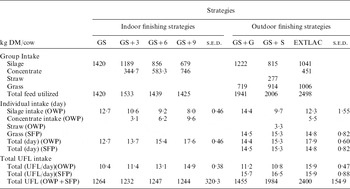
Table 3 presents a summary of measured group intake as well as estimated individual animal intake for each experimental strategy. The total DM intake for each strategy was 1·4, 1·5, 1·4, 1·4, 1·9, 2·0 and 2·5 tonnes/cow for the GS, GS+3, GS+6, GS+9, GS+G, GS+S and EXTLAC treatments, respectively. Total unité fourragère lait (UFL) intake was 1264, 1232, 1247, 1244, 1455, 1984 and 2400 UFL/cow in finishing feed for the GS, GS+3, GS+6, GS+9, GS+G, GS+S and EXTLAC treatments, respectively.
Individual and group DM intakes for Holstein-Friesian cull dairy cows offered eight finishing strategies

GS, grass silage; GS+3, grass silage and 3 kg concentrate/day; GS+6, grass silage and 6 kg concentrate/day; GS+9, grass silage and 9 kg concentrate/day; C, slaughtered on day 0; GS+G, grass silage+grass; GS+S, grass silage, straw 0·30+grass; EXTLAC, milking group offered grass silage and 6 kg concentrate/day, +grass. s.e.d., standard error of difference.
OWP, Over-wintering period (12 weeks); SFP, spring-finishing period. UFL (1 UFL (UFL, Unité Fourragère Lait) is the net energy equivalent of 1 kg standard air-dry barley utilized for lactation (1 UFL=7100 kJ)).
Cull cow price
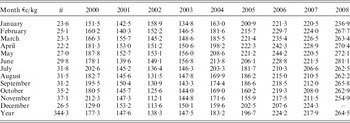
In Table 4, cull cow beef price shows substantial seasonal trends and year to year variation. The seasonal trend in cull cow carcass value shows higher prices offered during the spring and early summer months, reaching a peak in May and June and subsequently dropping to a minimum in the November and December months.
Mean value (€c/kg) offered for TARGET carcass in Irish commercial slaughter facilities from 2000 to 2008

Source: Department of Agriculture and Food.
#=10-year average of total cow numbers ('000) slaughtered per month in Ireland.
Economic implications of strategies evaluated
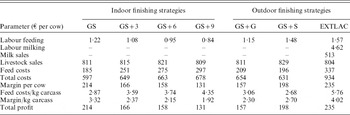
Table 5 shows the key output parameters from the model for the eight strategies investigated, which include seven FS and a control group slaughtered at the end of a conventional 300-day lactation. The seven FS were finished to TARGET carcass criteria. The highest profit was realized with the EXTLAC strategy (€235/cow) and the lowest profit (€131/cow) was achieved by the GS+9 strategy. The GS, GS+3, GS+6, GS+G and GS+S strategies were intermediate, realizing profits of €214, €166, €158, €157 and €198, respectively. The total costs of production were marginally different between the GS, GS+3, GS+6, GS+9, GS+G and GS+S feed strategies. The EXTLAC strategy produced 1263 kg milk which resulted in milk sales receipts of €513/cow. Feed and labour costs for the EXTLAC strategy were, respectively, 30 and 80% greater than the average costs associated with the same period (OWP) for the other six dietary strategies. The production of milk (milk sales) during this period did however, result in the EXTLAC strategy returning the highest profit (milk sales output was greater than the increased additional cost in feed). Feed costs per kg of carcass were lowest for the GS+G and GS+S strategies, resulting in the highest margin per kg of carcass with the exception of the EXTLAC strategy.
Key herd parameters in a quota scenario using up-to-date costs and prices for eight finishing strategies for cull dairy cows, assuming a purchase price of 1·26 c/kg and selling price of 2·52 c/kg

GS, grass silage; GS+3, grass silage and 3 kg concentrate/day; GS+6, grass silage and 6 kg concentrate/day; GS+9, grass silage and 9 kg concentrate/day; GS+G, grass silage; GS+S, grass silage and straw 0·30; EXTLAC, milking group offered grass silage and 6 kg concentrate/day.
Risk analysis
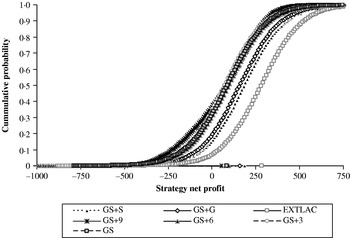
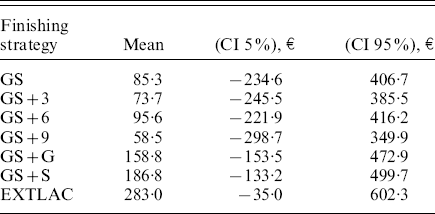
Figure 1 shows the plotted CDF of variation in net profit per cow resulting from variation in milk price, concentrate cost, purchase price and sale price for seven finishing strategies. The graph shows that there was little difference in the distributions of farm profit for the GS, GS+3, GS+6, GS+9, GS+G and GS+S finishing strategies. The mean farm profit with the GS, GS+3, GS+6, GS+9, GS+G, GS+S and EXTLAC was €85·3, €73·7, €95·6, €58·5, €158·8 and €186·8 and €283·0, respectively; with 0·90 confidence intervals (0·05 to 0·95) of −€234·6 to €406·7, −€245·5 to €385·5, −€221·9 to €416·2, −€298·7 to €349·9, −€153·5 to €472·9, −€133·2 to €499·7 and −€35·0 to €602·3, respectively (Table 6).
Cumulative probability distribution showing the influence of milk price, cull cow sale value, cull cow purchase value and concentrate costs on net profit per cow. GS, grass silage; GS+3, grass silage and 3 kg concentrate/day; GS+6, grass silage and 6 kg concentrate/day; GS+9, grass silage and 9 kg concentrate/day; C, slaughtered on D 0; GS+G, grass silage; GS+S, grass silage and straw 0·30; EXTLAC, milking group offered grass silage and 6 kg concentrate/day.

The mean, 0·05 and 0·95 confidence intervals for each of the finishing strategies based on the stochastic distributions
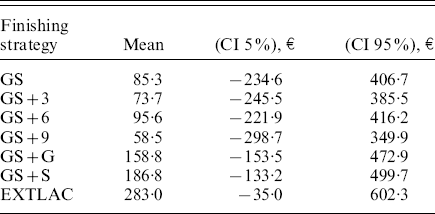
GS, grass silage; GS+3, grass silage and 3 kg concentrate/day; GS+6, grass silage and 6 kg concentrate/day; GS+9, grass silage and 9 kg concentrate/day; GS+G, grass silage; GS+S, grass silage and straw 0·30; EXTLAC, milking group offered grass silage and 6 kg concentrate/day.
The EXTLAC strategy shows a preferential first degree stochastic dominance to all the strategies evaluated. First degree stochastic dominance means that for any given level of risk there is a greater level of profit or conversely for a given level of profit there is reduced risk when the CDF is further to the right. For the other FS combinations (GS, GS+3, GS+6, GS+9, GS+G and GS+S), there was some crossing over of the individual CDF lines on the cumulative probability distribution graph. Therefore, the principle of second degree stochastic dominance must apply; this takes into account the farmer's level of risk aversion and how this affects the decision-making process.
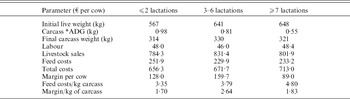
Age
Table 7 shows the key output parameters from the model for the three age categories investigated which include ⩽2 lactations, 3–6 lactations and ⩾7 lactations. The highest profit (€159·7), final carcass weight (330 kg) and final carcass value (€831·4) was realized with the 3–6 lactation category. The lowest profit (€89) and carcass weight gain (0·55 kg/day) was achieved with the ⩾7 lactation category, which corresponded to the highest total costs. The highest ADG was achieved with the ⩽2 lactations (0·98 kg/day). Due to their initial live weight being substantially lower at the start of the finishing period compared to the 3–6 and ⩾7 lactation categories, the final carcass weight achieved was lower than the other two age categories and therefore it took longer to reach the TARGET weight.
Key herd parameters in a quota scenario using up-to-date costs and prices for three age classes of dairy cull cows, assuming a purchase price of 1·26 €/kg and selling price of 2·52 €/kg

* ADG, average daily gain.
DISCUSSION
The focus of the current study was to develop, validate and describe a DSS model based on the investigations of two finishing experiments conducted by Minchin et al. (Reference Minchin, Buckley, Kenny, Monahan, Shalloo and O'Donovan2009a, in press) for different cull dairy cow finishing systems. The proposed service of the model reported is to help with the decision-making process of farmers in relation to cull cow finishing specifically (1) if cull cow finishing is viable and (2) the most economically viable finishing strategy under varying farm resources and management alternatives. A function of any beef production strategy is the variability of key input and output variables. The DSS developed in this study captures the effect of this variability through stochastic budgeting and highlights the large influence of finishing strategy employed on enterprise profitability within Irish cull cow beef production strategies.
DSS models
Within the world of agriculture a great amount of research resources have been devoted to the development of DSS to enhance the decision-making capabilities of farmers and their advisers (Newman et al. Reference Newman, Lynch, Plummer, Abbass and Towsey1999). These initiatives have been driven by the increased complexity of agricultural production brought on by market globalization, the need for sustainable production practices, and the increasing rate and volume of information exchange (e.g. Groves & Da Rin Reference Groves and Da Rin1999). Decision support tools can assist farmers in making more informed decisions by integrating information from a number of sources which may recommend altering production strategies, enhancing management skills and reducing costs of production. The DSS described in the present study, in the context of beef production, can guide the decision-making process for farmers whether or not to finish cull cows and what strategies to implement. It can also help the farmer with cost reduction, improved productivity and therefore profitability by matching livestock requirements to feed inputs. Within Ireland there is a seasonal nature to cull cow price and there is a seasonal nature to finishing strategies due to the grass-based milk production systems employed. The complexity of the decision-making process is compounded by the seasonal availability of cull cows for this enterprise and the seasonal nature of price offered. The complexity of decisions in relation to cull cows necessitates the requirement for a dynamic DSS.
Despite the benefits of DSS their adoption by farmers in the past has been limited (Lynch et al. Reference Lynch, Gregor and Midmore2000). Reasons include the lack of end user evaluation prior to and during DSS development, as well as the fact that the complexity of knowledge needed to operate the DSS can be large. In the present study, the DSS is designed to be user friendly reducing complexity through practical costing for inputs from accessible websites (e.g. CSO 2008; DAF 2008). This DSS is designed to be used by extension officers in conjunction with their farmer clients to identify the key strategies for cull cow finishing. Through extension officers using the tool with farmers, it is expected that farmers will adopt the technology and use the tool. The communication process between the extension officer and end user will decide how readily this tool will be used at commercial level.
Influence of strategy selection on farm profit
Feed costs in a cull cow enterprise account for more than half of the total costs (Hughes Reference Hughes1995) (when there were no costs included for animal purchase), hence associated costs with different feed types (concentrate, grass silage and grass) and its availability (weather and geological location) are principal factors to consider when selecting the optimum dietary strategy to best suit individual farm resources. Biological increases in output are often associated with increased input costs and where adequate nutrients are supplied in the basal diet, supplementary concentrate feeding can influence overall farm profitability only through its influence on animal production performance (McCarthy et al. Reference McCarthy, Horan, Dillon, O'Connor, Rath and Shalloo2007). The EXTLAC strategy resulted in greater feed input costs (concentrate and labour) in comparison with the other six strategies; however, increased sales surpassed costs associated with increased feed and labour, making it the most profitable strategy evaluated. While the EXTLAC strategy was the most profitable strategy evaluated, its success is reliant on four factors: (i) the availability of a milking facility on the farm site, (ii) the prevailing milk price, (iii) milk quota availability and (iv) labour availability.
The increased output associated with the production of milk in the EXTLAC system will not be possible on non-dairy farms. Therefore the optimum strategy on these farms for cull cow finishing will focus on minimizing costs. Numerous studies carried out in Ireland (e.g. Dillon et al. Reference Dillon, Crosse, Stakelum and Flynn1995; Shalloo et al. Reference Shalloo, Dillon, Rath and Wallace2004) have shown that grazed grass is the cheapest feed available. The two strategies (GS+G and GS+S) evaluated in the present study that finished cull cows from grazed grass returned a substantially higher profit than any of the other finishing strategies where milk production was not carried out.
Age
The theoretical work of Taylor et al. (Reference Taylor, Moore, Thiessen and Bailey1985) indicated that biological efficiency decreases as the number of lactations per dam increases in a cow beef enterprise. Therefore, younger cows have a greater proportion of total feed used for carcass production and a smaller proportion used for maintenance, lactation, gestation and regaining of body condition. Biological performance (ADG and days to slaughter) reported by Minchin et al. (Reference Minchin, Buckley, Kenny, Monahan, Shalloo and O'Donovan2009a, in press) was significantly different between younger (two or fewer lactations) and older cows (seven or more lactations). This would suggest that younger animals would be more profitable because of their biological efficiency; however, due to the Irish payment system that rewards larger carcasses in a non-linear fashion rather than rewarding meat yield (set by carcass weight criteria), this results in the 3–6 lactation cows being the most profitable due to superior biological efficiency compared with older cows and higher initial live weight compared with younger cows.
Agricultural policies
The optimal strategy of cull cow beef production depends greatly on the prevailing economic environment (purchase and sale price, milk price, feed costs, housing and labour) as well as the relative availability of the key factors of production (cull cows, land, feed, etc.). Within the present milk quota scenario in Ireland, dairy farmers maximize profit by maximizing efficiency per litre of milk produced (Shalloo et al. Reference Shalloo, Dillon, Rath and Wallace2004). Recent reform of milk quota policy in Ireland (introduction of milk quota exchange system between commercial milk farmers) will result in easier movement of quota from farm to farm which coupled with EU milk quota policies, which are being relaxed (Fischer Boel Reference Fischer Boel2007; Smith Reference Smith2008), will allow expansion at the farm level. The economic principles applying to a no-quota environment are substantially different from those that apply within a quota environment (Shalloo et al. Reference Shalloo, Dillon, Rath and Wallace2004). The abolition of milk quotas will create opportunities for Irish milk producers to expand their dairy enterprise and therefore will create a situation where cull cow finishing enterprises will have to compete with milk production on dairy farms and may become even more attractive for non-dairy farms with the national cow numbers increasing. It has been shown that there are significant costs associated with culling dairy cows on dairy farms (Evans et al. Reference Evans, Dillon, Buckley, Berry, Wallace, Ducrocq and Garrick2006); for this reason, it may be a more useful policy for dairy farmers to focus on reducing the number of cull cows in the system.
Risk analysis
The stochastically efficient or dominant set is found by comparing the CDFs of risky prospects (Thomas et al. Reference Thomas, DeLorenzo, Bray, Weldon, Bucklin and Martin1997). Figure 1 shows the CDF for the spread in strategy net profit resulting from variation in milk price, purchase and selling price and concentrate costs. Including variability in the models provides greater information for the decision maker with key decisions (Frey & Patil Reference Frey and Patil2002). Risk analysis indicated that profitability for the EXTLAC strategy was stochastically dominant to all other strategies, meaning there is a higher level of profit and a lower level of risk associated with the EXTLAC strategy. Consequently, there is a higher probability that the EXTLAC system would achieve a higher level of profit than the other strategies. Stochastic budgeting can be used to identify significant risk factors affecting key decisions and help aid decisions in developing priorities for risk mitigation. The model described in the present study helps the decision maker with routine regulatory decisions by accounting for variation in milk price, cull cow sale value, cull cow purchase value and concentrate costs on net profit per cow.
CONCLUSION
The purpose of the current study was to develop a DSS to enhance the decision-making process in relation to cull cow finishing and to incorporate the effect of risk on profitability. The DSS shows the optimal cull cow beef production strategy depends greatly on the prevailing economic environment; purchase and sale price, milk price, feed costs, housing and labour. The results indicate that the most profitable strategy was the EXTLAC strategy, which achieved €283 net profit per cow. For non-dairy farmers, the highest profit was achieved with cull cows fed a proportion of their finishing diet from grazed grass. Risk analysis suggests that the EXTLAC strategy shows stochastic dominance over all other options. Live weight and age of cull cows selected for finishing enterprises have substantial effects on the overall profitability of cull cow finishing enterprises in Ireland.