Introduction
Pinna perichondritis can arise as a rare complication secondary to ear piercing. An increase in incidence in recent years is associated with the rising popularity of chondral piercings,Reference Hanif, Frosh, Marnane, Ghufoor, Rivron and Sandhu1 which cause stripping of the perichondrium and microfractures of the cartilage.Reference van Wijk, Kummer and Kon2 This potentially deforming condition affects a young age group that is likely to be sensitive to cosmetic outcome.
We systematically examined cases of patients with sporadic pinna perichondritis associated with piercing who presented to a district general hospital over 10 years. The study focused on causative organisms, antibiotic use and cosmesis. A literature review of pinna perichondritis associated with piercing was undertaken.
Case reports
Case one
An 11-year-old girl presented to our department with a 4-day history of a painful, swollen cartilage piercing. She reported no significant co-morbidities. She had been prescribed flucloxacillin by her general practitioner, which she had taken for 48 hours prior to presentation. The pus swab grew Pseudomonas aeruginosa. She was initially started on intravenous co-amoxiclav and flucloxacillin by the on-call ENT team; however, this was changed to oral ciprofloxacin on the basis of the culture results. Following incision and drainage, and the administration of antibiotics, the abscess resolved without residual deformity.
Case two
A 16-year-old girl presented to our department with an ear cartilage piercing which had become infected 2 weeks previously after she accidentally pulled on the earring. She had been prescribed a course of clarithromycin by her general practitioner (flucloxacillin was avoided due to a penicillin allergy), but this failed to relieve the symptoms. On examination, a fluctuant abscess was present over the site of the piercing. Incision and drainage of the abscess was carried out. Culture of pus showed P aeruginosa. She was prescribed a 7-day course of ciprofloxacin. There was no cosmetic deformity of the pinna at follow up.
Materials and methods
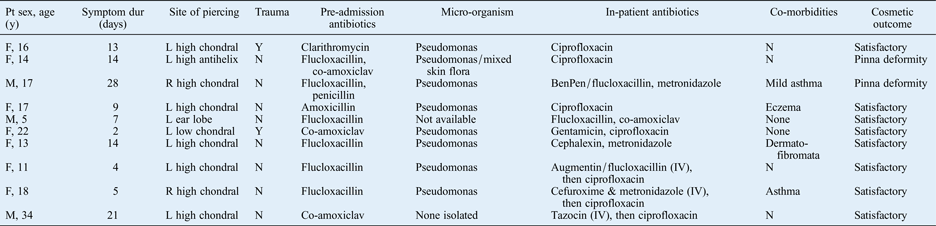
We undertook a retrospective review of local patient notes dating from 2001 to 2012 using the World Health Organization International Classification of Diseases version 10 code H60.0 (abscess of the external ear). Cases with no history of associated piercing were excluded. The diagnoses of excluded cases included sebaceous cyst, infected pre-auricular sinus and spontaneous pinna perichondritis. The data extracted from the notes included patient age at presentation, gender, site of piercing, duration of symptoms, co-morbidities, first-line and second-line antibiotic treatment, incision and drainage, duration of antibiotic use, and cosmetic outcome at follow up (Table I).
Case series summary*
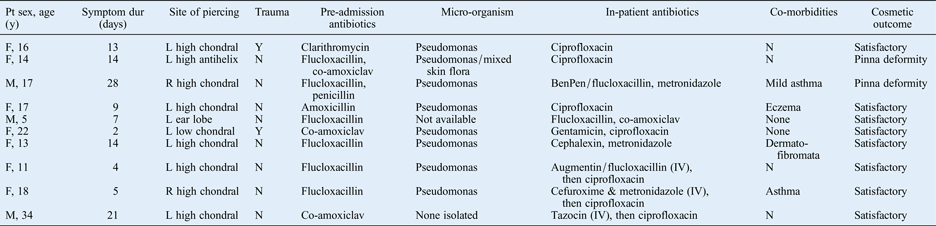
* Patients with sporadic pinna perichondritis associated with piercing who presented to Colchester General Hospital between 2001 and 2012. Pt = patients; y = years; dur = duration; F = female; L = left; Y = yes; N = no; M = male; R = right; BenPen = benzylpenicillin sodium; IV = intravenous
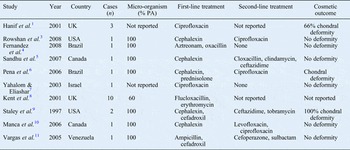
A literature search was carried out using Pubmed with the key words ‘pinna perichondritis’, ‘pinna abscess’, ‘pinna infection’ and ‘piercing’. Sixteen studies reporting pinna perichondritis secondary to piercings were identified, all of which were case reports or case series.Reference Hanif, Frosh, Marnane, Ghufoor, Rivron and Sandhu1, Reference Rowshan, Keith, Baur and Skidmore3–Reference Folz, Lippert, Kuelkens and Werner17 A total of 32 cases were reported. Six studies were excluded from the analysis: one article was in Dutch and one was in Danish, and the other four were available in abstract form only (Table II).Reference Janssen and Kon12–Reference Folz, Lippert, Kuelkens and Werner17 In addition, two studies reported outbreaks of pinna perichondritis with an identifiable source of Pseudomonas aeruginosa.Reference Keene, Markum and Samadpour18, Reference Fisher, Kacica and Bennett19
Literature review summary*

* Case reports of sporadic pinna abscess secondary to piercing (1997–2008). PA = Pseudomonas aeruginosa
Results and discussion
Ten cases of sporadic pinna perichondritis associated with piercing were identified during the 10-year period (from 2001 to 2012). Ninety per cent of these involved piercings through the chondral cartilage. The duration of symptoms ranged from 2 to 28 days. Trauma to the ear was reported in two cases. No predisposing factors were identified in the other cases. Asthma was reported as a co-morbidity by two of the patients, although none of the patients were on systemic steroid therapy. For 8 of the 10 patients, pus swabs grew P aeruginosa. In the remaining two cases, no organisms were isolated. Prior to admission, all 10 patients had been prescribed an antibiotic that did not have anti-pseudomonal activity. The most common pre-admission antibiotics prescribed were flucloxacillin (60 per cent) and co-amoxiclav (20 per cent). Patients were started on an anti-pseudomonal antibiotic by the first on-call ENT clinician in only 50 per cent of cases. At follow up, 20 per cent of patients were reported to have suffered permanent cosmetic deformity of the pinna.
Our literature review identified 16 studies reporting 32 cases of sporadic pinna perichondritis secondary to piercing.Reference Hanif, Frosh, Marnane, Ghufoor, Rivron and Sandhu1, Reference Rowshan, Keith, Baur and Skidmore3–Reference Folz, Lippert, Kuelkens and Werner17 The most common causative organism detected was P aeruginosa.Reference Rowshan, Keith, Baur and Skidmore3–Reference Pena, Sueth, Tinoco, Machado and Tinoco6, Reference Kent, Rokade, Premraj and Butcher8–Reference Vargas, Carballo, Hernández, Rojas, Jiménez and Riera11 Cephalexin was the most frequently administered (in-patient) first-line treatment worldwide,Reference Rowshan, Keith, Baur and Skidmore3, Reference Sandhu, Gross, Wylie, Van Caeseele and Plourde5, Reference Pena, Sueth, Tinoco, Machado and Tinoco6, Reference Staley, Fitzgibbon and Anderson9, Reference Manca, Levy and Tariq10 with ciprofloxacin a common second-line agent.Reference Rowshan, Keith, Baur and Skidmore3, Reference Pena, Sueth, Tinoco, Machado and Tinoco6, Reference Manca, Levy and Tariq10 The review revealed that perichondritis can occur after recent piercings or spontaneously in old piercings. A significant number of cases resulted in chondral deformity or ‘cauliflower ear’.Reference Hanif, Frosh, Marnane, Ghufoor, Rivron and Sandhu1, Reference Pena, Sueth, Tinoco, Machado and Tinoco6, Reference Staley, Fitzgibbon and Anderson9 Outbreaks of P aeruginosa associated perichondritis were also described.Reference Keene, Markum and Samadpour18, Reference Fisher, Kacica and Bennett19 Risk factors associated with infection included location of piercing (upper cartilage piercings carried a higher risk than lobule piercings) and use of contaminated disinfectant solution.
Ciprofloxacin is the oral antibiotic of choice for treating pinna perichondritis secondary to piercing. Ciprofloxacin has anti-pseudomonal as well as anti-staphylococcal activity, and shows excellent tissue penetration. However, its use has been restricted in paediatric populations due to the risk of arthropathy seen in animal models. In our case series, 70 per cent of patients were under 18 years of age. It is therefore important to consider the safety of oral ciprofloxacin in comparison with other intravenous anti-pseudomonal antibiotics. A recent meta-analysis of 16 184 paediatric patients given systemic ciprofloxacin suggested that the risk of musculoskeletal adverse events attributed to ciprofloxacin use was 1.6 per cent, with arthralgia representing 50 per cent of reported adverse events.Reference Adefurin, Sammons, Jacqz-Aigrain and Choonara20 Almost all of the reported events resolved with discontinuation of the drug. No study was able to identify any significant growth disturbance secondary to ciprofloxacin use. Therefore, a short course of ciprofloxacin in a paediatric population is likely to be safe in the context of appropriate monitoring and follow up.
• Chondral piercings of the pinna have become increasingly popular
• Compared with lobe piercings, these carry greater risk of pinna perichondritis or abscess formation
• Pseudomonas aeruginosa accounts for the majority of cases presenting to secondary care
• An antibiotic with activity against both pseudomonas and staphylococcus is recommended as a first-line agent
• A short course of ciprofloxacin is safe and effective in a paediatric population
Our study confirms that P aeruginosa is the predominant causative organism in pinna perichondritis associated with piercings in patients presenting to secondary care. Therefore, prescribing antibiotics with activity against staphylococcus only is likely to lead to persistent infection and risk of cosmetic deformity. Currently, medical practitioners including ENT specialists do not routinely prescribe anti-pseudomonal antibiotics as a first-line treatment for these cases. Patients presenting to secondary care physicians are likely to have been prescribed antibiotics prior to admission. From the limited data available, it is not possible to determine whether P aeruginosa has a preferential ability to infect cartilage piercings, or whether the cases seen in secondary care are distinguished based on prior antibiotic use. An epidemiological study would be valuable in order to determine the micro-organisms responsible for pinna perichondritis in primary care, and would inform whether the recommendations in this study can be extended to the treatment of these cases in a community setting.