Introduction
It is important for trainee otolaryngologists to be competent in performing surgical tracheostomy. It continues to be the procedure used as standard management for patients dependent on long-term ventilation,Reference El Solh and Jaafar1 reducing the risk of laryngeal injury and allowing weaning from intermittent positive pressure ventilation.Reference McCormick and Venn2 Its use results in less sedation and improved patient comfort, and it also allows the patient to speak.Reference McCormick and Venn2
Surgical tracheostomy should be performed in patients within 7–10 daysReference Byhahn, Lischke, Meininger, Halbig and Westphal3 of onset of mechanical ventilation, when an artificial airway is likely to be needed for more than 21 days.Reference Plummer and Gracey4, Reference Rehm, Wanek, Gagnon, Pearson and Mullins5
Percutaneous dilatational tracheostomy has come to the forefront as a viable and relatively safe procedure, which offers an alternative to surgical tracheostomy.Reference Rossi, De Monti, Sonnino and Giacometti6, Reference Rajajee, Fletcher, Rochlen and Jacobs7 There is controversy about whether it is suitable for those patients with ‘difficult access’ neck anatomy. Studies have demonstrated the safety of this technique;Reference Mansharamani, Koziel, Garland, LoCicero, Critchlow and Ernst8–Reference Heyrosa, Melniczek, Rovito and Nicholas11 however, the neck anatomy of some patients means that bedside percutaneous tracheostomy is too dangerous.
Some authors take the traditional viewpoint that percutaneous techniques can be performed in all patients except those in whom anatomical landmarks are difficult to define.Reference Lim and Raman12, Reference Romero, Cornejo, Ruiz, Galvez, Llanos and Tobar13 Morbidly obese individuals with thick, short necks fall into this category.Reference Byhahn, Lischke, Meininger, Halbig and Westphal3, Reference Lim and Raman12
Studies that suggest the use of tighter safety parameters, with percutaneous tracheostomy performed under endoscopic guidance, highlight the common difficulties encountered in obese patients with short necks and limited mobility of the cervical spine.Reference Rossi, De Monti, Sonnino and Giacometti6
Obese patients (defined by a body mass index (BMI) of at least 30 kg/m2) and those who are critically ill are at greater risk of requiring intubation and prolonged ventilation.Reference Romero, Cornejo, Ruiz, Galvez, Llanos and Tobar13 Although obesity is not an independent risk factor for increased pulmonary complications after critical injury,Reference Dossett, Heffernan, Lightfoot, Collier, Diaz and Sawyer14 severely obese patients require longer intensive care unit stays,Reference Romero, Cornejo, Ruiz, Galvez, Llanos and Tobar13, Reference Dossett, Heffernan, Lightfoot, Collier, Diaz and Sawyer14 leading to the need for tracheostomy.
The incidence of complications related to tracheostomy in morbidly obese individuals has been quoted as 25 to 43.8 per cent,Reference El Solh and Jaafar1, Reference Byhahn, Lischke, Meininger, Halbig and Westphal3 with an estimated mortality of 2 per cent.Reference El Solh and Jaafar1 A morbidly obese individual is 83 per cent more likely to die within 30 days of tracheostomy than an individual who is not morbidly obese,Reference Darrat and Yaremchuk15 with the commonest serious complication being tube obstruction.Reference McCormick and Venn2
We present our experience with the technical aspects of securing the airway of a morbidly obese patient and describe a two-flap technique through which access can be enhanced.
Case report
A 52-year-old man was referred for surgical tracheostomy following fractures of the 12th thoracic vertebra and the first and third to fifth lumbar vertebrae secondary to long-term corticosteroids, resulting in neurological deficits from the level of the 12th thoracic vertebra downwards.
The patient had a significant background history of chronic obstructive pulmonary disease, non-insulin dependent diabetes, coronary artery disease, chronic obstructive sleep apnoea and hypertension. He was markedly obese, with a weight of 220 kg and a BMI of 64 kg/m2, resulting in hypoventilation syndrome. He was also a chronic smoker with an 80-pack-year history.
Following his spinal fractures, he suffered multiple respiratory arrests necessitating intubation and ventilation. He subsequently underwent a successful endoscopic-guided percutaneous tracheostomy six months prior to the patient being referred to ENT. With improved ventilatory status, he was decannulated four months later. He then redeveloped respiratory failure and required further intubation.
In view of his previous tracheostomy scar and morbid obesity, a decision was made, with the close cooperation of intensivists, to embark on surgical tracheostomy.
An Eschmann T20M operating table (Eschmann Equipment, West Sussex, UK) capable of supporting a weight of 380 kg was sourced.
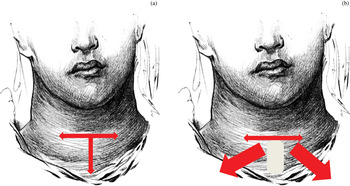
The previous tracheostomy scar was excised with elevation and mobilisation of platysmal myocutaneous flaps. The patient's neck measured a mere 7 cm from hyoid to sternal notch, which prevented tension-free skin advancement. As the patient had a prominent thyroid isthmus and a deeply plunging trachea extending inferiorly to the superior mediastinum, a vertical skin incision was dropped inferiorly to the sternum and two distal flaps were retracted inferiorly (Figure 1).
Line illustration of the technique used. (a) A traditional transverse incision is made; due to the extremely short neck and the trachea plunging down to the superior mediastinum, a vertical incision was dropped down to the sternum. (b) Two distal flaps were then retracted inferiorly and finally sutured to the inferior lip of the tracheostoma.

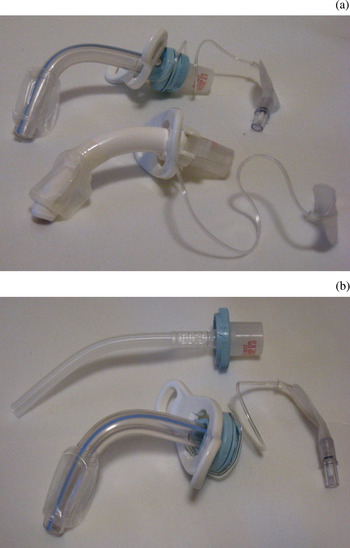
The trachea was incised between the third and fourth rings and a size 8 Shiley XLT Proximal Extension cuffed tracheostomy tube (Covidien-Nellcor, Boulder, Colorado, USA) (Figure 2) inserted abutting the sternal notch. The distal skin flaps were secured to the inferior lip of the tracheostoma. The position of the tube above the carina was confirmed by flexible endoscopy.
(a) Proximal extended length Shiley tracheostomy tube (top) compared with a standard Shiley cuffed tube (bottom). (b) Proximal XLT tracheostomy tube (bottom) and its inner cannula (top).

Discussion
Tracheostomy was a previously feared and formidable procedure. With better anaesthesia and safety enhanced by ultrasound guidance,Reference Rajajee, Fletcher, Rochlen and Jacobs7 percutaneous tracheostomy is now performed at the bedsideReference Rehm, Wanek, Gagnon, Pearson and Mullins5 if anterior neck landmarks can be palpated.Reference Blankenship, Kulbersh, Gourin, Blanchard and Terris16
However, tracheostomy becomes a formidable task in patients with demanding neck anatomy, such as individuals with short, morbidly obese necks or intra-thoracic displacement of the entire length of the trachea.Reference Rehm, Wanek, Gagnon, Pearson and Mullins5 In obese patients, the value of computed tomography angiography of the neck and upper chest prior to percutaneous tracheostomy has been emphasised, and is considered essential by some, to prevent accidental puncture of the great vessels and/or lungs.Reference Biderman, Weinbroum, Rafaeli, Raz, Porat and Wiesel17 We would recommend an open procedure in such individuals.
When surgery is considered in morbidly obese patients, several concerns need to be addressed. Firstly, the patient must be transferred safely to the operating theatre, requiring close cooperation with the anaesthetist. Secondly, a specialised operating table is necessary to accommodate the added weight, as most standard tables can only support 130 kg. Thirdly, the overwhelming abundance of adipose tissue between the anterior neck skin and the underlying trachea will complicate the procedure,Reference Lim and Raman12 and standard-sized tracheostomy tubes often fit poorly. Compounding this, there may be submental fat occluding the outer opening of a standard tracheostomy and rendering oxygenation extremely limited or non-existent.Reference El Solh and Jaafar1
The surgeon has two options to overcome the latter problems. Firstly, as the tracheostomy tube may not conform to the curvature of the neck,Reference Darrat and Yaremchuk15 a Shiley XLT tube can be used to enable a better fit, as in the reported case. Secondly, the neck can be recontoured using cervical lipectomy to accommodate a standard tube.Reference Gross, Cohen, Andersen and Wax18 In our patient, we achieved this with a second vertical incision.
Some authors have tried various adjustable neck flange tracheostomy tubes (Bivona Medical Technologies, Smiths Medical, Dublin, Ohio, USA) that permit alteration of shaft length without extubation,Reference Lim and Raman12 or reinforced laryngectomy tubes (Laryngo Flexw, Willy Rusch, Laryngo Flex® Willy Rusch, Kernen, Germany) with flanges (ULTRA TracheoFlexw, Willy Rusch).Reference Shimizu, Mizutani, Takahashi, Hoshi and Tanaka19 However, these tubes can dislodge from the flange, and they have single lumens that can be easily obstructed with thick secretions. In the reported patient, we used a Proximal Extension Shiley tube with an elongated proximal limb and removable inner cannula to gain access to the patient's plunging trachea.
Accidental decannulation is the most common and serious complication associated with tracheostomy in obese patients.Reference Szeto, Kost, Hanley, Roy and Christou20 The soft tissue thickness between trachea and skin can be predicted using anthropometric tape measures, assisting the pre-selection of appropriate tracheostomy tube sizes for obese patients.Reference Szeto, Kost, Hanley, Roy and Christou20
Some surgeons advocate performing a Björk flapReference Price21 to prevent accidental decannulation, incising an inverted U-shaped flap in the anterior tracheal wall at the second to fourth cartilaginous rings. This flap is sutured to the skin, creating a tracheal tissue bridge that guides tube replacement.Reference Price21, Reference Greisz22 A higher incidence of tracheal stenosis after decannulation has been reported following the use of this technique,Reference Orringer23 although long-term follow up has provided contradictory results.Reference Tommerup and Borgeskov24
Other options include creating a permanent tube-free tracheostomy in which a skin-lined, self-sustaining stoma is created. Surgical closure of the stoma may have to be considered once the underlying disease has resolved.Reference Eliashar, Goldfarb, Gross and Sichel25
• Otolaryngology trainees must be competent performing both standard and complicated percutaneous tracheostomies
• Tracheostomy in morbidly obese patients is a high risk procedure
• Such tracheostomies should be performed in a controlled surgical environment
• Extended proximal limb tracheostomy tubes are appropriate for morbidly obese patients
Our case highlights the difficulty associated with secure airway placement in an anatomically difficult neck. We supplemented the traditional transverse incision by dropping a vertical limb to the sternum for access, and creating a distal skin-to-trachea flap. The Proximal Extension cuffed Shiley XLT tube is appropriate for cases such as ours, providing extended proximal limb length to traverse the deep subcutaneous tissues and reach the trachea.
Close cooperation with anaesthetic colleagues is essential and adequate pre-operative planning is paramount to ensure a safe outcome.
With the advent of percutaneous tracheostomy, more and more technically complex tracheostomies are being performed by otolaryngologists. Thus, trainees should be competent in performing these techniques.