




No CrossRef data available.
Article contents
- Abstract
- Perceptual fill-in is supported by neural computations in visual cortex
- The neural substrate that supports perceptual fill-in develops during infancy
- Perceptual completion in human infants is associated with the development of oculomotor skill
- Growth of the neural substrate that supports visual attention leads to developmental changes in perceptual completion
- References
Oculomotor skill supports the development of object representations
Published online by Cambridge University Press: 19 May 2011
Article contents
- Abstract
- Perceptual fill-in is supported by neural computations in visual cortex
- The neural substrate that supports perceptual fill-in develops during infancy
- Perceptual completion in human infants is associated with the development of oculomotor skill
- Growth of the neural substrate that supports visual attention leads to developmental changes in perceptual completion
- References
Abstract
Are infants' initial object representations innately specified? We examine the development of perceptual completion in infants by highlighting two issues. First, perceptual completion is supported by neural mechanisms that rely on experience with the environment. Second, we present behavioral and modeling data that demonstrate how perceptual completion can emerge as a consequence of changes in visual attention and oculomotor skill.
Information
- Type
- Open Peer Commentary
- Information
- Copyright
- Copyright © Cambridge University Press 2011
References
Albright, T. D. & Stoner, G. R. (2002) Contextual influences on visual processing. Annual Review of Neuroscience
25:339–79.CrossRefGoogle ScholarPubMed
Amso, D. & Johnson, S. P. (2006) Learning by selection: Visual search and object perception in young infants. Developmental Psychology
42:1236–45.Google Scholar
Gottlieb, J. P., Kusunoki, M. & Goldberg, M. E. (1998) The representation of visual salience in monkey parietal cortex. Nature
391:481–84.Google Scholar
Johnson, S. P., Slemmer, J. A. & Amso, D. (2004) Where infants look determines how they see: Eye movements and object perception performance in 3-month-olds. Infancy
6:185–201.Google Scholar
Peterhans, E. & von der Heydt, R. (1989) Mechanisms of contour perception in monkey visual cortex. II. Contours bridging gaps. Journal of Neuroscience
9:1749–63.CrossRefGoogle ScholarPubMed
Ruthazer, E. S. & Stryker, M. P. (1996) The role of activity in the development of long-range horizontal connections in Area 17 of the ferret. Journal of Neuroscience
16:7253–69.CrossRefGoogle ScholarPubMed
Schlesinger, M., Amso, D. & Johnson, S. P. (2007a) The neural basis for visual selective attention in young infants: A computational account. Adaptive Behavior
15:135–48.Google Scholar
Schlesinger, M., Amso, D. & Johnson, S. P. (2007b) Simulating infants' gaze patterns during the development of perceptual completion. In Proceedings of the Seventh International Workshop on Epigenetic Robotics: Modeling Cognitive Development in Robotic Systems, ed. Berthouze, L., Prince, C. G., Littman, M., Kozima, H. & Balkenius, C., pp. 157–64. Lund University Cognitive Studies.Google Scholar
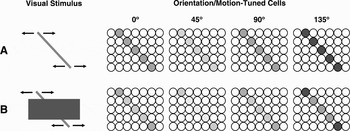
Figure 1. Schematic diagram of a population of neurons that responds to partially occluded objects. The visual stimulus (a moving bar) is illustrated on the left, and the corresponding pattern of neural activity in four sets of orientation- and motion-specific cells is presented on the right. Darker circles represent higher firing rates. (A) A completely visible stimulus and (B) a partially occluded stimulus.
 You have
Access
In The Origin of Concepts, Susan Carey (Reference Carey2009) explores the idea that a small set of fundamental concepts – including objects, number, agency, and causality – are innately specified as core cognition within the human species. Carey addresses the issue by carefully describing and evaluating an impressive array of empirical studies that span from infancy through childhood.
There are numerous facets of Carey's argument that not only contribute to the nature–nurture debate in a constructive way, but also illuminate areas of the debate where polarized dichotomies tend to prevail. A particularly valuable strategy is the use of analogies from ethology (e.g., how indigo buntings learn to exploit the North Star as a spatial cue), which create an intuitive anchor for elusive terms such as sensory, perceptual, and conceptual representation. In addition, Carey makes excellent use of comparative data, both within and across species. Specifically, Carey highlights behavioral “signatures” or profiles that provide a qualitative basis for comparing organisms systematically. We enthusiastically endorse the approach, and believe that the comparative analyses that Carey describes will have a positive impact on the field of developmental science.
Whereas much of the story that Carey presents is persuasive, there are a few places in her argument where important pieces of empirical evidence seem to be overlooked. To illustrate, we use the example of the development of core object cognition.
As a specific case study of innate object representation, Carey discusses the phenomenon of perceptual completion, which is the capacity to perceive partially-occluded objects as integrated wholes. An essential component of the capacity is a fill-in mechanism that “reconstructs” (i.e., infers the presence of) occluded edges or surfaces of objects that are partially occluded. In proposing that perceptual completion is innate, Carey raises the challenge: “What learning process could create representations of complete objects that persist behind barriers taking only perceptual primitives as input?” (p. 59). We provide an outline here of a learning process that is well-suited to address this question.
1. Perceptual fill-in is supported by neural computations in visual cortex
In their investigation of contour perception in macaques, Peterhans and von der Heydt (Reference Peterhans and von der Heydt1989) identify a unique class of neurons in visual cortex. These neurons respond optimally to edges in a particular orientation that move in a specific direction. Figure 1A illustrates how four different sets of these cells, each tuned to a different line orientation (e.g., 0°, 45°, 90°, and 135°, respectively) respond to a moving bar (“Visual Stimulus”). In this diagram, darker circles represent neurons with higher firing rates. Thus, note that the set of cells tuned to 135° responds at a high level, while the firing rates in the cells tuned to other orientations are proportionally lower.
Schematic diagram of a population of neurons that responds to partially occluded objects. The visual stimulus (a moving bar) is illustrated on the left, and the corresponding pattern of neural activity in four sets of orientation- and motion-specific cells is presented on the right. Darker circles represent higher firing rates. (A) A completely visible stimulus and (B) a partially occluded stimulus.
An important property of these neurons is that they also respond to partially-occluded objects. In particular, note in Figure 1B that activation spreads in the set of neurons tuned to 135° from those that are stimulated by the visible portions of the moving bar, to neighboring neurons that have no direct visual input.
2. The neural substrate that supports perceptual fill-in develops during infancy
A mechanism that can help explain the spreading of activation is the growth of horizontal connections between neurons in visual cortex (e.g., Albright & Stoner Reference Albright and Stoner2002). Whereas these connections initially rely on endogenous input, their subsequent growth is experience-dependent and occurs in the weeks after birth (e.g., Ruthazer & Stryker Reference Ruthazer and Stryker1996).
What role does visual activity play in the development of this neural substrate? We have hypothesized that oculomotor skill, and in particular the development of visual selective attention, is a critical ability that makes possible optimal information pick-up. In other words, we are proposing that progressive improvements in visual scanning ability provide the input into and help to drive the development of the perceptual fill-in mechanism. Therefore:
3. Perceptual completion in human infants is associated with the development of oculomotor skill
A series of perceptual-completion studies with 3-month-olds demonstrates that infants who have achieved the capacity for perceptual completion are more effective at deploying their attention than infants who have not yet reached the same milestone (e.g., Johnson et al. Reference Johnson, Slemmer and Amso2004; Amso & Johnson Reference Amso and Johnson2006). This difference between 3-month-olds in oculomotor skill is not limited to displays such as Figure 1A and 1B, but is also found on other measures of visual selective attention (e.g., visual search).
However, these findings do not specify the direction of developmental influence. Therefore, it may be the case that the onset of perceptual completion leads to improvement in oculomotor skill (i.e., a priori knowledge of objects leads to improvements in deploying attention). In order to address this issue, we have designed and tested an eye-movement model that simulates the development of oculomotor skill in infants.
4. Growth of the neural substrate that supports visual attention leads to developmental changes in perceptual completion
Our model, which is inspired by the structure and function of the mammalian visual system, includes a component that represents activity in the parietal cortex, an area of the brain that supports visual attention (e.g., Gottlieb et al. Reference Gottlieb, Kusunoki and Goldberg1998). A key finding is that systematic changes in this component of the model result in corresponding improvements in perceptual completion (Schlesinger et al. Reference Schlesinger, Amso and Johnson2007a; Reference Schlesinger, Amso, Johnson, Berthouze, Prince, Littman, Kozima and Balkenius2007b). Therefore, the model illustrates a plausible developmental pathway: as infants develop the ability to scan the visual world effectively and efficiently, they acquire a skill that provides necessary input into the neural system that learns to compute perceptual fill-in.
Whereas there is considerable overlap between our account and the one provided by Carey (e.g., the orientation- and motion-specific cells illustrated in Figure 1 resemble Carey's innate perceptual analyzers), there are two important issues in our account that should be emphasized. First, the development of the fill-in mechanism – a basic form of object representation – may not be innately specified, but is instead a product of multiple interactions between biology and environment. Second, active exploration is an essential ingredient: infants encode and represent the world in more complex ways through advances in sensorimotor skill.