The Potential Role of Mixed Crop–Livestock Farms
Systems of mixed crop–dairy farming are crucial to world food securityReference Herrero, Thornton, Notenbaert, Wood, Msangi, Freeman, Bossio, Dixon, Peters, van de Steeg, Lynam, Parthasarathy Rao, Macmillan, Gerard, McDermott, Seré and Rosegrant1. French policy makersReference Cambino, Laisney and Vert2 as well as the scientific communityReference Lemaire, Franzluebbers, Faccio Carvalho, Dedieu and Herrero3 are focusing especially on mixed crop–dairy farming that is self-sufficient. Such farms are an archetype of agronomic coherence, e.g., within organic farming systemsReference Bellon, Prache, Benoit and Cabaret4, Reference Vaarst, Weisbjerg, Kristensen, Thamsborg, White, Roderick, Lockeretz, Kristiansen, Taji and Reganold5. Mixed crop–dairy farms that are self-sufficient (i.e., require little off-farm, purchased inputs) and are autonomous (i.e., guided by farmers who have developed their own technical reference framework) have proved their sustainability in several respects: sociallyReference Deléage6, environmentallyReference Alard, Béranger and Journet7 and economicallyReference Le Rohellec, Mouchet, Boutin and Brault8–Reference Garambois and Devienne10. In France, this approach to farming was promoted by a technical and political movement that started in the 1970sReference Deléage6. Autonomous farmers strived toward farming with very few synthetic inputs (if any), and emphasized the necessity to create their own technical reference framework. This necessity was justified by the local and situated nature of knowledge and resources in systems using few inputsReference Coquil, Beguin and Dedieu11, and by these farmers' wish to ‘extricate themselves’ from the norms and technical constraints conveyed by the prevailing farm advisory services. Despite this early start, the number of mixed crop–livestock farms is diminishing, reflecting the overall trend of ongoing specialization of farms and the consequent increase in the use of inputsReference Antop12. Yet, there are a number of mixed crop–dairy farmers who are interested in strengthening their autonomy, not least through implementing a self-sufficient farming system. Supporting this interest through research results can help to develop farming systems that contribute to the sustainable development of rural territories.
A number of multidisciplinary studies have analyzed processes of transition toward self-sufficient farming systems (e.g., Reference Lamine and Bellon13, Reference Hill and MacRae14). In a review of the topic, Lamine and BellonReference Lamine and Bellon13 have shown that such studies focus primarily on transitions a posteriori. For example, the theoretical framework of Hill and MacRaeReference Hill and MacRae14 characterizes the depth of changes made, from the experts' point of view. However, it barely documents the processes that farmers implemented during the transition process, nor the farmer's reasons for selecting specific changes. The aim of our research was to analyze transitions in action, and to develop a theoretical framework that allows analyzing the transition process from intensive crop–dairy farms that use significant amounts of purchased inputs, toward crop–dairy farms that are self-sufficient in inputs.
Our focus in analyzing transitions in action is on the resources that farmers actually mobilize during the transition, i.e., identify which resources and tools farmers use. This will allow us to formalize them, and to make them available to intensive crop–dairy farmers who wish to transform their system toward more self-sufficiency and more autonomy.
We used the ‘Instrument Mediated Activity’Reference Béguin and Rabardel15–Reference Béguin17 as a theoretical framework to conceptualize the notion of ‘instrument’. The theory allows us to highlight three important aspects of instruments: that instruments need to be seen as embedded in a historical context; to point out that instruments are always a coupling of a tool and a human dimension; and to differentiate an instrument from the outcome that is to be achieved through using it. Within Instrument Mediated Activity, the concept of an ‘instrument’ is drawn from the international research stream of historico-cultural approaches to activity (see for e.g., Reference Engeström18), whose main argument is that human beings are faced with an environment that has many dimensions designed or produced by humans themselves and that influence their functioning and transform them. From this perspective human activity, especially what they do when they are working, is a historical construction that cannot be separated from the instruments used. Consequently, the instruments themselves enable us to analyze transition processes and changes of farming practices.
Yet, when focusing on instruments, the theory of Instrument Mediated Activity points out that an instrument is a ‘coupling’ between a technical resource and the use to which it is put. For example, a monkey wrench is not an instrument per se; it is only a tool. Depending on the use to which it is put, it can unscrew a nut, or serve as a hammer. Another simple example is a chair: it can be used to sit on but also to stand on so that one can change a lightbulb. An instrument is therefore a compound entity: it always consists of a tool—which can be either a material tool (e.g., a chair) or a cognitive tool (e.g., a procedure, a graph)—and of a way of doing things, a human dimension related to how the tool is used. It is this association between the tool and the human dimension that constitutes the instrument (for a detailed conceptual discussion, see in particular Reference Rabardel and Béguin16, Reference Béguin17). Insofar as the instrument is a combination between these two dimensions, analyzing the instruments that appear during transitions in farming systems cannot be reduced to tools, i.e., artifacts. It is also necessary to examine the use to which they are put: the ways of doing and thinking that farmers associate with the tools they employ.
Furthermore, Instrument Mediated Activity highlights that an instrument is finalized, insofar as the farmer's intention is not to interact with the tool itself. An instrument can thus not be analyzed as something autonomous, but must be understood in relation to the final purpose to which it is put. More precisely, the purpose of the instrument is to act on or to transform an object to achieve an outcome. For example, word-processing software (a tool) can be used as an instrument to prepare a political speech (an object) the purpose of which is to ensure that the speaker is elected (an outcome). The notion of object thus defines that on which a person acts to achieve an outcomeReference Ochanine19.
When analyzing a transition from intensive to self-sufficient farming systems, several elements need to be distinguished, although they are all closely interwoven: the instruments (tools and ways of using them) that farmers select to act on agronomic entities (objects), with the purpose of achieving a desired outcome. In this analysis of a transition in action we will focus on answering two questions: which tools do farmers use to transform their intensive mixed crop–livestock farm into a more self-sufficient system? And on what objects do mixed crop–dairy farmers act during this transition toward self-sufficiency?
We will first present the network of farms we studied and the methods used for collecting and analyzing the data. We will then present tools we identified and how farmers used them during the transition. We will also identify a particular category of tools: the key tools of the transition. In the last part, we discuss the interest of an analysis of transitions in action.
Materials and Methods
We used a case-study approach and thus focus on the in-depth study of ten cases. This allowed us to study each case within its context to understand the specificities and history of the situationReference Eisenhardt20, Reference Flyvbjerg, Denzin and Lincoln21. This inductive approachReference David22 allowed us to analyze singularities and detect patterns, before formulating hypotheses regarding tools and objects. We explored these further before formulating some general issues and principles.
Ten mixed crop–dairy farms
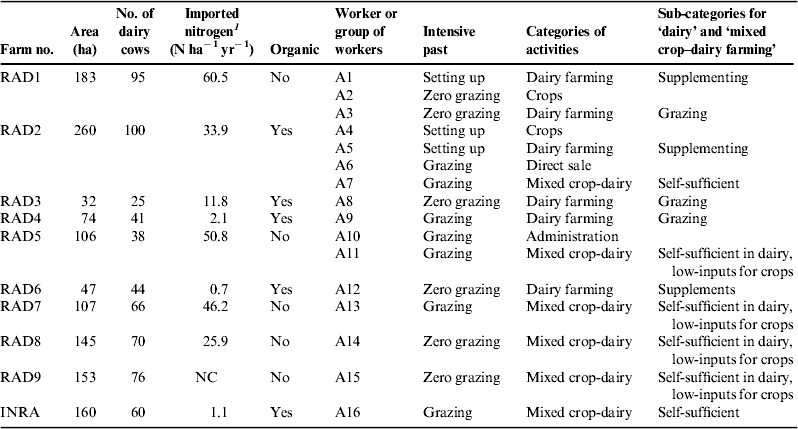
Ten mixed crop–dairy farmers were selected, nine commercial farms and an experimental farm. The farms were selected to cover a diversity of area devoted to cash crops (excluding maize silage): between 0% and more than 50% of the Utilized Agricultural Area. The selection also included differences in experiences, e.g., with regard to grazing of dairy cows. The ten farms also cover a range of farm types regarding ownership, management and workforce: individual farmers, couples and shared ownership (Groupement Agricole d'Exploitation en Commun—GAEC) with or without employees. As the farms are not necessarily homogeneously managed, we distinguish between 16 workers or group of workers which each act differently in the farm (Table 1). All ten farms had been managed intensively (i.e., based on a high reliance on purchased synthetic inputs) before gradually changing their practices to use fewer synthetic inputs and striving to become self-sufficient. We characterized the reduced use of these inputs using an indicator of imported nitrogenReference Vertes, Delaby, Ruiz, Moreau and Gascuel-Odoux23. In 2010, the ten farms imported between 0.7 and 60.5 units of nitrogen ha−1 yr−1.
Characteristics of the ten mixed crop–dairy farms included in the study.

1 Imported N=N mineral+(0.65 or 0.75)×N imported fodder (concentrates, forages)±importation/exportation N organicReference Vertes, Delaby, Ruiz, Moreau and Gascuel-Odoux23.
In this equation:
• N mineral=imported nitrogen in mineral fertilizers.
• N imported fodder=imported nitrogen in bought food×0.75 (for ruminants) and imported nitrogen in bought food×0.65 (for monogastric animals) (0.75 because 25% of N intake is valorized by ruminants and 35% of N intake is valorized by monogastrics animals: the rest of N stays on the farm in slurry, manure or is lost by atmospheric emissions or leaching in water).
• ±importations/exportations organic N: compost, manure, etc.
The nine commercial farms belonged to a sustainable agriculture network called the Réseau Agriculture Durable (RAD), a federation of farmers wanting to develop their autonomy, i.e., create their own reference framework, focusing on ways to reduce their purchases of farming inputs and eventually becoming self-sufficient. Autonomy and self-sufficiency correspond to the implementation of farm management based on the notion of stewardship, i.e., ‘a good family father’ (a ‘bon père de famille’Reference Deléage6). This form of management is characterized by a cautious approach, using a minimum of cash expenditures, implementing the precautionary principle by limiting the use of potentially polluting inputs (chemical fertilizers, pesticides, etc.)Reference Alard, Béranger and Journet7.
The tenth farm was the experimental farm managed by the INRA ASTER-Mirecourt research unit. An area of 240 ha was converted to organic farming for the purpose of designing two systems requiring very few inputs: a grassland dairy system and a mixed crop–dairy system. These two systems, set up in 2004, were designed progressively, in a step-by-step fashion to allow learning from experience. The experimental approach focused on ongoing improvement aimed at solving the technical difficulties encountered along the way and reinforcing the self-sufficiency of the systemsReference Coquil, Fiorelli, Blouet, Trommenschlager, Bazard and Mignolet24. This experimental approach was designed and implemented by a collective (i.e., farm employees and researchers). The collective used to manage the experimental farms intensively in the early 1980s and more extensively until 2004, when the conversion from conventional to organic farming was initiated.
Analysis of the activity of mixed crop–dairy farmers
We collected data to characterize the work of the farmers and to analyze the development of this work, starting from the initial, more intensive farming practices. The data were collected through a series of three interviews with farmers over a period of a year and a half (from February 2011 to September 2012). The first introductory interview used the open interview techniqueReference Kaufman25. During this first interview, we discussed the definition of mixed crop–dairy farming from the farmers' point of view, and the difficulties in establishing a self-sufficient system. The second and third interviews were based on the elicitation interview techniqueReference Vermersch26, which allows it to remain as close as possible to the action underway. This enables the identification of individual actions and their determinants as they take place, and not as an a posteriori analysis. During the second interview, we focused on a description of the course of the 2010 agricultural campaign, i.e., the last agricultural campaign that had been completed at the time of the interview. The analysis of this interview was designed to formalize the farmers' work on their self-sufficient mixed crop–dairy farms in 2010. This formalization was inspired by the conceptual structure of situations as defined by PastréReference Pastré, Barbier, Bourgeois, Chapelle and Ruano-orba27 and Caens-MartinReference Caens-Martin28, Reference Caens-Martin and Pastré29: a representation shaped around farmer's objects and daily indicators to act in his farm. Based on formalizations around different objects, 16 formalizations of the activity of the autonomous and self-sufficient mixed crop–dairy farmers emerged (Table 1). These 16 formalizations correspond to the activity of individual farmers or groups of farmers mainly depending of farms' collectives and work organizations. The third interview was mostly used to validate the analysis of the first two interviews and assess in which order the tools were used. We thus asked the farmers to go over the steps and events in the transition toward self-sufficiency in inputs, which were identified through the analysis of the data from the first interview. We also asked them to review the practices and indicators that they used in 2010, which we identified through the analysis of the second interview. The analysis of this third interview focused on the chronological order in which the tools were used during the transition, on their instrumentation (i.e., how the tools were integrated into farmers' agricultural practices), and on the agricultural objects that appeared or were transformed during the use of these tools, in the farmers' activity during the transition.
On the INRA ASTER-Mirecourt experimental station, data were collected through interviews with the farm managers, through group interviews and individual interviews with farm technicians. Active participation of one of the authors in the design of the farming system also served as a source of data. The data were then used to identify the objects of experimenters of this experimental farm in 2010, as well as their development since 1973.
The data collected through the interviews were analyzed case by case and a monograph was written on each case. These ten monographs were then used as material for the transversal analysis. This analysis focused on the tools used by farmers during the transition, the objects transformed during the farmers' activity by the use of these tools, and the agricultural practices adopted during the transition. The aim of the analysis was to compile an inventory of tools that farmers integrated into their agricultural practices during their transition toward self-sufficiency in inputs. Tools were thus grouped based on the agricultural object that was transformed through the farmer's use of the tool.
Based on this inventory of tools, we defined the key tools by analyzing their function on the agricultural objects (e.g., animals, crops and economics). The key tools were those that brought to the fore new objects in farmers' activity during their transition toward self-sufficiency. The appearance of new objects revealed the adoption of new operational and cognitive approaches by the farmers, which restructured their work. We thus distinguish between key tools, which brought forth new objects, and tools which modified or consolidated objects which already existed in the activities of farmers.
The other purpose of the analysis is to understand the dynamics of the use of these key tools during the transition. We therefore focus on the effects of the original system, on the categories of activities in 2010, and on the chronology of the application of key tools during the transition. Three groups of original systems, that is, the intensive mixed crop–dairy system which existed before the start of the transition process, were distinguished. Some farmers used pastures to provide grazing for dairy cows, some did not use pastures and two farms were set up directly as a system that was self-sufficient (Table 1).
The categories of the activities were defined on the basis of objects. Four categories emerged: one revolving around dairy farming, another around mixed crop–dairy farming, a third around direct sales and a fourth around administration (Table 1). The category ‘dairy farming’ had two sub-categories: ‘supplementing’, consisting of farmers who focused on dairying and who gave their cow's supplements so as to be as reactive as possible to their health and physical condition. The second sub-category was ‘grazing’, consisting of farmers who used grazing as the (almost) exclusive means of feeding their cows. The category ‘mixed crop–dairy farming’ also had two sub-categories: ‘self-sufficient’, encompassing farmers aiming for self-sufficiency in inputs for both their crops and their cows; and ‘self-sufficient in dairy and low-input in crops’, consisting of farmers who aimed at being self-sufficient in inputs for dairying, but who only aimed at reducing their inputs for their cropping.
Results: Tools and Practices of the Transition
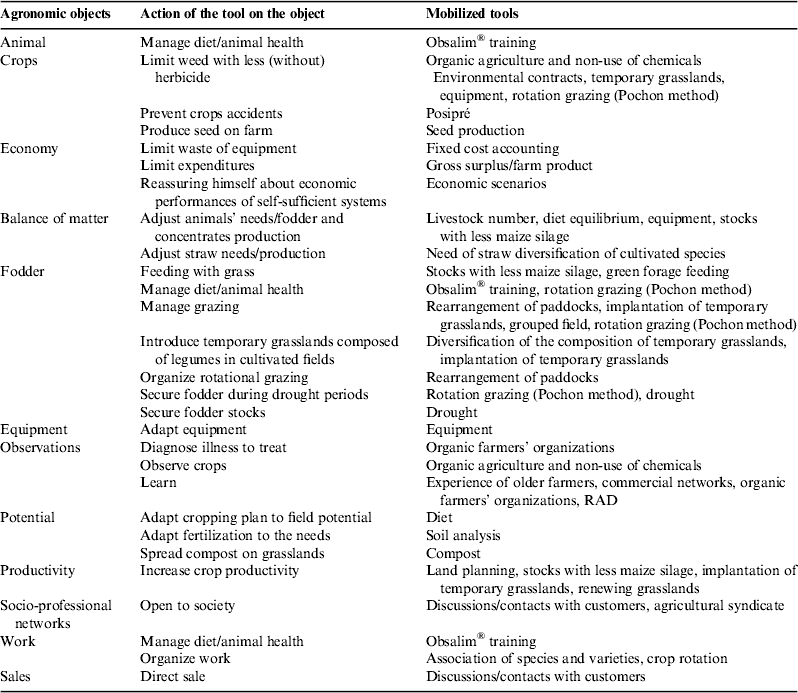
During their transition toward autonomy in decision-making and self-sufficiency inputs, farmers use a variety of tools. When used, these tools become the instruments of the farmers' action. This encounter between usage and the tool transforms not only the tool but also the farmers' practices, by revealing or modifying the objects of their work. Hence, the usage of tools induces a change in the objects on which farmers act to do their work. This dialectic between tools and usage spawns the instrument or the ‘application of the tool’, which is always singular. We will focus more particularly on the 34 key tools (Table 2), that is, the tools whose use reveals new objects on which farmers act during the transition. We then examine the singular nature of an instrument consisting of the same tool used by several different farmers. Finally, we analyze the explanatory factors and chronology of mixed crop–dairy farmers' mobilization of the key tools.
Key tools mobilized by farmers to steer their farming systems toward self-sufficiency.
The key tools of the transition to autonomy
The farmers mobilized a total of 43 tools. We have sorted these tools according to the objects on which the farmers acted when they used the tools. Thirteen agronomic objects appeared, were modified or lasted under the effect of the farmers’ use of the tools: animals, crops, economics, employment, balance of matter, fodder, equipments, observations, potential, productivity, socio-professional networks, work and sales (Table 2). The use of 34 of these 43 tools by farmers resulted in the appearance of new objects structuring the farmers’ activity during the transition. In the transition to autonomy and self-sufficiency in inputs, it acted on all the agronomic objects of the transition, except employment. We will now discuss the tools that were used on the 12 identified objects, and the reasons farmers used these tools.
Farmers act on ‘fodder'using 14 tools, 9 of which played a key part in the evolution of the farmers’ work during the transition (Table 2). Some farmers reduced stocks from maize silage, and increased the proportion of grass in their animal feed by more use of grazing and green forage feeding, and by building up stocks from grass (hay, silage, etc.). They introduced or changed their pasture management by means of rotation grazing, which in the RAD Network is called the ‘Pochon method’. It consists of temporary pastures with mainly raygrass and white clover, where cows are left for 3 days on the paddocks, and the grass is then left for 35 days to grow back. The introduction of rotation grazing sometimes required a rearrangement of paddocks, such as the planting of hedges to provide the animals with shelter, the creation of paths, or exchanges of fields so that they were accessible to the cows. Rotation grazing was also used by some farmers to deal with animals’ health problems (e.g., problems of tonicity of dairy cows that are calving). Farmers who had been trained in the Obsalim®Reference Giboudeau30 method for diagnosing their animals’ health problems and the relationship between health and food, changed their forage system by granting more importance to the distribution of stored forage. The diversity of the stocks built up (alfalfa hay, multi-species hay, etc.) and the availability of stocks as supplements, including during periods of grazing, was increased. Starting off with the creation of temporary pastures with raygrass or white clover (Pochon method) in rotation grazing, farmers sometimes diversified the composition of pastures, depending on the type of paddocks (cocksfoot was often introduced in dry paddocks) and on the use of the pasture. The mixture based on raygrass and white clover proved difficult to dry in the form of hay. The creation of these temporary pastures of grass and legume fodder crops was also intended to improve the nutritional quality of the fodder harvest. Periods of drought and the wish to ensure fodder security in the summer led the farmers to test and then integrate new fodder species that grow in limited rainfall conditions, such as alfalfa and fodder sorghum. Fodder security in times of drought was achieved partly though the increase and diversification of fodder stocks. Occurrences of drought in spring, summer and autumn prompted farmers to multiply fodder resources in order to constitute stocks in all periods of water stress (mixed cereal and legumes crops, fodder corn, sorghum, intercrops, etc.).
Seven key tools of the transition enabled farmers to act on crops. Those who had converted to organic farming or entered into a Contrat Territorial d'Exploitations (part of the French agri-environmental program) such as the Système Fourrager Econome en Intrant (low-input fodder system), limited the use of pesticides on field crops. They consequently also extended and diversified their rotation, and used new farm equipment such as hoeing machines, maize sowers with localized herbicides sprayer and weeding harrows. These tools reduced the pressure to use herbicides yet allow weeding of crops. By creating temporary pastures in crop rotation they limited weeds and thus the use of herbicides. Alfalfa for instance, tends to clear grasslands of thistle; maize fields tend to be clear of weeds after ploughed grasslands; and grazing tends to have a cleaning effect on temporary pastures, which limits dock populations in crop rotation. One of the farmers used the Posipré method build by Patrick Saulas to diagnose diseases on cereals. This diagnosis led him to discover that mixed-variety cereals tend to be less prone to disease, which enabled him to avoid spoiled crops while limiting the use of fungicides. Finally, the farm production of seed for cereals, corn, fodder grass and legumes is a key tool that enabled several farmers to achieve economies of inputs (seed) during the transition period.
Farmers used six key tools having an effect on balance between fodder needs and what could be produced on-farm, they adjusted the livestock numbers in relation to available fodder; they adjusted winter diets of the various batches, based on fodder available on the farm (stocks with less maize); they adjusted the composition of winter diets close to the protein and energy balance, by having less maize silage, more hay, and grass silage; and they used grain crushers and oil presses to produce farm concentrates. The farmers acted on the balance between straw needs and availability by limiting the needs. They did so by replacing straw with poor-quality hay for litter, and by increasing the productivity of cereal straw by planting varieties such as rye and wheat with a high straw yield.
Farmers used six key tools making them devote time to observation and develop their skills and autonomy. They participated in training organized by Groupements d'Agriculteurs Biologiques (interest groupings of organic farmers), mainly on how to care for animals. This raised farmers’ level of vigilance so that they could diagnose ‘abnormal’ states of their animals and be able to provide them with care rapidly. Farmers also observed the development of their crops, so that they could intervene when necessary (e.g., interseeding with another crop in case of problems of raising) or else not intervene (e.g., not destroy regrowth of rapeseed and thus leave it in place for a second crop year) without any risks of persistence of pesticides. The experience of older farmers, interaction within groups of farmers in the network of sustainable agriculture, and exchange between organic farmers all afforded opportunities to compare the findings and lessons learned by each of them, and thus to increase their knowledge and apply it on their own farm.
Farmers stabilize or increase the productivity of crops using four key tools: changing the land use to include as many fields of the farm as possible in rotations with temporary pastures; mixing crops of wheat and legumes (e.g., peas, horse-bean) to rival the productivity of maize silage; renewing pastures to maintain the flora and their productivity by introducing productive varieties such as red clover and hybrid raygrass; and working on temporary pasture sowing practices to ensure their raising and limit their spoilage by weeds (seeding combined with oats).
Farmers work on their farm economics using three key tools: fixed cost accounting (allowed if annual economical product stays below 76,000€) was used by one couple to pay set social welfare contributions from 1 year to the next and thus avoid the temptation that farmers who opt for actual cost accounting have, of making too many tax-deductable investments in the farm. Their investments were thus guided by the necessity for farm equipment and not by the necessity to create charges to obtain tax deductions. This limited the replacement of equipment that had not been used, and thus limited wastage. The ratio of gross surplus to farm product is a commonly used indicator of the economic efficiency of a farm. The discovery of a ratio that could attain 50% made one of the farmers aware of the economic performance of systems that were self-sufficient in inputs. He consequently studied their functioning with a view to limiting expenses on his own farm. This farmer also built several scenarios of reduced inputs on his farm, which enabled him to evaluate their economic performance and thus to reassure himself before actually making changes.
Some farmers adjusted their work organization by mobilizing three tools during the transition. First, the farmers who applied the ruminant feeding principles learned during the Obsalim® training organized their work by splitting up and ordering the distribution of meals to their dairy cows. One of the farmers combined peas with a cereal which gave the pea plants support and thus facilitated the harvesting of the latter. After this initiative he engaged in the regular large-scale use of such combinations. Farmers with a farm consisting of sites over 15 km apart organized their long rotations by giving particular importance to logistics during the harvesting of fodder and the spreading of manure.
Field potential became an object of farmers in transition, through the use of three key tools. Two brothers revised their animals' diets so that they could adjust the land use to its potential and not to the diets that they wanted to give. They created pastures on lands that were difficult to cultivate. Some farmers analyzed the soil to adjust basic fertilization to the needs and potential of the land, and thereby to stop systematic fertilization. One farmer composted part of his manure to fertilize pastures with farm fertilizers and thus to limit the purchase of mineral fertilizers.
Discussions and contacts with customers and participation in an agricultural syndicate were valuable tools mobilized by farmers, which afforded them contact with society. This contact helped to reassure them with regard to their choice of self-sufficiency for their farm, as the low use of synthetic inputs converged with society's expectations. Deliberate choices of this kind can be difficult for farmers to live with in an agricultural world in which the consumption of inputs prevails as a form of security and a way to optimize yields.
Farm equipments are a key tool mobilized by some farmers in the transition to autonomy. Farmers grant importance to the choice, the tuning and the transformation of equipments for sowing, mechanical weeding and working the soil, so that they can adjust these tools to the conditions in which they want to use them. One farmer created a seeder enabling him to sow broadcast large quantities of cereal seed in a field under a crop cover.
Only one key tool was mobilized by farmers to act on their animals during the transition: the Obsalim® training. The ways in which this training was used are detailed in the following section.
From tool to singular uses: the instrument
Each of the tools can be mobilized by farmers during the transition to self-sufficiency, thus contributing to their decision-making autonomy. Farmers' usage of these tools is anchored in ways of doing things, in whatever is meaningful to them in their ways of working and in the context in which they work. This always results in singular instruments that we we will consider through the use of the key tool of the transition period, mobilized by mixed crop–dairy farmers to act on their animals: the Obsalim®Reference Giboudeau30 training.
Integration of the Obsalim® training and its application by autonomous mixed crop–dairy farmers was concretized in several instruments. Some farmers systematically distributed ‘fibrous’ or ‘mechanical’ hay at the beginning of the morning or evening meal to stimulate the animals’ salivation and thus create a buffer for the pH of the rumen. The Obsalim® training encouraged other farmers to organize their work around a divided distribution of meals, so that the cows could be left to eat the fiber and only afterwards be given foods with a higher energy value. After this training several farmers multiplied their observations of the animals (consistence of dung, licking on shoulders, number of shot jaws by mouthful ruminated, etc.), alone or in a group through ‘rally poils’ (name of the group observing cows and especially their appearance), in order to assess their well-being and their health. These observations enabled them to diagnose the cows and to adjust diets and meals accordingly, with a view to improving their health. Farmers thus generally preferred the diversity of available fodder in stock to make up meals. They gave significant quantities of fibrous foods and, from a qualitative point of view, recognized the advantages of maize silage for limiting gastric reflux in the cows during turn out to grasslands. This enabled them to maintain the physical health of their dairy cows. Starting from the same tool, the Obsalim®Reference Giboudeau30 training, farmers learn about the relation between diet and animal health. The different instruments developed depended on several factors: interest of farmers to health management, the diversity of forages they have to adjust the diets—the main factor explaining different instruments was the genesis it promoted in the farmers' activity. For some farmers, the use of that tool created new objects, like the coupled management of diet and health, changing many practices, like the different forages that are cultivated on the farm. For other farmers, the use of that tool just made practices move or appear, like the systematic distribution of hay at the beginning of every meal.
A sequence in the use of key tools?
This analysis highlights the progressive nature of the transition, that is, the step-wise changes in the agricultural system. Such gradual change raises the question of the existence of a chronology in the mobilization of the tools, whether the tools appear in a set sequence during a transition toward self-sufficiency. We first examine this chronology in relation to the farmers' past and then we examine it according to the structure of their activity in autonomous and self-sufficient systems in 2010.
Three of the 16 farmers or farmers' collectives (Table 1) settled on an autonomous self-sufficient mixed crop–dairy farm. Two of these farmers were engaged in the transition to autonomy, and mobilized older farmers' experience to this end. The third farmer had chosen to settle on an autonomous farm because of the appeal that grazing cows had for him. His application of the Obsalim® training very quickly caused him to depart from the technical choices of his experienced partners. Aware of the link between animals' food and their health, this new partner chose to increase the quantity of stored fodder and the concentrates distributed, so that he would be able to give his cows supplements, including during grazing periods. This way of ensuring fodder security by stocking, which was very different to the maximization of grazing that his partners had opted for, was reinforced during drought periods. Chronologically, the first two farmers drew on their experienced partners' know-how as soon as they started farming. They applied this experience in practice, thus gradually transforming it into their own experience (notably with regard to managing grazing and to combinations of cereal and high-protein crops). One of these two farmers subsequently applied the knowledge acquired in the Obsalim® training, which led him to more finely adjust his herd's feeding plan that his predecessor had implemented.
Before their transition, seven farmers or farmers' collectives out of 16 worked in systems of intensive mixed crop–dairy farming with a grazing herd. These farmers mobilized various key tools for their transition to autonomy and self-sufficiency in inputs. The tools enabled them to work on new objects pertaining to the animals, the crops, the farm economy, balance of matter, fodder, farm equipment, observations, potential of fields, the farm's productivity, work and sales. The mobilization of key tools and the objects structuring these farmers' activity during the transition did not seem to be closely related to their past when they practiced intensive farming with grazing. On the farms of three of these seven farmers or farmers' collectives we witnessed the structuring of a reduction in the use of herbicides and, more broadly, pesticides on large crops, which mobilized key tools such as the signing of a Contrat Territorial d'Exploitation, engagement in organic farming and rotation grazing on temporary pastures in order to limit weeds in the fields during the rotation. For three of these seven farmers the work on grass became a structuring feature of their activity: management of the rotation grazing, creation of pastures with pulse crops in the rotation, and the constitution of stocks without maize silage changed their ways of working their farms. These farmers' past experience in intensive farming with grazing did not seem to affect the order in which they mobilized their key tools during the transition.
Six farmers or farmers' collectives out of 16 worked within systems of intensive mixed crop–dairy farming without grazing for their dairy cows. The key tools that they used during their transition also varied widely and caused them to work on new objects concerning their animals, crops, farm economy, balance of matter, fodder, observations, potential, productivity, socio-professional networks and work. Yet with these six farmers or farmers' collectives the work on fodder structured the activity, from the beginning of the transition. They started by rearranging their parcels of land into groups, planting hedges, building paths and then creating temporary pastures before starting rotation pasture management or green forage feeding. Later on in their transition they worked on diversifying fodder by planting diversified pastures or sward that could serve for grazing (sorghum) or that could be harvested (intercrops) to ensure the security of the fodder system.
We now examine chronology of transition according to farmers' activity in their autonomous and self-sufficient farming system in 2010.
Two farmers or farmers' collectives out of 16 structured their activity around mixed crop–dairy farming with the aim of achieving autonomy and self-sufficiency in inputs for their crops and animals. During their transition to autonomy, their activities were structured around new objects pertaining to crops, equipment, field potential, balances, farm productivity, work and observation. For these farmers observation was the new object that appeared during the transition. They observed and experimented with new techniques for managing crops without pesticides. This opened new perspectives: not acting and letting nature do its job, or intervening as soon as they wished to since there could be no side-effects of pesticides.
Four of the 16 farmers or farmers' collectives focused on mixed crop–dairy farming and aimed for autonomy in inputs for their dairy farming and a reduction in the use of inputs for their crops. During the transition to autonomy, their activities were structured around new objects pertaining to economy, balance of matter, fodder, field potential, productivity, socio-professional networks and work. From the beginning of the transition these four farmers worked on fodder: three of them set up and optimized rotation grazing, and the fourth one sowed grass and valorized it through green foraging.
Three farmers or farmers' collectives concentrated on dairy farming in their system of autonomous and self-sufficient mixed crop–dairy farming. They departed from a system of grazing exclusively and gave the animals supplements. During the transition to autonomy their activities were structured around new objects pertaining to the animals, crops, fodder, observation and work. The three farmers mobilized the Obsalim®Reference Giboudeau30 training. This opened perspectives for them regarding animal management and fodder management during the transition. Whereas they had started their transition with work on rotation grazing, the appearance of the link between food and animal health caused them to depart from grazing alone. They supplemented their animals' food by a variety of fodder, including during grazing periods.
Three farmers structured their activity in autonomous and self-sufficient systems around dairy farming, concentrating their feed diets on grazed grass. During the transition to autonomy their activities were structured around new objects related to animals, crops, balance of matter, economy, fodder and productivity. The arrangement of parcels of land and the setting up and management of rotation grazing were highly structuring in the transition of these three farmers or farmers' collectives. They started the transition with work on fodder by mobilizing these tools.
Finally, two farmers structured their activity in autonomous and self-sufficient systems by focusing on crop management. During their transition to autonomy and self-sufficiency in inputs, their activities were structured around new objects relating to crops, fodder, observations, socio-professional networks and sales. Their openness to others' experience so that they could ask them questions and thus enrich their own experiences in contact with their predecessors or peers did not take place at the same time and did not have the same functions. The first farmer was experienced, and interaction with his peers took place when he was already engaged in change. They reassured him with regard to his choices. The second farmer was a novice and training was his first key tool; it enabled him to make contact with his predecessor.
Discussion and Conclusion
This study proposes a formalization of the transition of agricultural systems in action. We approach the transition by way of its contents: we formalize the key tools that farmers mobilize to change their practices, and the objects concerned by that change. We also examine some explanatory elements of the chronology of mobilization of tools by farmers with regard to their past and the work situations that they construct during the transition. This formalization of transitions in action is original in the study of agricultural transitions and in the field of systems and analytical agronomy.
By focusing on the contents of the transition effected by a farmer, we are able to formalize the tools and objects transformed during the transition. The research community studying transitions in agricultural systems has until now concentrated on the a posteriori analysis of change. These studies afford access, for example, to a characterization of the extent of changes underway in agricultural systemsReference Hill and MacRae14, Reference Chantre, Cerf and Le Bail31 or a characterization of learning trajectories, according to the process (trial and error, experimentation, etc.) taken to construct learningReference Chantre32.
In our study we propose a conceptualization of the dynamics of agricultural systems in the long term, based on the creativity of farmers' action. Farmers drive change on their farm and manage it partially by mobilizing tools they adapt to the use they can and wish to make of them. As the usage of these tools transforms their activity, farmers re-discover their work, in a sense, which in turn fuels the transition process. Autonomous and self-sufficient mixed crop–dairy farmers give attention to object subject to simplification in agronomy: animal observations to adjust their diet, consideration to the diversity of crops and their link to the soil, the crop rotations, etc. This anthropocentric conceptualization of the dynamics of agricultural systems is original in agronomy. Agronomic conceptualizations leave little room for initiative and improvization by farmers. Agronomists usually represent agricultural systems as technical systems that are stable in the long runReference Capillon33, Reference Aubry, Capillon and Servettaz34, or systems that function and adapt to natural cycles, on different time stepsReference Landais35. More recent formalizations present agricultural systems with reference to the adaptive cycle of HollingReference Holling36: in the long term, agricultural systems cross through a series of stable phases and transition phasesReference Moulin, Ingrand, Lasseur, Madelrieux, Napoleone, Pluvinage, Thenard, Dedieu, Chia and Leclerc37. The routes by which these systems adapt and the routes of these farmers are studied in transition phases. These formalizations represent farmers either as beings who react to foreseen situations according to set rulesReference Sebillotte, Soler, Brossier, Vissac and Le Moigne38, or as actors who depend on fluctuations in their environmentReference Girard and Hubert39. Self-sufficiency regarding inputs is closely tied with the autonomy in decision making of farmers: the skills of the farmer, i.e., self-sufficiency, depends on farmer's ability to make choices autonomously, yet this autonomy, as a value, is also a precondition for the self-sufficiency. It is thus a close co-evolution of the two aspects: farming practices toward low/no external inputs and farmer's observation skills, his knowledge.
In this work, we highlight a panel of key tools that emerge during farmers' transition, along with new objects on which farmers act during the transition. By construction these tools adhere to the farmers' work situationsReference Schwartz, Beguin and Cerf40. Their usage reveals 13 agronomic objects during the transition. We formalize farmers' objects as they use them and not scientific representations of objects. Tools do not respect usual categories of agronomical sciences: crop management is at the same level as work organization, farm equipment, etc. Balance of matter is emblematic of autonomy and self-sufficiency in inputs. Tools such as adjustment of numbers of animals are mobilized to limit the need for fodder when the farm's own production of fodder is insufficient. Autonomy leads to a practice that contradicts prevailing practice, consisting in purchasing fodder, so that the farmer can produce his milk quota. These key tools and objects of transition are potential resources enabling farmers who wish to change to be in concrete situations of transition to autonomy and self-sufficiency in inputs.
The instrumental approach described here contributes to a more global analysis of transition aimed at understanding the initiation of the process of change and at refining the process of instrumentation of tools. This is achieved essentially by analyzing the way in which the use of tools raises questions on the meaning of a farmer's work. In this study, we highlight the change of the objects on which farmers work—change must be seen more broadly as a change of farmer's work in its praxical and axiological dimensionsReference Beguin41.
Acknowledgements
The authors thank farmers and staff from the RAD and INRA ASTER-Mirecourt for their collaboration. The authors thank Ika Darnhofer for her precious advice during the writing of this paper. This work has been partly financed by the projects ANR Systerra O2LA (ANR- 09-STRA-09) and CASDAR Praiface.