Introduction
Maternal mortality and child mortality were at the heart of the Millennium Development Goals, and maternal and child health continues to be a critical component of the United Nations Sustainable Development Goals (SDGs) (United Nations, 2012, 2015). Globally, maternal mortality rates have declined by 47% in the last two decades, from 400 maternal deaths per 100,000 live births in 1990 to 210 maternal deaths per 100,000 live births in 2013. In 2013 alone, about 289,000 women died of pregnancy-related causes. Progress in reducing maternal mortality has been uneven across the world (WHO et al., 2015). The unequal rate of decline in maternal mortality is a trajectory towards missing the target in many developing countries. Inequality continues to persist and large disparities remain in access to basic health services (Hogan et al., Reference Hogan, Foreman, Naghavi, Ahn, Wang, Makela and Murray2010a, Reference Hogan, Lopez, Lozano, Murray, Naghavi, Rajaratnam and Foremanb; Goli & Arokiasamy, Reference Goli and Arokiasamy2014b; WHO et al., 2015).
According to a 2015 WHO report (WHO et al., 2015) fourteen countries have made insufficient progress towards, and eleven are likely to miss, the maternal mortality reduction target worldwide. Developing countries account for 99% of global maternal mortality. Every day, about 830 women die due to complications related to pregnancy and childbirth. Almost all of these deaths occur in low-income settings. The maternal mortality rate of developing countries (240 maternal deaths per 100,000 live births) was reported to be 33% higher than that of developed regions (160 maternal deaths per 100,000 live births). Within the developing regions, sub-Saharan Africa has the highest mortality ratio (500 maternal deaths per 100,000 live births).
Although there is strong evidence in the public health literature for the role of maternal health care services in reducing the risk of maternal deaths, women in many developing countries continue to have poor access to these services (Price & Pokharel, Reference Price and Pokharel2005; Countdown Coverage Writing Group, 2008; Goli & Jaleel, 2014). An extensive literature has demonstrated the unequal progress in maternal health care use among women in different economic classes in both developed and developing countries (Filippi, et al., Reference Filippi, Ronsmans, Campbell, Graham, Mills, Borghi and Osrin2006; Hill et al., Reference Hill, Thomas, AbouZahr, Walker, Say and Inoue2007; Goldie et al., Reference Goldie, Sweet, Carvalho, Natchu and Hu2010; Nawal & Goli, Reference Nawal and Goli2013a; Goli & Arokiasamy, Reference Goli and Arokiasamy2014b). Findings from these studies show that within low- and middle-income countries, some countries have experienced rapid improvements in maternal health care use, while others continue to have large socioeconomic-related inequalities in use (Hill et al., Reference Hill, Thomas, AbouZahr, Walker, Say and Inoue2007; Graham et al., Reference Graham, Ahmed, Stanton, Abou-Zahr and Campbell2008; Hogan et al., Reference Hogan, Foreman, Naghavi, Ahn, Wang, Makela and Murray2010a, Reference Hogan, Lopez, Lozano, Murray, Naghavi, Rajaratnam and Foremanb; Yadamsuren et al., Reference Yadamsuren, Merialdi, Davaadorj, Requejo, Betrán, Ahmad and Hagan2010; Zere et al., Reference Zere, Tumusiime, Walker, Kirigia, Mwikisa and Mbeeli2010 Alam et al., Reference Alam, Hajizadeh, Dumont and Fournier2015). In particular, there is unanimity that socioeconomic disparity in access to health care is a critical factor influencing progress in maternal health, particularly in developing countries (Gaudin & Yazbeck, Reference Gaudin and Yazbeck2006; Filippi et al., Reference Filippi, Ronsmans, Campbell, Graham, Mills, Borghi and Osrin2006; Coburn & Coburn, Reference Coburn and Coburn2007; Marmot et al., Reference Marmot, Allen, Bell and Goldblatt2012; Goli et al., Reference Goli, Doshi and Perianayagam2013; Çalışkan et al., Reference Çalışkan, Dilek, Selcen and Emre2015). In the interests of achieving the post-MDG (i.e. SDGs) targets of low maternal mortality, in particular Goal 3 (Ensure healthy lives and promote well-being) and Goal 10 (Reduce inequality within and among countries), it is imperative that key factors contributing to low maternal health care use in high-risk regions are identified, with an understanding of how they vary across countries and geographical and cultural contexts.
There is a large literature on the country-specific social determinants of maternal health care. Studies discuss the probable variation in the pathways by which socioeconomic inequality affects the use of maternal health care from country to country (Goodburn & Campbell, Reference Goodburn and Campbell2001; Braveman et al., Reference Braveman, Cubbin, Egerter, Chideya, Marchi, Metzler and Posner2005; Ronsmans et al., Reference Ronsmans and Graham2006; Houweling et al., Reference Houweling, Ronsmans, Campbell and Kunst2007; Say & Raine, Reference Say and Raine2007; Zere et al., Reference Zere, Tumusiime, Walker, Kirigia, Mwikisa and Mbeeli2010; Goli & Arokiasamy, Reference Goli and Arokiasamy2014a). However, a comparative quantitative assessment of the relative contributions of social determinants of maternal health care in different populations has not been made. The explanatory ability of the social determinants of health varies by geographical and cultural setting. Against this backdrop, this study quantified the relative individual contributions of various socioeconomic determinants of inequality to the utilization of maternal health care services in selected countries in diverse geographical and cultural settings.
The analysis focused on two countries from South Asia (Nepal and Bangladesh) and two from sub-Saharan Africa (Zimbabwe and Ethiopia). These countries were chosen because, firstly, South Asia and sub-Saharan Africa contribute 29% and 56% respectively to the global burden of maternal deaths, together accounting for 245,000 maternal deaths (WHO et al., 2015). Second, within these regions, the countries are in the top fifty in terms of levels of maternal mortality, and in the bottom fifth in rankings of recent progress in maternal mortality decline, based on the WHO et al. (2015) report. From the shortlisted countries, those with comparable Demographic and Health Survey (DHS) data sets collected after 2010 were selected because findings from more recent surveys are more relevant for future policymaking. Finally, steps were taken to ensure that the sample size was adequate to make robust statistical estimates.
Methods
Data
Data came from the DHS conducted in Nepal (Ministry of Health and Population et al., 2011), Bangladesh (NIPORT et al., Reference NIPORT2013), Ethiopia (Central Statistical Agency & ICF International, 2012) and Zimbabwe (ZIMSTAT & ICF International, 2012). The sampling design of the DHS across all four countries was uniform, and the sample was representative at the national, residence (urban–rural) and regional level (states). The sample was based on a stratified two-stage cluster design. In the first stage enumeration areas (EAs) were drawn from census files. In the second stage, for each selected EA a household sample was drawn from the listing of households. The surveys used the sampling frame as the list of EAs prepared for the latest Population and Housing Census (of 2010) in the respective countries. In all four countries, more or less homogeneous questionnaires were administered. These questionnaires were adapted from model survey instruments developed for the MEASURE DHS project to reflect population and health issues. For more details on sampling design and survey questionnaires see Ministry of Health and Population et al. (2011), ZIMSTAT & ICF International (2012), Central Statistical Agency and ICF International (2012) and NIPORT et al. (2013).
The numbers of eligible women (in the age group 15–49 years) interviewed were 12,674 in Nepal, 17,842 in Bangladesh, 16,515 in Ethiopia and 9171 in Zimbabwe. Since the focus of the analysis was on maternal health care use, the sample was restricted to those women who had a live birth in the 5 years preceding the survey. This included 4148 women in Nepal, 7764 in Ethiopia, 5596 in Zimbabwe and 4956 in Bangladesh. The survey response rate and coverage in the four countries was above 90%.
Outcome variables
The DHS datasets used for the analyses contain not only the detailed household-level socioeconomic characteristics and individual-level demographic information of all women who gave birth in the last 5 years, but also provide information on access to, and use of, antenatal care, place of delivery and postnatal care. Using this information, following Rutstein and Rojas (Reference Rutstein and Rojas2006), the main outcome variables ‘ANC visits’, ‘place of delivery’ and ‘postnatal care’ were categorized. For ease of interpretation and comparison of inequalities in the maternal health care, both outcome variables and its predictors were dichotomized into ‘disadvantaged’ (1) and ‘advantaged’ groups (0).
ANC visits
The WHO recommends that pregnant women should make at least four ANC visits to a skilled provider to monitor the pregnancy and reduce the risk of morbidity for the mother and baby. Using information on ANC coverage for the respondent’s most recent birth, the responses were categorized into a binary outcome variable, taking a value of 1 if <3 ANC visits and 0 if >3 ANC visits.
Institutional delivery
Institutional deliveries are those taking place in public, private and other recognized non-governmental hospital settings. This has been identified as being critical for reducing the risk of deaths arising from obstetric and emergency obstetric complications. For the respondent’s most recent birth, the institutional delivery variable took a value of 1 for non-institutional delivery and 0 for institutional delivery.
Postnatal care
This is an important component of maternal health care as there is a high chance of developing grave and life-threatening maternal health complications after delivery. A postnatal care visit is an ideal time to educate a new mother on how to care for herself and her newborn. It is recommended that women receive at least three postnatal check-ups, the first within 2 days of delivery, the second on the third day after delivery and the third on the seventh day after delivery. In this study, postnatal care within 2 days of delivery was considered as the outcome variable, taking a value of 1 if the respondent did not receive postnatal care within 2 days of delivery and 0 otherwise.
Explanatory variables
With regards to explanatory variables, the choice of socioeconomic variables was guided by policy-relevant variables that have been identified in previous studies as being critical factors for maternal health care utilization (see Wagstaff et al., Reference Wagstaff, Paci and Van Doorslaer1991, Reference Wagstaff, Van Doorslaer and Watanabe2003; Kakwani et al., Reference Kakwani, Wagstaff and Van Doorslaer1997; Wagstaff, Reference Wagstaff2002a; Kawachi et al., Reference Kawachi, Subramanian and Almeida-Filho2002; Rowe et al., Reference Rowe, Thapa, Levine, Levine and Tuladhar2005; Subramanian et al., Reference Subramanian, Nandy, Irving, Gordon, Lambert and Davey Smith2006; Subramanian & Ertel, Reference Subramanian and Ertel2009; Konda et al., Reference Kondo, Sembajwe, Kawachi, van Dam, Subramanian and Yamagata2009; Goland et al., Reference Goland, Hoa and Målqvist2012; Van Bon-Martens et al., Reference van Bon-Martens, Denollet, Kiemeney, Droomers, de Beer, van de Goor and van Oers2012; Goli, et al., Reference Goli, Doshi and Perianayagam2013; Goli & Arokiasamy, Reference Goli and Arokiasamy2014a). For comparison purposes, the same set of explanatory variables was used in estimations for all four countries.
Household wealth quintile was used as a proxy for the respondent’s economic status. The wealth quintile was constructed using the household assets, accounting for rural/urban differences in assets. All the asset variables used in the construction of the wealth quintile were dichotomized as ‘1’ if the household did not own the asset or ‘0’ if the household did own the asset. Principal Component Analyses (PCA) was used to produce the common factor score for categorical and continuous variables for each household. Separate factor scores were produced for households in urban and rural areas using area-specific indicators. The third step combined the separate area-specific factor score and produced a nationally applicable combined wealth quintile score by adjusting the area-specific score through a regression on common factor scores and the resulting assets scores were standardized in relation to the normal distribution with the mean of zero and standard deviation (SD) of one. Further, as indicated by Wagstaff and colleagues (Reference Wagstaff and Van Doorslaer2003), the sample was divided into five equal quintiles to use as a rank variable in the Concentration Index (CI) estimation, but for the decomposition analyses the variable ‘wealth quintile’ was dichotomized into 1=poor and 0=non-poor.
The other variables included were place of residence (rural=1/urban=0) and mother’s literacy level (illiterate=1/literate=0). Level of education was originally given in four broad categories: no education, primary, secondary and higher, but for decomposition analysis these categories were combined into two: illiterate (1) and literate (0). Husband’s education level was similarly classified. Child’s birth order (respondent’s most recent birth), originally available as a continuous variable, was dichotomized, taking a value of 1 for birth order 3+ and 0 for birth order ≤3. Women’s work status was classified as working (0) and not working (1). Women’s risky age of childbearing, defined as 15–19 years and 30 years and above, was classified as risky (1) and non-risky (0).
Decomposition model
The investigation of inequality in health has traditionally been analysed using inequality measures such as mean deviation, poor–rich ratio, regression and concentration index. While these measures can identify the differences and gaps in health care utilization, they are unable to attribute the relative shares to different factors that influence inequality in maternal health care usage (Wagstaff et al., Reference Wagstaff, Van Doorslaer and Watanabe2003; Hosseinpoor et al., Reference Hosseinpoor, Mohammad, Majdzadeh, Naghavi, Abolhassani, Sousa and Vega2005; O’Donnell et al., Reference O’Donnell, Van Doorslaer, Wagstaff and Lindelow2008). To address this shortcoming, Wagstaff et al. (Reference Wagstaff, Van Doorslaer and Watanabe2003) proposed an inequality decomposition model that integrates all the above techniques into a single robust inequality assessment model, and this approach was used here.
The analysis had two stages. In the first stage maternal health inequalities were calculated in terms of concentration indexes (CIs), which were estimated using equation (1). The CI was computed as twice the weighted covariance of the health variable and the woman’s relative rank in terms of her economic status divided by the mean. Women were ranked in ascending order by household wealth status to determine the cumulative fraction (Wagstaff & Van Doorslaer, Reference Wagstaff and Van Doorslaer2003).
 $$C{\equals}{2 \over \mu }{\mathop{\rm cov}} _{{\rm w}} \left( {y_{i} R_{i} } \right)$$
where y i refers to the health status of the i th woman, and R i is the fraction rank of the i th woman (for weighted data) in terms of the index of household economic status; µ is weighted unconditional mean of the health variable of the sample and covw denotes the weighed covariance. This equation gives the concentration of inequality (C) among the subgroup of the population. The weights were used to adjust for the design effect of the sample survey data. The value of CI lies between −1 and +1, where a negative value implies a concentration of the outcome variable among disadvantaged groups and a positive value implies a concentration among the advantaged group. A zero value of concentration index implies no inequality.
Wagstaff et al. (Reference Wagstaff, Van Doorslaer and Watanabe2003) proposed the following linear regression model linking the health variable of interest, y, to a set of k health determinants, x k . This linear regression was estimated separately for each of the ‘disadvantaged’ maternal health outcomes, i.e. women with <3 ANC visits, non-institutional delivery and no postnatal care within 2 days of delivery. Each of the dependent variables was linked to the socioeconomic factors by the expression:
 $$y_{i} {\equals}\alpha {\plus}\mathop{\sum}{\beta _{k} x_{{ki}} {\plus}{\epsilon}_{i} } $$
where ε i is the error term. Given the relationship between y i and x ki , the concentration index for y (C) can be written as:
 $$\left( {{{\beta _{k} x_{k} } \over \mu }} \right)C_{k} {\plus}{{GC_{{\epsilon}} } \over \mu }{\equals}C_{y} {\equals}{{GC_{{\epsilon}} } \over \mu }$$
Equation (3) shows that C is made up of two components. The first is the determinant or ‘explained’ component. This is equal to the weighted sum of the concentration indices of the regression, where the weights are elasticity (a unit-free measure) of [partial] association, i.e. the percentage change in the dependent variable (maternal health care variables) associated with a percentage change in the predictor’s variables, (β K X k /µ) of y with respect to each x k ; the second is a residual or ‘unexplained’ component (GC ε /µ), where GC is the Generalized Concentration Index. The explained component reflects the proportion of inequalities in the dependent variable (health variable) that is explained by the systematic variable in the selected predictors, i.e. x k . The unexplained component reflects that part of inequalities could not be explained by the selected predictors across socioeconomic groups.
Ethical approval
The study used a data source that is available in the public domain so ethical approval was not required.
Results
Inequalities in maternal health care
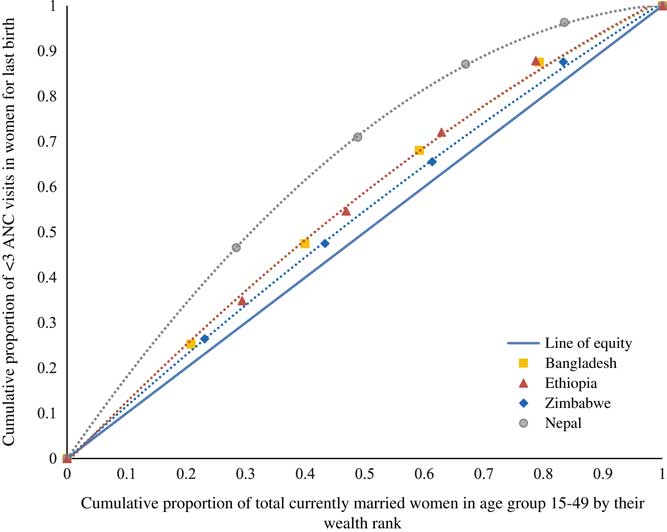
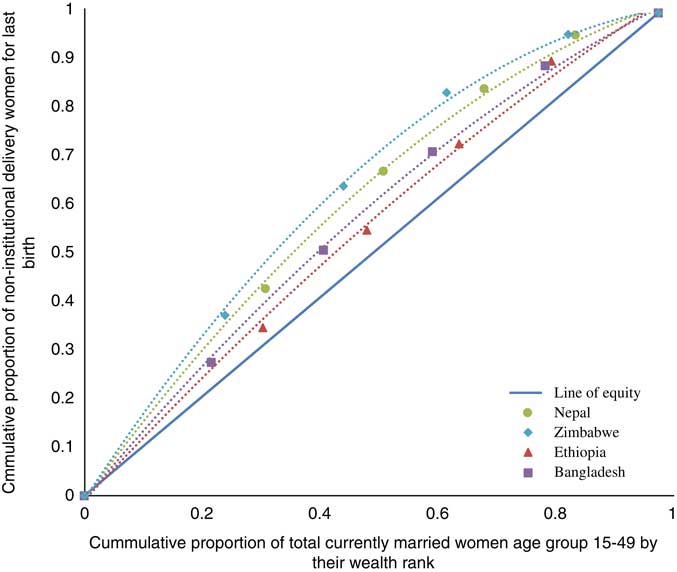
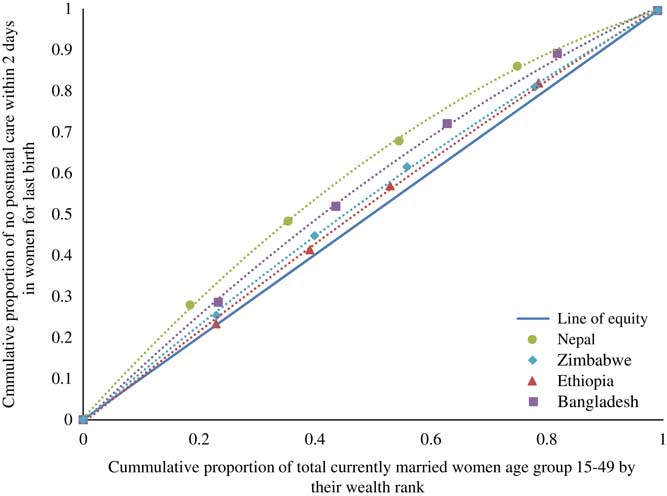
Figures 1, 2 and 3 show the concentration curves for the dependent variables <3 ANC visits, non-institutional delivery and no postnatal care within 2 days, respectively, for the four countries. For each health variable, the concentration curves show the cumulative proportion of the variable against the cumulative proportion of currently married women in the age group 15–49 years. The concentration index will be a 45-degree line (the line of equity) if a woman, irrespective of her wealth status, has the same values of maternal health care use. A concentration curve that lies above the line of equity represents a situation where poor maternal health care utilization is more concentrated among the ‘disadvantaged’ population. The analyses found that for all four countries the plotted CI curves diverged from the line of equity for all three maternal health indicators, indicating that the under-utilization or non-utilization of maternal health care was heavily concentrated among relatively poor women. Furthermore, the CI estimates revealed that the values were negative for all three maternal health variables in the selected countries, indicating a greater concentration of poor maternal health care outcomes among economically disadvantaged populations (see also Tables 1, 2, 3). In terms of specific outcomes with regard to inequality in ANC visits, the distance from the line of equity to the line of concentration curve was greatest in Nepal (CI=−0.2859) relative to Bangladesh (CI=−0.1147), Ethiopia (CI=−0.1146) and Zimbabwe (CI=−0.0632). In the case of institutional delivery, inequality was highest in Zimbabwe with a CI value of −0.2527, followed by Nepal (CI=−0.1959), Bangladesh (CI=−0.1337) and Ethiopia (CI=−0.03702). Nepal also had the greatest inequalities in postnatal care visits within 2 days of delivery (CI=−0.1816), followed by Bangladesh (CI=−0.1153), Zimbabwe (CI=−0.0577) and Ethiopia (CI=−0.0370). Ethiopia had the least inequality with regard to postnatal care within 2 days of delivery.
Concentration curve for <3 ANC visits for women’s last birth (15–49 year age groups) for selected countries.

Concentration curve for non-institutional delivery for women’s last birth (15–49 year age groups) for selected countries.

Concentration curve for no post-natal care within 2 days of delivery for women’s last birth (15–49 year age groups) for selected countries.

Effect and contribution of predictor variables of women with <3ANC visits based on decomposition analysis in selected countries

SE: standard error of the estimate.
*p<0.05; **p<0.01; ***p<0.001.
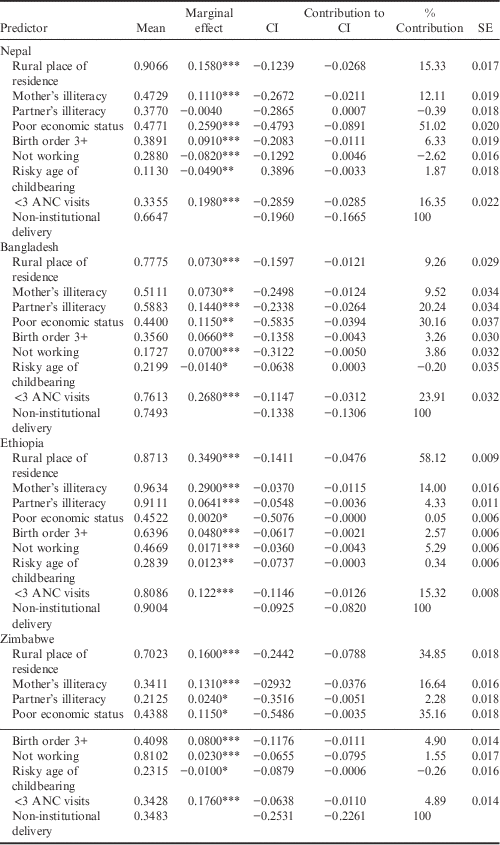
Effect and contribution of predictor variables of women with non-institutional delivery based on decomposition analysis in selected countries

SE: standard error of the estimate.
*p<0.05; **p<0.01; ***p<0.001.
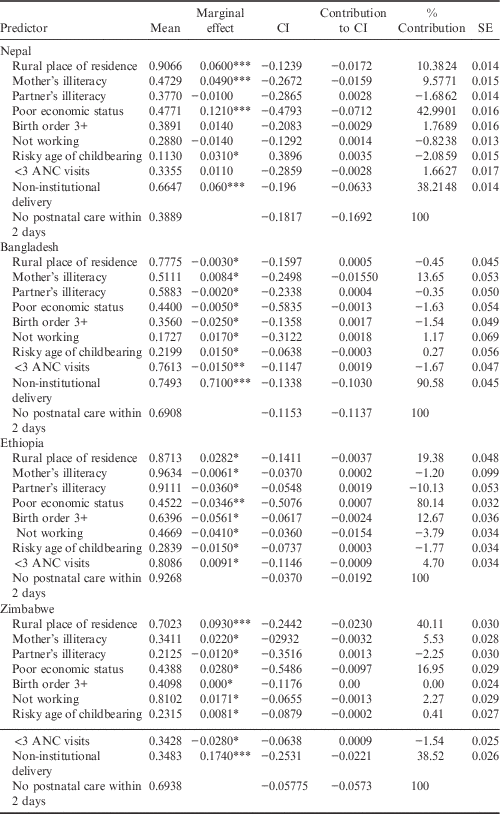
Effect and contribution of predictor variables of women who had no postnatal care within 2 days of delivery based on decomposition analysis in selected countries

SE: standard error of the estimate.
*p<0.05; **p<0.01; ***p<0.001.
Decomposition of inequalities in maternal health care
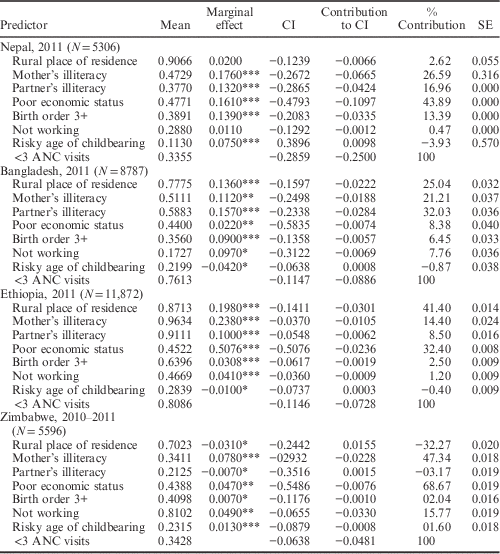
Economic inequality in health care operates through certain factors, and so do maternal health care inequalities (Goli et al., Reference Goli, Doshi and Perianayagam2013). Therefore, decomposition analyses were carried out to identify the relative contribution of socioeconomic and demographic factors to inequalities in maternal health care utilization. The results of the inequality decomposition analyses for the four selected countries for the dependent variable ANC visits are shown in Table 1. The variables mother’s illiteracy, partner’s illiteracy, poor economic status and birth order 3+ were found to be positively associated with <3 ANC visits in all four countries. The marginal effects revealed that all the predictors were positively associated with <3 ANC visits, with the exception of ‘risky age of childbearing’ and ‘work status of women’ in Nepal. Subsequently, they were not included in the decomposition model. There was heterogeneity in the level of association between the dependent variable ‘<3 ANC visits’ and selected predictor variables across the four countries. For instance, the marginal effects showed that mother’s illiteracy increased the probability of having <3 ANC visits by approximately 18 percentage points (β=0.1760, p<0.001), followed by birth order 3+ (β=0.1390, p<0.001) and partner’s illiteracy (β=0.1320, p<0.001). However, in the case of Ethiopia, poor economic status (β=0.0220, p<0.001) and mother’s illiteracy (β=0. 2380, p<0.001) were significantly associated with <3 ANC visits. In Bangladesh, the sizes of the marginal effects were largest for the variables partner’s illiteracy (β=0.1570, p<0.001) and rural place of residence (β=0.1360, p<0.001), while in Zimbabwe they were largest for mother’s illiteracy, work status and poor economic status.
Decomposition of the relative contribution of predictor variables to inequality in ANC use showed an interesting pattern. In general, in Nepal, Ethiopia and Zimbabwe, poor economic status contributed most to inequality in ANC utilization. However, the size of the contribution of specific factors, including poor economic status, varied across different countries. In Nepal, poor economic status (44%) and mother’s illiteracy (26%) contributed most to inequalities in utilization of ANC, whereas in Bangladesh the greatest contributors were partner’s illiteracy (32%) and rural place of residence (25%). Among the African countries, in Ethiopia rural residence (41%) and poor economic status (32%) were found to be the largest contributors to <3 ANC visits, and in Zimbabwe poor economic status (69%) and mother’s illiteracy (47%) made the greatest contribution to inequalities in ANC utilization. It is noteworthy that Zimbabwe was the only country in the sample where rural residence improved ANC utilization.
The estimates of the marginal effects and decomposition of inequalities in institutional delivery in the sample countries are presented in Table 2. Once again, the same set of predictor variables that were positively associated with <3 ANC visits also showed a positive association with institutional delivery. Country-specific assessment of the association between non-institutional delivery and socioeconomic predictor variables revealed that for Nepal the variable ‘poor economic status’ had the greatest association (β=0.2590, p<0.001) followed by rural residence (β=0.1580, p<0.001) and mother’s illiteracy (β=0.1110, p<0.001). For Bangladesh, having <3 ANC visits (β=0.2680, p<0.001) and partner’s illiteracy (β=0.1440, p<0.001) showed the strongest association with non-institutional delivery. In both Ethiopia and Zimbabwe, rural residence emerged as a statistically significant factor and was positively associated with non-institutional delivery (β=0.3490, p<0.001; β=0.1600, p<0.001, respectively), followed by mother’s illiteracy (β=0.2900, p<0.001; β=0.1310, p<0.001, respectively). However, the absolute level of association between <3 ANC visits and non-institutional delivery was highly significant in Zimbabwe, with a β value of 0.1760.
The results of the relative contributions of socioeconomic factors to inequalities in institutional delivery revealed that poor economic status made the highest contribution to the total inequality in institutional delivery in Nepal (51%) and Bangladesh (30%), but rural place of residence made the highest contribution in Ethiopia (58%) and Zimbabwe (35%). However, the contribution of poor economic status (35%) was equally significant in the case of Zimbabwe. Also, the contribution of <3 ANC visits to overall inequality in institutional delivery was statistically significant for Bangladesh (23%) and Ethiopia (15%). Among other factors, mother’s illiteracy contributed around 10–16% of inequalities in institutional delivery in the select countries.
Table 3 shows the marginal effects and inequality decomposition estimates for postnatal care within 2 days of delivery (no postnatal care) for the four countries. The marginal effects showed that in Nepal four variables, viz. poor economic status, mother’s illiteracy, birth order 3+ and non-institutional delivery, were significantly associated with ‘no postnatal care’. However, the marginal effects of the selected covariates on ‘no postnatal care’ showed that the absolute level of association was greater with poor economic status in Nepal (β=0.1210, p<0.001), non-institutional delivery in Bangladesh (β=0.7100, p<0.001) and Zimbabwe (β=0.1740, p<0.001) and birth order 3+ in Ethiopia (β=−0.0561, p<0.05). Furthermore, the relative contribution of the predictor variables to inequalities in utilization of postnatal care showed that poor economic status (43%) and non-institutional delivery (38%) made greater contributions in Nepal. While in Bangladesh non-institutional delivery (90%) alone contributed the most to inequalities in postnatal care, in Ethiopia the contribution of poor economic status was highest (80%). In Zimbabwe, rural place of residence (40%) and non-institutional delivery (38%) contributed to the bulk of inequalities in postnatal care use.
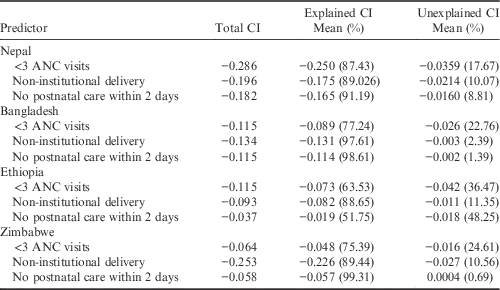
Finally, Table 4 shows the extent to which the selected explanatory factors contributed to the total estimated inequalities in the three maternal health care variables. The explained and unexplained components of the estimated concentration index value in the decomposition analyses are shown for the three maternal health care variables in the selected countries. The results point to the validity of the selection of predictor variables in the decomposition models. They show that the contribution of seven predictor variables (place of residence, woman’s and partner’s educational status, household economic status, birth order, work status, age at childbearing) of interest collectively explain 87%, 77%, 63% and 75% of the inequalities in ANC visits for Nepal, Bangladesh, Ethiopia and Zimbabwe, respectively. The remaining part (CI=−0.036, −0.0261, −0.0418, −0.0157 for Nepal, Bangladesh, Ethiopia and Zimbabwe, respectively) constitutes the unexplained residual for inequalities in ANC. The estimates indicated that out of the total inequality in institutional delivery, the eight selected variables (place of residence, woman’s and partner’s educational status, household economic status, birth order, work status, age at childbearing, ANC) of interest explained 89% with a residual value of −0.0214 for Nepal, 98% with a residual value of −0.0032 in Bangladesh, 89% with a residual value of −0.0150 for Ethiopia and 89% with a residual value of −0.0267 for Zimbabwe. With regard to inequalities in postnatal care, the nine predictors (place of residence, woman’s and partner’s educational status, household economic status, birth order, work status, age at childbearing, ANC and institutional delivery) jointly contributed 91%, 99%, 52% and 99% of the total inequality (that is CI=−0.016, −0.0015, −0.0179, −0.0004) observed in Nepal, Bangladesh, Ethiopia and Zimbabwe, respectively. However, for Ethiopia, the nine variables together were able to explain only CI=−0.0192 out of total CI=−0.0370, leaving an unexplained residual component of 48%.
Explained and unexplained concentration index (CI) in decomposition analyses for the three selected maternal health care variables for selected countries

Discussion
This study measured the inequality in utilization of maternal health care services in a sample of Asian and African countries. In keeping with previous studies, socioeconomic status was identified as being strongly associated with the utilization of maternal health care in Nepal, Ethiopia and Zimbabwe (Chakraborty et al., Reference Chakraborty, Islam, Chowdhury, Bari and Akhter2003; Mekonnen & Mekonnen, Reference Mekonnen and Mekonnen2003; Ronsmans et al., Reference Ronsmans and Graham2006; Stephenson et al., Reference Stephenson, Baschieri, Clements, Hennink and Madise2006; Dhakal et al., Reference Dhakal, Chapman, Simkhada, Van Teijlingen, Stephens and Raja2007; Houweling et al., Reference Houweling, Ronsmans, Campbell and Kunst2007; Amin et al., Reference Amin, Shah and Becker2010; McTavish et al., Reference McTavish, Moore, Harper and Lynch2010; Kevany et al., Reference Kevany, Murima, Singh, Hlubinka, Kulich, Morin and Sweat2012; Mazambani et al., Reference Mazambani, Chigusiwa, Mudavanhu, Bindu and Muchabaiwa2012; Goli et al., Reference Goli, Doshi and Perianayagam2013; Nawal & Goli, Reference Nawal and Goli2013a). The study assessed the socioeconomic inequalities in the use of ANC, institutional delivery and postnatal care within a more comprehensive model, and using a greater number of predictors, than in previous studies. In addition, comparative evidence on the critical socioeconomic predictors of maternal health care inequalities is presented across diverse geographical settings. Variations in the level of health inequalities across countries were identified, along with the relative contributions of socioeconomic predictors. Nepal and Ethiopia showed greater socioeconomic inequality in antenatal care utilization, while Zimbabwe and Nepal showed more inequality in institutional delivery. Nepal had the highest inequality for postnatal care, followed by Bangladesh.
Regarding the relative contributions of socioeconomic factors to total health inequalities, the major contributing factors were found to vary by country. For instance, in the case of ANC, poor economic status and mother’s illiteracy have been found to contribute the most in Nepal (Matsumura & Gubhaju, Reference Matsumura and Gubhaju2001; Nawal & Goli, Reference Nawal and Goli2013a; Joshi et al., Reference Joshi, Torvaldsen, Hodgson and Hayen2014) and Zimbabwe (Kambarami et al., Reference Kambarami, Chirenje and Rusakaniko1999), while it is partner’s literacy and rural place of residence in Bangladesh (Anwar et al., Reference Anwar, Sami, Akhtar, Chowdhury, Salma, Rahman and Koblinsky2008; Pulok et al., Reference Pulok, Sabah, Uddin and Enemark2016) and rural place of residence and poor economic status in Ethiopia (Tura, Reference Tura2009; Wilunda, Reference Wilunda, Quaglio, Putoto, Takahashi, Calia, Abebe and Atzori2015). Similarly, for institutional delivery, poor economic status and <3 ANC visits contribute more in Nepal and Bangladesh (Wagle et al., Reference Wagle, Sabroe and Nielsen2004; Choudhury & Syed, Reference Choudhury and Syed2011), while it is a rural place of residence and <3 ANC visits in Ethiopia (Amano et al., Reference Amano, Gebeyehu and Birhanu2012; Teferra et al., Reference Teferra, Alemu and Woldeyohannes2012) and poor economic status and rural place of residence in Zimbabwe (Moyer & Mustafa, Reference Moyer and Mustafa2013) that contribute the bulk of the inequalities in the same indicator. The findings for inequalities in postnatal care suggest that poor economic status and non-institutional delivery contribute more in Nepal, while non-institutional delivery and mother’s illiteracy contribute greatly in Bangladesh. In Ethiopia, poor economic status and rural residence contribute relatively more to inequalities, while in Zimbabwe rural residence and non-institutional delivery contribute the bulk of the inequalities for the same indicator.
Overall, this study presents a robust measurement of inequality in maternal health care utilization and the factors contributing to it, using a cross-country perspective in low-income and high-maternal-mortality settings. It provides a framework for maternal health care usage that can be used when designing policies at the global level. The findings help in understanding variations in the level of inequalities by country and types of maternal health care indicators. Also, it gives clear guidance on which factors should be the focus of policy for a particular country on a specific maternal health care outcome indicator. For instance, in both African countries (Ethiopia and Zimbabwe) and Nepal (except in the case of ANC), the variable ‘rural place of residence’ was found to be the key factor contributing to the bulk of inequality, along with ‘poor economic status’. In particular, the greater role of rural place of residence, compared with mother and partner’s illiteracy, indicates that a lack of health care infrastructure in rural areas in these low-income countries is still a huge constraint to accessing quality services for institutional delivery and postnatal care. However, in the South Asian countries (Nepal and Bangladesh), the variables ‘poor economic status’ and ‘mother’s illiteracy’ made key contributions to the lack of institutional delivery and post-delivery care. However, for ANC, mother’s illiteracy makes a key contribution along with economic status for both South Asia and African countries.
The significant role of ANC in institutional deliveries suggests that the information obtained during ANC visits is critical in enabling women to seek natal care in health facilities. Similarly, information and advice obtained during ANC visits and institutional deliveries can also help in seeking timely postnatal care in a health facility; this is especially true in the case of the two Asian countries, Nepal and Bangladesh. With the exception of Ethiopia, for all the other three countries the selected predictors explained around 75% to 99% of the total inequality in maternal health care utilization, indicating that the study’s variable selection was robust.
Local health policies are highly influenced and driven by global health strategies and interventions. Local variation in the social determinates of health have time and again received lower priority. However, this is important for policy priorities and actions, both at the global and local level, if Goal 3 of the SDGs is to be achieved. Global maternal health policy interventions should be uniquely placed to deal with countries from different socioeconomic settings to bring ‘efficiency with equity’ in outcome indicators. In general, worldwide both rich and poor socioeconomic groups are progressing in terms of maternal health care utilization, but there continues to be a large gap that varies from country to country. Policies focusing on the eradication of avoidable maternal health care inequalities need to focus not only on the progress or change in averages, but should also give importance to the convergence of such progress across different socioeconomic groups and across countries. Such efforts need to identify specific barriers and challenges in different countries to (or intend to) achieve equitable access to maternal and child health services.
There is a need to identify key maternal health policies in order to achieve convergence in outcome indicators. To a large extent, the differences in the levels of maternal health inequality in the four study countries can be attributed to their adoption of different maternal health care strategies (Nawal & Goli, Reference Nawal and Goli2013b). The governments of Nepal and Bangladesh have made efforts to reduce maternal mortality and morbidity through Safe Motherhood and Birth Preparedness programmes, aimed at increasing access to ANC services, institutional delivery and postnatal care (Nawal & Goli, Reference Nawal and Goli2013b). However, the maternal health care policies in these countries must prioritize improvement in the access of women of poor economic status, and efforts must be directed towards improving awareness among illiterate women. Improving maternal education would lead to increased demand for ANC services and institutional deliveries. Similarly, although governments in African countries like Zimbabwe and Ethiopia have attempted to provide an enabling environment to reduce maternal deaths, they should scale-up strategies to address the barriers to access to ANC and institutional delivery in rural areas. Rural primary health centres and district hospitals should be targeted to improve the quality of maternal health care services.
Overall, policy initiatives must consider factors such as economic status, education level and regional disadvantages to reduce the burden of maternal mortality in low- and middle-income countries. The present study contributes in terms of identifying key factors responsible for the bulk of the inequalities in maternal health care utilization and their spatial variation. Since the key contributing factors vary across different countries, a country-specific intervention strategy has to be adopted to improve maternal and child health care utilization in these laggard countries. Moreover, given the contribution of poor household economic status to maternal health care inequalities, it is proposed that these countries should receive adequate investment, especially from local governments. Steady higher health care expenditure as a proportion of GDP in Zimbabwe might be the reason behind its lower socioeconomic inequality compared with the study’s other three countries for two of the three maternal health care indicators (WHO, 2014). Even from a global context, the public health spending on primary health care in the majority of developing countries is far below that of many developed countries (Hopkins, Reference Hopkins2010). Unless the laggard countries scale-up maternal health coverage interventions to create acceleration in the catching-up process of disadvantaged socioeconomic groups, it will be difficult to achieve equity in maternal and child health care and mortality indicators in these countries.