


INTRODUCTION
Democracy may be an idea that has conquered the world, but as a form of government it is neither self-evident nor inevitable. As Winston Churchill famously observed, “No one pretends that democracy is perfect or all-wise. Indeed it has been said that democracy is the worst form of government except for all those other forms that have been tried from time to time.” Nevertheless, many of “those other forms” continue to exist, and transitions from democracy to such regimes are far from rare. Between 1975 and 2015, 37 democracies broke down, and in addition democracy has recently eroded in countries such as Hungary, Poland, and Turkey. How, then, can we best sustain democracy under challenging conditions?
An influential literature promotes the remedy of political powersharing institutions, which aim to limit threats from unrestrained majoritarian rule and to ensure that no groups, and ideally no citizens, suffer policies seriously detrimental to their interests (Lijphart Reference Lijphart1977, [Reference Lijphart1999] Reference Lijphart2012; Hartzell and Hoddie Reference Hartzell and Hoddie2007; Norris Reference Norris2008). Powersharing does so by guaranteeing groups at risk access to power, by dispersing and decentralizing political authority, or by imposing constraints on potential abuses of power by office-holders and dominant groups. Powersharing solutions have most commonly been adopted in states recovering from violent conflict and other deeply divided societies. Thus, political observers currently propose powersharing for states such as Iraq, Burma, and Ukraine.Footnote 1
Yet there is an inherent tension between powersharing and democracy. If democracy requires “institutionalized uncertainty” (Przeworski Reference Przeworski1991), popular sovereignty, and electoral anonymity (“one person, one vote”), then powersharing may contravene all of these values. If powersharing means inclusiveness such as grand coalitions, then it may limit accountability and the ex ante uncertainty of elections. If it means minority autonomy and veto power, then it may render some votes more valuable than others and thus violate anonymity. And if it means limitations on government authority, it may circumscribe popular sovereignty. This tension between powersharing and democracy thus poses an intriguing empirical puzzle: Does powersharing help protect democracy or is it a liability? And does the answer depend on the form that powersharing takes and the political context?
Unfortunately, we have little systematic evidence on whether powersharing institutions protect democracy. After Lijphart's (Reference Lijphart1977) pioneering work on consociationalism, empirical studies of powersharing have mainly focused on the risk of conflict renewal (Roeder and Rothchild Reference Roeder and Rothchild2005; Jarstad and Sisk Reference Jarstad and Sisk2008; Gates et al. Reference Gates, Graham, Lupu, Strand and Strøm2016). In this article, we return to Lijphart's concerns about the effects of political powersharing on democratic survival, but greatly expand the scope of the analysis. We focus on three critical conditions for democratic survival: (1) electoral winners must not have incentives (and opportunities) to abuse their power; (2) electoral losers must not have incentives to renege on their democratic commitments; and (3) third parties must not suffer discrimination or exclusion, denial of basic rights, or other deprivations that undermine their regime support. While these conditions are all critical, their relative importance may vary by context. Specifically, we expect the first two conditions to be most urgent in highly conflictual or fragile states.
We identify three types of political powersharing—inclusive, dispersive, and constraining—and derive expectations concerning their effects on democratic survival in societies with and without a recent history of civil conflict. To ensure that powersharing and democracy are defined in mutually distinctive terms, we use a nonoverlapping definition of (electoral) democracy from Boix, Miller, and Rosato (Reference Boix, Miller and Rosato2013), updated to 2015. We employ a global dataset that encompasses all democracies since 1975 and uses factor analysis to combine 19 institutional variables into three distinct powersharing dimensions (Strøm et al. Reference Strøm, Gates, Graham and Strand2017). Employing these index measures helps us avoid the severe estimation problems that result from models that include a large number of mutually correlated institutions.
We find that institutions that constrain political leaders consistently enhance democratic stability, regardless of political context. Other types of powersharing have more contingent effects. In societies that have recently undergone violent civil conflict, mutual security is of pre-eminent concern, and hence inclusive arrangements that guarantee group representation support democratic survival, as do constraining institutions. In contrast, dispersive institutions that divide power territorially destabilize democracy in such conflictual settings. Absent recent armed conflict, however, neither inclusive nor dispersive powersharing has any systematic effect on democratic survival.
We also investigate powersharing's effects in other “hard cases” where democratic survival is particularly difficult, such as poor or fractionalized countries and those that have suffered ethnic strife. In all these tests, constraining powersharing consistently sustains democracy, while the effects of inclusive and dispersive powersharing vary by context. Under nearly all circumstances, constraining powersharing has a more beneficial effect than either inclusion or dispersion. Our results thus highlight the merits of restrained government, civil rights and liberties, and effective checks on those with access to arms. These findings are robust to a large number of controls and instrumental variables analysis, bolstering our confidence in the causal effects of powersharing.
To our knowledge, this is the first empirical study to relate powersharing to democratic survival dynamically, or to compare the effects of powersharing in post-conflict versus other states. Our findings have implications for both theory and policy. First, we gain a more discriminating understanding of powersharing and its effects on democratic governance. Our study shows that it is necessary to disaggregate powersharing and consider how its effects vary by political environments. Our results also speak to several centuries-old debates on institutional design, including federalism vs. centralization, electoral responsiveness vs. group guarantees, and restraints on power vs. state capacity. Moreover, our findings have policy implications for democracy promoters and international peacekeepers, whose standard postconflict reform package emphasizes inclusive and dispersive powersharing (Jarstad and Sisk Reference Jarstad and Sisk2008). We call for shifting focus from dispersive to constraining powersharing. And while inclusive powersharing may protect nascent democracies in conflictual environments, it may not be the best prescription for the long haul. Lastly, our findings remind us that institutional designers must consider the incentives of ordinary citizens as well as political elites.
POWERSHARING AND DEMOCRATIC SURVIVAL
Political powersharing mandates or facilitates the participation of a broad set of actors in political decision making. The parties to such agreements are usually ethnic groups, political parties, armed forces, or other organizations representing social groups with opposed interests (Hartzell and Hoddie Reference Hartzell and Hoddie2003; Reference Hartzell and Hoddie2007). The study of powersharing is greatly beholden to Arend Lijphart's (Reference Lijphart1977) seminal work on consociational democracy in divided societies, characterized by grand coalitions, a mutual veto, segmental autonomy, and proportional representation.Footnote 2 Lijphart's later work on “consensus democracy” ([Reference Lijphart1999] Reference Lijphart2012) expands his institutional focus to an executive-parties dimension and a federal-constitutional dimension. Other scholars have further added to the diverse forms of powersharing.Footnote 3
Powersharing has been widely promoted by international actors and peacekeepers (including the United Nations), particularly in post-conflict settings and in concert with immediate elections (Sisk Reference Sisk1996; Downes Reference Downes2004; Roeder and Rothchild Reference Roeder and Rothchild2005; Jarstad and Sisk Reference Jarstad and Sisk2008). This pattern is exemplified by the peace agreements in Northern Ireland, Bosnia, Kosovo, Nepal, and Sierra Leone. Of the 38 civil wars with negotiated settlements between 1945 and 1998, Hartzell and Hoddie (Reference Hartzell and Hoddie2003) find that all but one contained some form of powersharing.
The political effects of powersharing have attracted a growing body of scholarship. Several studies find that powersharing promotes civil peace, although differences emerge regarding the types of powersharing that best forestall conflict and the conditions under which they are most effective (Walter Reference Walter2002; Hartzell and Hoddie Reference Hartzell and Hoddie2003; Reference Hartzell and Hoddie2007; Gates, Graham, Lupu, Strand, and Strøm Reference Gates, Graham, Lupu, Strand and Strøm2016). At the same time, a growing chorus of critics argue that powersharing practices have negative long-term effects on political stability and peace (Downes Reference Downes2004; Jarstad and Sisk Reference Jarstad and Sisk2008; Jung Reference Jung2012; LeBas Reference LeBas2014; Rothchild and Roeder Reference Rothchild, Roeder, Roeder and Rothchild2005; Sriram and Zahar Reference Sriram and Zahar2009).
The literature relating powersharing to democracy, although theoretically rich, is much less extensive empirically. Cross-national quantitative studies are surprisingly rare, with three important exceptions. Linder and Bächtiger (Reference Linder and Bächtiger2005) conduct a cross-sectional study relating powersharing to average democracy levels in 62 African and Asian cases from 1965 to 1995. They identify two dimensions of powersharing: horizontal (similar to our inclusive dimension below) and vertical (similar to dispersive). They find that only horizontal powersharing is positively correlated with democracy. Analyzing a global panel from 1970 to 2004, Norris (Reference Norris2008) relates several powersharing institutions (e.g., parliamentarism, PR, and federalism) individually to different democracy measures. She finds nearly all powersharing indicators to be positively associated with democracy. Hartzell and Hoddie (Reference Hartzell and Hoddie2015) also employ panel data, but focus on democratization rather than democratic survival, limit themselves to a post–civil war sample, and make no differentiation among types of powersharing.Footnote 4
Both Norris and Linder and Bächtiger correlate powersharing with democracy contemporaneously, which leaves their studies susceptible to reverse causation. A positive relationship could simply indicate that democracies are more likely to adopt powersharing, rather than that powersharing sustains democracy. As critics point out, powersharing may simply reflect peaceful cooperation rather than cause it (Andeweg Reference Andeweg2000). We therefore model democratic performance dynamically by estimating the effects of powersharing on subsequent democratic survival or breakdown. In what follows, we discuss how powersharing may affect democratic survival and develop distinct predictions for each form of powersharing.
DEMOCRACY AND POWERSHARING: FROM CONCEPTS TO MEASURES
The outcome we seek to explain in this article is regime survival among the world's democratic states. We define democracy narrowly as a regime in which those who govern are selected through free and fair popular elections (Boix, Miller, and Rosato Reference Boix, Miller and Rosato2013). This contestation in turn implies (1) ex ante uncertainty, (2) ex post irreversibility, and (3) repeatability (Przeworski Reference Przeworski1991). This definition of democracy focuses on the electoral process and implies nothing about the features commonly associated with powersharing. Like Lijphart (Reference Lijphart1977, [Reference Lijphart1999] Reference Lijphart2012), we focus strictly on initially democratic states, as we expect powersharing to work differently in autocracies.Footnote 5 Figure 1 shows the total number of democratic breakdowns and percentage of democracies that fail each year, divided by four 10-year periods. From 2005 to 2014, nine democracies broke down, representing a failure rate that has held fairly steady since the mid-1980s.
Democratic Breakdown by Period

Our main explanatory variable is powersharing institutions. The core function of political powersharing is protection from the potential abuses of majoritarian rule. Powersharing thus encompasses a bundle of related institutions and practices, of which virtually all modern polities contain some instances. For example, the American founders adopted a range of powersharing features for their new republic, including federalism and separation of powers. Even many autocracies adopt powersharing provisions, such as grand coalition government in Zimbabwe, federalism in the former Soviet Union and Yugoslavia, and powerful high courts in Cameroon and predemocratization Kenya and Taiwan.Footnote 6 However, the extent of powersharing clearly varies. At a low extreme in democratic regimes is what O'Donnell (Reference O'Donnell1994) refers to as “delegative democracy,” in which power is highly concentrated in an elected president, with minimal constraints from the judiciary, legislature, or civil society. At a high extreme is a decentralized system with multiple countervailing powers and an inclusive central government. Specific institutional forms vary considerably, however.
Inclusive, Dispersive, and Constraining Powersharing
Following on prior work by Strøm et al. (Reference Strøm, Gates, Graham and Strand2017), we identify three distinct forms of powersharing. To understand the differences between them, consider how we think about sharing in ordinary life. In some contexts, sharing means enjoying or consuming something jointly, as when families share special occasions. In contrast, when family members share an inheritance, sharing means a dispersion of goods to be consumed separately by their respective recipients. Finally, those that ask elites to “share the wealth” or motorists to “share the road” typically wish to prevent a powerful group from excluding others from some good or privilege. Sharing can thus refer to joint and inclusive consumption, dispersion, or constraints on a dominant actor's control of something valuable.
Political powersharing similarly takes a variety of forms, which we divide into (1) inclusive arrangements that mandate the participation of several parties or groups in particular offices or decision-making processes, (2) dispersive arrangements that divide authority among actors in a well-defined pattern (e.g., territorial decentralization), and (3) constraining arrangements that limit the power of any actor and thus protect ordinary citizens and vulnerable groups against encroachment and abuse.
Inclusive powersharing places power broadly and jointly in the hands of multiple recognized groups. This includes grand (cabinet) coalitions representing all significant parties; constitutional or statutory provisions that reserve specific political offices for particular parties or social groups; rules that mandate inclusiveness in the armed forces, civil service, or other government appointments; and rules that grant minority groups veto power over sensitive policy areas, such as language policy. Inclusive powersharing thus aligns closely with several features of Lijphart's consociationalism and with Norris's “positive action strategies” (Reference Norris2008, 107). Its purpose is to guarantee each group a share of political power and a floor level of political expectations, thus reducing the threat that they might be shut out of the political process.
Dispersive powersharing limits the power of one faction over others through partitioning or devolution of political authority. Dispersive powersharing is often territorial and includes federalism and other measures that increase the autonomy of subnational governments and render them accountable to local constituents rather than to the central government.Footnote 7 Since Rousseau, Montesquieu, and the American Federalists, territorial power dispersion has been touted as a promising way to promote democracy.Footnote 8 Such dispersion protects geographically concentrated minorities and ideally maximizes the efficiency of local popular representation (Tiebout Reference Tiebout1956; Oates Reference Oates1972; Norris Reference Norris2008).
Finally, constraining powersharing limits the scope of political authority to maximize citizens’ autonomy and protect them from encroachments by the powerful. As Norris (Reference Norris2012, 29) notes, “Power-sharing democracies are characterized by multiple democratic checks and balances designed to ensure that power is widely dispersed vertically and horizontally.” The struggle to impose constraints on rulers was critical in Western political development, as liberals fought for checks on executive power, parliamentary autonomy, individual rights, and the rule of law. The Glorious Revolution of 1688–89 famously erected substantial constraints against the Crown, providing a foundation for England's subsequent democratic evolution and economic ascendancy (North and Weingast Reference North and Weingast1989; Acemoglu and Robinson Reference Acemoglu and Robinson2012). Some modern thinkers see such constraints as the most fundamental guarantors of freedom, which ideally should be secured prior to competitive elections (Zakaria Reference Zakaria2003; Mansfield and Snyder Reference Mansfield and Snyder2007).
We focus our analysis on constraints that protect individuals, minority groups, and election losers from abuse by those in power.Footnote 9 Constraining powersharing institutions include independent and non-partisan judicial institutions, electoral commissions and other regulatory agencies; rules subjecting the armed forces to civilian control; and protections of religious freedom and separation of church and state. Through non-partisan institutions and civil society protections, constraining powersharing removes issues from the electoral arena. The political effects of such institutions have been empirically under-investigated, although Gibler and Randazzo (Reference Gibler and Randazzo2011) and Reenock, Staton, and Radean (Reference Reenock, Staton and Radean2013) find that independent judiciaries promote democratic survival.Footnote 10
Some scholars may view these constraints as distinct from powersharing, or even as integral to democracy. However, democracy as a concept is compatible with a high concentration of governmental power, as long as that power is delegated through free and fair elections. Indeed, numerous democracies feature weak constraints on political power.Footnote 11 Of course, the fragility and perils of such unfettered majority rule have long been recognized (Lijphart Reference Lijphart1977; O'Donnell Reference O'Donnell1994). Like all forms of powersharing, constraining institutions are designed to guard against abuses of power. However, they do this not by allocating governmental power, but by restricting it, and thus leaving decision-making in the hands of citizens and civil society. We see this as a critical strategy for preventing majoritarian abuse to be considered alongside inclusive and dispersive powersharing.
Measures
We next identify these forms of powersharing empirically in the world's states. We draw on data covering 19 different political powersharing institutions from 1975 to 2010 in all 180 countries with a population of at least 250,000 (Strøm et al. Reference Strøm, Gates, Graham and Strand2017). Compared to other available powersharing measures, this data covers more political systems and includes more indicators. It encompasses both democracies and autocracies, and states with and without recent civil conflict. Previously available data have been limited to post-conflict cases (e.g., Walter Reference Walter2002; Hartzell and Hoddie Reference Hartzell and Hoddie2003; Reference Hartzell and Hoddie2007; Reference Hartzell and Hoddie2015; Ottman and Vüllers Reference Ottmann and Vüllers2015) or focused on a narrower range of institutions (e.g., Rothchild and Roeder Reference Rothchild, Roeder, Roeder and Rothchild2005; Norris Reference Norris2008). A larger number of indicators facilitates more precise empirical estimates, and by including different forms of powersharing in the same analysis, we can distinguish their effects and account for the degree to which they co-vary.
While powersharing includes both de jure rules and de facto practices, this dataset focuses heavily on de jure rules and on constitutional rules in particular.Footnote 12 To the extent that powersharing rules on the books are not thoroughly enforced, this approach reduces the probability that we will observe strong effects. If anything, the results should therefore be biased against our expectations. At the same time, this measurement approach has pragmatic value in that de jure rules are more amenable to objective coding and can more easily be manipulated politically. If we want to change the world, formal rules are the easiest levers to pull. We want to know whether these levers are likely to work.
Empirically, we treat each form of powersharing as a latent variable that cannot be directly observed. Therefore, to create our measures, we identify a range of observable institutions that we a priori associate with each type of powersharing. We expect that institutions with similar purposes will be correlated and load on a common latent factor. For example, states with high levels of constraining powersharing should have a range of institutions restricting rulers from oppressing the weak.
To test these expectations, we factor-analyze the 19 powersharing indicators presented in Table 1, which reveals that they indeed cluster around three latent variables that correspond to our three conceptual types. Further, the patterns of correlation between indicators match our theoretical expectations. We use the resulting factor loadings to construct index measures of each type of powersharing, which we use in our analysis below. Table 1 reports the relevant indicators along with examples of countries with high values on each powersharing dimension. The online appendix has further detail.
Indicators of Powersharing

THEORY ON DEMOCRATIC SURVIVAL
To predict how powersharing influences democratic survival, we focus on mechanisms that maintain key actors’ support for democracy. We understand democracy as a self-enforcing equilibrium in which all elite players must have incentives to commit to a mutually accepted order of political contestation that features ex ante uncertainty, ex post irreversibility, and repeatability (Przeworski Reference Przeworski1991). Our focus on elites is empirically warranted, as democratic failures are almost always initiated by elite actors (Houle Reference Houle2009). According to Maeda (Reference Maeda2010), half of all democratic breakdowns between 1950 and 2004 resulted from military coups, with another 38 percent “self-coups” initiated by civilian leaders to consolidate power (e.g., Fujimori in Peru).
Democracy also means that ordinary citizens decide which politicians to empower. While elites make the critical decisions, they must be constantly mindful of their electoral accountability. Democratic stability requires that election losers choose to contest the next election rather than challenge the winners forcibly and that election winners choose to conduct future elections fairly rather than abuse their power (Walter Reference Walter2002; Mattes and Savun Reference Mattes and Savun2009).Footnote 13 It also requires that other powerful actors, particularly in the armed forces, civil society, and the international community, value the democratic order. Compared to a Hobbesian “state of nature,” a stable democratic order has many advantages. Yet consistently maintaining the compliance of electoral winners, losers, civil society, and other actors with coercive capabilities is no easy task.
All such compacts require a few key conditions for their adoption. First, each participant must expect a higher payoff from cooperation than they could obtain through defection. Each player must also believe that other critical players will continue to follow the rules of the commitment. Lastly, the compact itself must be reasonably efficient and legitimate, or the players will expect constant pressures to renegotiate. These are the ex ante conditions that determine whether the leaders of major social groups are likely to submit themselves to a democratic process in the first place.
In many ways, this is the easy part. The greater challenge is securing compliance with the results of the democratic process. Once electoral outcomes are realized (ex post), the players must still be willing to comply.Footnote 14 A stable democracy must satisfy the following three conditions: (1) Electoral winners must not have incentives (and opportunities) to abuse their power and manipulate the rules to their advantage, (2) Electoral losers must not have incentives to renege on the constitutional game (e.g., by resorting to armed violence), and (3) Third parties must not withdraw their support because of large costs or because of elite behaviors that “drastically reduce the confidence of other actors in democratic institutions” (Przeworski Reference Przeworski1991, 28). Ultimately, robust stability arrives when elites collectively regard democracy as the “only game in town” (Przeworski Reference Przeworski1991; Linz and Stepan Reference Linz and Stepan1996) and do not fear the repercussions of others taking office.
Democracy can be undermined by opportunistic non-compliance. Self-interested politicians often engineer biased political institutions, violate the security of their competitors, tolerate ineffective governance that works to their own advantage (Geddes Reference Geddes1994), or resort to coercive means if they fail in civilian contestation. To capture how powersharing influences democratic stability, we therefore need to understand how such agreements can incentivize democratic behavior. We next discuss the three conditions in greater detail, focusing on how different forms of powersharing can help secure compliance.
Compliance Among Winners
A fundamental compliance problem is that strong players can renege on their democratic commitments to a “level playing field” by using their power to undermine competition. This can result in the steady erosion of civil liberties and electoral standards witnessed in Putin's Russia and Chavez's Venezuela, where strong executives gradually magnified their power, persecuted opposition politicians, and harassed the media and civil society. Limiting such power consolidation is necessary to reassure other elites and maintain an effective electoral opposition. In particular, electoral losers must expect a fair chance of securing power in the future (Przeworski Reference Przeworski1991).
Political institutions can help limit opportunities for leaders to abuse their power. Inclusive powersharing does so by increasing the number of democratic “stakeholders” and giving the leaders of all relevant groups a share in decision-making. This raises their incentives to support the regime as well as their ability to prevent competitors from abusing political power. The more effectively the “losers” are represented politically and can monitor central government behavior, the more difficult it is for the “winners” to use these same offices for sectarian purposes or to undermine the political compact. Similarly, much of the democratization literature claims that elite pacts stabilize democracy (Przeworski Reference Przeworski1991; Bunce Reference Bunce2000).
Dispersive powersharing instead gives multiple groups a stake in power at the sub-national level and thus a measure of localized security and autonomy, which can protect them against an abusive central government. Thus, dispersing power regionally can help prevent a tyranny of the majority, a virtue much emphasized by James Madison. Minority elites with a regional base can also expect their constituents to support their opposition to winners bent on abuse of power. What they may less reliably possess, however, is good information about politics in central institutions.
Constraining powersharing institutions, such as strong, independent judiciaries, civilian control of the armed forces, and intra-governmental checks and balances, can also help restrain winners from abusing their power. Institutions that submit the armed forces to civilian control may in particular help contain military coups, the most frequent threat to democratic stability (Maeda Reference Maeda2010). Judicial constraints may similarly limit opportunities for elite power-grabs by safeguarding civil liberties and electoral laws (Moraski Reference Moraski2009; Gibler and Randazzo Reference Gibler and Randazzo2011). There is strong evidence that such institutions can be effective, especially in regimes that seek democratic legitimacy. Even when facing intense political pressure, judges have enforced constitutional term limits for a number of sub-Saharan African presidents, sharply increasing the likelihood of party turnover (Posner and Young Reference Posner and Young2007; Cheeseman Reference Cheeseman2010). Independent judiciaries also overturned fraudulent elections in Ukraine in 2004 and in the Philippines in 2007, helping to prevent autocratic consolidation.
Compliance Among Losers
Democratic stability also depends on electoral losers deciding to stick with the electoral game rather than withdrawing their support or resorting to armed violence. This decision depends in part on whether they believe that winners will comply with democratic rules. Yet even if electoral losers believe that they can compete fairly in the future, they must also be satisfied with the current distribution of power and its implications for their core rights and interests. To secure compliance with democracy, all groups must therefore have sufficient stakes in political power, ideally commensurate with their shares of coercive power. If not, the urge to resort to civil conflict or a coup may be irresistible. For instance, a major destabilizing force in Iraq since 2006 has been the marginalization of the Sunni minority, leading many Sunnis to support violent opposition. Ensuring a minimum share of power for potential spoilers gives these groups and their leaders a stake in the democratic system, which over time can improve their loyalty to the regime (Stedman Reference Stedman1997).
Most importantly, members of groups at risk must feel that their most critical rights and interests, including sensitive issues like language policy, religion, and personal autonomy, are not in jeopardy. This can be achieved either by guaranteeing groups sufficient political power to protect these rights or by removing these issues from the political arena entirely. Thus, winner-take-all elections without protection of the rights of losers may incentivize both undemocratic campaign behavior and subsequent non-compliance by the losers.
Opposition compliance can be fostered through various forms of powersharing. Inclusive arrangements, such as pacts and group quotas, are classic strategies for this purpose. Especially when they contain proportionality norms for minorities, inclusive measures can guarantee groups access to political power even if they end up electoral losers. By predetermining power relations, inclusiveness lowers the stakes of elections and thus lessens the temptation for losing parties and candidates to defect (Lijphart Reference Lijphart2002). Inclusive arrangements can also build mutual trust and respect through recognition and bargaining (Lijphart [Reference Lijphart1999] Reference Lijphart2012, Reference Lijphart2002). Ideally, as Norris (Reference Norris2008, 108) writes, “[E]ach distinct religious, linguistic, or nationalistic community will feel that their voice counts and that the rules of the game are fair and legitimate.” In this way, mutual security can be forged by a culture of political accommodation among national elites (Dahl Reference Dahl1971; Higley and Burton Reference Higley and Burton1989).
In contrast, dispersive powersharing can protect minority autonomy by decentralizing critical decisions about matters related to faith or ethnicity. Dispersive powersharing thus gives multiple groups a stake in power regionally and a concomitant measure of security. Territorial divisions also tend to be stable, so groups that feel secure within a particular sub-national area also face low uncertainty over the future. However, dispersion can also mean that ethnic appeals become increasingly likely regionally, potentially worsening ethnic tensions nationally, as occurred in Nigeria in the 1960s and Sudan in the 2000s (Downes Reference Downes2004; Hale Reference Hale2004). In direct contrast to inclusive powersharing's centripetal pressure that necessitates compromise and centralizes bargaining, dispersive powersharing enables groups to retreat to their separate corners, with secession and civil war as potential consequences. Thus, Roeder (Reference Roeder2009, 206) notes that of 11 ethnically defined federations in modern history, only 4 reached 2005 as unified countries.Footnote 15
Constraining powersharing aids loser compliance by removing sensitive issues from the political arena entirely and by inserting third-party barriers to government manipulation. If these checks work effectively, they increase mutual security among elites (Dahl Reference Dahl1971). While constraints do not allocate fixed shares of power to specific groups, they do reassure minority groups that their interests will be protected when rivals take power. For instance, South Africa's 1996 constitution introduced strong property rights and a Supreme Court with the power of judicial review, which Sisk and Stefes (Reference Sisk, Stefes, Roeder and Rothchild2005) argue were critical for stabilizing the divided country. The constitution reassured business interests and the white minority that they would be protected under ANC rule. Constraints such as a strong judiciary also help to stabilize democracies by sharply reducing the stakes of elections. By ensuring that electoral losers will have later opportunities to gain power, electoral losses become less threatening and less likely to encourage coups.
Nigeria's rocky road to democracy illustrates the importance of gaining compliance among electoral losers. During the country's first decade of independence, civilian rule was brought down by a coup among Ibo officers reacting to blatant ethnic discrimination, and the country slid into a devastating civil war. Mutual distrust among the various ethnic groups remained deep long thereafter. After the return to civilian rule in 1999, however, trust among politicians has increased (although civil violence persists) to the point that in 2015, President Goodluck Jonathan peacefully conceded defeat and resigned after a closely contested, high-stakes presidential election. Informed observers characterized this as a watershed in Nigeria's political history (e.g., The Economist, April 4, 2015). A key component of this decision was the mutual expectation that Jonathan's People's Democratic Party could freely contest future elections.
This trust was undergirded by a complex set of formal and informal rules designed to promote mutual security. Nigeria has adopted explicit inclusive rules and expectations about “zoning” or division of the spoils and rotation of political offices (including the presidency) between regions. Federalism and revenue-sharing among the 36 states allow many ethnic minorities a “homeland” and promote dispersion of power. Further, executive power has been reined in by the 1999 Constitution's elaborate judicial system, including a Supreme Court with powers of judicial review. For instance, the courts have increasingly constrained the abuse of power by election winners by ruling against the government in several election-related disputes (Campbell Reference Campbell2013, 36).
Compliance Among Third Parties
Most analyses of compliance problems in emerging democracies focus on the government and other elites, such as the leaders of former insurgent groups. Yet democracy depends on the compliance of “third parties” as well, including the military, civil society organizations, and groups not granted formal political representation. Because many mechanisms of powersharing mainly benefit opposition elites, they may not credibly constrain politicians from repressing or exploiting the broader public.
Ordinary citizens play an important role in sustaining democracy. When insurgents initiate armed conflict against the government, they depend critically on masses for recruits (Gates Reference Gates2002) and for moral and material support (Mukherjee Reference Mukherjee2006). A rich research tradition has therefore explored mass participation in civil conflicts (e.g., Kalyvas and Kocher Reference Kalyvas and Adam Kocher2007). If the supporters that opposition elites seek to recruit view armed violence as too risky or illegitimate, they may withhold their support, in turn making insurgency too costly (Mattes and Savun Reference Mattes and Savun2009, 739). Therefore, if the government can credibly commit to providing for ordinary citizens, opposition elites may find it unprofitable to renege on their democratic commitments.
Democratic stability is thus enhanced when government is seen as well-functioning and accountable to popular demands, especially through the provision of economic opportunities and public goods (Przeworski Reference Przeworski1991; Acemoglu and Robinson Reference Acemoglu and Robinson2012). The democratic breakdown in Ecuador in 2000, for instance, was partly triggered by a large-scale protest by indigenous groups who felt politically and economically excluded. Effective governance is most critical in weak democracies, as the inability to resolve policy crises is one of the most common causes of military intervention (Maeda Reference Maeda2010). Coups are also more likely if citizens are polarized and only weakly support democracy (Linz and Stepan Reference Linz and Stepan1996). Thus, democratic stability rises when ordinary citizens view their government as capable and conducive to economic inclusiveness and growth.Footnote 16 Especially important to popular legitimacy is the protection of political and economic liberties, which in turn safeguard civil society and generate economic prosperity (Acemoglu and Robinson Reference Acemoglu and Robinson2012).
Inclusive powersharing fosters minority representation and may in turn protect the rights of ordinary citizens (Mukherjee Reference Mukherjee2006; Norris Reference Norris2008). Yet particularly when it is ethnically based, inclusive powersharing can also jeopardize democracy by limiting electoral responsiveness and accountability (Rothchild and Roeder Reference Rothchild, Roeder, Roeder and Rothchild2005; Lake and Rothchild Reference Lake, Rothchild, Roeder and Rothchild2005; LeVan Reference LeVan2011; Selway and Templeman Reference Selway and Templeman2012). Although it reduces threats to elites, the predetermination of power is inherently undemocratic: “Without the possibility of political turnover, leadership selection yields neither uncertainty about outcomes nor institutional credibility for the process” (LeVan Reference LeVan2011, 12). By freezing power relations in place, inclusive powersharing can also hamper the development of a vibrant opposition and civil society (Jung, Lust-Okar, and Shapiro Reference Jung, Lust-Okar and Shapiro2005; Mehler Reference Mehler2009). In particular, it often blocks new entrants from electoral competition, potentially alienating underrepresented or emerging populations (Reilly Reference Reilly2005).Footnote 17 Inclusive powersharing can also impede effective governance and distance factional leaders from their respective constituents. The inclusion of so many opposed interests in government often produces rigidity and inefficiency, as occurred in Cyprus in the early 1960s and Lebanon between 1943 and 1975. Moreover, pacts may promote mutual security for political elites at the expense of ordinary citizens. For example, the Nigerian experience highlights the blatant rent-seeking that sweetened the deals between the country's factional leaders. Such practices do little to enhance economic performance or regime legitimacy.
Dispersive powersharing is in many ways conducive to responsive and legitimate governance. Norris (Reference Norris2008) emphasizes that federalized countries provide more access points to government. The result is political decision making that is closer to the people, leading to improved policy responsiveness, greater public goods provision, more tailored policies, and potentially a more engaged and supportive civil society (Tiebout Reference Tiebout1956; Oates Reference Oates1972). But a federal structure also has liabilities, especially when it coincides with ethnic divisions (Monteux Reference Monteux2006; Roeder Reference Roeder2009). As politics becomes regionally defined, national identity suffers and nationally representative parties are less likely to develop (Linz and Stepan Reference Linz and Stepan1996; Chhibber and Kollman Reference Chhibber and Kollman2004).
Constraints, in contrast, overwhelmingly contribute positively to accountability and governance. A strong independent judiciary and limits on the armed forces help to secure civil liberties, toleration of opposition parties, a credible election process, and a robust civil society, furthering the participatory “civic culture” that supports democracy and effective governance (Almond and Verba Reference Almond and Verba1963; Muller and Seligson Reference Muller and Seligson1994). Secure civil liberties and a strong civil society can also help citizens coordinate against antidemocratic leaders. Finally, independent judicial institutions protect property rights and the rule of law, fostering economic growth.
Predicted Effects of Different Types of Powersharing
Powersharing can help sustain democracy by lessening the opportunities and incentives for winners to abuse their power, for losers to renege, and for citizens or third parties to withhold or withdraw their support. Yet such beneficial effects likely differ across forms of powersharing. After summarizing our theoretical expectations, we present predictions for the average effect of each type of powersharing across all democracies, then turn to predictions specific to postconflict societies.
Inclusive powersharing is likely to constrain winners, safeguard minority interests, and enhance mutual elite security. However, it may adversely influence popular accountability and governance. For democratic survival, inclusive powersharing thus presents a difficult tradeoff, and the net effect is unclear. However, inclusive powersharing is most likely to bolster democracy when the mutual security of elites is most urgent, such as in deeply divided or war-torn societies. We incorporate this expectation into Hypothesis 3 below.
While dispersive powersharing may protect regionally concentrated minorities and improve the responsiveness of local politicians, it typically does not foster integration or mutual security among elites nationally. Moreover, unless complemented by a strong rule of law, it does little to guarantee the rights of minorities within each region. As with inclusive institutions, dispersive powersharing thus provides countervailing incentives for the maintenance of democracy.
We believe constraining institutions positively affect the compliance of winners, losers, and third parties. Constraints provide mutual security to elites and protect groups’ core interests by lowering the stakes of elections and limiting opportunities for abuse. Furthermore, unlike inclusive powersharing, we do not expect constraining powersharing to impede democratic legitimacy and accountability.
In a typical democracy, we expect our compliance conditions to carry roughly equal weight. We expect inclusive and dispersive powersharing to have mixed effects on compliance, whereas constraining powersharing strongly and positively reinforces compliance by winners, losers, and third parties alike. This leads to the following hypotheses:
Hypothesis 1: In the full sample of democracies, constraining powersharing positively promotes democratic survival.
Hypothesis 2: In the full sample of democracies, constraining powersharing more strongly promotes democratic survival than inclusive or dispersive powersharing.
Are postconflict contexts different? Societies that have recently undergone civil conflict often have special and more severe institutional needs. Intense hostility and insecurity, coupled with high uncertainty over the future, encourage the resumption of violence, and political leaders often have easy access to arms and experienced combatants. Therefore, the first two compliance conditions rise in importance compared to societies without recent political violence. In contrast, popular accountability falls in relative importance in the short term.
Because inclusive powersharing particularly favors mutual security, we expect it to have more positive effects in postconflict settings than elsewhere. This is because inclusive powersharing protects the leaders of minority groups and lessens uncertainty. Institutions such as reserved executive positions and mandated grand coalitions can offer specific guarantees to individual leaders that they will exercise power under the new order, lowering their incentives to challenge election results by force. Further, inclusive powersharing centralizes political bargaining, which produces national-level recognition and interaction among opposing groups and facilitates mutual monitoring.Footnote 18
Dispersive powersharing, in contrast, increases the power of regional leaders, shifts the focus away from national-level politics, and tends to mutually isolate contending groups. Political decentralization increases the capacity of regional leaders to challenge the existing democratic order by force, especially when regional governments gain fiscal autonomy and/or their own paramilitary forces. Mutual isolation may remove ethnic flashpoints but at the same time foster incendiary ethnical appeals. Mutual isolation also means that contending elites will have less information about one another and fewer opportunities to build mutual trust. Furthermore, dispersive powersharing fails to guarantee local-level minority rights, as it may empower hostile regional ethnic majorities prone to secession and human rights abuses (Sriram and Zahar Reference Sriram and Zahar2009). Thus, dispersive powersharing may be riskier in a postconflict context than otherwise.
Lastly, postconflict situations only magnify the critical role of constraining powersharing in limiting government abuses, improving mutual security, and protecting civil liberties. This leads us to the following hypothesis:
Hypothesis 3: In postconflict countries, constraining and inclusive powersharing promote democratic survival, whereas dispersive powersharing does not.
MAIN VARIABLES AND DESCRIPTIVE STATISTICS
Democracy
To examine the relationship between powersharing and democracy, we must begin with measures that are mutually distinct. This is nontrivial because broad measures of democracy often include aspects of powersharing, such as executive constraints. We therefore adopt the Boix, Miller, and Rosato (Reference Boix, Miller and Rosato2013) definition of electoral democracy, which builds on Dahl's (Reference Dahl1971) twin dimensions of participation and contestation, and has no component that taps into powersharing. Democracy is coded 1 when the following conditions are met: (1) The executive is directly or indirectly elected, (2) The legislature is freely and fairly elected, and (3) A majority of adult men have the right to vote. It is coded 0 otherwise. This measure, which has been updated to 2015, is conceptually distinct from our powersharing dimensions as it hinges only on free and fair elections. In the online appendix, we show the robustness of our results to several alternative democracy measures.
Powersharing
This article draws on a global dataset covering 180 countries from 1975 to 2010 (Strøm et al. Reference Strøm, Gates, Graham and Strand2017). A factor analysis of 19 institutional indicators shows that they cluster around the three latent dimensions of inclusive, dispersive, and constraining powersharing. We use the three indices from this analysis.
Civil War
We capture postconflict status through the civil war measures from the UCDP/PRIO armed conflict dataset (Themnér and Wallensteen Reference Themnér and Wallensteen2012) and Correlates of War (2010). Post–Civil War equals 1 if a state is currently at peace but, according to either dataset, has experienced a civil war (with at least 1,000 battle deaths) in the past 10 years.Footnote 19 This characterizes 9.2% of democratic country-years in our sample, including 31 separate democratic spells. To distinguish the effects of powersharing in the postconflict context, we interact each type of powersharing with Post–Civil War. For robustness, we vary the window from 5 to 15 years. We also employ two alternative measures: One includes smaller civil conflicts that do not reach 1,000 battle deaths, and the other includes states currently experiencing civil war. As discussed below, in some models we also control for characteristics of civil wars.
Descriptive Statistics
Table 2 shows the pairwise correlations between democracy and each type of powersharing. Our three powersharing indices are clearly mutually distinct, with pairwise correlations at 0.05, 0.07, and 0.40. This allows us to include all three in the same model without multicollinearity.Footnote 20 While all three types of powersharing are present in both democracies and autocracies (see Figure B1 in the online appendix), democracy is modestly correlated with dispersive and constraining powersharing. In contrast, inclusive institutions are equally common in democracies and autocracies and only marginally co-vary with other types of powersharing.
Cross-Correlations

Democracy and powersharing steadily increased in prevalence between 1975 and 2010. Figure 2 shows the prevalence of each type of powersharing over time, net of the global annual average of democracy.Footnote 21 The full sample (left panel) exhibits a strong upward trend in constraining institutions, especially after the Cold War, with inclusive and dispersive powersharing relatively flat. In post–civil war countries (right panel), constraining institutions have steadily spread throughout the entire period, whereas inclusive and dispersive institutions trend upward since 1990. This is consistent with the adoption of a standardized postconflict approach by international actors, especially post–Cold War.
Powersharing Over Time

EMPIRICAL STRATEGY
To estimate how powersharing affects democratic survival, we run dynamic probit regressions (sometimes called “Markov transition models”) on a sample of democracies and test whether current levels of powersharing predict whether a state remains democratic in year t + 5. The sample includes all democracies from 1975 to 2015. Since we control for Regime Age (consecutive years of democracy), these models are a type of duration model.Footnote 22
We use a 5-year lag of all independent variables for two reasons. First, and most importantly, the lag reduces the risk that our results are driven by reverse causation. Many regimes institute political reforms in reaction to political crises. Although these reforms may precede breakdown, they are not its causes. We want to avoid including misleading transitional institutions of this type. Second, the 5-year lag increases the incidence of democratic breakdown. If we use a 1-year lag, breakdown occurs in only 1.4% of our democratic country-years. Using probits for such small likelihoods can cause statistical problems (see King and Zeng Reference King and Zeng2001) that we avoid by analyzing 5-year transition probabilities. Boix (Reference Boix2011) adopts a similar 5-year panel setup. However, to ensure that our results do not depend on this 5-year lag specification, we vary the lags from 1 to 10 years in robustness checks. Our online appendix includes this check and all others referenced, but not shown, in the article.
Control Variables
Our primary specifications include standard predictors of democratic development. We control for GDP/Capita (logged, in real 2000 dollars, from Haber and Menaldo Reference Haber and Menaldo2011; World Bank 2014), GDP Growth (annual % change in GDP/Capita), Population (logged, from Heston, Summers, and Aten Reference Heston, Summers and Aten2011), and Fuel Dependence (% of GDP, from Ross Reference Ross2013). We expect faster-growing and higher-income countries to be more stable. Although the literature is not unanimous, many suggest that resource wealth has negative effects on democracy. We further control for Ethno-Linguistic Fractionalization (from Roeder Reference Roeder2001), which is an important potential confounder as it often inspires powersharing arrangements (Roeder Reference Roeder, Roeder and Rothchild2005; Cederman et al. Reference Cederman, Hug, Schädel and Wucherpfennig2015). Although not displayed here, results are unchanged after additionally controlling for economic inequality, foreign aid, and state capacity (see Table A6).
Democratic trajectories may be affected by conditions in surrounding countries, so we control for the Regional Polity average (not including the country itself; see below on Polity). We also control for Past Democratic Breakdowns (total since 1800) and Regime Age. We expect newer regimes and those with past breakdowns to be more prone to transition. Lastly, to control for the time period, we include a cubic polynomial of the year.
In further models, we control for Recent Irregular Turnover and Recent Regular Turnover, which refer to executive turnovers in the previous 5 years. Regular turnovers follow constitutional procedures, whereas irregular turnovers are extra-legal and generally violent. Data are taken from the Archigos dataset (Goemans, Gleditsch, and Chiozza Reference Goemans, Gleditsch and Chiozza2016).
In the additional models, we also control for alternative freedom and democracy measures. Freedom House is the Freedom in the World civil liberties score, which captures the protection of basic speech, press, and assembly rights (Freedom House 2016), rescaled from 0 to 1 (with 1 the freest). Although constraining powersharing does not directly include these rights, we expect that it makes their legal provisions more effective. Horizontal Constraints measures legislative constraints on the executive (Henisz Reference Henisz2010) and does not overlap with our measure of constraining powersharing. Polity, which runs from –10 to 10, is a widely used democracy measure (Marshall and Jaggers Reference Marshall and Jaggers2014). When including Polity, we add the binary variable Disruption, which takes the value 1 in cases of foreign intervention or state collapse, from the same dataset.Footnote 23
Horizontal Constraints and Freedom House are particularly useful controls because these variables capture democracy components that fall outside of our dependent variable. Controlling for these additional elements increases our confidence that it is powersharing itself, and not some other aspect of the institutional environment, that accounts for the effects we observe. Polity does overlap somewhat with our powersharing measures, which should increase standard errors and tilt our findings away from significance. Thus, its inclusion presents a very demanding test of our predictions. Nevertheless, our results are robust to the inclusion of Polity, Freedom House, and Horizontal Constraints.
Causal Claims
We must show great care in the causal interpretation of our empirical results. Powersharing institutions are not randomly assigned, making tests of their effects prone to omitted variable bias. However, several features of our analysis increase our confidence in the causal nature of our findings, especially relative to prior work. We control for several variables that should be predicted by similar omitted factors, such as Polity, Freedom House, and Horizontal Constraints, and find little variation based on their inclusion. The 5-year lag also prevents bias from characteristics of the transition process itself. A sensitivity analysis, using the technique recommended by Oster (forthcoming), also indicates that our results are unlikely to be explained by omitted variables (see fn.24).
Finally, the online appendix includes an instrumental variables analysis, which we summarize briefly here. We use legal origin, colonial history, and historical state capacity to instrument for constraining powersharing, as inheritance of an English common law system and other institutions are widely argued to increase executive constraints. For dispersive powersharing, we include geographic size, mountainous terrain, population density, and colonial history as instruments. We use the geographic variables because territorial fragmentation is often a response to geographically divided populations; our use of colonial history to predict dispersive powersharing parallels Cederman, Hug, Schädel, and Wucherpfennig's (Reference Cederman, Hug, Schädel and Wucherpfennig2015) strategy of using British colonial history to instrument for decentralization. Finally, for inclusive powersharing, we leverage the fact that states often follow their former colonizer's style of governance by instrumenting with the former colonizer's level of inclusive powersharing and use of PR. For all three types of powersharing, the instruments are strong predictors of the corresponding powersharing measures and our results on democratic survival are robust to this approach.
EMPIRICAL RESULTS
General Results for Democratic Survival
Table 3 displays the general results for democratic survival, with the three models successively adding controls. Our most striking result is the consistently positive effect of constraining powersharing, which is strongly positive for democratic survival both substantively and statistically (p < 0.0001). For the Model 1 sample, the 5-year likelihood of democratic survival is 95.1%. If we increase constraining powersharing by one standard deviation, that probability rises to 97.5%—the risk of democratic failure is cut in half. Remarkably, the effect remains significant controlling for Freedom House, Polity, and Horizontal Constraints. In contrast, neither inclusive nor dispersive powersharing has a significant effect. These results strongly support Hypotheses 1 and 2.
Powersharing and Democratic Survival

Notes: The table displays probit models predicting democratic survival. All models control for non-linear time trends. t statistics (based on robust standard errors) are in parentheses. *p<0.05, **p<0.01, ***p<0.001
To further validate our theoretical mechanisms, we estimated separate models for three mutually exhaustive types of democratic breakdown: (1) military coups, (2) self-coups or incumbent abuse, and (3) civil wars or violent protests. Predictions for each breakdown type (separately or with a multinomial logit) confirmed our expectations. Dispersive powersharing predicts breakdown through renewed civil war, whereas it is negative for military coups. Inclusive powersharing protects against self-coups, but not against other breakdowns, suggesting that bringing multiple factions into central government helps to prevent power grabs but has no significant effect on military or third party compliance. Constraining powersharing protects against military coups and violent protest (and is negative but nonsignificant for self-coups), indicating reduced fear among electoral losers and third parties. See Table A9 in the online appendix for more detail.
Democratic survival may not be one's only concern, especially in conflictual societies. If powersharing had countervailing effects on civil conflict, we would have to balance our competing concerns. However, other research shows that the three powersharing dimensions affect conflict much as they affect democratic survival (Gates et al. Reference Gates, Graham, Lupu, Strand and Strøm2016): Constraining powersharing strongly predicts civil peace, whereas the other two forms are generally nonpredictive. There is thus no tradeoff between civil conflict and democratic survival—what is good for peace is also good for democracy.
Among the control variables in Table 3, greater fuel dependence and a history of democratic breakdowns jeopardize democratic survival, while more democracy in the region, higher income, and recent regular turnover all support survival. All of these effects are in the expected direction, increasing our confidence that our model is correctly specified. States with greater civil liberties (Freedom House) are more likely to remain democratic, but Horizontal Constraints has no effect. This suggests that it is specifically the type of constraints we conceptualize as constraining powersharing that enhance survival, and not veto players more generally. Surprisingly, Polity does not independently affect survival after accounting for Freedom House and powersharing.
Post–Civil War Settings
We now consider the politically significant set of democracies recovering from civil war. Table 4 applies the same models as above and adds a dummy for Post–Civil War states and interaction terms between this dummy and each type of powersharing. To interpret the coefficients, the base term for each powersharing measure indicates the effect in states without recent conflict. The interaction term indicates the difference in effects between postconflict and other states.
Powersharing, Civil War, and Democratic Survival
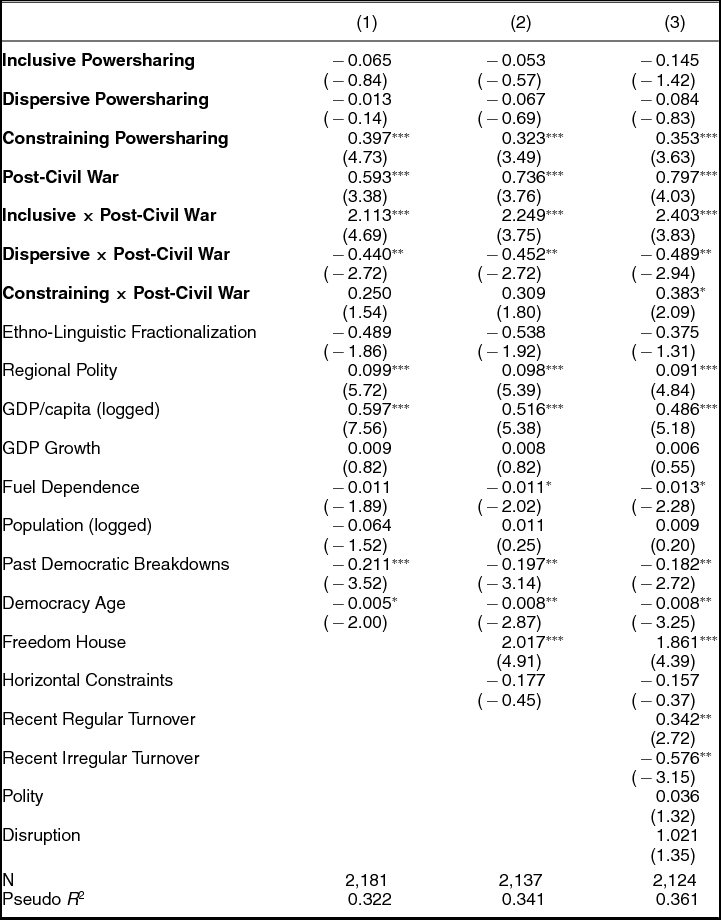
Notes: The table displays probit models predicting democratic survival. All models control for non-linear time trends. t statistics (based on robust standard errors) are in parentheses. *p<0.05, **p<0.01, ***p<0.001
Recall that across our full sample only constraining powersharing significantly enhances democratic survival. This also holds true for countries without recent conflict. In contrast, for postconflict countries we find significant effects for all three powersharing types.Footnote 24 Constraining institutions have an even stronger positive effect on democracy following conflict. Consistent with Hypothesis 3, inclusive powersharing now also has a significantly positive effect. Indeed, within our sample, only two post–civil war democracies with an above-average level of inclusive powersharing have broken down (Lebanon 1976, Pakistan 1999). According to Model 1, shifting constraining powersharing from the 10th to 90th percentile value in a post–civil war democracy raises the 5-year likelihood of survival by 20.9% (assuming the median value corresponds to an average likelihood); the equivalent effect for inclusive powersharing is a 8.3% increase. We also see a negative effect of dispersive powersharing, for which the equivalent effect is a decrease of 19.7%. This strong effect calls into question the common advocacy of ethnic federalism in postwar settlements.
Because the coefficients on interaction terms are cumbersome to interpret, we also present these results graphically. Figure 3 displays the predicted probabilities of democratic survival in both post–civil war and other states. The predicted probabilities of survival are on the y-axis and the values of powersharing are on the x-axis.Footnote 25 Note especially the substantively large, and opposite, effects of constraining and dispersive powersharing in postconflict countries, as well as the contrasting effects of inclusive powersharing in peaceful vs. postconflict states.
Effects of Powersharing by Context

The online appendix displays several robustness checks for these results. As discussed, we vary the window defining post–civil war and also test two alternative postconflict measures, one lowering the threshold of conflict intensity and one adding ongoing civil wars. Results are highly consistent across these models. One notable difference is that inclusive powersharing is significantly negative for democratic survival in states that are neither post–civil war nor currently experiencing a civil war. This bolsters our view that inclusive powersharing is primarily advisable only in societies plagued by violent conflict. We also control for several civil war characteristics, including whether the war was a separatist conflict (Themnér and Wallensteen Reference Themnér and Wallensteen2012), whether it resulted in a peace settlement as opposed to military victory (Sarkees and Wayman Reference Sarkees and Wayman2010), and whether international peacekeepers were involved (Fortna Reference Fortna2008). None of these controls change our main results.Footnote 26
Democratic Survival in Other Challenging Environments
We now investigate the effects of powersharing specific to other sets of “hard cases.” We do this for three reasons. First, we want to make sure that our results (especially for constraining powersharing) do not simply reflect the stability of consolidated liberal democracies. This concern is already mitigated by our controls for Freedom House, Polity, and Regime Age, but it deserves further validation. Second, we further examine the extent to which powersharing's effects vary by context. Third, these relatively fragile states are precisely those in which institutional design decisions are most pressing and where new knowledge can do the most good.
To investigate these hard cases, we run Model 1 from Table 3 on ten different samples, all subsets of the full sample used in Tables 3 and 4. Each sample was chosen to represent a challenging environment for democratic survival. The sample restrictions are as follows: (1) countries within 10 years of a civil war (including ongoing civil wars), (2) countries within 10 years of any internal conflict (Themnér and Wallensteen Reference Themnér and Wallensteen2012), (3) countries that have ever experienced an ethnic war (Marshall Reference Marshall2012), (4) country-years in the top 25% of our sample on the State Fragility Index, a measure of state weakness (Marshall and Cole Reference Marshall and Cole2014), (5) democracies less than 10 years old, (6) country-years in the bottom 25% of our sample on per-capita income, (7) countries within 5 years of an economic or financial crisis,Footnote 27 (8) countries for which ethnicity is politically relevant (Wimmer, Cederman, and Min Reference Wimmer, Cederman and Min2009), (9) countries in the top 25% of our sample on Ethno-Linguistic Fractionalization, and (10) country-years in the bottom 25% on the estimated likelihood of democratic survival.Footnote 28 The results for each powersharing dimension are pictured in Figure 4 (alongside the full-sample results for comparison), with the full regressions shown in the online appendix.Footnote 29
Effects of Powersharing in Challenging Environments

Constraining powersharing's positive effects on survival are remarkably robust, predicting survival at the 0.01 significance level in all 10 “hard case” samples and at the 0.001 level in 8 of them. The effects are particularly strong for the civil and ethnic war samples (Models 1–3). The estimated effects of dispersive powersharing are generally negative, especially in the three conflict samples and after economic crises (Models 1–3 and 7). In countries that have experienced ethnic war, for example, shifting dispersive powersharing from its 10th to 90th percentile lowers the 5-year likelihood of survival from 95.7% to 61.9%. This suggests that territorial divisions can foster renewed ethnic polarization and conflict (Downes Reference Downes2004; Hale Reference Hale2004). Inclusive powersharing is positive for survival in most samples, but its effect size and significance vary. The estimated effect of inclusive institutions is strongly positive after lower-level internal conflicts and economic crises (Models 2 and 7), as well as in fragile and poor states (Models 4 and 6). However, the effects are null for young democracies (Model 5) and the hard cases estimated in Model 10. In sum, the results demonstrate the consistently positive effect of institutional constraints, whereas the effects of other forms of powersharing differ sharply by context.
CONCLUSION
In this project, we develop a theory about the effects of powersharing on democratic survival, distinguishing three types of powersharing and three compliance conditions that are critical for democratic survival. We then test our expectations against global data with a broad definition of the institutional diversity of powersharing. Because our measures focus heavily on de jure institutions, our findings easily lend themselves to institutional recommendations.
We show that only constraining powersharing—including independent judiciaries, civilian control of the armed forces, and strong protections of civil rights and liberties—strongly supports democratic survival in all political contexts. Inclusive powersharing may promote democratic survival, but primarily post–civil war. We find no evidence that dispersive powersharing is advantageous for democracy; in fact, it harms democratic survival in states that have already experienced civil conflict. Future research is needed to ascertain whether this effect is due to ethnic federalism, reflects the inheritance of formal federalism from autocracies without real dispersion of power (such as the Soviet Union), or depends on whether ethnic minorities are geographically concentrated. Future work is also needed to explore the role of powersharing in autocracies, including its effect on democratization.
The sharply contrasting effects of various forms of powersharing in postconflict societies highlight the importance of national reconciliation and bargaining in these contexts. In polarized societies, decentralized structures can undermine democratic consolidation by weakening national consensus and encouraging ethnic appeals. We should therefore rethink the standard postconflict reform package promoted by international actors, which emphasizes inclusive and dispersive powersharing (Roeder and Rothchild Reference Roeder and Rothchild2005; Jarstad and Sisk Reference Jarstad and Sisk2008; Bratton Reference Bratton2010). This is particularly urgent with respect to efforts to bring peace to Yemen and Syria, help reunify Cyprus, and stabilize democratic transition in Burma, to name just a few cases. Western democracy promotion efforts are increasingly informed by an awareness that inclusive and dispersive powersharing institutions raise long-run issues (e.g., Nixon and Hartzell Reference Nixon and Hartzell2011). Our results suggest shifting emphasis in postconflict states away from dispersive powersharing, especially territorial divisions along ethnic lines, and toward constraining institutions. Inclusive powersharing can play a positive role, but a highly contingent one and primarily when mutual elite security is an especially pressing concern.
Powersharing and democracy are uneasy allies. Each reflects the ideals of equalizing power and restraining leaders, but they diverge on the priority and scope of electoral responsiveness. The connection between powersharing and democracy is therefore complex and context-dependent. Determining how to tailor these institutions to each political context is a vital task for both democratic theory and practice. Yet our results strongly suggest that a credibly constrained government is the best guarantee of democratic survival. This is further bolstered by the positive effect we find for civil liberties (Freedom House). Such constraints prevent electoral victors from abusing their authority, persuade electoral losers to accept temporary defeat, and encourage third parties to support the democratic order.
SUPPLEMENTARY MATERIAL
To view supplementary material for this article, please visit https://doi.org/10.1017/S0003055417000326.
Replication materials can be found on Dataverse at https://doi.org/10.7910/DVN/KGOUYI




Comments
No Comments have been published for this article.