

It is a truism that the psychological wounds of battle are as inevitable as their physical counterparts.Footnote 1 During the Second World War, controversy surrounded not the inevitability of psychiatric casualties but the extent to which they could be minimized by selection, training, morale, and leadership.Footnote 2 Some like Field-Marshal Lord Gort, who had given evidence to the 1922 War Office inquiry into shell shock, argued that psychological disorders could almost be eliminated: ‘in face of strong morale and esprit de corps “shell shock” would be practically non-existent’.Footnote 3 Whilst commanders trusted traditional military virtues to address the problem of battle exhaustion, a new breed of psychiatrist believed that psychometric tests and a deeper understanding of human behaviour would enable them to identify those at risk of breakdown.Footnote 4 Such vulnerable individuals could either be discharged from the armed forces or transferred to non-combatant roles, leaving only robust soldiers to engage the enemy. By early 1944, when planning for the D-Day landings was well advanced, the problem of the psychiatric battle casualty was considered manageable by a combination of careful preparation and clinical understanding.
The invasion of Europe by the western Allies was not only a high-profile and vital operation, but it also stretched the British army's resources to the limit. Under no illusions about the fierce fighting ahead, commanders needed a ready supply of aggressive and resourceful infantry. The shell shock epidemic suffered by the British Expeditionary Force during the First World War had taught a salutary lesson: large numbers of front-line troops could be lost to combatant units if psychiatric casualties found their way to base hospitals.Footnote 5 Return-to-duty rates fell to 20 per cent when soldiers who had broken down were treated any significant distance from war zones. In the knowledge that there were few high-quality combat replacements should the assault on the European mainland prove costly, elaborate preparations were made not only to prevent psychiatric breakdown but also to treat those who succumbed. Indeed, the Directorate of Army Psychiatry (DAP), a new organization set up in April 1942, sought to demonstrate both to commanders and military doctors that it too could make an effective contribution to the war effort. Normandy was the ideal stage on which to present the skills of the army psychiatrist.
On balance, historians have judged that the Directorate had achieved its aim of both preventing and treating psychological casualties. F. A. E. Crew, professor of public health at Edinburgh and author of the government-sponsored history of army medical services, argued that forward psychiatric units succeeded in returning almost 50 per cent of admissions ‘to full combatant duties in their original units and 10% to 20% were returned to line of communications or base duties’.Footnote 6 R. H. Ahrenfeldt, himself a former army psychiatrist, calculated that British forces suffered 13,255 cases of psychological disorder (16 per cent of all battle casualties) in the campaign for north-west Europe. Of these, he estimated, one third were returned to full duty: ‘just over 4,400 men saved for combatant duties, at a time when our manpower situation was critical’.Footnote 7 More recently, Mark Harrison concluded that ‘despite widespread scepticism, the psychiatrists succeeded in returning the majority of their “exhaustion” cases to duty, often within days of their evacuation from the front. This was a great achievement.’Footnote 8 By contrast, Terry Copp explained high breakdown rates among Canadian troops by military psychiatrists over-estimating the effectiveness of pre-invasion screening, whilst under-estimating the psychological effects of combat.Footnote 9 Ben Shephard too documented the shortcomings of army psychiatry in Normandy, though considered that this owed more to the intensity of fighting than failures of treatment.Footnote 10 Using recently discovered medical records, this article explores the challenges faced by the Directorate of Army Psychiatry and how it sought to prepare, manage, and treat British troops from the D-Day landings of 6 June until the closure of the Falaise Gap at the end of August 1944.
I
Led by Brigadier H. A. Sandiford, a regular Royal Army Medical Corps (RAMC) officer, and Brigadier J. R. Rees, in peacetime the director of the Tavistock Clinic, the DAP had failed to establish its credentials in the Western Desert or Italy. Although military psychiatrists had been deployed to both theatres and Brigadier G. W. B. James had set up a system to manage psychiatric casualties for the Eighth Army, commanders remained sceptical of the speciality's military role. In December 1942, Winston Churchill had described their work as ‘charlatanry’ and thought them capable of ‘doing an immense amount of harm’.Footnote 11 Brigadier E. Phillips, deputy director of medical services for 21 Army Group, characterized psychiatry as ‘a new form of witchcraft’.Footnote 12 A commander of medical services in Tunisia had ordered Majors Wishart and Kenton, two newly arrived psychiatrists, not to disclose their specialist training as ‘he had promised all the hospitals that no gentlemen with such an interest would be permitted in the [First] army’,Footnote 13 while Brigadier Morrison, his counterpart on Malta, refused to allow a psychiatrist to land on the island.Footnote 14 By their mere presence, it was believed, military psychiatrists could undermine the fighting spirit.Footnote 15 Military physicians and surgeons could authorize a transfer to the rear only if a soldier had a recognized wound or disease. By contrast, psychological disorders had no objective signs or symptoms. Many felt that soldiers who wished to escape combat would simulate a breakdown if they knew that a psychiatric evacuation route existed.Footnote 16 Senior officers doubted whether psychiatrists, who were almost exclusively recruited from civilian practice, had the understanding or resolve to act as military gatekeepers, fears reflected in their popular nicknames ‘trick cyclists’ and ‘pissy Christs’.Footnote 17 Under pressure, it was believed that they would favour an individual soldier and his wish to escape death or wounding, rather than serve the army's need to retain as many men as possible in action.Footnote 18
To counter prejudice and demonstrate the value of speciality, Brigadiers Sandiford and Rees put their faith in ‘forward psychiatry’ or the ‘PIE’ method of treatment (proximity to combat, immediacy, and expectation of recovery). A technique first practised by the French army during 1915, it had reluctantly been adopted by the British in the following year. Statistics collected during the First World War appeared to show that ‘PIE’ methods could return large numbers of psychiatric casualties to active duty, thereby serving as what would later be termed a ‘force multiplier’.Footnote 19 Forward psychiatry had been rediscovered during the defence of Tobruk in the Western Desert in May 1941.Footnote 20 In the retreat to Alamein, the label ‘exhaustion’ was adopted for psychiatric battle casualties to avoid use of medical terminology and encourage an attitude of recovery.Footnote 21
By late 1942, the preservation of manpower had become a key concern for the British Army. Bernard Montgomery, commander of 21 Army Group, recognized the need to conserve the strength of his fighting units because recruitment could no longer compensate for losses.Footnote 22 Infantry, in particular, were in short supply.Footnote 23 Although accurate statistics for soldiers who had broken down in the Western Desert and Italy had not been collected, it was commonly stated that psychiatric disorders ranged between 5 per cent and 30 per cent of all sick and wounded.Footnote 24 The military gain from returning most battle exhaustion cases to combatant duty was undeniable and, if this were achieved, the DAP would have justified its role.
Facing institutional scepticism, the DAP diverted considerable resources into the provision of acute psychiatric services for the tough fighting expected in Normandy.Footnote 25 For Operation Overlord, Lt Colonel Tom Main, psychiatric adviser to 21 Army Group, designed a treatment system based on ‘PIE’ principles. Every corps was to have its own designated ‘exhaustion centre’ run by a psychiatrist. These were to take troops referred by regimental medical officers and offer immediate psychological first aid. Admissions were to be held for no more than forty-eight hours and, if not recovered, transferred to a specialist unit, 32 General (Psychiatric) Hospital. With six hundred beds, nineteen psychiatrists and thirty-five nursing officers, it had a significantly higher staffing ratio than comparable units in the First World War. Five days of treatment was considered sufficient to return most admissions to full duty; resistant cases were to be evacuated to the UK.
Before deployment, Main had briefed regimental medical officers on the signs of battle exhaustion and how cases should be managed.Footnote 26 An attempt had also been made to identify men in combat units who showed signs of ‘temperamental instability’ and to transfer them to base or support roles. However, in the absence of a verified screening instrument, this was inevitably a crude process.Footnote 27 Between October 1943 and April 1944, for example, the psychiatrist attached to 8 Corps examined nearly six hundred men and recommended that 85 per cent should either receive treatment or be transferred to other forms of duty.Footnote 28
The provision of psychiatric services for Normandy was based on a number of heroic assumptions. On account of the pre-invasion screening programme, Main believed that psychological casualties would initially be light, increasing only when the killed and wounded rate rose and fatigue overwhelmed front-line troops.Footnote 29 As a result, two exhaustion centres at corps level were considered sufficient for the first month of the campaign. Thereafter, they were to be supplemented by the deployment of a specialist hospital. The two-tier system of care was designed to limit evacuation of psychiatric casualties to the UK to all but the most severe cases. Had this goal been achieved, the credentials of military psychiatry would have been established in a verifiable manner.
II
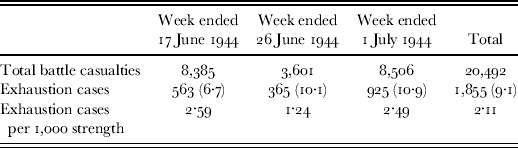
On 14 June 1944, an ‘exhaustion centre’ opened at 35 Field Dressing Station (FDS) in Bayeux to treat psychiatric casualties from 30 Corps. Field dressing stations were the first medical unit in the chain of evacuation and designed to assess patients, stabilize wounds, and provide vital first aid. They were chosen to house exhaustion centres because treatment could be offered quickly and as close to the front line as possible. On 17 June, to serve troops invalided from 1 Corps, exhaustion centres were set up at 50 FDS in Reviers and at 20 FDS in Douvres.Footnote 30 At first, the three forward units coped with the flow of breakdowns. Major J. W. Wishart, the psychiatrist attached to 35 FDS, reported a total of 154 admissions in the first five days of its operation.Footnote 31 Of these 94 (61 per cent) were evacuated to the UK, 25 (16 per cent) returned to duty and 35 (23 per cent) remained in treatment. Wishart, a veteran of the Tunisian campaign, was reassured because in 53 cases (34 per cent) he had identified a history of ‘neurotic reaction’, implying that these breakdowns were a failure of screening, rather than of resolve on the battlefield. In addition, 75 (49 per cent) had combat experience from earlier campaigns and could legitimately be regarded as war weary.Footnote 32 Furthermore, official casualty returns for the three weeks to 1 July 1944 showed that exhaustion cases, which totalled 1,855 and represented only 9 per cent of all battle casualties (Table 1), were low when expressed as a proportion of troops deployed (2·11 per 1,000).Footnote 33 Although these statistics suggested that British servicemen had coped well under the intense stress of combat, they did not vindicate forward psychiatry as an effective treatment of psychiatric battle casualties. Most soldiers admitted to the three corps exhaustion centres had failed to recover within forty-eight hours and over 50 per cent of admissions had required evacuation to the UK; no more than 15 per cent had been returned to duty in combat units.Footnote 34
Casualty returns for three weeks to 1 July 1944
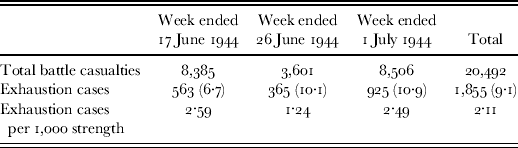
Figures in parentheses are percentages of total casualties.
Source: TNA, WO177/321, casualty return, 11 July 1944.
Within a month of the landings, senior officers had become concerned by the number of psychiatric casualties and more particularly by failures of the system designed to manage them. Following a visit to the beachhead on 4 July, Colonel R. F. Walker, deputy director of army medical services, reported ‘a definite feeling that psychiatry is getting out of hand. Too many cases are being evacuated to the UK.’Footnote 35 Main had over-estimated the ability of psychiatrists in forward treatment units to return psychological casualties to duty. At this stage, however, he was not unduly worried for the main weapon in his armoury, a specialist hospital, was about to deploy to Normandy. Its arrival, Main believed, would address the crucial question of capacity.
Divided into two sections, 32 Psychiatric Hospital comprised an ‘advanced’ unit with 200 beds, commanded by Lt Colonel J. F. Wilde, which deployed to Bayeux on 6 July 1944, thirty days after the beachhead had been established.Footnote 36 From its arrival, it functioned as an exhaustion centre.Footnote 37 The base section, commanded by Colonel R. J. Rosie, a regular RAMC doctor, arrived in France three weeks later to treat severe psychiatric casualties in the expectation that they could be returned to duty without evacuation to the UK. Both sections made use of ‘PIE’ principles. Throughout the Normandy campaign they remained close to the front line. Patients were routinely sedated (usually with sodium amytal) to provide them with a short period of complete rest. Expectation of recovery was a crucial element in therapeutic procedures. Acute anxiety cases, Captain Patrick de Maré recorded, were treated in part ‘by strong suggestion, to bolster up the tottering ego. The heightened suggestability at this stage makes such a procedure well worthwhile.’Footnote 38 Throughout their treatment, patients wore uniform and were actively encouraged to resume normal military roles.
Although the British Second Army secured the Normandy beachhead relatively quickly and established itself in Bayeux, it struggled to advance inland. Fighting reached such intensity that killed and wounded rates surpassed those experienced by the British Expeditionary Force during the First World War.Footnote 39 Caen, the Second Army's objective for 6 June, was not reached until 9 July despite a number of costly assaults, notably Operation Epsom (25–29 June). Even with Caen secured, Allied forces continued to encounter stiff resistance and were held at the Falaise pocket. As a result, by the end of July 1944, British and Canadian forces had suffered a total of 55,221 battle casualties, including 7,803 killed.Footnote 40 During Operation Epsom the number of exhaustion cases rose dramatically, accounting for 30 per cent of sick and wounded from the 51 Highland Division.Footnote 41 On 18 July, Operation Goodwood, an armoured assault, failed to achieve a breakthrough and determined defence saw no diminution in casualties as increasing numbers of infantry were drawn into combat.
High physical casualties were accompanied by a dramatic increase in the number of exhaustion cases referred to corps centres and the hospital at Bayeux.Footnote 42 By mid-July they represented 15 per cent of all casualties,Footnote 43 rising to 22 per cent in August. Between 450 and 700 patients a week were referred to 32 Psychiatric Hospital,Footnote 44 but because recovery times were slower than predicted,Footnote 45 beds became blocked. Psychiatric casualties awaiting transfer from other medical units were often left where they lay. A survey of 4,115 admissions to seven casualty clearing stations between July and September 1944 showed that 1,608 (40 per cent) were exhaustion cases.Footnote 46 The system designed by Main could not cope; it had become saturated to the point that civilian psychiatrists had to be transferred from routine and research work to UK military hospitals to cope with rising numbers of casualties evacuated from Normandy.Footnote 47
To reduce the flood of psychological cases sent home, overflow units were opened in Normandy. A Rest Centre for the 2nd Army was opened on 4 July at 13 Convalescent Depot.Footnote 48 It held short rehabilitation courses designed to prepare partially recovered exhaustion cases as reinforcements or for non-combatant roles.Footnote 49 Convalescent depots were designed to accommodate sick and wounded soldiers who no longer required hospital treatment, but were not yet sufficiently recovered to return to their units. They offered a two-week rehabilitation programme which included physical and military training under medical supervision.Footnote 50 In August, when the waiting list for admission to 32 Psychiatric Hospital reached six weeks, 500 beds at 12 Convalescent Depot were also allocated to exhaustion cases.Footnote 51
Throughout August, exhaustion cases remained a cause for concern and it was not until September that medical officers reported a fall in admissions to a level where specialist units could cope. The pattern experienced by British and Canadian troops was also seen in the US 1st Army, which suffered an exhaustion epidemic in July and August during the fighting to break out of the Normandy bridgehead and repulse the German counterattack at Mortain.Footnote 52 With the closure of the Falaise gap at the end of August and the advance of Allied forces eastwards, 32 Psychiatric Hospital, which remained in Bayeux, no longer functioned as a ‘PIE’ unit but became a base hospital.
In retrospect, Main argued that the shortcomings of the Normandy planning arose because the DAP had based their estimates on data from the Western Desert. The two theatres, he argued, were very different:
In the Middle East, the great separation from home … the rarity of action, the occasional big battles … lasting only a few days, contrast with the battles of Normandy bridgehead which went on without remission for over two months in familiar green fields and copses, with scarcity of sleep, the multi-barrelled mortar, and the continued carnage as the great excesses.Footnote 53
III
To understand why the DAP had under-estimated psychiatric casualties in Normandy and to discover what went awry with the treatment system, a detailed analysis of cases referred to 32 General Hospital has been conducted. Data were extracted from the admission and discharge books of 32 Psychiatric Hospital from its opening on 6 July until 21 August 1944, the point at which the Allies closed the Falaise gap and moved to a new phase of mobile warfare. These volumes were standard issue to all Royal Army Medical Corps' hospitals and their design did not vary over the period of study. Although all cases were included, this does not represent a complete sample. Details of officers treated in the unit were recorded in separate registers and these, together with equivalent records for other hospitals, have been destroyed. Only admission books for private soldiers and non-commissioned officers (NCOs) survive. The post-war destruction of officer files appears to have been a policy designed to protect their identity at a time when the stigma of psychiatric disorder was sufficient to halt promotion.
Each patient had an entry that recorded their unit, age, rank, length of service, diagnosis, dates of admission and discharge, together with a note about where they were sent after treatment. No cases were omitted even if an entry was incomplete and missing data was limited to outcomes. A total of 1,721 other ranks and NCOs were admitted to 32 Psychiatric Hospital between 6 July and 21 August 1944. These included seven re-admissions. The mean age on admission was 25·6 years; the youngest referral was 18 and the oldest 50 years. Most patients were private soldiers: 1,398 (81·2 per cent). Corporals accounted for 210 (12·2 per cent) admissions, and 113 (6·6 per cent) were sergeants and warrant officers.
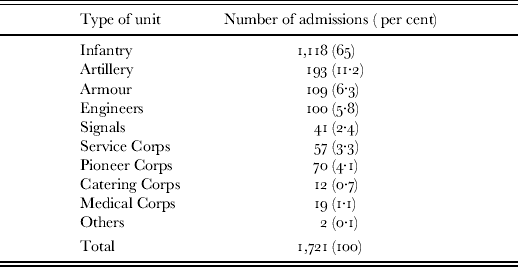
Table 2 shows that 65 per cent of those admitted to 32 Psychiatric Hospital were infantry soldiers. This percentage was disproportionate to the numbers of troops deployed in the war zone. During Operation Epsom, a particularly costly offensive to secure Caen, the 15 (Scottish) Infantry Division suffered 152 exhaustion cases of whom 140 (92 per cent) were drawn from its nine rifle battalions, even though they accounted for only 24 per cent of the division's total strength of 17,000.Footnote 54 Infantry units sustained the highest casualties in Normandy.Footnote 55 For example, over a period of forty-three days, 1 Hampshire Regiment lost 686 killed, wounded, or missing, which represented about 85 per cent of their strength on D-Day.Footnote 56 By 26 August 1944, the fourth battalion of the Dorset Regiment had only twenty-eight of its complement of thirty-six officers and of the survivors only nine had been with the unit when it landed in France.Footnote 57 Officers in the first battalion of the Royal Norfolk Regiment deployed to north-west Europe had a 72 per cent chance of being wounded and 17 per cent chance of being killed, while for other ranks the statistics were only marginally lower, 65 per cent and 17 per cent respectively.Footnote 58 That infantry, or other front-line combat troops, were most likely to breakdown was supported by a contemporary study of 100 psychiatric casualties evacuated to a UK hospital during the first ten days of the Normandy campaign. All patients were from combat units: ‘glider-troops, commandos, paratroops and assault infantry who had been in the vanguard of battle’.Footnote 59 It was scarcely surprising, therefore, that intensity of combat was established in post-war studies as the variable most likely to cause breakdown in soldiers.Footnote 60
Admissions for battle exhaustion to 32 Psychiatric Hospital, Bayeux, 6 July to 21 August 1944
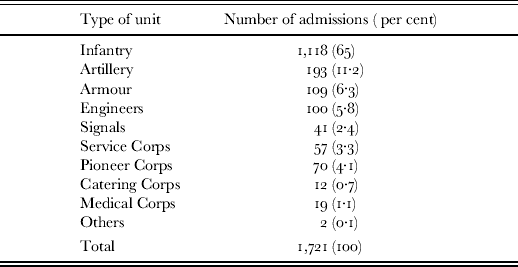
Source: Admission and Discharge Registers for 32 Psychiatric Hospital, War Pensions Archive, Heywood, Lancashire.
Admissions to 32 Psychiatric Hospital followed in proportion to vulnerability on the battlefield, with gunners being the most numerous group after infantry. Those in jobs of lesser hazard were much less likely to succumb to battle exhaustion. Combat support troops represented only 12 per cent (201) of admissions, despite the fact that as many as 45 per cent of troops in an infantry division operated in support roles.
Between front-line units significant variations were observed, caused not only by the intensity of battle but also their morale. Major R. J. Phillips, who ran the exhaustion centre for VIII Corps, reported that divisions and brigades engaged in the same operation recorded a wide range of breakdown rates. Psychiatric casualties expressed as a percentage of total wounded varied between 4·8 per cent and 21 per cent.Footnote 61 It is instructive to compare the 51 Highland Division, an experienced unit transferred from Italy at the request of Montgomery because of its known fighting qualities, with 6 Airborne, an untried but highly trained elite unit. The Highland Division, composed of war-weary veterans, was cautious in attack, sustaining 776 battle casualties in the three weeks from 10 June to 1 July 1944. By contrast, the aggressive 6 Airborne suffered 2,264 casualties. Paradoxically, psychiatric disorders were more common in the Highland Division totalling 141 (18·2 per cent) compared with 93 (4·1 per cent) in the Airborne.Footnote 62 This data reflects the finding that, though the trend of psychiatric casualties follows the killed and wounded rate, the actual level is mediated by other factors such as morale, confidence in equipment, and success in operations.Footnote 63 An infantry component of 51 Highland Division was 7 Argyll and Sutherland Highlanders, which had the second highest number of admissions (23) from a single unit to 32 Psychiatric Hospital.
Soldiers in armoured units were less likely to breakdown than their infantry counterparts. Following fierce fighting east of Caen at the end of July, it was reported: ‘the psychiatric casualties came almost entirely from infantry on the flanks. Only about 50 men in the armoured units broke down with neurotic symptoms.’Footnote 64 Although tank crews represented only 6 per cent of admissions to 32 Psychiatric Hospital, protected not only by armour plate but also the comradeship of the small group, it was observed that those who broke down were often more severely affected than infantrymen. Tanks were prone to catch fire causing a particularly horrific death.Footnote 65 Those crews that were hospitalized with exhaustion were unlikely to return to active duty because ‘their comrades lose confidence in them – a factor to be avoided at all costs in a small compact team’.Footnote 66
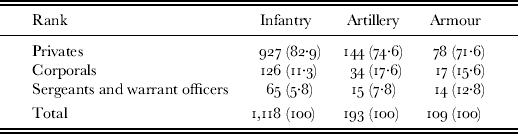
It has been argued that rank protected junior officers and NCOs against psychiatric breakdown because ‘their responsibilities for their subordinates gave them less time to brood about the dangers they confronted’.Footnote 67 To assess the impact of promotion on breakdown rates (Table 3), admissions from infantry, artillery, and armoured regiments were analysed. Typically, an infantry company consisted of 108 soldiers, including five officers, five warrant officers and sergeants, eighteen corporals and lance corporals together with eighty-one privates.Footnote 68 On this basis, corporals (17·5 per cent by distribution) were at reduced risk of breakdown, while privates (77·7 per cent by distribution), sergeants, and warrant officers (4·9 per cent) were at increased risk of psychological disorder. Infantry soldiers were the most vulnerable troops on the battlefield, and many privates experienced combat for the first time. They may have felt a complete loss of control, whereas a corporal had some power to influence his destiny in battle. By comparison, private soldiers were less likely to breakdown if they served in artillery and armoured units, possibly because of the lower mortality rates and protection conferred by small group loyalty.
Admissions for battle exhaustion by rank
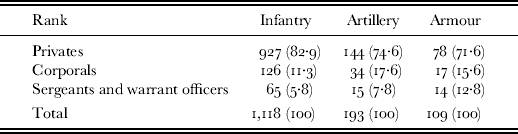
Figures in parentheses are percentages.
Source: Admission and Discharge Registers for 32 Psychiatric Hospital, War Pensions Archive, Heywood, Lancashire.
Responsible for leading their men in battle, senior infantry NCOs were particularly exposed to being killed or wounded,Footnote 69 and the stress of command may have added to their burden. In addition, some admissions were soldiers with extensive combat experience from the Western Desert or Italy. In 1949, the clinical presentation of the war-weary NCO was described under the label ‘old sergeant syndrome’.Footnote 70 Findings from Normandy accord with a similar study of shell shock cases treated at a ‘PIE’ unit in the First World War, which showed that infantry NCOs were slightly over-represented among admissions. Responsibility weighed even more heavily on artillery and armour NCOs who were deployed in a similar ratio to infantry battalions but suffered higher exhaustion rates. Rank, therefore, was not a guaranteed protection against psychological disorder.Footnote 71 By contrast, a recent study of 4,762 UK service personnel deployed to Iraq from 2003 found that the symptoms of post-traumatic stress disorder were associated with lower rank.Footnote 72
Evidence for officers is inconclusive. An entry in the war diary of 32 Psychiatric Hospital for 27 July 1944 recorded that a total of 125 officers (16 per cent) and 666 other ranks (84 per cent) had been treated since the advanced unit had opened.Footnote 73 By 1944, an infantry battalion typically consisted of 36 officers (4·6 per cent) and 746 men (95·4 per cent).Footnote 74 This suggests that officers were disproportionately represented and therefore at increased risk of breakdown. Yet, data collected at the exhaustion centre serving 8 Corps between 29 June and 13 July implied the opposite: a total of 928 cases admitted of whom only 21 (2 per cent) were officers.Footnote 75 However, officers who suffered from a psychological disorder were often evacuated with a neutral diagnosis to protect them from stigma attached to mental illness. Some were simply transferred to duties in the UK to protect their regiment's reputation.Footnote 76 Since officers were at greater risk of wounding and death than other ranks,Footnote 77 it is likely that they were also more vulnerable to breakdown, and that this outcome was hidden by reporting bias.
IV
Referral to 32 Psychiatric Hospital by medical officers attached to combat units accounted for 21·8 per cent of patients, whilst a further 54 per cent came from field dressing stations. In other words, 75·8 per cent of admissions satisfied the immediacy principle of ‘PIE’ treatment, having come quickly from the front line. Other admissions were secondary referrals from casualty clearing stations (3·7 per cent) and general hospitals (18·8 per cent). Soldiers sent to 32 Psychiatric Hospital for whom there were no beds were transferred to army psychiatrists based nearby at 77, 79, and 84 General Hospitals. Because the Allied forces made little territorial progress until the end of August, medical units of all types clustered within a limited area and none was far from the front line.
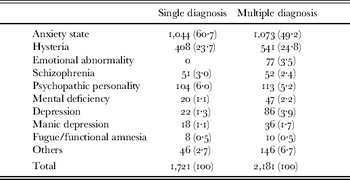
Medical officers in the field were instructed to label all psychiatric casualties as cases of ‘exhaustion’. Only after they had been assessed by a specialist could a specific diagnosis could be given. By suggesting that breakdown in combat was a reversible and non-medical issue, this policy was designed to avoid any repetition of the shell shock epidemic of the First World War. Table 4 shows that anxiety state was the most common disorder, accounting for 49 per cent of admissions when expressed as a multiple diagnosis. However, almost a quarter of admissions were categorized as a form of hysteria. This stands in contrast to contemporary claims that disorders characterized by the somatic expression of stress, a common feature of the First World War, had virtually disappeared.Footnote 78 A comparison with terminology used in a First World War ‘PIE’ unit shows that ‘depression’ and ‘personality disorder’ were innovations as neither diagnosis appeared in any of its admission registers.Footnote 79 Higher staffing ratios, allowing more time for assessment, combined with advances in knowledge pioneered in departments of psychological medicine during the interwar period probably explain this development.
Diagnosis of admissions to 32 Psychiatric Hospital between 6 July and 21 August 1944

Source: Admission and Discharge Registers for 32 Psychiatric Hospital, War Pensions Archive, Heywood, Lancashire.
V
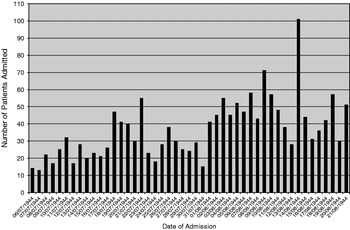
Daily admission totals to 32 Psychiatric Hospital (Figure 1) in part reflected the incidence of exhaustion cases in the field. At first, unable to effect a cure within the allocated five days, military psychiatrists retained patients and the hospital rapidly filled to capacity. As a result, new cases ‘could be held no longer than 48 hours’ with the result that only 15 per cent were fit to return to some form of military duty in Normandy and 85 per cent were evacuated to the UK for further treatment.Footnote 80 Admissions to 32 Psychiatric Hospital fell towards the end of July not because treatment methods had suddenly improved but because psychiatric beds had been opened in other units. The numbers admitted in August were significantly higher than in July partly because a further 200 beds had been opened, and also because the five-day protocol was strictly enforced.
Admissions to 32 Psychiatric Hospital by date

Furthermore, pressure was increasingly brought to bear on regimental medical officers to reduce the number of referrals to specialist psychiatric units. Some senior commanders returned to a view popular during the First World War that cases of exhaustion should be regarded as failures of discipline and subject to punishment rather than treatment. Lt General Sir Richard O'Connor, commander of 8 Corps, even used the terminology of 1914–18, stating that ‘there were genuine cases of shell shock but the great majority were merely frightened of shelling, and wanted an excuse to get out of it’.Footnote 81
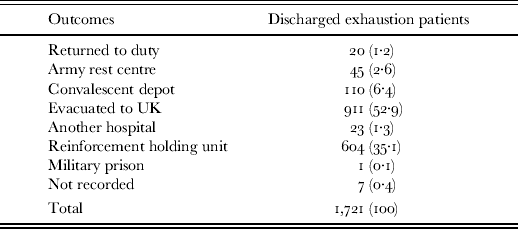
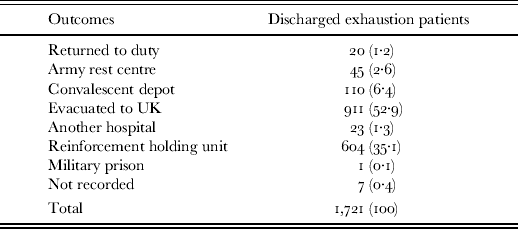
Most soldiers treated at 32 Psychiatric Hospital and who had made a good recovery were not returned directly to their units (Table 5) but sent to a reinforcement holding unit (RHU). Infantry replacements were vulnerable to breakdown particularly if they joined a battalion where they were unknown. The RHU was designed to ease the transition back into combat through physical and mental hardening. Discharged patients considered unsuited for combat but able to perform base duties were sent to an army rest centre before redeployment. Convalescent depots not only took referrals from 32 Psychiatric Hospital but also direct from field dressing stations. By end of July 1944, for example, 13 Convalescent Depot had admitted 1327 cases of battle exhaustion. Only a third returned to duty in their original medical category, two-thirds were downgraded often involving a change of job.Footnote 82
Outcomes of battle exhaustion patients admitted to 32 Psychiatric Hospital between 6 July and 21 August 1944
Source: Admission and Discharge Registers for 32 Psychiatric Hospital, War Pensions Archive, Heywood, Lancashire.
Most admissions were evacuated to the UK (56 per cent) for further treatment (Table 4). This statistic related in large part to pressure on beds and may not have been a reflection of the severity of cases. In general, between 6 July and 30 September 1944, 32 Psychiatric Hospital and its satellites admitted a total of 3,187 patients of whom 1,395 (44 per cent) were transferred to the UK.Footnote 83 Such a high percentage stands in marked contrast to the published statements of military psychiatrists practising in North Africa. Lt Colonel H. B. Craigie, a psychiatrist attached to the Middle East Force, reported that 71·5 per cent of a series of 350 exhaustion cases seen in 1941 were returned to duty (53·7 per cent full and 17·8 per cent base) figures that in 1942 improved to 92 per cent of 625 cases of neuroses (61 per cent full and 31 per cent base).Footnote 84 He was, however, later forced to concede that these rates had been inflated by severe restrictions on the numbers that could be evacuated to the UK and acknowledged that in many cases a relapse was likely.Footnote 85 Major Harold Palmer, who ran a rehabilitation unit in the Western Desert, claimed 98 per cent of his patients returned to duty within three weeks but did not specify the type of posting;Footnote 86 because his unit treated chronic or severe cases, contemporaries doubted the veracity of his reports.Footnote 87 Published statistics contrasted with more modest reports contained in classified internal reports,Footnote 88 and suggested that military psychiatrists felt considerable pressure to demonstrate their effectiveness and value to the army. Although the return-to-duty results for 32 Psychiatric Hospital were lower than those reported in medical journals, they are similar to those found by analysing admission and discharge registers for a First World War ‘PIE’ unit, which achieved an overall rate of 36·5 per cent (16·9 per cent to combat units and 19·6 per cent base).Footnote 89
No objective measures exist to record the number of casualties referred to 32 Psychiatric Hospital who were assessed and returned to duty without admission. Circumstantial evidence suggests that this figure was low. Doctors at the unit were so overwhelmed with admissions that they were unable to offer any out-patient facilities.Footnote 90 Indeed, Captain de Maré in his report of August 1944 wrote that new cases ‘are usually admitted’, the exception being severe disorders that required evacuation.Footnote 91
VI
The evidence of British troops in Normandy is that psychiatric casualties were an inevitable consequence of combat and that those at the sharp end of battle suffered disproportionately. By the end of August 1944, psychiatric cases represented 22 per cent of all battle casualties, or 66 per cent of non-surgical cases. However, Major Donald Watterson, the psychiatrist attached to airborne forces, believed that for every formal admission ‘there were certainly three or four ineffective men remaining with their units’.Footnote 92 Despite the high incidence of battle exhaustion, or today what might be called combat stress reaction, British forces in Normandy did not suffer a collapse in morale or failure of fighting spirit. The trend of psychiatric casualties was determined by the killed and wounded rate, though the actual level was mediated by other factors such as preparedness, morale, confidence in leaders and weapons, and success on the battlefield.
Some commanders feared that psychiatric casualties were a form of institutionalized malingering. Indeed, one senior army doctor believed that the incidence of battle exhaustion could be dramatically reduced by the publication of monthly league tables so that units with high rates could be shamed into reducing their psychiatric casualties.Footnote 93 The speed with which some soldiers had broken down reinforced these ideas. Commanders had been misled by the experience of the First World War into believing that breakdown was justified only in the context of a prolonged conflict of attrition. Hence, battle exhaustion was acceptable only if it arose in a context of static warfare characterized by extensive artillery bombardment. The Normandy campaign demonstrated that a high-intensity battle could rapidly demoralize troops to the point that they were no longer effective in combat.
The high breakdown rates demonstrated that pre-deployment screening had failed. Major A. E. Moll, a psychiatrist serving with I Canadian Corps, acknowledged not only the ineffectiveness of the instrument but also that ‘a neurotic presentation in an individual does not necessarily preclude him from being a brave man and a good soldier’.Footnote 94 Furthermore, a post-war study of 544 exhaustion cases showed that two-thirds had ‘no apparent history of neurotic predisposition or previous instability’.Footnote 95
The question remains, why did Main and the DAP get their estimates of psychiatric breakdown so wrong? Since Main had no operational experience himself, he was reliant on the reports of army psychiatrists when they returned home from a tour of duty. Most sought to cast a positive light on their work and any failures were attributed to shortages of doctors and nurses, which undoubtedly existed. In addition, Main may have been misled by optimistic accounts of forward psychiatry in the Western Desert published in peer-reviewed medical journals. In 1942, a study of Australian troops treated within the Tobruk garrison suggested that 60 per cent of admissions could be returned to full combatant duties,Footnote 96 while a paper by Lt Colonel Alfred Torrie on British soldiers with severe disorders reported 30 per cent to 40 per cent had been returned to full duty.Footnote 97 The pervading spirit of optimism was captured in an editorial in the Lancet for 15 April 1944, which observed that if ‘the men are healthy and of fine morale, their disabilities are comparatively light and prompt treatment will therefore be remarkably successful’.Footnote 98 Verbal reports and publications appeared to support the received wisdom that well-trained soldiers with high morale properly led were virtually immune from breakdown, the conclusion of the 1922 War Office committee of inquiry into shell shock.Footnote 99 However, published statistics stood in marked contrast to what psychiatrists reported in classified documents to their commanders in the field.Footnote 100 Captain Patrick de Maré, a psychiatrist who ran an exhaustion centre at 50 Field Dressing Station in Normandy, conceded in a private report that 86 per cent of admissions were sent to convalescent deports where many were downgraded to non-combatant roles.Footnote 101 Indeed, when Brigadier Sandiford himself visited 21 Army Group during October 1944, he found that 43 per cent exhaustion cases in 39 General Hospital had already been ‘treated elsewhere for exhaustion, returned to duty and relapsed’.Footnote 102 In other words, ‘PIE’ methods were less effective in preparing soldiers for combat than for combat-support roles.
Nevertheless, the pre-invasion planning by Main and the DAP did not solely rely on optimistic statistics from the Western Desert, but incorporated a significant margin for error. Brigadier Sandiford wrote in December 1943 that he was anxious to avoid the ‘hand to mouth arrangements and repeated demands for psychiatric aid from home’ that had arisen both in North African and Italy.Footnote 103 As a result, the number of psychiatrists and psychiatric nurses deployed to Normandy far exceeded what had been provided in North Africa or Italy. Hitherto, a specialist psychiatric hospital had never been set up so close to the front line. The high staffing ratio combined with pre-invasion screening and briefing programmes was considered more than sufficient for the intense combat expected.
Yet, by 1943 warning signs had been posted, which implied flaws in the Southborough Committee's conclusion that well-trained units of high morale were virtually immune from psychological disorder. Studies by Royal Air Force psychiatrists of breakdown rates among bomber crewsFootnote 104 and investigations of naval officers assigned to Arctic convoysFootnote 105 showed that even the brightest and the best had limits when exposed to extreme or prolonged hazard. These findings were to be replicated in Normandy where, for example, elite units such as 6 Airborne Division suffered exhaustion cases. The files of Directorate of Army Psychiatry suggest that there was little exchange of data between various forces.Footnote 106 Indeed, each of the three services tended to consider their problems in isolation, believing that the characteristics of their personnel and combat experience were specific to land, sea, or air. The failure to appreciate the wider significance of findings from the air force and navy was the crucial flaw in the pre-invasion planning. In November 1944, Main lost his post as adviser in psychiatry to 21 Army Group and was succeeded by Watterson; he was far from being the only casualty of the Normandy campaign.