Introduction
Single ventricle physiology refers to a class of congential heart diseases in which the heart has only one functional ventricle instead of two separate ventricles. A series of surgical palliations are performed to redirect the blood flow and improve oxygenation. Reference Heaton and Heller1 The most critical period is between the first and second palliations, also known as the interstage period, a high-risk time requiring close monitoring due to the infant’s fragile cardiovascular state and risk for potential complications. Reference Rudd, Ghanayem and Hill2 With these advancements in medical management, more infants are surviving previously fatal cardiac diagnoses, but the interstage period is marked by numerous medical and feeding challenges. The focus has thus shifted to managing these conditions as chronic which requires enhanced medical management, feeding support, and increased caregiver involvement during the interstage. Yet, we lack a clear understanding and standardised guidelines specifically related to feeding support for this fragile cohort of patients and their families.
Infants encounter many medical challenges during the interstage period, which often result in increased caregiver responsibilities. Feeding difficulties, dysphagia, and malnutrition are prevalent in infants with single ventricle physiology due to decreased cardiac output, poor endurance with oral feeds, increased risk for recurrent laryngeal nerve damage, prolonged and multiple intubations, and baseline respiratory distress. Reference Del Castillo, Moromisato and Dorey3–Reference McGrattan, McGhee and DeToma6 As patients are discharged home during the interstage, current management of care includes close monitoring by medical providers and the use of practices like in-home monitoring, placing an increased burden on caregivers who face high levels of stress and anxiety. Reference Foster, Steltzer and Snyder7–Reference March9 Caregivers are tasked to manage medical comorbidities, check vitals, monitor weight gain, and attend outpatient follow-up appointments while monitoring changes in medical status, all while feeding their infant (orally or enterally). Reference Shackleford, Nelson and Brasher10 Although many institutions now have multidisciplinary clinics for single ventricle patients, there continues to be a lack of feeding support during the interstage period. Feeding interventions and support are critically needed and must be specifically tailored to the individual needs of the patient and their family.
In our institution, prior to the implementation of a dedicated interstage multidisciplinary clinic that provides feeding support, comprehensive support from rehabilitative services, and close nutritional monitoring, Children’s Healthcare of Atlanta completed a quality improvement project to examine baseline interstage single ventricle medical and feeding characteristics and their impact on caregiver stress. By understanding the challenges of infants and their families during the interstage period, the multidisciplinary team can address the unmet needs of the single ventricle population to enhance care during this critical phase.
Methods
The quality improvement project had two components. The first component was a medical chart review from birth until the second-stage palliation surgery. The second component was a cross-sectional caregiver survey assessing stress around feeding infants with single ventricle physiology.
Setting and participants
The project was completed at Children’s Healthcare of Atlanta’s Egleston Hospital, a 330-bed paediatric acute care facility. Participants in this project were single ventricle patients and their caregivers. We included patients with a diagnosis of single ventricle physiology and who received both stage 1 and stage 2 palliative procedures. All infants were under the age of one year, given palliation timing. There were no additional exclusion criteria.
Procedures
Data collection activities occurred at the time of the second-stage palliation. All instrumental data were documented and stored in REDCap, a secure Health Insurance Portability and Accountability Act-compliant web application for data capture. Reference Harris, Taylor and Minor11,Reference Harris, Taylor, Thielke, Payne, Gonzalez and Conde12 Data were collected between August 2023 and March 2024. Determination of non-human subject research from Children’s Healthcare of Atlanta’s institutional review board was obtained prior to the initiation of this project.
Single ventricle medical chart retrieval procedures
The speech-language pathologist completed medical chart data retrieval from the electronic health record system. Patient and feeding characteristic data were extracted after the completion of the second palliation procedure, the bidirectional Glenn.
Single ventricle patient characteristics outcomes. We collected socio-demographic information and clinical variables (i.e., medical diagnosis, type of repair, and the timing of surgical and non-surgical palliation) from the medical chart. We included additional socio-demographic questions in the caregiver survey that are not available in the medical chart.
Feeding outcomes. The Pediatric Functional Oral Intake Scale is an outcome measurement tool used to assess changes in the oral intake of food and liquids in paediatric patients. Reference Dodrill, Groher and Crary13,Reference Yi and Shin14 Responses were recorded using a 6-point scale, with “1” representing no oral intake and “6” representing a full oral diet without restrictions. Reference Yi and Shin14 This tool is used by inpatient speech-language pathologist for all cardiac patients at Children’s Healthcare of Atlanta. The Pediatric Functional Oral Intake Scale data were collected three times throughout the study: preoperatively, 6 weeks post-stage 1 palliation procedure, and pre-Glenn operation. We obtained additional feeding characteristics from the medical chart and caregiver survey, including the presence of preoperative feeding, the number of days required to initiate oral feeds, the completion of the videofluoroscopic swallowing study, breastfeeding during the interstage period, and the receipt of outpatient services.
Caregiver survey procedures
The caregiver survey was available in both English and Spanish. The timing of survey completion was tailored to the patient’s specific care circumstances. Admitted patients completed the survey one day before the bidirectional Glenn procedure. Patients who remained outpatient during the interstage period completed the survey during their pre-Glenn appointment, which is typically 48 hours before the second palliation. The speech-language pathologist administered the surveys to caregivers in English, as all caregivers spoke English.
Single ventricle caregiver stress outcomes. The Feeding/Swallowing Impact Survey is an 18-item instrument designed to measure and improve understanding of caregiver issues. Reference Lefton-Greif, Okelo, Wright, Collaco, McGrath-Morrow and Eakin15 The instrument has three subscales, including Daily Activities, Worry, and Feeding Difficulties, and a total of 18 questions. Responses were recorded using a 5-point scale, with “1” representing less caregiver impact than a “5” response. Caregivers completed the scale prior to the second palliation surgery.
Statistical analysis
We analysed data from the medical chart and relevant caregiver information from the caregiver survey, such as socio-economic factors, education, and salary, to address the characteristics of single ventricle patients. We completed descriptive statistics analysis, including count and frequency for categorical variables, to examine the patient, caregiver, household characteristics, and medical attributes. For continuous variables, we calculated the mean and standard deviation for normally distributed data, and we calculated the median and interquartile range for non-normally distributed data. To further explore caregiver impact, we stratified by Pediatric Functional Oral Intake Scale scores. Because Pediatric Functional Oral Intake Scale measures were collected at three time points, we selected the third time point, which reflected oral intake at the time of the second palliation. At this stage, oral intake was highest across all three time points, and patients had the most exposure to oral feeding. Infants were grouped based on their Pediatric Functional Oral Intake Scale scores: scores of 1–2 (minimal or no oral intake) and scores of 3–6 (greater oral intake).
Results
We enrolled 15 patients in the quality improvement project. The timing of the first intervention ranged from 3 to 34 days with a median of 8 days (interquartile range of 3.5–13.5). While the second-stage palliation occurred between 92 and 197 days after the first-stage palliation with a median of 147 days (interquartile range of 126–156.5).
Child, parent, and household characteristics
The demographic profiles of the patient cohort revealed a predominance of males (73.3%), with the majority identifying as Black/African American (60%) (see Table 1). Primary insurance coverage was predominantly Medicaid (93.3%), and English was the primary language for the majority of patients (93.3%). Most caregivers (46.7%) completed high school followed by having completed some college education (26.7%).
Socio-demographic and clinical characteristics of infants with single ventricle physiology during the interstage

In terms of clinical characteristics and diagnostic conditions, hypoplastic left heart syndrome (26.1%) was the most prevalent diagnosis (see Table 1). The most common surgical repair was Norwood + Sano (43.8%). Approximately 40% of patients experienced at least one readmission, with feeding intolerance (20%) and desaturations (26.7%) being the primary causes (see Fig 1). Among the medical complications observed during the interstage inpatient period, milk protein allergy (26.9%) was the most common (see Fig 1). Despite these complexities, a majority of the patients (86.7%) were discharged home during the interstage period.
Interstage Readmissions (Panel A) and Medical Complications (Panel B) of infants with Single Ventricle during the Interstage. Note. *Interstage unplanned reinterventions included delayed chest closure, catheterisation intervention, and/or intervention in the operating room. ECMO = extracorporeal membrane oxygenation.

Feeding characteristics
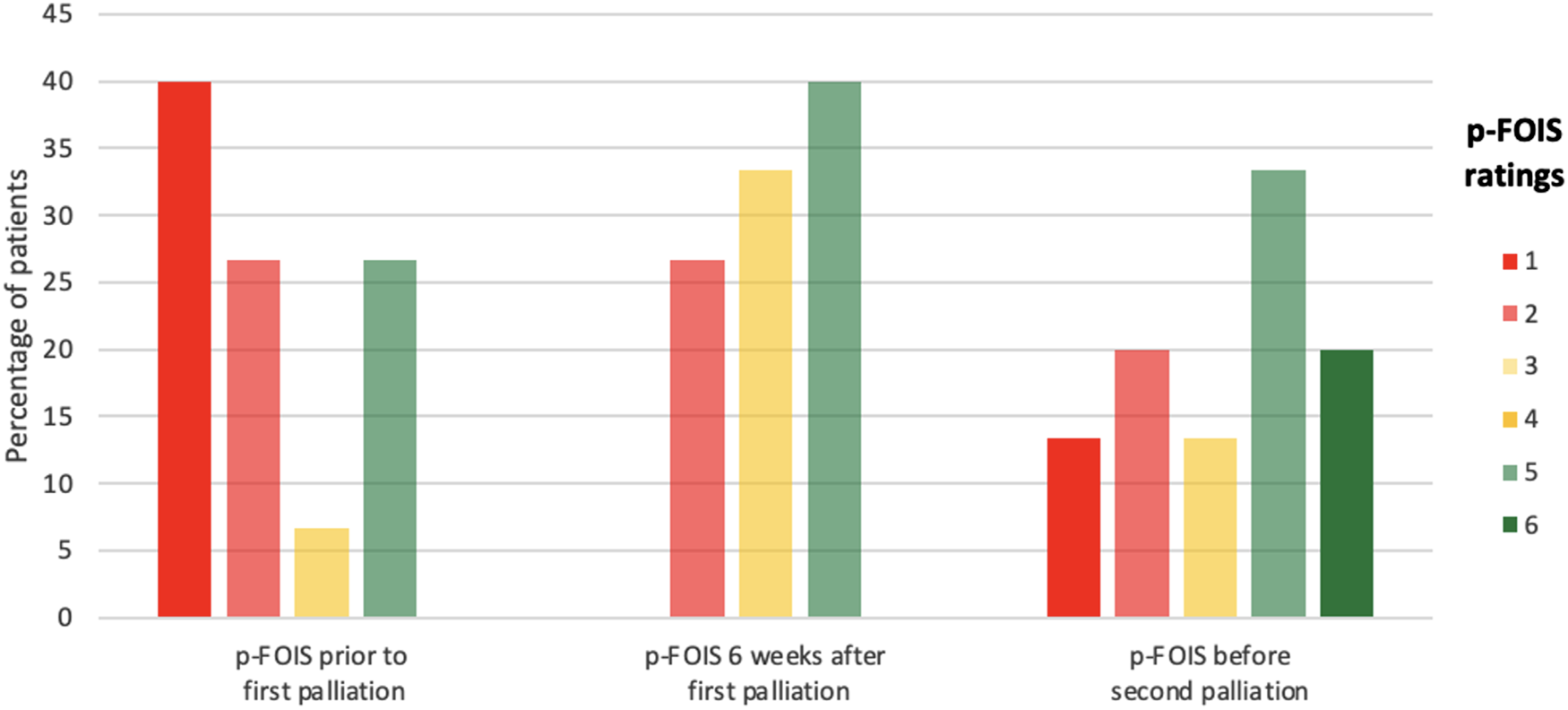
Most patients (73.3%) were offered oral preoperative feeds prior to surgical or catheterisation intervention (see Table 1). Nearly half of infants (46.6%) initiated oral feeding within 1-3 days after the first palliation. Breastfeeding during the interstage period was uncommon, with only 13.3% of patients being able to breastfeed either exclusively or in combination with other feeding methods (e.g., bottle feeding, supplemental nasogastric feeds, or nasojejunal feeds). Oral feeding increased during the interstage, with 53% of the patients successfully transitioning to oral intake without the need for enteral support (see Fig 2).
Progression of feeding during interstage. Note. The p-FOIS scores are categorised as follows: 1-Nothing by mouth, 2-Tube dependent with minimal oral intake, 3-Tube dependent with consistent liquid intake, 4-Total oral diet with special preparations, 5-Total oral diet without special prep but with compensations, and 6-Total oral diet with no restrictions.

Most patients (93.3%) did not receive outpatient feeding services during the interstage period, and concerns about outpatient feeding support were prevalent, with 86.6% of patients indicating insufficient support upon discharge (see Table 1). All caregivers (100%) indicated that a dedicated multidisciplinary clinic would be beneficial (see Table 1).
Caregiver stress
Our analysis revealed a mean (standard deviation) total score of 2.23(1.54), revealing that parents are impacted by their child’s feeding disorder (Supplementary Material A). Among the three subscales, the “Daily Activities” subscale had the highest mean (standard deviation) score of 2.71(1.63), indicating the highest level of caregiver impact. When stratifying by Pediatric Functional Oral Intake Scale scores, we found that caregivers of infants with Pediatric Functional Oral Intake Scale scores of 1–2 reported higher FS-IS total scores, with a mean (standard deviation) of 2.97(1.70), as compared to 1.85(1.29) for those with scores of 3–6 (Supplementary Tables S1).
Discussion
The purpose of this quality improvement project was to examine the medical and feeding characteristics of infants with single ventricle physiology during the interstage and to assess the impact of feeding on caregivers. We found that interstage infants faced multiple medical complications and experienced feeding challenges, resulting in readmissions, unplanned reinterventions, and the need for nutritional support. These challenges placed a considerable burden on caregivers, who reported elevated impact levels, particularly related to daily activities. The results highlight the critical need for enhanced medical management and targeted feeding support to improve care and outcomes for these infants during the interstage period.
Despite improvements in postoperative survival, feeding difficulties are common among single ventricle patients and are further exacerbated by medical comorbidities during the interstage period. Reference Rudd, Ghanayem and Hill2,Reference Hill, Tanem and Ghanayem16 The National Pediatric Cardiology Quality Improvement Collaborative Phase 1 registry reported that 17% of single ventricle patients required at least one unplanned interstage intervention, with the majority being catheter based. Reference Rudd, Ghanayem and Hill2 Similarly, our project found increased medical complications, with 19% of infants requiring interstage interventions such as delayed chest closure, catheterisation, or surgery, and high readmission rates due to desaturation events. Our project findings align with the current literature highlighting the susceptibility of this population to complications, necessitating heightened support and care due to anatomic and haemodynamic variations. Reference Simsic, Phelps and Kirchner17
Feeding progression is also hindered by the high prevalence of intraabdominal complications, feeding intolerance, and necrotising enterocolitis, regardless of the choice of first-stage palliative repair. Reference Weiss, Gossett, Kaushal, Wang, Backer and Wald18 Our project found that 31% of the patients experienced a concern for milk protein allergy or necrotising enterocolitis during the interstage period. This issue is further compounded as weight gain is crucial during the interstage period to prevent adverse outcomes at the time of the second palliation. Studies have shown that up to 89% of patients with single ventricle physiology failed to meet the standards for adequate growth as indicated by the Centers for Disease Control and Prevention, and 50% were considered severely underweight at the time of the second palliation. Reference Hill, Silverman and Noel5,Reference Anderson, Beekman and Border19,Reference Kelleher, Laussen, Teixeira-Pinto and Duggan20 To ensure adequate weight gain in preparation for the second palliation, nutritional practices that optimise caloric consumption (i.e., increasing feeding volume, adding fortification) place an increased strain on the mesenteric system, potentially leading to oral aversion and delaying the introduction of oral feeding. Reference Del Castillo, Moromisato and Dorey3,Reference Weiss, Gossett, Kaushal, Wang, Backer and Wald18,Reference Weston, Husain and Curzon21,Reference Jones, Winder and Ou22 Addressing these challenges is imperative to improve feeding outcomes and overall development in this high-risk population.
In our project, we observed underlying medical complications during the interstage period and affected oral intake. We postulate that oral intake is impacted by medical complications. The Pediatric Functional Oral Intake Scale scores in our project revealed a general increase in oral intake as patients approached bidirectional Glenn palliation, although a third of infants still consumed minimal volumes or had no oral intake at this time, indicating a need for additional support during this critical phase. In a study by Hill et al., 56% of infants required feeding tube supplementation after the first palliation, but this decreased to 37% by the second palliation as oral intake improved during the interstage period. Reference Hill, Silverman and Noel5 We suspect similar factors contributing to minimal or no oral intake within our group, including the need for unplanned reinterventions, prolonged mechanical ventilation, length of intubation, need for extracorporeal membrane oxygenation, medical comorbidities, and altered physiology. Reference Hill, Silverman and Noel5 These factors can temporarily suspend feeding, thereby hindering oral feeding success. Given the inherent feeding challenges in this demographic, these findings highlight the need for enhanced interstage support services, including regular follow-ups with healthcare providers, thereby reducing unexpected hospitalisations and decreasing potential complications. Reference Jones, Winder and Ou22,Reference Hill, Tey and Jung23
Feeding challenges with cardiac infants have been shown to increase caregiver stress and result in dysfunctional patient–caregiver interactions. Reference March9,Reference Silverman, Erato and Goday24 Existing literature has shown that caregivers feel unprepared for discharge and struggle to recognise signs of infant deterioration during the interstage. Reference Gaskin, Barron and Daniels8 Our project focused on the interstage period to better examine the impact of feeding on caregivers. Previous studies using the same instrument found caregiver impact with total scores ranging from 1.7 to 3.3, which were interpreted as negative caregiver impact. Reference Lefton-Greif, Okelo, Wright, Collaco, McGrath-Morrow and Eakin15,Reference Serel Arslan, Demir, Karaduman, Tanyel and Soyer25,Reference Simione, Harshman and Cooper-Vince26 Our total score findings, a mean of 2.23, fall within that range, indicating a negative impact on caregivers (Supplementary Table S1). When we further explored the impact based on oral intake, we found that caregivers of infants with minimal oral intake showed greater caregiver burden than caregivers of infants with greater oral intake. This finding underscores the challenges caregivers face when their child is unable to feed orally, particularly during the interstage period. It highlights the importance of providing targeted support to these infants and their families to help address the unique difficulties associated with minimal or no oral feeding. Finally, across these measures, the “daily activities” subscale had the highest score, while the “feeding” subscale had the lowest score. We suspect that the impact score was highest with “daily activities” since the questions were more relevant to our cohort, while the questions on the “feeding” subscale were possibly more suited for older infants. The increased impact reported by caregivers in “daily activities” is consistent with the heightened responsibilities caregivers face during the interstage period. Reference Gaskin, Barron and Daniels8–Reference Shackleford, Nelson and Brasher10
Additional information from the retrospective data and survey questions indicated that there was a high need for caregiver support during the interstage period as a majority of caregivers (93.3%) did not receive outpatient feeding therapy during the interstage period, and 86.7% of patients indicated insufficient support upon discharge. Additionally, caregivers unanimously affirmed that a dedicated multidisciplinary clinic would be highly beneficial. These findings highlight the significant gap in the continuity of care for these patients during the interstage period, proving the need for a more patient-centered approach to ensure care encompasses all aspects of daily life. A specialised clinic would bridge the gap in care, improve patient outcomes, and support caregivers of patients with single ventricle physiology.
Though our project highlighted the need for dedicated feeding support during the interstage period, it is important to also acknowledge the limitations. One significant limitation is the sample size, with only 15 patients included in the analysis and with limited diversity among participants. Another constraint is the overall applicability of the Feeding/Swallowing Impact Survey to our study population, as the infants in our cohort had limited oral intake. We suspect that this subscale may be more applicable for patients who may have more variability in their oral intake. Finally, the quality improvement project was conducted within a singular unit of a paediatric hospital. Consequently, the generalisability of our results to broader populations of infants with single ventricle physiology may be limited.
Conclusion
Our project sheds light on the multifaceted feeding challenges and caregiver impact encountered by single ventricle infants during the interstage period and underscores the critical need for tailored support systems and multidisciplinary care. We identified medical complications during the interstage that can impede oral feeding success, which can further exacerbate the stress and burden placed on caregivers. Additionally, our findings revealed a significant gap in feeding support that many caregivers experienced during the interstage period. Dedicated feeding support during the interstage is essential, as feeding difficulties are a common source of stress for caregivers and are impacted by various interstage medical complications. Implementing tailored interstage feeding support and protocols may improve patient outcomes in preparation for the second palliation. Our findings suggest that implementing a dedicated multidisciplinary clinic could provide the comprehensive support necessary to address both the medical and psychosocial needs of this high-risk population, ultimately benefiting the infants' growth and development while alleviating caregiver stress.
Supplementary material
The supplementary material for this article can be found at https://doi.org/10.1017/S1047951125000423.
Acknowledgements
We extend our heartfelt gratitude to the families who participated in this project.
Financial support
Dr Simione’s time was supported by grant number K23HL161447 from the National Heart, Lung, and Blood Institute.
Competing interests
None.