Natural disaster can be defined as a sudden event with adverse effects on people and their societies in the context of vulnerability.Reference Daneshmandi, Amiri and Vahedi 1 Each year, natural disasters affect many people and cause tens of thousands of injuries and deaths and significant economic loss.Reference Keeney 2 , Reference Mahdaviazad and Abdolahifar 3 The goal of disaster management encompasses mitigation, preparedness, response, and recovery through measures to reduce adverse effects and potential damage.Reference Abd elazzeem, Adam and Mohamad 4 Disaster management thus requires collaboration among many sectors. In this respect, public education and training that focus on appropriate knowledge, attitudes, and practices play a crucial role in preparedness and disaster mitigation, as “Education is the fundamental bedrock of disaster risk reduction.”Reference Keeney 2 , Reference Izadkhah and Hosseini 5
Because of its geographic location, Iran is susceptible to many natural disasters, especially earthquakes. On average, earthquakes of a magnitude greater than 7 on the Richter scale occur every 10 years.Reference Izadkhah and Hosseini 5 Moreover, of 40 known types of disasters in world, 31 types have occurred in Iran.Reference Ghafory-Ashtiany 6
In recent years, particularly after the Bam earthquake of 2003, disaster management has become one of the main priorities of the Iranian health system, and many efforts have been made to raise awareness and educate the public. According to limited research evidence, however, it appears that household preparedness is low and still in the early stages, particularly in the area in which we conducted our research.Reference Ardalan, Masoomi and Goya 7
As noted, special measures are required to evaluate these efforts and assess the efficiency of preparedness programs. This study therefore was designed to assess knowledge, attitudes, and practices of households regarding natural disasters in Shiraz, Iran.
METHODS
Participants and Sampling
A cross-sectional descriptive design was used for this study, which was conducted from May to September 2011. The target population was adult citizens in the city of Shiraz, Iran. Shiraz is the capital of Fars Province in southwestern Iran, and is the fifth most populous city in the country. In 2011, the population was 1.3 million.
The required sample size was calculated with the equation n = (z2 1-α/2 × p × [1-p]/d2, with p = 50% for each component, α = 0.05, and an absolute precision of 5% [d = 0.05]). This calculation yielded a sample size of 384. In accordance with a stratified random-sampling technique, a total of 500 individuals were interviewed. In each of the 9 city districts, sample size was calculated proportionately to district population. Then blocks were chosen randomly in each district. Appropriate permits were obtained before data collection began.
The researchers visited the research area and conducted face-to-face interviews with each participant to complete the specially designed questionnaire. All participants gave their verbal consent to participate after being briefed about the study objectives. Anonymity and confidentiality of the information were ensured. Exclusion criteria were dissatisfaction and any physical or psychological impairment in the participant.
Questionnaire Design
The data collection tool was a self-administered questionnaire developed by the researchers based on a review of the relevant literature and standard checklists available on the Emergency Preparedness and Response website of the Centers for Disease Control and Prevention (http:// emergency.cdc.gov/preparedness/kit/disasters/). The questionnaire was reviewed by experts in the field of disasters and knowledge, attitudes, and practices studies to check and improve its validity. To establish the reliability of the questionnaire, it was pretested in 100 participants. Cronbach α coefficient was 0.79 for knowledge questions, 0.91 for attitude questions, and 0.74 for practice questions.
The items were grouped in 4 separate parts. The first part covered demographic characteristics (5 items: age, gender, marital status, educational level, and occupation). The second part included knowledge questions (9 items). The participants were asked to choose 1 of 3 possible responses: correct, incorrect or do not know. Each correct answer was scored 1, and each incorrect or do not know answer was scored 0. The sum of the scores was used as the knowledge score for each participant (total scores ranged between 0 and 9). The third part contained questions about attitudes (9 items). The participants scored each item from 1 (for the least favorable attitude) to 5 (for the most favorable). Thus, the attitudes score for each participant ranged between 9 and 45. The fourth part dealt with aspects of practices and consisted of 8 yes or no items. Participants received a score of 1 for each correct answer and a score of 0 for each incorrect answer (total scores ranged between 0 and 8).
Data Analysis
Statistical analysis was done with the SPSS statistical software package (version 16). The Pearson correlation coefficient was calculated to determine the correlation between age and scores for knowledge, attitudes, and practices. To detect significant differences between mean scores for knowledge, attitudes, and practices in association with demographic data, we used independent sample t tests for dichotomous variables and 1-way ANOVA for ordinal variables. The differences were considered statistically significant at a P<.05 for all analyses.
RESULTS
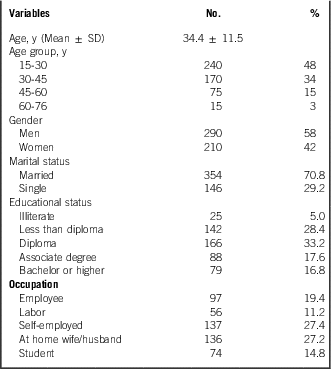
Between May and September 2011, a total of 500 citizens in Shiraz (290 men, 58%; and 210 women, 42%) completed the questionnaire. The demographic data for participants are shown in Table 1. Most respondents were aged between 15 and 30 years, and most (70.8%) were married. Two thirds of them (333; 66.6%) had a high school diploma or lower level of education. In the occupation category, most participants were self-employed (27.4%) or were a stay-at-home wife or husband (27.2%).
Demographic Data of the Participants

Table 2 shows the participants’ responses to items about their knowledge, attitudes, and practices. In the first part, responses ranged from 75% for “storing chemical products securely in closed cabinets with latches and on bottom shelves” to 87.8% for “availability of a flashlight or emergency lighting.” In the second part, 43.8% of the respondents believed that “hanging heavy items such as pictures and mirrors away from beds, couches, and anywhere people sit or sleep” is very important. In the third part, 77.2% of participants reported “placing large or heavy objects on lower shelves.” The overall mean scores for all participants were 7.3 ± 2.0 for knowledge, 26.3 ± 6.5 for attitudes, and 5.2 ± 2.2 for practices.
Correlation Between Age and Participants’ Scores for Knowledge, Attitudes, and Practices

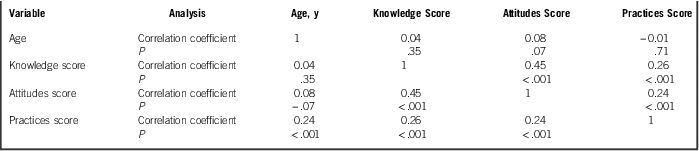
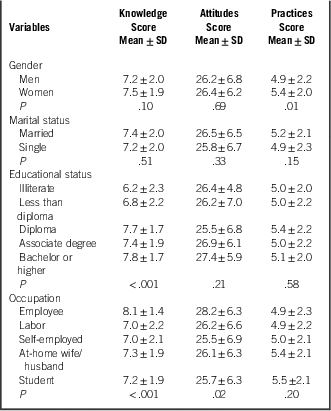
Table 3 shows the correlations between variables. This analysis detected no significant positive linear correlations between age and participants’ scores for knowledge, attitudes, or practices. However, we found significant positive linear correlations between knowledge and practice scores (correlation coefficient: 0.26; P<.001), attitude and practice scores (correlation coefficient: 0.24; P<.001), and knowledge and attitude scores (correlation coefficient: 0.45; P<.001). Table 3 also shows the associations between demographic data and mean scores for knowledge, attitudes, and practices.
Associations Between Demographic Data and Mean Scores for Knowledge, Attitudes, and Practices

Mean scores for all 3 dimensions were higher in women than in men, but the difference was statistically significant only for the association between gender and practice score (P=.01). Student t test did not detect significant differences in mean scores for knowledge, attitudes, and practices according to marital status. The mean score for knowledge in illiterate participants was lower than in other categories of educational status (6.2 ± 2.3), and higher mean scores were associated with a bachelor’s diploma and higher educational levels (7.8 ± 1.7). One-way ANOVA disclosed statistically significant differences between these categories (P<.001). However, the mean scores for attitudes and practices did not differ significantly between different educational levels.
In the occupation category, the highest mean scores for knowledge and attitudes were associated with employees (P<.001), and the lowest mean score was seen in the self-employed category (P=.02). None of the other mean scores for practices differed significantly between the other occupation categories.
DISCUSSION
Although the household is the smallest unit of measurement for analyses of disaster preparedness, appropriate household preparedness can significantly reduce the adverse effects of disasters. By taking some simple measures, people can manage themselves and their families during the first 72 hours after an event.Reference Sutton and Tierney 8 , Reference Levac 9 Many governmental and nongovernmental organizations in Iran have used various methods to increase the level of community awareness, education, and preparedness. The National Disaster Task Force is involved in seminars, workshops, drills, and many research projects in community training. The Ministry of Education is responsible for conducting national earthquake drills in schools. The Islamic Republic of Iran Red Crescent Society is another active institution that publishes books, posters, and brochures; provides training videos; and conducts rescue and first-aid courses.Reference Izadkhah and Hosseini 5 However, according to the findings of our study and a review of the management of recent disasters in Iran, it appears that although public awareness has improved, tangible or observable effect on outcomes has been small.
A feature that distinguishes our study from previous surveys is our interview method. In face-to-face interviews we explained the 3 main categories of questions for participants, and the response rate was high. Questions, particularly in the area of practices, act as triggers that may motivate participants in disaster preparedness. The scores for knowledge, attitudes, and practices in our study were similar to those in a study of inhabitants of Tehran.Reference Taghizadeh, Hosseini and Navidi 10 According to Leger Marketing, 86% of Canadians believed that disaster preparedness is important, but half of them were unprepared. 11 In contrast to the study by Lemyre et al, our findings showed that the mean score for practices in women was significantly higher than in men.Reference Lemyre, Lee and Turner 12 The differences between these studies may be explained by differences in the cultural context of the 2 study populations.
The mean score for knowledge was lowest in illiterate participants in our study; this finding was also reported by Taghizade et al.Reference Taghizadeh, Hosseini and Navidi 10 Another study that assessed the relationship between social determinants of health and disaster susceptibility found that a low literacy level was an important risk factor for unpreparedness in society.Reference Enarson and Walsh 13 Among different occupational categories, the mean scores for knowledge and practices were significantly higher in employees than in self-employed participants. This finding may have reflected the higher educational level of employees. Moreover, employees were required to participate in training programs and workshops at their organizations.
Limitations
Our study had 2 main limitations. First, we used a self-administered questionnaire—a type of instrument that may be a source of bias. Second, some socioeconomic factors such as income or salary as a determinant of preparedness level were not included in our study, because these variables were undesirable in our cultural setting.
CONCLUSION
Based on our findings, knowledge and attitude scores for household preparedness were encouraging, but overall they did not reflect significant changes in the scores for practices. This problem highlights the fact that although Iran was one of the first countries to create a national committee for natural disaster harm reduction and establish an awareness program, the translation of knowledge into effective attitudes and appropriate practices has been weak. To attain preparedness goals, we recommend that public health providers focus on motivational educational programs and coordinate all activities by different organizations under a single collaborative policy that covers all public education and training initiatives. Finally, although the preparedness practice scores in our study are a potentially valuable source of basic information for policymakers, additional research about the effects of new, robust variables such as individual and community empowerment and social networks is needed to ensure the continued monitoring of household preparedness.
Funding and Support
This article is based on the thesis (grant No. 90-01-01-2973) prepared by Arash Kiani in fulfillment of the requirements for the medical doctor degree. This work was supported by the Vice Chancellory of Research, Shiraz University of Medical Sciences.
Acknowledgment
Karen Shashok assisted in the preparation of the manuscript.