INTRODUCTION
Androdioecy is an extremely rare breeding system in which populations have both male and hermaphroditic individuals; functional androdioecy has been demonstrated in fewer than ten plant species (Landry & Rathcke Reference LANDRY and RATHCKE2007, Pannell Reference PANNELL2002). Mathematical models predict that androdioecy is rare because males can be maintained in populations with hermaphrodites only under stringent selective conditions that provide males with at least a two-fold fitness advantage over the male function in hermaphrodites (Charlesworth Reference CHARLESWORTH1984, Lloyd Reference LLOYD1975, Pannell Reference PANNELL2002). These models also predict that male frequency will vary depending upon the relative fitness advantage of males; however, all androdioecious populations are predicted to have low male frequencies because the male fitness requirement increases to infinity as male frequency approaches 50% (Vassiliadis et al. Reference VASSILIADIS, VALERO, SAUMITOU-LAPRADE and GODELLE2000).
Selective factors vary among populations; therefore, male plants could achieve the required fitness advantage and be maintained at equilibrium frequencies via internal population dynamics in some populations, but not others. However, male emigrants from ‘stable’ androdioecious populations (‘source’ populations) could regularly invade populations with less than ideal conditions (‘sink’ populations), thereby maintaining androdioecy regionally via dispersal. In this case, male frequency in sink populations should decrease as distance from the source population increases, and hermaphroditic populations (i.e. populations without male plants) should be isolated from androdioecious populations.
We have documented that some populations of Laguncularia racemosa (L.) Gaertn. f. (Combretaceae) are functionally androdioecious and vary in male frequency, but that male plants are absent from other populations (Landry Reference LANDRY2005, Landry & Rathcke Reference LANDRY and RATHCKE2007, Rathcke et al. Reference RATHCKE, LANDRY, KASS, Clark-Simpson and Smith2001a). For ease of reference throughout this paper, populations comprised of male and hermaphroditic plants are referred to as ‘androdioecious’ and populations that are comprised of only hermaphroditic plants are referred to as ‘hermaphroditic’. Other studies have demonstrated that male frequencies vary among androdioecious populations of other species (Akimoto et al. Reference AKIMOTO, FUKUHARA and KIKUZAWA1999, Dommee et al. Reference DOMMEE, GESLOT, THOMPSON, REILLE and DENELLE1999, Ishida & Hiura Reference ISHIDA and HIURA1998, Liston et al. Reference LISTON, RIESEBERG and ELIAS1990, Pannell Reference PANNELL1997a, Pannell & Ojeda Reference PANNELL and OJEDA2000), and in some cases, the populations are hermaphroditic (Akimoto et al. Reference AKIMOTO, FUKUHARA and KIKUZAWA1999, Liston et al. Reference LISTON, RIESEBERG and ELIAS1990, Pannell Reference PANNELL1997b). Species with mixed breeding systems offer a unique opportunity to directly investigate the factors involved in the evolution and maintenance of androdioecy.
Dispersal of propagules is one important factor to consider in the maintenance of androdioecy, as dispersal may be important in maintaining males on a regional scale (Obbard et al. Reference OBBARD, HARRIS and PANNELL2006, Pannell Reference PANNELL1997a, Reference PANNELLc). The first step in determining the potential importance of dispersal in the maintenance of androdioecy is to describe the geographic distribution of androdioecious and hermaphroditic populations, and then to consider the pattern of distribution with respect to potential dispersal pathways. Because L. racemosa grows along ocean coastlines and fruits are water-dispersed, water currents should largely dictate fruit dispersal patterns. The dispersal of male seedlings into hermaphroditic populations will depend upon the dispersal of fruits from androdioecious populations, because all available evidence suggests that maleness is genetically inherited and that male plants must have male pollen parents (Landry & Rathcke Reference LANDRY and RATHCKE2007). In this study, we relate the geographic distributions of hermaphroditic and androdioecious populations to probable dispersal routes determined by prevailing water currents, and we describe potential dispersal barriers that may isolate hermaphroditic populations from androdioecious ones. Further, we consider whether populations with low male frequencies are downstream of populations with high male frequencies, and if so, whether the decline in male frequency is continuous, as would be predicted by a source-sink dispersal model. The patterns described here are used to construct dispersal hypotheses that will be tested in future studies addressing the evolution and maintenance of androdioecious populations of L. racemosa.
STUDY SPECIES
Laguncularia racemosa is an insect-pollinated shrub or tree found in mangrove forests throughout the Neotropics and north-western Africa (Correll & Correll Reference CORRELL and CORRELL1982, Tomlinson Reference TOMLINSON1986). The species was first described as morphologically androdioecious on San Salvador Island, Bahamas (Rathcke et al. Reference RATHCKE, KASS, HUNT, Elliott, Edwards and Godfrey1996). The small white flowers are displayed on racemes and typically bloom in June–August in Florida (Landry et al. Reference LANDRY, RATHCKE, KASS, Rathcke and Hays2007), although flowering is reported to occur as early as April in Florida (Tomlinson Reference TOMLINSON2001) and throughout the year in the Bahamas (Correll & Correll Reference CORRELL and CORRELL1982, Kass Reference KASS2005, Landry et al. Reference LANDRY, RATHCKE, KASS, Rathcke and Hays2007). Both hermaphroditic and male flowers have one style, one stigma, and ten stamens arranged in two whorls of five, but male flowers do not have ovaries (Tomlinson Reference TOMLINSON2001). Hermaphroditic plants bear only hermaphroditic (perfect) flowers, which are urn-shaped and either sessile on the rachis of the raceme (Landry et al. Reference LANDRY, RATHCKE, KASS, Rathcke and Hays2007) or firmly held on the rachis by a short pedicel (Kass Reference KASS2005). In contrast, the flowers on male plants are smaller and cup-shaped, and are always weakly held on the rachis by a short pedicel; male flowers typically dehisce after 1–2 d, leaving the rachis bare. The flowers are visited by many insect species, including bees, wasps, flies and butterflies (Landry Reference LANDRY2005, Landry et al. Reference LANDRY, RATHCKE, KASS, ELLIOTT, BOOTHE, Buckner and McGrath2005, Rathcke et al. Reference RATHCKE, KASS, ELLIOTT, Clark-Simpson and Smith2001b), although flowers can also self-pollinate and self-fertilize (Landry Reference LANDRY2005, Landry & Rathcke Reference LANDRY and RATHCKE2007, Rathcke et al. Reference RATHCKE, LANDRY, KASS, Clark-Simpson and Smith2001a). Laguncularia racemosa is semi-viviparous; the seed germinates inside the fruit while attached to the maternal plant, but the seedling does not emerge from the fruit until after dispersal. The fruits are filled with aerenchymatous tissue that provides buoyancy, and are water-dispersed (Kass Reference KASS2005, Landry pers. obs., Tomlinson Reference TOMLINSON2001).
In previous pollination studies conducted in Florida (Coral Gables, Hollywood and Wabasso; Landry & Rathcke Reference LANDRY and RATHCKE2007) and in the Bahamas (San Salvador Island; Rathcke et al. Reference RATHCKE, LANDRY, KASS, Clark-Simpson and Smith2001a) we determined that morphological hermaphrodites have both male and female function; therefore, populations with both hermaphroditic and male plants are functionally androdioecious. In the geographic survey presented here, we assume that morphological hermaphrodites are also functional hermaphrodites (i.e. they have both male and female function) in all populations; however, pollination studies are necessary to confirm this assumption.
METHODS
Population surveys
Gender surveys were conducted to determine the breeding system in Laguncularia racemosa populations in Florida, USA and the Bahamas. We define a population as a group of individuals that are geographically separated from other groups. In some cases, multiple sites were sampled within the same contiguous population. In large populations in Florida (N > 100 plants), surveys were conducted along transects that included at least 100 plants; in smaller populations, all accessible trees were included in the survey. In all cases, flowering trees were recorded as either male or hermaphrodite based on floral morphology. Populations with both male and hermaphroditic plants were recorded as androdioecious and populations that included only hermaphroditic plants were recorded as hermaphroditic. We calculated the frequency of males in androdioecious populations based on the number of plants in flower.
A total of 65 L. racemosa populations were surveyed over a 7-y period (1999–2005): 36 populations in Florida, on the east and west coasts and in the Keys; and 29 populations on nine Bahamian islands in north-central Bahamas (Great Abaco, Little Abaco, Eleuthera, New Providence, North Andros, Cat Island, San Salvador Island, Great Exuma and Little Exuma). Much of the Florida coastline is privately held; while we gained access to several populations on land held by private institutions, most surveys were conducted on public lands. Along the east coast of Florida, we surveyed at least one population every 40 km, depending on whether we could gain access to the trees. Along the west coast, we surveyed the large populations north of Everglade City that were accessible by land. In the Florida Keys, we surveyed most accessible populations on public lands. In the Bahamas, we typically surveyed most of the accessible populations on each island, with some exceptions that we note below.
Ocean and coastal currents
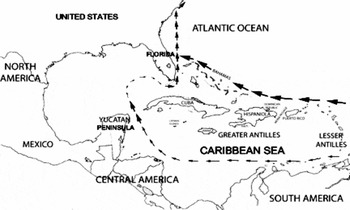
Dispersal potential was assumed to depend upon the path and direction of the ocean currents flowing through the area. The major ocean currents that could potentially disperse L. racemosa fruits in Florida and the Bahamas are the Loop Current (30 Sverdrups (Sv)), the Florida Current (30 Sv), and the Antilles Current (2–7 Sv) (Figure 1). Ocean current transport rates are measured in Sverdrups; one Sverdrup is equal to one million m3 s−1 water flowing. Near-shore currents and the Intracoastal Waterway on the east coast of Florida were also considered as potential dispersal pathways. The geographic distributions of androdioecious and hermaphroditic populations in four regions (Florida east coast, Florida west coast, Florida Keys and the Bahamas) were compared to these ocean currents in order to formulate hypotheses concerning the effect of dispersal dynamics on the maintenance of androdioecious populations of L. racemosa.
Major ocean currents affecting near-shore surface currents in the Caribbean Sea and adjacent North Atlantic Ocean, including the Gulf of Mexico. The Caribbean Current is the major current within the Caribbean basin, entering through several channels between the islands of the lower Lesser Antilles. The Caribbean Current feeds the Yucatan Current, which enters the channel formed by the Yucatan Peninsula and Cuba. The Yucatan Current feeds the Loop Current in the Gulf of Mexico, which in turn feeds the Florida Current off the south coast of Florida. The Florida Current flows northward along the south-east coast of Florida. The Antilles Current flows along the northern edge of the Antilles Islands and the eastern and northern edge of the Bahamas, merging with the Florida Current north of the Bahamas. Map adapted from original created by Annamarie Noel.

RESULTS
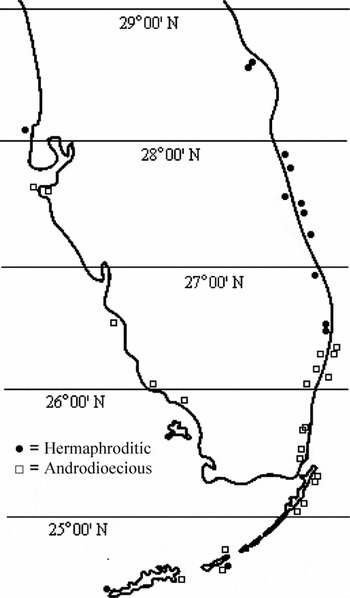
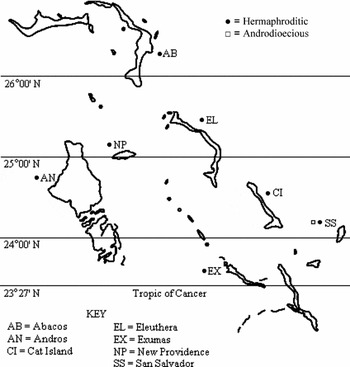
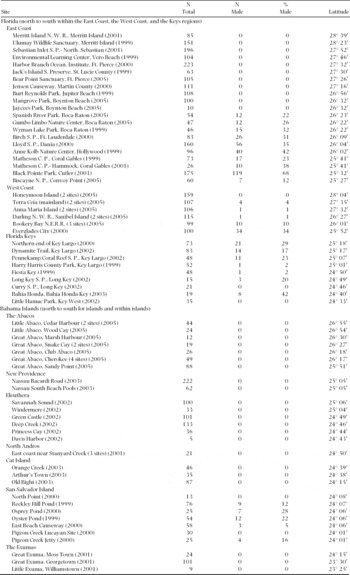
Surveys of Laguncularia racemosa populations in Florida and the Bahamas demonstrated that some populations were androdioecious while others were hermaphroditic (Appendix 1). In most populations, most plants were in flower at the time of our surveys, with some exceptions that we note below. In Florida, 22 of 36 populations were androdioecious (Figure 2); androdioecious populations were found on both the east and west coasts of mainland Florida and in the Florida Keys. In contrast, only five of 29 populations surveyed in the Bahamas were androdioecious, and all were located on San Salvador Island (Figure 3).
Approximate locations of surveyed Laguncularia racemosa populations in Florida, USA; see Appendix 1 for specific site information. Symbols on the inland side of the state line represent mainland populations, while symbols on the ocean or gulf side of the state line represent island populations.

Islands surveyed in Bahamas; see Appendix 1 for specific site information.

Florida
On the east coast of Florida, all populations south of Boca Raton (latitude 26°30′N) were androdioecious, whereas the 11 populations north of this latitude were hermaphroditic (Figure 2). The northernmost populations surveyed were on Merritt Island (28°39′N), which is near the northern limit of the species range. In the androdioecious populations, male frequencies varied from 12–68% with no clear geographic pattern (Appendix 1).
On the west coast, all populations south of Terra Ceia (27°35′N) were androdioecious, whereas the one population surveyed north of this latitude (Honeymoon Island) was hermaphroditic, and is near the northern limit of the species range on the west coast (Figure 2). Male frequencies in the androdioecious populations declined from 34% at Everglades City in south-western Florida to 10% at nearby Rookery Bay to 1–4% farther north (Appendix 1).
In the Florida Keys, most populations were androdioecious, but two were hermaphroditic: Curry State Park (Long Key) and Little Hamac Park (Key West) (Figure 2). The frequency of males in androdioecious populations ranged from 2–42% with no clear geographic pattern (Appendix 1). Male frequencies were low to moderate in androdioecious populations in the Upper Keys (2–29%) and more variable (2–42%) in androdioecious populations in the Middle and Lower Keys.
The Bahama Archipelago
Of nine islands surveyed, androdioecious populations were found only on San Salvador Island, the easternmost island in the Bahama Archipelago (Figure 3). All populations on the eight other islands in north and central Bahamas were hermaphroditic. Few plants were flowering at the time of the survey on North Andros; the actual population sizes on this island are larger than they appear from the survey data (Appendix 1, N Total), which includes only plants in flower. Population sizes reported for all other islands more closely reflect actual population sizes because most plants were in flower.
On San Salvador Island, L. racemosa grows along the shores of isolated inland hypersaline ponds on the north end of the island and along the Pigeon Creek lagoon, which connects to the ocean on the south end of the island. Seven populations were surveyed on San Salvador Island; five were androdioecious and two were hermaphroditic (Appendix 1). Male frequencies in androdioecious populations on the island ranged from 5–28%.
DISCUSSION
Androdioecy in Laguncularia racemosa was widespread in Florida but not in the Bahamas. The geographic distribution of androdioecious and hermaphroditic populations suggests that dispersal may be important in maintaining some androdioecious populations and could limit the distribution of androdioecious populations in some areas, but local selective filters, forest fragmentation, or drift may be more important in other areas.
In general, there is limited information concerning the functional breeding system of L. racemosa populations upstream of Florida and the Bahamas. Rathcke has found male and hermaphroditic plants on the southern coast of the Yucatan Peninsula (unpubl. data). Floras for Venezuela (Berry et al. Reference BERRY, HOLST and YATSKIEVYCH1998) and Nicaragua (Stevens et al. Reference STEVENS, ULLOA, POOL and MONTIEL2001) report that while most plants are hermaphroditic (having morphologically perfect flowers), plants with unisexual flowers are often found, and that these plants ‘are usually male’. Populations in Venezuela and Nicaragua are upstream of the Loop and Florida Currents along the Yucatan Current, which flows through Yucatan Strait, and the Caribbean Current, which flows through the Caribbean Sea, respectively (Tomczak & Godfrey Reference TOMCZAK and GODFREY1994) (Figure 1). In addition, the geographic location of L. racemosa populations on the northern coast of Cuba suggests that they could provide emigrants to the Keys via the Loop Current, but we found no published information about the breeding system in the Cuban populations.
In the Bahamas, we have found androdioecious populations of L. racemosa only on San Salvador Island. If androdioecious populations occur on more southern Caribbean islands, then male seedlings could have dispersed as fruits from these islands to San Salvador Island via the weak Antilles Current (2–7 Sv), which flows north and west along the arc islands of the Antilles and the eastern edge of the Bahama Archipelago (Tomczak & Godfrey Reference TOMCZAK and GODFREY1994) (Figure 1). Gillis (Reference GILLIS1974) reported that the south Florida mainland, along with Cuba and Hispaniola, are thought to be sources of the flora of the Bahamas Archipelago. However, according to Smith (Reference SMITH1993), about 60% of the flora on San Salvador Island is derived from the Caribbean while only 30–35% is shared with Florida, which suggests greater gene flow to San Salvador Island from the Caribbean Islands than from Florida.
Androdioecy has not been described in any populations of L. racemosa on islands upstream of San Salvador Island. Floras of Puerto Rico (Liogier Reference LIOGIER1994) and Hispaniola (Liogier Reference LIOGIER1989) report that male flowers are sometimes intermixed with hermaphroditic flowers on an inflorescence, which suggests that some individuals are andromonoecious. In an evolutionary sense, andromonoecy could be an intermediate breeding system between hermaphroditism and androdioecy, so this report needs further investigation. In contrast, islands on the western edge of the Bahama Archipelago could receive male immigrants via the strong Florida Current (30 Sv), which flows northward between the Florida coast and the western edge of the Bahama Archipelago (Tomczak & Godfrey Reference TOMCZAK and GODFREY1994) (Figure 1). This current could carry fruits from androdioecious populations in southern Florida to western islands of the Bahamas.
Florida east coast
The sharp switch between androdioecious populations to the south of Boca Raton (26°23′N) and hermaphroditic populations to the north (26°32′N) (Figure 2) may be explained by three major barriers to northward oceanic dispersal: (1) the strong north-flowing Florida Current (30 Sv) continues due north following the submerged continental shelf (Tomczak & Godfrey Reference TOMCZAK and GODFREY1994) whereas the Florida coastline recedes westward near latitude 26°50′N, so this major ocean current should carry fruits from androdioecious populations eastward away from the coast; (2) north of this oceanic barrier, meanderings of the Florida Current cause near-shore ocean currents to flow in a southerly direction, also preventing northward fruit dispersal; and (3) water flows southward through the Intracoastal Waterway out of the Loxahatchee River Aquatic Preserve (near latitude 26°57′N) in a narrow channel for more than 8 km before emptying into the Lake Worth estuary (near latitude 26°50′N), again preventing northward male dispersal via fruits from androdioecious populations. In addition, due to land development, there are no populations of L. racemosa along the 28-km section of the Intracoastal Waterway between the Loxahatchee River Aquatic Preserve and the small relictual hermaphroditic populations at Boynton Beach (26°32′N). The next population south of Boynton Beach is the androdioecious population at Boca Raton (26°23′N), which is more than 8 km further south and along a different estuarine basin than the Boynton Beach population. The long distances between these populations make pollen dispersal by pollinators from southern androdioecious populations unlikely because the distances are too great for insect pollinators to regularly traverse.
Male frequencies in the androdioecious populations on the south-east coast of Florida varied from 22–68% but not in a consistent pattern, as would be predicted by a source-sink model. Local selective filters must impart a significant advantage to male plants in populations with high male frequencies, but this remains to be tested.
Florida west coast
Male frequencies of L. racemosa on the west coast of Florida decline from 34% in the large continuous mangrove populations near Everglade City (25°52′N) northward to 10% at Rookery Bay (26°01′N) to only 1–4% male plants in populations between Sanibel Island (26°27′N) and Terra Ceia (27°35′N) (Figure 2). This decline suggests that male plants may be selected against in the more northern populations, and that males might be maintained in these populations by northward oceanic dispersal from the large source population near Everglade City. The relatively strong decline in male frequencies may reflect the variability of the Loop Current along the Florida Coastline. The strong Loop Current (30 Sv) generates meanderings and eddies that can cause near-shore currents to flow northward along the west coast of Florida only when the Loop Current extends into the Gulf of Mexico (Tomczak & Godfrey Reference TOMCZAK and GODFREY1994). The Loop Current rarely extends as far north as Honeymoon Island (28°04′N), which may explain the lack of males in this hermaphroditic population.
Florida Keys
Male frequency in androdioecious populations of L. racemosa in the Florida Keys was highly variable and often differed between nearby populations. For example, one population on Long Key is hermaphroditic (Curry State Park), but two nearby populations are androdioecious (Long Key State Park and Fiesta Key) (Figure 2). Furthermore, male frequency varies considerably in these androdioecious populations (Fiesta Key, 2% males; Long Key State Park, 20% males). This variability and the complex distribution of male frequencies could reflect local dispersal or differences in local selective filters, although it seems unlikely at such fine geographic scale. Alternatively, male frequencies in the small populations characteristic of the Keys could be affected by drift or habitat fragmentation. For example, the two populations on Long Key, which are separated by land development, could be fragments of a former large population where males were not evenly distributed throughout the population, but instead were clumped. The present distribution could reflect one region within that former population that included male plants and one region that did not. Additional studies are needed to determine which of these factors are important in populations in the Florida Keys.
The Bahama Archipelago
The presence of androdioecious L. racemosa populations on San Salvador Island, the easternmost island in the Bahamas, but not on other islands in the Bahamas is puzzling. For Bahamian Islands downstream of San Salvador Island, males could disperse via the Antilles Current from San Salvador Island (Tomczak & Godfrey Reference TOMCZAK and GODFREY1994) (Figure 1), but L. racemosa populations surveyed on the more northern islands upstream of San Salvador Island (Cat Island, Eleuthera, and Great and Little Abaco) all lack male plants (Figure 3). Dispersal from San Salvador Island might be limited because there is only one androdioecious population with a direct connection to the Atlantic Ocean. This population is at the northern end of the Pigeon Creek estuary (which connects to the Atlantic Ocean on the south-eastern end of the island), and fruits would have to travel the full length of the estuary (~5.5 km) to reach the mouth at the southern end. Other androdioecious populations of L. racemosa on San Salvador Island are found along the shores of isolated inland hypersaline ponds (Edwards Reference EDWARDS, Elliott, Edwards and Godfrey1996, Godfrey et al. Reference GODFREY, EDWARDS, DAVIS and SMITH1994), so it is unlikely that fruits from these populations would regularly enter the oceanic Antilles Current.
The lack of androdioecious populations on the north-western Bahamian islands surveyed is also puzzling. Male dispersal to these islands would most likely occur via the strong Florida Current (30 Sv), which flows northward between the Florida coast and the western edge of the Bahamas Archipelago (Tomczak & Godfrey Reference TOMCZAK and GODFREY1994) (Figure 1). This current could carry fruits from androdioecious populations in southern Florida to western islands of the Bahamas, but there was no evidence of males on North Andros or New Providence. However, Bimini, Grand Bahamas Island, and other nearby islands still need to be surveyed, and additional surveys on Andros are needed because few plants were flowering when surveys were performed.
The distribution of androdioecious populations on San Salvador Island is difficult to explain. Most androdioecious populations occur along the shores of inland hypersaline lakes and ponds (Long Lake, and Reckley, Osprey and Oyster Ponds), which may have been isolated from the ocean and each other for at least 10 000 y (Teeter Reference TEETER and Curran1985) and perhaps for 40 000 y (Carew & Mylroie Reference CAREW, MYLROIE and Curran1985). However, we have evidence that hurricanes could disperse L. racemosa fruits over land. After Hurricane Floyd, which passed over San Salvador Island in September 1999 as a Category 5 hurricane, we found one fruit on the shore of an inland pond that did not have an extant L. racemosa population (Rathcke & Landry Reference RATHCKE, LANDRY, Smith and Smith2003). Whether androdioecy is maintained through rare dispersal events between these ponds or through long-term persistence of isolated populations remains to be determined. In either case, the long-term maintenance of androdioecy over 10–40 000 y or more is unexpected. Charlesworth (Reference CHARLESWORTH1984) and others (Lloyd Reference LLOYD1975, Pannell Reference PANNELL2002) have suggested that androdioecy cannot be maintained over evolutionary time due to the large fitness advantage required for male maintenance.
The occurrence of adjacent androdioecious and hermaphroditic populations at the north end of Pigeon Creek on San Salvador Island is also difficult to explain. It seems unlikely that the difference in breeding system can be explained by dispersal or by differential selection. Instead, the difference may be due to the fragmentation of a formerly larger androdioecious population in which male plants were clumped.
Future studies
The varied and complex distribution of androdioecious and hermaphroditic populations of L. racemosa provides a unique opportunity to understand the influence of dispersal, selection and drift on the maintenance of androdioecy. We intend to continue our reproductive ecology studies and to use molecular markers to estimate gene flow throughout the Neotropics in order to address the origin and subsequent spread of androdioecy in L. racemosa.
ACKNOWLEDGEMENTS
The authors thank the following for financial and in-kind support of this work: Montgomery Botanical Center, Coral Gables, Florida, USA; Fairchild Tropical Gardens, Coral Gables, Florida, USA; Horace Rackham School for Graduate Studies, University of Michigan, Ann Arbor, Michigan, USA; Department of Ecology and Evolutionary Biology, University of Michigan, Ann Arbor, Michigan, USA; and The L.H. Bailey Hortorium, Department of Plant Biology, Cornell University, Ithaca, New York, USA. We also thank the following people who helped us in the Bahamas: Rena Boothe; Eric Carey; Susan Danforth; Nancy Elliott; Ted Fleming; Don and Kathy Gerace; Robert E. Hunt; Anita Knowles; Judith Monestone; Wanza Munroe; Vincent J. Voegeli (former Director) and the staff at the Gerace Research Centre on San Salvador Island; and Chris Maxey (Director) and the staff at the Island School on Cape Eleuthera. Thanks to Ed Proffitt for site locations of populations on the west coast of Florida, to Annamarie Noel for the map of the Caribbean, and to David Bay for assistance with map modifications. Portions of this work were performed with permission from: the Department of Agriculture, Nassau, New Providence, Bahamas; Harbor Branch Oceanographic Institute, Ft. Pierce, Florida, USA; and Montgomery Botanical Center, Coral Gables, Florida, USA. All other surveys were performed in areas open to the public.
Male frequencies found in populations of Laguncularia racemosa in Florida, USA and on nine Bahamian islands. The total number of plants in flower (N, Total), the number of male plants (N, Male), and the percentage of male plants (%, Male) are shown for each population. In some cases, multiple sites within a population were surveyed and the data pooled; in these cases, the number of sites is indicated in parentheses. All surveys were conducted while L. racemosa was flowering in either June or July of the year indicated in parentheses. Latitude (degrees and minutes) is indicated for all populations. Key: C. P. = County Park; N. E. R. R. = National Estuarine Research Reserve; N. W. R. = National Wildlife Refuge; Ocean. = Oceanographic; S. P. = State Park; S. Preserve = State Preserve.