INTRODUCTION
Associations between literacy and cognitive ability have been well documented. Although there are some exceptions (Deloche et al., Reference Deloche, Souza, Braga and Dellatolas1999; Manly et al., Reference Manly, Jacobs, Sano, Bell, Merchant, Small and Stern1999, Reference Manly, Byrd, Touradji, Sanchez and Stern2004; Reis et al., Reference Reis, Guerreiro and Petersson2003), the preponderance of studies that compare the test performance of literate and illiterate individuals or that use continuous measures of literacy have shown effects of reading ability on a range of cognitive tasks, including measures of orientation, visual and verbal memory, visuospatial ability, attention, language, calculation, and praxis (Ardila et al., Reference Ardila, Rosselli and Rosas1989; Deloche et al., Reference Deloche, Souza, Braga and Dellatolas1999; Manly et al., Reference Manly, Jacobs, Sano, Bell, Merchant, Small and Stern1999; Matute et al., Reference Matute, Leal, Zarabozo, Robles and Cedillo2000; Reis & Castro-Caldas, Reference Reis and Castro-Caldas1997; Reis et al., Reference Reis, Guerreiro and Castro-Caldas1994, Reference Reis, Guerreiro and Petersson2003; Rosselli et al., Reference Rosselli, Ardila and Rosas1990). Longitudinal associations between literacy and cognitive decline have also been reported. Manly et al. (Reference Manly, Touradji, Tang and Stern2003) found that although ethnically diverse elders with both high and low reading levels declined in immediate and delayed memory over time, the decline was more rapid among elders with a low reading level.
A number of recent studies have shown that reading ability is a better predictor of cognitive performance than education despite the traditional use of years of education for neuropsychological test norm development and as a demographic correction in neuropsychological research. Reading level predicts cognitive performance even when controlling for education (Albert & Teresi, Reference Albert and Teresi1999; Byrd et al., Reference Byrd, Jacobs, Hilton, Stern and Manly2005; Johnson et al., Reference Johnson, Flicker and Lichtenberg2006; Manly et al., Reference Manly, Jacobs, Ferraro and Ferraro2002, Reference Manly, Byrd, Touradji, Sanchez and Stern2004; Mayeaux et al., Reference Mayeaux, Davis, Jackson, Henry, Patton, Slay and Sentell1995; Weiss et al., Reference Weiss, Reed, Kligman and Abyad1995). For example, in a sample of African Americans who were primarily of low socioeconomic status (SES), we (Dotson et al., Reference Dotson, Kitner-Triolo, Evans and Zonderman2008) found that literacy, but not education years, significantly predicted performance on a battery of neuropsychological tests, including measures of visual and verbal memory, attention and executive functions, semantic fluency, and visuospatial abilities. Reading ability had a highly significant incremental contribution to test scores after the effect of education was partialed out. In contrast, education did not contribute to test scores after accounting for the effect of literacy.
It is hypothesized that reading is a better predictor of cognitive performance than years of education because it is a better measure of quality of education (Manly et al., Reference Manly, Jacobs, Sano, Bell, Merchant, Small and Stern1999, Reference Manly, Jacobs, Ferraro and Ferraro2002). Factors such as teaching methods, teacher quality, pupil–teacher ratios, presence of special facilities, length of school year, peer characteristics, and per pupil expenditures (Gurland et al., Reference Gurland, Wilder, Cross, Teresi and Barrett1992; Manly et al., Reference Manly, Jacobs, Ferraro and Ferraro2002) affect quality of education but are not reflected in years of education. Reading level, on the other hand, correlates with these direct measures of quality of education (Hedges et al., Reference Hedges, Laine and Greenwald1994) and with overall academic achievement (Wilkinson, Reference Wilkinson1993).
The impact of unequal educational quality may be particularly salient for African Americans, whose educational opportunities have been limited due to historical factors such as segregation (Anderson, Reference Anderson1988), which resulted in lower education expenditures, shorter school years, and higher student–teacher ratios for African American students (Loewenstein et al., Reference Loewenstein, Arguelles, Arguelles and Linn-Fuentes1994; Manly et al., Reference Manly, Jacobs, Ferraro and Ferraro2002; Ryan et al., Reference Ryan, Baird, Mindt, Byrd, Monzones and Bank2005; Whitfield & Wiggins, Reference Whitfield and Wiggins2003). Indeed, the impact of unequal educational quality on achievement, test performance, and outcomes such as wage earnings in African Americans is well documented (Baker et al., Reference Baker, Johnson, Velli and Wiley1996; Hanushek, Reference Hanushek1989; Margo, Reference Margo1986). Moreover, numerous studies have shown that African Americans read at a grade level that is significantly lower than their reported years of education (Albert & Teresi, Reference Albert and Teresi1999; Baker et al., Reference Baker, Johnson, Velli and Wiley1996; Johnson et al., Reference Johnson, Flicker and Lichtenberg2006; Manly et al., Reference Manly, Jacobs, Ferraro and Ferraro2002; O’Bryant et al., Reference O’Bryant, Schrimsher and O’Jile2005; Wilson, Reference Wilson1995; Wilson & McLemore, Reference Wilson and McLemore1997; Wilson et al., Reference Wilson, Racine, Tekieli and Williams2003) and that the discrepancy between years of education and reading level is greater in African Americans and other minority groups than in Whites (Ryan et al., Reference Ryan, Baird, Mindt, Byrd, Monzones and Bank2005).
Because of these findings, investigations of the relative influence of education and literacy on cognitive performance have primarily focused on African Americans. However, demographic factors other than race may contribute to education–reading ability discrepancies. For example, SES is associated with cognitive functioning, perhaps because higher SES individuals have greater access to high-quality education and to resources that increase the chances for participation in cognitively stimulating activities (Farah et al., Reference Farah, Shera, Savage, Betancourt, Giannetta, Brodsky, Malmud and Hurt2006; Noble et al., Reference Noble, McCandliss and Farah2007; Weiss et al., Reference Weiss, Harris, Prifitera, Courville, Rolfhus, Saklofske, Holdnack, Weiss, Saklofske, Prifitera and Holdnack2006; Wilson et al., Reference Wilson, Bennett, Beckett, Morris, Gilley, Bienias, Scherr and Evans1999). Consequently, low SES, regardless of race, may be associated with poor educational quality and thus a greater influence of literacy than education on cognitive performance. Furthermore, the discrepancy between reading ability and years of education may vary within the African American community as a function of SES, with less of a discrepancy in higher, compared to lower, SES African Americans. The current study was aimed at investigating the unique influences of education and literacy on cognitive performance in a sample stratified by race (African American and White) and SES (low income and higher income). We hypothesized that literacy would be a better predictor of cognitive performance than education across domains of cognition, particularly for low-SES participants and African Americans. This study extends our previous work (Dotson et al., Reference Dotson, Kitner-Triolo, Evans and Zonderman2008) in African Americans by examining the relative influence of literacy and education as a function of both SES and race.
METHOD
Participants
Data for the present study were obtained from the Healthy Aging in Neighborhoods of Diversity across the Life Span (HANDLS) study at the National Institute on Aging. HANDLS is a multidisciplinary, prospective epidemiologic longitudinal study that is collecting data from a representative sample of African Americans and Whites between 30 and 64 years old. A fixed cohort of participants was recruited by household screenings from an area probability sample of 12 census segments in Baltimore, MD. After the baseline recruitment was completed in 2008, participants will be reexamined every 3 years. Data for the present study were from baseline examinations, which began in November 2004. The Institutional Review Board of the Intramural Research Program, National Institute on Aging approved this study, and all subjects gave written informed consent in compliance with the Declaration of Helsinki.
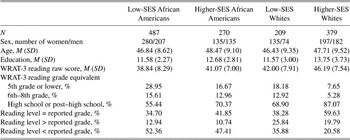
For the purposes of this study, only 1610 participants with available cognitive test data and no missing demographic data were selected from the total sample. Based on self-report data, 103 participants were excluded due to significant cardiovascular disease (e.g., coronary artery disease, myocardial infarction), and an additional 148 participants were excluded due to head injury with loss of consciousness or neurological conditions (e.g., epilepsy, stroke). Fourteen participants who reported a diagnosis of schizophrenia were also excluded, resulting in a final sample of 1345 participants (747 women and 598 men). A summary of participant demographic information for the final sample is presented in Table 1. Participants ranged in age from 30 to 64 years (M = 47.35, SD = 9.12) and ranged from 1 to 21 years of formal education (M = 12.41, SD = 3.10).
Demographics and reading levels of the four groups

Participants were self-defined as African American (N = 757) or White (N = 588). Individuals reporting multiracial backgrounds were asked which race they identified with primarily and were categorized as such. SES was defined by self-reported income. Participants who reported income below 125% of poverty level as defined by the Department of Health and Human Services (2003) were considered low SES, while participants with reported income above 125% of poverty level were considered higher SES. For example, participants with families of four with income of $23,000 or lower were considered low SES because the poverty guideline for a family of four is $18,400.
Four groups were formed based on race and SES: low-SES African Americans, higher SES African Americans, low-SES Whites, and higher SES Whites. Analysis of variance revealed an effect of group on age [F(3,1341) = 2.81, p = .04]; however, post hoc Tukey’s Honestly Significant Differences test did not reveal any significant pairwise comparisons. As expected, groups differed in years of education [F(3,1341) = 44.95, p < .0001], with post hoc tests revealing significant differences for all group comparisons except for the comparison between low-SES African Americans and low-SES Whites. Groups also differed in the proportion of men and women [χ 2(3) = 12.99, p = .005].
Measures and Procedure
The neuropsychological measures were administered as part of a larger evaluation that involved cognitive evaluation, physical examination, and an in-home interview that included questionnaires about the participant’s health status, psychosocial factors, neighborhood characteristics, and demographics. Neuropsychological measures were administered by psychometrists who were trained and supervised by a research psychologist (M.H.K.-T.).
The reading subtest of the Wide Range Achievement Test-3rd Edition (WRAT-3) (Wilkinson, Reference Wilkinson1993) was administered to assess participants’ ability to recognize and name letters and words. The total score was used as a continuous measure of literacy. The Benton Visual Retention Test-5th Edition (BVRT) (Sivan, Reference Sivan1991) and a modified version of the California Verbal Learning Test (CVLT) (Delis et al., Reference Delis, Kramer, Kaplan and Ober1987) served as measures of short-term visual and verbal memory, respectively. For the CVLT, three, rather than five, learning trials were administered, and cued recall trials were not administered. Animal Fluency assessed language and generative abilities. The Card Rotation Test (Ekstrom et al., Reference Ekstrom, French and Harman1976) served as a measure of visuospatial ability. The Brief Test of Attention (BTA) (Schretlen et al., Reference Schretlen, Bobholz and Brandt1996) and the Wechsler Adult Intelligence Scale-Revised (Weschler, Reference Weschler1981) Digit Span subtest measured attention and immediate verbal memory. The Trail Making Test (TMT) was administered to assess attention, cognitive control, processing speed, and visuomotor scanning (Reitan, Reference Reitan1992). The Identical Pictures Test (Ekstrom et al., Reference Ekstrom, French and Harman1976) also measured processing speed. Raw neuropsychological test scores were used in all analyses.
Data Analyses
Multiple regression analyses were used to examine the effects of literacy and years of education on cognitive performance, controlling for age and sex (women = 0 and men = 1). Separate models were run for each cognitive test within each of the four groups. Using a Bonferroni correction to control for multiple comparisons, p values less than .001 were considered significant.
In secondary analyses aimed at examining whether the contribution of education and literacy to cognitive test performance differed significantly across groups, pairwise comparisons of the parameter estimates from the multiple regression analyses were performed using Wald tests.
RESULTS
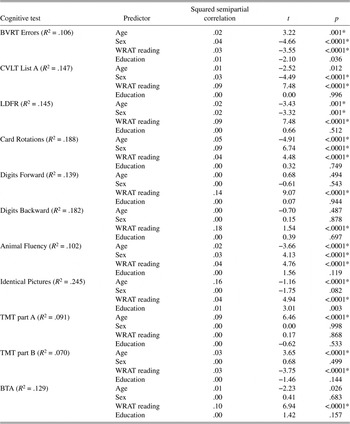
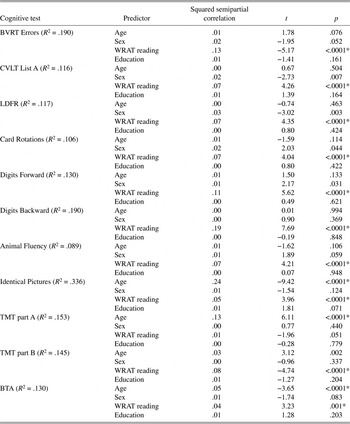
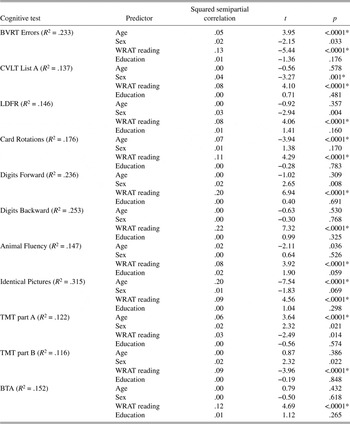
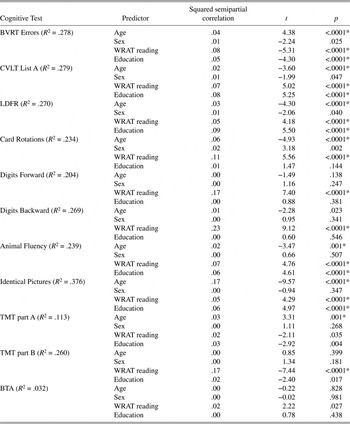
Results of the regression analyses are summarized in Tables 2–5. For both low- and higher-SES African Americans and low-SES Whites, reading scores were significant predictors of each cognitive measure except for TMT part A (p < .001), while education did not have a significant unique effect on any of the cognitive measures after Bonferroni correction. In contrast, both education (p < .0001) and literacy (p < .0001) were significant predictors of CVLT trials 1–3, CVLT Long Delay Free Recall, BVRT Errors, Animal Fluency, and Identical Pictures in higher-SES Whites. Neither literacy nor education was associated with the BTA or TMT part A in this group. Literacy (p < .001), but not education, significantly predicted scores on the remaining measures (Card Rotations, Digits Forward, Digits Backward, and TMT part B) in higher-SES Whites.
Contributions of demographic variables and literacy to test performance in low-SES African Americans

Note
Women were coded as 0; men were coded as 1. LDFR, Long Delay Free Recall.
* p < .001 (Bonferroni corrected).
Contributions of demographic variables and literacy to test performance in higher SES African Americans

Note
Women were coded as 0; men were coded as 1. LDFR, Long Delay Free Recall.
* p < .001 (Bonferroni corrected).
Contributions of demographic variables and literacy to test performance in low-SES Whites

Note
Women were coded as 0; men were coded as 1. LDFR, Long Delay Free Recall.
* p < .001 (Bonferroni corrected).
Contributions of demographic variables and literacy to test performance in higher SES Whites

Note
Women were coded as 0; men were coded as 1. LDFR, Long Delay Free Recall.
* p < .001 (Bonferroni corrected).
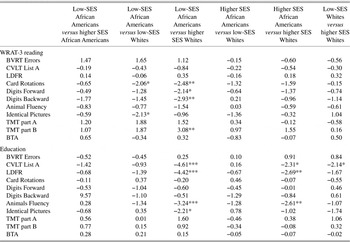
Secondary analyses comparing regression parameters across groups (Table 6) revealed that the association of WRAT-3 reading scores with test scores after adjusting for demographic measures was significantly smaller in low-SES African Americans compared to low-SES Whites for Card Rotations (Wald z = −2.06, p < .05) and Identical Pictures (Wald z = −2.13, p < .05) and compared to higher-SES Whites for Card Rotations (Wald z = −2.48, p < .01), Digits Forward (Wald z = −2.14, p < .05), Digits Backward (Wald z = −2.93, p < .01), and TMT part B (Wald z = 3.08, p < .01). Education estimates were significantly larger in higher-SES Whites compared to low- and higher-SES African Americans for CVLT trials 1–3 (low SES Wald z = −4.61, p < .001 and higher SES Wald z = −2.31, p < .05), CVLT Long Delay Free Recall (low SES Wald z = −4.42, p < .001 and higher SES Wald z = −2.69, p < .001), and Animal Fluency (low SES Wald z = −3.24, p < .001 and higher SES Wald z = −2.61, p < .001). Education regression parameters were also larger in higher-SES Whites compared to low-SES African Americans for Identical Pictures (Wald z = −3.24, p < .001) and compared to low-SES Whites for CVLT trials 1–3 (Wald z = −2.14, p < .05).
Wald z scores from the comparison of group regression parameters for the WRAT-3 reading score and years of education

Note
LDFR, Long Delay Free Recall.
* p < .05.
** p < .01.
*** p < .001.
DISCUSSION
The purpose of this study was to examine the unique influence of literacy and education on cognitive performance in a sample stratified by race and SES. Given the associations of both race and SES with quality of education, we expected literacy to be a better predictor of cognitive functioning than education in African Americans and low-SES participants.
Results confirmed our hypotheses. Consistent with our previous work (Dotson et al., Reference Dotson, Kitner-Triolo, Evans and Zonderman2008) as well as the work of others (Albert & Teresi, Reference Albert and Teresi1999; Byrd et al., Reference Byrd, Jacobs, Hilton, Stern and Manly2005; Johnson et al., Reference Johnson, Flicker and Lichtenberg2006; Manly et al., Reference Manly, Jacobs, Ferraro and Ferraro2002, Reference Manly, Byrd, Touradji, Sanchez and Stern2004; Mayeaux et al., Reference Mayeaux, Davis, Jackson, Henry, Patton, Slay and Sentell1995; Weiss et al., Reference Weiss, Reed, Kligman and Abyad1995), literacy was a stronger predictor of cognitive performance than years of education in African Americans. While significant WRAT-3 reading effects were observed, education did not have a significant effect on any measure once reading ability was taken into account. This relationship held for both verbal and nonverbal measures and was found for all but one test. Both low- and higher-SES African Americans showed this pattern of results; thus, literacy appears to be a stronger predictor of cognitive functioning than education regardless of SES in African Americans. In contrast, findings varied by SES in White participants. Low-SES Whites were similar to African Americans; that is, literacy was a significant predictor of all but one measure, while education did not significantly predict any measure. However, findings were more variable for higher-SES Whites, with both literacy and education showing significant relationships with some measures, while for other measures, literacy, but not education, was a significant predictor. The differential effects of SES on our results in White and African American participants may be related to social mobility. Participants with currently low SES may have come from a low-SES background, suggesting that quality of education during the school years would have been poor. The higher-SES groups, on the other hand, may comprise a mix of individuals, some of whom came from a higher-SES background and others who may have changed social status in adulthood. It is possible that our higher-SES African American group is more likely to consist of individuals who were raised in a lower SES environment but in adulthood were able to benefit from increasing opportunities for African Americans. In this case, their quality of education as a child may not have substantially differed from that of individuals in the low-SES African American group. In contrast, the higher-SES White group may be more heterogeneous in regard to childhood SES and thus has more variable educational quality. Because information about childhood SES was not available for the current study, we were unable to test this possibility.
Secondary analyses, which compared the associations of reading scores and education across groups, revealed smaller reading parameter estimates in low-SES African Americans compared to low- and higher-SES Whites for some measures. This is not surprising considering that the regression models tended to account for less variance in low-SES African Americans (9–25%) than in low- and higher-SES Whites (11–38%). For low-SES African Americans, although reading level is a better predictor of cognitive performance than education, the association between reading and cognitive functioning is smaller compared to Whites for some cognitive functions. Thus, other factors that were not included in our regression models may be important in predicting the cognitive performance of low-SES African Americans. For some measures, secondary analyses also revealed larger education estimates in higher-SES Whites compared to the other groups. Combined with the finding that both literacy and education predicted performance on some measures in higher-SES Whites, the secondary analyses suggest that education is a better predictor of cognitive abilities in higher-SES Whites than in other groups.
Our findings highlight the importance of considering an individual’s reading level when interpreting performance on cognitive tasks. Previous studies have shown that literacy is a better predictor of cognitive performance than years of education, presumably because it is a better measure of quality of education (Albert & Teresi, Reference Albert and Teresi1999; Byrd et al., Reference Byrd, Jacobs, Hilton, Stern and Manly2005; Johnson et al., Reference Johnson, Flicker and Lichtenberg2006; Manly et al., Reference Manly, Jacobs, Ferraro and Ferraro2002, Reference Manly, Byrd, Touradji, Sanchez and Stern2004; Mayeaux et al., Reference Mayeaux, Davis, Jackson, Henry, Patton, Slay and Sentell1995; Weiss et al., Reference Weiss, Reed, Kligman and Abyad1995). Although research in this area has focused on African Americans, our results suggest that reading ability may be a more important consideration than education years for some cognitive abilities in Whites as well, particularly in those with low SES. The finding that education predicted performance on some measures in higher-SES Whites but was not associated with any cognitive measure in African Americans and low-SES Whites is consistent with the idea that individuals from disadvantaged groups are more likely to obtain poor quality education. As a result, education is less likely to accurately reflect educational achievement or predict cognitive performance in these groups. The extension of previous research in African Americans to another disadvantaged group (i.e., those with low SES) underscores the need for research that examines predictors of cognitive performance in myriad groups with limited educational opportunities.
The potential impact of intellectual functioning on our findings is unclear. Both educational attainment and reading ability are associated with intelligence, and word reading tests are frequently used as estimates of premorbid intelligence (Bright et al., Reference Bright, Jaldow and Kopelman2002; Crawford et al., Reference Crawford, Deary, Starr and Whalley2001). Because of these relationships, including intelligence scores in our statistical models would have resulted in problems with multicollinearity. It is possible that group differences in intelligence affected the relative contributions of reading ability and education level to cognitive test scores. Another possibility is that reading ability is a stronger predictor of cognitive functioning in low-SES and African American participants because it has a stronger correlation with intelligence than does education years in those groups. Because the HANDLS study does not include intelligence estimates other than word reading ability, we were unable to explore these possibilities in the current study.
We chose to perform separate analyses for each group and for each cognitive test in order to avoid obscuring differences between tests caused by forming composite scores and to provide the most straightforward demonstration of group differences in the relative contribution of education years and literacy on cognitive functioning. Although the number of analyses in this study was inflated, we do not consider this to be a limitation of the study because the results withstood Bonferroni correction, which is a very conservative correction for multiple comparisons.
Participants were not given a learning disability evaluation. As a result, it is possible that undiagnosed cases of reading disabilities were present in our sample. Although this may have contributed to the observed discrepancy between reading ability and reported grade level, particularly in low-SES groups, it is unlikely to have affected our analysis of the relative contribution of education years and reading level to cognitive scores. Indeed, because individuals with reading disabilities would be expected to have reading skills that are much lower than other cognitive abilities, it is likely that the presence of undiagnosed learning disability would have reduced the impact of reading scores on our cognitive tests. The magnitude and consistency of our finding that literacy is a better predictor of cognitive functioning than education years despite the possible inclusion of individuals with a learning disability attest to the strength of our findings.
The proportion of women was greater in the higher-SES White group (65%) compared to the other groups (50–58%). The inclusion of more women may have contributed to the differential findings in this group. However, this possibility was minimized by the inclusion of sex as a covariate in the statistical analyses. Although years of education for our sample ranged from 1 to 21 years, the majority of participants had 9–13 years of education. Thus, the limited variability in education years may have obscured education effects since education is known to have a nonlinear effect on cognition (Ardila et al., Reference Ardila, Ostrosky-Solis, Rosselli and Gomez2000). Moreover, the limited variability in education years suggests that the present results may not generalize to individuals with extremely low or extremely high levels of education as they were not adequately sampled in this study. The categorical definition of low- and higher-SES groups based solely on current income and the relatively smaller sample sizes in the low-SES White and higher-SES African American groups are additional limitations of our study.
Nonetheless, the present results are useful in that they provide further evidence that reading ability better predicts cognitive functioning than years of education, and they suggest that disadvantages associated with racial minority status and low SES affect the relative influence of literacy and years of education on cognition. Our findings contribute to the existing literature by providing evidence that (1) despite the previous focus on African Americans, literacy is a better predictor of cognitive functioning than education in both African Americans and Whites and (2) SES affects the relative contribution of reading ability and education to cognitive performance in Whites but not in African Americans. These results also suggest that minority status and SES have independent effects on cognitive performance. Additional research is needed to examine the effects of education and literacy on cognitive performance in different ethnic groups. Moreover, our understanding of group differences in neuropsychological test performance will be enhanced by further exploration of intragroup differences and the impact of diverse cultural experiences on cognitive performance.
ACKNOWLEDGMENTS
This research was supported (in part) by the Intramural Research Program of the NIH, National Institute on Aging. Portions of these data were presented in Dotson et al. (Reference Dotson, Kitner-Triolo, Evans and Zonderman2008). The authors have no conflicts of interest to disclose.