1. INTRODUCTION
Since 1868 in Japan, the maritime transport business has been one of the key industries and has supported the economic growth of Japan. Those ships, built and operated by the Japanese, allow Japan to earn foreign currency by transporting goods to and from foreign countries. The significant aspect of the maritime transport business is that it offers direct access to the foreign money needed for economic development in Japan. Having meagre resources and being surrounded by ocean, it is well known that the existence of Japan depends essentially on foreign trade. According to recent statistics, 99·7% of trade goods to or from Japan are transported by sea. Transporting such a substantial amount of goods, the maritime transport business makes the core of the maritime cluster.
The Japanese maritime sector was once devastated by the War. However, the community pushed its companies to improve their merchant fleets which were trading overseas, and in less than 30 years it became a world-leader. In 1972, Japanese merchant fleets consisted of 655 foreign-chartered vessels and 1580 national flag vessels, 2235 ships altogether. Although Japan still has about 2000 ships, which appears to differ little in number, there is a significant change in the way those ships are operated. In other words, after the 1970s the Japanese maritime sector was forced to replace its old, more self-contained system, in which Japanese seafarers operated national flag vessels, with a more dependent one, in which foreign seafarers operate Japanese ships that were registered overseas.
In this paper, the current situation of the Japanese maritime sector and its dependence on foreign seafarers, the cause and process of the change and the problems of the outcomes are explained, and the possible solutions in terms of the social mechanism of personnel development and utilization are discussed.
2. ISSUES DUE TO MARITIME INTERNATIONALISATION
2.1. Process of Internationalisation
Recently on-shore industries, for instance the manufacturing of cars and electric appliances and the clothing industries have increasingly relocated their production bases overseas to avoid expensive domestic production costs in the struggle against international competition. This is the result of realistic choices to reduce labour costs by replacing expensive domestic labour with cheaper foreign labour. However such choices have caused increased unemployment of domestic labour and the hollowing out of the domestic industries. Furthermore, there is a deepening concern that with this approach the Japanese maritime community might lose precious assets such as the long time accumulation of knowledge, skills, and high motivation.
Japan is constantly exposed to global competition and it has already been 40 years since change started in the shipping business. As the number of Japanese vessels as workplaces for Japanese seafarers has been reduced, the number of Japanese seafarers has dropped off as well. Consequently, the Japanese maritime sector is facing a reality of insufficient sea experienced personnel to support the maritime cluster.
At the beginning of the 1970s, the Japanese merchant fleet consisted of 655 foreign-chartered vessels and 1580 Japanese national flag vessels. Within 30 years, however, the number of Japanese ships has decreased drastically to 154, about one tenth of what Japan used to have and currently it only has about 100. According to the data, the figure has remained flat in recent years. Such a decrease started after the new “flag of convenience” system was introduced. Under this system, shipping companies were able to lower operating costs by having their ships registered overseas where registration costs and tax rates are lower, thus Japanese shipping companies have been eager to follow this world-wide trend and changed the nationality of their ships. The Japanese maritime community now faces the consequence of this trend with the dramatic decrease in the number of Japanese ships.
One clear distinction of those flag of convenience ships is that they are operated exclusively by low-cost foreign seafarers. Technically those ships belong to foreign countries and thus do not have to be operated by higher salaried seafarers. Keeping with such a world trend of the flag of convenience system, Japanese shipping companies did not hesitate to adopt the new system, which has caused a drastic drop in the number of Japanese seafarers, as can be seen in Figure 1, from almost 60,000 at the beginning of the 1970s to 3000, which is one twentieth below the peak within the past 30 years.
Change in the number of Japanese seafarers for oceangoing ships.

Roughly there are two main causes for this dramatic decrease in the number of Japanese vessels and seafarers. One reason is that freight charges for foreign routes are usually calculated in dollars. The other reason is that in 1973 the government decided to introduce a new regime for the yen-dollar exchange rate and the fixed rate system was replaced with a floating one. In particular, after the Plaza Accord was signed in 1985, the value of the yen against the dollar sharply jumped up. It is said that the cost for one Japanese seafarer was equal to almost that for six to eight foreign ones.
Under such a floating system of foreign exchange, even with the same amount of earnings in dollars, with the exchange rate the value of the yen was less, which pressed the management of the shipping companies. Furthermore, the more the domestic economy grew, the higher the salaries for domestic seafarers became, which also aggravated an already difficult situation.
The maritime sector adopted a strong policy to reduce the personnel expenditure by downsizing the large number of Japanese seafarers. At the same time, more and more Japanese vessels were becoming flag of convenience ships and were operated increasingly by more foreign seafarers. Due to that policy and other management efforts thereafter, the Japanese maritime sector managed to gain back a global competitive edge although at the same time those efforts have caused a sharp fall in the number of Japanese vessels and have brought about a possible depletion of Japanese seafarers.
2.2. Political response
Under such circumstances there has been an argument about the excessive dependence on overseas shipping in transporting the absolute essentials for daily life. It might be a problem if Japan should ever face an emergency and be forced to become independent in maintaining the same level of ocean transport ability. In fact, as flag of convenience ships are beyond Japanese law, it is possible that in the case of a national emergency such as a major disaster etc., the Japanese government might be unable to rely on those ships for transportation.
Responding to the argument, the Council of Transport Policy had a series of long discussions starting in February 2007 and estimated that in the case of a national emergency, assuming only Japanese vessels and seafarers were available, 450 vessels and 5500 seafarers would be required for the public to maintain their daily lives. Once these figures were determined, the government decided to take various actions to revitalize the maritime sector to the level at which Japan is able to cope with emergencies on its own.
Furthermore due to the Basic Act on Ocean Policy coming into effect, a front office for general ocean policy was set up in July 2007 with the Prime Minister as chief and the Minister of Land, Infrastructure and Transportation as the minister responsible, followed by the Basic Act on Ocean Policy schemes plotted out in March 2008. Among the schemes, the Japanese government decided to adopt a tonnage tax system for Japanese shipping companies to become more competitive internationally. Also they set up a goal in which the number of Japanese ships is to be doubled to 200 within five years and to increase Japanese seafarers to 3900, 1·5 times the current number within ten years.
In the course of reaching the numerical targets for the project, an average of 130 seafarers will be added each year in the coming decade to the current number of approximately 2600. Although things do not always go as planned, and it might take a while to see a difference, it is certainly a positive movement for the maritime cluster to have more Japanese seafarers. Hopefully more Japanese seafarers will take a leading role with their remarkable technical capabilities to support the maritime cluster in the future.
2.3. Conventional seafarer's career path
In Japan, there are eight national maritime education and training institutions including two major maritime universities. In those schools students are able to learn how to operate ocean going merchant fleets. Figure 2 shows an overview of the actual conditions and career paths the graduates experience in the maritime cluster. Normally active personnel in the maritime cluster are those who have graduated from maritime education and training institutions. First they take a position in shipping companies as seafarers after graduation. They accumulate sea experience as an officer or engineer and then eventually are promoted to captain or chief engineer.
Typical human resource flow of conventional maritime sector.

Their sea experience is often considered useful or sometimes a prerequisite to hold a position at some related on-shore companies comprising the cluster. Those companies are willing to offer a position as second career for retired seafarers with abundant sea experience. Accumulating sea experience through shipping companies before moving onto on-shore tasks at maritime related companies was a typical career path for many people. It was like the main stream running through the cluster and that was always the way the maritime cluster had been.
2.4. Changes and challenges in career path
Currently there are some differences from such a typical stream. The differences were caused by the sharp decrease in the number of domestic seafarers. Until the 1970s almost all the graduates from the maritime education and training institutions were employed at shipping companies. However, after Japanese shipping companies went through major changes, such as the substantial reduction of Japanese seafarers, the newly introduced flag-of-convenience system and a rapid increase in the number of foreign seafarers on Japanese ships, companies started to refrain from employing graduates from maritime education and training institutions.
Recent data from the institutes suggests that only 40% of the graduates are employed by shipping companies. It is clear the stream of human resources from maritime education and training institutions to the shipping company is beginning to become stagnant. Consequently shipping companies try to keep precious personnel who have sea experience as an officer, captain, engineer or chief engineer. As a result maritime related industries that rely on retired workers from shipping companies for labour power because of their previous work experience on ships, might suffer from a shortage of qualified personnel. This undesirable change in the stream flowing between the educational world and maritime transport industry is beginning to have an impact on each part of the cluster as the personnel who used to be engaged in off-shore tasks are becoming less available.
The steady flow of human resources from maritime education and training institutions to shipping companies and thereafter to maritime related industries was forming the foundation for a healthy condition of the cluster and the people working there. If those people concerned overlook the issue, it will be increasingly hard for the maritime related industry to find the right personnel that have sea experience. Japan might even find itself in the situation that the maritime cluster would have no choice but to collapse.
3. POSSIBLE SOLUTIONS
It would be significant to overcome the issue and try harder to gain more prosperity for the cluster. If the Japanese maritime community could design solid and long lasting programs to cultivate human resources and create enough opportunities for them, it would be a firm base for the next phase of the cluster.
There are three pillars which are necessary to develop human resources and to establish a solid framework to keep them actively flowing within the cluster. The first pillar represents a clear understanding of capabilities or skills a person should have to take an important role for the cluster and its development. The second pillar represents a solid educational system which must be created to cultivate the right talent. And the third one is to establish a system so that human resources could actively flow between the educational world and shipping companies, and thereafter to the maritime related industries.
Supported by those three pillars, each group, the maritime education and training institutions, shipping companies and maritime related industries should interact and associate closely with each other to create a new social mechanism where the right talents can be developed and utilized for the cluster.
3.1. Both-wing ability
What are the abilities and skills desirable personnel are expected to have for the cluster and its development? As a maritime country, Japan has been considerably dependent on ocean transportation. In that sense, Japanese seafarers are indispensable assets as a human resource because Japan is and will be unable to exist without steady ocean shipping. The question is if such vital assets, expected to support the next generation of the cluster should be built in the same fashion as foreign seafarers are. Future seafarers should strive to improve their abilities so that they can be assigned not only to operate ships but be versatile enough to do other on-shore tasks as well.
Besides operating ships, ideal seafarers should be able to provide labour of high-added-value. To take assignments on shore in maritime related industries, it is often a prerequisite to have sea experience. Furthermore, related industries highly value the talents of those who can provide solid service based on their previous sea experience. This means that desirable personnel should be able to do both on- and off-shore tasks for the cluster and its development. They should be able to operate vessels and, when necessary, should be able to take on management work onshore. To describe such personnel the author uses the term “both-wing ability” as it indicates cultivating two or more skills. By training and using two wings in a balanced manner, one could fly strongly and smoothly, which is the ideal expected for personnel in the cluster of a maritime advanced nation.
3.2. Educational scheme following a two-phased career path
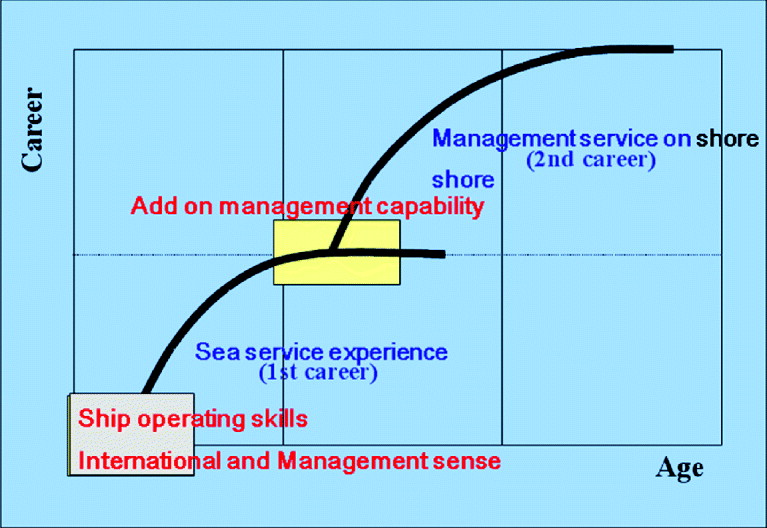
To foster the both-wing ability, the Japanese maritime community has to discuss how an educational scheme should be designed. Figure 3 shows the concept, “the educational scheme following a two-phased career path”. Although the both-wing ability is about developing two or more skills, it is not necessary to acquire them simultaneously. This idea proposes a step-by-step approach so that anyone who hopes to develop their skills to enhance their career path could try to do so without sacrificing themselves entirely.
Educational scheme following a two-phased career path.
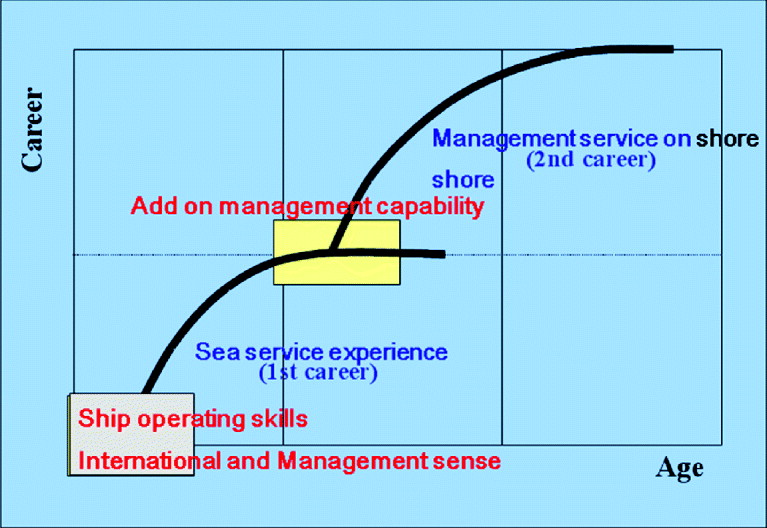
The first phase is to prepare for acquiring a license to operate ships. During this phase learners could focus on passing the exam to be officially qualified to operate ocean going vessels. Also students should learn English and foreign manners and customs to improve their international sense so they are prepared for working in a global society. The course should include lessons for basic managerial skills so that eventually they can take some responsibility in the organizations or teams in which they belong.
The second phase is for supplemental education. This course should be designed to offer adequate “support to progress one's career” so that learners could eventually take an on-shore managerial position. Advanced level managerial skills could be obtained through the course, by which the maritime related industries could employ a capable management practitioner with precious sea experience. The goal of this second wing is to develop managerial skills. Generally speaking, to achieve a task in an organization, it is important that everyone concerned is equally motivated. Everyone's adequate commitment for reaching the goal heading in the same direction is the key to success. In any type of organization, such as international, social, business or private, the true nature of the managerial function depends on the ability to inspire members in a group. The purpose of this phase is to improve such managerial ability. Through the course retired seafarers could build up their skills to be prepared to eventually take leadership in achieving goals or completing projects.
In each stage, learners could acquire basic expertise, technical capabilities and managerial skills, intrinsic properties of workers. In addition, they could learn how to keep the right attitude such as having enthusiasm or motivation towards assignments in both-wing.
“The educational scheme following a two-phased career path” proposes gradual steps in developing personnel who are eager to take an active role to bring more prosperity to the maritime cluster. For example, after successfully receiving the license at the end of the first phase, learners would become seafarers ready to provide their service on a ship. Eventually, they could improve themselves further by taking supplementary education before holding positions as their secondary occupations on shore. This would be the typical steps of a seafarer's career path.
Also these steps might be taken backwards or switched around, meaning retired seafarers could first secure a position on-shore and then they might be able to figure out what skills they need to improve through supplementary education. Basically, the image of the educational scheme is seafarers following either a straight or zigzag line between the educational world and the business world as their careers progress. By going back and forth between the two worlds, eventually when they reach their goals with both-wing abilities fully developed, they would be completely ready to provide solid and quality service for the cluster.
3.3. Formation of new personnel flow – A career path scheme based on a cooperative maritime cluster
The third pillar represents the creation of a cooperative system in which the educational world and maritime related industries work together and construct a framework for personnel to actively flow within the maritime cluster.
In the maritime related industries there are many types of positions requiring sea experience, such as superintendent, pilot, inspector, surveyor, terminal operator, or port captain. Also fields such as insurance, legal, port administration and maritime administration welcome those with sea experience. Usually applicants for such positions are from those who have retired from shipping companies. In other words the maritime related industries have usually been rather passive when it comes to hiring, waiting for seafarers to leave their first positions at shipping companies and come to them to start their second career.
However, since the situation has changed, the related industries are beginning to have difficulties finding such applicants. The reason for such difficulties is that in recent years the number of graduates holding positions at shipping companies has decreased, which means that the companies cannot afford to let as many seafarers retire as previously. In fact, as the number of applicants for positions in related industries has been decreasing, a potential depletion of personnel with sea experience is becoming a real threat for maritime related industries.
Under these circumstances, to stimulate the flow of personnel that has been rather stagnant inside the cluster, an innovative approach might be necessary. Figure 4 shows the concept of the theory, “A career path scheme based on a cooperative maritime cluster”, which proposes that strong pipelines should be created across the cluster. The theory suggests a way to design a new social system where an efficient growth path could be set up for personnel to actively flow across the cluster. The system is beneficial specifically for related industries as it helps them in securing an adequate number of personnel, which should be feasible if related industries could directly employ graduates who have a license but have never actually operated a ship, and develop them by providing an opportunity to work at sea.
Career path scheme based on a cooperative maritime cluster.

However, there is a dilemma. The maritime related industries have no capacity for providing sea experience themselves even though it is a prerequisite for some of the positions they offer. Therefore a program that solves this dilemma is introduced. The program is called “OJT at sea”. It gives an opportunity to employees who have never worked on a ship to do so. It would be impossible for an individual company to implement this system, thus the entire community, with each industry collaborating with the others, must work together to push the program forward. In particular, during the implementation of the program, it would be indispensable to ask shipping companies to cooperate since they are the ones that actually own and operate ships.
Such cooperation with and from each part of the cluster is a very important base of the theory because, besides this program, “A career path scheme based on a cooperative maritime cluster” also requires support from some other parts of the cluster. It is only feasible through cooperation from maritime education and training institutions as it involves giving “step-up support” to those who hope to progress in their career. In this program, different types of supplementary educational programs would be available with the help from various related industries so that learners could improve their specific abilities or skills needed for them to work.
“A career path scheme based on a cooperative maritime cluster” suggests that the entire cluster should cooperate to foster both-wing personnel, those capable of performing on- and off-shore, the precious assets needed by each part of the cluster. But it is not feasible without mutual cooperation of the entire cluster. The educational world must work cooperatively with maritime related industries in fostering and providing human resources. Likewise maritime related industries must collaborate with shipping companies in creating opportunities to work at sea for those who have never done so.
4. POTENTIAL SEAFARERS WORKING ON-SHORE
It was previously stated that the Japanese government set up a policy to increase the number of Japanese seafarers to 3900, 1·5 times the current number within 10 years starting 2008. Nevertheless, if the extra expense that companies must incur on pricy Japanese seafarers is considered, the existing 2600 could be the most they could afford while staying competitive against their international rivals. Seeking for a possible way to keep 1300 seafarers fostered under the government's policy is another challenge the entire maritime cluster must take.
As already mentioned, Japanese seafarers cost more than foreign ones because of their higher salaries. Discovering an innovative approach to keep and make the most of them requires harmony inside the cluster. For example, they might be able to accept those newly fostered seafarers together keeping them as potential seafarers inside the cluster. New seafarers would then be assigned on- and off-shore jobs according to the demands of their employers. It seems possible that through experiencing multiple tasks both on and off shore, they could improve themselves developing both-wing abilities. Ordinarily new seafarers could be engaged in on or off-shore tasks. However if a national emergency should occur, they could respond to commands from the government serving as crew on Japanese ships.
In this system, unique rules could be created. For instance someone who usually works on-shore could be promoted to a senior crew depending on their sea experience. With such rules, an adequate number of Japanese seafarers ranging from officers to captains or engineers to chief engineers would be secure, being constantly available inside the cluster. This approach is particularly beneficial for maritime related industries, which are now confronting the problem of personnel shortages, as they could secure employees with sea experience following this strategy. Of course, to enhance this approach to keep 1300 Japanese seafarers potentially in the cluster, under the guidance of maritime administration, deep understanding, strong commitment and budgetary support might be necessary from the government.
Setting up steady pipelines for human resources to flow between shipping companies and related industries could contribute to establishing a better educational system, where both-wing talents, indispensable resource for maritime advance countries, would expand.
5. CONCLUDING REMARKS
In this paper the current situations and challenges that the Japanese maritime community is facing are explained, particularly highlighting the stagnant personnel flow within. In responding to the matter, some reasonable ideas for developing personnel and making the most of them on the assumption of cooperation offered by each part of the cluster are suggested. The current issue of personnel shortages for the cluster has already been experienced in European nations. They have discovered their own way to address the issue, Japan must find its own solutions.
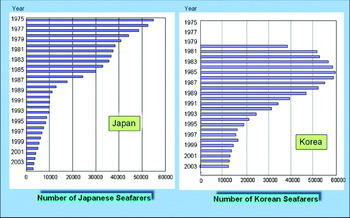
Such issues have always been a challenge for front-runners in the maritime world. Japan is a front-runner in the Asian region, with Korea as the runner up. In Korea, which is about 10 years behind Japan, as can be seen in Figure 5, seafarers who used to number approximately 60,000 in 1985, have been drastically reduced to 10,000 today.
Comparison of the change in the number of seafarers in Japan and Korea.

Korea is beginning to face the same problem as Japan. The number of Korean seafarers is decreasing due to the increased number of foreign seafarers. Korean shipping companies are limiting the employment of Korean seafarers, which is having an impact on graduates from maritime education and training institutions, depriving them of opportunities to work at sea.
In Japan, responding to such a decrease in Japanese ships or seafarers, the “international ship registration system” was introduced, hoping for more ships to carry our national flag. Also to secure more Japanese seafarers while enhancing our international competitive edge, a tonnage system was adopted. Concerned over the same issue, Korea has been implementing those policies as well, making efforts to secure an adequate number of Korean ships and seafarers. To encourage Korean ship registration, for instance, starting in 2002, a preferential tax treatment has been given to vessels registered in Jeju. Due to this favourable tax reduction, almost 500 ships have registered on the island up to this point. Also the tonnage system was introduced in 2005. After that, in order to secure enough ships and seafarers in the face of a national emergency, a new system was adopted in 2006. In the case of a national emergency, under the new system the government could mandate the use of commercial vessels. Currently there are 30 with plans for 88 by 2012.
Since marine transportation is a type of business activity conducted in the international market, when a nation's maritime sector becomes a world leader and confronts some issues, usually countries that follow will encounter the same sorts of challenges along the way. In a maritime community, the typical process a runner-up will undertake along the way to catch up with the front runner is:
• As a nation's economy grows, its domestic labour costs rise and create a gap with those abroad, which in turn depresses the international competitiveness of shipping companies.
• To maintain their economic strength, shipping companies have their ships fly a “flag of convenience” relying on more and more cheap foreign labour.
• As a result, the nation gradually loses domestic seafarers, which, in the worst case, leads to a depletion of national human resource for its maritime cluster to continue existing.
In that sense, the personnel shortage issue is a fate for top runners in the marine transport world, where international competitiveness is inevitable. The Japanese maritime business, which has followed European nations, has been trying to deal with the issue, while in our neighbouring country, Korea, it is becoming a reality. In the marine transport business world, a nation experiences the same types of issues along the way to be a top runner. In other words, those repeating issues are like a relay baton of international challenge, from a top runner to a runner up.
Therefore it is important that the Japanese maritime cluster, as a role model, come up with the best solution possible to overcome the issues at hand, in particular for the benefit of a nation that is receiving the baton as a maritime advanced nation.