Clinical Implications
-
• The degree of D2 receptor occupancy in the basal ganglia following lurasidone treatment is associated with improvement of positive but not negative symptoms in patients with schizophrenia and schizoaffective disorder.
-
• Some patients require doses of 120 mg/day or 160 mg/day to achieve D2 receptor occupancy of greater than 65% thought to be required for efficacy.
-
• Changes in thalamus and amygdala D2 receptor occupancy with lurasidone treatment are also associated with improvement in positive but not negative symptoms in patients with schizophrenia.
-
• Sufficient receptor occupancy for efficacy is not adequately predicted by lurasidone dose. Therefore, the use of a wide dose range of 80–160 mg/day (perhaps 40–160 mg/day) in the treatment of patients with schizophrenia is clinically appropriate.
Introduction
Lurasidone, an azapirone derivative, is an atypical antipsychotic medication approved for the treatment of schizophrenia starting at a dose of 40 mg/day to a maximum dose of 160 mg/day. It has a high affinity for D2 and 5-HT2A receptors, which is similar to other atypical antipsychotic medications, as well as for receptors putatively involved in the enhancement of cognitive functions such as 5-HT7 and 5-HT1A.Reference Nakamura, Ogasa and Guarino 2 , Reference Meyer, Loebel and Schweizer 3 Its Ki is 0.99 nM in human cloned D2 receptors.Reference Ishibashi, Horisawa and Tokuda 4 Its primary D2 blocking activity is related to its parent compound, with a minor contribution (approximately 25%) by its major metabolite ID-14283.Reference Tarazi and Stahl 5 Cmax for lurazidone is at 1–3 hours. Plasma elimination half-life is at 18 hours for lurasidone and 7.5–10 hours for ID-14283 for 40 mg doses and perhaps twice as long for the higher doses. 18F-fallypride, as other radioligands, is used to measure both D2 and D3 receptor occupancy.Reference Mukherjee, Christian and Dunigan 6 Lurasidone has very low affinity for D3 receptors (Ki = 15.7 nM); therefore 18F-fallypride occupancy measures for lurasidone have little, if no, D3 contribution, and occupancy is referred to as D2 rather than D2/D3.
Approximately 65% D2 receptor occupancy is thought to be required for antipsychotic efficacy.Reference Nordström, Farde and Wiesel 7 However, the duration of D2 receptor occupancy and the regional requirements for antipsychotic efficacy have not been sufficiently studied. There is controversy as to whether lurasidone at doses higher than 80 mg/day has additional efficacy in patients with acute schizophrenia. In 2 randomized controlled trials (RCTs), no additional benefit of 120 mg compared to 40 mg or 80 mg was observed.Reference Citrome 8 , Reference Meltzer, Cucchiaro and Silva 9 However, based on results of a 6-week placebo-controlled trial, Loebel etal Reference Loebel, Cucchiaro and Sarma 10 observed that a dose of 160 mg/day may have greater efficacy than 80 mg/day. The effect size for Positive and Negative Symptom Scale (PANSS) total improvement at 80 mg/day was 0.58 compared to 0.83 for 160 mg/day.
To investigate the relationship between lurasidone D2 receptor occupancy and clinical symptoms, this study examined change in D2 receptor occupancy, symptoms, and side effects in patients with schizophrenia or schizoaffective disorder after steady state (1-week) lurasidone treatment doses of 80, 120, or 160 mg/day.
Methods
Seventeen patients with The Diagnostic and Statistical Manual of Mental Disorders, 4th ed. (DSM-IV) diagnoses of schizophrenia (n = 10) or schizoaffective disorder (n = 7) were washed out of their antipsychotic medications (for at least 5 half-lives), scanned with 18F-fallyprideReference Mukherjee, Yang and Brown 1 , Reference Mukherjee, Christian and Dunigan 6 , and then randomly assigned to 80, 120, or 160 mg/day of open-label lurasidone for 1 week. Using a random assignment design, subjects were scanned 1–3 additional times while remaining on the same lurasidone dose. Patients were instructed to take their blinded lurasidone mediation at a specific time each day with food and were given an instruction sheet with their medication. Scans were administered over a 26-hour post-dose time period. Blood concentrations for lurasidone and its major metabolite, ID-14283 (liquid chromatography – tandem mass spectrometric method LC/MA/MS detection),Reference Koo, Kim and Lee 11 were also obtained with each positron emission tomography (PET) scan. The concentrations of lurasidone and ID-14283 are referred to as “lurasidone concentration” for the remainder of the manuscript.
Blinded clinical assessments were obtained with the Extrapyramidal Symptom Rating Scale—Abbreviated (ESRS-A),Reference Chouinard and Margolese 12 the Montgomery–Asberg Depression Rating Scale (MADRS),Reference Montgomery and Asberg 13 the Clinical Global Impression Scale (CGI),Reference Guy 14 and the PANSS.Reference Kay, Fiszbein and Opler 15 Subjects were evaluated while off medication near the time of the baseline PET scan and while on lurasidone within 2 days of the additional 1-2 follow-up PET scans. Correlations were computed between regional D2 receptor occupancy of lurasidone and ESRS-A and PANSS ratings.
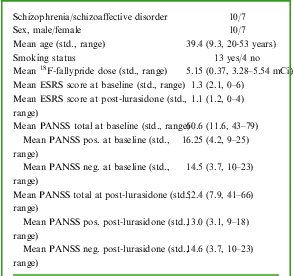
Five of the 25 subjects were not included in the analysis because they received only a baseline PET scan. Three additional subjects were excluded: 1 subject due to a failed drug abuse screen, and 2 subjects because their blood serum concentration of lurasidone was zero at all time points, indicating failure to comply with the study protocol. Data are presented from 17 subjects as described in Table 1.
Subject demographic and clinical variable means

ESRS-A = Extrapyramidal Symptom Rating Scale-Abbreviated; PANSS = Positive and Negative Syndrome Scale.
PET Imaging Data Collection
18F-fallypride PET scans were obtained using a high-resolution research tomograph (HRRT) camera (Siemens Medical Systems, Malvern, PA, USA).Reference Sossi, de Jong and Barker 16 18F-fallypride synthesis used the methods previously described in Mukherjee etal.Reference Mukherjee, Yang and Brown 1 , Reference Mukherjee, Christian and Dunigan 6 The HRRT is the highest resolution PET system commercially available. The HRRT has an axial field of view (FOV) of 25.3 cm and a transaxial FOV of 17.5 cm. It produces 207 image slices with an isotropic resolution of ∼2.5 mm3. PET reconstructions were performed using a 3D ordinary Poisson-ordered subset expectation maximization algorithm (3D OP-OSEM)Reference Hong, Chung and Kim 17 with 3D iterative scatter correction.Reference Hong, Burbar and Michel 18
Each PET scan was collected during 2 acquisition sessions with a small break in between. The first acquisition was collected over 80 minutes, and 26 frames were reconstructed (6 × 30 seconds, and 7 × 1, 5 × 2, 4 × 5, 4 × 10 minutes). The second acquisition was collected over an additional 80 minutes, and 8 frames were reconstructed (8 × 10 minutes). For attenuation correction, transmission scans were collected using a 30 mCi Cesium point source before the first acquisition and after the second acquisition. For anatomical reference, subjects received T1-weighted MRI scans using a 3.0 T Siemens Tim Trio scanner (MP-RAGE sequence, TR = 2300 ms, TE = 2.9 ms, flip angle = 9°, FOV = 22 cm2, matrix = 256 × 192). All scans were visually inspected for artifacts prior to analyses.
Image Processing and Statistics
Subject-specific anatomical regions of interest were obtained from the high-resolution MP-RAGE using Freesurfer 4.4.0 (http://surfer.nmr.mgh.harvard.edu/fswiki). Each patient's PET scan frames were co-registered to his/her own MRI using SPM8 (http://www.fil.ion.ucl.ac.uk/spm). The Freesurfer segmented brain was then overlaid on the PET frame data to generate an anatomical label for each PET voxel for each frame. Time–activity curves were generated for each labeled voxel, as well as for each region of interest (ROI) as a whole. Distributed volume ratios (DVRs) for each voxel within an ROI were computed using the Logan reference tissue model.Reference Logan JFowler and Volkow 19 The average of all voxels within the cerebellar cortex was used as the reference, as this area has low D2/D3 receptor densities. Fallypride has approximately equal affinities for D2 and D3 receptors.Reference Mukherjee, Yang and Brown 1 Lurasidone has high affinity for D2 and very low affinity for D3; therefore, fallypride occupancy measures reflect D2 occupancy. Voxel DVR values were averaged within each the following five bilateral ROIs: (1) caudate nucleus, (2) putamen, (3) nucleus accumbens, (4) globus pallidus, and (5) thalamus. For each ROI, a patient's change in receptor occupancy was defined as the percentage reduction of binding potential (BPlurasidone) relative to their own BP while in an antipsychotic-free state (BPcontrol), according to the following equation:
 $${\rm{\% }}\,{\rm{occupancy}}\, = \,{\rm{(1}}\,{\rm{ - }}\,{\rm{(B}}{{{\rm{P}}}_{{\rm{lurasidone}}}}{\rm{/B}}{{{\rm{P}}}_{{\rm{control}}}}{\rm{))}}\,\times \,{\rm{100}}\eqno\rm$$
Statistical analyses included all subjects at all time points with lurasidone serum concentration greater than zero when rounded to the nearest ng/mL (n = 29). Because blood lurasidone data were not normally distributed, Spearman rank order correlations were computed between serum lurasidone concentration and occupancy. Regression analyses examined the effects of dose and serum lurasidone concentration on D2 receptor occupancy. This analysis included post-dose time as a covariate. Regression analyses were performed to evaluate the lurasidone concentration necessary achieve a therapeutic occupancy level (SAS version 9.2 for Windows; SAS Institute Inc., Cary, NC, USA). The data were fitted by nonlinear regression analysis to the following equation:
 $${\rm{\% }}\,{\rm{occupancy}}\, = \,{\rm{(}}{{{\rm{E}}}_{{\rm{max}}}}\,\times \,{\rm{[}}{{{\rm{C}}}_{{\rm{lur}}}}{\rm{])}}\,{\rm{/}}\,{\rm{(E}}{{{\rm{C}}}_{{\rm{50}}}}\, + \,{\rm{[}}{{{\rm{C}}}_{{\rm{lur}}}}{\rm{])}}\eqno\rm$$
where Emax, the highest attainable receptor occupancy, was fixed at 100%. The parameter EC50 indicates the serum concentration predicted to achieve 50% occupancy and was calculated from the model, while [Clur] is the concentration of lurasidone+ID-14283 metabolite immediately prior to the PET scan. To evaluate the relationship between change in D2 receptor occupancy in regions of interest and change in clinical measures, Spearman partial correlations were computed.
Results
There were significant correlations (range in r = 0.60–0.79) between serum lurasidone concentration (parent and major metabolite ID-14283) and D2 receptor occupancy as measured by 18F-fallypride (Table 2). These findings indicate a strong relationship between serum lurasidone concentration and D2 receptor occupancy (Pearson product-moment correlations ranged from 0.64 to 0.82).
Spearman rank order correlations between blood serum concentration of lurasidone + major metabolite (ID-14283) and D2 receptor occupancy in each region of interest

Nonlinear regression analyses showed significant associations between serum lurasidone concentration and D2/D3 receptor occupancy in all regions examined (caudate: F(1,28) = 203.1, p < .0001; putamen: F(1,28) =164.5, p < .0001; nucleus accumbens: F(1,28) = 93.4, p < .0001; globus pallidus: F(1,28) = 136.0, p < .0001; thalamus: F(1,28) = 132.3, p < .0001; F(1,28) = 139.7, p < .0001).
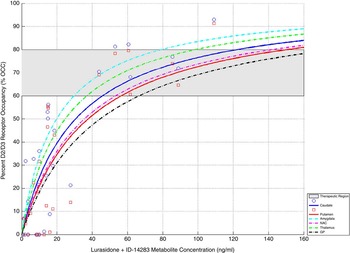
The relationship between occupancy and serum concentration of lurasidone is further described by the nonlinear regression curves for each ROI, as shown in (Figure 1). Figure 1 suggests that the total lurasidone serum concentration should be greater than 70 ng/mL in order to achieve a 65% occupancy level in the caudate, putamen, and nucleus accumbens. Estimates of the serum concentration to achieve similar occupancy were lower for the amygdala and thalamus and higher for the globus pallidus (Figure 1).
Nonlinear regression fit of percent D2 receptor occupancy by serum concentration of lurasidone plus ID-14283 metabolite for each region of interest. The data points for the caudate (blue) and putamen (red) are included, but not those for amygdala, nucleus accumbens (NAC), thalamus, and globus pallidus (GP) for figure clarity. The region of 60–80% occupancy is highlighted in gray.

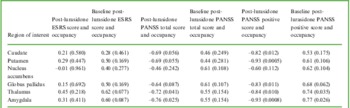
In contrast to the significant correlations between serum lurasidone concentrations and occupancy, there were no significant correlation between lurasidone dose and occupancy at Tmax (eg, caudate r = 0.37, p = 0.35; putamen r = 0.23, p = 0.59). To evaluate the relationship between clinical measures and D2 receptor occupancy in regions of interest, the Spearman partial correlation coefficient was computed using the PET scan session after lurasidone intake, with the number of hours post-dose added as the partial variable (Table 3). Following lurasidone administration, lower PANSS positive scores were associated with higher D2 occupancy for the caudate, putamen, globus pallidus, thalamus, and amygdala (negative correlations). “Baseline-post-lurasidone” indicates the change from baseline on assessment scores; positive numbers indicate clinical improvement on the PANSS correlated with increased occupancy. Thalamus and amygdala occupancy showed a significant correlation with positive symptom improvement.
Spearman rank order correlations (p-values) between PANSS total and PANSS positive symptom subscore measures and D2 receptor occupancy in regions of interest

Significant correlations at p < 0.05 are indicated in bold.
The PANSS and ESRS were administered within 2 days of the PET scanning session. There were no regions with significant correlations for D2 receptor occupancy with either the PANSS negative subscale totals post-lurasidone or the PANSS negative change scores. Similarly, there were no significant correlations of D2 receptor occupancy with either the ESRS score post-lurasidone or change scores (comparing ESRS at baseline to ESRS post-lurasidone).
Discussion
Serum concentration of lurasidone was significantly correlated with D2 receptor occupancy in all brain regions examined. These results are consistent with Wong etal,Reference Wong, Kuwabara and Brašić 20 who found significant correlations between both serum lurasidone and metabolite ID-14283 with D2 receptor occupancy in healthy male volunteers after a single dose (10–80 mg).
A nonlinear regression analysis allowed us to evaluate the lurasidone concentration necessary to achieve putative therapeutic occupancy levels. Serum concentrations greater than 70 ng/mL may be required to achieve a 65% occupancy level in the caudate, putamen, and nucleus accumbens. No relationship between occupancy and negative symptoms was observed. These data are in keeping with the occupancy threshold for clinical response suggested by Kapur etal Reference Kapur, Zipursky, Jones, Remington and Houle 21 and Farde etal.Reference Farde, Wiesel, Halldin and Sedvall 22 We did not observe a relationship between occupancy and Parkinson's symptoms as reported by Kapur etal Reference Kapur, Zipursky, Jones, Remington and Houle 21 ; however, we had very low rates of extrapyramidal symptoms (EPS) and akathisia.
In accord with PET D2 occupancy studies with ziprasidone,Reference Mamo, Kapur and Shammi 23 clozapine,Reference Gründer, Landvogt and Vernaleken 24 and aripiprazole,Reference Gründer, Fellows and Janouschek 25 we did not observe a correlation between serum concentration and dose; however, the small number of subjects did not make it possible to fully explore dose–plasma level relationships. This lack of dose concentration correlation is most likely related to intersubject variability in serum concentrations at a given dose of lurasidone (even when the subjects with very low lurasidone concentrations were excluded) and/or the difficulty some patients had in complying with the protocol's complicated dosing schedule and the related challenge of meeting the 350-calorie food requirement with dosing. Variability in lurasidone concentration may also be related to CYP450 3A4 metabolic status, which can also be significantly affected by BMI and smoking.Reference Rahmioglu, Heaton and Clement 26 The dosing schedule was restricted by the practicalities of 18F-fallypride synthesis requirements. Several subjects had extremely low (or zero) serum concentrations at doses that should have resulted in much higher serum concentrations, indicating a likely failure to comply with the study protocol. There are some limitations in the use of the cerebellum as a reference area; however, low levels of significant cerebellar D2 receptor binding have been reported.Reference Mukherjee, Christian and Dunigan 6 , Reference Pinborg, Videbaek and Ziebell 27 Our relatively small sample prevented us from considering the impact of clinical, demographic, and historical variables in our analysis, such as substance abuse, duration of illness, untreated psychosis, and medication history. The baseline PANSS total score was 60.6 following washout, indicating low severity of symptoms; therefore the results may not generalize to more acute patients in clinical practice.
An advantage of our study is that dosage assignment was at random, thus avoiding the confound that subjects who are more symptomatic are typically assigned to higher medication doses.
These data suggest that subjects with higher D2 occupancy on lurasidone may be the subjects who show a larger improvement in symptoms as measured by the PANSS, especially the PANSS positive subscale total. However, the study was not designed to specifically test this hypothesis.
When this study was designed, the highest approved lurasidone dose was 80 mg/day with a suggestion of less efficacy at 120 mg/day. A subsequent randomized clinical trial demonstrated that 160 mg/day was effective and possibly more effective than 80 mg/day.Reference Loebel, Cucchiaro and Sarma 10 This study indicates that some subjects achieve greater than 65% D2 receptor occupancy at the higher lurasidone doses and that these doses are associated with clinical improvement.
Conclusions
D2 receptor occupancy in all brain regions examined was significantly correlated with serum concentration of lurasidone but not with lurasidone dose. Serum concentrations greater than 70 ng/mL may be required to achieve a 65% occupancy level in subcortical structures—a level associated with improvement in positive symptoms. No relationship between occupancy and negative symptoms, however, was observed. The considerable variability in plasma levels and the associated D2 occupancy observed at fixed doses of lurasidone, in this and other studies, supports individualized dosing based on the patient's response in positive symptoms.
Disclosures
Steven Potkin has the following disclosures: Bristol-Myers Squibb, research, research support; Otsuka, advisory board, honoraria; Otsuka, speaker's bureau, honoraria; Roche, research, research support; Roche, advisory board, honoraria; Novartis, speaker's bureau, honoraria; Sunovion, research, research support; Sunovion, speaker's bureau, honoraria; Merck, speaker's bureau, honoraria; Takeda, research, research support; Takeda, advisory board, honoraria; Lundbeck, speaker's bureau, honoraria; Janssen, research, research support; Janssen, advisory board, honoraria; Amgen, research, research support. David Keator, Marilyn Kesler-West, Dana Nguyen, Theo G. M. van Erp, and Jogeshwar Mukherjee do not have anything to disclose. Adreian Preda has the following disclosure: Boehringer-Ingelheim, consultant, consulting fee.