Proverbs are figurative expressions such as silence is golden, haste makes waste, and early to bed, early to rise that convey the beliefs, social norms, or moral concerns of a society (Gibbs, Strom, & Spivey-Knowlton, 1997; Mieder, Reference Mieder1993; Nippold, Reference Nippold2007; Simpson, Reference Simpson1982; Whiting, Reference Whiting and Harris1932). Used to instruct, motivate, persuade, or clarify concepts (Gibbs, Reference Gibbs1994; Ibanez, Reference Ibanez2002; Obens, Reference Obens1996), proverbs occur in all known languages and cultures of the world, dating back at least to the ancient Egyptians (Katz, Reference Katz1999).
Proverbs often occur in fables that children and adolescents are asked to read in their literature books at school (Nippold, Hegel, Uhden, & Bustamante, 1998). For example, middle school students may be assigned to read Aesop's fable, “The Dog and His Shadow,” which concludes with the Greek expression, grasp at the shadow and lose the substance, a comment on greed (L'Estrange, Reference L'Estrange1906). Comprehending this proverb requires one to understand the story in which a dog sees a shadow of himself holding a steak in his mouth as he crosses a bridge over a river. Because the dog thinks his reflection in the water is another dog holding a bigger piece of meat, he tries to grab the steak, dropping it from his mouth into the river. The reader also must realize metaphorically how the dog's shadow represents excessive materialism, and how his quest for more than he needs causes him to lose what he already has, the substance.
Proverb comprehension gradually improves during childhood and adolescence, and even into adulthood (Billow, Reference Billow1975; Douglas & Peel, Reference Douglas and Peel1979; Nippold et al., Reference Nippold, Hegel, Uhden and Bustamante1998; Nippold, Allen, & Kirsch, 2000; Nippold & Haq, Reference Nippold and Haq1996; Nippold, Martin, & Erskine, 1988; Nippold, Moran, & Schwarz, Reference Nippold, Allen and Kirsch2001; Nippold, Uhden, & Schwarz, 1997; Power, Taylor, & Nippold, 2001; Resnick, Reference Resnick1982; Richardson & Church, Reference Richardson and Church1959), reflecting the protracted nature of later language development (Nippold, Reference Nippold2007). Factors that affect the comprehension of proverbs include the learner's analogical reasoning skills, reading proficiency, amount of formal education, and prior exposure to proverbs, as well as the difficulty of the expressions themselves (Nippold et al., Reference Nippold, Martin and Erskine1988, Reference Nippold, Uhden and Schwarz1997, Reference Nippold, Hegel, Uhden and Bustamante1998, Reference Nippold, Allen and Kirsch2000; Nippold, Allen, et al., 2001; Nippold & Haq, Reference Nippold and Haq1996; Nippold, Moran, et al., Reference Nippold, Moran and Schwarz2001).
Regarding the difficulty of proverbs, studies have shown that expressions containing concrete nouns (e.g., a rolling stone gathers no moss) are often easier than those containing abstract nouns (e.g., blame is safer than praise; Nippold & Haq, Reference Nippold and Haq1996; Nippold et al., Reference Nippold, Uhden and Schwarz1997, Reference Nippold, Hegel, Uhden and Bustamante1998). Nippold and Haq asked children and adolescents from Grades 5, 8, and 11 (n = 180) to interpret sets of concrete and abstract proverbs, with each expression occurring in a short story context. For example, the concrete proverb sleeping foxes catch no poultry occurred in a story that described a sprinter who was talented but did not win races because she often skipped workouts. Most participants (94%) readily understood this proverb, perhaps because they were able to visualize the metaphorical analogy in which a lazy sprinter was likened to a sleeping fox, and winning races was likened to catching chickens. In contrast, the abstract proverb the end justifies the means was understood by fewer participants (49%), perhaps because of difficulty visualizing how the nouns in this expression mapped onto a story in which a chess player was able to win a tournament, the end, by subtly distracting his opponent, the means.
Nippold and Haq (1996) suggested that this difference in difficulty between concrete and abstract proverbs might have resulted, in part, from the higher imagery values of concrete proverbs, a factor that might make it easier to mentally represent the expressions. As suggested by Paivio and Walsh (1993), metaphors may evoke vivid mental images, offering a “memorable and emotion-arousing representation of perceived experience” (p. 309). Nippold and Haq did not test their hypothesis concerning the role of mental imagery in relation to proverb comprehension. Nevertheless, the argument that concrete proverbs are easier to understand than abstract proverbs because the former evoke stronger mental images than the latter is consistent with dual coding theory (Gibbs, Reference Gibbs1994).
Dual coding theory is an established framework in cognitive psychology that helps to explain how people gain meaning from language (Paivio, Reference Paivio1971, Reference Paivio1986, Reference Paivio1991; Paivio & Walsh, Reference Paivio, Walsh and Ortony1993; Sadoski & Paivio, Reference Sadoski and Paivio2001). A key feature of the theory is the distinction between verbal information, which consists of associated words and phrases, and nonverbal information, which consists of associated mental images. As Sadoski (Reference Sadoski2005) explained, abstract nouns (e.g., truth) are more difficult to understand than concrete nouns (e.g., dog) because the former rely primarily on verbal information; in contrast, concrete nouns are easier because they are supported by two sources of information, verbal in addition to nonverbal (i.e., dual coding). In relation to metaphors, Paivio and Walsh (1993) explained that the presence of concrete terms “provides access to information-rich images” (p. 324), increasing the efficiency of interpretation.
In a relevant investigation, Sadoski, Kealy, Goetz, and Paivio (Reference Sadoski, Kealy, Goetz and Paivio1997) demonstrated that concrete nouns (e.g., mother, hotel, library) were easier for young adults (n = 48) to define than abstract nouns (e.g., fun, mind, science) equated for familiarity. When participants were asked to report on the mental strategies they used to define each word, visual imaging (picturing relevant objects or events) was more likely to be used with concrete nouns than with abstract nouns. With abstract nouns, strategies were primarily verbal (relating the nouns to other words or phrases) with little use of visual imaging. According to the investigators, mental images associated with concrete nouns helped to support their meanings, making these words easier to understand.
Regarding proverbs, there is evidence that these expressions vary in imageability. Higbee and Millard (1983) asked young adults (n = 51) to rate a set of 203 proverbs for the ease with which they could visualize each expression, using a 7-point Likert scale (1 = low imagery, 7 = high imagery). Expressions containing nouns that referred to tangible objects (i.e., concrete proverbs) were frequently rated as highly imageable, such as birds of a feather flock together (M = 6.47) and don't count your chickens before they're hatched (M = 6.57). In contrast, expressions containing nouns that referred to abstract entities (i.e., abstract proverbs) were among the least imageable such as brevity is the soul of wit (M = 1.59) and familiarity breeds contempt (M = 2.73).
Suggesting a link between mental imagery and proverb comprehension, Gibbs, Strom, and Spivey-Knowlton (1997) presented young adults (n = 24) with a list of 16 proverbs that were highly familiar and concrete (e.g., the early bird catches the worm, one rotten apple spoils the whole barrel, too many cooks spoil the broth). Participants wrote down their mental images of each expression in detail, and answered a set of questions that probed their understanding of the actions described in each proverb.
Gibbs et al. (Reference Gibbs, Strom and Spivey-Knowlton1997) reported that mental images for individual proverbs were often consistent across participants, and that responses to the probe questions reflected their understanding of the psychological concepts being expressed. For example, for the proverb the early bird catches the worm, participants often described an image of a bird aggressively competing with other birds to obtain the best available food, and many of them personified the bird by likening it to a human being who tried to beat all others. These findings were interpreted to support the view that people's images of proverbs reflect their ability to think metaphorically and to grasp the figurative meanings.
However, in the Gibbs et al. (Reference Gibbs, Strom and Spivey-Knowlton1997) investigation, participants’ mental images were not scored systematically, and there was no attempt to determine objectively if the images that people reported were linked to their understanding of the figurative meanings of the expressions. Hence, it remains to be determined if people's mental images of proverbs truly are associated with their own comprehension. If nonverbal information (imagery) supports language comprehension, as proposed by dual coding theory (Sadoski & Paivio, Reference Sadoski and Paivio2001), then it should be possible to demonstrate that mental images reflect comprehension. For example, if people fail to understand the figurative meanings of certain proverbs, perhaps their images of those expressions are quite literal. In contrast, if they understand the figurative meanings of other proverbs, perhaps their images for those expressions are more metaphorical. It is unlikely that a strong metaphorical image could occur without grasping the proverb's figurative meaning.
Consider the highly imageable proverb birds of a feather flock together (Higbee & Millard, Reference Higbee and Millard1983). Even without knowing its figurative meaning (i.e., like-minded people enjoy each others’ company), upon hearing this expression, it is easy to visualize a group of pink flamingos congregating in a shallow pool of water. This would represent a strong literal image. In contrast, if the figurative meaning of this proverb has been well learned, perhaps the individual goes beyond a literal image and instead, visualizes a group of teenaged girls, dressed similarly, gossiping at the mall. This would represent a strong metaphorical image. Children, adolescents, and adults differ in their comprehension of proverbs, with older people more likely to grasp the figurative meanings than younger ones (Nippold, Reference Nippold2007). Given this developmental pattern in comprehension, one might expect the mental images of adults to be more metaphorical than those of children. Prior to the present study, no investigators had examined the development of mental imagery for proverbs. Thus, it was important to determine if mental images for proverbs change in relation to increasing participant age, and if metaphorical images are associated with stronger comprehension of proverbs.
In contrast to proverbs, the development of mental imagery for idioms, another type of figurative expression, has been studied (Nippold & Duthie, Reference Nippold and Duthie2003). Idioms often occur in the form of verb phrases that have become conventionalized after years of repeated use (e.g., shake a leg, kick the bucket, paint the town red). As with proverbs, comprehension of idioms gradually increases during childhood, adolescence, and adulthood, and is associated with the learner's level of reading proficiency, amount of formal education, prior exposure to the expressions, and ability to infer meaning from the larger context in which the expression occurs (Brasseur & Jimenez, Reference Brasseur and Jimenez1989; Gibbs, Reference Gibbs1987, Reference Gibbs1991; Nippold, Reference Nippold2007; Nippold & Martin, Reference Nippold and Martin1989; Nippold & Rudzinski, Reference Nippold and Rudzinski1993; Nippold & Taylor, Reference Nippold and Taylor1995; Nippold, Taylor, & Baker, Reference Nippold, Taylor and Baker1996; Strand & Fraser, Reference Strand and Fraser1979).
Studies have also shown that some idioms are easier to understand than others, particularly when they are transparent rather than opaque (Gibbs, Reference Gibbs1987, Reference Gibbs1991; Nippold & Rudzinski, Reference Nippold and Rudzinski1993; Nippold & Taylor, Reference Nippold and Taylor1995). With transparent idioms, the literal and figurative meanings are closely related, allowing one to infer the figurative meaning from the literal meaning. For example, the literal meaning of the transparent idiom go by the book, to follow written directions (as in a cookbook) exactly, is closely related to its figurative meaning, to follow rules, regulations, and social norms without question. With opaque idioms, however, there is little overlap between the literal and figurative meanings, making it difficult, if not impossible, to infer meaning in this way. For example, the literal meaning of the opaque idiom bring the house down, to destroy a building, has little to do with its figurative meaning, to applaud a performance wildly. This difference in ease of understanding between transparent and opaque idioms is consistent with the metasemantic hypothesis of figurative understanding (Nippold & Rudzinski, Reference Nippold and Rudzinski1993). According to this hypothesis, upon initial exposure to an expression, the learner performs an internal analysis of it to make sense of the expression, a process that is more profitable when the literal and figurative meanings are related.
Regarding mental imagery, Nippold and Duthie (2003) asked children (mean age = 12 years) and adults (mean age = 27 years, n = 40 per group) to write down their mental images of 20 idioms that frequently occurred in American English. Half of the expressions were transparent (e.g., go by the book) and half were opaque (e.g., paint the town red). After completing the imagery task, participants took a multiple-choice idiom comprehension task, where each idiom was presented in the context of a short story. Participants selected the best interpretation of the idiom from four answer choices.
Nippold and Duthie (2003) reported that mental images of idioms were closely associated with comprehension of the expressions; that the adults outperformed the children on both tasks; and that transparent idioms evoked metaphorical images more often than did opaque expressions. For example, for the transparent idiom go by the book, a child replied, “I hear someone reading a book” (p. 798), a literal image, whereas an adult replied, “I can hear the stern librarian telling me to be quiet in the library” (p. 799), a metaphorical image. In addition, close examination of all literal responses revealed a mixed literal-metaphorical subtype, an image that was primarily literal but contained elements of the figurative meaning of the idiom. For example, for go by the book, an adult described the image of “A nerdy looking person on a job site who refers to his book of instructions every time a questionable moment arises” (p. 798). Adults reported this mixed image more often than did children, and both groups reported it more often with transparent than with opaque idioms. Nippold and Duthie interpreted their findings as support for the hypothesis that “conceptual metaphors underlie the figurative meanings of idioms and that tacit knowledge of these metaphors is expressed through the mental images people describe” (p. 790), first argued by Gibbs and O'Brien (1990).
Notably, the mixed literal–metaphorical image reported by Nippold and Duthie (2003) was also identified by Bortfeld (Reference Bortfeld, Heredia and Altarriba2002) in a study that examined mental images of idioms in adults (n = 50). Half of the participants in Bortfeld's study were native speakers of English and half were nonnative speakers whose primary language was Latvian. Participants were presented with 25 common American idioms, in random order, that expressed different psychological concepts such as insanity (e.g., go off your rocker), anger (e.g., blow your stack), and revelation (e.g., spill the beans). They were instructed to describe their mental images of each idiom, based on its literal meaning. Results indicated that, for both speaker groups, the “hybrid” image was the most common response type, one that combined elements of the literal and figurative meanings. For example, a hybrid image of go off your rocker was “a crazy woman rocks and rocks in her rocking chair until she loses her grip on the chair and flies off” (p. 281). Literal (e.g., “Getting off my rocking chair to get food,” p. 281) and figurative (e.g., “The old man loses his mind,” p. 281) images also occurred but were less common for both speaker groups. It is intriguing that, despite instructions to focus on the literal meanings of the idioms, both groups of adults often included figurative elements in the images they described. Although the nonnative speakers were less familiar with the idioms than the native speakers, it appears that they too attempted to make sense of them at a figurative level. This strengthens the claim that mental images reflect figurative understanding.
Studies have demonstrated a link between mental imagery and figurative understanding for idioms (e.g., Bortfeld, Reference Bortfeld, Heredia and Altarriba2002; Gibbs & O'Brien, Reference Gibbs and O'Brien1990; Nippold & Duthie, Reference Nippold and Duthie2003), yet questions remain with respect to proverbs. Thus, we were motivated to conduct the present investigation. Its purpose was to address the following questions:
1. Does mental imagery for proverbs undergo developmental change during the years between late childhood and early adulthood?
2. Is there a relationship between mental imagery for proverbs and comprehension of those same expressions? In other words, do easier proverbs evoke stronger (i.e., metaphorical) images than more difficult ones?
Method
Participants
The participants included children, adolescents, and adults whose respective mean ages were 11 years, 8 months (11;8; range = 11;1–12;2), 17;0 (range = 16;1–17;9), and 23;6 (range = 20;1–29;9). Those ages were selected because previous research had indicated that growth in proverb understanding may be more evident by comparing groups separated by several years (e.g., Nippold et al., Reference Nippold, Martin and Erskine1988, Reference Nippold, Hegel, Uhden and Bustamante1998).
There were 70 participants in each age group, and all spoke English as their primary language. The children and adolescents (enrolled in Grades 6 and 11, respectively) attended public schools in a district in western Oregon that represented a mix of socioeconomic levels, including lower middle to upper middle income family backgrounds. According to their teachers, no students had been identified for special education services or had any known deficits in hearing, cognition, learning, communication, or emotional/behavioral skills. The adults were undergraduate and graduate students attending a public university in western Oregon. Based on self-report, no adults had any known deficits in language, learning, cognition, or hearing. The adults’ socioeconomic backgrounds ranged from lower middle to upper middle income.
Procedures
All participants were tested in large group fashion in their public school or university classrooms. Each was given a booklet that contained a brief written description of the directions along with the experimental tasks. The adults were asked to read the directions silently before proceeding with the tasks. In testing the children and adolescents, the examiner read the directions aloud as the students followed along.
Tasks
The mental imagery task was always administered first, followed by the proverb comprehension task. This order was employed because it was thought that the story contexts contained in the comprehension task might influence the participants’ images of the proverbs. This sequence helped to elicit unbiased responses on the imagery task.
Each task contained the same 20 proverbs, presented in a different random order. Each proverb consisted of an independent clause that contained two nouns, both of which were concrete (e.g., a good sailor likes a rough sea; the restless sleeper blames the bed; one bad apple spoils the barrel). The concreteness of the nouns had been verified in a previous study (Nippold & Haq, Reference Nippold and Haq1996). Concrete proverbs were employed because past research (Higbee & Millard, Reference Higbee and Millard1983) had indicated that they were likely to evoke stronger mental images than abstract proverbs. In another study (Nippold & Haq, Reference Nippold and Haq1996) each expression had been rated for familiarity by asking adolescents (mean age = 18;0, n = 40) and adults (mean age = 36;11, n = 40) to indicate how often they had heard or read the proverb before, using the following rating system: 1 = never, 2 = once, 3 = a few times, 4 = several times, 5 = many times. The proverbs used in the present study had a mean familiarity rating of 2.50 (moderate) but ranged in familiarity from low (<2; e.g., scalded cats fear even cold water) to high (>3; e.g., the early bird catches the worm).
To introduce the tasks, the following information was provided on the cover page of the booklets. Participants were asked to follow along as the examiner read aloud:
We are conducting a research project on figurative language. This includes expressions such as “Barking dogs seldom bite” and “All that glitters is not gold.” We would like your help with the project by answering some questions. You will need to use a pencil or a pen, whichever you prefer.
The participants then were asked to provide their name, date of birth, age, grade, and primary language spoken at home on the cover page of their booklets. After this activity was completed, they turned the page and the experimental tasks were presented.
Mental imagery task
The mental imagery task was designed for the present study. Participants were asked to write down a brief description of their images for each proverb. Before they began the experimental task, they were given examples of images that a person might have for two proverbs that were not part of the task. The purpose of the examples was to ensure that all participants understood that they were expected to describe their mental images, not to explain the proverbs’ meanings. The examples offered literal images rather than figurative to avoid confusion, particularly for the children, if they did not understand the figurative meanings. Based on past research (Nippold & Duthie, Reference Nippold and Duthie2003), it was expected that if participants understood the proverbs, their images would include figurative elements or be entirely figurative despite the literal examples. The following instructions were presented in print and read aloud to the groups:
We would like to learn what people imagine when they hear different figurative expressions. For example, when you hear the expression, “Look before you leap,” you might imagine yourself glancing around a dusty trail before you're about to jump across a creek. You might feel a cool breeze on your neck. You might hear the water in the creek rushing by, and the leaves rustling in the trees above . . .
What do you see, feel, or hear when someone uses the expression, “Don't put all your eggs in one basket?” You might imagine a little girl collecting plastic eggs filled with jellybeans. She is carrying a small, purple basket with a long handle over her arm. She smells fresh flowers and cut grass as she hurries to gather all of the eggs that she sees. She hears other children shouting as they find eggs. She feels the weight of the basket on her arm as her basket fills. You might even imagine her basket tipping and some of the eggs spilling out.
We are interested in what you see, feel, or hear in your mind when you read the following expressions. Starting on the next page, there are 20 different expressions. Please write down what you imagine when someone uses each one. There are no “right or wrong” answers. Remember: Don't write what you think the expression means. You will be asked to interpret them later. Please just describe your mental images for this part.
Scoring
It was of interest to determine the degree to which people's mental images expressed literal versus figurative concepts. For each proverb, the figurative meaning and its associated psychological concepts were listed on an information sheet that was used to assist in scoring the responses. This information was derived from a variety of reference books on proverbs (Fergusson, Reference Fergusson1983; Mieder, Kingsbury, & Harder, Reference Mieder, Kingsbury and Harder1992; Ridout & Witting, Reference Ridout and Witting1967; Simpson, Reference Simpson1982). To evaluate each response, a 4-point scoring system, adapted from Nippold and Duthie (2003), was employed. Shown below, all examples pertain to the expression the tongue is sharper than the sword:
0 = Irrelevant. The response is unrelated, vague, incomplete, or incorrect. This includes responses such as “I don't know” and “You have a long tongue,” and leaving the answer space blank.
1 = Literal–concrete–relevant. The response describes a relevant image using words from the proverb, but does not express the psychological (metaphorical) meaning of the proverb, for example, “A tongue darting out of a person's mouth with a pointy end.”
2 = Literal–metaphorical–relevant. The response describes a relevant image using words from the proverb, and expresses the psychological (metaphorical) meaning by describing an emotion, thought, or feeling, for example, “A tongue hurting someone with mean words.”
3 = Figurative–metaphorical–relevant. Using different words from the proverb, the response describes a situation where the proverb could be spoken, expressing the psychological (metaphorical) meaning, for example, “I hear a witty, cutting comment during a verbal debate.”
Images that were entirely figurative received the highest score because they reflected an ability to go beyond the proverb's literal meaning. It was assumed that a response of this nature could not occur without having fully internalized the figurative meaning. Images that contained both literal and figurative elements received the next highest score, followed by those that were entirely literal. Points were assigned in this manner because in past research involving idioms (Nippold & Duthie, Reference Nippold and Duthie2003), adults produced more images that contained figurative elements than did children.
Using this system, the 20 images produced by all 210 participants (20 × 210 = 4,200) were scored independently by two of the investigators. Interscorer reliability was calculated by dividing the total number of agreements by the total number of items scored (1,400) for each age group separately. For the groups of children, adolescents, and adults, the total number of agreements and the resulting levels of reliability were 1,320 = 94%, 1,266 = 90%, and 1,235 = 88%, respectively. Thus, for all groups combined, interscorer reliability was 91% (3,821/4,200 = 0.91). All disagreements were resolved through discussion so that 100% agreement was attained between the two investigators.
Proverb comprehension task
The proverb comprehension task was first administered in a study that was conducted over 10 years ago (Nippold & Haq, Reference Nippold and Haq1996) where its original design and development was described in detail. The task has since been employed in several other studies (Nippold, Allen, et al., 2000, 2001; Nippold et al., Reference Nippold, Hegel, Uhden and Bustamante1998; Nippold, Moran, et al., Reference Nippold, Moran and Schwarz2001) with minor revisions. It was selected for use in the present study because of its efficiency and objectivity in administration and scoring. For this investigation, the task contained 20 multiple-choice questions that examined the participants’ understanding of each proverb's figurative meaning. Each question consisted of a short paragraph with a concluding proverb. Four answer choices followed each paragraph. Participants were asked to circle the letter of the choice that best expressed the proverb's meaning. An example of a question on the experimental task was as follows:
Barb and Kay were assigned to plan their school picnic together but could never agree on anything. One day they got into a huge argument over the decorations, food, and music, and Barb called Kay a horrible name. Later, Kay told her mom what Barb had said. Mom said, “The tongue is sharper than the sword.”
What does it mean to say the tongue is sharper than the sword?
A. A compliment is better than a criticism
B. People should always use good manners
C. Words can hurt more than hitting
D. Most people like to be praised
To administer the comprehension task, the following information was read aloud to the participants as they followed along in their test booklets:
Your booklet contains 20 short stories. The stories are about young people and some situations in which they sometimes find themselves. Each story contains a figurative expression and asks a question about its meaning. There are four answer choices. Read each answer choice carefully. Then choose the best one. Choose the answer that you think best explains the meaning of the expression. Draw a circle around the letter of your choice—A, B, C, or D.
Following this introduction, two practice problems were presented that were identical in style to the experimental problems. After the students completed the practice problems, the examiner asked the students to call out the correct answers. After confirming the correct responses, the examiner read aloud the following directions:
Now we would like you to answer the rest of the questions by yourselves. Please do your own work, and don't share answers with your neighbors. Some problems may be easy for you, whereas others may be more difficult. If some problems seem difficult, don't worry. Just try to do your best work. Read each story and the four answer choices carefully. If you aren't sure of the best answer, take a guess and pick the one that you think is best. After you finish, go back and check your work. Make sure you didn't skip any problems.
Results
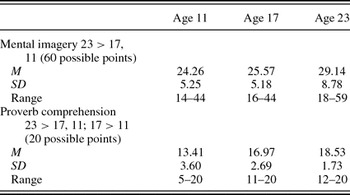
Each participant earned a total raw score on each task, Imagery (20 × 3 = 60 possible points) and Comprehension (20 × 1 = 20 possible points). Performance on the two tasks is reported in Table 1 for the three age groups. In terms of the percentage of total possible points, the following mean scores were obtained by the children, adolescents, and adults, respectively: imagery = 40, 43, and 49%; comprehension = 67, 85, and 93%. To examine group differences, a one-way analysis of variance (ANOVA) was performed on each task. Effect sizes were computed using the eta-squared coefficient (η2). The resulting effect sizes were interpreted as follows: small = .01–.04, medium = .05–.13, and large = .14–.50 (Cohen, Reference Cohen1969). The labels small, medium, and large indicate the degree to which group membership can account for the findings (Meline & Paradiso, Reference Meline and Paradiso2003). When group differences were statistically significant, Tukey's studentized range test (p = .05) was used to determine where they occurred.
Performance on the tasks for the three groups of participants (70/group)

Note: There was a statistically significant difference between groups.
The results yielded statistically significant effects for both tasks: imagery, F (2, 209) = 10.21, p < .0001, η2 = .09; and comprehension, F (2, 209) = 62.30, p < .0001, η2 = .37. The effect size was medium for imagery and large for comprehension. Tukey tests indicated that the adults outperformed the adolescents and the children on imagery and comprehension and the adolescents outperformed the children on comprehension. The adolescents and children did not differ on imagery.
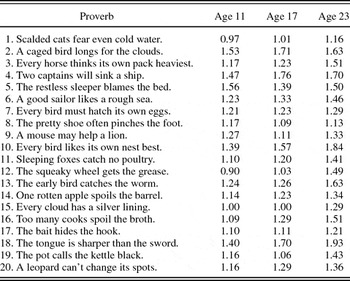
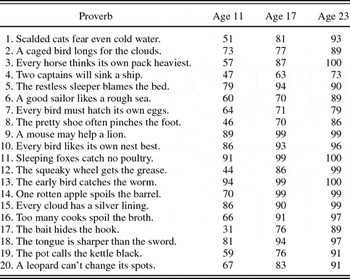
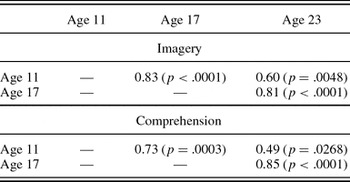
The 20 proverbs are listed with their mean scores on imagery and comprehension, respectively, in Tables 2 and 3, with the results shown for each group separately. To determine if the groups performed similarly in responding to the proverbs, correlation coefficients were calculated for each variable, imagery and comprehension, using the mean scores for each proverb, reported in the tables. The results, shown in Table 4, were positive and statistically significant, with the coefficients particularly strong between the children and adolescents, and the adolescents and adults.
Mean imagery scores for each proverb

Note: 0 = irrelevant, 1 = literal–concrete–relevant, 2 = literal–metaphorical–relevant, 3 = figurative–metaphorical–relevant.
Mean comprehension scores (percentages) for each proverb

Correlation coefficients calculated between each age group for each task

Note: All are statistically significant results.
To examine the relationships between tasks, Pearson product–moment correlation coefficients were calculated using the raw scores that each participant had obtained on imagery and comprehension. Statistically significant coefficients were obtained for the children (r = .43, p = .0002) but not for the adolescents (r = .06, p > .05) or the adults (r = −.15, p > .05). The absence of statistically significant coefficients for the two older groups may have resulted from ceiling effects on comprehension. Many of the adolescents (50%) and adults (81%) in this study earned scores of at least 90% accuracy on this task, which restricted the amount of variance within each of these groups. In contrast, far fewer children (11%) performed at ceiling level on comprehension.
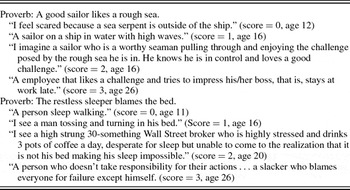
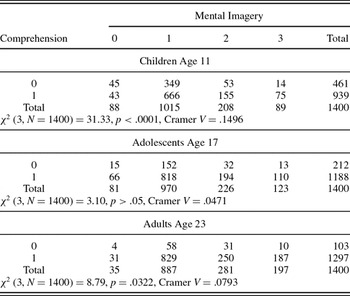
Hence, to explore these relationships further, analyses were performed to examine proverb comprehension in relation to the types of mental images that each expression evoked. As described previously, on comprehension, each response earned a score of 0 (incorrect choice) or 1 (correct choice), and on imagery, each response earned a score of 0 (irrelevant), 1 (literal–concrete–relevant), 2 (literal–metaphorical–relevant), or 3 (figurative–metaphorical–relevant). Examples of these types of responses on imagery, produced by participants in this investigation, are shown in Table 5. Using the frequencies with which each of these scores occurred, a 2 × 4 (Comprehension × Imagery) contingency table was constructed separately for each group, with the data reported in Table 6. Chi-square tests yielded statistically significant results for the children, χ 2 (3, N = 1,400) = 31.33, p < .0001, and the adults, χ 2 (3, N = 1,400) = 8.79, p = .0322, but not for the adolescents, χ 2 (3, N = 1,400) = 3.10, p > .05. To measure the strength of these relationships, the Cramer V coefficient was calculated (Meline & Schmitt, Reference Meline and Schmitt1997), yielding small effect sizes (Cohen, Reference Cohen1969, p. 111; children, V = .15; adolescents, V = .05; adults, V = .08). In sum, these findings provide evidence of an association between proverb comprehension and mental imagery in older children and young adults.
Examples of mental images

Note: Scores and participants' ages are indicated. 0 = irrelevant, 1 = literal–concrete–relevant, 2 = literal–metaphorical–relevant, 3 = figurative–metaphorical–relevant.
Contingency report of how frequently proverbs were comprehended in relation to the types of mental images they evoked

Note: 0 = irrelevant 1 = literal–concrete–relevant, 2 = literal–metaphorical–relevant, 3 = figurative–metaphorical–relevant.
Inspection of Table 6 indicates that on imagery, the score most frequently obtained by all groups was literal–concrete–relevant (1), followed by literal–metaphorical–relevant (2). In addition, it appears that the frequency of figurative–metaphorical–relevant images (3) increased as the frequency of irrelevant (0) images declined with each successive age group. To examine these patterns statistically, a series of one-way ANOVAs was performed on each response type (0, 1, 2, 3) individually and by combining the two metaphorical types (2 + 3 = “metaphorical”). Bonferroni corrections for multiple F tests (adjusted α = .01) were employed. Results were statistically significant for the combined metaphorical type, F (2, 209) = 7.98, p = .0005, η2 = .07, but not for any of the other types, including irrelevant, F (2, 209) = 3.49, p = .0323, η2 = .03, literal–concrete–relevant, F (2, 209) = 2.72, p = .0681, η2 = .03, literal–metaphorical–relevant, F (2, 209) = 3.14, p = .0453, η2 = .03, or figurative–metaphorical–relevant, F (2, 209) = 3.56, p = .0303, η2 = .03. The effect size was medium for the metaphorical response type. Tukey tests indicated that the adults produced metaphorical images more frequently than did the adolescents or children, but that the adolescents and children did not differ in the frequency of metaphorical images they produced.
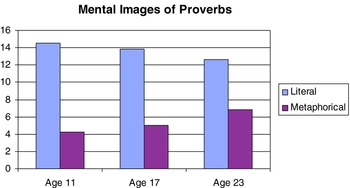
Because the metaphorical response type was the only one that evidenced an age-related increase, it was of interest to compare its frequency of occurrence to the most common type of response, literal. A series of dependent t tests (with Bonferroni corrections; adjusted α = .02) indicated that literal responses were more frequent than metaphorical for every age group: children (t = 10.65, p < .0001, d = 2.47); adolescents, t = 9.57, p < .0001, d = 2.24; adults, t = 5.13, p < .0001, d = 1.22). The magnitude of the difference between literal and metaphorical responses, computed by the Cohen d, was very large for each group (Cohen, Reference Cohen1988). These patterns are shown graphically in Figure 1.
The mean frequency of literal versus metaphorical images of concrete proverbs produced by children, adolescents, and adults (n = 70 per group). [A color version of this figure can be viewed online at www.journals.cambridge.org]

Discussion
The development of mental imagery in relation to the comprehension of concrete proverbs was examined in children, adolescents, and adults. It was predicted that imagery and comprehension would show age-related changes, and that imagery would be associated with comprehension, in keeping with dual coding theory (Sadoski & Paivio, Reference Sadoski and Paivio2001). This is the view that nonverbal information (e.g., related imagery) supports language comprehension along with verbal information (e.g., related words and phrases). The results showed that mean raw scores on both tasks increased in relation to age, and that the two domains were associated in children and adults but not in adolescents.
Mental imagery
Although mental imagery for proverbs has been studied in adults (Gibbs et al., Reference Gibbs, Strom and Spivey-Knowlton1997), this is the first study to examine imagery in children and adolescents in addition to adults. It is also the first to perform a systematic scoring and analysis of participants’ mental images of proverbs in relation to their performance on an objective measure of proverb comprehension, a task that had been used in previous studies (e.g., Nippold & Haq, Reference Nippold and Haq1996; Nippold et al., Reference Nippold, Hegel, Uhden and Bustamante1998, Reference Nippold, Allen and Kirsch2000) to document developmental change during this age range.
Upon comparing the groups in terms of the total possible points that could be earned, the findings indicated that mental imagery for concrete proverbs evidenced a gradual increase in relation to age, with the adults earning higher scores than the children and adolescents. The two younger groups did not differ in mental imagery.
It had been expected that the adolescents would outperform the children on imagery. The finding that they did not suggests that the task was challenging and that growth in mental imagery is a gradual process. Consistent with this perspective is the finding that not even the adults in this investigation approached mastery of the imagery task, earning only about one-half of the total possible points. This result also seems to reflect a pattern in which the most common type of mental image for each group was literal–concrete–relevant (1). This would suggest that a literal-concrete image is, in effect, a “good answer” in response to the question, “What does the expression make you see, hear, or feel?” To illustrate, the appropriateness of this type of image is apparent in relation to the proverb one bad apple spoils the barrel when an 11-year-old child wrote, “A big barrel of apples and a woman picks up one that is rotten and there are worms in it and the worms go to all the other apples.” Similarly, a 17-year-old adolescent reported, “I see these beautiful red apples and one that is all bad and rotten and stinks up the air,” and a 25-year-old adult described an image of “A wicker barrel of apples with a rotten apple on the top. All of the apples close to the rotten one are starting to turn bad as well.” Each of these images reflects tension between positive and negative forces and recognizes the destructive potential of an entity that has digressed from the norm.
Participants in all three groups were capable of reporting this type of image and frequently did so. Nevertheless, developmental change occurred, with the adults providing significantly more metaphorical images than the children or adolescents. Whereas irrelevant and literal images (scores of 0 and 1) remained static in relation to age, metaphorical images (combining scores of 2 and 3) became more frequent, revealing a subtle shift from primarily literal to increasingly metaphorical with age, a pattern that is evident in Figure 1. With respect to the “apple” proverb, for example, a 21-year-old adult described a metaphorical image of “A group of friends standing around, but then an unpleasant person walks by and disrupts the group.” This response is intriguing because the writer is likening a barrel of apples to a group of friends, and a rotten apple to an unpleasant person, evidencing analogical reasoning. This developmental pattern suggests that adults have a deeper and more metaphorical understanding of proverbs than children or adolescents, a level of understanding that is detected more readily on a descriptive mental imagery task than on a multiple-choice task of proverb comprehension.
Although the frequency of metaphorical images increased in relation to age, it is possible that the imagery task itself may have restricted this type of response. To ensure that participants would understand the task and describe their own images (rather than explain the proverbs), the examples used in the practice items focused on literal images. Perhaps this overemphasis on literal images inadvertently discouraged metaphorical responses. Had different procedures been used, it is possible that metaphorical images might have been more common. In a study of adults’ mental images of idioms, Bortfeld (Reference Bortfeld, Heredia and Altarriba2002) found that “hybrid” responses were far more common than literal or figurative responses. Hybrid responses were similar to the literal–metaphorical–relevant response type (score = 2) used in the present study. Apparently, Bortfeld did not provide examples of mental images but simply asked participants to “form mental images based on the literal meanings” (p. 279) of the idioms. Even so, the adults in her study went beyond purely literal images to include metaphorical elements. This tendency for adults to include metaphorical elements in their mental images for idioms was consistent with our findings for proverbs, although in the present study, only 20% of the adults’ responses were hybrid compared to 70% in Bortfeld's study. Future studies should attend to these issues to ensure that participants fully understand the task and offer their best responses.
Despite the age-related differences that occurred in mental imagery, the correlation coefficients reported in Table 4 indicate that the three groups responded similarly to this set of 20 concrete proverbs, particularly when comparing the children to the adolescents (r = .83) and the adolescents to the adults (r = .81). This suggests that for individuals of the age range between 11 and 29 years, certain proverbs may evoke stronger images than others, a pattern that is consistent with previous research (Higbee & Millard, Reference Higbee and Millard1983). For example, a caged bird longs for the clouds, two captains will sink a ship, and the tongue is sharper than the sword were among the most imageable proverbs, whereas scalded cats fear even cold water, the pretty shoe often pinches the foot, and every cloud has a silver lining were somewhat less imageable. Thus, it cannot be assumed that all proverbs are highly imageable just because they are concrete.
Comprehension
The adults in this study demonstrated better comprehension of proverbs than did the adolescents and children, and the adolescents demonstrated better comprehension than did the children. These age-related changes are consistent with previous developmental studies of proverb comprehension and replicate the earlier findings (e.g., Billow, Reference Billow1975; Douglas & Peel, Reference Douglas and Peel1979; Nippold et al., Reference Nippold, Martin and Erskine1988, Reference Nippold, Uhden and Schwarz1997, Reference Nippold, Hegel, Uhden and Bustamante1998, Reference Nippold, Allen and Kirsch2000; Nippold & Haq, Reference Nippold and Haq1996; Power et al., Reference Power, Taylor and Nippold2001; Resnick, Reference Resnick1982; Richardson & Church, Reference Richardson and Church1959).
In the present study, proverb comprehension was assessed using a multiple-choice response format, which is generally considered to be an easier method for children to demonstrate their understanding than an explanation task. As a group, the adults showed mastery of the task (M = 93% correct), the adolescents approached mastery (M = 85% correct), and the children were still in the process of learning the expressions (M = 67% correct). Perhaps the adults and adolescents possessed a greater amount of world knowledge or personal experience that contributed to their comprehension, or were able to make better use of context clues to determine the meanings. Despite these differences, the correlation coefficients reported in Table 4 indicate that the three groups performed similarly in comprehending the 20 proverbs. As with the imagery task, these relationships were particularly close between the children and adolescents (r = .73) and between the adolescents and adults (r = .85). In examining the ranges in this table, it appears that the proverbs varied in difficulty and that certain expressions were easier than others, a result that was consistent with previous investigations (e.g., Nippold & Haq, Reference Nippold and Haq1996; Nippold et al., Reference Nippold, Uhden and Schwarz1997). For example, a mouse may help a lion, sleeping foxes catch no poultry, and the early bird catches the worm were among the easiest proverbs to comprehend, while two captains will sink a ship, the pretty shoe often pinches the foot, and the bait hides the hook were among the most difficult for all three groups.
Imagery and comprehension
Given the similar patterns observed in mental imagery and proverb comprehension across groups, it was important to examine the relationships between the two tasks. Correlation coefficients revealed that imagery and comprehension were significantly associated for the children but not for the adolescents or the adults. As mentioned above, on the comprehension task, the children, as a group, showed the most variance in their performance, whereas the adolescents and adults performed near ceiling levels. This restricted variance on the comprehension task made it difficult to obtain statistically significant correlation coefficients between proverb comprehension and mental imagery. Had more difficult proverbs (e.g., abstract) been presented, it is possible that the correlation coefficients between comprehension and imagery may have reached statistical significance for the adolescents and adults. This possibility should be examined in future investigations that include participants from these same age groups.
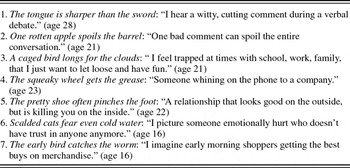
Nevertheless, the chi-square analyses provided evidence of an association between mental imagery and proverb comprehension in children and adults. As shown in Table 6, the children were more likely to describe relevant imagery (1, 2, or 3) if they also comprehended the proverb, but were more likely to describe irrelevant imagery (0) if they did not comprehend the proverb. One 11-year-old child's mental image of the bait hides the hook suggests that he possessed a strong figurative understanding when he wrote, “A computer pop-up saying you won an Apple iPod and you actually get a virus.” Similarly, in response to the pot calls the kettle black, that same child wrote, “A person who gets F's calling someone else who gets F's a flunky.” Both of these images were scored as figurative–metaphorical–relevant (3). In contrast, another 11-year-old child's image of the squeaky wheel gets the grease suggested confusion regarding the proverb's meaning when he wrote, “A man telling a joke to a person that finally got it,” a response that was scored as irrelevant (0). Regarding the adult group, all participants comprehended the proverb sleeping foxes catch no poultry and one described the mental image, “This makes me feel like if I don't wake up, life will pass me by.” This response, which was scored as figurative–metaphorical–relevant (3), reflects a sophisticated understanding of the proverb. Other examples of mental images that suggested this level of insight are shown in Table 7, many of which seem to reflect knowledge gained from personal life experiences and observations of human behavior. Similar patterns occurred in a developmental study of idiom comprehension and mental imagery (Nippold & Duthie, Reference Nippold and Duthie2003). Together, these findings support the view proposed by Gibbs and colleagues (Gibbs, Reference Gibbs1994; Gibbs et al., Reference Gibbs, Strom and Spivey-Knowlton1997; Gibbs & O'Brien, Reference Gibbs and O'Brien1990) that mental images of figurative expressions such as proverbs and idioms reflect an understanding of their nonliteral meanings and a tacit awareness of the underlying metaphorical concepts.
Examples of mental images that reflected a clear understanding of the proverb's figurative meaning (score = 3)

Note: The participants' ages are indicated.
The absence of a link between imagery and comprehension in the adolescents was an unexpected result, given the statistically significant findings for the other two groups. It is possible that this result stems from a discrepancy in development between these two domains. Although the adolescents, as a group, performed quite well on the comprehension task, their mental images of the expressions more closely resembled those of the children than the adults, giving the impression that imagery was lagging behind comprehension. Perhaps a stronger performance on imagery requires a greater amount of world experience, reflective insight, or interpersonal knowledge than what these adolescents possessed. A certain amount of prior exposure to specific proverbs used in the study (e.g., hearing relatives use proverbs in conversation) may also be required before a young person can internalize the figurative meanings well enough to produce metaphorical images. The adults, all of whom were university students, may have had the advantage not only of greater world experience and interpersonal knowledge but also of greater exposure to these particular proverbs compared to the adolescents and children. Although familiarity ratings were available for the proverbs used in this study, they were obtained 15 years ago from participants who were not part of the current cohort. Thus, it is unlikely that those ratings would reflect the perceptions of the children, adolescents, and adults who participated in the present study. In future research, the contribution of proverb familiarity to mental imagery should be investigated.
Conclusions
Proverb comprehension represents an aspect of later language development that gradually increases during childhood, adolescence, and into adulthood. This study investigated mental imagery in relation to the comprehension of concrete proverbs in participants between the ages of 11 and 29 years old. The findings revealed that children and adolescents are capable of generating relevant images of concrete proverbs, and performed as well as adults in generating strong literal images. Nevertheless, significant age-related change occurred in the tendency to produce mental images that reflected metaphorical elements of the proverbs, namely, to produce images that transcended the concreteness of the words contained in the expressions. This tendency to report a metaphorical image suggests that the proverb has been understood at a deeper level, leading the individual to conceptualize a situation where the expression could apply.
FUTURE RESEARCH
Further exploration of the development of mental imagery and proverb comprehension is needed. In the present study, the multiple-choice comprehension task was not as challenging to the adolescents and adults as it was to the children. As a result, the two older groups evidenced a restricted range of performance on the comprehension task. In the future, it will be important to present a more difficult comprehension task, perhaps one containing abstract proverbs (e.g., humility often gains more than pride, expectation is better than realization, gentle persuasion is better than force) in addition to concrete proverbs. Future studies also might employ some alternative assessment procedures. For example, participants might be asked to report their own experiences with each proverb as a measure of familiarity; to explain the figurative meanings as a measure of comprehension; and to describe situations where the proverbs could apply as a measure of mental imagery. These procedures may yield additional new insights. However, in judging participants’ responses on these sorts of tasks, it is suggested that a blind scoring system be employed. In scoring mental images, the present investigators attempted to ignore information on the test booklets that might reveal the ages of the participants. Greater efforts to ensure objectivity should be made in future research.
IMPLICATIONS FOR EDUCATION
Because proverbs often occur in literate contexts, it is important for educators to be aware of ways in which they might promote the learning of these expressions in students who struggle with figurative language comprehension. Research that reveals developmental patterns in youth can be informative. The present study determined that there is a gradual increase in the metaphorical nature of people's mental images of proverbs and that their images are associated with their own comprehension. Teaching the meanings of proverbs might best be achieved by beginning with concrete expressions that children in this study found easiest, using the comprehension scores in Table 3 as a suggested guide. Teachers could encourage students to form clear, literal images of an expression. The discussion then could encourage students to identify other characters and situations in which the proverb might apply, thus providing a bridge between the literal and figurative meanings. Some students might benefit from explicit attention to the analogical relationships of the literal to the metaphorical elements. For example, a lesson might begin with the early bird catches the worm, a proverb that all age groups in this investigation comprehended well. Following a discussion of the literal images that this expression evokes, the teacher may suggest that instead of a bird, the class imagine how the proverb might apply to a child on a school morning. Students could be asked to talk about situations that might have desirable outcomes if that child were to wake up early, get dressed, and arrive for school before class begins. To encourage analogical reasoning, the teacher might point out that although the child is represented by the early bird, events such as enjoy breakfast at school, trade baseball cards, play a computer game, or finish an art project are represented by the predicate catches the worm.
Little information is available in the educational literature on how to teach figurative language effectively in schools. Yet, given the intriguing nature of this topic, the frequent occurrence of figurative expressions, and the delightful ways in which they capture our attention, inform, and persuade us, the time is right for the design and evaluation of instructional programs that reflect what is known about development.
ACKNOWLEDGMENTS
We express sincere gratitude to the children, adolescents, and adults who participated in this investigation. We also thank the teachers and administrators who granted us permission to conduct the study and helped to organize the testing schedules.