INTRODUCTION
The monkfish Lophius gastrophysus occurs in the western Atlantic Ocean from North Carolina, USA, to Argentina (Figueiredo et al., Reference Figueiredo, Santos, Yamaguti, Bernardes and Rossi-Wongtschowski2002). It is the only species of Lophius off the Brazilian coast, where it is known as ‘tamboril’ or ‘toadfish’. Recently the species became the principal target of the fishing fleet that operates in depths of more than 200 m off the south-eastern and southern Brazilian coast (Perez & Wahrlich, Reference Perez and Wahrlich2005). It is much in demand because of its increasing value in the international fish market. The species is both a target of the deepwater gillnet fishery (Wahrlich et al., Reference Wahrlich, Perez and Lopes2004) and a bycatch component of the shrimp-trawler fishery (Vianna & Almeida, Reference Vianna and Almeida2005). Despite its economic importance and the increasingly intense fishing pressure (Perez et al., Reference Perez, Pezzuto and Andrade2005), biological data on this species are sparse and urgently needed.
The family Lophiidae is known for the presence of the illicium, the modified first ray of the dorsal fin, which has on its distal end an esca, a pendulous fleshy structure similar to a bait. This feature, together with a flat, deep body, benthic habit, large mouth, and small recurved teeth, suggest that these fish use an ambush strategy to attract and capture prey. The Lophiidae embraces four genera and 25 species (Caruso, Reference Caruso1983), of which Lophius is the most important genus because of the commercial value of its seven species. The lophiid predator habit, suggested by the anatomical lure device, has been confirmed by analysis of stomach contents (e.g. Crozier, Reference Crozier1985). Lophius gastrophysus was classified as a piscivore and benthic feeder in studies on feeding relationships of demersal fish off south-eastern and southern Brazil (Soares et al., Reference Soares, Gasalla, Rios, Arrasa and Rossi-Wongtschowski1993; Muto et al., Reference Muto, Silva, Vera, Leite, Navarro and Rossi-Wongtschowski2005).
The aim of the present study was to contribute to knowledge of the feeding ecology of this species, using fish obtained from commercial trawlers that operate off the coast of Rio de Janeiro. We analysed the feeding intensity, diet composition, and its variation among size-classes and during periods of three months. The prey items and the relationships between predator–prey length and weight were investigated.
MATERIALS AND METHODS
From April 2004, over a period of two years, 22 samples of L. gastrophysus, totalling 454 individual fish, were obtained consistently from the same commercial trawlers in the fishing port of Niteroi, Rio de Janeiro state. Total length (LT-cm) and total weight (WT-g) of each specimen were recorded. Each fish was dissected to identify the sex, the intestine length was measured, in cm, and the stomach was removed and fixed in 10% formalin. Prey items were identified to the lowest taxonomic level whenever possible. Whole prey items were measured and weighed; the others were only weighed. Items such as sciaenids otoliths were considered evidence of Sciaenidae prey; vertebrae and bones were considered as digested fish.
To evaluate ontogenetic variation in feeding activity, the frequency of stomachs containing some contents (%F) and empty stomachs (%E) among the length-classes for males (<31; 32–36; 37–47; >48 cm) and females (<31; 32–49; 50–67; >68 cm) were computed. Length-groups were established based on the length at first maturity of males and females (Valentim, unpublished). Males over 37 cm (LT) and females over 50 cm (LT) were considered adults; when the sexes were grouped, adults had an LT over 43 cm. To evaluate temporal variation in feeding activity, (%F) and (%E) were compared among periods of months. For both cases, the χ2 non-parametric test (Zar, Reference Zar1996) was performed at the 95% significance level (α = 0.05). The intestinal quotient (IQ) was calculated dividing the intestine length and fish total length. Values of IQ were determined for each size-class combining both sexes (<31; 32–42; 43–49; 50–64; >65 cm) and tested using a one-way analysis of variance (F; P < 0.05).
The food items found in the mouth cavity and/or oesophagus were not considered in the diet analysis, following Crozier (Reference Crozier1985) and Laurenson & Priede (Reference Laurenson and Priede2005). Frequency of occurrence and percentage weight as given by Hyslop (Reference Hyslop1980) were applied to characterize the diet. They were combined in the alimentary index (IAi) proposed by Kawakami & Vazzoler (Reference Kawakami and Vazzoler1980). The IAi was modified to percentage weight (%W) instead of percentage volume (%V), according to the equation: (IAi) = (%FO × %W)/Σ (%FO × %W) × 100, where %FO is the percentage frequency of occurrence of the food item, and %W is the percentage weight of the feeding item. Similarity analyses using the Bray–Curtis index were performed relating the IAi percentage of the food items to both the size-classes (for both sexes together) and to the fish capture months. The values obtained were entered in a similarity matrix for cluster analysis, using the Past Statistics Program (Hammer et al., Reference Hammer, Harper and Ryan2003) with a 0 to 1.0 variation. Length and weight of prey related to predator were evaluated using linear regression analyses (Zar, Reference Zar1996).
RESULTS
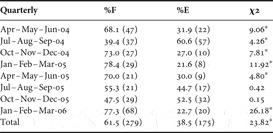
The total lengths of the individual fish ranged from 8.9 to 76.0 cm (mean±SD LT = 48.2±13.2 cm). Of 454 stomachs analysed, 61.5% (279) contained some prey items (‘full stomachs’) and 209 were females (52.9±12.4 cm) and 70 were males (37.0 ± 10.7 cm). The rate of full stomachs (F) differed significantly in males below 31 cm, in females over 32 cm and in the total analysed sample (Table 1). Empty stomachs (E) were recorded during the entire sampling period. The lowest rate of empty stomachs was recorded in the quarter January–February–March, 2005 (Table 2), with significant difference (χ2 = 11.92; P < 0.05).
Proportion of full stomachs (%F) and empty stomachs (%E) of Lophius gastrophysus per total length-class. Numerical frequency in parentheses; χ2 test; * indicates significant difference (P < 0.05).

J, juveniles; A, adults
Proportion of full stomachs (%F) and empty stomachs (%E) of Lophius gastrophysus, per period of three months. Numerical frequency in parentheses; χ2 test; * indicates significant difference (P < 0.05).

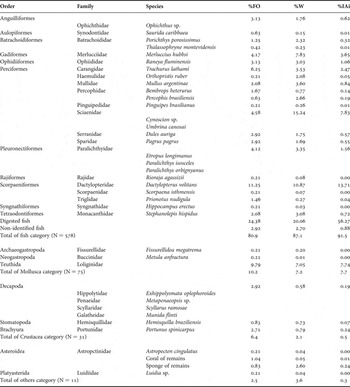
We identified 40 food items, grouped into four categories: fish, Mollusca, Crustacea and others. Fish was the principal category in the diet (IAi = 91.5%), followed by Mollusca (IAi = 7.7%), Crustacea (IAi = 0.5%) and others (IAi = 0.3%) (Table 3). In the fish category, the digested fish item predominated both in occurrence and in weight (20.4%), reaching the highest IAi value (56.3%). Among the 25 identified species distributed in 20 families, Dactylopterus volitans (flying gurnard) showed the highest IAi rate. The most important families in respect to frequency of occurrence were Dactylopteridae (11.2%), followed by Carangidae (6.2%) and Paralichthyidae (4.2%). In weight, the most important was Sciaenidae (15.1%), followed by Dactylopteridae (10.8%) and Merluccidae (7.7%). The other fish showed IAi values down to 1.1%. In the Mollusca category, squids were present in 10.2% of the stomachs, with a high IAi value (IAi = 7.7%). The categories Crustacea and others, such as starfish, sponges, and cnidarians showed IAi values down to 0.3% (Table 3).
Frequency of occurrence (%FO), percentage weight (%W) and alimentary index (%IAi) of items in the diet of Lophius gastrophysus. N, numerical frequency.

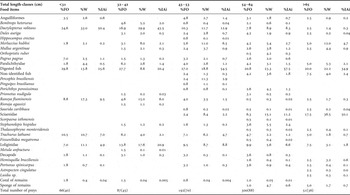
The diet composition in the different length-classes of L. gastrophysus is shown in Table 4. In the fish category, D. volitans. Merluccius hubbsi, Raneya fluminensis, Trachurus lathami and the digested fish were the main items and occurred in all size-classes. Paralichthyids were observed in all size-classes, despite the small percentage of occurrence and weight. Dactylopterus volitans showed the largest percentage in juveniles (<31 and 32–42 cm). The Mollusca category was the second most important, being present in all size- classes (Table 4).
Frequency of occurrence (%FO), percentage weight (%W) and alimentary index (%IAi) per total length-class of items in the diet of L. gastrophysus. (Number of the samples containing prey in parentheses.)

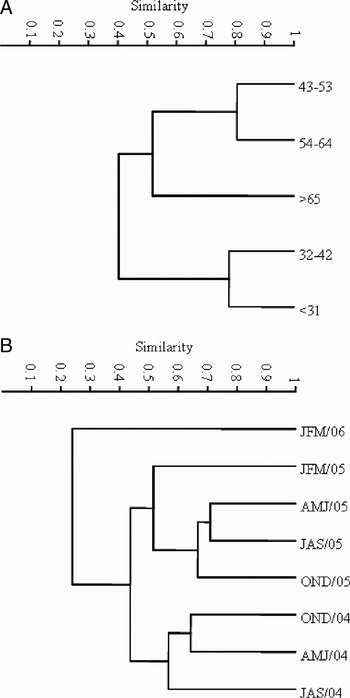
Cluster analysis of diet composition related to length (Figure 1A) indicated two main groups, associated with <31 and 32–42 cm and with 43–53 and 54–64 cm plus >65 cm. Considering that length at first maturity for both sexes combined was about 42 cm, the first two size-groups obtained in the dendrogram (<31 and 32–42 cm) corresponded to juveniles, and the larger fish, in the other size-group, to adults. The similarity was high, among juvenile and adult groups.
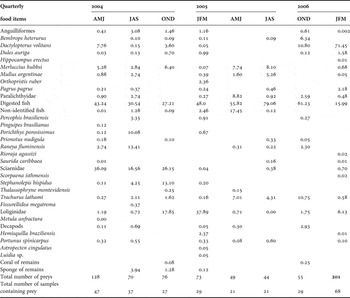
Variations in the predominance of consumed prey occurred. Anguilliformes, D. volitans, Dules auriga, M. hubbsi, Sciaenidae, Stephanolepis hispidus and T. lathami occurred in almost all samples in 2004; sciaenids reached the highest IAi value. In 2005, Paralichthyidae and T. lathami reached high IAi values (Table 5). The largest number of items occurred in 2004, but the feeding spectrum was more diverse in the quarter January–February–March, 2005. The second most consumed category was Mollusca; the squid item occurred in almost all the quarters of the year, mainly in summer and autumn of both years. Crustacea was not an important item in the diet, but decapods were the most consumed.
Alimentary index (%) of items consumed by Lophius gastrophysus.

AMJ, April–May–June; JAS, July–August–September; OND, October–November–December; JFM, January–February–March
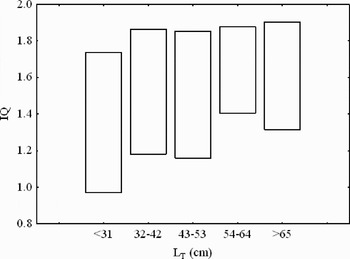
The cluster analysis of the IAi percentage of items consumed by L. gastrophysus in each quarterly sampling is shown in Figure 1B. The dendrogram showed two separate groups: 2005 samples and 2004 samples. Both groups had IAi values exceeding 27% for digested fish (Table 5). The highest similarity was observed between April–May–June, 2005 and July–August–September, 2005 (coefficient of about 0.7), as a consequence of high IAi values for digested fish and M. hubbsi. In general, the diet of L. gastrophysus was quite similar among the quarterly samples, promoted by the constant presence of fish items. The feeding habit with a tendency to piscivory was evident in all length-classes and throughout the two-year sampling period, varying only in the relative importance of the different items in the diet. The IQ was significantly different among the five length-classes (F = 9.54; P < 0.05; N = 443) (Figure 2).
Dendrogram based on the Bray–Curtis similarity index among (A) length-classes (by cm), and (B) among quarterly samples, based on the alimentary index (%) of items consumed by Lophius gastrophysus. JFM, January–February–March; AMJ, April–May–June; JAS, July–August–September; OND, October–November–December.

Intestinal quotient (IQ) values of Lophius gastrophysus per length-class; bars indicate standard deviation (N, sample size).

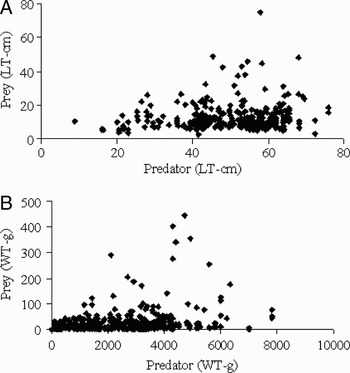
The linear regression analysis showed no correlation between total lengths of predator and prey items (N = 342; r = 0.13; P = 0.001), or the total weights of predator and prey items (N = 497; r = 0.22; P = 0.000001). On the other hand, the dispersion graphs in Figure 3 show that, regardless of its size, L. gastrophysus consumed mainly prey items of small size and low weight.
Relationship between (A) total lengths of Lophius gastrophysus and total lengths of prey items consumed and (B) between total weights of L. gastrophysus and total weights of prey items consumed.

DISCUSSION
The sample size of Lophius gastrophysus was larger than that taken on the inner continental shelf by Soares et al. (Reference Soares, Gasalla, Rios, Arrasa and Rossi-Wongtschowski1993), but similar to the sample size reported by Muto et al. (Reference Muto, Silva, Vera, Leite, Navarro and Rossi-Wongtschowski2005) on the outer continental shelf and upper slope. These are the areas exploited by commercial trawlers based in the state of Rio de Janeiro, from which the samples analysed in the present study were obtained. The proportion of empty stomachs was similar to that recorded by Olaso et al. (Reference Olaso, Pereda and González1982) and Crozier (Reference Crozier1985) for congeneric species. The high proportion of empty stomachs among individuals of L. gastrophysus can be explained by their exclusively fish-based diet. According to Nikolsky (Reference Nikolsky1978), the high nutritional value of this kind of diet reduces the need to ingest food continuously. On the other hand, Zavala-Camin (Reference Zavala-Camin1996) noted that a large number of empty stomachs might result from regurgitation of stomach contents, providing misleading information about the population behaviour. We have no records of the frequency of regurgitation in L. gastrophysus taken by the commercial trawlers that constituted our sample, but some stomachs were flaccid (5%), enlarged and filled with liquid. Crozier (Reference Crozier1985) suggested that, despite the lack of studies on the subject in Lophius piscatorius, the degree of digestion and the high rate of remains of non-identified fish indicate that the digestive process is slow. The same may hold true for L. gastrophysus, although some regurgitation may occasionally occur.
The possibility of incidental digestion of prey by fish caught in trawls poses a problem for the evaluation of their diet. Laurenson & Priede (Reference Laurenson and Priede2005) observed that prey were ingested during the tow in L. piscatorius, in addition to the stomach contents. The same was observed during our study, and these prey items were not considered in the diet analysis.
Lophius gastrophysus is essentially piscivorous, with a wide spectrum of prey, as previously demonstrated in other studies (Soares et al., 1983; Muto et al., Reference Muto, Silva, Vera, Leite, Navarro and Rossi-Wongtschowski2005). Armstrong et al. (Reference Armstrong, Musick and Colvocoresses1996), Laurenson et al. (Reference Laurenson, Hudson, Jones and Priede2004) and Preciado et al. (Reference Preciado, Velasco, Olaso and Landa2006) classified different species of Lophius as opportunists that take both benthic and pelagic prey, and even seabirds (Bigelow & Schroeder, Reference Bigelow and Schroeder1953). Based on this criterion, the presence of pelagic, benthopelagic and demersal prey in the stomachs of L. gastrophysus allows it to be classified similarly, although demersal prey predominate.
The stomach contents might reflect the spatial and temporal availability and abundance of the prey, as fisheries were carried out in similar areas and depths in both years. Muto et al. (Reference Muto, Silva, Vera, Leite, Navarro and Rossi-Wongtschowski2005) reported that in L. gastrophysus from south–south-eastern Brazil, Merluccius hubbsi and squid predominated in the stomach contents. Both of these resources are abundant in that area (Haimovici et al., Reference Haimovici, Wongtschowski, Bernardes, Santos and Fischer2002). Squid were also the second most important resource. However, among the items of the fish category, Dactylopterus volitans was the most important. The predominance of D. volitans in the stomach contents of juveniles of L. gastrophysus probably reflects the distribution of predators in shallower areas near the shore. Figueiredo & Menezes (Reference Figueiredo and Menezes1978) and Soares et al. (Reference Soares, Gasalla, Rios, Arrasa and Rossi-Wongtschowski1993) characterized D. volitans as a coastal benthic species that mainly eats crustaceans, molluscs and small benthic fish. It is recognized by commercial trawler fishermen as an indicator species of the presence of pink shrimp (Farfantepenaeus spp.). The life habit of D. volitans and the bathymetric stratification of L. gastrophysus, with smaller and immature individuals in shallower areas and larger and adult individuals in deeper areas (Perez et al., Reference Perez, Pezzuto, Andrade, Schwingel, Rodrigues-Ribeiro and Wahrlich2002), explains the importance of this prey in the diet of juveniles of L. gastrophysus. A similar bathymetric stratification was observed by Laurenson et al. (Reference Laurenson, Johnson and Priede2005) for Lophius piscatorius, with juveniles occurring in coastal areas and swimming to deeper waters as they grow. In L. gastrophysus, the juveniles consumed smaller quantities and variety of prey than did the adults, in contrast to the behaviour of L. piscatorius (Laurenson & Priede, Reference Laurenson and Priede2005) and Lophius americanus (Armstrong et al., Reference Armstrong, Musick and Colvocoresses1996; Scharf et al., Reference Scharf, Juanes and Rountree2000). The higher prey diversity in the diet of adults, however, might be a bias caused by the different sampling size. The prey-capture strategy of Lophius involves, besides attracting the prey by wiggling the illicium, a large and quite protractile mouth combined with a strong bone structure and a developed musculature, which forms an efficient suction mechanism (Paxton & Eschmeyer, Reference Paxton and Eschmeyer1998). Through the extreme expansion of the mouth and the gill cavity, the rapid opening of the mouth easily sucks in the prey (Paxton & Eschmeyer, Reference Paxton and Eschmeyer1998). Thus, the smaller size of the mouth of juveniles and, consequently, the amplitude of the oral cavity might explain the pattern observed. In fact, in L. americanus, the mouth opening increases about four times as fast as the fish grows (Scharf et al., Reference Scharf, Juanes and Rountree2000). On the other hand, it is noticeable that L. gastrophysus, despite capturing a larger variety and quantity of prey when adult, takes mainly small prey in spite of its large mouth.
The similarity among size-classes indicated gradual changes in diet composition during the growth of L. gastrophysus. Crozier (Reference Crozier1985) recorded the same pattern for L. piscatorius, and the importance of a crustacean (Nephrops) for the latter fish led him to suggest that lophiids may be the principal predator of this commercial fishing resource of Northern Ireland. However, the presence of D. volitans in stomachs of juveniles of L. gastrophysus and their capture by commercial trawlers indicates that this shrimp fishery may be having an impact on L. gastrophysus juveniles.
In fish, the dietary composition may vary seasonally because of alterations in food availability caused by changes in habitats available for forage, changes due to biological patterns of organisms and changes caused by feeding activity of the fish themselves (Wooton, Reference Wootton1990). The diet of L. gastrophysus showed some seasonal changes, as evidenced by the clustering of the same periods in both sampling years. Squid, for example, were more intensively consumed during summer. Some climatic differences occurred in the Equatorial Pacific Ocean during the two years of the study (www.cptec.inpe.br), which may have been reflected in fish communities of the Atlantic (Sánchez et al., Reference Sánchez, Calienes and Zuta2000).
In the relationship between feeding habit and digestive tract morphology of fish, carnivores tend to have shorter intestines compared to herbivores (Zavala-Camin, Reference Zavala-Camin1996). The low values of the IQ of L. gastrophysus confirm its carnivorous habit with a tendency to piscivory. Zavala-Camin (Reference Zavala-Camin1996) noted that fish which keep the same diet show a decrease in IQ as they grow, because daily consumption is relatively smaller in larger-sized individuals. In L. gastrophysus the length of the intestine did not follow the growth of the fish, despite the fact that both juveniles and adults are fish eaters.
In general, the size of the prey has a direct relationship with the size of the predator (Gerking, Reference Gerking1994); however, for L. gastrophysus, the linear regression between the predator length and the lengths of the prey items indicated only a slight correlation. Small, light prey tended to be consumed independently of the size of the predator, suggesting that L. gastrophysus shows low selectivity for prey. Thus, it consumes any prey of handling size and/or weight that it can attract, as observed by Crozier (Reference Crozier1985) for L. piscatorius. Therefore, considering that L. piscatorius juveniles and adults feed in the same area, intra-specific competition may occur. However, competition among different sized individuals in L. gastrophysus would be minimized by the dietary segregation observed between juveniles and adults.
ACKNOWLEDGEMENTS
This research was financially supported by a UFRJ-UNIVALI cooperative agreement (Contract UNIVALI-SEAP/PR/001/2003), and is part of Maria de Fátima M. Valentim's doctoral thesis at PPGE/UFRJ. We are grateful to CAPES (Coordenação de Aperfeiçoamento de Pessoal de Nível Superior) for Maria de Fátima M. Valentim's doctoral scholarship, and to CNPq (Conselho Nacional de Desenvolvimento Técnico e Científico) for Érica P. Caramaschi's research scholarship. We thank Mestre Sebastião da Silva for obtaining the samples analysed in this study; biologists Luis C.S. Junior and Amanda C. Andrade for their aid in identifying stomach contents, Dr Maria C. Ostrowski and biologist Tereza C.G.S. Ferreira for identification of crustaceans, and Dr Miriam P. Albrecht for suggestions on the manuscript. Dr Janet W. Reid revised the English text.