INTRODUCTION
Every hospital unit is a part of an organizational system. The concept of culture or organizational culture is not consistently described in the literature. It can be thought of as the “normative glue” in organizations (Sleutel, Reference Sleutel2000) or the sense-making and control mechanisms that guide and shape the behavior and attitudes of the members of an organization (Weick & Quinn, Reference Weick and Quinn1999). In general, a culture consists of three different levels: the observable artifacts as tangible or visible aspects of culture; the values as explicitly articulated norms, social principles, and ideologies; and the basic underlying assumptions as the deepest level or core elements of culture. These levels provide expectations that influence perceptions, thoughts, and feelings about the organization (Schein, Reference Schein1992; Scott-Findlay & Estabrooks, Reference Scott-Findlay and Estabrooks2006). In doing research in which the aim was to explore the specific factors in one special working culture, we decided to use a questionnaire based on psychometric principles, which aimed to describe all three different levels: the visible aspects, the norms, and the underlying assumptions (Bales & Cohen, Reference Bales and Cohen1979; Bales, Reference Bales1999; Sjøvold, Reference Sjøvold2006).
The special challenge for health care personnel in palliative medicine is working with patients who are in the last phase of their lives, in which the most important goal is to meet the dying person's specific questions, wishes, desires, and needs (Sepulveda et al., Reference Sepulveda, Marlin and Yoshida2002). To reach the goal of optimal quality of life in palliative medicine, there is a constant need for assessment and control of subjective symptoms (Kaasa & Loge, Reference Kaasa and Loge2003). However, implementation of new practice and new technological tools in these units can be hampered because of the underlying conflict between “high tech” and “high touch” (André et al., Reference André, Ringdal and Loge2009). Schröder et al. found that nurses working with terminal ill or dying patients had a high occurrence of psychosomatic complains on one hand and high satisfaction with work on the other hand (Schroder et al., Reference Schroder, Bansch and Schroder2004). Neergaard et al. reported as their most important finding that there was a need for better working culture and willingness to be equal team partners among health professionals working in palliative specialist teams in Denmark (Neergaard et al., Reference Neergaard, Olesen and Jensen2010). André et al. (Reference André, Ringdal and Loge2008a, 2009) conducted a study among healthcare workers at a palliative medicine unit (PMU) based on an implementation of a computerized tool, which had taken place at the unit 3 years earlier. The implementation did not result in any change in behavior and the computer was no longer in use. To be able to give the best possible care in these units, it is necessary to develop and improve practice through use of new technological tools and procedures. This can be challenging because of healthcare personnel's resistance to changes and “high tech.” To find the specific factors that may influence the work culture among healthcare personnel on these units, understanding and implementing changes in a successful manner will be important. Based on these assumptions, we wanted to examine the following research questions: What are the specific factors that characterize the work culture at a PMU? In what way may an implementation process be influenced by the work culture at a PMU?
METHOD
The study was conducted during the spring of 2004, to obtain knowledge about the work culture at a PMU in Norway.
Subjects and Data Collection
Of the 36 healthcare personnel working at the PMU, 26 (70%) filled in and returned the questionnaire. The sample consisted of 18 nurses, 2 physicians, 2 physiotherapists, and representatives of 4 other professions, in total 25 females and 1 male. The questionnaires were distributed and filled in at morning meetings (in ~10 minutes), or delivered to mailboxes for those who were not present at the meeting.
The Instrument and Data Analysis
The Systematizing Person-Group Relations Instrument (SPGR) (Sjøvold Reference Sjøvold1995, Reference Sjøvold2002, Reference Sjøvold2006, Reference Sjøvold2007) was used for data collection and analyses. The respondents were asked to describe the present situation, “our culture today,” at the unit. Each item was rated according to whether the behavior described never or seldom occurred (1), sometimes (2), or often or always occurred (3). The numbers describe a mean value on a linear scale from 1 to 9.
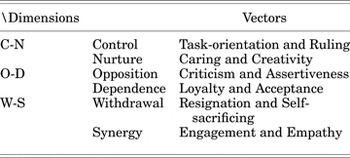
In SPGR, the organizational culture is described by the organizations' predominant behavior. The organizational behaviors are described along dimensions labeled as; Control and Nurture (C-N), Opposition and Dependence (O-D), and Withdrawal and Synergy (W-S), and each dimension has two vectors applied (Table 1). The SPGR is a balance model, which means that if there is much of something, for example, loyalty and acceptance, there is less of the opposite, criticism and assertiveness.
Description of dimensions and vectors

The SPGR analysis was used to display the typical work culture in the organizational unit. As a reference group, the “Norwegian Norm” was used, which consists of the average of 340 ratings of well-functioning Norwegian organizations using the same scale. We display this reference group as a guide to qualities that probably are important in organizations but not as a demand or a norm, more as an ideal (Sjøvold Reference Sjøvold1995, Reference Sjøvold2002). The “Control” dimension is in focus when analytical, task-oriented, or autocratic behavior dominates, “Nurture” dimension is in focus when caring, empathic, or spontaneous behavior dominates; “Opposition” dimension is in focus when critical, assertive, or self-sufficient behavior dominates. Furthermore, “Dependence” dimension is in focus when passive and obedient behavior dominates, “Synergy” is in focus when engagement and constructive goal-orientated behavior dominates, and “Withdrawal” behavior is characterized by restriction from contribution and commitment to initial role as the dominant behavior. The findings in the present study will be compared with the reference group, and possible differences compared with the reference group will be discussed.
The validity and reliability of the SPGR has been confirmed in previous studies (Koenigs et al., Reference Koenigs, Hare and Hare2002, Reference Koenigs, Hare, Hare, Hare, Sjovold and Baker2005). The theoretical foundation for SPGR (Sjøvold, Reference Sjøvold2007) and psychometrics in have been elaborated in the work of Sjøvold, Reference Sjøvold1995 and Reference Sjøvold1998. A further discussion of the technical issues posed by the SPGR methodology can be found in the SPGR manual (Sjøvold, Reference Sjøvold2002).
Ethical Considerations
Participation in this study was voluntary for the informants, and they could withdraw from the study at any point. They were informed about the aim and purpose of the study. All registration of the informants was anonymous. The management of the unit sanctioned the study.
RESULTS
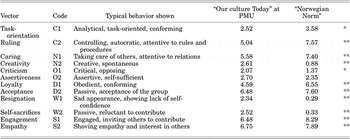
We found differences in how the respondents perceived their work culture compared with the “Norwegian Norm” in 11 of 12 vectors. In nine of the vectors, the difference was significant at a 0.01 level. The most desired for a work culture is to be as close to the “Norwegian Norm” as possible, and both higher and lower scores will make the SPGR balance model out of balance. The results presented in Table 2 show the dimensions the vectors are connected to. The findings must be interpreted according to the scores of the reference groups, the” Norwegian Norm.”
Ratings of “Our Culture Today” at PMU versus “Norwegian Norm” along the twelve SPGR vectors

*Correlation is significant at the 0.05 level (2-tailed).
**Correlation is significant at the 0.01 level (2-tailed).
Ratings of “Our Culture Today” n = 26.
Ratings of “Norwegian Norm” n = 347 (Ratings across industry, gender, and organizational level).
PMU, palliative medicine unit; SPGR, Systematizing Person-Group Relations.
The mean values of the SPGR vectors stating “our culture today” for the healthcare personnel at the PMU are presented in Table 2 and compared with the “Norwegian Norm.” The results showed that the healthcare personnel working at the PMU had significant higher scores than the “Norwegian Norm” in the vectors creativity, criticism, resignation, and self-sacrifice. Creativity is in the “Nurture” dimension, whereas resignation and self-sacrifice are both in the “Withdrawal” dimension, and criticism is in the “Opposition” dimension. Further on, the results show that the healthcare personnel at the PMU had significantly lower scores than the “Norwegian Norm” in the task-orientation, ruling, caring, loyalty, acceptance, engagement, and empathy vectors. The empathy and engagement vectors belong to the “Synergy” dimension, and acceptance and loyalty belong to the “Dependence” dimension, whereas caring is in the “Nurture” dimension and task-orientation and ruling are in the “Control” dimension (Table 2).
DISCUSSION
The research questions we wanted to explore were factors describing the work culture at a PMU and how a work culture can have an influence on an implementation process. To explore these factors, we conducted a study among healthcare personnel at a PMU. The respondents were asked to answer a survey to describe their current “our culture today” situation.
In the SPGR reference group, a good distribution between task orientation and human orientation is a sign of a well-functioning organization. However, when comparing an organization with the reference group it is important to realize that these reference group scores cannot give specific guidelines for how a unit should function. It is obvious that the values in an organization that cares for patients in their last phase of life is different than companies that are directed toward trade and the market, as one example. However, the work culture in a hospital unit has much of the same elements and consists of the same levels as other organizations: the observable artifacts, values, social principles, and ideologies, and the basic underlying assumptions (Schein, Reference Schein1992; Scott-Findlay & Estabrooks, Reference Scott-Findlay and Estabrooks2006). Comparing the groups can give a good indication of which behavior dominates this specific work culture at a PMU compared with the most desired balance for a work culture.
The sample at this PMU was quite small, with few respondents in each profession. This study also represents a point estimation, with the limitations that involves. Furthermore, the study was conducted in a field where this focus, so far, has not been described in detail. The present findings can give an indication as to the directions that research ought to follow in subsequent studies.
To find higher scores than the “Norwegian Norm” on the vectors “empathy” or “caring” would have been an expected outcome for this kind of unit with the focus on giving the best possible care to patients in the last phase of their life. However, as shown in Table 2, the respondents have significant lower scores on both these vectors. In the “Synergy” dimension the respondents in this study have significant lower scores than the reference group. This was a surprising finding, as the “Synergy” dimension is the dimension with is the strongest indicator for developing mature and well-developed skills for collaboration. Both these skills will be of importance in a PMU.
What Are the Specific Factors that Characterize the Working Culture at a PMU?
The findings reported in Table 2 indicate that the respondents at the PMU experience higher self-sacrificing and resignation than the reference group, which is negative for the work culture. The mean scores from the respondents regarding task-orientation, engagement, and empathy are all considerably lower than the reference values. Both empathy and engagement belong to the “Synergy” dimension, which is important in organizations and for developing a higher level of maturity in both independent work and collaboration (Sjøvold, Reference Sjøvold2006). Together with the high mean scores on the self-sacrificing vector, this gives association to employees who not always do their task with joy, and can give fertile conditions for a culture of complaining, less satisfaction, and passivity. Taking care of patients who are expected to die in a relatively short time may require healthcare personnel with more focus on caring and less on task-orientation in patient care. Task-orientation can be viewed as a more “high tech” approach to the patients’ situation, especially if this includes technology or computer technology (André et al., Reference André, Ringdal and Loge2008a; Reference André, Ringdal and Loge2009). Earlier findings show that computer technology could influence the communication between the patient and healthcare personnel and lead to a an “artificial way of communication” (André et al., Reference André, Ringdal and Loge2009). As found in another study, healthcare personnel at PMUs have a high occurrence of psychosomatic complaints (Schroder et al., Reference Schroder, Bansch and Schroder2004), which can make them more resistant when changes or implementations are introduced, because changes can be too challenging (André et al., Reference André, Ringdal and Loge2009).
To facilitate changes in healthcare, it is important to influence the behavior and intentions of the healthcare workers (André et al., 2008a). Both behavior intentions and behavior are influenced by several factors such as attitudes, norms, and motivation, and are well described (Ajzen, Reference Ajzen1991; Strobe, Reference Strobe2008). Influencing values and norms are generally difficult, whereas motivation and attitudes are more susceptible to influence and may also be influenced by the healthcare worker's present life situation (André et al., 2008a).
The low scores on the empathy and caring vectors were both surprising and alarming. Because of the goal of the PMU, one should imagine that both empathy and caring would be vectors for which these units should have higher scores than other organizations. Neergaard et al. reported as their most important finding that there was a need for better working culture among health professionals working in palliative specialists teams in Denmark (Neergaard et al., Reference Neergaard, Olesen and Jensen2010). These findings can indicate that healthcare workers in these units have challenges connected to their work culture, and that values and attitudes toward patient care and treatment are not automatically transferred to their work culture.
In What Way May an Implementation Process be Influenced by the Working Culture at a PMU?
A main challenge in palliative care is assessment and management of pain, which is a subjective symptom (Kaasa & Loge, Reference Kaasa and Loge2003). In the PMU, goal-oriented methods to improve patient treatment can be interpreted as distant, and the core aspect seems more in accordance with the values the respondents expressed in the present study. In coping with the different aspects of symptoms and needs of to this patient group, it is important also to use methods that can be interpreted as goal oriented, for example, improved symptom control (Kaasa & Loge, Reference Kaasa and Loge2003). It seems as if the conflict between “high tech” and “high touch” in these units can be an obstacle when trying to implement new tools (André et al., Reference André, Ringdal and Loge2009) and that the respondents are not in a position to change their behavior as is indicated by their low scores at the task-orientation, engagement, and caring vectors. One may assume that it can be too challenging to participate in an implementation process when healthcare personnel, as found in this study, score high on resignation and self-sacrificing, but score low on caring, engagement, and empathy.
CONCLUSIONS
The culture at the PMU seems to value more time and closer relationships with the patients as important. Caring for the dying must be permeated by a focus on making the last days of these patients' life as good as possible (Kaasa & Loge, Reference Kaasa and Loge2003). Still, task-orientation and use of “high tech” must be given greater attention if healthcare personnel are going to reach the goal of optimal quality of life in palliative medicine, because of the need for better symptom registration and management (André et al., Reference André, Ringdal and Loge2009). The present findings indicate that the conflicts between “high tech” and “high touch” are visible at these units and that the work culture is influenced by this conflict. According to our findings, the special factors that characterize the working culture at a PMU are that the respondents perceive their work culture as different from the reference group, the “Norwegian Norm,” in several dimensions. These differences are in important dimensions such as “Synergy,” which promotes engagement and constructive goal-oriented behavior, where the respondents in this study had lower scores. They also experience a higher degree of both resignation and self-sacrifice, which can lead to behavior characterized by restriction from contribution and commitment to initial role. These factors are important in developing a dynamic work culture that can be able to cope with challenges, such as changes and implementation of new procedures or technology.