Introduction
Local adaptation, defined as a modification resulting from natural selection of an organism so that it becomes better suited to exist and perform under the conditions of its local environment, is a major concept that can explain the adaptability and spread of life on Earth (Schilthuizen, Reference Schilthuizen2001). The strong link existing between insect herbivores and their host plants is often used to support the concept of local adaptation (Mopper et al., Reference Mopper, Beck, Simberloff and Stiling1995; Alonso et al., Reference Alonso, Ruohomäki, Riipi and Henriksson2001). This phenomenon has been particularly documented for sessile insects that can generate hundreds of generations on the same specific host plant (Edmunds & Alstad, Reference Edmunds and Alstad1978; Karban, Reference Karban1989). In such cases, locally adapted populations showed greater biological performances on their local host. For mobile herbivores, local adaptation was considered through the differential availability of host plants at the regional scale (Hsiao, Reference Hsiao1978; Horton et al., Reference Horton, Capinera and Chapman1988; Nitao et al., Reference Nitao, Ayres, Lederhouse and Scriber1991; Mopper et al., Reference Mopper, Beck, Simberloff and Stiling1995; Andreeva, Reference Andreeva2002; Hébert et al., Reference Hébert, Berthiaume, Bauce and Brodeur2006). In such cases, the comparison of survival, growth or fecundity of individuals between populations reared on different host plant species, only available locally, supports the local adaptation concept (Nitao et al., Reference Nitao, Ayres, Lederhouse and Scriber1991; Hébert et al., Reference Hébert, Berthiaume, Bauce and Brodeur2006).
If local adaptation can be achieved on different host species, this potential adaptability inherent to each species might also have evolved from variability in characteristics within a given host species, such as the age of the host plant. A few studies showed that long-lived plant susceptibility to insect herbivores can vary with the age of the plant (Karban, Reference Karban1987; Bauce et al., Reference Bauce, Crépin and Carisey1994), and population build-up of some insects was only related to some specific age of the host plant (Karban, Reference Karban1990; Quiring, Reference Quiring1992; Martikainen et al., Reference Martikainen, Siitonen, Kaila, Punttila and Rauh1999). However, even if intrinsic nutritional quality of long-lived host plants changes over time (Bauce et al., Reference Bauce, Crépin and Carisey1994), there is no experimental evidence that host age may lead to herbivore local adaptation.
Prerequisites for the appearance of locally adapted populations are the reduction of gene flow (Diehl & Bush, Reference Diehl and Bush1984; Mopper et al., Reference Mopper, Beck, Simberloff and Stiling1995; Skulason & Smith, Reference Skulason and Smith1995; Schluter, Reference Schluter2001; Kawecki & Ebert, Reference Kawecki and Ebert2004), which presumes mating between individuals under similar selective pressures (Berlocher & Feder, Reference Berlocher and Feder2002) and a relative stability of the environment (Futuyma & Moreno, Reference Futuyma and Moreno1988; Schluter, Reference Schluter2001) to maintain constant selective pressures. For herbivorous insects, persistence in the local environment of long-lived host plants, such as trees, provides conditions for supporting such stability. We hypothesized that the probability of finding an herbivore population locally adapted to the age of its host plant should be greater in a region with a relatively uniform age structure of the host plant. On the other hand, variations in fragmented habitats may hinder the evolution of adapted populations. In North America, the northern landscape of the boreal forest is characterized by a limited number of tree species and shows a relatively uniform age structure because the matrix is still dominated by old-growth forests maintained by natural disturbances (Boucher et al., Reference Boucher, De Grandpré and Gauthier2003), thereby promoting conditions for the evolution of locally adapted populations. On the other hand, the southern landscape in the mixed-wood forest supports a more diverse flora within a more fragmented habitat (Grondin, Reference Grondin, Bédard and Côté1996). Furthermore, anthropogenic disturbances that occurred over the last century in the southern landscape have also increased fragmentation of these habitats and reduced the overall age of the forest (Reed et al., Reference Reed, Johnson-Barnard and Baker1996; Sachs et al., Reference Sachs, Sollins and Cohen1998), thus reducing the possibility of the evolution of a population adapted to host age.
To test the hypothesis that host plant age may favour local adaptation of herbivore populations, the hemlock looper (Lambdina fiscellaria) (Lepidoptera: Geometridae) is a particularly interesting model because it has evolved in a variety of eco-zones having different levels of floristic composition and host plant age structure. The hemlock looper is a highly polyphagous species mainly known for its outbreaks in old-growth balsam fir forests in the north (Otvos et al., Reference Otvos, Clarke and Durling1979; Hébert & Jobin, Reference Hébert and Jobin2001). This species is largely distributed in North America, ranging from deciduous forests in the south to pure coniferous forests in the north (Hébert & Jobin, Reference Hébert and Jobin2001). Previous studies showed local adaptations of populations on different host plants and across a gradient of latitude (Hébert et al., Reference Hébert, Berthiaume, Bauce and Brodeur2006; Berthiaume, Reference Berthiaume2007). Moreover, female moths are known to be poor flyers (Watson, Reference Watson1934; Carroll, Reference Carroll1956), limiting gene flow among populations.
To test local adaptation, we compared the biological performances of two hemlock looper populations, collected from northern and southern regions of the province of Quebec, Canada, on three age classes of balsam fir trees, which were their main host (Hébert & Jobin, Reference Hébert and Jobin2001). Based on the local adaptation hypothesis, we predicted that the population from the northern boreal forest, which has evolved in old-growth coniferous stands under a natural disturbance regime and is considered as a homogenous and stable environment, is better adapted to older balsam fir trees than the southern population, which has evolved in a more diversified and fragmented habitat under an anthropogenic disturbance regime within coniferous forests of heterogeneous age structure. In the laboratory, the relative suitability of foliage from three age classes of balsam fir trees for the hemlock looper was determined by measuring several parameters of moth fitness (survival, developmental time, size, longevity and fecundity) and by calculating a growth related index.
Material and methods
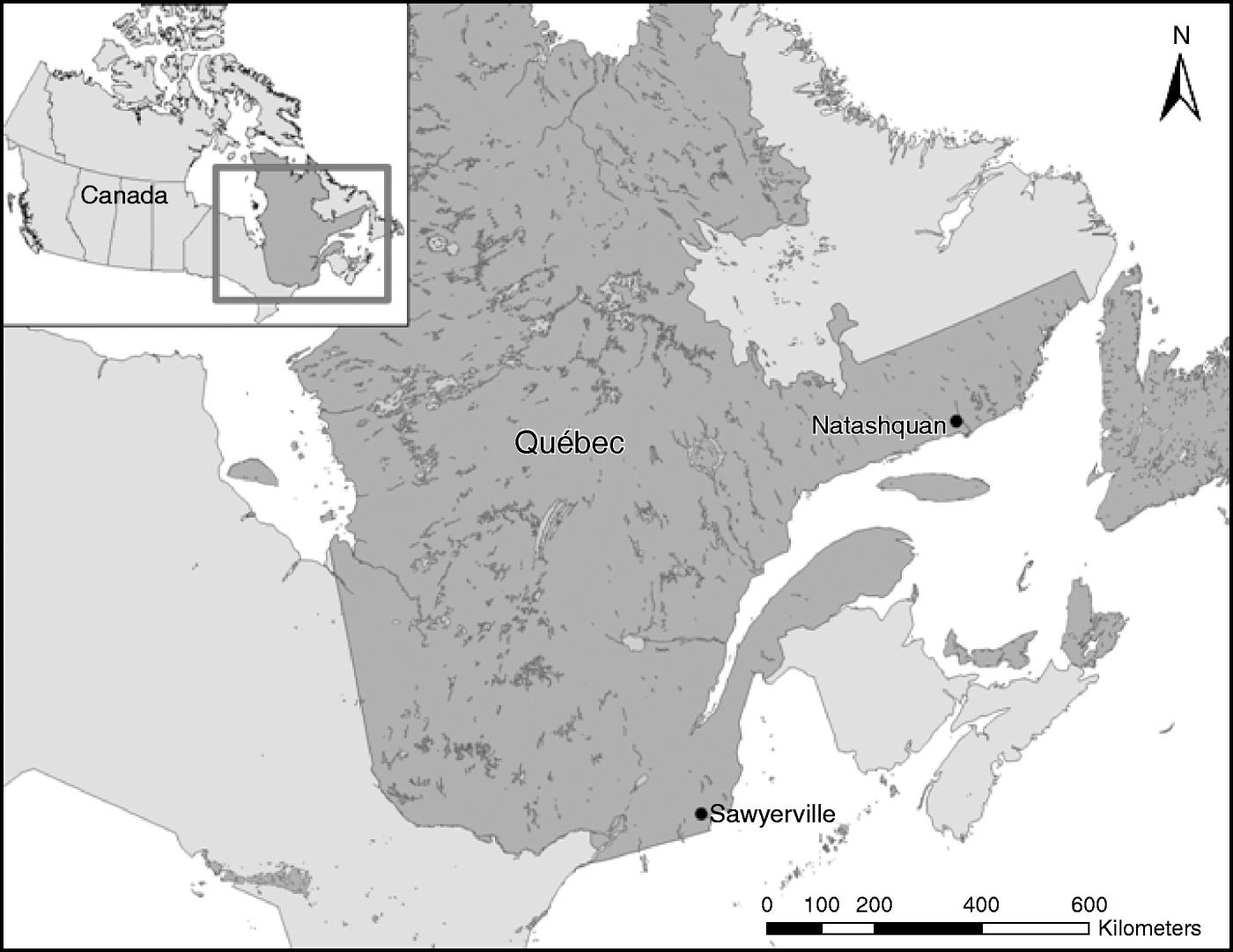
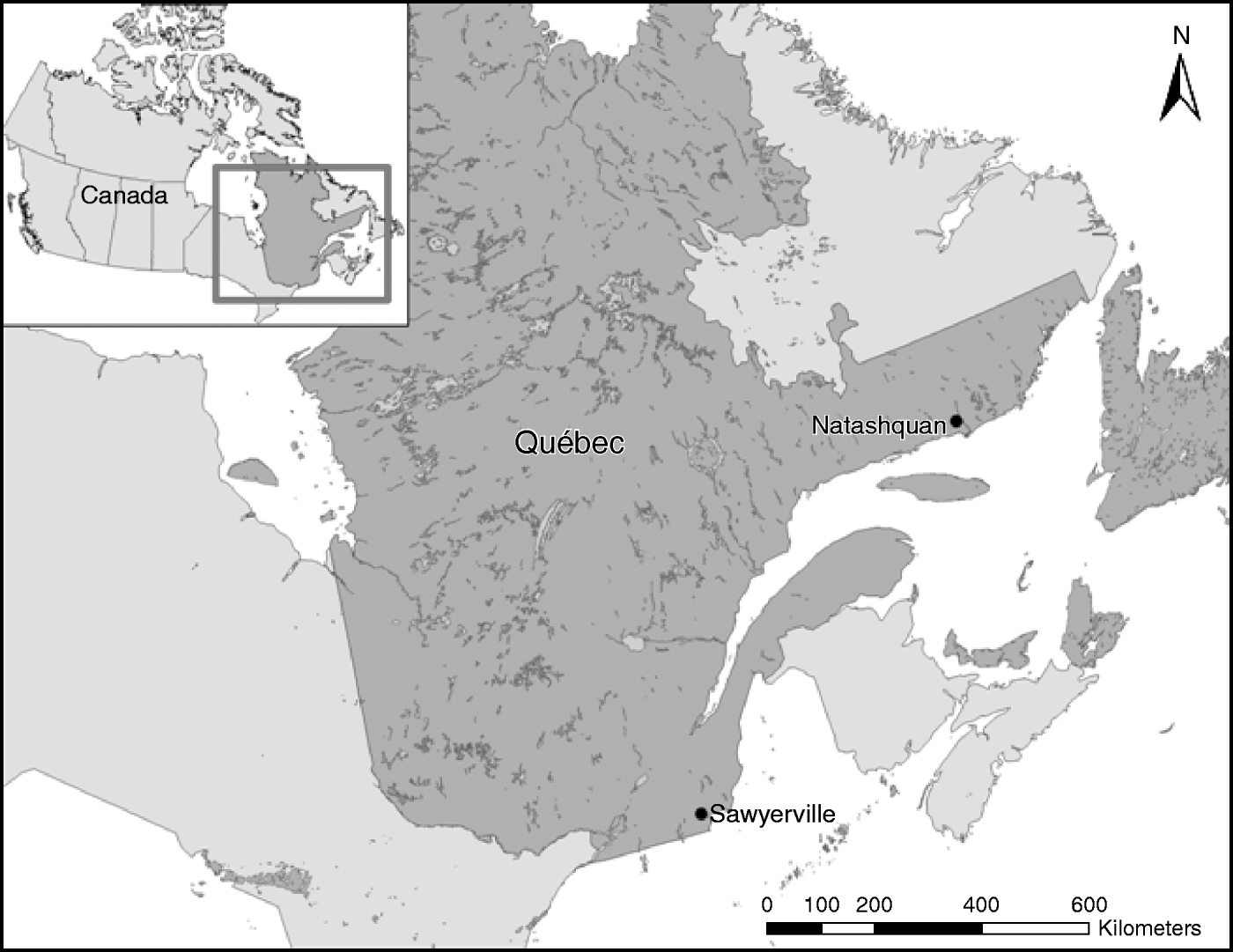
The experiment was carried out with two hemlock looper populations collected in the province of Québec: one from Natashquan (Lat: 50 °12′N, Long: 61 °49′W) and the other from Sawyerville (Lat: 45 °20′N, Long: 71 °34′W), hereinafter referred to as the northern and southern populations, respectively (fig. 1). Larvae were reared on the foliage of three groups of balsam fir trees representing juvenile trees (25 years old), mature trees (60 years old) and overmature trees (100 years old). Eggs used to start the experiment were obtained from colonies established three years before the beginning of the current experiment (Berthiaume, Reference Berthiaume2007). These colonies were reared during the three previous years (three complete generations) on foliage of balsam fir trees to eliminate any potential maternal effect. In mid-November, eggs were stored in a field insectary located at the Laurentian Forestry Centre in Quebec City to expose hemlock looper eggs to natural winter conditions. The following spring, egg hatching was recorded daily and at peak hatching, 75 larvae per population were randomly selected and reared on each age tree class, for a total of 225 larvae per population. Larvae were reared individually on balsam fir shoots inside 500 ml glass containers (Mason jars) with muslin replacing the metal lid to allow ventilation, at 20±1°C, 40% RH and 16L:8D photoperiod inside a growth chamber.
Location of the two hemlock looper populations studied in Québec, Canada.
Balsam fir trees representing the required age gradient (25, 60 and 100 years old) were selected and numbered in a balsam fir forest near Quebec City (Lat: 46 °53′N, Long: 71 °18′W). Thus, the two hemlock looper populations were reared on foliage collected from the same trees in a neutral stand. This stand was characterized by large openings due to partial cuttings done in the past. As host trees of each age class were found in this stand, it was possible to eliminate potential site effects on foliage quality. The stand concurs with Grandtner's (Reference Grandtner1966) description of the balsam fir-white birch association and was classified as a site 1 quality stand with good drainage (Bélanger et al., Reference Bélanger, Ducruc and Pineau1983). Balsam fir tree age was determined by collecting cores at breast height using a Pressler probe. For mature and overmature trees, five trees per age class were selected and numbered. Considering the small size of juvenile balsam fir trees and frequent foliage removal required for rearing hemlock looper larvae, five groups of ten trees were selected to support foliage removal without affecting foliage feeding quality as a result of the possible impact of excessive defoliation on foliage chemistry. Foliage was removed evenly between these trees during each collection. The juvenile stage of trees was determined by the absence of male flowers and male flower scars on branches. At the end of the growing season, diameter at breast height (hereinafter DBH) and height of each tree were also determined. Fifteen larvae of each population were reared on shoots collected from a single tree or group of trees. Throughout the experiment, each larva always received foliage from the same selected tree or group of trees and foliage was provided ad libitum to prevent nutritional stress from food depletion.
The foliage was collected twice weekly from previously numbered trees using a pole pruner for mature and overmature trees and with pruning shears for juveniles. In the laboratory, balsam fir shoots, which included current-year and one-year-old foliage, were inserted into Hydropic® to maintain their turgescence, freshness and quality between bi-weekly renewals. The availability of both current-year and one-year-old balsam fir foliage during hemlock looper larval development was necessary because larvae usually perform better when they have access to these two types of foliage (Carroll, Reference Carroll1999).
Larval mortality was recorded at each foliage renewal. Near the end of larval development (pre-pupal period), insects were checked every day to record the presence of pupae to determine the duration of larval development. Pupae were weighed 24 h after their formation using an electronic scale (Mettler AE163). Then, pupae were checked every day for moth emergence to determine the duration of pupal development. Once emerged, moths were sexed and placed with a sexual partner originating from the same population and treatment in 500 ml glass containers (Mason jars) in a growth chamber at 15±1°C, 40% RH and 12L:12D photoperiod. A two-dram vial containing an 8% water-sugar solution (V/V) was always available to the moths as a food source. This plugged with cotton wool water-sugar solution was renewed twice weekly. A foam strip (5×7 cm) was placed inside each container as substratum for female oviposition (Hébert et al., Reference Hébert, Jobin, Auger and Dupont2003). After female death, eggs were counted and extracted from foam strips using fine forceps and preserved inside numbered Solo® cups. For each mated female, the length and width of 15 randomly selected eggs were measured using an electronic graduated ocular (Wild MMS 235) mounted on a stereomicroscope to determine the average volume of eggs for each female. Considering that hemlock looper eggs have an elliptical shape, egg volume was determined using the following formula: volume=1/6×3.1416×width2×length (Berrigan, Reference Berrigan1991; Tauber et al., Reference Tauber, Tauber and Tauber1991).
Statistical analysis
Biological performances of both sexes were compared separately as males and females have different life history strategies. One-way analyses of variance were performed to compare tree characteristics (DBH, height and age) of juvenile, mature and overmature balsam fir trees. When significant differences were detected, the analysis of variance was followed by a LSD test to determine which groups of trees differed from the others. Cross nested analyses of variance with trees nested within age classes and populations crossed with age classes were performed to compare duration of larval and pupal development, pupal weight, growth related index and longevity for both sexes. The growth related index is a simple ratio that integrates two important fitness variables of insect development (pupal weight/larval development time) that are the result of important trade-offs into a single index, which facilitates the ecological interpretation of these two variables, particularly for ecotypes going through a different number of instars (Hébert et al., Reference Hébert, Berthiaume, Bauce and Brodeur2006; Berthiaume et al., Reference Berthiaume, Bauce, Hébert and Brodeur2007). Similar analyses of variance for females were also performed for fecundity and egg size. When the age class factor was significant, analyses of variance were followed for each population by an ls-means procedure to determine which age classes of trees differed. This approach allowed us to test for simple effects within each population and verify whether the age class factor was significant for each population. Data were not transformed, as they met the requirements for the analysis of variance. All statistical analyses were performed using SAS programs (SAS Institute Inc., 1999), and we refer to the 5% error rate as the threshold for significance.
Results
Balsam fir tree characteristics were highly different between the three groups of trees used for rearing the two hemlock looper populations (table 1). Juvenile trees averaged 25 years old and had the smallest morphological characteristics of all trees; mature trees averaged 56 years old and had intermediate characteristics; while overmature trees were over 100 years old and exhibited the tallest (height) and largest (DBH) characteristics of all sampled trees (table 1).
Comparison of diameter at breast height (DBH), height and age of juvenile, mature and overmature balsam fir trees. Values are mean±SE with five trees per treatment.

1 One-way analysis of variance, df=2.
2 Means within a row followed by different letters are significantly different; LSD procedure.
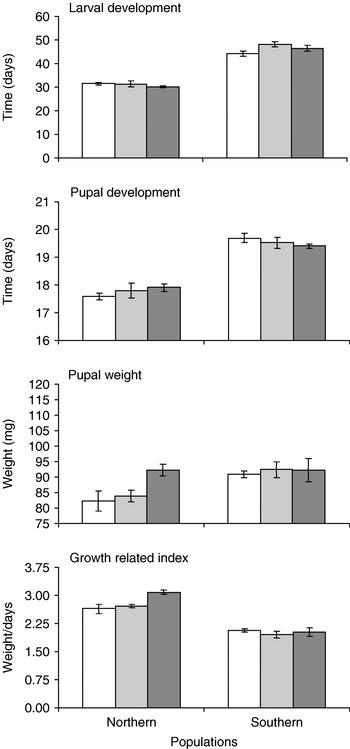
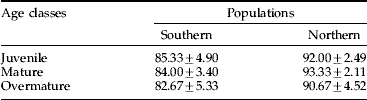
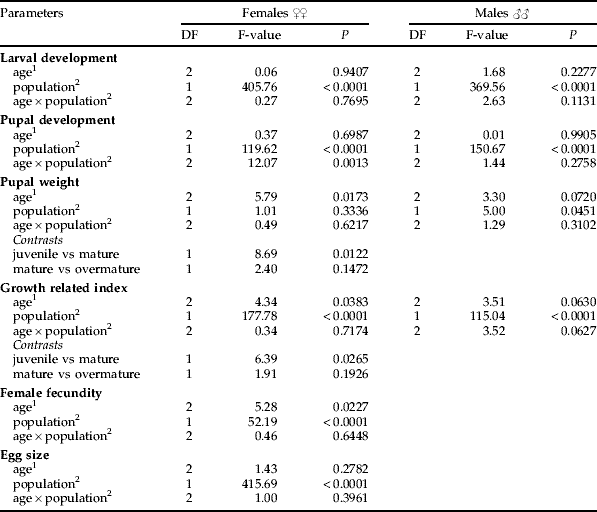
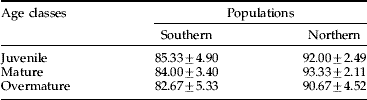
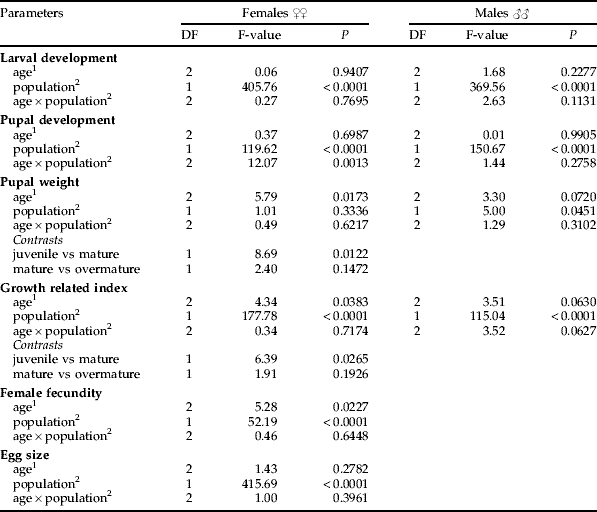
Larval survival was high, ranging from 82.67 to 93.33%, and was not affected by the age of the balsam fir trees for both populations (table 2). However, larval survival of the northern population was significantly higher than that of the southern population (table 2; F=6.00, df=1.29, P=0.0220). Except for one individual reared on foliage of the 25 year old balsam fir, all larvae of the northern population went through four larval instars. On the other hand, all larvae of the southern population went through five larval instars, except for two individuals reared on the foliage of 25 and 50 year old balsam fir. The age of balsam fir trees did not significantly affect the biological performance of male insects (larval and pupal development, pupal weight and growth related index) (fig. 2, table 3). However, for all variables, significant differences were detected between the two populations studied. In fact, males from the southern population took more time to complete their larval and pupal development, reached superior weight and had an inferior growth related index compared with the northern population (fig. 2, table 3).
(a) Larval development time, (b) pupal development time, (c) pupal weight and (d) growth related index of males from two hemlock looper populations (northern and southern) reared on foliage from three age classes of balsam fir trees (□, juvenile;  , mature;
 , overmature).

Larval survival of southern and northern hemlock looper populations reared on three different age classes of balsam fir trees. Values are mean percentages±SE.
Analysis of variance results for the biological performance of females and males of two hemlock looper populations (northern and southern) reared on three different age classes of balsam fir trees.
1 Error term was ‘trees (age)’ with 12 degrees of freedom.
2 Error term was ‘populations×trees (age)’ with 12 degrees of freedom.
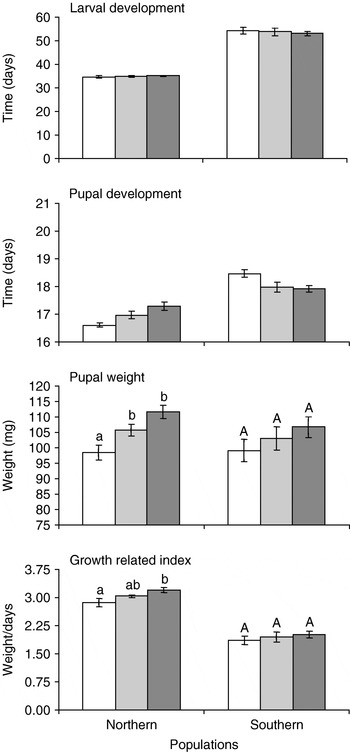
The duration of female larval and pupal development was not influenced by the age of the balsam fir trees, but females from the northern population developed faster than those from the southern population (fig. 3, table 3). A significant interaction between populations and age of the balsam fir was found for the duration of female pupal development (table 3). Pupal weight was similar for females from both populations (table 3). However, the age of the balsam fir trees influenced significantly pupal weight of females from the northern population, as individuals developing on foliage from juvenile trees were smaller than those reared on foliage from mature and overmature trees (fig. 3). Female growth related index was strongly influenced by both the origin of the population and the age of the balsam fir trees (table 3). As observed for pupal weight, host tree age did not influence the growth related index of the southern population (fig. 3). However, the growth rates of females from the northern population increased with host tree maturity. Mature and overmature trees provided the best food for hemlock looper larvae from the northern population, as revealed by the highest pupal weight and growth rate (growth related index) of this population when reared on these trees compared with juvenile trees (fig. 3).
(a) Larval development time, (b) pupal development time, (c) pupal weight and (d) growth related index of females from two hemlock looper populations (northern and southern) reared on foliage from three age classes of balsam fir trees (□, juvenile; , mature; , overmature).

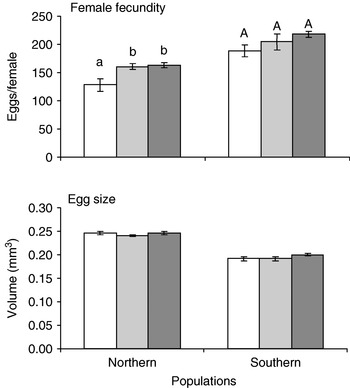
Females from the southern population laid significantly more eggs than their counterparts from the northern population (table 3, fig. 4). Furthermore, the fecundity of females from the northern population was influenced by the age of the balsam fir trees used as food during larval development. For this population, fecundity increased significantly from juvenile trees toward overmature trees (fig. 4). A similar, non-significant trend was observed for females from the southern population. Females from the northern population laid larger eggs than females from the southern population (fig. 4, table 3). However, the age of the balsam fir trees had no significant impact on the size of the eggs produced by hemlock looper females from both populations (fig. 4, table 3).
(a) Female fecundity and (b) egg size for two hemlock looper populations (northern and southern) according to age classes of balsam fir trees on which they were reared during larval development (□, juvenile; , mature; , overmature).

Discussion
Our results confirm, as previously reported in other studies on this insect (Hébert et al., Reference Hébert, Berthiaume, Bauce and Brodeur2006; Berthiaume, Reference Berthiaume2007), that local adaptation on a specific host available everywhere in the herbivore distribution area is possible and, thus, that the regional non-availability of a host plant is not essential to promote local adaptation. Few studies have shown such local adaptation for distant populations having access to the same food resource. In fact, except for female pupal weight, we found significant differences for all biological variables between the two hemlock looper populations. This indicates that each population was submitted to different selective pressures, and they evolved into populations well adapted locally that used different strategies for exploiting the same food resource. Our results confirm, as reported elsewhere (Berthiaume, Reference Berthiaume2007), that these two populations represent different ecotypes that are characterized by a natural variation in the number of instars during their larval development, with the northern population going through four larval instars compared with five for the southern population. In addition to this natural variation in the number of larval instars, individuals from the northern population develop faster during larval and pupal development, reach inferior weight, are less fecund and lay larger eggs than individuals from the southern population.
Although we detected significant differences in biological performances between the two populations, no significant effect of the age of the balsam fir trees could be detected for males in these populations, indicating that even though variations in host quality can exist, males failed to exploit more efficiently such differences. However, our results suggest that, unlike males under the same selective pressures, females adapt their strategies to maximize their fitness on old trees. This indicates that, notwithstanding the original landscape where populations evolved, selective pressures induced by local environments are apparently dissimilar for males and females of a given population. This observation agrees with the general trend observed between male and female Lepidoptera (Nylin & Gotthard, Reference Nylin and Gotthard1998). In general, females are more influenced by food variation and host quality than males because their weight is more critical for their contribution to the next generation (Scriber & Slansky, Reference Scriber and Slansky1981; Blake & Wagner, Reference Blake and Wagner1984). In Lepidoptera, overall fecundity of numerous species (Tammaru et al., Reference Tammaru, Kaitaniemi and Ruohomäki1996, Reference Tammaru, Esperk and Castellanos2002; Awmack & Leather, Reference Awmack and Leather2002; Thurston & MacGregor, Reference Thurston and MacGregor2003) is strongly related to their weight and, thus, females attempt to maximize it. Considering that females are more sensitive to host quality variations than males (Nylin & Gotthard, Reference Nylin and Gotthard1998), we could hypothesize that females may have developed over time compensatory mechanisms to limit the negative potential effect arising from host quality. Our results suggest that, under similar selective pressures, females are naturally predisposed to adapt their strategies to maximize their fitness in any particular situation. This also indicates that females are the driving force of long-term evolution that allows populations to adapt to their local environment through the local adaptation concept.
Based on the local adaptation hypothesis, our results confirm that the population from the northern boreal forest, which has evolved in old-growth coniferous stands, has better biological performances when it feeds on mature and overmature trees than the southern population, which has evolved in a more diversified and fragmented habitat. This is the first example that local adaptation can occur, based on these host tree characteristics. For herbivorous insects, local adaptation was demonstrated on populations exploiting different host plants (Hsiao, Reference Hsiao1978; Horton et al., Reference Horton, Capinera and Chapman1988; Nitao et al., Reference Nitao, Ayres, Lederhouse and Scriber1991; Mopper et al., Reference Mopper, Beck, Simberloff and Stiling1995; Hébert et al., Reference Hébert, Berthiaume, Bauce and Brodeur2006) or, to a lesser extent, on populations exploiting different individuals on a same host plant (Edmunds & Alstad, Reference Edmunds and Alstad1978; Karban, Reference Karban1989). Detection of local adaptation on different host plants appears easier than inside a continuum of a particular species, probably because chemical and physiological changes are more important between several host plant species than within the same host species. Numerous studies reported that insect herbivores often perform better when they feed on specific age classes of their host plant (Karban, Reference Karban1987, Reference Karban1990; Quiring, Reference Quiring1992; Bauce et al., Reference Bauce, Crépin and Carisey1994; Martikainen et al., Reference Martikainen, Siitonen, Kaila, Punttila and Rauh1999), but no study reported variations in these capacities between different populations of a particular herbivore species. In fact, hemlock looper adaptability appears so strong that it can develop populations locally adapted to the age of balsam fir trees. Variations have been reported in nutrient conditions (water, nitrogen, sugar and/or polyphenol contents) among age classes of balsam fir foliage (Bauce et al., Reference Bauce, Crépin and Carisey1994). For example, larval performances of the spruce budworm (Choristoneura fumiferana) on young and old balsam fir trees were partially related to variations in tannin and monoterpene contents (Bauce et al., Reference Bauce, Crépin and Carisey1994). Such variation in foliage quality could also explain variation in general performances observed between northern and southern hemlock looper populations.
A recent ecological concept proposes that species attributes are not fixed in time and result from an amalgam of numerous populations interconnected by genetic flow, which is more or less important depending on each species' attribute (Ruffié, Reference Ruffié1986; Schilthuizen, Reference Schilthuizen2001). This concept implies that each population evolves from the original genotype as a response to selective pressure induced by the local environment and becomes, with successive generations, more adapted to local conditions (Diehl & Bush, Reference Diehl and Bush1984; Turelli et al., Reference Turelli, Barton and Coyne2001; Berlocher & Feder, Reference Berlocher and Feder2002). The two hemlock looper populations studied here evolved for numerous generations in distinct habitats, and their adaptation seems to reflect selective pressures occurring inside their original environment. In fact, the northern hemlock looper population evolved in a region where the original landscape has not been altered by human activity and is relatively homogenous and dominated by mature and overmature coniferous forests that are under natural disturbance regimes, mostly shaped by estimated 300- to 500-year forest fire cycles (Boucher et al., Reference Boucher, De Grandpré and Gauthier2003). Throughout the evolution process, the northern population developed local adaptation that leads this population to perform better on mature and overmature balsam fir trees, which is the most important component of its original environment (Boucher et al., Reference Boucher, De Grandpré and Gauthier2003). In fact, for the same duration of larval development, female pupae were 12% heavier and had fecundity increased by 27% on overmature trees compared with larvae reared on juvenile trees.
On the other hand, the southern hemlock looper population showed similar biological performances in all age classes of balsam fir trees, indicating that selective pressures at the regional scale were probably not strong enough to promote or maintain over time such local adaptation for this specific population. Local environment could explain this lack of local adaptation to host tree age. In the southern region, the floristic composition is more diversified and the habitat is more fragmented than in the northern boreal forest (Groombridge, Reference Groombridge1992; Grondin, Reference Grondin, Bédard and Côté1996; Primack, Reference Primack2002). Considering that the hemlock looper is a highly polyphagous species (Watson, Reference Watson1934; Hébert & Jobin, Reference Hébert and Jobin2001), this higher host diversity should limit the appearance of populations well adapted to specific trees or age classes of these trees. Furthermore, human intervention in the southern inhabited region reduced the overall age of forests, including coniferous ones, reducing the possibilities to maintain or promote the appearance of well-adapted populations to mature and overmature balsam fir trees. The non-significant trends observed in biological performances of the southern population might be ancestral attributes that disappeared over many generations with the transformation of the forest age structure induced by human activity. In fact, such an environment does not promote local adaptation on a particular host but promotes plasticity of this population to exploit a greater variety of host plants naturally encountered in their original environment.
The current study reveals that local adaptation is possible in response to subtle variations in habitat, such as host tree age, but the number of generations needed to reach this state remains undetermined. Quantification of the speed for developing local adaptation of a given organism is a major challenge for ecologists. However, this information is fundamental for understanding the spread of life on Earth and for determining the capacity of numerous species to adapt to anthropogenic disturbances or climate change that could threaten their future existence as a species.
Acknowledgements
We are grateful to Maxime Lapointe, Isabelle Paquin, Isabelle Grenier, Julie Blais and Nicolas Chouvet for their help in rearing the hemlock looper. Special thanks to Sophie Brugerolle for editing fig. 1. This research was supported by the Ecological Processes Network of the Canadian Forest Service, the Fonds québécois de la recherche sur la nature et les technologies (FQRNT), and the Natural Sciences and Engineering Research Council (NSERC), and by scholarships from Donohue Funds and NSERC to Richard Berthiaume.