Stephen Kemble was not amused. Having just presided over one of the worst disasters of the War for American Independence, Britain's leading soldier in Central America was in no mood to be chastised by his indigenous allies. Tasked with leading a force up the Rio San Juan to Lake Nicaragua, he was in no position to counter the point made by Colvil Briton, the governor of the Tawira Miskitu people that, without indigenous assistance, British operations were in vain. ‘I apprehend your Men alone are too few for the Expedition’, Briton told Kemble, ‘and though I believe you would Beat ten times your number, still, a great many more might kill some of your People, which I should be very sorry for.’ Inverting the colonial narrative of indigenous dependence on European imperialists, Briton reminded his counterpart that ‘Your People never asked me for Provisions that they did not get it, and as much as they could eat’ and announced that, while Kemble was ‘a brave Captain’, he could expect no further support.Footnote 1
The San Juan expedition was Britain's most significant military intervention in interior Central America. From its source at Lake Nicaragua, the Rio San Juan emptied into the Caribbean Sea and was a valued means of getting precious metals, plantation products, and food staples from the Pacific side of the isthmus to the Atlantic Ocean. British strategists believed that an invasion of Nicaragua would disrupt this vital trade route and force Spain to the negotiating table.Footnote 2 While often neglected in histories of the American Revolution, substantial military and naval resources were committed to Nicaragua, even as Britain fought a global war for its empire after 1778. The campaign displaced an alternative plan for attacking New Orleans – an operation that might have secured a significant imperial presence in southern North America – and greater numbers of reinforcements were sent to support the expedition than were sent to Sir Henry Clinton in New York.Footnote 3 But despite this impressive commitment of British resources, the planning, conduct, and eventual failure of the expedition owed much to decisions made by figures within the indigenous Miskitu community. Seeking to exploit their existing alliance with the British, the Miskitu supported the expedition in order to direct imperial resources toward Miskitu ends. When these ends were no longer served, the Miskitu withdrew their support, ending Kemble's hopes of reaching Lake Nicaragua and triggering a Spanish counter-attack that eventually ended the British presence on the Mosquito coast.
The influence of the Miskitu derived from the manipulation of their most valuable resource to British needs: military labour; that is to say males of military age hired on the basis of localized patterns of labour negotiation.Footnote 4 Colonial campaigns placed great dependence on indigenous military labour, something increasingly acknowledged in histories of both North and South America.Footnote 5 As Wayne Lee states, ‘Local peoples proved to be the essential determinants of imperial success or failure…[i]ndeed, imperial “expansion” was very often illusory, the Europeans’ ability to project power actually depended entirely on local cooperation.’Footnote 6 The effective mobilization of indigenous military and logistical power, however, was no easy task. Indigenous/European alliances brought together peoples with conflicting interpretations of warfare and different measurements of cost, reward, success, and failure. Intercultural alliances exposed these differences as no other form of diplomatic engagement could.Footnote 7 Mobilizing indigenous resources was not merely the process of hiring exotic adjuncts to support European professional soldiers. It was a broader process of political and cultural engagement with consequences that reverberated far beyond the battlefield.
This was not unique to the Mosquitia. The Miskitu experience shared many similarities with the European employment of indigenous manpower in North America, which commands far greater attention from historians. Where European authority was weak – areas defined as Native, Middle, or Divided grounds by historiansFootnote 8 – indigenous societies were able to configure their contributions to European endeavours and took a lead in determining the nature of the colonial relationship.Footnote 9 Equally, the resulting alliances – in North America as in the Mosquitia – reflected the shifting interests of particular groups and individuals within both societies rather than the interests of their communities as a whole.Footnote 10 Most crucially, the difficulty of reconciling indigenous warfare with European military structures and traditions was also as problematic in North America as it was in Central America.Footnote 11
Nevertheless, the San Juan expedition generated cultural assumptions that were unique to the Mosquitia. The survival of sources relating to this neglected campaign – including manuscripts that give some indication of Miskitu perspectives – make it possible to explore in great detail the evolution of a specific intercultural military alliance. The conditions upon which intercultural alliances could be made to work for European ends – variables such as the robustness of European diplomacy; the strength of indigenous power structures; and the contributions of indigenous soldiers to imperial defence – generated military and cultural assumptions that defined colonial encounters in various regions of the globe.
Tracing these cultural contingencies with relation to the Miskitu offers an illuminating insight not only into Britain's dependence on indigenous military labourers but also into the construction of European attitudes to colonial environments. Such a study reveals just how vulnerable supposedly rigid and immutable ideas about national interest, strategy, and racial hierarchies were to interpretive understandings of indigenous peoples; something that needs to be more fully appreciated.Footnote 12 As the failure of the expedition became obvious, British agents began to reassess their interest in the region and, with it, their understanding of the Miskitu. The consequences of this reassessment were felt into the nineteenth century. The San Juan was much more than a military campaign aimed at limited political, territorial, or pecuniary rewards; it was a crucial forum for understanding and articulating cultural difference.
I
Relations between the Miskitu and the British were over 140 years old when a combined force of indigenous, African, and European soldiers began their journey up the Rio San Juan in 1780. Initially drawn by the commodity trade in mahogany, sarsaparilla, and turtle shell, small numbers of English settlers had established themselves in the Mosquitia in the 1630s and both the Miskitu and the settlers benefited from an increasingly close relationship.Footnote 13 The Miskitu/British relationship – formalized as a military alliance in 1740 – is traditionally read as evidence of Miskitu dependency on the colonial powers. Miskitu leaders were portrayed as mere ‘puppets of the British’ who looked to the appointed superintendents and the governors of Jamaica for their legitimacy.Footnote 14 The British, in this reading, served to structure Miskitu politics and read their own hierarchies and needs onto Miskitu kingship. British agents dealt primarily with the Miskitu king, whom the English had first ‘crowned’ in 1631 in a ceremony that became a regular occurrence from the 1680s.Footnote 15 Miskitu identity was shaped by European contact and became entangled with English modes and customs as a result of British efforts to engender Miskitu loyalty.Footnote 16 James Lawrie, who became superintendent in 1776, was clear in his answers to William Robertson's questions about the settlements that European contacts had been highly disruptive to the region.Footnote 17
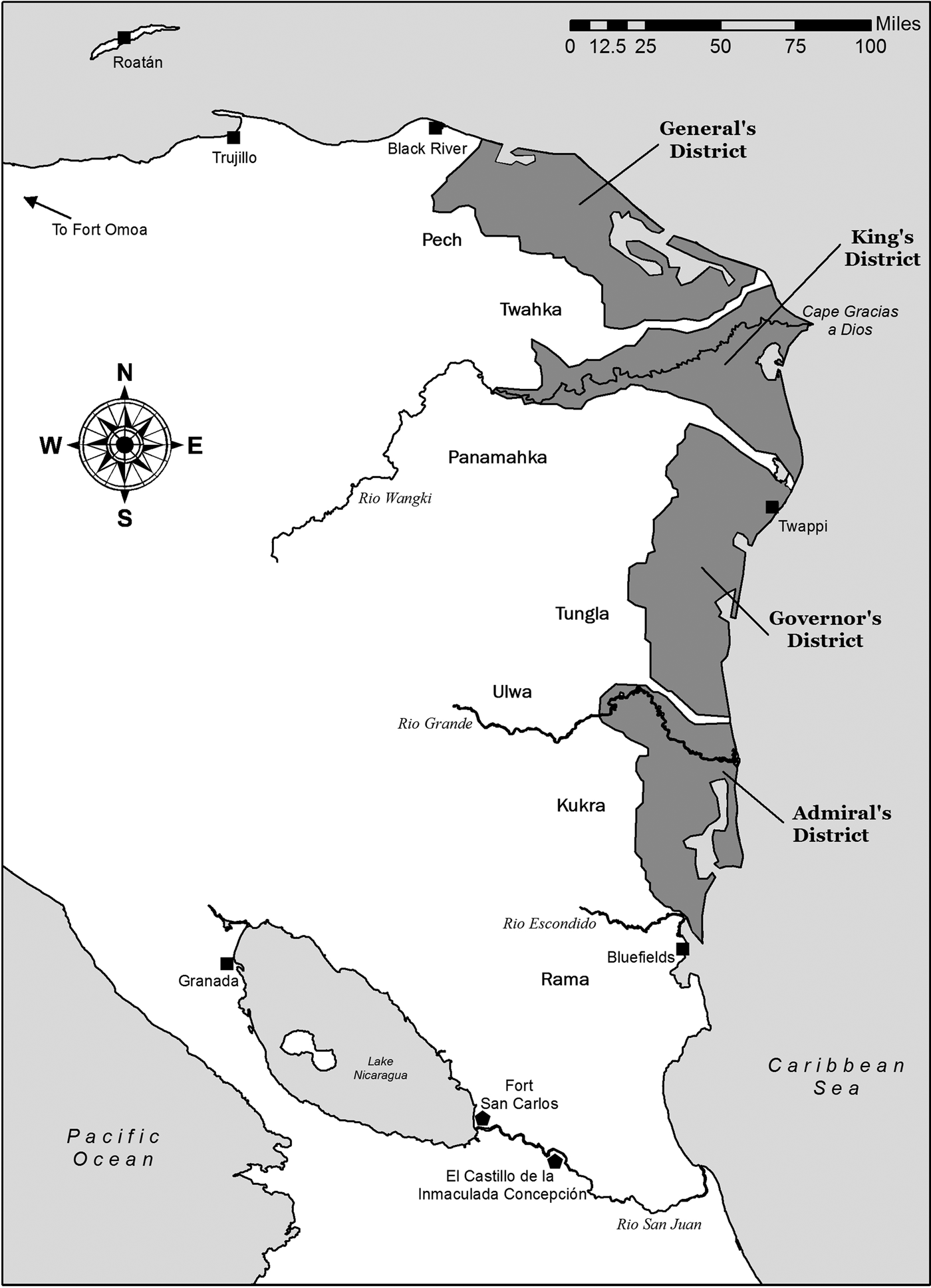
Few Britons at the time, however, would have recognized this characterization of Miskitu dependency. While the British promoted the king as the nominal head of the Mosquitia, they had no role in the selection of the Miskitu monarch.Footnote 18 Nor did the king's authority necessarily extend to all the Miskitu. There were, in fact, two groups of Miskitu in four semi-autonomous districts of the Mosquitia (see Figure 1). The Sambo Miskitu under the king and the general (a group forged by the incorporation of people of African descent into Miskitu kingship networks in the seventeenth century) occupied territory from the Black River to Sandy Bay. The Tawira Miskitu, often defined in the sources as the ‘pure Indians’, under the governor and – after 1757 – the admiral occupied from Sandy Bay to as far south as Bluefields.Footnote 19 Cultural commonalities, shared interests, and common threats could bring the Miskitu together but the districts all maintained independent hierarchies and policies from those of the king.Footnote 20
The Mosquitia, c. 1780. Created by Matthew Dziennik and Geoff Cunfer, Historical GIS Laboratory, University of Saskatchewan (2015).

The Mosquitia was a Caribbean borderland where the Miskitu negotiated a position of considerable strength between the competing empires of Britain and Spain.Footnote 21 Throughout the eighteenth century, the Miskitu voluntarily enhanced their links with British settlers and worked to bring colonial influences into arenas where they could be managed toward Miskitu ends. British agents had little choice but to accede to Miskitu demands since their presence in the Mosquitia depended on the Miskitu for protection. In the 1750s, there were just 154 whites, 170 free people of colour, and 800 African and Amerindian slaves in the British settlements at Black River, Cape Gracias a Dios, and Bluefields, or less than half of the estimated military-aged Miskitu population.Footnote 22 The economic vitality of the coast was also dependent on Miskitu efforts. The settlements relied on enslaved labour, which was only prevented from running away by Miskitu patrols.Footnote 23
Miskitu forbearance of the British presence was based on three main priorities: trade, domestic politics, and ethnic/racial tensions. Since the 1630s, the Miskitu had taken advantage of their geographic proximity to the settlements to acquire European firearms and other goods. These commodities were used to enhance the regional influence of the Miskitu. When British support for Miskitu raids on the Spanish ended with the Peace of Utrecht in 1713, the Miskitu began to target the neighbouring territories of the Ulwa, Pech, Twahka, Panamahka, and Tungla, who became tributary clients of the Miskitu. By the time British/Spanish hostilities were renewed in 1739, the Miskitu were a major regional power. Miskitu officials toured their districts and taxed British settlers, Spanish traders, and tributary Indians. Trade regulation, taxation, and resource management were all part of a Miskitu-centred world.Footnote 24
Renewed warfare between Britain and Spain after 1740 allowed the Miskitu to pressure the British into supplying more trade goods.Footnote 25 Between 1744 and 1778, Britain spent £28,530 on gifts to the Miskitu and, when war threatened, the supply of goods always increased. Gifts to the Miskitu more than doubled between 1776 and 1778, eventually accounting for a quarter of the superintendent's expenditure.Footnote 26 British officials understood they were being manipulated. Lawrie claimed, for example, that the Miskitu hid their arms during times of crisis in order to demand more from British officials. Surviving lists of diplomatic gifts from the 1770s suggest that the Miskitu received at least two muskets (in addition to other articles) for every man they contributed to British operations.Footnote 27
Besides trade goods, the Miskitu kings used their connections with the British to enhance their authority within the Miskitu districts.Footnote 28 A key means of doing this was through land concessions. King Edward (r. 1739–55) and King George I (r. 1755–76) made at least fourteen land concessions to British settlers during their reigns.Footnote 29 The Miskitu kings expected the beneficiaries of these concessions to swear allegiance to them. As Carlos Vilas explains, the Miskitu kings conceived of British diplomatic gifts as the ‘equivalent of the tribute they received from their own subjects; material tokens of recognition of their authority’.Footnote 30 The king's ability to maintain followers within his own district was also underpinned by British gifts. By insisting that diplomatic gifts were dispensed through him, the king ensured a large retinue of captains and established his prominence within the Mosquitia as a whole.
A third imperative for the Miskitu was ethnic/racial tension within the kingdom. Racial differentiation between the Tawira and Sambo, if initially of limited significance, came to mean a great deal once the growth of mixed-race communities near Cape Gracias a Dios established a two-to-one demographic superiority over the Tawira to the south and west. The 1727 smallpox epidemic devastated the Tawira and the coronation of Peter I in c. 1729 marked the beginning of uninterrupted Sambo control of the crown. By 1780, the division between the Tawira and Sambo was such that the creation of separate companies for every ‘cast or quota of Indians’ was recommended to British officers.Footnote 31
The Sambo realized that a closer identification with the British settlements in the Bay of Honduras afforded them a means of enhancing their power over the Tawira districts. In collusion with some British settlers – who were uneasy about Tawira enslavement of groups such as the Ulwa and Kukra on whom they relied for illicit trade with the Spanish – the Sambo tried to enforce a 1741 Jamaican law banning indigenous slavery. In 1774, the Sambo Miskitu sent a delegation to London in order to lay before the crown a self-serving complaint about the evils of indigenous slavery, knowing that the Tawira were far more dependent on indigenous slave-raiding than themselves.Footnote 32
A key figure in this delegation was King George I's brother, Duke Isaac, who would go on to become the chief adviser to his nephew, the eighteen-year-old King George II, after his brother's death in 1776. Olaudah Equiano, who met both figures on their return from England, noted the power Isaac possessed over his nephew and commented on the ridicule George received when he tried to convert to Christianity.Footnote 33 British officials did not trust Isaac but they could not afford to alienate such a powerful figure.Footnote 34 Through an interpreter, Isaac first wrote to, and then met with, the earl of Dartmouth, the secretary of state for the colonies, to complain against the ‘the severest grief & irreconcilable animosities’ caused by indigenous slave-raiding and convinced Dartmouth to renew Britain's commitment to ending it.Footnote 35
Dartmouth's decision undermined the Tawira districts but did little to end indigenous slavery since the Sambo – and Isaac in particular – had no interest in ending the practice so long as it was beneficial to the Sambo economy. During the 1780 expedition, Isaac demanded preferential access to captives and specifically rejected African slaves captured from the Spanish on the grounds that they were ‘damned Saucy’ and less easy to control.Footnote 36 The success of Isaac's delegation suggests how effectively indigenous leaders traded alliances for political concessions and how seriously Miskitu interests were taken in London.
II
The dependence placed on the Miskitu by British settlers also made senior ministers attune to the military power of the Miskitu. To understand why Miskitu manpower became so important, it is first necessary to review how British officials imagined the strategic situation in Central America. The idea of an assault on the Spanish empire through Nicaragua was at odds with most military planning in the eighteenth century. Ministries in London preferred amphibious actions that could be backed by the strong arm of the Royal Navy's ships of the line. While the disasters at Porto Bello in 1726–8 and Cartagena in 1741 became bywords for military failure and political mismanagement, the potential benefits of grand amphibious operations tended to ensure their continuing credibility.Footnote 37 Plans for ground operations in Central America gained little traction in the corridors of power. While British leaders had known about the potential of the Rio San Juan since the Commonwealth's Western Design of the 1650s, few gave it serious thought.Footnote 38 While a small military expedition was sent up the Rio San Juan in 1762, this had been a local initiative and Central America was not considered at the key cabinet meeting of 6 February 1762 in which the further conduct of the Seven Years’ War – the attacks on Havana and Manila – were discussed.Footnote 39
This changed with the Royal Navy's explorations of the Pacific Ocean in the 1760s, which exposed the vulnerability of the Pacific coast and the importance of Lake Nicaragua to the Spanish empire.Footnote 40 Convincing senior ministers to commit resources to the Mosquitia, however, was still a difficult task. Settlers were well aware that London remained ambivalent about the presence of settlements that were an affront to Spanish claims on the region.Footnote 41 Those who sought to enhance the government's commitment to the Mosquitia needed an argument that would excite interest in London and began to emphasize the Miskitu as crucial to Britain's activities in the region. In the aftermath of the Falklands crisis of 1770, the politician and historian Bryan Edwards claimed that ‘the Lake of Nicaragua, beyond all dispute, presents the most obvious and certain channel of attacking the Spaniards with success’. According to Edwards, British efforts here would be supported by several thousand Miskitu soldiers, who had maintained their independence ‘amidst the general carnage and desolation which the Spaniards had spread over the territories around them’.Footnote 42
Others joined with Edwards in emphasizing the martial strength of the Miskitu. The racial imagery of the Miskitu began to become synonymous with their ability to counter Spanish threats to British interests. Robert White, the agent for the Mosquito shore settlers, attempted to justify government interest in the region by emphasizing the ‘brave and hardy Race of Indians, well acquainted with all the interior avenues leading into the Spanish Provinces’ and Miskitu willingness to ‘Receive His Majesty's forces and to Co-operate with them in every fatigue and danger for Conquering and Destroying the Spanish government in America’.Footnote 43 The most explicit declaration of Miskitu martial strength emerged in the writings of the noted historian of Jamaica, Edward Long, whose information had come from Lieutenant Joseph Speer, a Jamaican-based subaltern in the 49th Foot. Long's comments in 1773 were clear:
They [the Miskitu] have always been, and still are, in the place of a standing army, which, without receiving pay, or being in any shape burdensome to Great-Britain, maintains the English in firm and secure possession, protects their trade, and forms an impenetrable barrier against the Spaniards, whom they keep in constant awe. Considered therefore as a British colony, it is superior to every other as having within itself sufficient means of defence.Footnote 44
The idea of a ready-made army of anti-Spanish indigenous warriors proved highly compelling. English writers had long appealed to the leyenda negra to undermine Spain's imperial legitimacy.Footnote 45 A surgeon who accompanied the expedition in 1780 mused that:
if the vengeance of offended morality should ever be awakened to punish empires, Spain will be torn from her foundation, to expiate the horrid sacrilege she has committed, in dishonouring the name of God, and making religion wade through torrents of innocent blood, and sanctify the murder of twenty millions of Indians.Footnote 46
In an article published in the British Magazine, Tobias Smollett asserted that the Miskitu would join any British ventures from their ‘implacable hatred to the Spaniards, for their inhumanity and cruelty’.Footnote 47 The support of the Miskitu provided clear proof – to British minds – of the illegitimacy of Spanish rule.
Experiences in the Mosquitia were then used to fill in the considerable gaps in Britain's understandings of indigenous South America. The Shore settlers believed that, given the huge numbers of Miskitu who would support a British attack, 15,000 troops would be enough to restore Nicaragua and Honduras ‘from Slavery to Liberty’. The governor of Jamaica, John Dalling, thought that all of Mexico and maybe even Peru could be liberated with just 5,000 regulars; assuming that the mere appearance of a British army would trigger a mass uprising against the Spanish empire.Footnote 48 It was later claimed that the Pueblo revolt of 1680 and the cimarrone communities of Popayán were both discussed in the planning of the San Juan expedition, something that letters to the colonial secretary, George Germain, do seem to substantiate.Footnote 49 It is even possible that Túpac Amaru's rebellion in Peru and the Comuneros revolt in New Granada, both of which occurred during the San Juan expedition, were equally part of this wider narrative.Footnote 50
What is remarkable, however, is that the intellectual and rhetorical power of these arguments originated with, and relied on, the Miskitu. It is difficult to identify a clear and direct Miskitu influence on British plans for the San Juan expedition. Imperial agents rarely gave voice to the influences that helped formulate their proposals. But, as Karl Offen has demonstrated in the case of British cartography, imperial representations of the Mosquitia, such as those by Thomas Jeffreys (1775) and Stephen Field (1785), reified a political reality of Miskitu authority that the Miskitu had been ‘most responsible for enacting’.Footnote 51 The same was true of strategic planning. Indeed, it was with Jeffrey's map in hand that the governor of Jamaica planned the Nicaragua expedition.Footnote 52 With the clear goal of developing contacts with the British, the Miskitu worked to enhance the perceived value of themselves to their allies.
The Miskitu began by convincing British agents of their implacable hatred for the Spanish. The Miskitu had a long tradition of manipulating British fears of foreign rivals in order to build up contacts, even in the absence of a clear threat to the Mosquitia.Footnote 53 Speer, Long, and Edwards all reported instances of Spanish cruelties being recited at length at Miskitu councils and assemblies.Footnote 54 These commentaries, while evidently self-serving and designed to focus metropolitan attention on the Mosquitia, enabled Miskitu leaders to demonstrate their loyalty to the British alliance even as they negotiated with the Spanish. The Tawira had been negotiating with Spanish officials since at least 1768. Sambo efforts to enforce suzerainty over the Tawira districts had increased Tawira receptiveness to Spanish overtures. The late 1760s also witnessed new Spanish approaches to indigenous America, one based on diplomacy and negotiation rather than threats and violence. By the 1780s, the Spanish secretary of state, the conde de Floridablanca, had made gift-giving the focus of official policy, ‘in imitation of the English’, as he put it.Footnote 55 The governor's son, Fara, signed a peace treaty with the Spanish in 1778 in exchange for hunting rights and free trade in all Spanish ports in the region. A new treaty with Britain only superseded this in September 1778 after considerable efforts by Lawrie to renew his commitment to the Tawira.Footnote 56
The Miskitu leaders also moved to enhance the value of their military labour. So long as Miskitu manpower could be presented as an important resource, the desire of Britain's officials to commit to the Miskitu alliance was enhanced. Miskitu leaders therefore incorporated cultural markers of martial effectiveness –British flags and weaponry – into their diplomatic exchanges.Footnote 57 The most obvious example of military cultural appropriation was the use of British uniforms by Miskitu leaders. ‘On particular occasions, the chief men usually appear in British regimentals, the military titles of which nation they invariably adopt’, explained one British officer. ‘I really believe the entire costume of Europe, civil and military, for the last hundred years, might at one view have presented itself at my table.’Footnote 58 The British dismissed these appropriations as silly caricatures and supplied the ‘suits of Rich Regimentals for the chiefs’ in order to humour the Miskitu.Footnote 59 But the Miskitu leadership understood the value of such demonstrative practices. It was also part of a two-way process of cultural exchanges. British diplomatic visitors, for example, were daubed with paint, ‘which is the compliment they usually pay visitors on such occasions’, as a means of solidifying the alliance.Footnote 60
Having established their martial credentials, Miskitu leaders were also careful to inflate the value of their contributions, particularly with regard to the numbers of armed men they could put into the field. A remarkable Spanish document of 1776 stated that Duke Isaac had pledged the support of 5,000 warriors to George III to supress any rebellion in the North American colonies.Footnote 61 It is unlikely that Isaac used the figure of 5,000 men. British sources estimated that the Miskitu male military-aged population was around 1,500 men.Footnote 62 It is conceivable, however, that Isaac made such a declaration. Recorded Miskitu speeches – of which a small number survive – do suggest an effort was made to emphasize Miskitu strength. At a congress held at Tebuppy/Twappi on 1 October 1780, the British were told that they could ‘depend upon our [the Miskitu] acting with the utmost vigilance against the Spaniards’.Footnote 63 At the same time, Miskitu leaders exaggerated or were deliberately vague about their numbers. At Tebuppy, King George II, Governor Briton, Duke Isaac, and Admiral Richards all refused to state definitively how many men they could put into the field.Footnote 64 In a deeply revealing comment, the first leader of the 1780 expedition, John Polson, complained that: ‘The Superintendent was entirely deceived by the Indians in the number of craft and men [they could supply], and still more in point of time.’Footnote 65
But, as the American rebellion became a global war against the Bourbon powers, the idea of Miskitu military importance won crucial adherents. In Jamaica, Dalling was convinced by Miskitu promises and became the leading advocate of the Nicaragua expedition. Dalling was in regular contact with Hodgson Jr – the former superintendent and the European with the closest connection to the Miskitu – during this time and justified the campaign on the basis of recruiting ‘easily obtained’ Miskitu soldiers.Footnote 66 In September 1779, instructions were issued to the new superintendent to recruit ‘700 Indians’ on the basis of ‘liberal…promises’ for an assault on the Rio San Juan. Dalling also paid for several merchants to travel to London to argue the case for indigenous participation directly to the colonial secretary.Footnote 67
Serious reservations about the expedition were ignored. Concerns expressed by British traders, particularly those in the Tawira districts who relied on illicit trade with the Spanish for as much as a third of their economic activities, were ignored.Footnote 68 Worries about the continued profitability of the region – and thus the value of committing overstretched imperial resources to the expedition – were brushed aside.Footnote 69 Also overlooked was the fact that there was no evidence that a strike against Nicaragua would unhinge Spanish power. There was limited land-based north–south communications in that area of Central America and the capture of Lake Nicaragua would not have split the Spanish empire in two if the sea-lanes remained open. It was for precisely this reason that a subsequent plan to repeat the San Juan expedition in 1804 was rejected.Footnote 70
But, in 1780, the colonial secretary was convinced. With the clear goal of enhancing contacts with British agents, Miskitu leaders had given the settlers and the superintendent – and ultimately even the governor of Jamaica and the colonial secretary in London – reason to believe that strong support would be forthcoming. The convergence of cultural assumptions, Miskitu manipulations, and imperial desires was to commit the British army to a campaign that had enormous risk and precious few potential benefits.
III
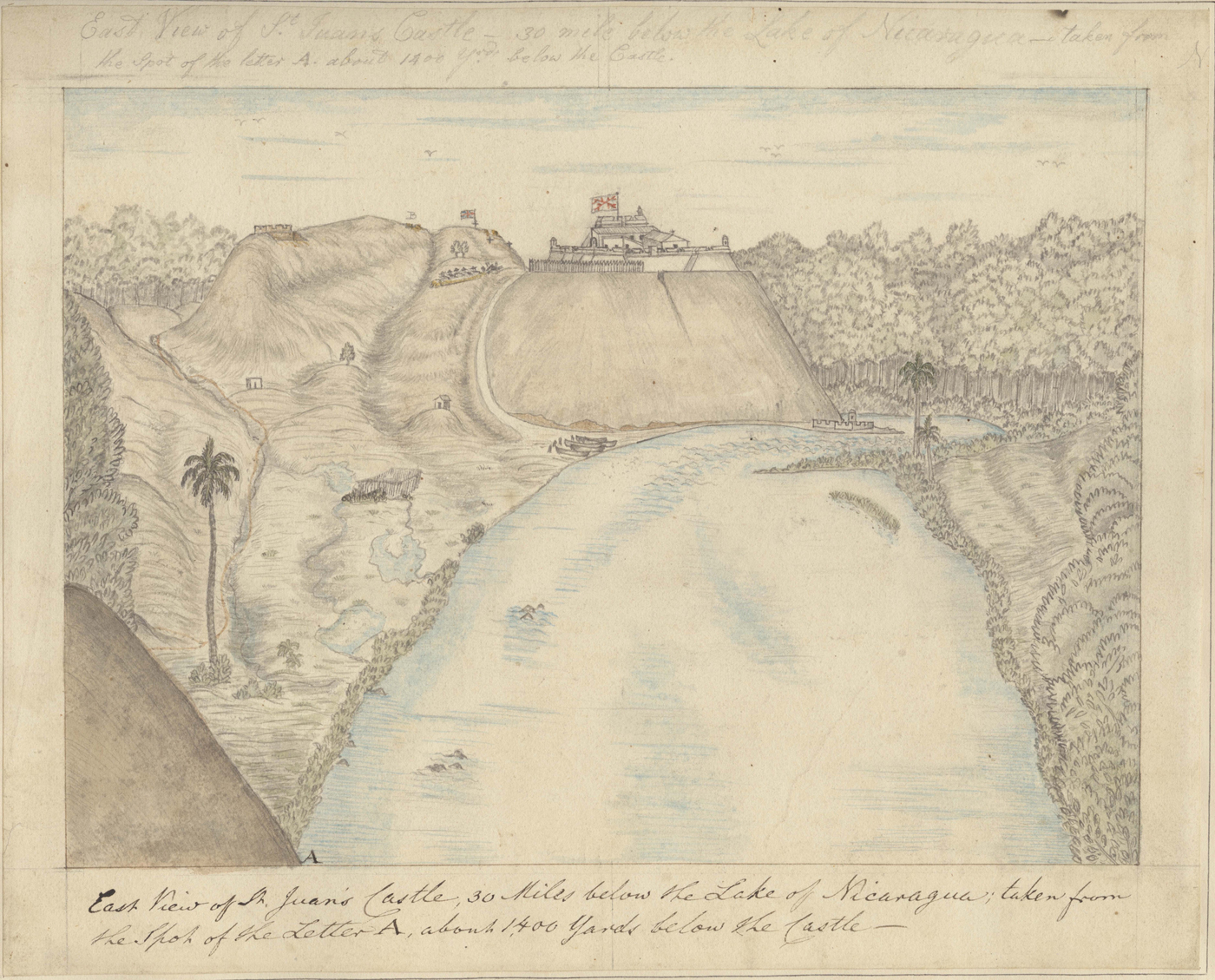
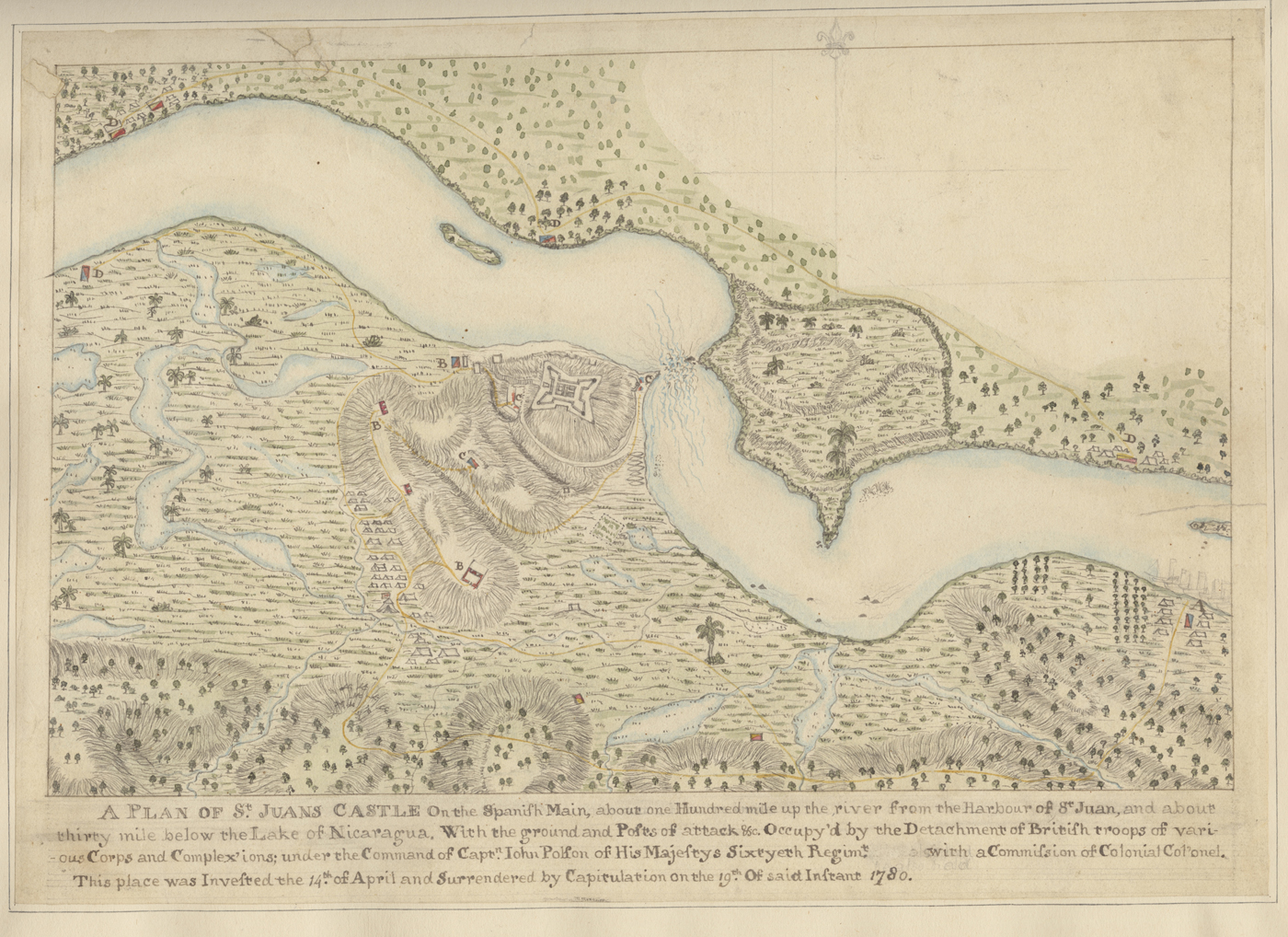
A force of 400 regulars and 200 Jamaica-raised volunteers sailed from Kingston in February 1780 under the command of Captain John Polson. Arriving at Cape Gracias a Dios, they were joined by 100 free and enslaved Africans of Lawrie's Black River Company and, more significantly, 300–400 Miskitu; a remarkable commitment of over a quarter of the Miskitu armed nation. But it was still less than British officers had been led to expect. Polson complained about the delays in collecting the Miskitu and reported that some ‘villains’ had convinced the Miskitu that the British army had come to enslave them. After a crucial delay as Polson convinced the Miskitu otherwise – a delay Dalling later blamed for the failure of the expedition – the force sailed to the Rio San Juan, reaching the mouth of the river in late March.Footnote 71 It took two weeks of arduous work, dragging the army's boats and stores over a major sand bar and several portages, to reach their objective: El Castillo de la Inmaculada Concepción, the ‘inland Gibraltar of Spanish America’ as Dalling termed it, and the only major fortress before San Carlos at the entrance to Lake Nicaragua (see Figures 2 and 3).Footnote 72 Ignoring the advice of a young Royal Navy officer, Horatio Nelson, the army settled down to a siege and the fort was in Miskitu/British hands by 29 April 1780.Footnote 73
Edward Despard's view of El Castillo de la Inmaculada Concepción from the East (1780). Courtesy of John Hay Library, Brown University.

British map of El Castillo de la Inmaculada Concepción (1780). Courtesy of John Hay Library, Brown University.

The value of the Miskitu in achieving this success was obvious to every observer. Most of the mahogany or cedar vessels used in getting over the shallows of the Rio San Juan had been hired from the Miskitu and their superiority as boatmen was widely acknowledged.Footnote 74 In an environment where time was of the essence – Polson knew that the river had to be secured before the Spanish reinforced Lake Nicaragua – the speed of the Miskitu boatmen was critical. Thomas Dancer, one of the expedition's two medical officers, stated that ‘I cannot omit the occasion of doing our Indians the justice to mention their spirited exertions and perseverance in the arduous enterprize of rowing up the boats such a length of way…I cannot help thinking that we are greatly indebted to them.’ His superior, Benjamin Moseley, agreed, stating that the San Juan would have been ‘insurmountable’ had it not been for the skills of the Miskitu.Footnote 75
Most of the Miskitu accompanied the first wave of Polson's force, proving equally adept in a combat capacity. These were skills British commanders had long recognized as useful. Beginning in 1720, Miskitu parties had been employed in fighting the Maroons in Jamaica and 200 Miskitu had taken part in the final campaign of the 1730s Maroon War.Footnote 76 Long and Edwards both celebrated the Miskitu for these actions, reporting that they were ‘the most proper troops to be employed in that species of action’ and that their skill with firearms was ‘remarkably expert’.Footnote 77 In October 1779, sixty Miskitu soldiers under General Tempest had accompanied a successful raid on Fort Omoa in the Bay of Honduras where British officers had been equally impressed by their allies. The raid's leader told Germain how the Miskitu had ‘advanced in front & dislodged them [the Spanish] from their Look Outs which prevented them from occupying the Defiles & passes’. Newspapers in London were soon printing this dispatch, noting how the Miskitu had proved ‘extremely sharp as scouts’ and that their musketry had kept the fort's ramparts clear of Spanish sharpshooters.Footnote 78
The capture of El Castillo was the high point of the expedition. At the moment of triumph, the Miskitu/British alliance broke down and the campaign began to unravel. Within days of the capture, every single Miskitu soldier on the expedition had left the army and had gone home – ‘deserted’ in the pejorative terms of British officers.Footnote 79 Without scouts and boatmen, the army had no means of proceeding further up the river, despite the arrival of nearly 500 reinforcements under Stephen Kemble and some twenty vessels laden with stores and equipment for the assault on the Lake. It was 7 July before Kemble was able to assemble his force for the push on Lake Nicaragua, thirty miles upstream, but many of his soldiers failed to cover the first mile before turning back.Footnote 80 ‘We had not proper people to work the crafts and were short of provisions’, explained a participant, ‘the troops being always exposed to the rains…became very sickly.’ Senior officers in Jamaica, receiving reports on the progress of the expedition, favoured a new strategy and told Dalling that: ‘white People are by no means equal to the Labour of dragging Craft over the Rapids’.Footnote 81
The remainder of the campaign was a deplorable waste of lives. The fort proved to be ‘worse than any prison’ and offered little protection from the elements as the summer rains began their annual cycle. There were few civilian structures in the area and most of the sick were accommodated in dilapidated huts on low-lying ground beneath the fort, in the heart of the Mosquito grounds. The burial grounds quickly became ‘shocking to behold’ by a ‘shameful neglect in interring the Dead’.Footnote 82 In November 1780, Dalling ordered the evacuation and destruction of the fort, something that was only partially accomplished before Spanish forces reoccupied the site in January 1781. This was the first of a series of counter-stokes that culminated in the Spanish capture of Roatán and Black River in March and April 1782. The recapture of Black River that August could not disguise the extent of the failure. From Jamaica, General Garth reported casualty rates on the expedition of over 80 per cent. John Hunter, the senior medical officer in Jamaica, explained that, ‘Of the troops sent upon the expedition against Fort St. Juan from Jamaica, scarcely a man ever returned.’Footnote 83
The removal of Miskitu military labour had doomed the expedition. Why they had withdrawn themselves quickly became the focus of general recriminations surrounding the disaster. British officers blamed the rapaciousness of Miskitu demands for captives. The fall of the fort had put a number of prisoners into British hands and the Miskitu demanded the fulfilment of a long-established system – backed by recent promises – that ‘Spanish Indians’ and people of colour would be turned over to them as slaves. Polson demurred, believing the claims of several prisoners that they were free people. This made the Miskitu ‘much dispirited, and angry at not being allowed to Plunder the Castle and make Slaves of all the Prisoners they took’.Footnote 84
Other sources, however, provide a more nuanced interpretation. The Tebuppy congress in October 1780 between the Miskitu and the Shore's agents, Colvil Cairns and James Thomson, was designed to identify what had gone wrong five months earlier. It became clear from this meeting what importance the Miskitu placed on the commercial value of their captives. The economic value of potential plunder was what gave military activity its significance to the Miskitu, something British officers had failed to recognize. If the alliance had already given Miskitu leaders preferential access to trade goods and a means of cementing their authority within the Mosquitia, a military campaign opened the possibility of plundering otherwise impregnable Spanish forts. As the Miskitu stated, ‘we fit out [for war] in hopes of plunder, we expect no payment from the English. If any of our country men are killed, we hope to revenge their death, and if any dies, we must pay their relations, out of what plunder we may acquire.’Footnote 85 The Miskitu did not view and treat captives in the same way as many Algonquian- and Iroquoian-speaking peoples in North America – as sources of community prestige to be subjected to ritual violence – and made it clear that they would accept compensation in the form of trade goods in lieu of the twenty-three captives that they claimed.Footnote 86 Cultural misunderstanding between the Miskitu and British, however, produced the same sense of betrayal and frustration that was common in North America as European commanders sought to impose alien conventions on their allies.Footnote 87
Miskitu confidence in their allies was hardly helped by what had happened at Fort Omoa the previous year. The plunder from Omoa, which the Miskitu had been led to believe they were due, was not delivered but was instead referred to the High Court of the Admiralty, which had jurisdiction over enemy seizures. As a result, the distribution of plunder to the land forces could not be made before the Admiralty had settled on its prerequisites, despite frequent assertions that Omoa, as an interior fort, did not fall under Admiralty jurisdiction. Both Dalling and Henry Walton, the agent for the European soldiers who helped capture Omoa, sent petitions on behalf of the Miskitu to the privy council, but they refused to act until the High Court of the Admiralty determined the navy's share.Footnote 88 The land parties, including General Tempest (who asked for an ordinary seaman's share for every Miskitu participant and for whom Robert White demanded an officer's share of the booty), had agreed on their respective shares in August 1780 but it was not until February 1783 that a final agreement was made. As a result, during the San Juan expedition, some Miskitu were still awaiting their share of the spoil from the previous year.Footnote 89
The crucial problem that underpinned these specific disagreements was that, as the British committed greater energies and resources to the region, the ability of the Miskitu to manage imperial intrusions into their country began to diminish. Confined to military norms that were not of their own making, the Miskitu quickly began to reconsider the value of British military activity in the Mosquitia. The first attempt to direct the Miskitu toward British goals in 1740 had ended in disaster when it became apparent how unwilling the Miskitu were to operate out of their immediate areas of habitation. Hodgson Sr had wanted to go to Leon and Grenada but the Miskitu ‘were so averse to it, that they declared, if I would not let them go on in their own way…they would proceed no further’.Footnote 90 In subsequent efforts, Hodgson Sr directed smaller groups of Tawira and Sambo Miskitu up the respective waterways immediately adjoining their settlements. This had the further advantage of not exposing British officers to complicity in slave catching, which they were keen to dissuade but feared the effect that this would have on Miskitu efforts. This proved to be the basis of successful raids on Spanish territories through the period, at least until the failure on the San Juan.Footnote 91
The appointment of European officers to command the Miskitu in 1780 had also been problematic. British officers, keen to improve command and control, ignored the instructions of both Dalling and Germain against forcing the Miskitu ‘to conform to our strict military ideas’ and for allowing them to act ‘in their own manner’.Footnote 92 Compounding the error, the European officers appointed to lead Miskitu companies knew little of their soldiers and cared even less. As one of those officers, David Lamb, explained, ‘The reasons given by the Indians themselves [for leaving] are that they were treated with contempt derision and abuse and that the officers were telling them they were a burden to the army.’ The Miskitu had also had their rations shortened several times and ‘much more than those of other corps’.Footnote 93
It is in this context that we should understand the governor's comments to Kemble in early 1781. The governor was entirely correct to invert the narrative of indigenous dependence on the European empires. Without Miskitu help, British efforts were indeed in vain. But the governor's comments were also an attempt to disengage the Miskitu from an arrangement that was no longer as useful to them as it had first appeared. As they told Cairns and Thomson at Tebuppy: ‘As we are entire strangers to the mode of fighting practised by the English, we wish rather to go to war our own way.’Footnote 94 The Miskitu had conceived of their alliance with the British as a voluntary arrangement designed to work European power to Miskitu ends. When the San Juan expedition exposed the inherent tensions in this arrangement, the Miskitu moved to prevent further encroachments by undermining British plans to renew operations. As the governor put pressure on Kemble, other Miskitu leaders travelled to Jamaica where they ‘propagated reports among the lower class of the white people’ that it was unsafe to enlist for operations in Central America.Footnote 95 Such interventions proved significant and a planned invasion of Costa Rica never took place.
IV
The consequences of the Rio San Juan expedition, however, reverberated long after the governor chided Kemble. Once the failure had exposed the difficulty of converting the Miskitu into projectors of imperial power, British assumptions about the region and its people began to change.Footnote 96 If the Miskitu had been characterized in the mid-century as vigorous warriors – ‘well-made, strong, and rather tall’ in Hodgson's 1757 analysis – this was more difficult to sustain after 1780.Footnote 97 As an evaluation written sometime in the 1780s made clear: ‘If the Spaniards earnestly desired to destroy…[the Miskitu], they could not…make a very vigorous resistance. They are chiefly defended by the rivers, morasses, and woods of the country, and perhaps more still by the diseases incident to the climate.’Footnote 98 Writing almost thirty years after the expedition, George Henderson, an army officer stationed in Belize, concurred. As he wrote, ‘In a political point of view, an alliance with the Mosquito Indians can be considered but of relative importance. They hold little pretention to the character of warlike…nor are there any advantages of a commercial nature resulting from such a connexion.’Footnote 99
British ideas about the Miskitu had, of course, always been contingent on imperial needs. As Troy Bickham argues, British perceptions of the indigenous ‘other’ were not static and essentialized but developed based on the shifting needs of the imperial metropole.Footnote 100 Racial understandings of the Miskitu were, at least in part, tied to the plausibility of their martial image, as least as far as British observers were concerned. Prior to 1780, the protection afforded by the Miskitu to the British settlers helped restrain and subvert the assumed inferiority of indigenous peoples.Footnote 101 The failure of the Miskitu to fulfil this promise altered the racist pathologies of British commentators. Figures such as Benjamin Moseley, who had praised the skills of Miskitu boatmen in 1780, now emphasized the meekness of the ‘pure’ Indians and prophesized their destruction unless they adopted what he assumed were the designing and aggressive characteristics of enslaved Africans.Footnote 102 After 1780, British imperial officials could claim that their interactions with the Mosquitia were based not on formalized alliances with a powerful political body but on humanitarian concerns for a ‘barbarous’ and fragile society.Footnote 103
By the time Britain was again ready to think about an invasion of Spanish Central America in 1804, the importance of the Miskitu had obviously declined. While certain that ‘their services would be of calculable utility’, the plan's author, Lt. Col. Thomas Barrow, noted that few of the Belize settlers had a close connection with the Miskitu and that no reliance should be placed upon them.Footnote 104 It was instead the enslaved African soldiers of the West India regiments who became the focus of British plans. The war against France in the 1790s convinced most senior officers in the Caribbean that the West Indian regiments were the key to British power.Footnote 105 The way in which Africans were integrated into the imperial military made them – in the eyes of those not horrified by the prospect of armed slaves – far more reliable as projectors of imperial power. Purchased at government expense and armed, trained, and disciplined as regular soldiers, the African military diaspora could be deployed with less risk of cultural misunderstanding and greater certainty of discipline and loyalty.Footnote 106 The same applied to South Asian sepoys, Russian mercenaries, German riflemen, French Royalists, and formerly enslaved Haitians, who were all considered as potential sources of manpower for future British operations in Central and South America.Footnote 107 These plans were never enacted but the eclipse of the Miskitu by disciplined infantrymen from the rest of Britain's global empire and beyond was telling.
As racial assumptions shifted, so too did British understandings of their interests in the Mosquitia. If Germain had been convinced that an assault on Central America was crucial to Britain's interests, his successors were less enthused. The defeats in Central and North America in 1780 to 1782 forced Britain to sue for peace and, in 1786, in order to avoid another war, Britain acceded to Spanish demands that the Shore settlers be withdrawn from the Mosquitia. The outcry against the withdrawal was muted and a motion against it in the House of Lords failed by a vote of 53 to 17. As it became obvious that Britain would not defend its settlements – even refusing Miskitu support for a pre-emptive attack on Spanish forces at Trujillo – settlers began to abandon the Shore, all the time fearful of an uprising by the betrayed Miskitu.Footnote 108
Subsequent efforts to renew British interest in the Mosquitia – and in Central America in general – failed to gain traction. In the 1790s, senior leaders such as William Pitt and Henry Dundas remained sympathetic to the idea of an attack on Spanish America but refused to commit themselves.Footnote 109 In the apparent absence of a reliable ally in the region, the potential costs were seen to far outweigh any gains. When Britain did commit soldiers to Spanish America in 1806–7 – the calamitous Buenos Aries expedition – it was, according to Dundas, to prevent France taking advantage of the revolts against Spain, not to free indigenous America from the bonds of Spanish slavery.Footnote 110 Britain instead settled on an informal imperialism in Central and South America. This was an imperialism that reflected a ‘pragmatic acceptance of limited power’ and demonstrated Britain's inability and unwillingness to convert the Amerindian population of Central America into projectors of imperial power as they had attempted to do before 1780.Footnote 111
The ability of the Miskitu to manage foreign colonial intrusions, however, remained intact. In contrast to North America, where the broader historical narrative examines a rise of European military and demographic superiority that is never relinquished, the Miskitu re-emerged as the region's dominant power. Without a strong British military presence, the region again became a borderland wherein the Miskitu extracted benefits from connections with both Britain and Spain. Miskitu fears of Spanish power were very real but new methods were found to benefit from European colonialism.Footnote 112 Miskitu leaders and their revenues continued to be ‘handsomely provided for at the public expense’ in Belize, the remaining British settlement on the coast.Footnote 113 Land concessions to British settlers, including the notorious Poyais Scheme of the 1820s, continued to play an important part in the politics of the Mosquitia.Footnote 114 Throughout the nineteenth century, efforts by Spain, Britain, and the United States to impose authority over the Mosquitia were resisted and it was not until the establishment of a centralized Nicaraguan state in the 1890s that the autonomous status of the Miskitu was effectively challenged. Miskitu resistance to that state continued and was a key part of the violence in Nicaragua in the 1980s.Footnote 115
The San Juan expedition of 1780 offers crucial insights into the importance of indigenous labour to imperial endeavours. In order to conduct offensive operations in Central America, British leaders needed to convert the Miskitu into projectors of imperial power. The effectiveness of these efforts was stymied by the weakness of British diplomacy in the region, the strength of Miskitu political structures, and the lack of viable alternative sources of soldiers and logistical support, at least before 1780. Germain later stated that ‘from the moment I heard no considerable Body of Mosquito Indians had been collected to go with the Troops…I ceased to flatter myself that any thing important would be effected’.Footnote 116 It was a remarkable admission of the importance of indigenous soldiers in British strategic thought.
The extent of this impact focuses our attentions on the importance of culture in colonial warfare. Military alliances generated regionally specific military and cultural assumptions that were highly vulnerable to misunderstanding. An interpretation of difference – not cultural difference itself – was the most problematic issue in intercultural alliances. In an immediate sense, British mistreatment and arguments over the fate of captives caused the Miskitu to withdraw their military labour from the expedition. In a more profound sense, however, the entire campaign was the product of building strategic assumptions around a misreading of the intention of coalition partners. The assumption that the Miskitu were willing to assist in any venture against the Spanish – an opinion deliberately cultivated by the Miskitu – led local agents, colonial governors, and even the administrative head of the British colonies into a campaign that drew vital resources away from other sectors of Britain's embattle empire. Supposedly rigid ideas about British interests, strategic thinking, and racial understandings of the Mosquitia's indigenous inhabitants changed to facilitate the campaign and were, in turn, changed by the campaign. Mobilizing military labour was not simply the process of hiring soldiers. It was a broader process of negotiation, understanding, and misunderstanding that helped define contacts between indigenous peoples and European empires.