Introduction
Parthenogenetic lineages have long been assumed to be evolutionary dead-ends due to their inability to either rapidly generate new genotypes or eliminate deleterious mutations (Maynard Smith, Reference Maynard Smith1978; Kondrashov, Reference Kondrashov1988, Reference Kondrashov1993; Vrijenhoek, Reference Vrijenhoek1998). The restricted reservoir of genetic variance makes the asexual lineages extremely sensitive to environmental perturbations. However, strictly parthenogenetic species occur in many phyla, especially in plants, rotifers, nematodes and arthropods (White, Reference White1978). These species reach high abundances, are spread over large geographical and ecological ranges and are evolutionarily long lived (Lynch, Reference Lynch1984). As the environment changes in time, different clones will be favoured in different generations; in the long run, the most successful genotypes will be those with the lowest temporal variance in fitness. According to the general-purpose-genotype model proposed by Lynch (Reference Lynch1984), specialized clones will survive as long as the narrow niche to which they are adapted remains available; but, over evolutionary time, clonal selection will promote the evolution of highly generalized genotypes. From that point of view, aphids are interesting biological models since they live in various environments, and they have the ability to use both sexual and asexual reproductive strategy during their annual life cycle.
Typically, aphids reproduce by cyclical parthenogenesis, which is the alternation of many parthenogenetic generations in spring and summer and a single sexual generation in autumn that produces over-wintering, diapausing eggs (Dixon, Reference Dixon1985). However, some aphid species consist of lineages that are parthenogenetic all year round, and some species are able to invest in both sexual and asexual reproduction at the same time of the year (Blackman, Reference Blackman1972; Dedryver et al., Reference Dedryver, Le Gallic, Gauthier and Simon1998).
The high rate of increase of parthenogens and the ability of an individual to establish a colony gives them a considerable advantage over sexual species when colonizing new habitats. In addition, aphid populations are usually composed of a mixture of wingless forms that ensure rapid development of populations after plant colonization and of winged individuals that can disperse over longer distances and may be locally very mobile (Dixon, Reference Dixon1985). These winged forms develop in response to crowding and/or to changes in the nutritional quality of the plant. As a consequence of parthenogenesis, a genotype can be represented by many individuals that are likely to be widely dispersed within a habitat. Therefore, the ability of clones to locate and feed on certain plants, avoid death from natural enemies and withstand periods of stress determines which genotypes survive. As aphid population size can be extremely large, the number of mutations per generation can be significant and the probability that an adaptive mutation occurs is far from negligible (Lushai & Loxdale, Reference Lushai and Loxdale2002; Loxdale & Lushai, Reference Loxdale and Lushai2003). Moreover, a mutation carried by an individual will be transmitted to all the offspring. Therefore, an adaptive mutation is likely to spread very rapidly (Lushai et al., Reference Lushai, Loxdale and Allen2003). This is illustrated by the rapid selection of mutations in response to insecticide treatments for crop protection. Trophic and climatic conditions in agroecosystems are favourable to aphid population increase. These outbreaks have been controlled by heavy insecticide pressures but cases of resistance to different insecticide chemicals rapidly occurred and spread all over the world (Devonshire et al., Reference Devonshire, Field, Foster, Moores, Williamson and Blackman1998; Andrews et al., Reference Andrews, Callaghan, Field, Williamson and Moores2004). Furthermore, while the great majority of aphid species exhibits a very high degree of host specificity, aphids that are considered as pests tend to have a wider host range. Some of these aphid pests are utilizing several plant species within the same plant family (as, for example, the cereal aphid, Sitobion avenae (F.), sensu lato on Poaceae or the pea aphid, Acyrthosiphon pisum (Harris), on Fabaceae; Blackman & Eastop, Reference Blackman and Eastop1984). A few aphid species are really polyphagous because they can feed on plants in very different families, as is the case for the two most important aphid pest species, the peach-potato aphid, Myzus persicae (Sulzer), and the cotton-melon aphid, Aphis gossypii (Glover) (Blackman & Eastop, Reference Blackman and Eastop1984). Given the variability in plant chemistry, this raises the question of the performance of these aphid species on very different host plants and whether or not host-associated differentiation has occurred.
The cotton-melon aphid, A. gossypii, has a worldwide distribution in tropical, subtropical and temperate regions (Leclant & Deguine, Reference Leclant, Deguine, Matthews and Tunstall1994). In the major part of its distribution area, the aphid is assumed to have an exclusively asexual mode of reproduction via apomictic parthenogenesis, although cyclic parthenogenesis has been reported in cool areas of Japan, China and USA (Ebert & Cartwright, Reference Ebert and Cartwright1997). A. gossypii generally is seen as a highly polyphagous species since it has been reported on several hundreds of plant species from numerous plant families (Ebert & Cartwright, Reference Ebert and Cartwright1997; Deguine et al., Reference Deguine, Martin and Leclant1999). However, this aphid appears to be variable in its performance between different host plants species and the existence of host races, that is to say host-adapted genotypes, was suspected (Guldemond et al., Reference Guldemond, Tiggs and De Vrijer1994; Wool et al., Reference Wool, Hales and Sunnucks1995). This belief has been confirmed by the use of molecular markers that discriminated a cucurbit-host race within the species A. gossypii (Vanlerberghe-Masutti & Chavigny, Reference Vanlerberghe-Masutti and Chavigny1998) and that showed that the melon aphid is genetically differentiated from the cotton aphid (Vanlerberghe-Masutti et al., Reference Vanlerberghe-Masutti, Chavigny and Fuller1999; Brévault et al., Reference Brévault, Carletto, Linderme and Vanlerberghe-Masuttiin press).
The aim of the present study was to investigate whether host specialization is a widespread evolutionary strategy within the species A. gossypii. In Tunisia, the melon aphid is one of the most damaging insect pests on several vegetable crops (potato, tomato, green pepper, melon, zucchini, etc.) in greenhouses, plastic tunnels and open fields and in citrus orchards (Ben Halima-Kamel & Ben Hamouda, Reference Ben Halima-Kamel, Ben Hamouda, Simon, Dedryver, Rispe and Hullé2004). We collected A. gossypii samples from different cultivated host plant species in six locations in Tunisia and used eight microsatellite markers to explore the genotypic diversity of the species according to host plant and geography.
Materials and methods
Sample collection
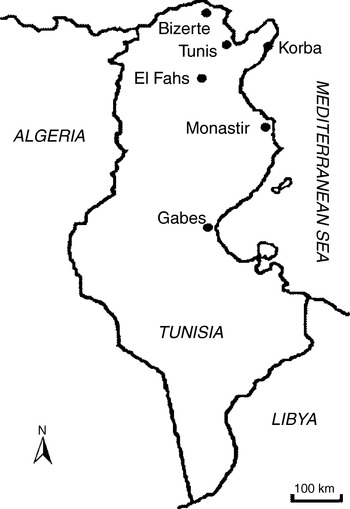
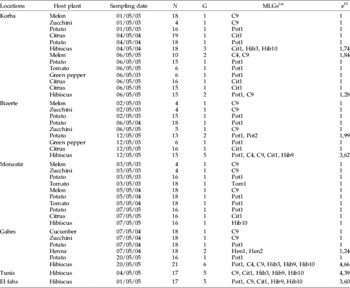
Aphids were sampled on cultivated host plants belonging to Cucurbitaceae (melon, zucchini and cucumber), Solanaceae (potato, tomato and green pepper), Rutaceae (citrus), Lythraceae (henna) and Malvaceae (Hibiscus syriacus L.). Collections were made during three consecutive years from four locations situated in northern Tunisia (Bizerte and Korba), central (Monastir) Tunisia and southern Tunisia (Gabes). Additionally, two locations in the north (Tunis and El Fahs) were sampled in 2005 (fig. 1). Forty samples, totalling 559 individuals, were obtained. Sampling sites, host plants and dates of collection are listed in table 1. At each site, aphids were collected from distant plants in order to limit the chance of sampling offspring of the same parthenogenetic mother. All samples were checked for species identification according to morphological criteria (Stroyan, Reference Stroyan1984). Aphids belonging to the A. gossypii species were stored in microtubes filled with 70% ethanol and preserved at −20°C prior to genotypic testing.
Map of Tunisia showing the geographic location of the samples.

Population sampling data and genetic diversity within the samples.

N, number of aphids analysed; G, number of different multilocus genotypes detected; eH, clonal diversity expressed as the exponential of Shannon-Wiener diversity index; a, see table 2 for definitions.
DNA extraction
Aphids stored in 70% ethanol were rinsed twice with a 0.65% (w/v) NaCl solution. Total genomic DNA was extracted from each single adult aphid using a cetyl-trimethyl ammonium bromide (CTAB) protocol (Doyle & Doyle, Reference Doyle and Doyle1987). Each individual was placed in a microtube and crushed with a small pestle in 50 μl of CTAB extraction buffer (100 mM Tris-HCl, pH 8, 2% CTAB, 1.4 M NaCl, 20 mM EDTA, 0.2% 2β-Mercaptoethanol). A volume of 150 μl of CTAB extraction buffer was added to the specimen. Following incubation at 65°C for 1 h, 200 μl of chloroform-isoamyl alcohol (24:1) were added, mixed and centrifuged at 8000 rpm, for 5 min at 4°C. The supernatant was transferred to a new tube. To precipitate DNA, 200 μl of isopropanol were added to the supernatant, mixed and incubated overnight at −20°C. The mixture was centrifuged at 13,500 rpm for 15 min at 4°C, the supernatant discarded and the remaining pellet washed in 70% ethanol for 10 min. The pellet was then dissolved in 20 μl TE buffer.
Microsatellite genotyping
Patterns of allelic diversity in Tunisian populations of A. gossypii were examined at eight microsatellite loci. DNA extracts were used as PCR templates to amplify the A. gossypii-specific microsatellite loci Ago24, Ago53, Ago59, Ago66, Ago69, Ago84, Ago89 and Ago126 (Vanlerberghe-Masutti et al., Reference Vanlerberghe-Masutti, Chavigny and Fuller1999). PCR reactions were performed in 25 μl final volume using 30 pmol of each primer, 0.25 units of Taq DNA polymerase (Qbiogene), 200 μM of each dNTP, 2 μl of ten-fold diluted DNA solution, 10 mM Tris-HCl, 50 mM KCl, 0.1% Triton X-100, 0.2 mg ml−1 Bovine Serum Albumin (BSA). PCR cycling parameters consisted of one step of 5 min at 94°C, 35 cycles of 1 min at 94°C, 1 min at locus-specific annealing temperature according to Vanlerberghe-Masutti et al. (Reference Vanlerberghe-Masutti, Chavigny and Fuller1999) and 30 s at 72°C, followed by 5 min at 72°C. Amplified fragments were separated by electrophoresis using 8% polyacrylamide gels and visualized using ethidum bromide staining. Microsatellite allele sizes were estimated by comparison with the standard DNA marker Φ X174-HaeIII (EUROGENTEC marker 4).
Data analysis
Each individual was described by its multilocus genotype (MLG), the allelic combination at the eight microsatellite loci. Individuals having an identical MLG were regarded as members of the same clone. Genetic diversity in each sample was estimated using two indexes. First, the ratio of the number of different MLGs (G) over the total number of individuals (N) was calculated. Second, the Shannon-Wiener diversity index (H) was calculated as −∑ip ilnp i, where p i is the relative frequency of the ith MLG. This algorithm determines the genetic diversity in relation to the number of MLGs and their relative abundance in the population. This value was expressed as eH as proposed by Vanoverbeke & De Meester (Reference Vanoverbeke and De Meester1997).
Since aphids with the same MLG are assumed to be members of the same clone and since inclusion of clonal copies usually strongly distorts estimates of population genetic parameters, the analysis was carried out with the data set reduced to only one representative of each MLG (Sunnucks et al., Reference Sunnucks, De Barro, Lushai, Maclean and Hales1997a; Llewellyn et al., Reference Llewellyn, Loxdale, Harrington, Brookes, Clark and Sunnucks2003). Two types of populations were considered: (i) six geographical populations, each made of one aphid per MLG sampled on a particular host plant at a particular date within the same site, and (ii) four populations corresponding to four out of the five host plant families, each made of one aphid per MLG sampled on a host plant species per date and per site. The population from Lythraceae family (henna) was omitted because it consisted of aphids displaying only two different MLGs (table 1). Departures from Hardy-Weinberg equilibrium and linkage disequilibrium were calculated using exact tests available in GENEPOP version 3.4 (Raymond & Rousset, Reference Raymond and Rousset1995). The program FSTAT version 2.9.3 (Goudet, Reference Goudet1995; Goudet, Reference Goudet2001) was used to test for genetic differentiation between pairs of populations by calculating F ST across loci (Wier & Cockerham, Reference Weir and Cockerham1984). To investigate the relationships among the MLGs, we used the program populations version 1.2.28 (http://www.cnrs-gif.fr/pge/bioinfo) to generate a matrix of pairwise genetic distances based on the Allele Shared Distance (DAS: Jin & Chakraborty, Reference Jin and Chakraborty1993) and to construct a neighbour-joining tree. Bootstrap values were computed by resampling loci and are given as percentages over 2000 replications.
Results
Genetic and genotypic diversity
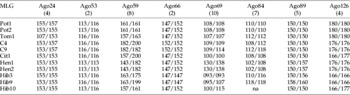
The analysis of 559 aphids collected on different host plants and from different localities, as listed in table 1, revealed that the allelic diversity at the eight microsatellite loci ranged from two to ten alleles per locus with 42 alleles identified across all loci. Overall, only 11 different multilocus genotypes could be distinguished (table 2). Much of the genotypic variation among these MLGs corresponded to possession of private alleles, rather than rearrangements of identical alleles. No evidence for recombinant genotypes was found. The great majority of the MLGs were found in many copies and occurred in many samples within and between collecting sites. Moreover, almost all samples were characterized by a very low clonal diversity, as expressed by the diversity indexes shown in table 1. The values of eH ranged from 1 (a single clone was observed) for 31 out of 40 samples to 4.66 in the sample collected on Hibiscus in the region of Gabes in 2005. Actually, out of the nine samples that consisted of more than one clone, six were collected on Hibiscus.
Allelic combination of the 11 multilocus genotypes (MLG) identified on the basis of the eight microsatellite loci from A. gossypii found in Tunisia.

The number of different alleles found at each locus is indicated between brackets. Allele sizes are given in base pairs; na, non-amplifying.
Differences between observed and expected heterozygosity were highly significant for the great majority of the loci, whether we considered site-associated populations or plant-associated populations. Significant linkage disequilibria were observed for 13 pairs of loci out of 28 when site-associated populations were analyzed (P<0.01) and for 20 pairs when plant-associated populations were analyzed (P<0.001).
Genetic population differentiation
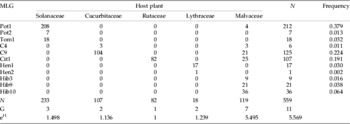
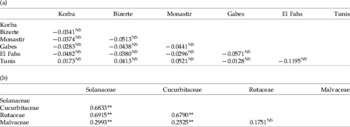
Differentiation between pairs of geographical populations estimated by multilocus F ST was not significant. On the contrary, a highly significant differentiation was observed between all pairs of plant family populations except the comparison between samples collected on Rutaceae (citrus trees) and those collected on Malvaceae (Hibiscus) (table 3). Out of the 11 MLGs identified in these samples, three were very frequently observed: Pot1, C9 and Cit1 represented nearly 80% of the aphids. These MLGs were not randomly distributed in the different botanical populations: 90% of the aphids collected on plants of the Solanaceae family displayed the MLG Pot1, 97% of those collected on Cucurbitaceae displayed the MLG C9 and 100% of those collected on Rutaceae displayed Cit1 (table 4). Except for the Malvaceae family, plants of a particular family were specifically infested by aphids displaying one particular MLG, whatever the site and the year of collection (table 1).
Distribution and number of individuals exhibiting one of the eleven multilocus genotypes (MLG) according to the plant family from which aphids were sampled.

N, total number of aphids analysed; G, number of different multilocus genotypes; eH, clonal diversity expressed as the exponential of the Shannon-Wiener diversity index.
Genetic differentiation according to pairwise F ST values: (a) pairs of six populations corresponding to samples pooled by geographical origin; (b) pairs of four populations corresponding to samples pooled by host plant origin.

NS, non-significant; **, P<0.01.
Genetic relationships among MLGs
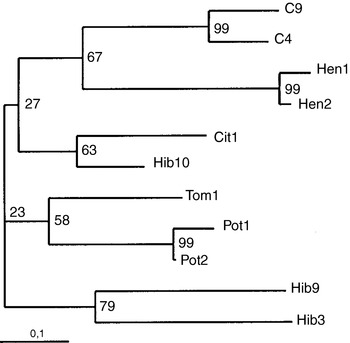
The neighbour-joining tree confirmed the genetic structuring according to host plant in Tunisian populations of A. gossypii (fig. 2). The MLGs characterizing aphids sampled on hosts of the same plant family were phylogenetically closer to each other, except for Hib10 that was more closely related to Cit1 from citrus trees than to Hib3 and Hib9 from Hibiscus. The phylogenetic nodes that were supported by very high bootstrap values (99%) corresponded to pairs of MLGs that differed by only one allele at the microsatellite locus Ago24 for the pair Pot1-Pot2 and the pair Hen1-Hen2 or by four alleles over three loci in the case of C9 and C4 (table 2). These differences resulted most probably from mutations during apomictic parthenogenesis. The two MLGs, Hib3 and Hib9, diverged from each other by ten alleles over six loci and their differentiation from all the other MLGs was observed in 79% of the bootstraps.
Neighbour-joining tree based on shared allele distances (DAS) calculated with eight microsatellite loci for 11 multilocus genotypes of A. gossypii from various crops in Tunisia. Bootstrap values are given in percentage over 2000 replications.

Discussion
In the present study, we analysed the genetic diversity within and between samples of A. gossypii collected in different regions of Tunisia from host plants distributed in five different families (Cucurbitaceae, Solanaceae, Rutaceae, Malvaceae and Lythraceae). Sampling was repeated over three successive years. The analysis of allele polymorphism at eight microsatellite loci of almost 600 aphids revealed a high genetic variability with up to ten alleles per locus. However, this allelic variability is distributed in only 11 multilocus genotypes, whilst all but one are present as multicopies. In fact, 80% of the aphids are characterised by either one of three MLGs (Pot1, C9, Cit1) that were found repeatedly every year of the study. Moreover, 31 of the 40 samples were monomorphic. Low clonal diversity, significant linkage disequilibrium among pairs of loci and the absence of recombinant genotypes confirm that A. gossypii reproduces by continuous apomictic parthenogenesis in Tunisia. This is expected since, according to the model of Rispe et al. (Reference Rispe, Pierre, Simon and Gouyon1998), the mild winter climatic conditions in that country should favour obligate parthenogenesis. These results are similar to those found in A. gossypii populations sampled from cucurbit crops in southern France, where 90% of the aphids had one of three common MLGs (Fuller et al., Reference Fuller, Chavigny, Lapchin and Vanlerberghe-Masutti1999).
Interestingly, this genetic analysis of 40 samples of A. gossypii collected on different crops in different regions of Tunisia revealed that the genotypic diversity is structured according to the host plant family, as reflected by the distribution of the same MLGs in aphids infesting plants of the same botanical family. Highly significant pairwise F ST values were detected among populations collected on different plant families, whatever their geographical origins. Moreover, 97% of the aphids collected on cucurbits in Tunisia displayed the MLG called C9 that is one of the most abundant MLGs found in A. gossypii sampled from cucurbit crops in southern France (Fuller et al., Reference Fuller, Chavigny, Lapchin and Vanlerberghe-Masutti1999) as well as in Cameroon (Brévault et al., Reference Brévault, Carletto, Linderme and Vanlerberghe-Masuttiin press). This MLG is characteristic of the cucurbit host race identified in A. gossypii (Vanlerberghe-Masutti & Chavigny, Reference Vanlerberghe-Masutti and Chavigny1998). In the same way that 90% of the aphids collected on Solanaceae in Tunisia exhibit the MLG Pot1 that is also characteristic of aphids collected on potato crops in France (Vanlerberghe-Masutti et al., Reference Vanlerberghe-Masutti, Chavigny and Fuller1999). The fact that it appears that the same MLG is found again on the same plant every crop season shows that Cucurbitaceae and Solanaceae plants contain highly selective nutritional factors affecting A. gossypii population genotypic structure. Comparative biological studies on samples of A. gossypii collected on cucumber and eggplant have shown that adult survival and fecundity decreased significantly when aphids were transferred to a host other than the original (Hosoda et al., Reference Hosoda, Hama, Suzuki and Ando1993; Owusu et al., Reference Owusu, Kim, Horiike and Hirano1996). However, these studies failed to detect any fixed genetic difference between aphids from cucumber and eggplant (Owusu et al., Reference Owusu, Kim, Horiike and Hirano1996). In our study, the two MLGs characterizing Cucurbitaceae and Solanaceae adapted aphids share less than 44% of their alleles. This genetic divergence is the result of a selection process favouring those clones that are able to feed and, therefore, survive and reproduce on Cucurbitaceae and Solanaceae, respectively.
The role of host plant in genetic structuring of aphid populations has been reported in several studies. One of the best-documented examples of host races in aphid is the differentiation of the pea aphid, A. pisum, into alfalfa, clover and pea-faba bean host races (Via, Reference Via1999; Via et al., Reference Via, Bouck and Skillman2000; Hawthorne & Via, Reference Hawthorne and Via2001; Simon et al., Reference Simon, Carre, Boutin, Prunier-Leterme, Sabater-Munoz, Latorre and Bournoville2003; Frantz et al., Reference Frantz, Plantegenest, Mieuzet and Simon2006). Similarly, populations of the cereal aphid, S. avenae sensu lato, confined to specific host plants have been discriminated from more generalist populations occurring on different hosts using RAPD markers (De Barro et al., Reference De Barro, Sherratt, Carvalho, Nicol, Iyengar and Maclean1995) and microsatellite loci (Sunnucks et al., Reference Sunnucks, De Barro, Lushai, Maclean and Hales1997a). Lushai et al. (Reference Lushai, Markovitch and Loxdale2002) have also shown, using RAPDs, that the host preference of the winged asexual female founders landing on poaceous hosts in the spring has a genetic component. Host restricted forms of Therioaphis trifolii have been identified from lucerne and clover (Sunnucks et al., Reference Sunnucks, Driver, Brown, Carver, Hales and Milne1997b). Recent studies on mitochondrial DNA variations among clones of the greenbug, Schizaphis graminum (Rondani), showed differences in their feeding behaviour, strongly supporting the existence of host-adapted races in this species (Shufran et al., Reference Shufran, Burd, Anstead and Lushai2000; Anstead et al., Reference Anstead, Burd and Shufran2002). Host associated population genetic structures have also been reported in populations of the cabbage aphid, Brevicoryne brassicae (L.) (Ruiz-Montoya et al., Reference Ruiz-Montoya, Núñez-Farfán and Vargas2003), and of the lettuce root aphid, Pemphigus bursarius (L.) (Miller et al., Reference Miller, Birley, Overall and Tatchell2003).
In the case of the pea aphid, it has been shown that feeding behaviour of the host races not only determines host choice and, therefore, the pool of potential mates for those that still have a sexual generation in their annual cycle, but also influences performance on the alternate plant. This association between assortative mating and performance on different host plants favours the evolution of ecological specialization (Caillaud & Via, Reference Caillaud and Via2000). In the case of A. gossypii that mainly reproduces by obligate parthenogenesis, the process of host plant specialization involving trade-offs that reduce fitness on other host plants may occur very rapidly.
The results presented here reveal that cultivated parcels of Cucurbitaceae (melon and zucchini) and Solanaceae (potato, tomato and green pepper) are infested by specialized A. gossypii genotypes. However, these crops are only seasonally grown, meaning that the specialized clones have to take refuge on other plants for the intercrop season. Surprisingly, a non-negligible number of aphids collected on Hibiscus syriacus display the MLGs characteristic of individuals specialized on Cucurbitaceae, Solanaceae or citrus trees. Furthermore, the clonal diversity of each sample collected on Hibiscus is significantly higher than on other crops, as evidenced by the Shannon-Wiener index. This strongly suggests that this plant does not exert a strong selection pressure on A. gossypii clones, which, moreover, do not undergo strong competition for food. H. syriacus happens to be one of the primary hosts on which A. gossypii sexual reproduction has been reported in some cooler environments (Ebert & Cartwright, Reference Ebert and Cartwright1997). Hence, it might be expected that different genotypes would settle on and accept Hibiscus as a host. As this ornamental shrub is perennial and widely distributed in Tunisia, it could constitute a suitable refuge for specialized genotypes all year round. Laboratory experiments to measure performance of clones on their host and on Hibiscus are needed to fully evaluate this hypothesis. Furthermore, the presence of colonies of specialized clones on Hibiscus should be searched for during the intercrop season. However, given the extremely large repertory of plant species hosting A. gossypii (Ebert & Cartwright, Reference Ebert and Cartwright1997; Deguine et al., Reference Deguine, Martin and Leclant1999), the existence of refuge hosts other than Hibiscus is highly probable.
The clonal diversity of the samples collected on Cucurbitaceae, Solanaceae, citrus trees and henna crops (expressed by an index eH ranging from 1 to 1.5) is extremely low as compared to the clonal diversity found on Hibiscus, which is surely the result of specialization. Yet, we cannot exclude that an additional selective factor may have favoured these particular genotypes, such as insecticide selection, since all these crops are commonly treated with organophosphate and pyrethroid insecticides. Insecticide resistance cases have been reported for A. gossypii populations in many countries (Delorme et al., Reference Delorme, Augé, Bethenod and Villatte1997; Ahmad et al., Reference Ahmad, Arif and Denholm2003; Andrews et al., Reference Andrews, Callaghan, Field, Williamson and Moores2004). Therefore, the host-adapted clones displaying the MLGs C9, Pot1, Cit1 or Hen1 could predominate because they possess an insecticide resistance mechanism that confers a highly selective advantage. Such a scenario has been advanced by Brookes & Loxdale (Reference Brookes and Loxdale1987) and Zamoum et al. (Reference Zamoum, Simon, Crochard, Ballanger, Lapchin, Vanlerberghe-Masutti and Guillemaud2005) to explain the genetic structure of populations of the peach-potato aphid, Myzus persicae, collected from oilseed rape and by Brévault et al. (Reference Brévault, Carletto, Linderme and Vanlerberghe-Masuttiin press) to explain the clonal diversity of A. gossypii on cottonwood. An investigation of the genetic variability of A. gossypii populations collected from both cultivated and uncultivated environments at a much larger geographical scale is needed for a better understanding of specialization and local adaptation in this aphid species.
Acknowledgements
We are very grateful to two anonymous referees for valuable comments on the manuscript and improvement of the text. This work was funded by Comité Mixte franco-tunisien pour la Coopération Universitaire (CMCU) project 03G0914. J. Carletto was supported by a PhD grant from Institut National de la Recherche Agronomique and Région Provence Alpes Côte d'Azur.