Disasters present unique challenges and opportunities to the medical community. Since the terrorist attacks of September 11, 2001, US health care institutions have advanced in developing methods to allocate sufficient human resources to manage the demands associated with disasters.Reference Stopford 1 – Reference Inglesby 3 Pharmacists represent a specific health resource uniquely positioned to render a general scope of health services in disasters. Since the publication of Hepler and Strand's pharmaceutical care paradigm, which signaled the profession's shift from product- to patient-centered orientation,Reference Hepler and Strand 4 pharmacists’ capacity for direct patient care has expanded in many ways, particularly in the context of disaster management.Reference Hogue, Hogue, Lander, Avent and Fleenor 2 , Reference Setlak 5 – Reference Austin, Martin and Gregory 7
Several methods of categorization have been developed to characterize traditional and patient-oriented responsibilities in disasters.Reference Setlak 5 , Reference Pincock, Montello, Tarosky, Pierce and Edwards 6 , Reference Chin, Chant, Tanzini and Wells 8 One classification method identifies 5 categories of pharmacist disaster duties and involves developing drug use guidelines and dosing charts, establishing drug distribution systems, providing drug counseling, obtaining medication histories, communicating with key medical personnel, and handling new situations creatively.Reference Chin, Chant, Tanzini and Wells 8 Another method distributes disaster duties among various pharmacy specialty practices.Reference Pincock, Montello, Tarosky, Pierce and Edwards 6 For example, clinical roles involve detecting and resolving drug-related problemsReference Hepler and Strand 4 for patients with moderate or severe chronic and acute conditions (ambulatory care, pharmacotherapy, or critical care specialties).Reference Pincock, Montello, Tarosky, Pierce and Edwards 6 Other roles include medication procurement, storage, inventory, distribution, logistics, and management.Reference Pincock, Montello, Tarosky, Pierce and Edwards 6
Although the preceding methods of categorization provide focused descriptions of disaster roles within a limited, pharmacy-centered framework, they exclude integrated duties that may be required of pharmacists in a broader, medical context. The most widely inclusive classification of pharmacists’ functions (and the basis of the classification method used in this analysis) is set forth by Setlak, who identifies 4 general disaster duties from a health systems perspective: response integration, patient management, pharmaceutical supply, and policy coordination.Reference Setlak 5
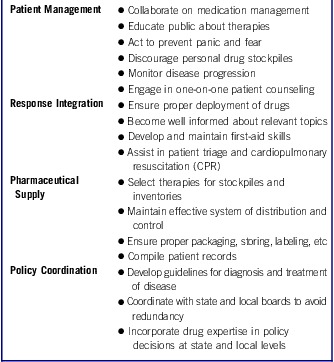
Response integration refers to pharmacists integrating into the casualty response by triaging patients alongside physicians and nurses and administering first aid and cardiopulmonary resuscitation. Patient management involves monitoring patient outcomes after administration of medical countermeasures and communicating with patients and the public about therapies used to counter various natural and manmade threats. Pharmaceutical supply concerns the coordination of the dispensing site layout and medication procurement, repackaging, distribution, and control. Policy coordination corresponds to eliminating duplicate therapies included in emergency formularies, streamlining paperwork to avoid duplicative forms, and applying drug expertise in decision-making.Reference Setlak 5
As the pharmacy literature showcases examples of pharmacists proffering their medical skills in response to the needs of disaster victims, disaster-related practice reports can provide a framework to examine associations between pharmacists’ roles and disasters. It has been shown that disaster-related articles are typically published within the first 6 months after a highly publicized event, with studies examining long-term health impacts published decades after the initial incident.Reference Smith, Wasiak, Sen, Archer and Burkle 9 This finding suggests that the impact of the disaster is as important to publishing priority as the immediacy of the event.
Time also represents an important consideration when analyzing peer-reviewed disaster reports. Cold War era (1950s–1990s) disasters and disaster-related activities can differ in many respects from those of post-Cold War/Pre-terrorism (1990–2001) or Terrorism (2001–present) eras. Nuclear disasters (ie, mutually assured destruction) and response-integration duties, for instance, may be emphasized more in Cold War era literature than in other times. Anthrax attacks, pandemic influenza, and terrorism threats, coupled with a patient management and policy coordination focus, may characterize the Terrorism era more than past times. While hurricanes may evoke pharmaceutical supply, policy coordination, and patient management roles in the current era, references to natural disasters (excluding the numerous references to hurricanes Katrina and Rita) may not characterize a particular time period.
Available literature regarding pharmacists’ involvement in disasters is primarily relegated to disaster-related practice reports and professional position statements. Few articles systematically analyze disaster-related issues, and, to our knowledge, no article to date has inferred the factors that might explain pharmacists’ participation in disasters. Assuming that (1) the impact and immediacy of disasters contribute equally to the publishing priority of disaster-related articles, and (2) disaster-related practice reports in peer-reviewed pharmacy literature serve as adequate markers of the profession's level of disaster preparedness, this analysis determines factors that significantly explain pharmacists’ disaster roles and examines differences in roles and disasters when stratified by time.
Methods
Content analysis is a method of quantifying the presence of certain words or phrases in written media and is thus a useful tool for evaluating literature reports of pharmacists’ roles in disasters.Reference Rubin and Babbie 10 Accordingly, the units of observation are the individual articles from which observations are made, and the units of analysis are words or phrases within the articles that denote pharmacists’ roles in various disasters.
A comprehensive literature search was conducted using PubMed, MEDLINE, the Cumulative Index to Nursing and Allied Health Literature (CINAHL), and International Pharmaceutical Abstracts (IPA) for articles in peer-reviewed pharmacy journals describing pharmacists’ roles in disasters. Database search terms included the words “pharmacist,” “role,” and “disaster.” Articles relating to disasters, published in the English language between 1960 and 2012, and available through library sources—a total of 98 peer-reviewed articles—were included in the analysis.
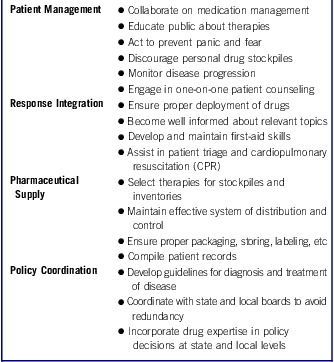
Words (ie, units of analysis) referring to specific roles and disasters were recorded and classified into mutually exclusive variables according to the following schemes. Modified pharmacist role descriptions were based on those presented by SetlakReference Setlak 5 (Table). Although descriptions of roles are from a health systems perspective, significant application could be made in other pharmacy practice settings, including community pharmacy. The classification of natural disasters encompassed tornadoes, hurricanes, floods, fires, snow/ice, earthquakes, influenza, and outbreaks of severe acute respiratory syndrome (SARS). Human systems failures (HSF) included crashes (automobile, airplane, and train), chemical spills, nuclear plant meltdowns, and building collapses. Chemical, biological, radiological, nuclear, and explosive (CBRNE) disasters encompassed chemical and biologic terrorism, use of radiologic dispersal devices (RDD), nuclear terrorism, or use of improvised explosive devices (IED). To test for historical differences in the quantities of disaster and role references in peer-reviewed reports, articles were sorted according to publication date and partitioned in 3 distinct periods: (1) Cold War era (1960–December 1991), (2), post-Cold War/Preterrorism era (January 01, 1992–September 30, 2001), and (3) Terrorism era (October 01, 2001–present). Data collection was performed solely by one of us (C.H.).
Classification of Pharmacists’ Disaster Roles
A negative binomial regression model was chosen to determine which disasters significantly explain roles assumed by pharmacists. Because count data typically do not conform to Gaussian distribution, several models including Poisson, zero-inflated, hurdle, and gamma regression models were compared using criteria that characterize data dispersion and model adequacy. 11
Gamma distributions yield inaccurate regression models when dependent variables can be zero, and zero-inflated, and hurdle models presuppose the presence of 2 data-generating processes, 1 generating zeros and 1 generating positive values. 11 Data in this analysis did not meet these assumptions. As data was found to be overdispersed (as indicated by mean and variance estimates), a negative binomial model was preferred over a Poisson model, which is less commonly applied with overdispersed count data. 11 Thus, the negative binomial distribution was chosen for regression modeling.
The regression equation took the following form:
 $${{\lambda }_{\rm{i}}}\, = \,\ital exp \,\left( {\beta {{{\rm{x}}}_{\rm{i}}}\, + \,{{ \in }_{\rm{i}}}} \right)\eqno\rm$$
where λi is the estimate, βi the coefficient, and €i the error term. Negative binomial regression models the log of incident counts, with coefficients interpreted accordingly: for a 1-unit change in λi, the log of βi is expected to change by the regression coefficient.Reference Piza 12 Negative binomial regression also allows the option of interpreting the effects of independent variables on the dependent variable in terms of incident rate ratios (IRR), which represent the percentage increase or decrease in the dependent variable.Reference Piza 12 Because IRRs are interpreted more intuitively, they will be used to describe the results of the regression analyses.
Differences in disasters and roles according to time period were examined using the nonparametric Kruskal-Wallis test, and a follow-up multiple comparison procedure (Dunn test) was run using an online macro that is compatible with the statistics software.Reference Elliot and Hynan 13 Statistical analysis was performed using SAS (version 9.3), and descriptive statistics, including counts and percentages, were run using Microsoft Excel (version 14).
Results
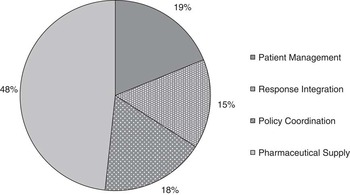
Figure 1 shows the cumulative percentages of pharmacists’ roles referenced in the pharmacy literature since the 1960s. Pharmaceutical supply predominates among role reports, with the percentage of era-specific pharmaceutical supply reports decreasing over time (56%, 52%, and 46% in Cold War, post-Cold War/Preterrorism, and Terrorism eras, respectively). Significant differences in mean ranks of role categories, however, were not observed across eras (P = .169, .5831, .1684, and .2953 for patient management, response integration, policy coordination, and pharmaceutical supply, respectively).
Total Percentages of Pharmacist Disaster Role References in Pharmacy Literature.

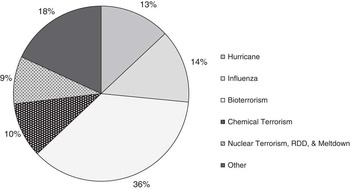
Figure 2 shows the cumulative percentages of disasters referenced in the pharmacy literature since the 1960s, with references to bioterrorism, chemical terrorism, hurricanes, and influenza outbreaks jointly comprising 73% of all disaster references. On a percentage basis, several disasters contribute substantially to reports published in each era. Chemical spills, hurricane, and tornado reports constitute 27%, 25%, and 16% of disasters reported in the Cold War era, respectively. While contributing little to the total percentages of Cold War-era disasters, reports of nuclear terrorism comprise all CBRNE disasters reports.
Total Percentages of Disaster References in Pharmacy Literature. Included in “Other” are references to tornado (2%), improvised explosive devices (1%), flood (2%), fire (1%), snow (1%), earthquake (1%), severe acute respiratory syndrome (4%), chemical spill (2%), building collapse (3%), and accidental explosion (1%). Abbreviation: RDD, radiologic dispersal devices.

Bioterrorism, hurricane, and nuclear plant meltdown references occur most frequently during the post-Cold War/Preterrorism era, composing 39%, 29%, and 10% of disaster reports, respectively. Bioterrorism, influenza outbreaks, hurricane, and chemical terrorism reports are among the most frequently occurring disasters in the Terrorism era, accounting for 38%, 16%, 10%, and 11% of disaster reports, respectively.
When stratified by era, significant differences in mean ranks of disasters were observed. Mean ranks of bioterrorism references strongly differ between both Terrorism and Cold War eras and between Terrorism and post-Cold War/Preterrorism eras (H = 21.6566, df = 2, P < .0001). Mean ranks of chemical terrorism references also strongly differ between Terrorism and Cold War eras (H = 12.615, df = 2, P = .0018). Mean ranks of tornado references significantly differ between Cold War and post-Cold War/Preterrorism eras (H = 8.1922, df = 2, P = .0166). Significant differences in mean ranks of building collapse references (which primarily refer to the collapse of the World Trade Center towers) occur between the Terrorism and post-Cold War/Preterrorism eras (H = 7.4302, df = 2, P = .0244).
Results from regression modeling indicate that certain natural disasters may significantly explain pharmacists’ assumption of disaster responsibilities. Tornado (P = .0403) and hurricane (P = .0281) references significantly explain pharmacists’ assumption of patient management roles. Incident rate ratios for tornado and hurricane (0.86 and 0.97, respectively) indicate that for every tornado and hurricane reference, references to patient management roles decrease by 14% and 3%, respectively. Hurricane reports (IRR = 0.96, P = .0138) significantly explain pharmacists’ assumption of response integration roles. Thus, for every one increase in hurricane references, references to response integration roles decrease by 4%. None of the natural disasters significantly explain pharmacists’ assumption of policy coordination or pharmaceutical supply roles.
The CBRNE disasters were also found to significantly explain pharmacists’ roles. Assumption of policy coordination roles was significantly explained by 2 categories of CBRNE disasters, particularly those due to use of RDDs (IRR = 0.63, P = .1015) and nuclear terrorism (IRR = 2.1, P = .0052). Incident rate ratios indicate that for every one report increase in RDD, policy coordination references decrease by 37%. Conversely, for every one report increase in nuclear terrorism, policy coordination references increase 110%. Although RDD as a main effects explanatory variable did not reach statistical significance, RDD as a second-order variable and interaction term significantly contributed to the overall negative binomial regression model. Other CBRNE disasters did not significantly explain the pharmacists’ roles. Likewise, none of the HSF disasters significantly explained pharmacists’ roles.
Discussion
The significant increase in references to bioterrorism (P < .0001), chemical terrorism (P = .0018), and building collapse (P = .02) is a very important aspect of the modern era, considering that the percentage of pharmaceutical supply roles has decreased only modestly since the 1960s. Also, no significant change in mean ranks of role reports have occurred across eras. This finding suggests that pharmacists today continue to undertake similar tasks in disasters as their Cold War era and post-Cold War/Preterrorism-era predecessors, reinforcing the popular image of pharmacists as suppliers and distributers of pharmaceuticals. Although the pharmaceutical care paradigm has exerted remarkable influence within the profession since its introduction in the early 1990s,Reference Hepler and Strand 4 , 14 reflecting the general increase in nontraditional roles for professions such as nursing and pharmacy, data indicate that pharmacists active in disaster management largely exhibit a product-focused practice orientation.
It is noteworthy that an important part of emergency medical response is ensuring patient access to both emergency and chronic medications. 15 This task is particularly vital in a decade characterized by medication shortages, which continue to impede efforts to provide care for patients. Fulfilling the medication needs of additional numbers of patients presenting to health care facilities after disaster will be a challenge requiring the expertise of professionals intimately familiar with the process of medication use and pharmaceutical supply chain.
Although providing access to pharmaceuticals can represent a critical and challenging aspect to disaster management, defining disaster responsibilities only in terms of pharmaceutical supply, particularly when disasters may require a nontraditional response, may limit pharmacists’ effectiveness in disasters generally, including as a potential medical responder.Reference Braucher 16 During the SARS crisis in Canada in 2004, community pharmacists served as primary care providers, some were diagnosing patients and prescribing medications in the absence of physicians.Reference Austin, Martin and Gregory 7
Interviews with pharmacists who maintained health system continuity by keeping their pharmacies open (while physician offices and emergency departments closed) disclosed a common theme: nontraditional roles increase considerably, and pharmacists should cross-train with other health professionals (ie, response integration) before disasters occur to better prepare the health system when human resources are scarce.Reference Austin, Martin and Gregory 7 This cross-training could be helpful to improved outcomes.
The utility of a pharmacist as a general medical provider was demonstrated in a recent report by Hogue etal.Reference Hogue, Hogue, Lander, Avent and Fleenor 2 Pharmacists in Birmingham, Alabama, performed a variety of nontraditional roles after receiving a large influx of Hurricane Katrina evacuees.Reference Hogue, Hogue, Lander, Avent and Fleenor 2 In addition to meeting an increased demand for prescription medications, pharmacist volunteers assisted the medical officer in assessing the health needs of patients at evacuation shelters, triaged patients to health care services, treated minor injuries with over-the-counter products, and served as the media contact for medication-related issues.Reference Hogue, Hogue, Lander, Avent and Fleenor 2 Another report described pharmacists developing a medical countermeasures algorithm and treating patients using the algorithm in response to the anthrax attacks of 2001.Reference Montello, Ostroff, Frank, Haffer and Rogers 17
Notwithstanding the professional interest in a product-based response, the modest decline in the percentage of pharmaceutical supply references from past eras may be indicative of a positive trend in pharmacists’ assumption of nontraditional (ie, patient management, response integration, and policy coordination) roles. The universal adoption of the doctor of pharmacy (PharmD) degree as the entry-level professional distinction in the United States was initiated near the end of the post-Cold War/Preterrorism era, 18 indicating the trend toward a patient-oriented profession. Vaccine delivery has been an example of this trend, with community pharmacists showing particular interest in bioterrorism and (pandemic) influenza preparedness.Reference Hayney 19 – Reference Guharoy, Panzik and Noviasky 23 Indeed, the large number of pharmacists and their widespread geographical distribution has engendered their utility in mass inoculation planning for large-scale events involving interventions for the prevention of the spread of communicable diseases. This issue was particularly evident in the most recent concern and planning for the anticipated pandemic influenza outbreak in 2009.
Pharmacists’ involvement in both response integration and patient management decreases in the setting of hurricane disasters, suggesting that forecastable disasters allow time to prepare using a sufficient number of traditional medical resources. While much debate leading to the adoption of the entry-level PharmD degree during the preceding decade helped direct pharmacy practice, 18 this finding may also suggest that pharmacists’ provision of health care services in common and potentially debilitating disasters other than as a pharmaceutical supplier may represent an acceptability problem of a paradigm shift to a nontraditional role. Participation in response integration and patient management roles reinforces pharmacists’ usefulness as an essential health care provider and highlights the professional ethic of providing each patient the full measure of their medical ability. 24
Pharmacists are also increasingly assuming policy coordination (planning) responsibilities in the context of pharmaceutical needs expected to result from nuclear detonation. The medical community, including the pharmacy profession, is becoming more alert to the lack of medical preparation for nuclear detonation.Reference Inglesby 3 This increased interest is occurring in spite of the fact that few nuclear or radiologic events have occurred to generate discussion within the academic literature, and most practitioners are unfamiliar with the medical sequelas of nuclear and radiologic events.Reference Goffman 25 On the other hand, the dearth of nuclear and radiologic references could be attributed to a powerful reaction that serves to defend against unwanted or undesirable knowledge: denial.Reference Dallas and Burkle 26 Attention has been drawn to the pervasive denial within the medical community of the devastating health consequences of nuclear war, and data suggest that the pharmacy profession is no exception.Reference Dallas and Burkle 26
While filling a vital gap in disaster response as an emergency medical provider during resource-intense disasters, the pharmacists’ adoption of disaster roles outside their traditionally accepted authority will likely present civil liability concerns to medical resource planners and practitioners themselves, particularly regarding crisis standards of care. Crisis standards of care can be employed when the level of health care in usual circumstances is impossible to provide due to a catastrophic event.Reference Stroud, Bruce, Nadig and Hougan 27
Some states have approached the legal concerns of crisis standards of care creatively, deputizing physicians during emergencies for sovereign immunity legal protection, for example. This practice has generated ambiguity regarding the physicians’ chain of command, and health care institutions have been less accommodating toward health care provider deputation or federalization as solutions to emergency legal protection.Reference Stroud, Bruce, Nadig and Hougan 27 Other states, including Colorado, Montana, and Virginia, have directly addressed crisis standards of care by allowing the governor to declare blanket legal protection to emergency health care providers.Reference Stroud, Bruce, Nadig and Hougan 27 The state of Georgia, for example, provides immunity from civil liability to licensed health care providers who, in good faith and without remuneration, provide emergency services to victims. 28 State codes typically exempt health care workers from liability if compensation for services is not provided. If compensation is provided, the health care worker can be held responsible under malpractice statutes.Reference Coule, Schwartz and Swienton 29
Many states also have statutory provisions discouraging gross negligence and willful misconduct during emergency provision of health care services. Many argue, however, that providing emergency medical triage or rationing health care resources, both of which constitute difficult decisions regarding the disposition of patients and life-saving treatments, can be interpreted as constituting negligence or misconduct. The highly publicized ethical and legal controversy surrounding the multiple deaths from intentional, palliative medication overdoses at a New Orleans hospital during Hurricane Katrina serves as a salient illustration.Reference Fink 30 It is believed that this fear restrains many health care providers from participating during emergencies, particularly when the legal environment can rapidly and drastically change.Reference Stroud, Bruce, Nadig and Hougan 27 It is reasonable to expect that this fear would extend to pharmacists, particularly when operating outside of their traditionally accepted authority (ie, dispensing medications).
Conclusions
The insistence on a supply-based disaster response is an interesting professional characteristic of pharmacists, considering the wide adoption of the paradigm shift introduced by Hepler and Strand in 1990,Reference Hepler and Strand 4 , 14 the universal adoption of the PharmD degree in 1997, 18 and the significant surge in bioterrorism, building collapse, and chemical terrorism references in the modern era. Although a modest decrease in supply-based response was observed across time periods, a substantial thrust in nontraditional role acceptability may be demonstrated in the profession's assumption of policy coordination roles in preparation for nuclear disaster, one of the most highly destructive events.
Assuming that the disaster genre in peer-reviewed pharmacy literature reflects the current state of preparedness within the profession, this literature analysis suggests that, although the capacity for pharmacist participation in nontraditional response exists, pharmacists in general will continue in disaster-related activities as suppliers and distributors of necessary medical supplies. Nevertheless, it is expected that liability problems currently affecting medical responders (eg, physicians and nurses) will also affect pharmacists who choose to participate in disasters as comprehensive medical services providers.
Unforeseen future developments within the profession may force significant shifts in pharmacists’ approach to disaster management. Nuclear disasters, which currently represent a small proportion of the pharmacy literature and are not typically expected to occur, appear to be gaining attention in allied health circles, as the reality of the potential for a single nuclear event is steadily increasing. The concept of health care coalitions, which are support partnerships between health-related entities for effective resource allocation in overwhelming disasters, tacitly acknowledges the potential for significant role change.Reference Courtney, Toner and Waldhorn 31 As a health care segment capable of providing a wide range of services, pharmacists will be a key group to engage. In addition to the new attention being given to policy coordination in preparation for nuclear disaster, future medical response to disasters may demand more of pharmacists than pharmaceutical supply expertise, especially when far too few health professionals are available to assist with the medical needs of disaster victims.
APPENDIX: Articles Included in the Literature Analysis
Cold War Era (1960 – December 1991) (I)
1. Schwerman EA. Role of the hospital pharmacist in disaster preparedness. Am J Hosp Pharm. 1967; 24:636-8.
2. American Pharmaceutical Association. Orientation manual on … disaster preparedness for pharmacists. J Am Pharm Assoc. 1966; NS6(2):80-2,85-6.
3. Levy DB, Barone JA, Raia JJ, etal. Pharmacist participation in the management of incidents involving harzardous materials. Am J Hosp Pharm. 1987; 44:549-56.
4. Moore TD. Administrative approach to disaster preparedness in the pharmacy. Am J Hosp Pharm. 1979; 36:1337-41.
5. Scott S, Constantine LM. When natural disaster strikes. Am Pharm. 1990; NS30(11):27-28,31.
6. Guynn Jr. JB. Disaster imminent – Hurricane Hugo. Hosp Pharm. 1990; 25:325-28.
7. Cramer RL, Weeks KG. Pharmacy disaster emergency: the Hunstville tornado. Hosp Pharm. 1990; 25:523-26.
8. Larson RL, Cherin EC. Emergency telephone numbers of pharmaceutical companies. Hosp Pharm. 1981; 16(10):531-3,537-9.
9. In the wake of the hurricane … pharmacy alert. J Am Pharm Assoc. 1965; NS5(10):545.
10. Edwards GA, Samuels TM. The role of the hospital pharmacist in emergency situations. Am J Hosp Pharm. 1968; 25:128-133.
11. Tranquilino C, Hanan ZI. Disaster alert plan for a hospital pharmacy. Am J Hosp Pharm. 1975; 32:1259-60.
12. Schroeder RE. Information about disaster situations requested. Am J Hosp Pharm. 1977; 34:124.
13. Carda E, Harcum J, Olthoff C. Mass casualty: a hospital pharmacist's call to action. Hosp Pharm. 1989; 24:697-99.
Post-Cold War/Pre-Terrorism Era (January 1992 – September 2001) (II)
1. Bethea S. Pharmacy mass casualty disaster plan implemented after the train wreck. Hosp Pharm. 1994; 29:224-5.
2. Sagraves R. Pharmacists are heroes, too. Am Pharm. 1995; NS35(10):33-4.
3. Bussieres JF, St-Arnoud C, Schunk C, etal. The role of the pharmacist in humanitarian aid in Bosnia-Herzegovina: the experience of Pharmaciens Sans Frontieres. Ann Pharmacother. 2000; 34:112-8.
4. Montello MJ, Ames T. Therapeutic selection during an emergency response. Am J Health-Syst Pharm. 1999; 56;236-40.
5. American Pharmaceutical Association. Extraordinary infections: a focus on bioterrorism. J Am Pharm Assoc. 2000; 40(5):S36-7.
6. Terriff CM, Tee AM. Citywide pharmaceutical preparation for bioterrorism. Am J Health-Syst Pharm. 2001; 58:233-7.
7. Berod T, Chan-ou-Teung F. Pharmacist's role in rescue efforts after plane crash in Indian Ocean. Am J Health-Syst Pharm. 1997; 54:1110.
8. Merges V. Hurricane Iniki – providing hospital pharmacy services. Hosp Pharm. 1993; 28:393-4,400.
9. Miller CG. Hurricane Iniki – providing prescription service in a clinic. Hosp Pharm. 1993; 28:401-3.
10. Duenas D, Penny J, Veatch RM. Pharmacist administration of controlled substances after an earthquake. Am J Health-Syst Pharm. 1992; 49:126-30.
11. Nestor A, Aviles AI, Kummerle DR, etal. Pharmaceutical services at a medical site after Hurricane Andrew. Am J Hosp Pharm. 1993; 50:1896-8.
12. Shalita EA, Samford JE. Pharmaceutical services to evacuated U.S. military dependents. Am J Hosp Pharm. 1992; 49:2474-6.
13. Berndt E. Posted list of emergency drugs and antidotes. Am J Hosp Pharm. 1994; 51:2602.
14. Antidotes dangerously understocked in Colorado, Montana, and Nevada. Am J Health-Syst Pharm. 1997; 54:16,19.
15. Pettit HE, McKinney PE, Achusim LE, etal. Toxicology cart for stocking sufficient supplies of poisoning antidotes. Am J Health-Syst Pharm. 1999; 56:2537-9.
16. Johnston WP, Stepanovich PL. Managing in a crisis: planning, acting, and learning. Am J Health-Syst Pharm. 2001; 58:1245-9129.
17. Dallas CE. Aftermath of the Chernobyl nuclear disaster: pharmaceutical needs in the Republic of Belorus. Am J Pharm Educ. 1993; 57:182-185.
18. Nichol A. Turning tragedy into opportunity. Am Pharm. 1992; NS32(11):54-55.
19. St. Jean AD. When the care givers are the victims. Am J Hosp Pharm. 1992; 49:2626,2629,2632,2634,2636,2642.
Terrorism Era (October 2001 – Present) (III)
1. Idemyor V, Smith SW. Biologic warfare – a growing healthcare concern. Ann Pharmacother. 2002; 36:1282-6.
2. Chan DS, Callahan CW, Hoffman JS. September 11th anniversary: revisiting the damage beyond Ground Zero. Ann Pharmacother. 2004; 38:1967.
3. Guharoy R, Panzik R, Noviasky JA, etal. Smallpox: clinical features, prevention, and management. Ann Pharmacother. 2004; 38:440-7.
4. Misita CP, Boosinger AB, Kendrach MG. Bioterrorism web sites for pharmacists. Ann Pharmacother. 2003; 37:132-5.
5. Robinson RF, Nahata MC. Management of botulism. Ann Pharmacother. 2003; 37:127-31.
6. Nolin K, Murphy C, Ahern JW, etal. Chempack program: role of the health-system pharmacist. Am J Health-Syst Pharm. 2006; 63: 2188,2190.
7. Gaudette R, Schnitzer J, George E, etal. Lessons learned from the September 11th World Trade Center disaster: pharmacy preparedness and participation in an international medical and surgical response team. Pharmacother. 2002; 22(3):271-81.
8. Chin TWF, Chant C, Tanzini R, etal. Severe acute respiratory syndrome (SARS): the pharmacist's role. Pharmacother. 2004; 24(6):705-12.
9. Haffer AST, Rogers JR, Montello MJ, etal. 2001 anthrax crisis in Washington, D.C.: clinic for persons exposed to contaminated mail. Am J Health-Syst Pharm. 2002; 59:1189-92.
10. Cohen V. Organization of a health-system pharmacy team to respond to episodes of terrorism. Am J Health-Syst Pharm. 2003; 60:1257-63.
11. Burda AM, Sigg T. Pharmacy preparedness for incidents involving weapons of mass destruction. Am J Health-Syst Pharm. 2001; 58:2274-84.
12. American Pharmacists Association Report. Promoting the pharmacist's role in public health. J Am Pharm Assoc. 2006; 46(3):311-18.
13. Pedersen CA, Canaday BR, Ellis WM, etal. Pharmacists’ opinions regarding level of involvement in emergency preparedness and response. J Am Pharm Assoc. 2003; 43(6): 694-701.
14. Traynor K. Snowstorm triggers emergency plans for home drug delivery. Am J Health-Syst Pharm. 2008; 65:596-7.
15. Lynx DH. Preparing for forecastable disasters. Am J Health-Syst Pharm. 2009; 66:1578-81.
16. Traynor K. Pharmacy products could be on bomb makers’ shopping lists. Am J Health-Syst Pharm. 2001; 58:2222.
17. American Society of Health-System Pharmacists. ASHP statement on the role of health-system pharmacists in emergency preparedness. Am J Health-Syst Pharm. 2003; 60:1993-5.
18. Velasquez L, Dallas S, Rose L, etal. A PHS pharmacist team's response to Hurricane Katrina. Am J Health-Syst Pharm. 2006; 63:1332-5.
19. Young D. Pharmacist's software design aids mass dispensing clinics. Am J Health-Syst Pharm. 2006; 63:400-2.
20. Margolis AR, Grabenstein JD. Immunizations against bioterrorism: smallpox and anthrax. J Am Pharm Assoc. 2009; 49(4):566-8.
21. Terriff CM, Newton S. Pharmacist role in emergency preparedness. J Am Pharm Assoc. 2008; 48(6):702,707-8.
22. Bratberg J. Hurricane Katrina: pharmacists making a difference. J Am Pharm Assoc. 2005; 45(6):654-8.
23. Lee JJ, Johnson SJ, Sohmer MJ. Guide for mass prophylaxis of hospital employees in preparation for a bioterrorist attack. Am J Health-Syst Pharm. 2009; 66:570-5.
24. Bhavsar TR, Kim HJ, Yu Y. Roles and contributions of pharmacists in regulatory affairs at the Centers for Disease Control and Prevention for public emergency preparedness and response. J Am Pharm Assoc. 2010; 50:165-8.
25. Setlak P. Bioterrorism preparedness and response: emerging role for health-system pharmacists. Am J Health-Syst Pharm. 2004; 61:1167-75.
26. Young D. Military reserve pharmacists provide vital services. Am J Health-Syst Pharm. 2003; 60:420-1.
27. Young D. Iowa pharmacists dispense from Strategic National Stockpile during drill. Am J Health-Syst Pharm. 2003; 60:1304-5.
28. Massoomi F. Pharmacists in the Omaha Metropolitan Medical Response System. Am J Health-Syst Pharm. 2005; 62:1290-8.
29. Young D. Pharmaicists play vital roles in Katrina response: more disaster participation urged. Am J Health-Syst Pharm. 2005; 62:2202,2204,2209,2216.
30. Pincock LL, Montello MJ, Tarosky MJ, etal. Pharmacist readiness roles for emergency preparedness. Am J Health-Syst Pharm. 2011; 68:620-3.
31. Feret B, Bratburg J. Pharmacist-based intervention to prepare residents of assisted-living facilities for emergencies. J Am Pharm Assoc. 2008; 48(6):780-3.
32. Young D. Omaha pharmacist helps city prepare for disasters. Am J Health-Syst Pharm. 2004; 61:756-8.
33. Teeter DS. Bioterrorism preparedness: answers for the health-system pharmacist. Am J Health-Syst Pharm. 2002; 59:928-30.
34. Grabenstein JD. Public and patient concerns in catastrophic circumstances. Am J Health-Syst Pharm. 2002; 59:923-5.
35. Traynor K. Pharmacy, public health intersect in Alabama disaster plans. Am J Health-Syst Pharm. 2007; 64:1998-9.
36. Maroyka EM, Andrawis M. Health care workers and influenza vaccination. Am J Health-Syst Pharm. 2010; 67:25.
37. Thompson CA. Illinois hospital pharmacies check their emergency preparedness. Am J Health-Syst Pharm. 2003; 60:1299-1300.
38. American Society of Health-System Pharmacists. Summary of the second executive session on emergency preparedness and the pharmaceutical supply chain. Am J Health-Syst Pharm. 2002; 59:1057-65.
39. Downs KE. Training requirements and opportunities in planning responses to bioterrorism. Am J Health-Syst Pharm. 2002; 59:1331-2.
40. Sharma RK. Chemical, biological, radiological, and nuclear disasters: pitfalls and perils. J Pharm Bioall Sci. 2010; 2(3):155-6.
41. Thompson CA. Illinois affiliate uses grant to improve emergency-response network. Am J Health-Syst Pharm. 2004; 61:1094-5.
42. Baumgartner-Azziz E, Wolkin A, Sanchez C, etal. Impact of Hurricane Ivan on pharmacies in Baldwin County, Alabama. J Am Pharm Assoc. 2005; 45(6):670-5.
43. Kirtley JC. Pharmacy's dedication in meeting hurricane evacuees’ needs. J Am Pharm Assoc. 2005; 45(6):653.
44. Stergachis A, Wetmore CM, Pennylegion M, etal. Evaluation of a mass dispensing exercise in a Cities Readiness Initiative setting. Am J Health-Syst Pharm. 2007; 64:285-93.
45. Vail J. Compounding in crisis. Int J Pharm Compound. 2007; 11(1):28-35.
46. Klepser M. Seasonal and pandemic influenza: preparing pharmacists for the frontline. J Am Pharm Assoc. 2008; 48(2):312-4.
47. Traynor K. Groups look to aid pharmacy response during disasters. Am J Health-Syst Pharm. 2008; 65:902-4.
48. Traynor K. Response teams need pharmacists. Am J Health-Syst Pharm. 2008; 65:904.
49. Traynor K. Katrina's aftermath expands Xavier students’ clinical options. Am J Health-Syst Pharm. 2007; 64:1124,1126.
50. Thomas JK, Noppenberger J. Avian influenza: A review. Am J Health-Syst Pharm. 2007; 64:149-65.
51. Maloney L. Are we prepared? Am J Health-Syst Pharm. 2007; 64:146.
52. Russum M. Responding to Katrina: a Veterans Affairs pharmacist's experience. Am J Health-Syst Pharm. 2006; 63:809-10.
53. Hayney MS. Avian influenza poses threat. J Am Pharm Assoc. 2005; 45(5):633-5.
54. Young D. CDC rolls out nerve-agent antidote program. Am J Health-Syst Pharm. 2004; 61:1866-8,1875.
55. Young D. Heartland states join for disaster response planning. Am J Health-Syst Pharm. 2004; 61:1867.
56. Young D. CDC provides guidance about chemical attacks. Am J Health-Syst Pharm. 2004; 61:1868.
57. Montello MJ, Ostroff C, Frank EC, etal. 2001 anthrax crisis in Washington, D.C.: pharmacists’ role in screening and selecting prophylaxis. Am J Health-Syst Pharm. 2002; 59:1193-9.
58. Poe BM. Expanding disaster preparedness to include bioterrorism. Am J Health-Syst Pharm. 2002; 59:926-7.
59. Lust E. Caring for animal patients following Hurricane Katrina. J Am Pharm Assoc. 2005; 45(6):659-62.
60. Veltri K, Yaghdjian V, Morgan-Joseph T, etal. Hospital emergency preparedness: push-POD operation and pharmacists as immunizers. J Am Pharm Assoc. 2012; 52:81-85.
61. Hashimoto T, Sato H. Earthquake, tsunami, and pharmaceutical care in eastern Japan. J Am Pharm Assoc. 2011;51(5):568.
62. Gershgol SM, Cantrell L, Mutrux B. Disaster relief efforts of pharmacy students during California wildfires. Am J Health-Syst Pharm. 2008; 65:2006-7.
63. American Pharmaceutical Association. Disaster planning and emergency preparedness: lessons learned. J Am Pharm Assoc. 2002; 42(5):S50-S51.
64. American Pharmaceutical Association. Implementing a bioterrorism response plan in your pharmacy. J Am Pharm Assoc. 2002;42(5):S52-S53.
65. Austin Z, Martin C, Gregory P. Pharmacy practice in times of civil crisis: the experience of SARS and ‘the blackout’ in Ontario, Canada. Res Soc Adm Pharm. 2007; 3:320-35.
66. Young D. Houston health system aids Astrodome evacuees. Am J Health-Syst Pharm. 2005; 62:2204.