Human rights differ from other areas governed by international law in at least one critical respect: they concern the relationship between the state and the citizenry, a fundamentally internal matter.Footnote 1 Compliance with HRAs raises questions that traditional International Relations (IR) theories have had trouble answering. These agreements rarely have formal enforcement mechanisms of their own.Footnote 2 Reciprocity and reputation often push governments to abide by international obligations, but these have not proven particularly reliable in the human rights arena.Footnote 3 Given the limited scope for enforcement through typical IR channels, why would any government keep these promises? If governments do comply, what does this tell us about the role of international human rights law in promoting respect for human rights?
Recently, many scholars have argued that the answers lie in domestic politics. The absence or entrenchment of democratic institutionsFootnote 4 has attracted the most attention. Democratic governments are among the strongest proponents of agreements like the International Covenant on Civil and Political Rights (ICCPR).Footnote 5 They are also among the most likely to respect the rights enshrined in that agreement.Footnote 6 Yet findings about the ICCPR’s causal impact have been very mixed, with virtually no agreement about when and where ratification improves trials, civil liberties, etc.Footnote 7
This article argues that a key to solving the puzzle of HRA ratification and compliance lies in understanding that scholars and practitioners have two conceptually distinct concepts of democracy in this setting. On the one hand, for many, democracy is a particular set of values and practices that are enshrined in several HRAs.Footnote 8 On the other hand, the literature also understands democracy as a mechanism for holding leaders to account, which provides the chief means of enforcing these agreements.Footnote 9 Often, the two overlap closely. For example, compliance with the ICCPR requires due process in court, protection of civil society/free speech and democratic elections,Footnote 10 which are thought to be precisely the mechanisms that help ensure the enforcement of HRAs. Gauging the impact of HRAs in this context is difficult, because the conditions necessary for compliance with (and enforcement of) legal obligations are largely the same.
We can better understand when and how HRAs work by examining cases in which the conditions for compliance and enforcement are distinguishable. We find such cases by looking at rights practices that are not definitional to democracy, an area not commonly covered in the IR literature. When human rights practices diverge sharply from what a treaty prescribes, but the domestic enforcement mechanisms that give HRAs their bite are robust, how do governments behave?
From one perspective, the fact that democratic institutions can provide enforcement turns out to be a problem: while HRAs have the greatest potential to ‘matter’ in democracies with poor rights situations, these countries are unlikely to participate because compliance would be difficult and enforcement likely. A more optimistic perspective emphasizes that governments face multiple incentives when considering ratification, and that conditions sometimes change. Consequently, countries sometimes find themselves parties to treaties even when compliance is hard and enforcement likely. Here, from the more optimistic point of view, there is real opportunity for HRAs to matter.
I explore these questions by examining ratification of (and compliance with) the Minimum Age Convention (MAC), a core international children’s rights agreement. The quantitative analyses show that democracies with high child labor ratify the convention slowly, and sometimes not at all. This suggests that concerns about the ability to comply play a crucial role in these countries’ ratification decisions. But this is not the whole story: even controlling for the endogeneity of ratification, I find that MAC parties with robust democratic institutions experience significantly lower child labor. The picture is quite different for non-democracies, among which ratification appears to be an empty promise, made with little intention of follow-through.Footnote 11 Absent transition to democracy, the domestic tools available to citizens in those countries are too sclerotic to have meaningful impacts on rights practices.
COMPLIANCE AND ENFORCEMENT IN INTERNATIONAL HUMAN RIGHTS LAW
Over the past decade, virtually every study of HRAs has focused on some aspect of how domestic politics drives commitment to and compliance with the agreements. The absence or entrenchment of democratic institutions has attracted the most attention.Footnote 12 The link between democracy and human rights, of course, is as old as the global human rights regime itself. ‘The values of freedom [and] respect for human rights’, the UN maintains, ‘[…] are essential elements of democracy. In turn, democracy provides the natural environment for the protection and effective realization of human rights’.Footnote 13 Put simply, (certain) human rights are definitional to democracy, but democracy is also crucial to the enforcement of these obligations.
When scholars and practitioners talk about democracy in the context of HRAs, they are in fact emphasizing two distinct – though often related – mechanisms. The first is about how closely a country’s values and practices conform to a given HRA’s standards – or, to simplify, what IR scholars typically call ‘compliance’.Footnote 14 The second is about the institutional environment that ensures commitments are respected – what IR scholars typically call ‘enforcement’.Footnote 15 In this section, I discuss the two concepts and discuss the chief mechanisms that HRA scholars have emphasized.
On the one hand, democracy is a set of values or preferences over rights, which are enshrined in a number of HRAs.Footnote 16 Consider the ICCPR, which many consider to be the quintessential example of an agreement covering Enlightenment rightsFootnote 17 that are ‘definitional’ to democracy. The agreement’s key provisions include the equality of individuals before the law, fair and public trial by an independent court established by law, freedom of expression and assembly, and democratic elections.Footnote 18 It is no wonder that democracies typically ratify this agreement quickly and frequently. They are already respecting the rights in question, so compliance is easy. They value the treaty content and ratify it, in part, in hopes of exporting their norms.Footnote 19
On the other hand, democracy is also understood as a means of holding leaders to account, which provides an important means of HRA enforcement.Footnote 20 Scholars have emphasized three mechanisms under the rubric of ‘democracy’, though seldom in the same study: an independent judiciary, civil society protections and democratic elections.
Independent domestic judiciaries are often thought to play an important role in the enforcement of international law.Footnote 21 They guarantee individual rights, enable citizens to challenge government (in)action legally and have the authority to review whether government (in)action is consistent with existing law.Footnote 22 Independent courts issue rulings based on legal principles (rather than popularity, government preference, citizen wishes or indifference, etc.)Footnote 23 While judges rarely make decisions in a political vacuum, the point is that legal principles are important and can trump considerations that pull countries away from compliance. Negative rulings seldom lead to full compliance, but they do typically make it harder for governments to continue reneging.Footnote 24
Civil society groups have also played an important enforcement role in international human rights law, in the form of ‘naming and shaming’ campaigns and by spearheading action in domestic courts and other venues.Footnote 25 How does an international agreement affect mobilization? While civil society groups do often make appeals to HRAs regardless of the country’s ratification status,Footnote 26 ratified treaties can carry more weight. They make it harder for governments to plausibly claim not to be committed to the principle(s) enshrined in the agreement.Footnote 27 Ratified agreements also expand the range of strategies that civil society can engage, for example by opening up previously unavailable litigation opportunities or creating new allies. Some groups care about compliance because respecting legal commitments is important to them. Others may see a political opportunity in exposing a government’s inability to keep its promises.Footnote 28
Political retribution is relatively costless in countries that hold democratic elections, so their leaders must be more responsive to citizen demands.Footnote 29 This link is well established in the IR literature generally. In the treaty compliance context, it means that democratic leaders have an interest in abiding by international law because citizens will punish them for breaking their promises. This mechanism is worth discussing in detail, because it is arguably the most tenuous of the three. Governments’ adherence to international legal obligations – in any issue area – very rarely figures centrally in electoral debates in the way that guns and butter do. No leader has ever lost an election based only on his or her failure to live up to an international human rights commitment.Footnote 30
These points are important, but it is worth acknowledging that citizen attitudes are multidimensional: citizens care about guns and butter, but they also care about ‘valence’ issues.Footnote 31 The public’s mind often links parties/candidates differentially to these issues, and electoral success may depend on politicians’ ability to strengthen or weaken these linkages.Footnote 32 Here, HRA compliance is best understood as a valence issue, where failure to keep promises is a sign of incompetence and/or outright disrespect for the law. Establishing empirically that citizens care about compliance with international rules is difficult, but recent survey experiments suggest that they do. For example, a recent study reports that respondents are more likely to oppose the use of torture if it violates international law.Footnote 33 Showing that such considerations lead to electoral losses is even harder, but debates surrounding the US Guantánamo Bay detentions provide some evidence of a link.Footnote 34
GAUGING THE EFFECTS OF INTERNATIONAL HUMAN RIGHTS LAW
The previous section argued that the HRA literature has typically thought of democracy in two ways, without explicitly parsing them out. The first is about how closely practices at home align with those enshrined in the agreement; the second is about how obligations are enforced. Gauging the impact of HRAs covering rights that are definitional to democracy is difficult, because the conditions necessary for compliance and the enforcement of legal obligations are similar. This may help explain, in part, why findings about how democratic institutions and ICCPR participation together affect compliance have been so mixed. Some research finds that ratification improves civil liberties in countries with democratic institutions and strong civil society attributes, but other studies find no relationship.Footnote 35 Other work examines fair trials and uncovers no evidence that ratification improves practices among full/entrenched democracies. Instead, one scholar finds, it is only in transitional countries that ICCPR ratification makes trials more just.Footnote 36
Overall, it may not be particularly surprising that ICCPR ratification does not reliably improve rights practices in democracies: if the conditions necessary for enforcement are present, governments are very likely to be complying already. I argue that we can make headway in understanding when and how HRAs work by turning our attention to human rights practices that are not definitional to democracy. I have two motivations. First – and most importantly – exploring these types of agreements helps us to differentiate compliance from enforcement. When human rights practices diverge sharply from what a treaty prescribes, but the domestic mechanisms of enforcement that give HRAs bite are robust, how do governments behave?
A second motivation for looking at HRAs that are not definitional to democracy is that we know much less about these agreements.Footnote 37 While women’s rights HRAs have gained more attention in recent years, agreements covering other rights and groups have, for the most part, been neglected.Footnote 38 We know little about whether these HRAs lead to human rights improvements, or how domestic institutions might condition these effects. This is surprising, given these agreements’ prevalence in the international human rights regime.Footnote 39 Children’s rights are an important part of this regime – they make up seven of the UN’s forty-six HRAs – but the treaty compliance literature seldom examines them. In the two studies that do look at children’s rights, domestic politics falls out of the compliance and enforcement story entirely, even though it is a crucial determinant of which countries ratify.Footnote 40 Hence, an additional contribution of this research is that it moves us into an area that the HRA literature has not explored heavily, explicitly considering the role(s) of domestic politics.
How do democracies react to the presence of a related agreement when they struggle with children’s rights abuses, when they fail to ensure opportunities for underprivileged groups, etc.? One response to this question emphasizes that the prospect of enforcement deters ratification by countries that anticipate difficulty in complying.Footnote 41 While enforcement is most likely when citizens have access to the domestic tools that give HRAs teeth, leaders in these countries understand that making empty promises can be costly, and so will not ratify if conditions at home diverge substantially from what the agreement prescribes. Democracies with poor rights situations – the practices of which international law could meaningfully shape – may opt out of the agreement entirely because compliance would be hard and enforcement likely.
There is certainly evidence, from treaties covering rights that are not ‘definitional’ to democracy, that compliance difficulties deter countries from ratifying if the specter of domestic enforcement is present. For instance, countries with high Polity scores and/or independent judiciaries tend not to ratify the Convention Against Torture if they engage in torture or political terror.Footnote 42 Countries with high Polity scores are also less likely to ratify the Convention on the Elimination of Discrimination Against Women if they have considerable gendered gaps in literacy rates.Footnote 43 And another study shows that as domestic constraints on executives increase, repressive governments opt out of many core UN HRAs.Footnote 44
The above paints a dismal portrait of HRAs’ ability to promote meaningful human rights improvement in countries where international law is enforced domestically. A more optimistic take emphasizes two points. First, leaders must contend with various pressures when an agreement opens for ratification. Non-governmental organizations (NGOs) have ongoing ratification campaigns, and ramp up ‘shaming’ efforts as more parties join.Footnote 45 Governments may ratify because they see themselves as proponents of a particular cause and/or as supporters of a particular organization – this is known as embeddedness.Footnote 46 Finally, governments may also face ‘peer’ pressure to ratify, particularly regionally.Footnote 47 Whether normative, social or more instrumental concerns motivate states is the subject of considerable debate.Footnote 48 While it is beyond the scope of this article to parse out these mechanisms, the overall point is that ratification decisions are rarely one-dimensional.
A second reason why the ‘dismal’ portrait may not be entirely accurate is that circumstances, leaders and even domestic institutions change. Governments cannot always accurately predict how hard compliance, or how likely domestic enforcement, will be. For instance, some countries ratify as non-democracies but later transition. Once democratic institutions are in place, these governments will be confronted with new enforcement pressures that were not faced at the time of ratification.
Thus far, I have said little about countries without independent judiciaries, civil society protections and/or democratic elections. For ease of expression, I call them ‘non-democracies’, and describe the mechanisms below. Consistent with much of the literature, I view their ratification decision as an empty promise, made with little intention of following through. The empirical record has shown fairly consistently that among non-democracies, the less compliant are as likely (and in some cases even more likely) to ratify.Footnote 49 Also in line with the bulk of the literature, I do not expect ratification to have a meaningful impact in these countries. Their domestic enforcement mechanisms are typically too sclerotic to induce significant improvement. Virtually every quantitative study has found that HRAs have either no impact, or a negative effect, on the human rights practices of these countries.Footnote 50
This way of thinking about HRAs raises important questions. How do governments facing a reasonable prospect of domestic enforcement weigh these competing incentives? Do they always opt out of HRAs with which compliance would be hard? Among democracies, does ratification lead to meaningful improvements, or do these obligations only reflect underlying preferences over rights? And finally, is there any hope for non-democracies? The following sections explore these and related questions.
METHODOLOGICAL CONSIDERATIONS AND RELATIONSHIP TO EXISTING RESEARCH
The above observations have important implications for how we assess treaty effects. High compliance rates among democracies that have ratified may indicate that HRAs have real causal impacts. Alternatively, they may simply indicate that when enforcement is relatively likely, these countries tend only to ratify when they anticipate being able to keep their promises. This problem is now well understood in the treaty compliance literature.Footnote 51 One of the key insights to emerge is that it rarely makes sense to consider ratification and compliance separately. To understand why countries join treaties, we must also appreciate the costs that such decisions might generate. Likewise, to know whether ratification has causal effects, we must also understand why countries become parties. Conceptually, scholars generally agree on these points.
Scholars using quantitative methods now agree that in these cases, standard regression techniques can yield biased and inconsistent estimates of the causal effect of the endogenous variable – ratification – on the outcome of interest.Footnote 52 However, there is no agreement on the most appropriate statistical approach. Heckman models have been used frequently, but have been criticized for their distributional assumptions and sensitivity to model specification.Footnote 53 Some scholars have employed instrumental variables (IV) regression to gauge treaty effects in the presence of endogeneity.Footnote 54 The choice of instrument(s) is crucial to a well-specified IV model. Unfortunately, good instruments are not always easy to find, and treaty compliance studies using IV regression sometimes omit information on instrument performance. Propensity score matching offers another solution, but it assumes treatment to be as if randomly assigned once groups are matched on observable covariates.Footnote 55 This can be problematic if unobservables drive ratification, as results can be very sensitive to omitted variable bias.
While recognizing the continuing debate over method, I opt for IV regression, given the availability of good instruments. I improve on some previous studies that use IV regression by providing ample information on instrument performance.
The argument made in the previous sections is about enforcement: democratic governments are likely to face some cost(s) if they renege on their promises. This is distinct from an argument about capacity, which focuses on countries’ underlying ability (bureaucratic, financial, etc.) to translate commitments into practice. Forthcoming research, for instance, shows that bureaucratically strong states are better able to abide by their ICCPR commitments.Footnote 56 Capacity is likely particularly important in areas such as child labor, in which governments are rarely directly responsible for abuses and must take steps to ensure that relevant actors follow rules.
Treaty compliance debates between the ‘enforcement’ and ‘managerial’ schools initially tended to view these as competing mechanisms.Footnote 57 I follow more recent scholarship, which emphasizes that both can affect compliance simultaneously.Footnote 58 For my purposes, the chief implication is that the analyses must also account for capacity, in order to avoid two dangers.Footnote 59 First, if democracies usually have higher bureaucratic capacity,Footnote 60 one might falsely attribute the effect of capacity to democracy. Secondly, even the most democratic country will have trouble meeting commitments if it lacks bureaucratic/financial ability. This may bias the impact of other variables, including ratification.Footnote 61
It is also worth considering how my approach compares to that of Simmons, who finds that HRAs have their strongest effects in partial democracies and transitional regimes.Footnote 62 In these countries, she argues, citizens have the motive (an imperfect rights situation) and the means (some domestic tools, even if imperfect) to press the government to improve rights. Simmons stipulates an important scope condition: it is most likely to apply to civil and political rights.Footnote 63 Given that I am interested in situations in which ‘the motive’ (child labor problems) and ‘the means’ (domestic institutions) do not necessarily coincide, there is not a strong reason to expect HRAs to matter most in partial democracies and transitional regimes.
TREATY OVERVIEW AND OPERATIONALIZATION OF CONCEPTS
I examine child labor because it is a human rights outcome that is not definitional to democracy. It is also a persistent problem of interest to policy makers.Footnote 64 Approximately 168 million (or 11 per cent of) children worldwide are engaged in child labor today.Footnote 65 The UN recognizes that children need special protections above those afforded under other existing law. Among these, I focus on the MAC, for several reasons. It is a core agreement in the international children’s rights regime, and unlike some others, it is relatively precise about what constitutes ‘compliance’, does not allow reservations and covers outcomes for which data are available. This makes it somewhat more straightforward to track compliance.
The MAC was created and opened for ratification in 1973. Where previous international legal efforts focused on specific sectors and did not prohibit family work, this agreement represents a shift: it aims to ‘ensure the effective abolition of child labor’.Footnote 66 It entered into force in 1976, one year after the requisite first two countries – Cuba and Libya – ratified. Finland and Romania soon followed. Today over 85 per cent of states are parties, although for many this took several years. The lack of participation by some populous countries in which child labor is prevalent (for example, India) has frustrated activists and the International Labor Organization.Footnote 67
While the ILO has agreed on a fairly clear definition of what constitutes child labor, measuring it is challenging. Data are only available cross-nationally for children aged ten to fourteen, so I rely on these.Footnote 68 The data indicate the percentage of children engaged in child labor; they cover several years and are available for virtually all UN members.Footnote 69 Wealthy Western countries and some Arab and former Soviet states report low/no child labor; on the opposite end of the spectrum lie many African and Asian states, with historical rates as high as 70 per cent. As with many measures of policy performance, data reliability is a concern. The Appendix describes robustness checks that attempt to account for these potential problems.
Ratification
Regarding ratification, I am chiefly interested in how democratic institutions and the ability to comply affect governments’ decisions to participate in the MAC. Where other studies typically focus on one institution, I examine each component. This can provide useful insight into which mechanism(s) best explain(s) who ratifies and when. To gauge Judicial Independence, I use data from Linzer and Staton.Footnote 70 For the civil society component, I am interested in the existence of guarantees enabling civil society to operate freely. Ideally, we want to know whether people have a safe and vibrant social/political space in which to hold governments (and other agents) accountable. I use the Freedom House Civil Liberties variable.Footnote 71 Finally, to gauge the electoral mechanism, I use the Cheibub, Gandhi and Vreeland Democracy variable, which I call Democratic Elections to avoid confusion.Footnote 72
One of my core expectations is that when considering ratification, democracies will be concerned about the difficulty of achieving compliance, whereas non-democracies will not. A common approach to gauging this idea considers how much a country’s practice deviates from what the treaty prescribes.Footnote 73 I take this approach and use Child Labor as a predictor of ratification. This seems reasonable enough, but it is a simplification: even at equal child labor levels, changing existing practice would be harder in some countries than in others. For this reason, I include variables aimed at controlling for these differences. Because I expect the effects of Child Labor to depend on institutions, I interact it with Judicial Independence, Civil Liberties and Democratic Elections in their respective regressions.
As discussed earlier, governments do not consider ratification in isolation. Instead, they face pressures from various international actors. I operationalize ideas about embeddedness in international institutions in two ways. Issue-Area Embeddedness indicates how many other major children’s rights conventions (Rights of the Child, Worst Forms of Child Labor) a country has ratified. International Institutional Embeddedness indicates the number of other core ILO treaties a country has ratified. To gauge ‘peer’ pressure, I use the variable Regional Ratification, which measures the percentage of other states in the region that has ratified the MAC.Footnote 74
I account for two additional domestic institutional factors that likely affect ratification. The first is Common Law legal heritage.Footnote 75 Common law countries have a greater incentive to be cautious about committing to HRAs, because legal commitments typically carry higher adjustment costs and governments usually have less control over treaty interpretation.Footnote 76 Secondly, I consider the impact of Ratification Barriers – the domestic institutional requirements for a treaty to be ratified.Footnote 77 These vary dramatically from country to country and can lengthen the amount of time it takes to forge a treaty commitment at home.
Compliance
As discussed earlier, I am chiefly interested in assessing how ratification affects compliance (with the MAC). Here, I provide a brief overview of the child labor literature, focusing specifically on its empirical findings.
At the most basic level, child labor is a symptom of poverty: children work because they need to help put food on the table.Footnote 78 Accordingly, all analyses include (logged) GDP Per Capita . I also include a measure of State Capacity, which I expect to be negatively related to child labor. Footnote 79 While the term ‘child labor’ often conjures images of little hands in Nike factories, the majority of children working are in the fields, alongside their parents.Footnote 80 Hence, I also obtain data on Agriculture as a Percentage of GDP, which should be positively related to child labor. This variable is highly correlated with GDP Per Capita,Footnote 81 so I only include it in robustness checks. Trade exposure has also received substantial attention, although economic theory makes ambiguous predictions about its impacts. On the one hand, if expanded trade makes families wealthier, children’s income may no longer be needed. On the other hand, trade might raise the demand for goods that children produce, thereby increasing child labor.Footnote 82 I include Trade as a Percentage of GDP to gauge this effect.
Some studies have suggested that the economy’s demand for child labor depends on the military situation.Footnote 83 Combat takes breadwinning adults out of the workforce, so war might drive up child labor through a substitution effect. But wars often depress the economy (therefore reducing the available jobs), and children are sometimes recruited into armies. Both would reduce child labor. To test these divergent hypotheses, I include variables indicating whether the country is in the midst of an Internal Conflict or Interstate Conflict.Footnote 84 Finally, there is some evidence of a ‘secular trend’ of decreasing child labor over time.Footnote 85 The analyses therefore include the variable Year.
Child labor also depends on how parents, children and other members of society view child work and its alternatives. While these are hard to operationalize in a large-N, cross-national study, I nonetheless discuss them and propose operationalizations. To begin, families may have children work because other opportunities are unavailable or inferior: schools may be expensive, far away and/or open during limited hours.Footnote 86 Parents – and indeed children – sometimes prefer work because they perceive low returns on education.Footnote 87 Gauging the availability and perceived usefulness of schools is challenging, but Primary School Enrollment seems a reasonable approximation.Footnote 88
Family decision-making dynamics are also important, in ways that researchers are only beginning to understand well. Parents, extended family and children themselves are involved in the child work decision, and can have divergent preferences.Footnote 89 Child labor should also be placed within the social/cultural context. Historically in the West, and throughout much of the developing world today, work was/is seen as essential to cultivating a child’s moral character.Footnote 90 I attempt to gauge each idea by including the country’s Birth Rate (to capture family dynamics) and Regional Child Labor rate (to capture social/cultural dynamics).Footnote 91
QUANTITATIVE ANALYSIS AND RESULTS
Ratification of the Minimum Age Convention
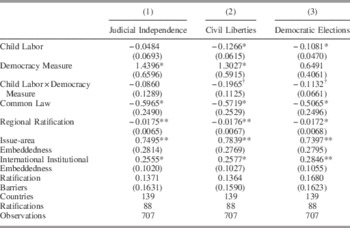
I first consider why states ratify. Following most of the literature, I examine the speed with which a state ratifies (if at all), using survival analysis. I use a Cox proportional hazards model.Footnote 92 The Appendix describes transformations of variables to mitigate skewness, set intercepts at theoretically interesting values and make comparisons straightforward. None of these transformations affects the results – displayed in Table 1 – substantively.
Ratification of the Minimum Age Convention

Note: Results of Cox proportional hazards models with clustering on country. Robust standard errors in parentheses. ‘Democracy measure’ refers to judicial independence, civil liberties or democratic elections. **p<0.01, *p<0.05, †p<0.1
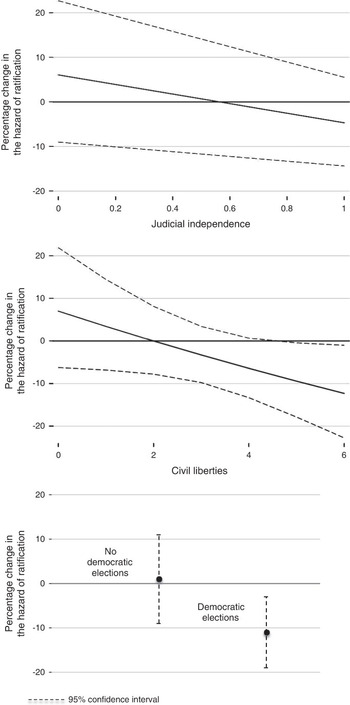
For countries with robust civil liberties and/or democratic elections, increases in child labor significantly reduce MAC ratification. On average, every one-unit increase in child labor makes countries with the best civil liberties ratings 13 per cent less prone to ratify, and countries with democratic elections about 11 per cent less prone to ratify.Footnote 93 Table 1 also indicates that there is a significant, negative, interactive relationship between civil liberties/democratic elections and child labor. Both findings lend support to my argument that as the prospect of enforcement through these mechanisms becomes more real, governments considering ratification become more concerned about whether they can subsequently comply.
Figure 1 makes the overall picture easier to interpret by graphing the effect of an increase in child labor as a function of Judicial Independence, Civil Liberties and Democratic Elections . This graph depicts an increase in the percentage of children in the labor force from 5 to 15 per cent. I chose these percentages based on real-world scenarios discussed in the literature. Figure 1 provides further evidence that as civil liberties increase and/or when democratic elections are present, the relationship between child labor and ratification becomes negative and systematic.
The effect of an increase in child labor on the hazard of ratification as judicial independence, civil liberties and elections vary

The findings for judicial independence are murkier. The Table 1 coefficients are in the expected directions, but their size and statistical significance do not lend support to the idea that the prospect of judicial enforcement reliably drives down the chances of ratification. Figure 1 shows that an increase in child labor reduces the chances of ratification as courts become more independent. But the relationship is not particularly large or statistically significant.
There are a few potential explanations for the null findings about judicial independence. One is that we have a data problem.Footnote 94 Perhaps the data do not gauge judicial independence well, or perhaps judicial independence should be thought of as categorical. Neither using alternative measuresFootnote 95 nor creating categories from original data changes the findings substantially, although they do come close to statistical significance in the latter case. Alternatively, it could be that judicial independence is not a good operationalization of the concepts of interest here. After all, my argument is just as much about citizens’ ability to lodge complaints against government as it is about courts’ independence.Footnote 96 The problem is that good data on this concept do not exist.Footnote 97 A final explanation, of course, is that courts do not matter for HRA ratification. Only with better data can we say definitively which is the case.
Two additional findings not directly related to my argument deserve discussion. First, among countries with no child labor, democratic institutions significantly increase the chances of ratification.Footnote 98 There is probably a large element of norm exportation here: if citizens in countries where children rarely work want to export that value, and if democratic leaders are more responsive to citizen demands, then it is intuitive that democracies with no child labor are more supportive.Footnote 99 Precisely how this plays out has not been well established in the literature.Footnote 100 In any event, while norm exportation may be present, it does not tell the whole story. Concerns about enforcement counterbalance norm exportation relatively quickly as child labor increases. Secondly, as countries become more autocratic, increases in child labor tend to boost the chances of MAC participation. This is consistent with some findings in the literature for other agreements.Footnote 101 However, we cannot make too much of this finding, given its lack of statistical significance.
The control variables generally perform as expected, with some exceptions. Common law countries take much longer to ratify. Governments embedded in the international children’s rights regime and/or the international ILO regime commit much more quickly. Surprisingly, governments appear to be less prone to join when their regional peers are doing so. The reasons are not clear, but seem to be explained in part by the variable’s correlation with the embeddedness variables. Finally, domestic ratification barriers do not notably affect ratification.
Child Labor
I now turn to the question of what drives child labor. I am particularly interested in gauging how MAC ratification affects child labor. As explained earlier, I use IV regression. This approach is fairly common, but it is important to get two things right when using it.
First, an instrument must be relevant – that is, correlated with the endogenous regressor. If the instrument does not predict ratification (or does so weakly), its inclusion can lead to large standard errors, inconsistent results and/or bias.Footnote 102 Secondly, an instrument must be valid – that is, orthogonal to the errors. If an instrument itself is endogenous, then it is no better than the endogenous variable. Theory should determine instrument choice, in conjunction with statistical testing, as some instruments predict MAC ratification well but are unlikely to affect child labor solely through that mechanism. We have already identified candidate predictors (Table 1). The next step is to consider which instruments I can reliably use.
I begin by examining democracies and non-democracies (using the component variables discussed earlier) separately.Footnote 103 I do this for three reasons. First, we have theoretical reasons to expect that ratification affects the two groups differently. Secondly, we have reasons to anticipate that endogeneity poses a potential threat to the inferences we make about democracies.Footnote 104 For non-democracies, this does not seem to be a concern, although this is a hypothesis to be tested rather than simply assumed. Finally, as the Appendix shows, although there is some overlap, certain instruments turn out to be more appropriate for democracies vs. non-democracies, and vice versa. It is useful to understand these considerations before analyzing all countries in one system of equations.
The Appendix describes in detail the statistical tests used to evaluate each candidate instrument. Looking first at democracies, Common Law Heritage is typically the result of a process started centuries ago; while legal legacy is certainly not random, there is not a strong reason to believe that it should drive a country’s use of child labor.Footnote 105 International Institutional Embeddedness is murkier. While countries join other core ILO treaties – on forced labor, union rights, etc. – for reasons that have nothing to do with children’s rights, their goals may coincide with those of child labor treaties. Unions, for instance, have good self-interested reasons to oppose the practice. Every statistical test indicates that these are relevant and valid instruments, so I use them in the analyses. In addition to theory-based concerns, Ratification Barriers, Regional Ratification and Issue-Area Embeddedness also fail on statistical grounds.
Turning to non-democracies, International Institutional Embeddedness is a statistically relevant and valid instrument. Regional Ratification also passes the tests of relevance and validity, although in one specification the relevance might be considered borderline, so I pay particularly close attention to this variable’s performance and confirm that its inclusion (exclusion) does not alter the findings notably.Footnote 106 All other candidate instruments are irrelevant and/or invalid.
Because the data are time-series-cross-sectional, we should worry about arbitrary heteroskedasticity and autocorrelation making estimates inefficient and standard errors incorrect. Accordingly, I use Newey-West robust standard errors.Footnote 107 The benefit of this approach is that estimates of the standard errors are consistent in the presence of unobserved heterogeneity. This comes at a cost: Newey-West estimates are inefficient. Another common approach involves the use of a lagged dependent variable,Footnote 108 but this can substantially bias substantive coefficients toward negligible values while artificially inflating the lagged dependent variable’s effect.Footnote 109 All methods of dealing with temporal dependencies, in other words, present trade-offs. Newey-West standard errors provide a reasonable approach in this context.
In all analyses henceforth, I exclude any country that ratified when it had no child labor.Footnote 110 In this dataset, no country’s child labor has ever increased from one year to the next. This means that it is computationally impossible for ratification to change child labor in countries that ratify when they have no child labor – and theoretically unrealistic that ratification would affect child labor in these countries. One might see this as ‘stacking the deck’ in favor of a particular set of findings, but in fact – as we will see for the non-democracies – this is not what we are doing. Instead, the goal is to identify (based on theory and data structure) where we might expect to see treaty effects, and to examine whether we do indeed observe them.
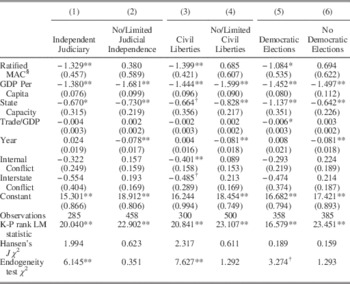
Models 1, 3 and 5 in Table 2 present the results for countries with independent judiciaries, civil liberties protections and/or democratic elections. Each model easily passes the standard tests of instrument relevance and validity. For these countries, the results consistently support the idea that the relationship between child labor and ratification is (in part) endogenous.Footnote 111 Importantly, however, I also find evidence that ratification is more than just an expression of pre-existing preferences over rights: even when controlling for endogeneity, MAC parties have significantly better child labor practices. Substantively, ratification is associated with child labor levels that are between 1.3 per cent and 1.8 per cent lower, depending on model specification.
The Determinants of Child Labor, Groups Analyzed Separately

Note: § Instrumented (see Appendix). Results of instrumental variables regressions with robust, heteroskedasticity and autocorrelation consistent standard errors in parentheses. K-P rank LM statistic denotes Kleibergen-Paap Lagrange Multiplier statistic. ‘Democracy measure’ refers to judicial independence, civil liberties or democratic elections. **p<0.01, *p<0.05, †p<0.1
Is this a large impact? In countries with widespread child labor, this is a drop in the bucket. Yet it is important to put this in context: it takes a lot to change child labor even a little. For instance, for the average country, a 1.8 per cent decrease in child labor would (based on Model 1) require GDP per capita to grow from $2,190 to $6,990. Such an increase in wealth would typically take years to achieve. Ultimately, we should think of ratification as having a substantively meaningful, but not radical, impact in these countries.
I now turn to the non-democracies. The results displayed in Table 2, Models 2, 4 and 6 also pass the standard tests of instrument relevance and validity. However, the relationship between ratification and child labor looks quite different in at least two respects. First, as expected, the endogeneity problems we saw for countries with these institutions are not present here.Footnote 112 Secondly, ratification is not linked to better child labor practices in these countries. Indeed, MAC parties appear to have higher child labor, but there is a great deal of uncertainty about this relationship. What is clear is that MAC ratification does not improve the lot of working children in countries that lack the domestic institutions to give this treaty bite.
The analyses presented in the first four models of Table 2 are simplifications: countries are categorized as either having independent judiciaries or not, and as either protecting civil liberties or not. This is a useful starting point, but the next step involves looking at Judicial Independence and Civil Liberties as continuous variables. This provides a richer understanding of how differences in domestic enforcement condition the impact of ratification on child labor. This approach requires us to pool all countries together into one system of equations. For the dichotomous Democratic Elections variable, the concern about simplification obviously does not hold. Nonetheless, pooling countries together is useful, allowing direct comparison of the two groups.
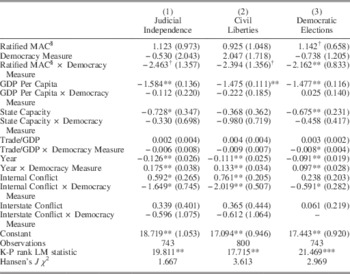
This approach requires two modifications from the split sample analyses. First, the same instruments must be used for all countries. The Appendix discusses this in greater detail. Secondly, each predictor (including each instrument) is interacted with the relevant democracy measure.Footnote 113 Table 3 displays the results, which pass the standard tests of instrument relevance and validity.
The Determinants of Child Labor, All Countries

Note: §Instrumented (see Appendix). Results of instrumental variables regressions with robust, heteroskedasticity and autocorrelation consistent standard errors in parentheses. K-P rank LM statistic denotes Kleibergen-Paap Lagrange Multiplier statistic. ‘Democracy measure’ refers to judicial independence, civil liberties or democratic elections. **p<0.01, *p<0.05, †p<0.1
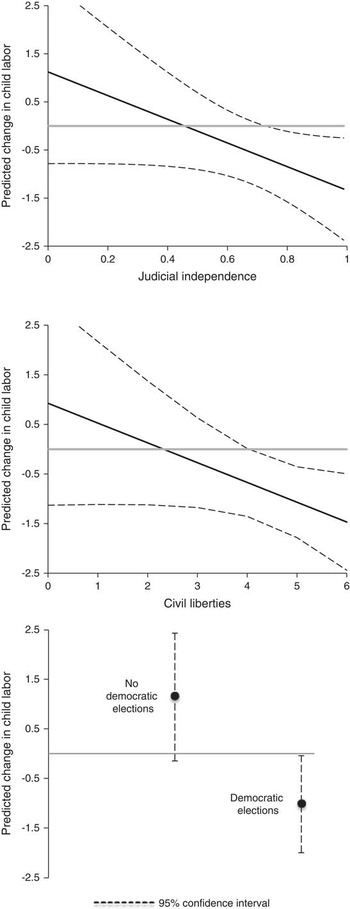
Ratified MAC indicates that in countries that have no judicial independence, civil liberties and/or democratic elections, ratification is associated with worse child labor outcomes. This relationship is far from systematic in Models 1 and 2, but it is fairly statistically significant when we focus on countries without democratic elections.Footnote 114 Understanding the interactive effects requires further tests. First, Figure 2 shows that when courts are sufficiently independent, civil liberties adequately protected and/or democratic elections held, MAC ratification is linked to significantly lower child labor.Footnote 115 This is consistent with the findings in Table 2 (Models 1, 3 and 5).
The effect of minimum age convention ratification on child labor, as judicial independence, civil liberties and elections vary

Additional tests show that the impact of ratification intensifies as judiciaries become more independent and/or as civil liberties are better protected.Footnote 116 For instance, moving from the lowest point at which Civil Liberties is linked to significant drops in child labor (four – for example, Brazil in 1990) to the highest value (six – for example, Costa Rica in 1990) doubles the impact of ratification. Each interaction term is significant at acceptable levels. This suggests that the impact of ratification depends in important ways on the level of judicial independence/civil liberties, and on the presence or absence of democratic elections.
Turning to the control variables, economic development and state capacity play crucial roles in the reduction of child labor.Footnote 117 Trade dependence appears to have no impact. Also as expected, there appears to be a ‘secular trend’ toward lower child labor over time, but only for countries with relatively low judicial independence, few civil liberties and/or no democratic elections.Footnote 118 Internal conflicts tend to drive up child labor for this latter group of countries (though not always significantly so). In contrast, internal conflicts decrease child labor when courts are sufficiently independent, when civil society protections are adequate and when democratic elections are held.Footnote 119 The reasons for this are unclear, but may underscore the indeterminacy of economic theory on this point. This would be interesting to examine in future research. Finally, interstate conflicts do not appear to affect child labor systematically.Footnote 120
CONCLUSION
This article addresses a growing body of research that aims to identify the conditions under which HRAs affect human rights outcomes. I have argued that when rights practices do not conform to treaty rules but strong domestic accountability mechanisms exist, HRAs can have real bite. While the specter of domestic enforcement may deter ratification by countries that anticipate compliance difficulties, there are many reasons why such governments might nonetheless find themselves parties. In the MAC case, the evidence shows that ratification leads to significantly lower child labor among democracies. In a literature marked by fairly limited evidence that HRAs ‘matter’, this is important. The null results for non-democracies underscore that international law human rights law remains an empty promise in many parts of the world.
This article also addresses broader debates about the effects of institutions in IR.Footnote 121 Does international law solely reflect underlying preferences, or can it also induce meaningful change? Whatever the issue area, answering these questions requires careful consideration of how legal obligations are enforced. Taking this approach, this study uncovers at least two troubling patterns. If enforcement is likely, governments often choose not to ratify if there is a substantial gap between practices at home and the principles enshrined in the agreement.Footnote 122 And if enforcement is unlikely, governments feel no obligation to comply. Neither is ‘good news for cooperation’.Footnote 123 That said, we should not neglect the ‘good news’: ratification, on the whole, does lead to improvements among countries in which enforcement is likely.
My findings point to a number of areas for future research. First, a core premise of this article is that examining rights that are not definitional to democracy can help clarify institutional effects because it separates compliance from enforcement. I explore child labor, but this approach should prove fruitful in several areas covered by international human rights law: women’s rights, socio-economic and labor rights, and other children’s rights.Footnote 124 Secondly, courts, civil society protections and democratic elections all seem to play a role in giving the MAC ‘bite’.Footnote 125 Whether this is true in other issue areas is an open question that is worth exploring. One could also gain additional insight by honing in on countries with only one or two of the mechanisms explored here.Footnote 126 These observations are important to keep in mind as scholars try to better understand why HRAs are experienced so differently from country to country, and from treaty to treaty.Footnote 127
Finally, it would useful to better understand how governments find themselves parties to treaties even when enforcement is likely and the gap between practice and treaty principles is large. In some cases, countries appear to succumb to ratification pressures from NGOs and other international actors, as discussed earlier. Leaders may also miscalculate sometimes, and underestimate the chances that ratification will unleash enforcement pressures.Footnote 128 Domestic political change – in leadership, partisanship or even regime type – offers another explanation. In the HRA context, this is potentially quite important: for countries that ratify as non-democracies, democratization has the potential to transform HRA pledges – even those not directly related to democracy – from empty promises into something more meaningful.