INTRODUCTION
Imposex in gastropods is the imposition of male sexual characteristics onto the female (Smith, Reference Smith1971) and has been described in over 195 species of prosobranch gastropods (Sternberg et al., Reference Sternberg, Gooding, Hotchkiss and LeBlanc2010). Imposex development may range from the subtle development of a small penis in a female snail to development of a penis with a complete vas deferens structure that can impede egg laying and cause sterilization (Gibbs et al., Reference Gibbs, Bryan, Pascoe and Burt1987). The relative degree of imposex in individual snails can be ranked based on vas deferens development (VDSI; Gibbs & Bryan, Reference Gibbs and Bryan1987) with Stage 0 indicating no obvious impact and Stages 5 and 6 indicating sterilization. Documented imposex effects on gastropod reproductive output have ranged from no obvious deleterious effects in Nassarius obsoletus in Long Island Sound, USA (Smith, Reference Smith1971) and Rapana venosa in the Chesapeake Bay (Mann et al., Reference Mann, Harding and Westcott2006; Harding et al., Reference Harding, Unger, Mann, Jestel and Kilduff2013) to the decimation of Nucella lapillus populations in the UK (Gibbs & Bryan, Reference Gibbs, Bryan, Champ and Seligman1996). There is a positive relationship between imposex development in Nucella lapillus and tributyltin (TBT) exposure through boating activity and antifouling bottom paints (Gibbs & Bryan Reference Gibbs, Bryan, Champ and Seligman1996). Gibbs & Bryan (Reference Gibbs, Bryan, Champ and Seligman1996) suggest that imposex development in N. lapillus begins at water TBT concentrations of <1 ng l−1 based on field transplant studies and laboratory exposure experiments.
The veined rapa whelk Rapana venosa is a large invasive predatory marine gastropod first discovered in the Chesapeake Bay, USA during 1998 (Harding & Mann, Reference Harding and Mann1999; Mann & Harding, Reference Mann and Harding2000). Rapa whelks are long-lived and highly fecund with annual estimates of embryo production of at least one million offspring per female per year (Harding et al., Reference Harding, Mann and Kilduff2008). Native Chinese populations of R. venosa display imposex but are not sterilized (Shi et al., Reference Shi, Huang, Zhu, Yu and Xie2005). Imposex has also been described in wild adult (>70 mm shell length, SL: maximum dimension from the tip of the spire to the bottom of the siphonal canal) rapa whelks collected throughout the known range of the established Chesapeake Bay breeding population (Mann et al., Reference Mann, Harding and Westcott2006; Harding et al., Reference Harding, Unger, Mann, Jestel and Kilduff2013; Supplementary Material 1), but does not appear to compromise reproduction or viability of veliger offspring at hatch (Harding et al., Reference Harding, Mann and Kilduff2008, Reference Harding, Unger, Mann, Jestel and Kilduff2013). Imposex incidence in wild adult Chesapeake rapa whelks declined from 1998–2009 commensurate with declines in ambient water TBT concentrations (Harding et al., Reference Harding, Unger, Mann, Jestel and Kilduff2013).
The depuration of hydrophobic organic compounds through egg laying has been documented previously for the marine copepod, Acartia tonsa (McManus et al., Reference McManus, Wyman, Peterson and Wurster1983) where the authors demonstrated that egg laying was an important mechanism for PCB depuration by female copepods. Harding et al. (Reference Harding, Unger, Mann, Jestel and Kilduff2013) described lower TBT body burdens in females relative to males for wild adult Chesapeake Bay rapa whelks as well as relatively higher TBT values in egg capsules. While the exponential decline observed in egg mass (group of egg capsules laid by one female in one reproductive event) TBT concentration from first to last egg mass produced by wild caught females within a reproductive season was attributed to the depuration of TBT through egg capsule deposition by Harding et al. (Reference Harding, Unger, Mann, Jestel and Kilduff2013), the ages and exposure history/location for these wild caught whelks were unknown. The time course of imposex development with ontogeny and relationship to environmental TBT levels is directly relevant for ecological and resource management reasons (Savini et al., Reference Savini, Harding and Mann2002) given the potential for population growth and range expansion of rapa whelks (Harding, Reference Harding2003; Mann & Harding, Reference Mann and Harding2003; Harding & Mann, Reference Harding and Mann2005).
All of the rapa whelks examined by Mann et al. (Reference Mann, Harding and Westcott2006) and Harding et al. (Reference Harding, Unger, Mann, Jestel and Kilduff2013) were wild-caught whelks of unknown age with shell lengths greater than 70–80 mm (SL) and considered adult. Rapa whelks have been successfully cultured from egg capsule through settlement to > age 5 at the Virginia Institute of Marine Science (VIMS) in the lower York River, Virginia, USA (e.g. Harding, Reference Harding2006; Harding et al., Reference Harding, Mann and Ware-Kilduff2007, Reference Harding, Mann and Kilduff2008, Reference Harding, Mann, Moeller and Hsia2009). Cultured whelks of known age and life history present the opportunity to evaluate imposex development in a controlled setting. A transplant study at ambient conditions was initiated in May 2002 using age 2 cultured rapa whelks to test two hypotheses: (1) observed imposex metrics are similar to TBT water concentrations at each of three sites (low, medium, high); (2) Male and imposex/female whelks from the same site will have similar TBT body burdens. Groups of whelks were maintained at sites with known histories of TBT contamination as well as the VIMS culture facility. The whelks were monitored at all three sites for 28 weeks to evaluate butyltin bioaccumulation, imposex incidence and severity, and reproductive output (Harding et al., Reference Harding, Mann and Kilduff2008: egg capsule wet weight g/parent tissue wet weight g) with regard to location and environmental concentrations of TBT.
MATERIALS AND METHODS
Source of animals
All rapa whelks were cultured at the Virginia Institute of Marine Science (VIMS) from egg capsules laid by wild Chesapeake Bay broodstock from May through August 2000. Whelks were cultured in flow-through tanks at ambient York River water temperature and salinity conditions from hatch in summer 2000 through May 2002 with egg laying observed during summer 2001. Whelks were held at densities of <12–15 whelks per 1 l flow-through chamber. Oysters (Crassostrea virginica), mussels (Geukensia demissa, Modiolus sp., Mytilus sp.), and soft clams (Mya arenaria) were consumed by whelks on demand and at least one bivalve prey was always available per two whelks in a chamber. Culture chambers were checked every 2–3 days. Prey that had been consumed were replaced, the chamber was gently rinsed, and epifauna that potentially blocked water flow were removed.
Transplant protocol
On 3 May 2002 total shell length (SL, mm), was measured for 224 randomly selected whelks. Eight of these whelks were frozen to provide information on size, sex, imposex development, and TBT tissue concentrations prior to transplantation. After measurement, each of the remaining 216 whelks were assigned to one of three transplant sites using a random number generator, given a unique serial number, and placed in individual 0.5 l flow-through chambers. Two oysters (York River source) were placed in each chamber as whelk food. Seventy-two individual chambers were deployed to each of three transplant sites (Supplementary Material 1): Reference (R), Creek (C) or Marina (M). Whelk chambers were deployed in a flow-through flume at R and in floating wire cages at M and C.
While the three sites selected for this study are in close proximity to each other on the York River, they represent a cline of exposure conditions to TBT ranging from high (M) to low (R) with an intermediate (C) site (Supplementary Material 1). Site R was at the VIMS oyster pier on the Gloucester Point campus (37°14′50.7″N 76°29′57.6″W) and was the source for water used to rear the whelks prior to transplantation. Site R in the current study corresponds to Site D of Bryan et al. (Reference Bryan, Gibbs, Huggett, Curtis, Bailey and Dauer1989). Site M was in the VIMS boat basin on the west side of Gloucester Point (37°14′51.62″N 76°30′14.7″W). The Commonwealth of Virginia pier (37°15′35″N 76°28′04″W) on Sarah's Creek, a small York River tributary just above Gloucester Point that contained residential and marina boat traffic was the location for Site C.
Monitoring protocol
Whelk chambers were checked twice a week from 3 May 2002 to 11 November 2002. At each examination, whelks were verified as live, the number of consumed oysters were recorded and replaced, and any egg capsules were removed and frozen in location and whelk-specific bags after enumeration and measurement of total egg capsule wet weight (g).
At ~6 week intervals (9 July, 6 August, 10 September and 8 October 2002), six whelks were chosen from each site and sacrificed for imposex determination and TBT analyses. A random number generator was used to select whelks for sacrifice based on their unique identification numbers. Sex (male, female, imposex), shell length (SL, mm), penis length (PL, mm), and wet tissue weight (g) were also recorded at the time of sacrifice. After female whelks began to distinguish themselves by egg laying, care was taken to sacrifice no more than three females per site per sampling period to ensure that some females would be left for the terminal sampling event in November 2002. The total egg capsule wet weight (g) produced by each female from 7 May 2002 to 16 August 2002 (the duration of the 2002 egg capsule deposition period) was standardized by female wet tissue weight (g) in November 2002 to evaluate reproductive output. On 7 November (M) and 11 November (R and C), all surviving whelks were returned to VIMS and sacrificed for imposex determination, vas deferens sequence (VDS) measurements, general morphological descriptions and TBT analyses.
Water temperature (°C) and salinity data were collected monthly at the VIMS hydrographic monitoring station at site R during the summer of 2002. Surface water samples for TBT analyses were collected monthly at all three stations at high tide in pre-cleaned polycarbonate bottles. They were kept on ice in the field and acidified to below pH 2 with concentrated hydrochloric acid when returned to the laboratory. Samples were stored at 4°C in the dark until analysis.
Laboratory methods
Whelks were dissected and gross morphological measurements including shell length, wet tissue weight and penis length were recorded. A 5 g piece of foot tissue was removed from each whelk and frozen for TBT analyses. Sex was distinguished in each whelk by external examination of the body after removal from the shell following the methods described in Mann et al. (Reference Mann, Harding and Westcott2006) for wild Chesapeake Bay rapa whelks. Males were distinguished by a large penis (penis length >0.15 of SL) and an orange gonad. True females had no penis (penis length = 0) and a yellow gonad. Imposex females had a small penis (penis length mm <0.15 of SL) and a yellow gonad. The VDS was determined by dissecting the vas deferens to trace its development and ranking the sequence of imposex development based on the 7 stage VDSI scale developed by Gibbs and coworkers (Gibbs et al., Reference Gibbs, Bryan, Pascoe and Burt1987; Gibbs & Bryan, Reference Gibbs, Bryan, Champ and Seligman1996). The relative penis length index (RPLI) was calculated as the ratio of mean penis length (mm) of imposex females to the mean penis length of males at each site multiplied by 100 (per Gibbs & Bryan, Reference Gibbs and Bryan1987). The relative penis size (RPSI, Gibbs & Bryan, Reference Gibbs and Bryan1987) was also calculated as the ratio of cubed penis lengths of imposex females to males to indicate volumes.
Analytical methods
The methods used previously (Unger et al., Reference Unger, MacIntyre, Greaves and Huggett1986, Reference Unger, Greaves, Huggett, Champ and Seligman1996; Rodigari et al., Reference Rodigari, Carpenter, Crecelius, Ramirez, Unger, Eaton, Clesceri, Rice, Greenberg and Franson2005) for routine monitoring of TBT water concentrations in Chesapeake Bay were applied to water samples from the three study sites. Briefly, these methods rely on the extraction of the butyltins with hexane/tropolone and then derivatization of the butyltin cations to tetraalkyltins with Grignard reagent (hexylmagnesium bromide). Quantification of the butyltins was conducted by gas chromatography with flame photometric detection. The analytical method for rapa whelk foot tissue and egg capsules is a modification of the technique used for environmental water samples. Tissues were subjected to acidic digestion followed by extraction with organic solvents and derivatization to stable hexylbutyltins. Whelk foot tissue or egg capsules were thawed, rinsed with deionized water and homogenized with a Virtus homogenizer. After the tripentyltin chloride (TPT, 95%, Aldrich) surrogate standard was added to a 5 g sample, the tissue was digested with concentrated HCl (VWR International Inc.). Extraction with a 1:1 hexane/toluene mixture was followed by separation using a centrifuge. Hexylmagnesium bromide (TCI America) was then added to derivatize the TPT, TBT, dibutyltin (DBT) and monobutyltin (MBT) ions to tetra-alkyl analogues. The extract was then passed through a column of florisil and sodium sulphate, followed by addition of the internal standard, tetrabutyltin (TTBT, 97%, Alfa Products). The samples were reduced in volume under dry nitrogen and injected into a gas chromatograph (Varian 3300) equipped with a dual-flame flame photometric detector. Analysis of butyltin spiked samples, blanks and replicates documented method performance.
Data analyses
Significance levels for all statistical tests were set at α = 0.05 a priori. Fisher's test was used as a parametric post-hoc comparison after ANOVA or ANCOVA. Dunnett's test was used for post-hoc multiple comparisons after t-tests. Dunn's test was used as a non-parametric post-hoc comparison test when needed.
Two one-way ANOVAs were used to compare water total butyltin and tributyltin data across sites. These data satisfied the assumptions of normality and homogeneity of variance after the logarithm transformation.
Shell length and penis length data were logarithmically transformed prior to linear regression analyses to describe the relationships between SL and PL by sex and site over time. The resulting regression slopes were compared within sexes across sites (ANCOVAs; Zar, Reference Zar1996) and across sexes (t-tests; Zar, Reference Zar1996).
Site-specific reproductive output data satisfied neither the assumptions of homogeneity of variance nor normality with transformation (logarithm, square root). A non-parametric Kruskal–Wallis test was used to compare whelk reproductive output data across sites from May to November 2002. Oyster consumption data satisfied assumptions of homogeneity of variance and normality after square root transformation and were compared across site and sex with a two-way ANOVA.
Penis lengths recorded at the time of collection were standardized by SL to remove potential allometric effects and used to describe the degree of imposex observed with respect to exposure history as indicated by SL (an integrated metric of whelk size, per Harding et al., Reference Harding, Unger, Mann, Jestel and Kilduff2013). The effects of site and exposure time (week of the year) on standardized PL or imposex severity (IS = PL/SL) were evaluated using an ANCOVA with week as the covariate. The standardized PL data satisfied the assumptions of homogeneity of variance and normality after logarithm transformation.
A two-way ANOVA was used to evaluate the effects of site and sex (male, imposex) on tissue TBT/DBT concentrations recorded in November 2002. TBT/DBT data were logarithm transformed prior to analyses as untransformed data satisfied neither the assumption of homogeneity of variance nor normality. Attempts to evaluate TBT body burdens (μg kg−1) by site and sex using a two-way ANOVA failed when the data did not satisfy the test assumptions even after logarithm transformation. Subsequently, a Kruskal–Wallis test was used to evaluate site effects on TBT body burden and site-specific one-way ANOVAs were used to compare body burdens across sexes within a site.
RESULTS
Environmental conditions, whelk growth and reproductive output
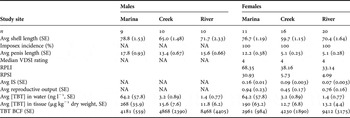
Daily water temperatures ranged from 8.0–29.5°C and salinity averaged 24.1 ± SE of 1.2 over the 28 week study period (Supplementary Material 2A & 2B). The gaps in the daily salinity record correspond to periods of sensor failure and/or servicing. A summary of measured TBT concentrations and rapa whelk parameters is provided in Table 1. The mean TBT water concentrations ranged from a low at site R of 1.4 ± 0.77 ng l−1, with site C at 3.2 ± 0.89 ng l−1 and site M, adjacent to a marina, providing the highest mean TBT concentrations of 64.2 ± 57.8 ng l−1. Tributyltin concentrations in the water at site M were significantly higher than TBT concentrations recorded at sites C or R (Supplementary Material 3). The measured ranges of TBT concentrations were 0.1–2.9, 1.4–5.4 and 7.2–199 ng l−1 for sites R, C and M, respectively. Total butyltin water concentrations from these sites followed the same trends with the lowest values observed at site R and the highest at site M (Supplementary Material 2C).
Information summary from the transplanted rapa whelk dissection in November 2002 including measured TBT concentrations.

Reproductive output, female specific (total wet weight of egg capsules deposited in 2002, g)/(wet tissue weight in 11/2002 g). n, the number of whelks.
Avg, average; SE, standard error of the mean; NA, not applicable; VDSI, Vas deferens sequence index from Gibbs & Bryan (Reference Gibbs and Bryan1987); RPLI, average penis length females/average penis length males from the same site × 100 from Gibbs & Bryan (Reference Gibbs and Bryan1987); RPSI, average penis length females/average penis length males from the same site × 100 from Gibbs & Bryan (Reference Gibbs and Bryan1987); IS, imposex severity (penis length/shell length); BCF, bioconcentration factor (TBT tissue concentration/TBT water concentration).
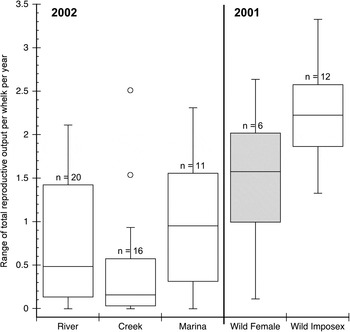
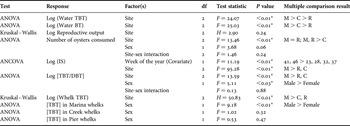
Reproductive output (Figure 1) was lowest at site C and highest at site M with average reproductive output values ranging from 0.45–0.94 g egg capsules/g female wet tissue weight, respectively (Table 1). Egg capsule deposition began in the three groups of transplanted whelks on 7 May 2002 (average daily water temperature = 18.9°C) and continued through 16 August 2002 (average daily water temperature = 27.0°C; Supplementary Material 2A). There was no significant difference in site-specific reproductive output (Table 2).
Box-whisker plots showing the observed reproductive output for study whelks at sites R, C and M during 2002 in contrast to wild-caught female and imposex whelks from 2001. The reproductive output (g egg capsules/g wet tissue of the female) data for wild Chesapeake Bay whelks in 2001 are from Ware (Reference Ware2002) and Harding et al. (Reference Harding, Mann and Kilduff2008).

Summary of non-regression statistical tests used to evaluate Rapana venosa transplant study data. Asterisks indicate statistical significance at α = 0.05.

df, degrees of freedom; TBT, tributyltin; DBT, dibutyltin; M, Marina; C, Creek; R, River; Log, logarithm; IS, imposex severity.
Imposex development and environmental TBT concentrations
Previous field studies examining the relationship between imposex development in gastropods and environmental TBT concentrations have used incidence of imposex (e.g. Gibbs & Bryan, Reference Gibbs, Bryan, Champ and Seligman1996; Fernandez et al., Reference Fernandez, de Luca Rebello, Wagener, Limaverde, Scofield, Pinheiro and Rodrigues2005; Mann et al., Reference Mann, Harding and Westcott2006; Titley-O'Neal et al., Reference Titley-O'Neal, MacDonald, Pelletier, Saint-Louis and Phillip2011), the VDSI (e.g. Gibbs & Bryan, Reference Gibbs and Bryan1987) and population relative penis size indices (RPLI, RPSI; Gibbs et al., Reference Gibbs, Bryan, Pascoe and Burt1987) as a measure of the stage of imposex development in affected populations. The incidence of imposex was 100% in all age 2 female whelks with corresponding average penis lengths of 5.1, 5.1 and 12.2 mm for the three sites (R, C, M) after 28 week exposure at transplant sites (Table 1). Imposex females will be referred to as ‘females’ hereafter since they laid egg capsules and were functional females with true females absent in the study populations. The observed median female VDSI value was 4 at every site (Table 1) even though there was a gradient in average TBT water concentrations across sites with the lowest values (1.4 ng l−1 ± SE 0.77) observed at the R site and the highest values (64.2 ng l−1 ± 57.8) observed at the M site.
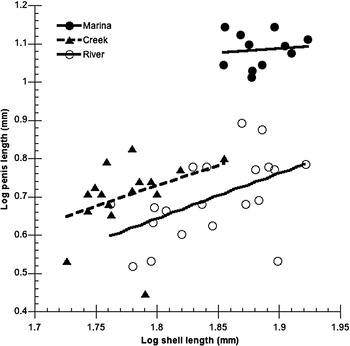
Penis length in both male and female whelks increased with increasing shell length (Figure 2, Supplementary Material 3). Female whelk PL was greatest at site M (Figure 2) that had the highest average TBT water concentrations (Table 1). The range of penis lengths found in site M female whelks overlapped with the range of penis lengths observed in male whelks from sites P and C, sites with lower average TBT water concentrations (Table 1). The slopes of the SL-PL relationship were significantly greater for males than females at sites C and M (Supplementary Material 4); however, female whelks at site R had a greater change in PL with SL than males (Supplementary Material 4) within a similar SL range (Table 1).
The relationship between Rapana venosa imposex female shell length (mm) and penis length (mm) observed at the three study sites (Marina, Creek, and River with N = 11, 16, and 20, respectively) in November 2002. Data were logarithm transformed for analyses with linear regression. Regression coefficients and statistics are presented in Supplementary Materials 3 and 4.

Both population level penis size indices showed higher values for the M site than either of the other transplant sites (Table 1). The RPLI at the M site was approximately double that observed at either sites R or C while the RPSI was 5–6 times greater at the M site than the others. The observed RPLI values for the M site were ~1.5 times higher than any observed RPLI from wild adult whelks while the site R and site C RPLI values were similar in magnitude to wild James River and Hampton Bar adult rapa whelks (Harding et al., Reference Harding, Unger, Mann, Jestel and Kilduff2013).
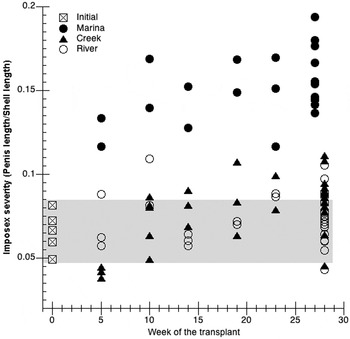
Penis length (PL) was divided by SL to provide an index of imposex severity (IS) for individual female whelks independent of whelk size to better evaluate the relative severity of imposex development in individual age 2 whelks. Imposex was evident in the cultured whelks prior to transplantation (Figure 3, Initial, week 0). The whelks were maintained in ambient York River water at site R that contained <2 ng l−1 TBT prior to deployment. Whelks transplanted to site M had significantly higher IS values than females from the other sites and significantly greater progression of IS over the 28 weeks relative to whelks at sites R and C (Table 2, Figure 3). These results showed that IS was site or TBT dose dependent and the incidence of imposex was 100% in rapa whelks where mean TBT water concentrations were at or above 1.4 ng l−1 (SE ± 0.77 ng l−1).
The observed change in imposex severity (IS, penis length/shell length) with time for female whelks at each transplant site over the 28 week study. The shaded horizontal box indicates the range of imposex severity observed in the five female snails sampled on 3 May 2002 (Initial) to provide a baseline for comparison with subsequent samples from the transplant sites.

Butyltin bioaccumulation and imposex development in rapa whelks
The recovery of TPT, the surrogate standard, from the rapa whelk tissue samples ranged from 60 to 90%. Butyltin concentrations were corrected for surrogate recovery. The recovery of TBT and DBT for spiked samples was linear (R2 for TBT = 0.99 and DBT = 0.95) up to 300 µg kg−1 (dry weight) demonstrating the suitability of the method over the range of tissue concentrations measured in this study. Six replicates of a muscle tissue sample were analysed and the mean per cent deviation was 2% for TBT and 18% for DBT demonstrating good precision for the method. The method detection limit for TBT was 2.9 µg kg−1 (dry weight) and for DBT was 3.5 µg kg−1 (dry weight).
The observed TBT accumulation in rapa whelks ranged from 11–268 µg kg−1 and was water dose dependent with the highest tissue concentrations (268 ± 35.8 and 190 ± 63.2 µg kg−1) found in male and female whelks respectively from site M, the station with the highest measured water concentrations (Table 1). These tissue concentrations are similar to the range of 3–429 µg kg−1 (Harding et al., Reference Harding, Unger, Mann, Jestel and Kilduff2013; Chesapeake Bay) and 17–309 µg kg−1 reported by Yang et al. (Reference Yang, Zhou, Liu and Jiang2006) for rapa whelks collected from a variety of locations in Chinese coastal waters. Calculated average TBT bioconcentration factors (BCF-tissue concentration/water concentration) ranged from 8464–9412, 4230–4868 and 2961–4181 for sites R, C and M, respectively.
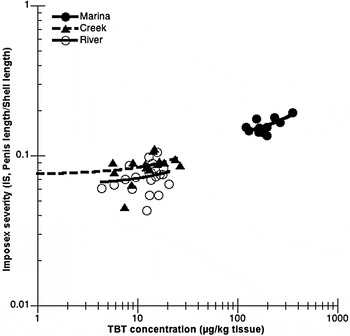
The TBT tissue concentrations and IS measured in female whelks after 28 weeks at the three study sites are presented in Figure 4. Whelks from site M had significantly higher TBT accumulation (average = 190 µg kg−1) than whelks from sites C and R (average = 12.7–13.2 µg kg−1) and significantly higher IS (average = 0.16 at M vs 0.07–0.09 for C and R; Tables 1 and 2). All three sites had 100% incidence of imposex and similar stages of imposex development (based on VDSI) but the IS metric shows that there are significant differences in imposex at site M relative to the other sites and that these differences are related to TBT dose. The slope of the TBT concentration–IS relationship was significantly higher in whelks at site M than at either of the other two sites (Supplementary Materials 3 & 4). The whelks from site M also had a greater range of TBT tissue concentrations (~100–300 µg kg−1) and there was a positive trend between tissue concentrations and IS development in the individual whelks within this site (Figure 4, Supplementary Materials 3 & 4).
The relationship between tributyltin (TBT) tissue concentration (μg kg−1 dry weight) and imposex severity (IS, penis length/shell length) for female Rapana venosa from the Marina (N = 11), Creek (N = 16), and River (N = 20) transplant sites. The coefficients for the fitted lines are presented in Supplementary Material 3. The relationship between TBT and IS observed from Marina females was significantly higher than for females from either Creek or River sites (Supplementary Material 4).

The average TBT tissue concentrations measured in female rapa whelks (190 ± SE 63.2 µg kg−1) from site M were significantly lower than those measured in males from the same site (268 ± 35.9 µg kg−1; Tables 1 & 2). There was no significant difference in prey consumption rates between the sexes that might have contributed to differences in TBT exposure through diet (Table 2, Supplementary Materials 5).
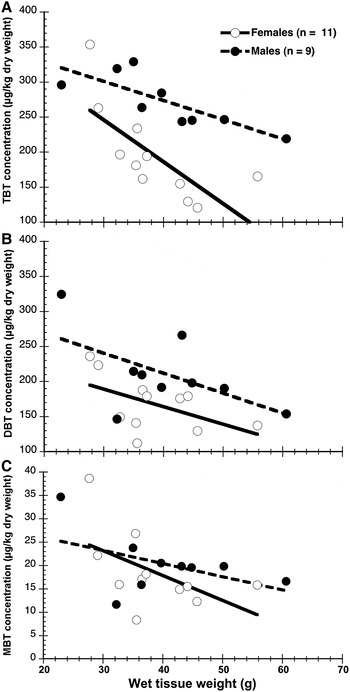
Tributyltin and its degradation products DBT and MBT were measured in male and female whelks from the site with the highest bioaccumulation rate (site M) to describe sex-specific differences in TBT accumulation after 28 weeks of exposure (Figure 5). The TBT concentration decreased as a function of whelk size (wet weight) and TBT accumulation was significantly lower in female whelks than in male whelks (Table 2, Figure 5A). The concentration differences between male and female whelks were much less distinct for DBT (Figure 5B) and not discernable for MBT (Figure 5C).
Trends in tributyltin (A), dibutyltin (B) and monobutyltin (C) bioaccumulation observed in male and female whelks from the Marina transplant site at the termination of the experiment (November 2002). The fitted regression coefficients are in Supplementary Material 3 with statistical comparisons within sexes across sites and within sites across sexes presented in Supplementary Material 4.

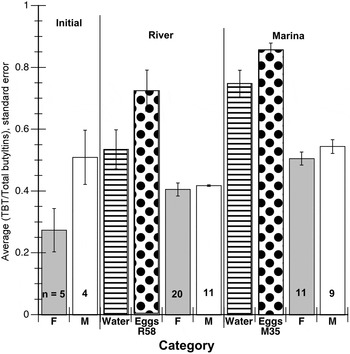
The female whelks monitored herein began laying egg capsules in early May when water temperatures exceeded 18–20°C and continued egg capsule deposition into August before the end of this study (November). The butyltin concentrations in selected egg capsules, adults and ambient water (May–August) were measured at sites R and M to evaluate egg capsule deposition as a possible depuration mechanism for TBT. The average ratio of TBT to the total butyltin concentration was calculated to allow direct comparison of the various matrices (Figure 6). The ratio of TBT to total butyltins was much higher in egg capsules than in adult female or male rapa whelks at the beginning (Initial, 3 May 2002) and the end of the transplant study (November 2002) and was elevated relative to the ambient water during the time of egg capsule deposition (May–August). Females had lower ratio values than males at the initial deployment and in November at both sites (Figure 6). Relatively higher TBT/total butyltin ratio values were noted in egg capsules and whelks from site M. These ratios reflect the higher TBT values relative to degradation products at site M compared with site R.
Summary of tributyltin/total butyltin ratios observed in baseline rapa whelks collected at the beginning of the study (Initial) compared with whelks from the River and Marina sites sacrificed in November 2002, all egg capsules produced by one River (R58) and one Marina female (M35) from May–August 2002, and water samples collected at the River and Marina sites while egg mass deposition was occurring (May–August 2002).

DISCUSSION
Imposex incidence of 100% was observed in veined rapa whelks reared in ambient York River, USA seawater with TBT concentrations as low as 0.63–2.17 ng l−1; however, imposex females rapa whelks were not sterilized (=functional females) and reproductive output was similar across sites. Imposex severity (PL/SL) increased significantly with the duration of exposure and the magnitude of the dose. Females exposed to the highest water concentrations of TBT (64.2 ± SE 57.8 ng l−1) for 28 weeks had penis lengths similar to male penis lengths from sites with lower ambient TBT levels. Female whelks had lower TBT body burdens than males of the same age from the same site and exposure history. Egg masses had higher TBT/total butyltin ratios than observed in the water or adult whelks at both low and high dose transplant sites indicating depuration of TBT by females during spawning. The amount of TBT in the egg masses increased with increasing environmental TBT concentration.
Egg capsule deposition in rapa whelks and the resulting depuration of the lipophilic TBT relative to DBT and MBT is a mechanism that reduces TBT accumulation in female rapa whelks. The observed trend of reduced bioaccumulation differences between the rapa whelk sexes with increased degradation of the butyltin molecules is likely driven by metabolic differences between the sexes or differences in uptake or depuration of the butyltins. TBT degradation to DBT and MBT and ultimately inorganic tin results from the sequential loss of a butyl substituent from the central tin moiety. The resulting degradation products have less carbon content, increased ionic behaviour and therefore greatly reduced lipophilicity. The whelks in this study were transplanted together and received the same diet so TBT exposure was similar between sexes and the resulting bioaccumulation differences are the result of differential metabolism, differential uptake or increased depuration of TBT by female whelks.
The current data prompt discussion of the application of imposex metrics as indicators of bioaccumulation. All RPSI values observed in this study are at least two orders of magnitude greater than those observed by Harding et al. (Reference Harding, Unger, Mann, Jestel and Kilduff2013; range 0–0.09) for wild Chesapeake Bay rapa whelks > 70 mm shell length. The observed average IS values from cultured age 2 rapa whelks (0.07–0.16) were within the range of IS values (0.03–0.16) observed for wild Chesapeake Bay rapa whelks >70–80 mm shell length (Harding et al., Reference Harding, Unger, Mann, Jestel and Kilduff2013). The range of wild Chesapeake whelk IS values declined from 1998 (0.13–0.16) to 2009 (0.04–0.08) as ambient TBT concentrations decreased (Harding et al., Reference Harding, Unger, Mann, Jestel and Kilduff2013). The use of IS as a metric for TBT effects on imposex in rapa whelks may provide a sensitive tool for future biomonitoring of TBT effects or ecosystem recovery post regulatory reduction of TBT antifoulants. The use of IS in other gastropod species should be evaluated for its predictive capability where populations are impacted but imposex incidence (%) and stage (VDSI) are similar.
The TBT concentrations measured at site R are within the range of values reported by Bryan et al. (Reference Bryan, Gibbs, Huggett, Curtis, Bailey and Dauer1989) for the same location (average = 1.6 ng l−1) from January through May 1988. The observed sensitivity of rapa whelks to low ambient TBT levels can be compared with previous work by Gibbs and co-workers (Gibbs et al., Reference Gibbs, Pascoe and Burt1988; Gibbs & Bryan, Reference Gibbs, Bryan, Champ and Seligman1996) that showed imposex development was evident in N. lapillus at TBT concentrations <1 ng l−1. It is unusual to see imposex incidence at 100% in all populations exposed to TBT concentrations in the 1–10 ng l−1 range without concurrent sterility. 100% incidence of imposex has been typically observed at TBT concentrations of 10 ng l−1 or above (e.g. Fernandez et al., Reference Fernandez, de Luca Rebello, Wagener, Limaverde, Scofield, Pinheiro and Rodrigues2005).
Previous work by Stickle et al. (Reference Stickle, Sharp-Dahl, Rice and Short1990) demonstrated that TBT exposure via food or water can produce increased imposex development in gastropods. The cultured rapa whelks were maintained in York River water sourced from site R (average TBT of 1.4 ng l−1) and fed with bivalves from this same location before transplantation representing the lowest possible ambient initial level of TBT exposure during the study. Whelks transplanted to study sites C and M experienced increased TBT water exposure during the 28 week post transplantation. All bivalve food was from non-marina areas of the York River and held at site R prior to dispersal to sites C and M. All whelks and all bivalve food were maintained in the water column (i.e. above the sediment) before and during the field exposure deployments. Consideration of sediment TBT concentrations as an additional method of exposure would be relevant if these whelks and food items had been infaunal. Thus, increased TBT exposure for the whelks at these sites was primarily via the water column and likely via feeding on oysters with increased TBT bioaccumulation prior to their consumption. It is likely that total TBT exposure for transplanted whelks at our most contaminated site was lower than would be expected for animals maintained in water and fed with food entirely sourced from this higher TBT contamination area. TBT bioaccumulation factors reported in the literature vary widely with species and conditions but most invertebrate BCFs fall into the range of 103–104 (Laughlin, Reference Laughlin, Champ and Seligman1996) and are comparable to those measured in this study for rapa whelks.
Rapa whelks are dioecious (Chung et al., Reference Chung, Kim and Kim1993, Reference Chung, Kim, Park and Park2002; Chung & Kim, Reference Chung and Kim1997). Previous work (Mann et al., Reference Mann, Harding and Westcott2006; Harding et al., Reference Harding, Unger, Mann, Jestel and Kilduff2013) has shown that ~30% of the wild female rapa whelks collected from Chesapeake Bay did not exhibit imposex development. Some of those whelks were collected from areas far from the influence of marinas but the water column TBT exposure history for those field-collected animals was unknown. Based on the data herein and the presence of 100% imposex in age 2 whelks, laboratory exposure experiments with carefully controlled TBT exposure concentrations ranging from no TBT to low ng l−1 and sub ng l−1 levels from hatching until at least age 2 would be required to establish the threshold and ontogenetic progression for TBT-induced imposex in rapa whelks. Given the potential influence of maternal TBT transfer to eggs (Harding et al., Reference Harding, Unger, Mann, Jestel and Kilduff2013 and this study), a complete evaluation of imposex sensitivity would use progeny from whelks with no TBT exposure as a control group.
The range of reproductive output values observed at these sites in 2002 overlaps with the range of reproductive output values observed in wild collected female and imposex female rapa whelks studied at VIMS from May to August 2001 (Ware, Reference Ware2002, Harding et al., Reference Harding, Mann and Kilduff2008). The level of imposex observed at all three study sites does not appear to compromise rapa whelk reproductive output in terms of the weight of egg capsules produced per egg-layer within a reproductive season. While egg capsule hatching success, veliger diameter at hatch and viability of larvae from wild collected whelks were not significantly affected by imposex (Harding et al., Reference Harding, Unger, Mann, Jestel and Kilduff2013), the rates of successful settlement and metamorphosis of larvae that are produced by imposex females with respect to larvae from true females are currently unknown.
The average TBT tissue concentrations measured in female rapa whelks from site M were lower than those measured in males in keeping with the trends observed by Harding et al. (Reference Harding, Unger, Mann, Jestel and Kilduff2013) in wild rapa whelks from the lower James River. A similar trend was noted by Titley-O'Neal et al. (Reference Titley-O'Neal, MacDonald, Pelletier, Saint-Louis and Phillip2011) when TBT concentrations in Strombus gigas from the British Virgin Islands were measured in 2008 and 2009. Male S. gigas had much higher body burdens of TBT than females from the same site. They noted that males might be ‘… more susceptible to bioaccumulate TBT than their female counterparts’ (Titley-O'Neal et al., Reference Titley-O'Neal, MacDonald, Pelletier, Saint-Louis and Phillip2011). Some possible mechanisms for ‘differing susceptibility’ between sexes are differences in lipophilic partitioning due to sexual dimorphism of tissues, metabolism, differences in depuration rates, differences in exposure, or a combination of factors. The sex-specific TBT bioaccumulation differences observed in both wild and cultured rapa whelks result from annual depuration of TBT in serially spawned egg masses where annual egg mass output is typically >50% of female body weight.
Sex-specific as well as seasonal differences in TBT bioaccumulation should be considered when using rapa whelks for biomonitoring in context with the latitude specific growing/reproductive season for the habitat in which the whelks occur. Gender-specific differences should be evaluated in other gastropods as they may influence the bioaccumulation of TBT as well as the effects of TBT exposure by altering the accumulated dose to adults or the developing offspring. Maternal transfer of TBT to developing Manila clam, Ruditapes philippinarium, embryos has been shown to act additively with water exposure to decrease developmental success of the clam (Inoue et al., Reference Inoue, Oshima, Usuki, Hamaguchi, Hanamura, Kai, Shimasaki and Honjo2006). The extreme sensitivity of rapa whelks to develop imposex at low ambient TBT concentrations (<1.4 ng l−1) concurrent with the onset of reproductive maturity may be, in part, due to higher exposure concentrations through maternal transfer to developing embryos. Gender differences in contaminant exposure and effects have been documented for a variety of invertebrate species (e.g. McClellan-Green et al., Reference McClellan-Green, Romano and Oberdorster2007) and should be considered when evaluating the potential effects in exposed populations. The life history of the target organism must also be considered. Animals that reach reproductive maturity later, have lower reproductive output, and are not serial spawners within the growing season are probably more vulnerable to population level sterilization effects because of the relatively low impact of depuration through egg production.
International regulations enacted in 2008 have reduced the inputs of TBT from marine antifoulant paints and many areas are reporting lower TBT concentrations and biological recovery (Langston et al., Reference Langston, Pope, Davey, Langston, O’ Hara, Gibbs and Pascoe2015). The hydrophobic nature of TBT leads to its sorption on particulate material and results in TBT accumulation in sediments where degradation rates are slow (e.g. 20–30 years) relative to the water column, especially in anaerobic sediments at depth (Maguire, Reference Maguire2000). In protected harbour areas where shipping and ship repair was concentrated and historical inputs were high, the release of TBT from contaminated sediments may pose a continuing long-term risk and additional biological monitoring is warranted (Langston et al., Reference Langston, Pope, Davey, Langston, O’ Hara, Gibbs and Pascoe2015). Sex-specific and seasonal differences in TBT bioaccumulation indentified in the rapa whelks may be useful to consider when evaluating the recovery of other species at these chronically impacted sites.
SUPPLEMENTARY MATERIAL
The supplementary material for this article can be found at http://dx.doi.org/10.1017/S0025315416000849.
ACKNOWLEDGEMENTS
Thanks are extended to all the people who checked the floats and/or helped clean the flume: E. Travelstead, G. Vadas, J. Greene, R. Howlett, C. Ware-Kilduff, E. Westcott and M. Southworth. N. Geyerhausen and Dr S.K. Allen Jr. loaned us the wire mesh Taylor Floats used for whelk deployment at field sites. M. Southworth assisted with experimental set up as well as laboratory dissections. D. Bunting, B. Mathews, M. Oesterling and R.V. Carmean maintained the seawater supply on the VIMS Oyster Pier. M. Fagan assisted with data entry. This is contribution number 3556 from the Virginia Institute of Marine Science.
FINANCIAL SUPPORT
This research received no specific grant from any funding agency, commercial or not-for profit sectors.