Introduction
Idiopathic sudden sensorineural hearing loss (SNHL) is defined as a hearing loss of more than 30 dB in at least three contiguous test frequencies, arising over less than 72 hours, with no identifiable aetiology. The incidence of sudden SNHL is reported as five to 20 per 100 000, and the disease accounts for approximately 1 per cent of all SNHL cases.Reference Wilson, Byl and Laird1
The aetiology of sudden SNHL has been debated for many years. The most popular theories include viral infection, immune-mediated reaction, vascular insufficiency and intralabyrinthine membrane rupture. However, viral infection seems the most probable cause, judging from the elevated viral titre and virus particles identified in patients.Reference Wilson, Veltri, Laird and Sprinkle2, Reference Cole and Jahrsdoerfer3
Researchers have identified many potential prognostic factors.Reference Slattery, Fisher, Iqbal, Friedman and Liu4 Vertigo, persistent or profound hearing loss, and delay between disease onset and treatment have been cited as negative prognostic factors.
Steroid applications, delivered orally or intravenously, are the mainstay of treatment for sudden SNHL.Reference Wilson, Byl and Laird1 Although the mechanism of action in reversing sudden SNHL is unclear and the optimal treatment dosage is unknown, higher concentrations of steroids in the inner ear are believed to be associated with improved recovery rates.
To achieve these higher concentrations, intratympanic steroid injection has been widely used in recent years. This route of delivery avoids such undesirable side effects as peptic ulcer, glaucoma, diabetes, osteoporosis and adrenal suppression. In addition, it can be used in patients for whom systemic steroids are contraindicated.Reference Slattery, Fisher, Iqbal, Friedman and Liu4 Previous research has indicated that four doses represents the optimal treatment course for intratympanic steroid therapy.Reference Slattery, Fisher, Iqbal, Friedman and Liu4–Reference Choung, Park, Shin and Cho7 However, the best intratympanic steroid dosage remains unclear.
This study aimed to evaluate: the efficacy of intratympanic steroid therapy in treating sudden SNHL; the influence of age on the number of injections; the effect of treatment timing on response rates; and the effect of steroid dosing frequency. We also aimed to evaluate possible prognostic factors.
Materials and methods
We conducted a retrospective chart review of patients undergoing only intratympanic steroid injection for sudden SNHL, between 1 January 2006 and 30 June 2007. Patients were included if they had suffered SNHL of 30 dB or more over three contiguous audiometric frequencies, tested within 72 hours of disease onset. All patients were examined and treated at the otolaryngology department of Shin-Kong Wu-Ho-Su Memorial Hospital, Taipei, Taiwan.
The hospital review board approved the study, and all patients provided written, informed consent before inclusion.
Exclusion criteria included any identifiable cause for sudden SNHL, as determined by clinical history, physical examination, radiological study or laboratory investigation. We also excluded patients who had ever received other forms of steroid therapy.
The treatment procedure was performed twice a week for two contiguous weeks, using an operating microscope, a 25-gauge spinal needle and a 1-ml syringe. The patient was placed in the supine position. An anteroinferior tympanic membrane puncture was made for ventilation. A posteroinferior puncture was made to enable perfusion of 0.5 ml dexamethasone (5 mg/ml; Shen-Dar, Taipei, Taiwan). After injection, the patient's head was turned 45° to the healthy side, and they were instructed to avoid swallowing or moving for 20 minutes, while continuing to lie supine.
Pure tone audiometry (PTA) was performed just before each injection, and also one week after the last injection. The data of untreated ears were also collected and assessed. A response to treatment was defined as hearing improvement equal to a decrease of 10 dB or more in the average PTA hearing threshold across three frequencies (0.5, 1 and 2 kHz). Each PTA frequency threshold difference was analysed.
In addition, the following possible prognostic factors were also evaluated: gender, side of ear, tinnitus, vertigo, diabetes mellitus, hypertension and pre-treatment PTA threshold.
Data were presented in numerical and percentage forms. A sample t-test was used to determine means. Statistical significance was determined using the two-tailed Student's t-test, Pearson's chi-square test or Fisher's exact test, as appropriate (p < 0.05). All analyses were conducted using the Statistical Package for the Social Sciences version 18 software program (SPSS Inc, Chicago, Illinois, USA).
Results
From our chart review, we identified 176 patients who had suffered sudden SNHL and received treatment over the 18-month study period. After inclusion and exclusion criteria were applied, 141 patients were identified as being treated solely with intratympanic dexamethasone. All patients had been informed that a follow-up period of at least six months was required, due to possible hearing variations and intratympanic dexamethasone side effects. Thirteen patients were lost to follow up. Therefore, a total of 128 patients was enrolled in the study.
The patients' average length of follow up was 11.4 months, with a range of six to 37 months.
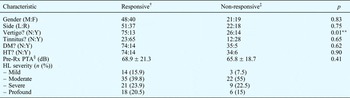
Table I shows the characteristics of patients who responded and did not respond to intratympanic dexamethasone therapy. The former comprised 88 patients (68.8 per cent) and the latter 40 patients (31.3 per cent). The average pre-treatment PTA threshold was 68.9 dB in the responsive group and 65.8 dB in the non-responsive group. We found no statistically significant difference between the two groups as regards any of the possible prognostic factors assessed, except vertigo. Notably, a statistically significant difference was found in response rates, comparing the group receiving early treatment (i.e. seven days or less; response rate 76.1 per cent) and those receiving delayed treatment (i.e. more than seven days; response rate 50 per cent) (Table II; p < 0.004).
Characteristics of responsive and non-responsive patients*

* Responsiveness defined as decrease in pure tone audiometry (PTA) threshold of 10 dB or more, averaged across 0.5, 1 and 2 kHz. †n = 88; ‡n = 40. **p < 0.05. §Mean ± standard deviation. M = male; F = female; L = left; R = right; N = no; Y = yes; DM = diabetes mellitus; HT = hypertension; Rx = treatment; HL = hearing loss
Response by treatment timing

Data represent patient numbers (percentages). *n = 88; †n = 40. ‡p = 0.004, versus treatment >7 days. Rx = treatment
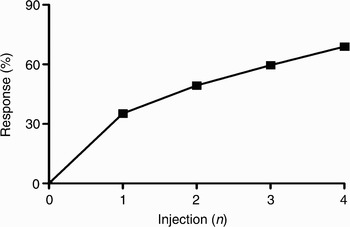
We further divided the responsive group into four subgroups by intratympanic steroid injection number. As shown in Figure 1, the response rate was 35.15 per cent after the first injection, and rose to approximately 50 per cent after the second injection. The response rate increased slightly after both the third and fourth injections. The total response percentage was 68.9 per cent after four steroid injections, suggesting that a full course of steroid therapy is helpful for recovery.
Patients' cumulative response rate by steroid injection number. Intratympanic steroid injections were administered with a 3-day interval.

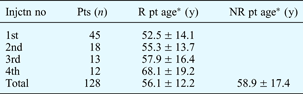
Table III shows patients' mean age by treatment response and injection number. Although there was no statistically significant difference in the mean age of the injection number subgroups, a trend towards decreasing responsiveness with increasing age suggested that elderly patients generally required more steroid injections to achieve a response.
Age of responsive and non-responsive patients
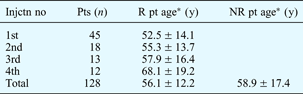
*Mean ± standard deviation. Injctn no = injection number; pts = patients; R pt = responsive pts; NR pt = non-responsive pts; y = years
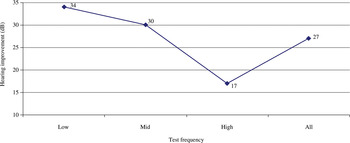
Further analysis of hearing improvement at each frequency in the responsive group (88 ears) showed mean improvements of 34 dB at low frequencies (i.e. 0.25 and 0.5 kHz), 30 dB at mid-level frequencies (i.e. 1 and 2 kHz) and 17 dB at high frequencies (i.e. 4 and 8 kHz), respectively. These results indicate hearing improvement at low and mid-level frequencies (Figure 2).
Hearing recovery in responsive patients, by pure tone audiometry test frequency. Low = 0.25 and 0.5 kHz; mid = 1 and 2 kHz; high = 4 and 8 kHz

The patients' mean PTA thresholds ± standard deviation were 32.4 ± 10.6 before intratympanic dexamethasone treatment and 30.8 ± 9.1 after treatment.
No significant effect was found in the untreated ears.
There were no long-term complications of intratympanic steroid injection. Six patients had a tympanic membrane perforation; all spontaneously healed during the follow-up period. Some patients complained of transient vertigo or dizziness because of the caloric effect of the steroid solution, but none discontinued treatment due to side effects.
Discussion
Steroid therapy is the mainstay of treatment for sudden SNHL. Wilson et al. showed that systemic steroid therapy led to a statistically significant improvement in hearing in patients with sudden SNHL.Reference Wilson, Byl and Laird1 In animal models, intratympanic steroid administration resulted in significantly greater concentrations of steroid in the perilymph, compared with either intravenous or oral administration.Reference Parnes, Sun and Freeman8, Reference Chandrasekhar9 Therefore, intratympanic steroid therapy has become popular both for primary and salvage treatment.
The present study investigated the efficacy of intratympanic steroid therapy as the primary treatment of sudden SNHL. Patients who had ever received any other form of steroid therapy were excluded.
Previous studies by Gianoli and Li, Lefebvre and Staecker and Kopke et al. evaluated patients who had received no benefit from oral steroids.Reference Gianoli and Li5, Reference Lefebvre and Staecker10, Reference Kopke, Hoffer, Wester, O'Leary and Jackson11 They used intratympanic steroid as a salvage treatment, and observed significantly improved hearing.
Banerjee and Parnes used intratympanic steroid therapy as primary treatment for sudden SNHL. They found significantly better hearing recovery in patients treated within 10 days of disease onset, compared with patients whose treatment was initiated after this time.Reference Banerjee and Parnes6
Slattery et al. conducted a clinical trial of intratympanic steroids in 20 patients with sudden SNHL, and found that those obtaining treatment within one month of onset of hearing loss were somewhat more likely to experience improvement.Reference Banerjee and Parnes6
These studies indicate that the timing of steroid application is controversial. In our study, patients who received intratympanic steroid therapy within seven days of disease onset had a significantly better response rate (76 per cent; Table II), compared with those receiving later treatment. These data are consistent with the results of Banerjee and Parnes; however, our patient pool (n = 128) was much larger than theirs (n = 33).Reference Banerjee and Parnes6 Our results suggest that commencing treatment within seven days of disease onset produces a better outcome. However, if intratympanic steroid therapy has been delayed for more than seven days, starting as soon as possible after this time may still be helpful.
Although many studies have reported the efficacy of intratympanic steroid therapy in treating sudden SNHL, no study has analysed the response rate following each injection, or what dosage and how many injections are required to achieve the optimum hearing threshold improvement. Studies by Gianoli and Li and Choung et al. indicated that at least four dexamethasone injections may be needed.Reference Gianoli and Li5, Reference Choung, Park, Shin and Cho7 We found a response rate of 35.15 per cent in all patients after the first intratympanic steroid injection, which rose to almost 50 per cent after the second injection. The total response rate was 68.75 per cent after the fourth injection. As shown in Figure 1, the slope of the response curve gradually levelled off following the first steroid injection, and reached a near-plateau after the fourth injection. Therefore, we recommend four intratympanic steroid injections for adequate treatment of sudden SNHL. Moreover, subdividing the responsive patients by injection number indicated that older patients appeared to require more steroid injections. We found that intratympanic steroid delivery was highly effective in treating sudden SNHL in younger patients. However, it was notable that the average age of the non-responsive group was not much greater than that of the responsive group. Thus, factors other than age may possibly affect patients' steroid responsiveness.
Analysis of frequency-specific hearing recovery in the responsive group indicated significant improvement in low and mid-level frequencies, but less effect in high frequencies. It is well known that steroid injected intratympanically penetrates through the round window to enter the cochlear perilymph, and affects the basal turn much more than the apical turn. Theoretically, high frequencies should be improved more. Surprisingly, we found that intratympanic steroid injection was more effective in patients with low and mid-level frequency hearing loss (Figure 2). Our finding is consistent with that of Choung et al., who also noted obvious hearing recovery in the low frequencies.Reference Choung, Park, Shin and Cho7 Therefore, we hypothesise that steroid introduced into the cochlea via intratympanic injection specifically influences the apical turn rather than the basal turn, when the concentration of steroid reaches a threshold level. This result may be analogous, in a positive sense, to the hearing loss caused by noise trauma or ototoxic drugs specifically deposited in the basal turn area.
• Idiopathic sudden sensorineural hearing loss (SNHL) accounts for approximately 1 per cent of all SNHL cases
• Oral or intravenous steroid treatment is widely used, but is associated with significant side effects
• The optimal dose and timing of intratympanic steroid therapy remains unclear
• In this study, patients receiving intratympanic steroid therapy within seven days of disease onset had significantly better response rates than those treated after seven days
• Patients with low and mid-frequency hearing loss appeared more responsive to steroid treatment
• Vertigo appeared to be a negative prognostic factor
Conclusion
Intratympanic steroid injection may be a simple and effective way to treat patients with sudden SNHL, especially when performed within seven days of disease onset. Patients with primarily low and mid-level frequency hearing loss seem more responsive to steroid treatment. We suggest at least four intratympanic steroid injections to achieve optimal treatment efficacy.