Introduction
Maternal prenatal psychological distress, which includes depression symptoms and anxiety, has been found to affect the offspring’s neurodevelopment, including motor and cognitive development, temperament, and mental health through effects on the developing fetus; a process commonly known as the Developmental Origins of Health and Disease hypothesis. Reference Gentile1–Reference Tan, Goh and Tsotsi12
The impact of maternal psychological distress during pregnancy on offspring development can depend on the offspring’s developmental age and sex; however, research results in this regard remain inconsistent. There are also inconsistent findings regarding the periods of pregnancy during which maternal psychological distress has the greatest impact on the offspring. Reference Rees, Channon and Waters2,Reference Van den Bergh, van den Heuvel and Lahti3 Furthermore, it has been reported that genetic variations related to race and ethnicity can influence this impact. Reference Nagasaki, Yasuda and Katsuoka13 In other words, there may be racial or ethnic differences regarding sensitivity to exposure to maternal psychological distress during gestation. Despite these issues, however, there has been no independent research on this topic in Japan.
In 2011, Japan commenced the Japan Environment and Children’s Study (JECS) – a nationwide birth cohort study of 100,000 pairs of parents and offspring – to investigate this population’s development and environments. Reference Kawamoto, Nitta and Murata14,Reference Michikawa, Nitta and Nakayama15 The JECS is currently ongoing, and is planned to continue until the participating offspring turn 18 years old. As a sub-cohort study of the JECS, trained testers have conducted evaluations of the motor and cognitive development of 5000 offspring randomly selected from the sample. In the present study, we used this dataset to examine the association between maternal prenatal psychological distress and the motor/cognitive development of two-year-old offspring.
Materials and methods
Design and participants
The JECS protocol was reviewed and approved by the Ministry of the Environment’s Institutional Review Board on Epidemiological Studies (no. 100910001) and the ethics committees of all participating institutions. It was also conducted in accordance with the latest version of the Declaration of Helsinki. Participants for the JECS were recruited between January 2011 and March 2014, and all pregnant women nationwide were eligible for participation. Participants were recruited from 15 regional centers located in Hokkaido, Miyagi, Fukushima, Chiba, Kanagawa, Yamanashi, Toyama, Aichi, Kyoto, Osaka, Hyogo, Tottori, Kochi, Fukuoka, and South Kyushu / Okinawa, respectively. Written informed consent was obtained from all participants. From the JECS cohort, a sub-cohort comprising 5% of the participating offspring, who were randomly selected and met specific eligibility criteria, was extracted. Reference Iwai-Shimada, Nakayama and Isobe16 This sub-cohort subsequently underwent extended outcome measurements, including face-to-face interviews with the offspring when they reached two and four years of age, respectively (conducted by specialized staff); the aim of these interviews was to evaluate the offspring’s neurological development using the Kyoto Scale of Psychological Development (KSPD). Reference Kawamoto, Nitta and Murata14
The present study used the jecs-ta-20190930 dataset, which was revised in April 2020. It contains the results of neurological development assessments (based on the KSPD) of the two-year-old offspring. As the present study investigated effects on unborn offspring, records for offspring born during multiple births (e.g., twins) were excluded from the analysis. Offspring with any congenital anomalies were excluded from the analysis. Reference Mezawa, Tomotaki and Yamamoto-Hanada17
Maternal psychological distress
The JECS examiners administered the six-item version of the Kessler Psychological Distress Scale (K6) to the mothers on two occasions: during the first (M-T1) and second (M-T2) half of pregnancy, respectively. Reference Iwai-Shimada, Nakayama and Isobe16 The K6 is widely used to assess psychological distress. Reference Kessler, Andrews and Colpe18,Reference Kessler, Barker and Colpe19 It is a self-administered questionnaire comprising six items (scored using a scale of 0 to 4) that evaluates depressive mood and anxiety over the preceding four weeks, and is based on the Diagnostic and Statistical Manual of Mental Disorders, fourth edition. Total K6 score is determined by summing the scores for each of the six items, with total scores ranging from 0 to 24. The Japanese version of the K6 was used in the JECS. We considered K6 scores ≥5 to indicate psychological distress; this accords with the approach used in previous studies of populations in Japan. Reference Furukawa, Kawakami and Saitoh20,Reference Kuroda, Goto and Koyama21,Reference Sakurai, Nishi, Kondo, Yanagida and Kawakami22 We analyzed the data to determine associations between maternal K6 scores ≥5 and the psychological development of their two-year-old offspring.
We classified participants into four groups based on K6 scores at M-T1 and M-T2, respectively: (1) K6 score ≥5 at both M-T1 and M-T2, (2) K6 score ≥5 at M-T1 and ≤4 at M-T2, (3) K6 score ≤4 at M-T1 and ≥5 at M-T2, and (4) K6 score ≤4 at both M-T1 and at M-T2.
Motor and cognitive development in two-year-old offspring
The KSPD is a standardized developmental assessment tool for Japanese offspring that has been widely used in clinical settings in Japan. Reference Koyama, Osada, Tsujii and Kurita23–Reference Mezawa, Aoki and Nakayama25 The KSPD covers the posture-motor (P-M), cognitive-adaptive (C-A), and language-social (L-S) areas of development. Reference Koyama, Osada, Tsujii and Kurita23–Reference Mezawa, Aoki and Nakayama25 The P-M area consists of gross motor skills, such as take a few steps forward, climb stairs using a handrail, and jump. The C-A area consists of nonverbal cognitive skills, such as pile up blocks, identify shapes, draw lines and shapes following a model, fold origami paper following a model, and stack cups of different sizes in sequence. The L-S area consists of verbal cognitive skills, such as point to a picture of the object being communicated, state the name of the object, recite numbers, select the indicated facial expression, and state the name of a color. A developmental quotient (DQ) was calculated by dividing the developmental age in days by the chronological age in days and multiplying the quotient by 100.
Administrative procedures and evaluations were strictly standardized to ensure testers’ reliability in this survey. For the reliability of administration, the testers received rigorous training before they were certified to conduct testing. The testers were certified by the JECS and the Kyoto International Social Welfare Exchange Centre, Kyoto, Japan.
Statistical analysis and covariables
We compared each group in terms of the characteristics of the mothers and their offspring by applying analysis of variance (ANOVA). Bivariate and multiple regression analyses were then performed to assess the association between maternal prenatal psychological distress and offspring’s psychological development.
The multiple regression analyses were adjusted for maternal age at delivery; whether the pregnancy was unplanned, use of infertility treatment, marital status, highest level of education (maternal and paternal), smoking during pregnancy (maternal and paternal), alcohol consumption during pregnancy, annual household income, whether the mother had any neuropsychiatric disorders, psychoactive drug use during pregnancy, whether pregnancy complications occurred, whether obstetric labor complications occurred, mode of delivery, offspring’s birth weight, gestational week of delivery, feeding method at six months postpartum, family structure, number of offspring (including the subject), offspring’s age at beginning attendance at a daycare center, location of regional center, and offspring’s sex for overall. Information regarding maternal neuropsychiatric disorders, pregnancy complications, obstetric labor complications, mode of delivery, offspring’s birth weight, and gestational week of delivery was obtained from physician’s records. All other information was obtained from the participants’ responses to the questionnaire, which was not verified.
These confounding factors were mostly chosen with reference to previous relevant studies. Reference Gentile1–Reference Van den Bergh, van den Heuvel and Lahti3 None of the confounding factors in this analysis were found to have multicollinearity. Multicollinearity was considered to be present should the following conditions arise: an association with the independent variables that featured a correlation coefficient of r ≈ 1, and/or a variance inflation factor of 10 or higher. For reference, parity and number of offspring (including the subject) were found to be multicollinear.
All analyses were performed using SAS statistical software, version 9.4 (SAS Institute Inc., Cary, NC, USA).
Results
Overview
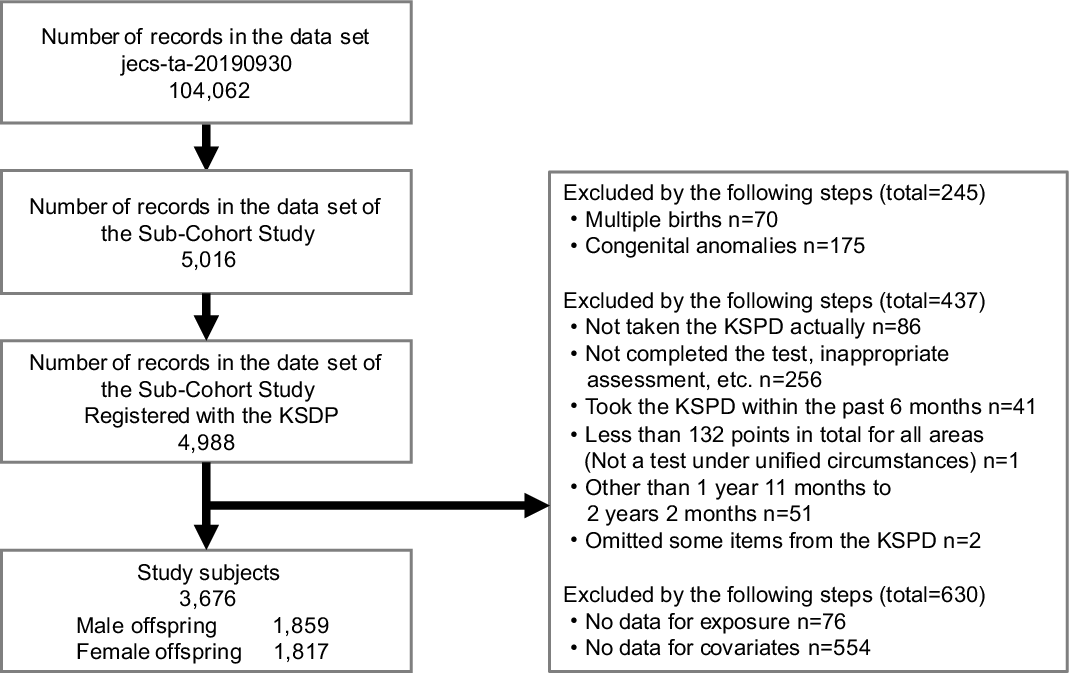
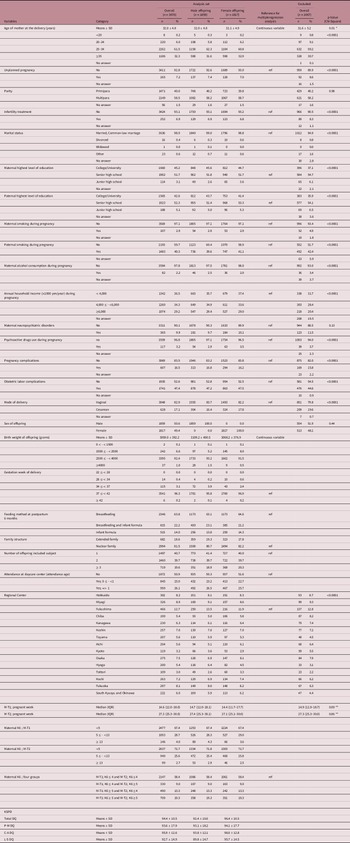
Of the 104,062 records in this dataset, records for 3676 offspring were analyzed (Fig. 1). Table 1 shows the characteristics of the participant sample, which comprised 3676 two-year-old offspring from single pregnancies without congenital anomalies who had undergone evaluation using the KSPD. This sample comprised 1859 male and 1817 female offspring.
Flow chart depicting research participants’ selection.

Characteristics of participants (total = 3676)

Abbreviations: Kyoto Scale of Psychological Development 2001(KSPD), developmental quotient (DQ), posture-motor (P-M), cognitive-adaptive (C-A), language-social (L-S), standard deviation (SD), interquartile range (IQR), the 6-item Kessler Psychological Distress Scale (K6; total point scores ranged from 0 to 24).
*t-test and ** Mann–Whitney U test were applied.
For male offspring, the maternal K6 score at M-T1 was collected at median 14.7 weeks of gestation (interquartile range; IQR: 12.0–18.1), and that for M-T2 was collected at median 27.4 weeks of gestation (IQR: 25.3–30.1). For female offspring, the maternal K6 score at M-T1 was collected at median 14.4 weeks of gestation (IQR: 11.7–17.7), and that for M-T2 was collected at median 27.1 weeks of gestation (IQR: 25.1–30.0). Overall, for M-T1 the maternal K6 score was collected at median 14.6 weeks of gestation (IQR: 12.0–18.0), and for M-T2 it was collected at median 27.3 weeks of gestation (IQR: 25.3–30.0).
Male offspring
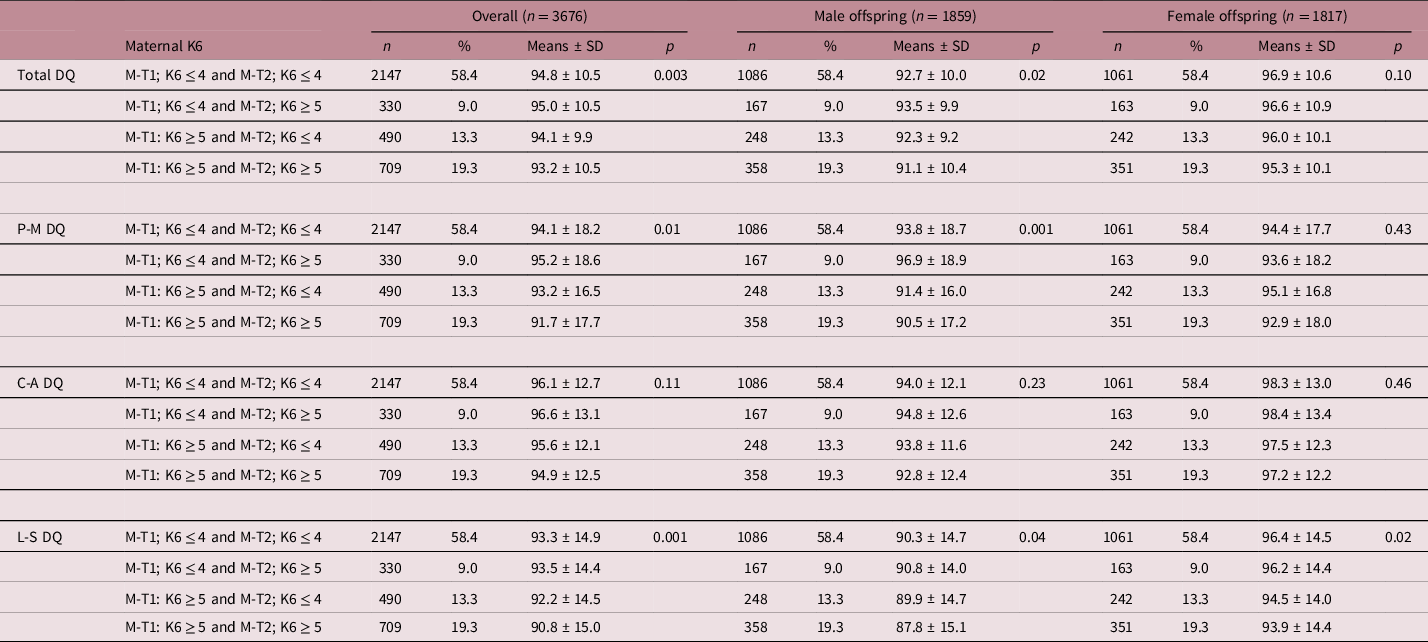
Mothers of male offspring were divided into four groups: (1) 358 mothers (19.3%) had K6 scores ≥5 at both M-T1 and M-T2, (2) 248 mothers (13.3%) had a K6 score ≥5 at M-T1 and a score ≤4 at M-T2, (3) 167 mothers (9.0%) had a K6 score ≤4 at M-T1 and a score ≥5 at M-T2, and (4) 1086 mothers (58.4%) had K6 scores ≤4 at both M-T1 and M-T2. Table 2 shows the results of the one-way ANOVA for maternal K6 scores and offspring’s KSPD scores; Table 3 shows the results of the bivariate analysis for maternal K6 scores and offspring’s KSPD scores.
ANOVA of maternal K6 and KSPD in four groups

Bivariate analysis of maternal K6 and KSPD in four groups

Abbreviations: Kyoto Scale of Psychological Development 2001(KSPD), developmental quotient (DQ), posture-motor (P-M), cognitive-adaptive (C-A), language-social (L-S), partial regression coefficient (B), confidence interval (CI), standardized partial regression coefficients (β), Interquartile range (IQR).
M-T1; Overall median 14.6 (IQR 12.0–18.0), Male median 14.7 (IQR 12.0–18.1), Female median 14.4 (IQR 11.7–17.7) pregnant weeks.
M-T2; Overall median 27.3 (IQR 25.3–30.0), Male median 27.4 (IQR 25.3–30.1), Female median 27.1 (IQR 25.1–30.0) pregnant weeks.
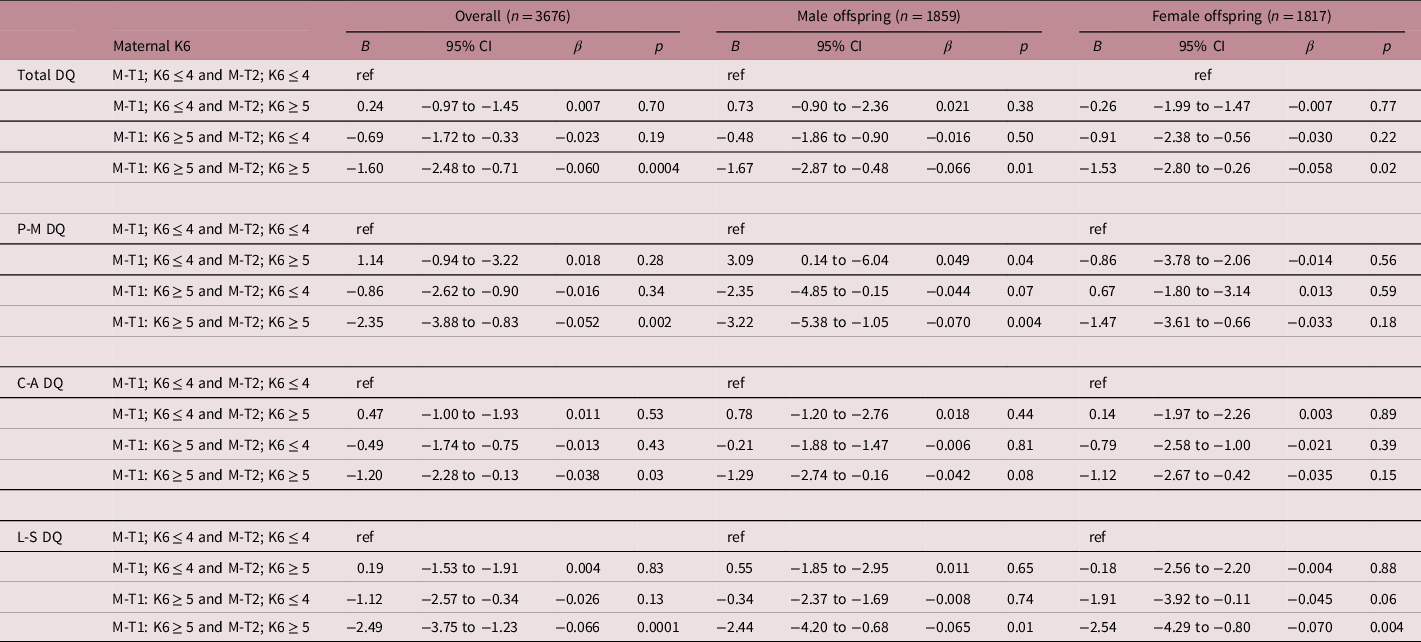
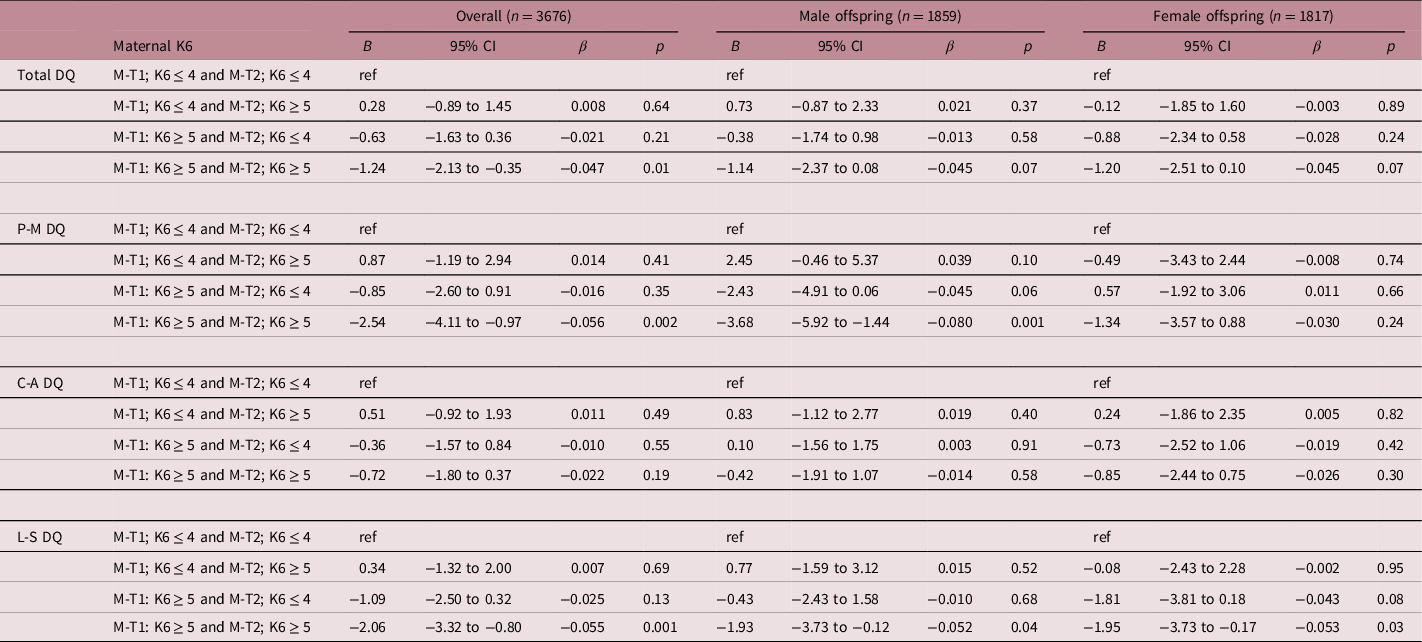
Multiple regression analysis showed that the group with maternal K6 scores ≥5 at both M-T1 and M-T2 had significantly lower scores for the P-M DQ (partial regression coefficient [B]: −3.68, 95% confidence interval [CI]: −5.92 to −1.44, β: −0.080, p = 0.001) and L-S DQ (B: −1.93; 95% CI: −3.73 to −0.12, β: −0.052, p = 0.04) compared with the group with maternal K6 scores ≤4 at both M-T1 and at M-T2 (Table 4).
Multiple regression analysis of maternal K6 and KSPD in four groups

Abbreviations: Kyoto Scale of Psychological Development 2001(KSPD), developmental quotient (DQ), posture-motor (P-M), cognitive-adaptive (C-A), language-social (L-S), partial regression coefficient (B), confidence interval (CI), standardized partial regression coefficients (β), Interquartile range (IQR).
M-T1; Overall median 14.6 (IQR 12.0–18.0), Male median 14.7 (IQR 12.0–18.1), Female median 14.4 (IQR 11.7–17.7) pregnant weeks.
M-T2; Overall median 27.3 (IQR 25.3–30.0), Male median 27.4 (IQR 25.3–30.1), Female median 27.1 (IQR 25.1–30.0) pregnant weeks.
Adjusted for age of mother at the delivery, unplanned pregnancy, infertility treatment, marital status, maternal highest level of education, paternal highest level of education, maternal smoking during pregnancy, paternal smoking during pregnancy, maternal alcohol consumption during pregnancy, annual household income, maternal neuropsychiatric disorders, psychoactive drug use during pregnancy, pregnancy complications, obstetric labor complications, mode of delivery, birth weight of offspring, gestational week of delivery, feeding method at 6 months postpartum, family structure, number of offspring included subject, attendance age of daycare center, location of regional center, and sex of offspring for overall.
Female offspring
Mothers of female offspring were divided into four groups: (1) 351 mothers (19.3%) had K6 scores ≥5 at both M-T1 and M-T2, (2) 242 mothers (13.3%) had a K6 score ≥5 at M-T1 and a score ≤4 at M-T2, (3) 163 mothers (9.0%) had a K6 score ≤4 at M-T1 and a score ≥5 at M-T2, and (4) 1,061 mothers (58.4%) had K6 scores ≤4 at both M-T1 and M-T2. Table 2 shows the results of the one-way ANOVA for maternal K6 scores and offspring’s KSPD scores (Table 2).
Multiple regression analysis showed that the group with maternal K6 scores ≥5 at both M-T1 and M-T2 had significantly lower scores for the L-S DQ (B: −1.95; 95% CI: −3.73 to −0.17, β: −0.053, p = 0.03) compared to the group with maternal K6 scores ≤4 at both M-T1 and M-T2 (Table 4). Otherwise, the group with maternal K6 scores ≥5 at both M-T1 and M-T2, did not have significantly lower scores for the P-M DQ compared to the group with maternal K6 scores ≤4 at both M-T1 and M-T2 (Table 4).
Overall
Multiple regression analysis showed that the group with maternal K6 scores ≥ 5 at both M-T1 and M-T2 had significantly lower scores for P-M DQ (B: −2.54; 95% CI: −4.11 to −0.97, β: −0.056, p = 0.002), and L-S DQ (B: −2.06; 95% CI: −3.32 to −0.80, β: −0.055, p = 0.001) compared to the group with maternal K6 scores ≤4 at both M-T1 and M-T2 (Table 4).
Discussion
Overall findings
In our analysis, among the group of mothers who showed continuous psychological distress during pregnancy (evidenced by K6 scores ≥5 at approximately 14 and 27 weeks of gestation), male two-year-old offspring tended to have a lower DQ for the P-M and L-S development areas, while female two-year-old offspring tended to have a lower DQ for the L-S development area.
In contrast, in the group for which maternal psychological distress was present at approximately 14 weeks of gestation but absent at approximately 27 weeks of gestation, and the group for which maternal psychological distress was absent at approximately 14 weeks of gestation but present at approximately 27 weeks of gestation, there was no significant impact on the DQ of any development area, regardless of the offspring’s sex.
This indicates that continuous maternal psychological distress from the first to the second half of pregnancy may impair the motor development and verbal cognitive development of male offspring at two years of age, and the verbal cognitive development of female offspring at two years of age. In other words, if maternal psychological distress is detected in the early stages of pregnancy, it may be possible to prevent negative effects on the offspring by immediately implementing appropriate interventions. However, this study did not examine the mother’s postpartum psychological distress. Since maternal postnatal psychological distress also affects the offspring’s motor and cognitive development, further study is needed. Reference Rees, Channon and Waters2,Reference Aoyagi and Tsuchiya26,Reference Oyetunji and Chandra27 However, our finding and suggestions were also fully consistent with our previous study examining the association between maternal prenatal psychological distress and autism spectrum disorder (ASD) among offspring. Reference Nishigori, Hashimoto and Mori28 That study showed that from the first to the second half of pregnancy, continuous maternal psychological distress was associated with ASD among offspring. Reference Nishigori, Hashimoto and Mori28
Our study focused on two-year-old offspring. In many related studies, the age of the offspring examined varied greatly. Previous studies have reported that the effects of maternal prenatal psychological distress on offspring vary as they age. Reference Gentile1,Reference Rees, Channon and Waters2,Reference Simcock, Kildea and Elgbeili29 Therefore, in this discussion section, in which we contrast our findings with those of existing studies, we limit our focus to studies concerning offspring of approximately two years of age (from 12 months to three years).
Motor development
Koutra et al. reported that motor development at 18 months of age is not significantly affected by maternal prenatal depression symptoms. Reference Koutra, Chatzi, Bagkeris, Vassilaki, Bitsios and Kogevinas30 However, Lin et al. found maternal prenatal psychological distress to have a negative effect on gross motor skills at 24–36 months of age. Reference Lin, Xu, Huang, Jia, Zhang, Yan and Zhang31 Notably, these two studies assessed maternal mental health only once, at 28–32 weeks, and at 28–36 weeks of gestation, respectively. Reference Koutra, Chatzi, Bagkeris, Vassilaki, Bitsios and Kogevinas30,Reference Lin, Xu, Huang, Jia, Zhang, Yan and Zhang31
Additionally, stress in the form of exposure to disasters during pregnancy may affect offspring’s motor development. An examination conducted during the 2010 Queensland Floods in Australia found that maternal prenatal subjective stress, especially post-traumatic stress, has a negative effect on the offspring’s fine motor skills at 16 months of age, particularly when the stress exposure occurs later than 26 weeks of gestation. Reference Moss, Simcock and Cobham32
Cognitive development
Koutra et al. reported that cognitive development at 18 months of age is significantly negatively affected by maternal prenatal depression symptoms. Reference Koutra, Chatzi, Bagkeris, Vassilaki, Bitsios and Kogevinas30 Meanwhile, Lin et al. reported that maternal prenatal psychological distress is marginally (p = 0.060) inversely associated with language development at 2–3 years of age. Reference Lin, Xu, Huang, Jia, Zhang, Yan and Zhang31 Davis and Sandman reported that, among all measures of maternal distress (perceived stress, state anxiety, pregnancy-specific anxiety and depression), elevated levels of maternal pregnancy-specific anxiety early in pregnancy are independently associated with lower scores (among the offspring) on the Mental Developmental Index, but not the Psychomotor Development Index, at 12 months. Reference Davis and Sandman33 Henrichs et al. reported a negative correlation between prenatal stress at 20 weeks of pregnancy and the offspring’s word comprehension at 18 months, but no such correlation with word production. Reference Henrichs, Schenk and Kok34 Henrichs et al. also found a negative correlation between prenatal stress at 20 weeks of pregnancy and nonverbal cognitive development at 24 months of age. Reference Henrichs, Schenk and Kok34 With regard to the effect of exposure to disasters during pregnancy, Moss et al. found the objective degree of exposure to the Queensland Floods in Australia to be associated with lower cognitive scores among the offspring at 16 months of age, especially if the flood occurred at 30 weeks of pregnancy or later. Reference Moss, Simcock and Cobham32 King et al. and Laplante et al., in Canada-based studies, found high levels of objective stress during pregnancy as a result of exposure to ice storms to be negatively associated with offspring’s intelligence quotient (IQ) scores at two years of age. Reference King, Dancause and Turcotte-Tremblay35,Reference Laplante, Barr and Brunet36 This effect of objective stress was more pronounced when mothers were exposed to ice storm disasters during the first or second trimester than during the third trimester.
Sex differences
Although we reviewed previous studies concerning the cognitive and motor development of offspring aged approximately two years, to the best of our knowledge no previous study has examined sex differences in terms of the development of these skills. In our study, maternal prenatal psychological distress was found to be associated with lower verbal cognitive and motor development among male offspring, and with lower verbal cognitive development among female offspring.
In a previous study of 11-year-olds, a linear decline in IQ with increasing maternal objective stress exposure was observed among male offspring; however, no such effect was observed among female offspring. Reference King, Dancause and Turcotte-Tremblay35,Reference Laplante, Barr and Brunet36
Although not considering offspring’s motor or cognitive development, there are some interesting previous studies on sex differences. Braithwaite et al. reported maternal prenatal stress predicted infant negative emotionality in a sex-dependent manner; female offspring exposed to high levels of maternal prenatal cortisol were more emotionally negative, whereas male offspring were less negative at 2 months of age. Reference Braithwaite, Pickles and Sharp37,Reference Braithwaite, Murphy and Ramchandani38 Elevated maternal prenatal cortisol was also associated with lower child callous-unemotional traits in female offspring, but not in male offspring at 2.5–5.0 years of age. Reference Wright, Pickles and Braithwaite39 Wei et al. reported that higher maternal prenatal depressive symptoms were associated with greater cortical surface area in male offspring and lower surface area in female offspring at 2 and 6 months of age, specifically in areas of the prefrontal cortex, superior temporal gyrus, and superior parietal lobule. Reference Wei, Zhang and Broekman40
For reference, sex differences have been observed among rodents. For instance, Weinstock found prenatally stressed male rats to show greater learning deficits and reductions in hippocampal long-term potentiation, hippocampal neurogenesis, and dendritic spine density in the prefrontal cortex when compared to female rats. Reference Weinstock41 Furthermore, memory of novel objects and spatial locations and facilitated memory of novel object/context pairings have been found to be weaker in prenatally stressed male rats when compared to normally developing rats, but no such difference has been found among prenatally stressed female rats. Reference Schulz, Pearson and Neeley42,Reference Zagron and Weinstock43 These gender differences may be due to the sensitivity of developing brain areas to stress hormones. A combination of reduced testosterone and aromatase activity, together with the action of other adrenal hormones, may foster learning deficits in male rats. Reference Weinstock44 Meanwhile, estrogens have protective effects on brain regions associated with learning and memory in rats and mice. Reference Liu, Day and Muñiz45–Reference Weinstock47
Period of exposure to psychological distress during pregnancy
Most related studies have only examined one period of maternal psychological distress during pregnancy. In our study, we examined whether, among our sample, mothers experienced continuous psychological distress during pregnancy (K6 scores of ≥5 over two periods) or only during one period. The group that experienced distress during both periods showed a negative correlation with their offspring’s cognitive and motor development. In contrast, there was no such correlation for the groups that showed distress during only one period. This indicates that continuity of psychological distress during pregnancy affects the offspring’s development, while temporary stress may not. Reference Nishigori, Hashimoto and Mori28
Limitations
This study has several limitations. First, in the present study’s data set, the K6 was used to assess psychological distress and the KSPD was used as a psychological developmental measure for the offspring; this combination has not been used in previous studies. Therefore, comparisons of the present findings with those of previous studies can only be for reference. Second, the K6 is a self-administered questionnaire; therefore, the mothers’ psychological distress was not medically diagnosed. Third, many of the confounding factors in this study were based on the participants’ responses to the questionnaire, and were not verified. Fourth, the sub-cohort study was based on 5% extraction of the 104,062 records/participants in the dataset. In reality, 3676 participants (3.5%) were analyzed in this study. There may be an intrinsic bias in the sub-sample used for the study. Fifth, the present study did not examine postpartum maternal mood. Sixth, differences in child-rearing practices for male and female offspring were not examined.
Strengths of the study
This was a prospective study of 3676 offspring aged around two years, making it the largest of its kind. Moreover, no previous studies have examined sex differences in the motor and cognitive development of two-year-old offspring whose mothers have experienced prenatal psychological distress. The confounding factors included a variety of maternal factors and child-rearing environment. To the best of our knowledge, the variables and number of confounding factors for statistical analyses were the largest compared to past studies.
Conclusion
Chronic maternal psychological distress from the first to the second half of pregnancy associated with lower motor and verbal cognitive development among male offspring and lower verbal cognitive development among female offspring at two years of age. This indicates that, if maternal psychological distress is detected in the early stages of pregnancy, it may be possible to prevent the negative effects on offspring through the administration of appropriate interventions.
The JECS is a prospective study that plans to follow and evaluate the development of the targeted offspring until they reach 18 years of age. The results of the current study are based on an interim report of the JECS, which featured data for that offspring at the age of two years. Further evaluations of the offspring’s neurodevelopment are planned in the future, including how the effects of maternal distress during pregnancy change as the offspring develop.
Acknowledgments
The authors are grateful to all study participants. The members of the JECS group as of 2021 are as follows: Michihiro Kamijima (principal investigator, Nagoya City University, Nagoya, Japan), Shin Yamazaki (National Institute for Environmental Studies, Tsukuba, Japan), Yukihiro Ohya (National Center for Child Health and Development, Tokyo, Japan), Reiko Kishi (Hokkaido University, Sapporo, Japan), Nobuo Yaegashi (Tohoku University, Sendai, Japan), Koichi Hashimoto (Fukushima Medical University, Fukushima, Japan), Chisato Mori (Chiba University, Chiba, Japan), Shuichi Ito (Yokohama City University, Yokohama, Japan), Zentaro Yamagata (University of Yamanashi, Chuo, Japan), Hidekuni Inadera (University of Toyama, Toyama, Japan), Takeo Nakayama (Kyoto University, Kyoto, Japan), Hiroyasu Iso (Osaka University, Suita, Japan), Masayuki Shima (Hyogo Medical University, Nishinomiya, Japan), Hiroshige Nakamura (Tottori University, Yonago, Japan), Narufumi Suganuma (Kochi University, Nankoku, Japan), Koichi Kusuhara (University of Occupational and Environmental Health, Kitakyushu, Japan), and Takahiko Katoh (Kumamoto University, Kumamoto, Japan).
Financial support
This study was funded by the Ministry of the Environment, Japan. The findings and conclusions of this article are solely the opinions of the authors, and do not represent the official views of the above government department.
Conflict of interest
None.
Ethical standards
The JECS protocol has been reviewed and approved by the Ministry of the Environment’s Institutional Review Board on Epidemiological Studies (no. 100910001) and the Ethics Committees of all the participating institutions. Written informed consent was obtained from all the participants.