


Since the seminal papers of Hotelling (Reference Hotelling1929), Downs (Reference Downs1957), and Black (Reference Black1958), models of spatial competition have greatly advanced our understanding of elections and campaigning. The central prediction is the median voter theorem: Given voters with single-peaked preferences over a unidimensional policy space and two office-motivated parties who are perfectly informed about voter preferences, both parties locate at the median voter's preferred policy in the unique equilibrium. In particular, forces of electoral competition generate perfect policy convergence. This insight extends to many variations of the basic model. For example, policy convergence occurs when parties are policy motivated but perfectly informed about voter preferences, or office motivated and imperfectly informed about voter preferences.Footnote 1
Platform convergence is not perceived favorably by the popular press, or by many academic scholars. To wit, it is often argued that there is “not enough choice” between candidates and that “they are all the same.” Indeed, a manifesto calling for “responsible parties” presented in 1950 by the Committee on Political Parties of the American Political Science Association, which included the most influential political scientists of the day, was based on the premise that office-motivated parties do not provide the electorate enough choice. Their opening statement reads, “Popular government of a nation [. . .] requires political parties that provide the electorate with a proper range of choice between alternatives of action” (Committee on Political Parties 1950, 15). Page (Reference Page1978, 21) observes that “[Many] American political scientists, most notably Woodrow Wilson and E.E. Schattschneider, have [. . .] called for parties to provide the electorate with sufficient choice” (our italics).
Despite the widespread negative perception of policy convergence, we lack a simple theoretical explanation of its supposed negative effects. Indeed, under conventional assumptions, it is easy to draw the contrary welfare implication that policy convergence maximizes voter welfare. Most starkly, if voters have symmetric, single-peaked, risk-averse preferences, then they prefer the known median policy to an election between two differentiated parties that win with equal probability and, hence, must be located symmetrically about the median bliss point of the voters. This observation extends to spatial models of electoral competition that derive policy divergence in equilibrium (e.g., the citizen-candidate models of Osborne and Slivinski Reference Osborne and Slivinski1996 or Besley and Coate Reference Besley and Coate1997).
This article begins by providing a formal account of the widespread unfavorable view of platform convergence. We show that in a model where voters' preferences are not perfectly known by parties, some divergence in platforms benefits all voters ex ante over the convergent outcome of competition between “opportunistic,” purely office-motivated parties. If there is slight dispersion in party platforms around that outcome at the ex ante median, then each party's platform individually targets the median less accurately; however, collectively, the platform closest to the realized position of the median voter is more accurate. Thus, the message of the Downsian model is fully reversed: Differentiated platforms raise voter welfare.
To gain intuition for this result, consider the following simple example. The preferred platforms of voters are initially distributed symmetrically around zero, but voters receive a random common shock μ to preferences, which may take two values, −1 and +1, with equal probability. Hence, a voter whose initial ideal policy location is δ prefers δ + μ = δ ± 1 at the time of the election, and the median bliss point is μ. The realization of μ is unobserved by parties when they choose platforms. Consider any voter with the initial bliss point δ ≥ 0, as the argument for voters with δ < 0 is analogous by symmetry. To fix ideas, suppose that the parties separate their platforms, with the left party locating at −1 and the right party locating at +1. Then the left party wins when the median is μ = −1, and the right party wins when μ = 1. In both cases, the winning platform is δ units away from the voter's preferred policy outcome. Now suppose parties are office motivated, so their platforms converge at zero, the ex ante median bliss point. If the voter is far from the median (i.e., δ ≥ 1), the policy outcome is always either δ −1 units (if μ = −1) or 1 + δ units (if μ = 1) from the voter's bliss point. The expected distance is the same as when party platforms diverge, as [(δ − 1) + (1 + δ)]/2 = δ, but the voter now faces greater risk. Provided the voter is risk averse, he or she is better off when platforms diverge. The same result holds a fortiori, for any voter who is close to the median (i.e., 0 < δ < 1). In fact, the expected distance between policy outcome and the voter's bliss point when platforms converge is [(1 − δ) + (1 + δ)]/2 = 1, which exceeds the expected distance, δ, when platforms diverge. We conclude that all voters are ex ante better off when platforms diverge at −1 and +1.
Our analysis extends this simple example to general distributions of voters exhibiting positive correlation across voter ideal points. Augmenting this characterization, we calculate the platforms that would be chosen by a benevolent utilitarian social planner who, like the parties, does not know the voters' preferences precisely. We show that when uncertainty increases (i.e., the dispersion in the distribution of the median bliss point is larger), the socially optimal amount of divergence increases.
Having concluded that some policy divergence unambiguously improves welfare, we proceed to analyze the effects of candidate motivations on electoral outcomes and voter welfare. We analyze a rich model of “responsible” parties with mixed electoral motives, caring about the policies implemented by the winning party in addition to office benefits. We provide general conditions for the existence and uniqueness of equilibrium in the party location game, complementing the analyses of Wittman (Reference Wittman1983) and Calvert (Reference Calvert1985). We then derive the extent of platform divergence that emerges in equilibrium. When the median policy is unknown, of course, opportunistic parties' platforms converge to the median of the distribution of the median voter's position, as candidates fail to internalize the externality of providing voters choice. Responsible parties, in contrast, trade off the probability of winning the election against the policy realized in equilibrium, typically choosing platforms closer to their preferred policies than the median of the median policy distribution.
Responsible parties' platforms diverge in equilibrium provided that the extent of ideological polarization in party preferences is sufficiently large relative to the level of office benefits and the degree of uncertainty about voter preferences. Given that platforms diverge at all, divergence rises with both the degree of ideological polarization and the level of uncertainty about voters' preferences, and it falls with the benefits from office. Thus, we predict that political platforms will diverge by more in polities that compensate elected officials by less, in elections where polling is less precise, and in elections with longer political campaigns, where voters' preferences may change by more between the political platform presentation stage and election day. As the extent of ideological party polarization grows arbitrarily large, we show that the extent of platform divergence is bounded, and we derive an explicit formula for the maximum equilibrium platform divergence consistent with responsible parties.
Assuming responsible parties are sufficiently polarized that they diverge, but not so polarized that they diverge excessively, all voters are ex ante better off with responsible parties—providing a formal case for responsible parties. In fact, our bound on divergence allows us to identify a wide class of model specifications for which responsible party platforms can never diverge by too much. When uncertainty is normally distributed and voter preferences are quadratic, voters always (independent of the degree of party polarization) prefer responsible parties to office-motivated ones. There always exists a range of office benefits for which responsible parties improve welfare vis-à-vis opportunistic parties, raising the question: Can office benefits (salary or other perquisites) be used as an instrument to induce responsible parties to choose the socially optimal level of dispersion? We show that as long as the parties are sufficiently ideologically polarized, then office benefits can indeed achieve the socially optimal level of platform divergence; and the first-best level of office benefits increases when the parties are more ideologically polarized. An implication is that the rewards to holding office should be greater in more polarized political systems.
MODEL AND PRELIMINARIES
In this section, we first consider the standard Downsian model, in which parties know the bliss point of the median voter, and we make the straightforward observation that a majority of voters are hurt by divergence from the median policy. We then modify the model to introduce uncertainty about the location of the median voter.
Two parties, L and R, simultaneously choose campaign platforms, xL and xR, prior to an election. We assume that the policy space is the one-dimensional continuum,  . Each voter v is indexed by his or her preferred policy θ, and when policy z is adopted, his or her utility is u(θ, z) = w(|θ − z|). We assume that the loss function w(x) is twice differentiable, strictly decreasing, and strictly concave in x ≥ 0, with w′(x) < 0 and w″(x) < 0 for all x > 0, and that it satisfies the standard Inada conditions, w′(0) = 0 and limx↑∞w′(x) = −∞.Footnote 2 Because a voter's preferences are symmetric around his or her bliss point, each voter votes for the party whose platform is closest to his or her preferred policy, voting for the parties with equal probabilities when indifferent (or when the parties choose the same platform). We assume electoral ties are resolved by a fair coin toss. We initially assume that the median μ of the distribution over θ is known and, without loss of generality, normalized to zero.
Let W θ(xL, xR) be the expected welfare of voter θ when the parties choose platforms xL and xR, where without loss of generality, we assume that xL ≤ xR. We first consider the case where parties locate symmetrically around the median, xR = −xL = x > 0, with each party winning with probability one half. From risk aversion, we conclude that convergence to the median policy, xL = 0 = xR, increases the welfare of every voter. For each voter θ,
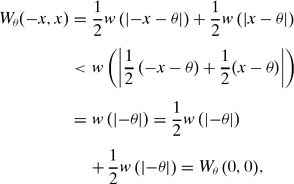
where the inequality follows from strict concavity of w(| ċ |). Now consider the case where departures from the median are asymmetric, xL ≠ −xR, and suppose without loss of generality that party L is closer to the median, 0 < |xL| < |xR|. Then party L wins, and voter θ's welfare is

Then, by definition of the median, W θ(0, 0) > W θ(xL, xR) for a strict majority of voters θ. Obviously, if one party locates at the median, then that party wins, and each voter θ's welfare W θ(xL, xR) coincides with W θ(0, 0). We summarize this discussion in the following result: Platform divergence from a known median policy always hurts a majority of voters.
Proposition 1.Assume that parties know the median policy. Then compared to platforms that converge to the median policy (i.e., xL = xR = 0):
1. Any other platform pair (xL, xR) symmetric around the median policy (i.e., with −xL = xR = x > 0) strictly reduces the expected welfare of all voters.
2. Any asymmetric pair (xL, xR) where neither party adopts the median policy (i.e., with xL ≠ 0 and xR ≠ 0) strictly reduces the expected welfare of a majority of voters.
3. Voter welfare is unchanged by any pair where at least one party adopts the median policy.
Henceforth, we consider a setting where the median voter is unknown to the parties at the time when campaign platforms are formed. We assume that the distribution of ideal points within the electorate is known up to a shift parameter, μ, which reflects a common shock to the electoral environment. For example, after platforms have been selected, a weakening economy may cause all voters to view an expansionary fiscal or monetary policy more favorably, or terrorist attacks may make all voters more willing to accommodate civil rights restrictions. More generally, voters may be initially uncertain about their preferences at the voting stage, and learn their preferences during campaigns via their exposure to information about issues.
We also allow for each voter v's preferences to be subject to an idiosyncratic shock, εv, to reflect the evolution of his or her personal views relative to those of the median voter; and consistent with a large electorate, we assume that there is no aggregate uncertainty in the realized distribution of idiosyncratic shocks. The arguments of this article all hold when idiosyncratic shocks are absent, but we include them because allowing for such shocks enhances the richness of the model at only a small cost in analytical difficulty. In fact, without ϵv, our model would imply that the bliss point of each voter v never moves relative to the median voter's bliss point μ, and voters whose initial views are to the left of the median will never revise their beliefs in a way that locates them to the right of the median. By including ϵv, we allow the political campaign process to change any particular voter v's political views relative to those of the median voter.
As is standard in the literature on Bayesian games, we model the location of the median voter as a random variable. Formally, we decompose the bliss point of a voter v as follows:

The term δv represents the ex ante location of voter v's bliss point relative to the ex ante median bliss point in the electorate. The empirical distribution of δv is given by a density h that is symmetric around zero with connected and bounded support. The common shock μ shifts all voters' bliss points in the same manner and is distributed according to a continuously differentiable density f that is symmetric around zero with connected support. Symmetry and differentiability imply that f′(0) = 0, and because the support of f is connected, we have f(0) > 0. Finally, εv is an idiosyncratic shock that may change the position of voter v relative to the median. We assume that εv is distributed independently of μ according to a symmetric density, g. With no aggregate uncertainty in the distribution of idiosyncratic shocks εv, the location of the median voter's bliss point is μ with probability one, even though the identities of the ex ante and ex post median voters differ with probability one. It follows that the median bliss point is distributed according to the density f. Accordingly, f(0) represents the likelihood that the median voter is perfectly centrist, or equivalently (when party platforms are symmetric), it is the likelihood of an electoral tie.
EX ANTE VOTER WELFARE: THE VALUE OF CHOICE
In this section, we establish that voters ex ante unanimously prefer divergence of party platforms, up to a welfare-improving threshold, to convergence to zero, the median of the density of the median bliss point. We then characterize the utilitarian optimum—the policies that maximize total ex ante voter welfare—and provide comparative static results with respect to the distribution of the median bliss point μ.
Given platforms (xL,xR), we obtain the ex ante expected welfare of voter v by integrating over the common shock μ to the electorate and the idiosyncratic shock εv. Parties do not see these shocks prior to choosing their platforms; therefore, their platforms are treated as fixed in the calculation of ex ante welfare. The outcome of the election does depend on voters' preferences, however, because the winner will be the party closest to the realized median. The ex ante welfare of voter v, denoted Wv(xL, xR), is defined formally as
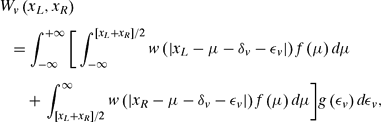
where the location of μ relative to the midpoint (xL + xR)/2 determines the winner of the election and, thereby, the realized policy outcome. If we view Wv(−x, x) as a function of x, then it is the integral of strictly concave functions and is therefore itself strictly concave. We now show that voters unanimously prefer some differentiation of parties symmetrically around the median of the median bliss point μ.
Proposition 2.There is a threshold policy  > 0 such that Wv(−x, x) > Wv(0, 0) for all voters v if and only if 0 < x < . That is, voters have a unanimous ex ante preference for symmetrically differentiated platforms (xL = −x, xR = x) over platform convergence at zero if and only if the platform x lies in the interval (0, ).
The Appendix contains the proofs of Proposition 2 and other results not proved in the text. At the beginning of the article, we discussed the special case where the median location μ may take two values, +1 and −1, with equal probability. We argued that every voter prefers the two parties locating symmetrically away from zero at a distance of one unit to convergence at zero. It is not obvious that this result extends to more realistic distributions of μ, such as the ones introduced in the previous section. Each voter v's utility at the election stage must be calculated for each realization of μ, and ex ante welfare is derived by weighting such utilities by f(μ).Footnote 3 To overcome this difficulty, the proof of Proposition 2 proceeds as follows. We first show that Wv(−x, x) strictly increasing in x at x = 0 for each voter v, so continuity and concavity yield a unique xv > 0 such that the voter is indifferent between the platform pair −xv, xv) and convergence at zero (i.e., Wv(−xv, xv) = Wv(0, 0)). We let > 0 be the minimum of xv over all voters,Footnote 4 delivering the threshold claimed in the proposition.
In sum, when the location of the median voter is unknown, some platform divergence benefits all voters. Convergent platforms cannot perfectly target the median policy, and introducing slight dispersion in party platforms, each party's platform targets the unknown median less accurately. Collectively, however, the platform closest to the realized median is more accurate, raising the ex ante welfare of the median voter. Then, as explained previously, it is the fact that each voter's bliss point is correlated with the median voter, together with the concavity of voter utility functions (so changes in policy far from a voter's bliss point have greater impact), that creates the scope for universal welfare gains. Provided platform divergence is bounded from above by the threshold, , divergence increases every voter's welfare. We conclude that the message of the Downsian model is fully reversed: Platform convergence hurts all voters.
Bernhardt, Duggan, and Squintani (Reference Bernhardt, Duggan and Squintani2009) describe a version of Proposition 2 in the special case where voter preferences are quadratic, the median bliss point is decomposed as μ = α + β, where α is uniformly distributed, β is a discrete random variable, and εv is degenerate. Under the quadratic form assumption of that article, the ex ante preference over symmetrically located platform pairs are identical across all voters; in particular, the welfare of any voter v only differs from the median voter's by the constant −δv2. Thus, once it is known that some platform divergence raises the welfare of the median voter, it follows that separation automatically raises the welfare of all other voters. The logic behind the result in Proposition 2 is deeper, as we establish that voters other than the median voter benefit from platform divergence, even when they do not share the same ex ante preferences.
To further elucidate the welfare properties of equilibrium platforms in the following sections, we conclude by considering the choice of party platforms by a utilitarian social planner. For clarity of comparison with the equilibrium, we assume the planner faces the same uncertainty as the parties, and because parties select symmetric platforms, we also constrain the choice of the planner to symmetric platforms. That is, the planner chooses platforms (xL, xR) such that −xL = xR = x*, so as to maximize the total ex ante welfare of voters,
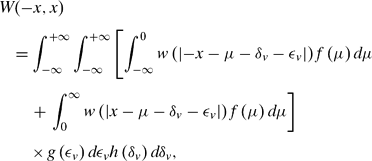
where we now integrate over voters to aggregate voter welfare.
The next result gives a first-order characterization of the utilitarian social optimum and shows that the socially optimal level of divergence in platforms increases when the distribution over the median grows more dispersed. This is intuitive: The social planner chooses (−x*, x*) to collectively target the median voter's location, so when the median is more likely to be further from zero, divergence must increase. We formalize the notion of increased dispersion by considering the density of μ conditional on μ ≥ 0, denoted f(ċ|μ ≥ 0); then the median is more likely to be extreme when f(ċ|μ ≥ 0) increases in the sense of first-order stochastic dominance.
Proposition 3.A benevolent utilitarian planner selects the platforms (−x*, x*), where x* is the unique solution to
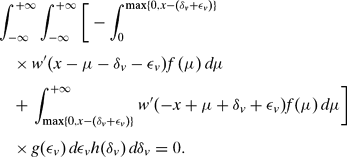
A first-order stochastic increase in the conditional distribution of the median f(ċ|μ ≥ 0), corresponding to an increase in the uncertainty about the median bliss point μ, induces an increase of x*.
We have already noted that the ex ante welfare Wv(−x, x) of each voter is a strictly concave function of x. The utilitarian welfare function W(−x, x) is simply the integral over voter welfare functions, and as the integral of strictly concave functions, it is also strictly concave. Thus, the utilitarian optimum x* is unique and characterized by the first-order condition in Equation (2).
EQUILIBRIUM ANALYSIS: RESPONSIBLE VS. OPPORTUNISTIC PARTIES
Until now, we have considered the properties of voter welfare divorced from an equilibrium analysis of how parties, in pursuit of given objectives, actually position themselves in elections. In this section, we provide conditions for existence and uniqueness of a symmetric equilibrium, along with a comparative statics analysis of equilibrium platforms, and we determine conditions under which voters prefer responsible parties to opportunistic, purely office-motivated ones. Our existence and uniqueness result holds, essentially, when the distribution of the median voter satisfies a standard monotone hazard rate condition. We find that all voters prefer responsible parties to opportunistic ones when parties are sufficiently ideologically polarized to differentiate their platforms, but not so polarized that platforms diverge by too much. We provide an explicit bound on the maximum equilibrium divergence between responsible parties as party preferences become more polarized, and we show that when parties are sufficiently polarized, office benefits can be used to achieve the socially optimal level of divergence.
It is known that in equilibrium, opportunistic parties choose platform x = 0, the median of the distribution of the median bliss point μ. We model responsible parties as having mixed policy and office motivations, à la Wittman (Reference Wittman1983) or Calvert (Reference Calvert1985). For expositional simplicity, we assume parties L and R have symmetric bliss points −ψ and ψ, respectively, so that ψ > 0 measures the degree of ideological polarization between parties. For simplicity, we assume that ψ 2 lies in the support of the distribution of the median (i.e., f(ψ/2) > 0). The party that wins office also receives a benefit b ∈ + ∪ {∞}. We focus on symmetric equilibria, with −xL = xR = x. Hence, if policy x is implemented, then the payoff of party L is w(| − ψ − x|) if it loses the election, and w(| − ψ − x|) + b if it wins; and the payoff of party R is w(| ψ − x|) if it loses the election, and w(|ψ − x|) + b if it wins. The case b = 0 captures purely policy-motivated parties, and b = ∞ represents purely office-motivated parties.
Parties maximize expected payoffs, and to ensure that these expected payoffs are single-peaked over the relevant range, we assume
(A1) For all μ ∈ [0, ψ/2],

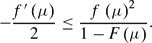
This condition is weaker than the assumption that the hazard rate,  , is weakly increasing on [0, ψ/2].Footnote 5 This monotone hazard property is shared by most common distributions, including normal, uniform, logistic, chi-squared, exponential, and Laplace distributions, as well as any distribution with an increasing density.Footnote 6 The condition is frequently assumed in the literature on industrial organization,Footnote 7 auction theory, and timing games, and it is used in work estimating conditional exit probabilities, where the condition is interpreted to mean that, conditional on survival to μ, the probability of exit is decreasing in μ.
To obtain the intuitive comparative statics that equilibrium divergence is increasing in polarization and uncertainty about the median voter, and decreasing in office benefit, we use
(A2) For all x ∈ (0, ψ),

We show in the Appendix that this condition is satisfied if the function w is a strictly increasing and strictly concave transformation of its derivative w′. Loosely speaking, the condition requires that w is “more concave” than w′. Assumption (A2) is reasonably weak, and indeed, we show that it is satisfied by all power loss functions w(|x|) ≡ −|x|α with α > 1; in particular, it is satisfied by the quadratic loss function w(|x|) ≡ −|x|2.
To characterize equilibrium platform choices as party ideologies, ψ, grow arbitrarily polarized, we use
(A3) Each voter's absolute risk aversion goes to zero for policies far from her bliss point, that is,
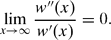
This weak restriction on the extent of voter risk aversion is satisfied by all power loss functions, w(|x|) ≡ −|x|α with α > 1, which exhibit constant relative risk aversion, 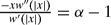 , a much stronger condition; in particular, it is satisfied by quadratic loss. In terms of risk preferences, (A3) requires that the voters become less concerned about hedging against small gambles over policies that are very remote from their preferred policies.
Next, we establish general conditions for existence and uniqueness of a symmetric equilibrium in the game between responsible parties,Footnote 8 and we characterize equilibrium platforms. We derive a threshold level of party polarization,  = w′−1(− bf(0)), such that if polarization lies below this threshold, then convergence at the median of medians is sustained as the unique equilibriumFootnote 9; and when polarization exceeds the threshold, equilibrium is characterized by the parties' first-order conditions, so we can derive comparative statics on the parameters that describe the environment. Viewed differently, we can construct a threshold level of office benefit,
 , such that above this level, responsible parties converge. Thus, our result complements the analyses of Wittman (Reference Wittman1983), who considers candidates who maximize a “weighted mandate” (151), and Calvert (Reference Calvert1985), who establishes a continuity result for responsible parties, but does not give conditions for existence or uniqueness, nor a characterization of equilibrium for the case of mixed motives. An implication of our result is that Calvert's (1985) “estimated medians” result for office-motivated parties (b = ∞) extends to the case of mixed motives as long as office benefits are sufficiently high.
Proposition 4.Under (A1), there exists a unique symmetric equilibrium (−x, x), and this equilibrium satisfies x ∈ [0, ψ). If |w′(ψ)| ≤ bf (0), then x = 0; and if |w′(ψ)| > bf(0), then x > 0 is the unique solution to

Adding (A2), if equilibrium platforms diverge (i.e., x > 0), then responsible parties adopt more extreme platforms as (1) ideological polarization ψ grows, (2) the likelihood f(0) of an electoral tie falls, or (3) office benefits b fall. That is,  .
The cutoff level of office benefit that determines when parties converge in Proposition 4 is easily understood in terms of marginal incentives. When both parties locate at zero, the marginal benefit of a small increase in party R's platform is  , reflecting the fact that party R wins approximately half of the time with a slightly preferred policy platform, and the marginal cost is
 , reflecting the marginal decrease in the probability that party R wins. Clearly, convergence at zero is supported in equilibrium if and only if the marginal benefit of a small deviation, −w′(ψ), is offset by the marginal cost, f(0)b (i.e., |w′(ψ)| ≤ bf(0)). When |w′(ψ)| > bf(0), equilibrium platforms are interior and are characterized by the parties' first-order conditions. Given platforms (−x, x), the marginal benefit to party R of moving to the right is
 , and the marginal cost is
![\[
\lbrack w(\psi\,\,-x)+b-w(x+\psi\,\, )]\frac{f(0)}{2}.
\]](https://static.cambridge.org/binary/version/id/urn:cambridge.org:id:binary:20151024011237888-0055:S0003055409990232_eqnU11.gif?pub-status=live)
Equating these two quantities yields Equation (3). Uniqueness follows because under (A1), the left-hand side of Equation (3) is strictly decreasing in x, so the first-order condition has at most one solution.Footnote 10
We now state a corollary that draws conditions under which the ex ante welfare of every voter is higher with responsible parties than with opportunistic ones, providing a formal case for responsible parties. From Proposition 2, there exists a threshold such that if the symmetric responsible party game equilibrium (−x, x) satisfies 0 < x < , then all voters prefer responsible parties to opportunistic parties that converge to zero in equilibrium. From Proposition 4, equilibrium platforms (−x, x) are characterized by the first-order condition (3) and satisfy x > 0 when |w′(ψ)| > bf(0). when |w′(ψ)| ≤ bf(0). A straightforward continuity argument then implies that when the latter inequality is close enough to holding, equilibrium platforms respect the threshold (i.e., 0 < x < ), and hence voters prefer responsible parties to opportunistic ones.
corollary 1.Under (A1), in equilibrium, voters have a unanimous ex ante preference for responsible parties over opportunistic ones if ideological polarization ψ is large enough relative to office benefits b and the likelihood f(0) of an electoral tie to induce responsible party platforms that separate, (−x, x) with x > 0, but ψ is not so large that parties diverge by too much, x > . In particular, responsible parties raise the ex ante welfare of all voters if −ε < bf(0) + w′(ψ) < 0 holds for sufficiently small ε > 0.
The comparative statics in Proposition 4 have natural interpretations. As one would expect, parties adopt more extreme platforms when they are more ideologically polarized or when the likelihood of a tight race decreases. For many symmetric distributions (e.g., normal, t, uniform), there is a one-for-one relationship between the likelihood of an electoral tie, f(0), and extent of uncertainty. In our electoral context, a reduction in uncertainty about the median voter's bliss point may reflect more precise polling information on voters' preferences, or an electoral design with a shorter political campaign—because there is then less time between political platform presentation and the election day for voter preferences to change—and the proposition indicates that platforms will diverge by less in such instances. Similarly, we predict that political platforms will diverge by less in polities in which the benefits of office (salary, length of term, other perquisites) are higher. The comparative statics analysis also has interesting implications for voter welfare. Proposition 2 together with the concavity of Wv(−x, x) provides the sign for the derivative with respect to the parties' platforms when they do not diverge by too much. For all policies close to zero, we have  . By Proposition 4, using the chain rule, we therefore have

for all such x and all voters v. Thus, perhaps counterintuitively, we find that a small increase in the level of party polarization can actually raise the welfare of all voters. To construct a global picture of the effect of ideological polarization on voter welfare, we start from ideologically identical parties (i.e., ψ =0). A small increase in party polarization has no effect because it is not sufficient to induce equilibrium platform differentiation (i.e., we still have |w′(ψ)| < bf(0)). Past the threshold level ≡ w′ −1(−bf(0)), equilibrium platforms diverge, and small increases in ψ raise all voters' welfare up to a second threshold  , the value at which party R's equilibrium platform is too far from the ex ante median. Past this point,
 and the concavity of Wv(−x, x) imply that further increases in ψ hurt some voters in the ex ante sense.
Proposition 4 also reveals the limiting properties of equilibria in the game between responsible parties as the model parameters b, f(0), and ψ range over their domain. As stated previously, platforms converge at zero when office benefits are sufficiently great, b ≥  ≡ f(0)/|w′ (ψ)|; and x > 0 is the unique solution to equation (3) when b = 0. It follows that platforms must become arbitrarily close to the convergent platforms offered by opportunistic parties as the likelihood of an electoral tie grows. Even when b = 0, Equation (3) demands x → 0 as f(0) → ∞. Conversely, w′(ψ − x) → 0 as f(0) → 0, implying x → ψ; without the possibility of a centrist median voter to draw them inward, the parties pull their platforms to their bliss points.
Finally, while the intuition behind the finding that greater polarization implies greater dispersion between equilibrium parties is straightforward, the maximum extent of this dispersion is less clear. The next result establishes that as parties become arbitrarily polarized, the distance between their equilibrium platforms remains bounded and converges to  . Interestingly, this limiting dispersion is independent of office benefits and does not rely on a specific functional form for voter utilities. In particular, it indicates that the effects of polarization on platform divergence are mitigated when the election is likely to be close (i.e., when f(0) is large). Furthermore, it implies that we must allow = ∞, in case the responsible party equilibrium platform x is bounded as a function of party polarization.
Proposition 5.Under (A1) and (A3), as party polarization grows large (i.e., as ψ → ∞), the divergence between equilibrium platforms (−x, x) approaches 1/f(0) (i.e., 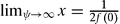 ).
An implication of Corollary 1 is that there is always (for all values of the other parameters) a range of office benefits for which responsible parties increase voter welfare. This raises the following questions: What level of office benefits underlies the responsible party equilibrium that maximizes total welfare? Is it possible to achieve the first best?
The next result uses the bound on platform divergence from Proposition 5 to provide a broad answer: If parties are sufficiently ideologically polarized, then one can obtain the socially optimal policy platforms x* via an appropriate choice of office benefits b*; otherwise, the optimal office benefit is b* = 0, but responsible parties still generate greater social welfare than opportunistic ones. Furthermore, we obtain comparative statics on the optimal office benefit with respect to model parameters.Footnote 11
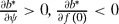
Proposition 6.Assume (A1) and (A3). Suppose that the socially optimal platforms do not diverge too much, specifically,  , and that the level of ideological polarization ψ is sufficiently large. Then there is a level of office benefit b* that achieves the socially optimal platforms (−x*, x*) in the responsible party equilibrium. Adding (A2), the optimal office benefit b* increases as (1) party polarization ψ rises and (2) the likelihood of an electoral tie drops (i.e., f(0) falls), or (3) the social optimum x* falls. That is,
 , and
 . When
 , or ψ is not sufficiently large, the optimal office benefit b* is zero and 0 < x < x*: The first best is not achieved in the responsible party equilibrium, but responsible parties still generate greater social welfare than opportunistic ones.
Thus, ideological polarization creates the scope for obtaining the first-best platforms by an appropriate choice of office benefit. To see how the social optimum can be achieved, recall from Proposition 5 that in equilibrium,  as polarization ψ increases. In particular, setting b = 0, when
 exceeds the social optimum x*, there exists ψ0 such that party R's equilibrium platform exceeds the social optimum (i.e., x 0 > x*). When parties are sufficiently ideologically polarized (i.e., ψ > ψ0), our comparative statics imply that equilibrium divergence increases so that x* < x. We can then increase office benefits in a continuous fashion until x = x*, and we conclude that a social planner can adjust office benefits to maximize social welfare. This positive result contrasts with the findings of Bernhardt, Duggan, and Squintani (Reference Bernhardt, Duggan and Squintani2009), who study platform separation induced by purely opportunistic parties that receive private information (through polling) about the actual location of the median voter. They find the negative result that privately informed opportunistic parties can never induce as much platform separation as is socially desirable.
The comparative statics in Proposition 4 are intuitive. For example, if polarization increases, then Proposition 4 implies that party R's platform increases, since  , and office benefits should then increase to compensate, since
 . Hence, office benefits should be higher in districts or societies characterized by more polarized political competition. Furthermore, recall from Proposition 3 that a first-order stochastic increase in the conditional distribution of the median f(ċ|μ ≥ 0) raises the social optimum x*. Proposition 4 implies that if the spread of the distribution of μ increases (holding f(0) constant), then the optimal level of dispersion between the parties grows (i.e., x* increases). It follows that the optimal level of office benefit decreases: Office benefits should be decreased when there is greater uncertainty about the location of the median voter. Alternatively, if the likelihood f(0) of an electoral tie increases holding x* constant, then b* decreases, and we conclude that office benefits should be higher when the election is more likely to be close.
QUADRATIC LOSS AND NORMALLY DISTRIBUTED MEDIAN
In this section, we specialize our general model by imposing added structure on voter and party loss functions, and on the distribution of the median bliss point. This allows us to develop insights and to obtain closed-form solutions for expressions we have characterized previously. Importantly, we find that in the canonical setting where loss functions are quadratic and the distribution of the median bliss point is normal, responsible parties always (weakly) improve the ex ante welfare of all voters, with strict welfare gains for all voters as long as party polarization is high enough relative to the ratio of office benefits to the variance of the median bliss point.
We first assume
(A4) Voters and parties have quadratic utility (i.e., w(|x|) = −x 2) for all x.
With (A4), we obtain closed-form solutions for the socially-optimal platforms and the responsible party equilibrium locations. We then add the condition that the median bliss point μ is normally distributed, which allows us to sharpen our results and derive the impact of the variance of μ on equilibrium platforms and the optimal office benefit:
(A5) The median bliss point μ is normally distributed with mean zero and variance σ2. For all μ, we have
.
 .
The next lemma reveals that with quadratic preferences, all voters have the same ex ante ordering over symmetric platform pairs, rendering welfare comparisons unambiguous. The socially optimal platform pair, (−x*,x*), maximizes the ex ante welfare of each voter. The result applies, in particular, to symmetric equilibrium platforms of the game between the parties.Footnote 12
lemma 1.Under (A4), each voter v's ex ante utility from symmetric platform pairs (−x, x) equals the ex ante utility of the ex ante median voter minus the constant δv2:

It follows that the social welfare function, W(−x, x), also differs from the ex ante welfare of the median voter by a fixed amount (the variance of δv), and we may therefore cease to distinguish the welfare functions of individual voters from the social welfare function. Up to a constant, we now have

Viewing the integrand as a quadratic function of the random variable μ − ε, we use mean variance analysis to rewrite voter welfare as
![\begin{eqnarray*}
W(-x,x) & = & -[(x-E[\mu-\epsilon|\mu >0])^{2}\\
&& -\, V[\mu-\epsilon|\mu >0].
\end{eqnarray*}](https://static.cambridge.org/binary/version/id/urn:cambridge.org:id:binary:20151024011237888-0055:S0003055409990232_eqnU15.gif?pub-status=live)
In particular, W(−x, x) obtains a maximum at

where the final equality follows because μ and ε are independently distributed, and E[ε] = 0. Because W(−x, x) is quadratic and hence symmetric around x*, we further obtain that the unique solution to the indifference condition W(0, 0) = W(−, ) is = 2x*. Thus, we have an explicit expression for the threshold from Proposition 2; therefore, all voters ex ante prefer divergent platforms (−x, x) to convergent platforms (0, 0) if and only if 0 < x < 2x*. This discussion is summarized next.
Proposition 7.Under (A4), the symmetric platform pair (−x, x) that maximizes the ex ante welfare of all voters is x* = E[μ ∣ μ > 0]. Thus, shifting policy platforms out up to x = E[μ ∣ μ > 0] increases voter welfare, but further outward platform shifts past E[μ ∣ μ > 0] reduce voter welfare. Furthermore, voters have a unanimous ex ante preference for the platform pair (−x, x) over the convergent platform pair (0, 0) if and only if 0 < x < 2E[μ ∣ μ > 0].
According to Proposition 7, the social optimum coincides with the expected median, conditional on μ ≥ 0. This result refines Proposition 3, which shows that the social optimum x* must increase when the conditional distribution of the median increases in the sense of first-order stochastic dominance. Such an increase implies an increase of E[μ ∣ μ ≥ 0], but the opposite implication does not hold. Indeed, the result that x* = E[μ ∣ μ > 0] makes it possible to determine the effect of any change in the distribution of μ, including changes that are not comparable in first-order stochastic dominance. In particular, adding the condition (A5) that μ is normally distributed, the social optimum x* simplifies to the standard deviation σ of μ times a constant:  (Johnson and Kotz Reference Johnson and Kotz1970). For future use, we note that
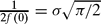 , from which it follows that

To determine the precise conditions under which responsible parties raise the voter welfare, we must first sharpen our equilibrium characterization. Next, we use the structure of quadratic utilities from (A4) to solve the first-order condition (3) in Proposition 4, yielding a closed-form expression for responsible party equilibrium platforms. Furthermore, we refine this result by adding (A5) to show that x is an increasing function of the standard deviation σ of μ. In particular, x = 0 when  , and x approaches ψ as σ → ∞.
corollary 2.Under (A1) and (A4), the unique symmetric equilibrium (−x, x) is as follows: If  then x = 0; and if
 , then
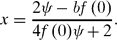
Adding (A5), if  , then x = 0; and if
 then
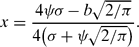
For responsible parties to raise voter welfare, they must be sufficiently ideologically polarized to differentiate their equilibrium platforms (i.e.,  ), but not so polarized that party R's equilibrium platform
 exceeds 2E[μ ∣ μ > 0]. This latter condition simplifies depending on two cases: In case
 , it becomes

whereas in case  , the condition always holds because party R's equilibrium platform is bounded above by
 . Importantly, using Equation (4), we see that this second case obtains whenever the median bliss point is normally distributed. Thus, for a wide class of model specifications, the case for responsible parties is very strong. Voters always weakly prefer responsible parties to opportunistic ones, strictly so if the parties provide any platform divergence.
Proposition 8.Assume (A1) and (A4). In case  , voters have a strict unanimous ex ante preference for responsible parties over opportunistic ones if and only if

whereas in case  , as under (A5), responsible parties generate strictly greater ex ante welfare for all voters than opportunistic parties if and only if
 (i.e., if
 under (A5)).
We conclude by reconsidering the issue of optimal institutional design. Returning to Proposition 4, the critical condition  reduces to
 . This condition is permissive. Using Equation (4), it is always satisfied under the normality assumption (A5). Assuming the condition holds, Proposition 6 dictates that the socially optimal platforms can be achieved by the appropriate choice of office benefits. We equate the first-best platform x* = E[μ ∣ μ ≥ 0] with the responsible party equilibrium platform
 and solve to obtain

In particular, responsible parties can achieve the first-best platforms x* in equilibrium whenever b* > 0. In this situation, differentiation reveals that  , and
 . Intuitively, the optimal level of office benefits b* increases to offset the centrifugal effect when parties become more ideologically polarized, the likelihood of a close election decreases, or the uncertainty about the median bliss point decreases.
Adding (A5) sharpens these results. The optimal office benefit takes the simple form

Differentiation reveals that b* increases in σ, the standard deviation of μ, for  , but it decreases in σ for σ >
 . In sum, an increase in the variance of μ—due to increased polling noise or increased voters' uncertainty about their preferences—has a nonmonotonic impact on the optimal office benefit. This result reflects that increasing σ both decreases f(0), which increases b*, and increases E[μ ∣ μ > 0], which reduces b*.
CONCLUDING DISCUSSION
We conclude by discussing the empirical relevance of our analysis. We begin by describing the facts substantiating our analytical framework. Our starting point is the Downsian framework, where voters vote according to well-defined ideological preferences on the left–right spectrum. Although criticized in classical work such as the American Voter (Campbell et al. Reference Campbell, Miller, Converse and Stokes1960), Converse (Reference Converse1962, Reference Converse and Ernest Apter1964), and several subsequent contributions, the assumption of issue preference voting has found strong empirical support (see, e.g., Key Reference Key1966, Page and Shapiro Reference Page and Shapiro1992, Achen Reference Achen1975, and, more recently, Ansolabehere, Rodden, and Snyder Reference Ansolabehere, Rodden and Snyder2008, and Jessee Reference Jessee2009a, Reference Jessee2009b).
The key point of departure of our model and those of Calvert (Reference Calvert1985) and Wittman (Reference Wittman1983) from the classical Downsian framework are the following assumptions:
• Parties have mixed motives, caring about both the direct benefits of winning office and the policies implemented by the winning party.
• When parties/candidates choose platforms, there is substantial uncertainty about the preferences over issues that voters will hold on election day.
The first assumption is hardly contentious. After all, Republican candidates systematically present platforms to the right of Democratic candidates. Many researchers have documented this separation (e.g., Budge et al. [Reference Budge, Klingerman, Volkers, Bara and Tanenbuam2001]; Klingerman et al. [Reference Klingerman, Volkers, Bara, Budge and McDonald2006], and Poole and Rosenthal [Reference Poole and Rosenthal1997]). This assumption constitutes one of the main differences between this article and Bernhardt, Duggan, and Squintani (Reference Bernhardt, Duggan and Squintani2009), where candidates are purely office motivated. In that article, the candidates, being ex ante identical, condition their choices of platforms on privately observed polling signals in the same way, so even in the pure strategy equilibria of that model, each candidate locates to the left or right of the other with equal probability. This is ruled out when candidates have policy motivations, unless the degree of ideological polarization is so small that it has no effect on party location. Furthermore, because office-motivated candidates can more easily find profitable deviations, they must be permitted to use mixed strategies to obtain general equilibrium existence in the framework of our previous article.
We now elaborate on our assumption that voters' election day preferences cannot be precisely predicted at the platform presentation stage. One can roughly decompose this uncertainty into two components: (1) the noise in the parties' assessments of voters' preferences at the platform presentation stage; and (2) the extent of uncertainty about the evolution in voter preferences after platforms are chosen, until election day.
The first source of uncertainty reflects factors such as the quality of information acquisition or polling available to parties. Although the craft of polling has improved significantly in recent years, there remains significant uncertainty in trying to determine voter participation rates of populations with different attributes. For example, there was substantial uncertainty over the participation rates of young and minority voters in the 2008 presidential election—and, to the extent that such groups are more liberal, their participation rates would influence the location of the median voter. So, too, uncertainty arises from trying to disentangle the impact of question wording on survey responses. Often, an apparently innocuous change in the ordering or wording of questions can induce dramatic changes in responses. Rugg (Reference Rugg1941) reports an early example, one replicated by Schuman and Presser (Reference Schuman and Presser1981): Approximately 20% more people were willing “not to allow” public speech against democracy in the U.S., than were willing to “forbid” public speech against democracy. Schuman and Presser also found that the mere order of possible alternatives in questions can induce response changes on the order of 20%. These results have been widely replicatedFootnote 13 and suggest that voters' preferences are hard to predict.
The second source of uncertainty about voters' election day preferences is generated by the uncertain evolution of voters' preferences after platforms have been chosen. Indeed, presidential and congressional campaigns last for several months, providing ample time for voters' preferences to change significantly in unpredictable ways.Footnote 14 For example, whether most voters will eventually prefer a monetary expansionist policy may depend on new data on the unemployment vs. expected inflation trade-off. Similarly, whether a majority of voters will favor a preemptive war may hinge on new facts regarding the seriousness of the military threat posed by an enemy country. This source of uncertainty is consistent with the possibility that the relative distribution of preferences in the electorate is known quite well to the parties, so that each voter's percentile in the distribution of bliss points may be stable. The key is that the voters' preferences over fixed policy platforms on election day will depend on unpredictable aspects of the political and economic environment. Thus, the stability of the location of the median bliss point reported by Merrill and Grofman (Reference Merrill and Grofman1999) and Adams, Merrill, and Grofman (Reference Adams, Merrill and Grofman2005) in the American National Election Studies data may simply suggest that respondents placed themselves on a relative, rather than absolute, scale.Footnote 15
The unpredictable evolution of voters' preferences during election campaigns is largely determined by voters forming their own preferences during the campaign process. There is significant evidence that voters are initially uncertain and ambivalent on issues, and learn or refine their election day preferences as they are exposed to campaign information.Footnote 16, Footnote 17 The literature on deliberative polling (see, e.g., Fishkin Reference Fishkin1997, Reference Fishkin2009, and Luskin, Fishkin, and Jowell Reference Luskin, Fishkin and Jowell2002) provides direct experimental evidence that voters significantly update preferences on the basis of the information to which they are exposed, with opinion changes in the range of 10%–21% (the National Issues Convention). Gilens (Reference Gilens2001) finds similar impacts on survey outcomes when respondents are provided policy-relevant information. The related experimental and empirical literature on priming (see, e.g., Iyengar and Kinder Reference Iyengar and Kinder1987) further documents the impact of exposure to information on political preferences. Further evidence for our learning hypothesis is provided by the finding that information is statistically related with opinions on issues in surveys such as the National Election Studies (see Althaus Reference Althaus1998, Bartels Reference Bartels1996, Gilens Reference Gilens2001, and Zaller Reference Zaller1992).
Having discussed the empirical validity of the model, we turn to discuss the normative and positive implications of our analysis. On the normative front, the primary message of the article is contained in Corollary 1, which outlines conditions under which responsible parties raise voter welfare: As long as parties are not too ideologically polarized, the pursuit of policy objectives by political parties does not hurt voters in expectation, and if parties are at all distinct, divergence will help all voters. This message is strengthened in Proposition 8, which shows that in a wide class of models, policy motivation always weakly improves the welfare of all voters. Our comparative statics reveal, perhaps surprisingly, that voter welfare is single-peaked in party polarization because some ideological distinction between the parties can serve to pull the parties apart; however, it may be that too much polarization creates too much divergence, eventually hurting all voters. Office benefits and the likelihood of a tight election have the opposite effect on voter welfare: For example, increasing office benefits from zero draws the parties together, and this can initially raise voter welfare, but further increases eventually produce platform convergence and result in lower voter welfare.
Proposition 3 shows that optimal platform divergence increases as the uncertainty over voters' election day preferences increases. This observation bears important implications. For example, to the extent that more resources are spent on polling in more developed countries, our results prescribe that parties' platforms should diverge by more in less developed countries. We also prescribe greater platform divergence with more heterogeneous populations (e.g., populations featuring more income inequality [see McCarty, Poole, and Rosenthal Reference McCarty, Poole and Rosenthal2006], greater racial diversity, or less homogeneous age or urban/rural composition) because greater heterogeneity makes it harder to predict participation and hence the median voter. Arguably, we provide stronger prescriptions when comparing local elections in different U.S. states, where the sources of heterogeneity are more limited. For example, platform divergence should be similar in states with similar demographics and similar campaign lengths and polling expenditures. We observe that Shor (Reference Shor2009a, Reference Shor2009b) documents a wide variation in roll call vote divergence between different states' chambers. This suggests the possibility of a loss in voter welfare due to excessive platform divergence in some states and/or to excessive convergence in others.
Whether party platforms in U.S. politics should have become more or less convergent in recent decades is less clear. Although polling technology improvements suggest that issue preference uncertainty may have decreased, presidential and congressional campaigns have also become progressively longer over the years since 1945, giving more time for voters' preferences to shift between the platform presentation stage and election day. These offsetting effects suggest that platform divergence should not have significantly changed over time. However, there is strong evidence that Congress has grown progressively more polarized (McCarty, Poole, and Rosenthal Reference McCarty, Poole and Rosenthal2006) since 1945, and weaker evidence of a polarization trend in presidential platforms (Budge et al. Reference Budge, Klingerman, Volkers, Bara and Tanenbuam2001; Klingerman et al. Reference Klingerman, Volkers, Bara, Budge and McDonald2006). Hence, a normative analysis might suggest that party platforms may have been too convergent in the 1940s (spurring the Manifesto on Responsible Parties), and are too polarized today (as is often claimed by the popular press and by academics such as McCarty, Poole, and Rosenthal Reference McCarty, Poole and Rosenthal2006).
Having discussed normative implications, we turn to the positive predictions of our equilibrium analysis of responsible parties. By Proposition 4, platforms diverge more when office benefits decrease, when ideological polarization increases, and when uncertainty about voters' preferences increases. This last prediction has important implications for welfare: Both responsible party equilibrium platforms and socially optimal platforms should diverge more when votersã preferences are more uncertain. In this way, the responsible party system embeds a åself-correctingô mechanism. That is, equilibrium platforms tend to change in accordance with changes in socially optimal platforms as votersã uncertainty changes. We also predict that because more heterogeneity in voter demographics (e.g., greater racial diversity, urban/rural composition, age composition, income inequality) presumably gives rise to greater party uncertainty about the ultimate views of the median voter, plausibly reinforced by greater ideological polarization, more heterogeneous polities will feature greater platform divergence. Another positive implication of our analysis is that party platforms should converge more in polities where office benefits are higher. Plausibly, office benefits are larger in larger polities. But the resulting platform convergence effect may be dominated by the platform divergence effects induced by greater heterogeneity in voter demographics.
The challenges to formal testing of these predictions are many. Although one can order the extent of uncertainty in voter preferences across districts (e.g., uncertainty is greater in more heterogeneous districts), estimating levels of uncertainty may be very difficult. This suggests that estimation should exploit relative comparisons across districts. However, even relative comparisons are complicated by the many cross-district sources of heterogeneity in voter preferences, office benefits, and party ideologies. For example, gerrymandering of district boundaries can give rise to extensive district heterogeneity (so that in some districts, the primary becomes the relevant election). This suggests that a more fruitful venue for testing might be in municipal elections, where the sources of “cross-district” heterogeneity are fewer and easier to measure. Furthermore, assessing real office benefits beyond office holder salaries presents challenges in and of itself (see, however, Diermeier, Keane, and Merlo Reference Diermeier, Keane and Merlo2005).
Although difficult to test, the relationship between equilibrium party platforms and party ideology is key for the understanding of our analysis of responsible parties' behavior. Indeed, extremization of party ideology may underlie the platform divergence over time that we previously discussed. Our analysis shows that excessive platform divergence can harm the electorate. Although we have concluded that under reasonable assumptions, responsible parties are always preferable to opportunistic ones, our analysis also shows that to maximize voters' welfare, responsible parties should not be too ideologically polarized. A call for moderation of ideologies may be germane in the current political arena, broadly characterized by a strong dichotomy between ideologically extreme groups that tend to pull party platforms far apart.
APPENDIX: PROOFS OF PROPOSITIONS
Proof of Proposition 2.] Consider the ex ante welfare of any voter v with bliss point δ relative to the median voter:
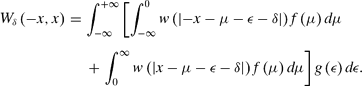
Differentiating with respect to x, yields

Define
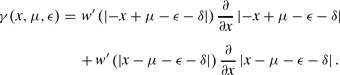
Hence, because we integrate over the positive reals, μ > 0, there are three cases:
Case 1: μ − δ − ε > 0 and − μ − δ − ε > 0. Then |μ − δ −ε| > | − μ − δ − ε|, because μ > 0, and γ(0, μ, ε) = −w′(|μ − ε − δ|) + w′(| − μ − ε − δ|).
Case 2: μ − δ − ε > 0 and − μ − δ − ε < 0. Then γ(0, μ, ε) = −w′(|μ − ε − δ|) −w′(| − μ − ε − δ|).
Case 3: μ − δ − ε < 0 and − μ − δ − ε < 0. Then | − μ − δ − ε | > |μ − δ − ε|, because μ > 0, and γ(0, μ, ε) = w′(|μ − ε − δ|) −w′(| − μ − ε − δ |).
In all cases, w′ < 0 and w″ < 0 imply γ(0, μ, ε) > 0.
Let Δ be the closure of the support of h. We have shown  for all δ. Then min{x ≥ 0 ∣ W δ(−x, x) = W δ(0, 0)} is positive, and as W δ(−x, x) is strictly concave in x, it is continuous in δ. Thus, it attains a minimum, > 0, on the compact set Δ. Given δ ∈ Δ, concavity of W δ(−x, x) then implies that W δ(−x, x) > W δ(0, 0) if and only if x ∈ (0, ).
Proof of Proposition 3. By differentiating Equation (1), we obtain

Setting this equation to zero, we recover Equation (2). By Proposition 2, the solution x* of Equation (2) is strictly greater than zero.
Consider a first-order stochastic increase from f(ċ ∣ μ ≥ 0) to  , and let x* and
 * be the associated social optima. For any fixed x,
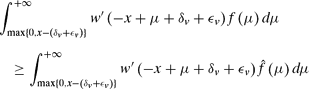
as w′ < 0, w′(|y|) is decreasing in y due to concavity of w, and  . Furthermore,
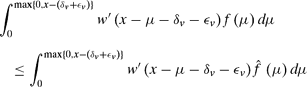
for the same reason, and at least one of the inequalities is strict, as  , for some μ. Hence, it must be that
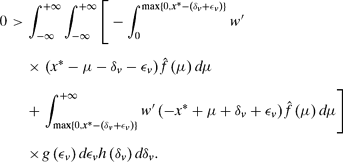
Viewing the right-hand side of Equation (5) as a function of x, observe that it is increasing in x, as both
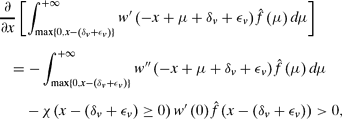
where χ(x − (δv + εv) ≥ 0) equals one if the inequality x − (δv + εv) ≥ 0 holds and equals zero otherwise, and
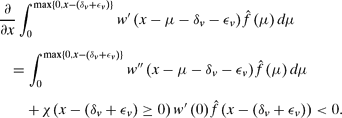
It follows that to restore equality, x must increase (i.e., * > x*).
Proof of Sufficient Conditions for (A2). Letting y = ψ − x, (A2) is implied by
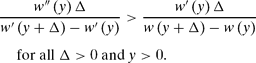
Let f = w′ and g = w, and suppose that g(y) = h(f(y)), where h is a strictly increasing, strictly concave function. Note that

where the first proportionality sign follows from f′(y) = w″(y) < 0, the third equality follows letting δ = f(y) − f(y + Δ) > 0, and the last proportionality sign follows because h(f(y) − δ) − h(f(y)) < 0. Hence, condition (6) is equivalent to h(f(y)) − h(f(y) − δ) > h′(f(y)) Δ, which is implied by strict concavity of h. We conclude that condition (A2) is satisfied if the function w is a strictly increasing and strictly concave transformation of its derivative w′.
To show that condition (A2) is satisfied by all power loss functions w(|x|) ≡ −|x|α, with α > 1, we cannot use the previous result because w is not necessarily a strictly increasing and strictly concave transformation of its derivative w′. Thus, we define  (|x|) ≡ −w(|x|) = |x|α. Noting that = −w, ′ = −w′ and ″ = −w″, condition (6) is equivalent to
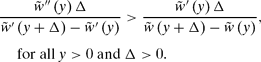
Similar to the previous result, we let f(x) ≡ ′(|x|) = α |x|α−1 and g(x) ≡ (|x|) = |x| α, and we note that g(x) = h(f(x)), where the function  is strictly increasing, and strictly convex. We obtain

where the first proportionality sign follows from f′(y) = ″(y) > 0, the third equality follows letting ρ = f(y + Δ) − f(y) > 0, the second proportionality sign follows from h(f(y) + ρ) − h(f(y)) > 0, and the last inequality follows because h is strictly convex.
Proof of Proposition 4. Given locations xL < xR, party R wins the election whenever μ > [xL + xR] /2, so party R wins with probability 1 − F([xL + xR] /2). Given xL = xR, party R wins with probability one half, creating a payoff discontinuity. Suppose that L chooses a location −x < 0. Because ψ ≥ 0 (i.e., the bliss point of R is positive), party R will never choose a location xR < −x. Hence, party R maximizes
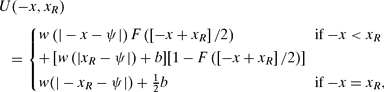
which is differentiable whenever −x < xR or −x = xR = 0. Differentiating, we obtain
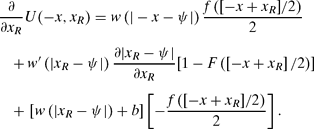
We first establish that the platform xR maximizing U(−x, xR) is such that xR ≤ ψ. In case xR > ψ define x′ = min{x, ψ}, and note that F([−x + xR]/2) ≤ 1/2 and

Furthermore, w(ψ − x′) + b > w(x + ψ), and either F([−x + xR]/2) > F([−x + x′]/2) or F([−x + xR]/2) < 1. We conclude that U(−x, x′) > U(−x, xR), so xR is not a maximizer, as claimed.
We now show that given x ∈ [0, ψ], there is at most one solution to the first-order condition  on the interval (−x, ψ] (or on [−x, ψ] if −x = 0), and if there is one, then it is the unique maximizer of U(−x, xR) on (−x, ψ] (or on [−x, ψ] if −x = 0). Consider

Rewriting the first derivative as

we substitute the first-order condition into the second derivative to obtain

where the last inequality follows from (A1). We have shown that every solution to the first-order condition satisfies the second-order sufficient condition for a strict local maximizer. Therefore, by continuity, the solutions are locally isolated. Consider any such solution x 1, and if x 1 is not unique, suppose there is a solution greater than x 1. Because the set of solutions is compact, we may choose x 2 to be the next solution (i.e., if y solves Equation (3) and y < x 2, then y ≤ x 1). Assume without loss of generality that U(−x, x 1) ≥ U(−x, x 2). Because x 2 is a strict local maximizer, it follows that min{U(−x, y) ∣ y ∈ [x 1, x 2]} < U(−x, x 2). But then this minimum must be achieved at some y ∈ (x 1, x 2), and y must solve the first-order condition, a contradiction. Therefore, there is at most one solution to the first-order condition; and if there is a solution, then a similar argument implies that it is the unique maximizer, as claimed.
We next claim that given x ∈ [0, ψ], there is a unique best response r(x) to −x restricted to [0, ψ] for party R. That is, there is a unique policy xR ∈ [0, ψ] such that for all y ∈ [0, ψ], we have U(−x, xR) ≥ U(−x, y). Existence follows from continuity. To prove uniqueness, suppose y and y′ are distinct best responses restricted to [0, ψ]. Then y, y′ ∈ {0, ψ}, for if y ∈ (0, ψ), then y satisfies the first-order condition and, by the previous argument, is the unique best response for party R. Thus, 0 and ψ are both best responses restricted to [0, ψ]. But then U(−x, ċ) achieves a minimum, say y, on [0, ψ], but then y satisfies the first-order condition and is the unique best response, a contradiction that establishes the claim.
That the mapping r: [0, ψ] → [0, ψ] so defined is continuous follows directly from an application of the theorem of the maximum. By Brower's theorem, r admits a fixed point, say x, and we claim that (−x, x) is a symmetric equilibrium. By symmetry of the parties, arguments for party R can be modified to fit party L, so we need only show that party R cannot deviate profitably to a platform y such that −x ≤ y < 0. In particular, we are concerned with the case x > 0. If x ∈ (0, ψ), then as a local maximizer, it satisfies the first-order condition and, by the previous arguments, is a best response over the interval (−x, ψ]. If x = ψ, then there cannot be a better response y < 0, for otherwise U(−x, ċ) achieves a minimum, say y, on [y, ψ], but then y satisfies the first-order condition and is the unique best response, a contradiction. Therefore, (−x, x) is indeed a symmetric equilibrium.
We now restrict attention to symmetric equilibria, imposing −xL = xR = x. The first-order condition characterizing a symmetric equilibrium (−x, x) with x ∈ (0, ψ) is
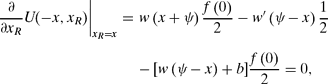
or equivalently,

Note that the left-hand side of Equation (7) is strictly decreasing in x, so it has at most one solution. Evaluated at x =ψ, the left-hand side of Equation (7) equals zero, so  , and we conclude that (−ψ, ψ) cannot be an equilibrium. We consider three remaining cases. If −w′(ψ)/b < f(0), then the left-hand side of Equation (7) evaluated at x = 0 is less than f(0), Equation (7) has no solution, and

so xR = xL = 0 is the unique symmetric equilibrium. If −w′(ψ)/b = f(0), then x = 0 is the unique solution of Equation (7), and (0, 0) is the unique symmetric equilibrium. Finally, if −w′(ψ)/b > f(0), then the left-hand side of Equation (7) evaluated at x = 0 is greater than f(0), while evaluated at ψ it is equal to zero and less than f(0). Therefore, by the intermediate value theorem, Equation (7) as a positive solution, which is unique and then characterizes the unique symmetric equilibrium.
Provided that x ∈ (0, ψ), the equation defining the equilibrium is

The comparative statics follow from the implicit function theorem:

where the inequality follows from (A2). Furthermore,
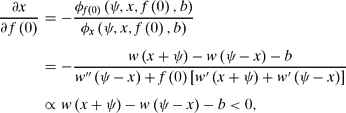
and, finally,
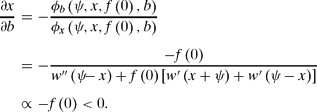
Proof of Proposition 5. As a first step, let z > 0 be arbitrary, and consider ψ > z. Then
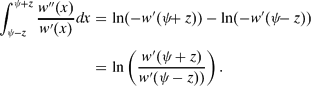
Because we assume w″(x)/w′(x) → 0 for all x ∈ [ψ − z, ψ + z] as ψ → ∞, this integral goes to zero; equivalently,

which implies w′(ψ + z)/w′(ψ − z) → 1. By concavity, we have
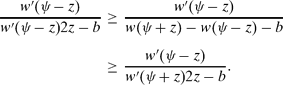
Dividing the numerator and denominator in the surrounding inequalities by w′(ψ − z), we then have

By assumption, b/w′(ψ − z) → 0 as ψ → ∞, and we have shown that w′(ψ + z)/w′(ψ − z) → 1, and, therefore,

We conclude that for all z > 0,

To prove the proposition, set  with η > 0 arbitrarily small, and note that

As we have previously shown, the equilibrium platforms of responsible parties with polarization ψ, say (−x(ψ), x(ψ)), solve

In particular, because the left-hand side of the latter equation is strictly decreasing in x, the foregoing analysis implies  for ψ sufficiently high. That is,
 , and because η > 0 is arbitrarily small, we conclude that
 . For the opposite inequality, set
 for η > 0 small, and note that

By a similar argument, it follows that  , for ψ sufficiently high, so
 . Because η is arbitrarily small, we conclude that
 . Combining these observations,
 .
Proof of Proposition 6. Let the symmetric equilibrium with ideological polarization ψ and office benefit b = 0 be (−x(ψ), x(ψ)). By Proposition 4 and the assumption that x* < 1/2f(0), we know that x(ψ) > x* for sufficiently high ψ. Given such a polarization level, Proposition 4 implies that the parties locate at 0 when b is sufficiently high, b ≥ −w′(ψ)/f(0). Because x* ∈ [0, x(ψ)], the intermediate value theorem yields b* ∈ [0, −w′(ψ)/f(0)] for which the symmetric equilibrium is (−x*, x*). Similar to the proof of the comparative statics results in Proposition 4, the optimal office benefit is the solution to the equation

By the implicit function theorem, we have
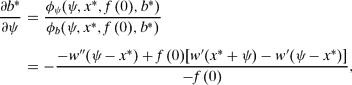
so we must argue that −w″(ψ-x*) + f(0)[w′(x* + ψ) − w′(ψ − x*)] > 0. This follows from
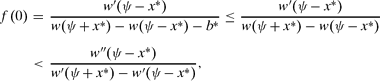
where the first equality uses φ(ψ, x*, f(0), b*) = 0, the second uses b* ≥ 0, and the third uses (A2). Furthermore,
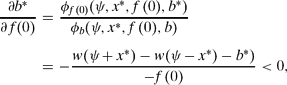
and, finally,
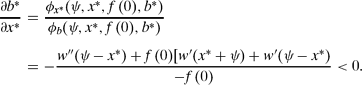
Proof of Lemma 1. The proof follows by straightforward manipulation:

 .



Comments
No Comments have been published for this article.