Introduction
Diplycosia Blume (Ericaceae) is a genus currently poorly represented in the Philippines in number of species. In his Flora Malesiana account Sleumer (1966–67) accepted only six species plus four varieties out of the 97 species known to him. Several of these Philippine species are only known from one or a very few collections. Only Diplycosia luzonica (A.Gray) Merr. is at all widespread, and indeed the genus as a whole is characterised by its endemicity with the majority of the species being known from only one mountain. Collections are poor because the small flowers attract little attention and are easily lost (Argent, Reference Argent2002). Fruits (including the accrescent calyx), which could provide additional characters, need to be described in the field as they do not press well.
In 2006, Conservation International-Philippines conducted a biological Rapid Assessment Program (RAP) expedition in the Mingan Mountains in the Central Sierra Madre in Luzon. Among the collected specimens was a Diplycosia that has proven to be a new species and is the first Diplycosia species to be added to the Philippine flora since Sleumer’s account.
Species Description
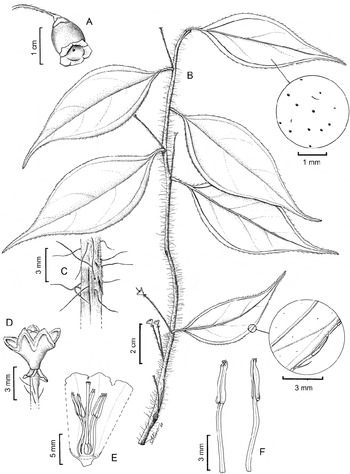
Diplycosia bartolomei Ferreras & Argent, sp. nov.Fig. 1.
Ab omnibus speciebus insularum philippinensium Diplocosiae cognitis combinatione setarum in caulibus longarum longitudine usque 5 mm instructarum et ad apicem foliorum sine glandulo terminali prominenti distincta. – Type: Philippines, Luzon Island, Aurora Province, Central Sierra Madre Mountains, Mt. Mingan, 15°27′59.87″N, 121°23′29.26″E, 4 vi 2006, U. Ferreras & N. Bartolome UF475 (holo PNH; iso E, L).
Diplycosia bartolomei Ferreras & Argent (UF475). A, flower (drawn from a photograph taken in the field); B, habit, with enlargements of the underside of the leaf and the leaf margin; C, close-up of the stem showing short hairs and bristles; D, pedicel apex with bracteoles, calyx and ovary; E, part of open corolla with anthers and pistil; F, stamens.

Epiphytic shrub c.1 m tall; stems covered in coarse, brown, contorted bristles variable in length but up to 5 mm long, sometimes with very short patent white hairs in the youngest part although these disappearing from older stems. Petiole 5–7 × c.1.25 mm, with long semi-appressed bristles which often persist for some time. Leaf blade elliptic, 35–65 × 20–30 mm, glabrescent above, punctate beneath with the remains of early caducous hairs; coriaceous, base cuneate, margin entire but with persistent appressed bristles along the edge, flat or very slightly and narrowly revolute, the apex acuminate to c.20 mm, narrowly acute, the extreme apex rounded and without a conspicuous terminal gland, midrib deeply impressed above and raised beneath, lateral veins obscure above and only faintly visible beneath, the smaller leaves with only a single very faint submarginal vein, larger leaves with up to 3 faint pinnate veins per side spreading at c.45° in addition to the faint submarginal pair which ascend to the base of the acumen. Flowers solitary, or paired, 5-merous; pedicels 20–25 mm, slender, less than 1 mm thick, somewhat densely covered with loosely appressed bristles. Bracteoles c.1.5 mm diameter, almost semicircular, the backs with occasional bristles and the edges glandular fimbriate. Calyx c.4 mm, the tube c.2.5 mm, the lobes broadly triangular, c.2.5 × 3 mm with dense brown glands around the margins, otherwise glabrous. Corolla campanulate, 12 × 10 mm, deep pink, glabrous both inside and out, the lobes broadly triangular, c.2.5 × 3.5 mm, reflexed. Stamens 10 mm, filaments linear, almost straight, glabrous, c.6 mm; anthers c.4.5 mm, finely echinulate, tubules c.1 mm, hooked at the apex. Disc glabrous; ovary glabrous; style c.8 mm, glabrous. Fruit not seen.
Distribution. Known only from the type locality.
Ecology. The type specimen was collected in a montane forest at 1637 m above sea level in gently sloping terrain. Dominant trees in the immediate vicinity include species of Engelhardtia Lesch. ex Blume, Syzygium Gaertn., Radermachera Zoll. & Moritzi in Zoll., Gynotroches Blume, Lithocarpus Blume, Adinandra Jack, Caldcluvia D.Don, Ascarina J.R.Forst. & G.Forst., Dacrydium Lamb., Elaeocarpus L. and Pittosporum Banks ex Gaertn. with a prevailing canopy height of 5–7 m.
Conservation status. Data Deficient (apparently rare).
Etymology. Named in honour of Mr Nestor A. Bartolome, a field botanist for Conservation International who contributed immensely to the success of the Mingan expedition and helped the first author set up the flora survey transects.
The type consists of three sheets all collected at the same time in the same locality, but only one of these has a single corolla remaining. There are traces of a fine short indumentum on some of the stems although no trace of this can be found on the very youngest growth. It is possible that these very short hairs are an artefact but further collections are needed to establish whether this species is variable in respect to this fine short indumentum. Presence or absence of this short indumentum is given considerable weight in Sleumer’s (1967) account but it is a difficult character to use unless collections are made of really young stems which then rarely have flowers attached.
This species keys in Sleumer (1967) with some difficulty to Diplycosia gracilipes J.J.Sm. from Sulawesi but, apart from the unlikely distributional pattern, that species has only occasional bristles on the stems and very differently shaped leaves with a conspicuous terminal gland which is lacking in the present species. It is distinct from all known Philippine species by the very long bristles on the stems (up to 5 mm) and the lack of a distinct thickened terminal gland. It most closely approaches Diplycosia trinervia Elmer but a comparison with the good isotype in (E) shows D. trinervia to have smaller leaves, with more distinct lateral veins and very pronounced terminal glands and much shorter pedicels. It lacks the bristles on the calyx lobes of Diplycosia loheri Merr. Diplycosia parvifolia Merr. is said to have 4-merous flowers which may or may not be a stable character (cf. D. paulsmithii Argent (Reference Argent2002) which is variable in this respect) and has fine hairs on the pedicels in addition to the bristles. Diplycosia luzonica (A.Gray) Merr., the most variable of the Philippine species, has serrulate leaf margins and much shorter pedicels. Diplycosia apoensis Elmer has very much shorter bristles on the stems and D. heterophylla Blume has no bristles at all.
Acknowledgements
The authors are grateful to Leonardo L. Co and Aloy Duya of Conservation International for the opportunity to participate in the RAP expedition. Thanks are also due to the teachers and staff of Nueva Ecija University of Science and Technology (NEUST) for their help and hospitality, M. Frank Dalin for his kind assistance and the DENR Regional Office for facilitating the release of the Gratuitous and Transport Permits.
We are also grateful to Dr Robert Mill for translating the diagnosis into Latin and to Aline Oliveira for drawing the illustration.