INTRODUCTION
Based on a world report on disaster risk reduction by International Strategy for Disaster Reduction (ISDR), Iran was located at the risk level of 8 from 10 with respect to the natural hazards,Reference Maini, Clarke, Blanchard and Murray1 the geographical location and topographic characteristics of the country, and the high vulnerability of the community to death and damages.Reference Ardalan, Holakouie Naieni and Honarvar2 Earthquake, flood, drought, landslide, and storms are regarded as the main natural hazards occurring in Iran,Reference Khankeh, Khorasani-Zavareh and Johanson3 among which flood constitutes about 32% of all natural disasters with various consequences.Reference Shabanikiya, Seyedin, Haghani and Ebrahimian4,Reference Seyedin, HabibiSaravi, Djenab and Hamedani5 Over 80% of cities in Iran are exposed to the occurrence of flood.
In April 5, 2019, when a high-congested rainfall system attacked the country, it resulted in creating heavy and simultaneous flooding in 5 provinces, which surprised all intersectional executive organizations related to crisis management in Iran.6 However, when the flood reached Haji-Abad – a village with a population of 600, located in a vast high plain between Kordkuy and Bandar Torkaman in Golestan Province – it could not claim losses as the village had already been protected by a well-fortified embankment having been constructed by the residents who were backed by the authorities.
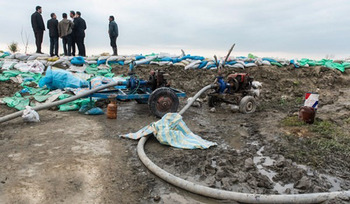
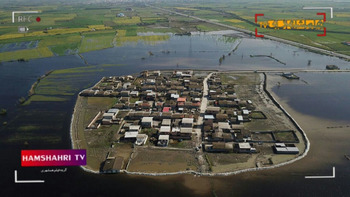
The idea of setting up a barrier emerged when, in the afternoon, everybody in the village could see from above the water approaching the village. The whole mitigation activities started from the evening and continued throughout the night and the next day. Non-governmental organizations (NGOs) from the Gomishan governor and from Iran's Road Maintenance and Transportation Organization provided the residents with 15 000 bags, large trucks of sand, and a considerable number of boots and shovels. To establish a dam, ditches were dug around the village on which levees were constructed. These were, in turn, fortified by bags filled with soil and sand by the people. Women came to help the men in the process of building the embankment. The crowd continued to install 3 water-discharging gasoline motors, which enabled them to drain the penetrating water. To make the embankment more sealed, large sheets of plastic were spread over the dam. Figures 1 and 2 show how the whole village had been surrounded by water like an island, but, ultimately, the flood almost failed to penetrate the village as a result of on-time mitigation measures. The purpose of this study was to scrutinize the factors that induced the successful flood mitigation measures made by Haji-Abad residents.
The Embankment Made of Bags of Mud and Sand Around Haji-Abad.

Result of Flood Mitigation Measures in Haji-Abad.

METHODS
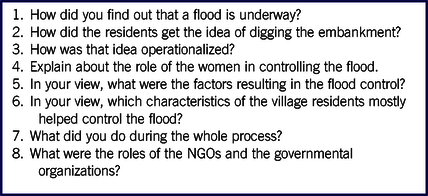
In this case study, reliable information was gathered from a variety of sources, including mass media documents and several telephone call interviews with the related Health House attendant (Behvarz) and the disaster liaison at Valaghouz Rural-Urban Healthcare Center, who were both residents of Haji-Abad as well. To help make the data-gathering processes more rigorous and unbiased, the researchers developed an interview guide (Table 1) prior to the interviews, recorded the interviews while simultaneously taking notes from the prominent points, and asked more questions in further interviews to learn about the details. The interview contents were transcribed, read, and edited several times. The resulting contents were then discussed with the interviewees for probable changes and editions. The final draft of the data was analyzed based on the thematic analysis technique.
The Interview Guide

RESULTS
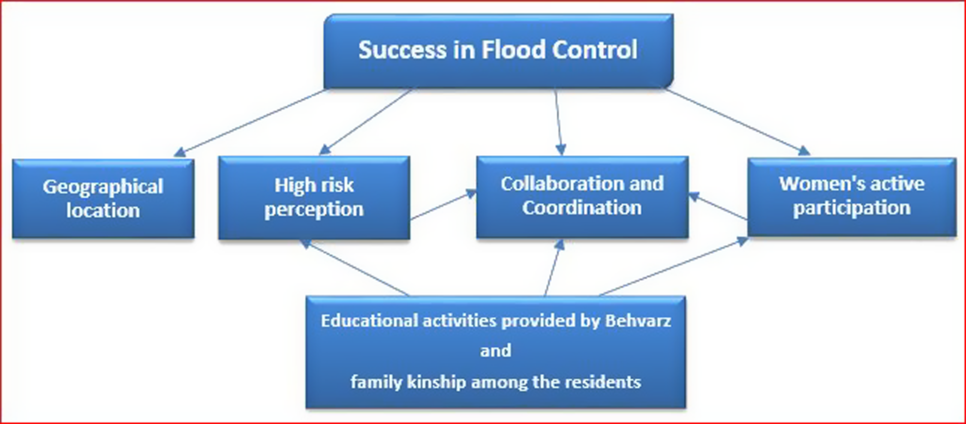
Analysis of the interviews showed that 4 major factors culminated in controlling the imminent flood, namely, the geographical location of the area, the residents’ high-risk perception, adequate collaboration and coordination among the residents and between them and the local authorities, and women's active participation before and during the incident. It was also found that these factors, in turn, have been induced by 2 more original causes, that is, a variety of educational activities provided by the local Behvarz and the vast family kinship among the residents (Figure 3).
Factors and Their Original Causes Found to Have Induced Success in Haji-Abad Flood Control.

DISCUSSION
Geographical Location of the Village
The geographical location of the area, that is, being on a relatively high plain, undoubtedly favored the people in 2 ways, including being able to see the incoming flood and finding enough time to prepare for combating the danger.
High-Risk Perception of All Residents
The analysis of the interviews with the Behvarz and the disaster liaison at the Rural-Urban Healthcare Center revealed that, based on the regulations and arrangements from Iranian Ministry of Health, a Behvarz (the one who is in charge of managing the rural Health Houses), along with other health-related education and guidance, usually provides special risk perception education for the women because it is believed that women usually spend more time with the children and other family members compared with men. It was discovered that 1 of the tasks of the existing Behvarz in Haji-Abad was helping women to fill out a family disaster preparedness assessment questionnaire.7 She usually illuminates those points, which the women cannot answer or do not know how to do. She performed the same services for Haji-Abad women during the months before the incident.
After teaching, Behvarz usually asks them to perform the required activities at home and hold meetings with family members to discuss the details and even simulate the activity. Later, she checks whether and how the women have engaged their family members with understanding and managing the particular risks threatening the area. The present Behvarz in Haji-Abad, on the other hand, had established a predisaster crisis management headquarter educating people on how to participate in protecting the neighborhood and the district after providing security for the family and homeFootnote * This finding shows that the people of the area were previously prepared and educated on how to manage dangers such as a flood.
Risk perception, which is defined as the ability to recognize and respond to potential dangers,Reference Bubeck, Botzen and Aerts8 was, therefore, adequately observed in the response of these villagers to flood. This level of risk perception by villagers resulted in reacting quickly toward the danger. Based on the philosophy of community-based disaster management, people should assume themselves as the owners of the disasters.Reference Lumbroso, Suckall, Nicholls and White9 The people under our scrutiny demonstrated that they were naturally aware that the upcoming possible disaster was truly theirs and that they were obliged to deal with it as quickly as possible.
This high-risk perception resulting in successful flood control could also be due to the vast family kinship among almost all of the residents. Caring about one's family and relatives is a great stimulus to save others’ lives and belongings.
Women's Active Participation
Apart from taking care of all house chores, women in the north region of Iran are usually involved with agriculture with their spouses in the fields. The women's role in providing the above-mentioned disaster preparedness education for the family in Haji-Abad accounts for the fact that women have had the highest risk of understanding in the family. This could be the reason why women joined men in the mitigation measures after a few hours due to the empathy and sympathy they felt toward them. On the other hand, they were aware of the significance of the danger and had formerly learned how to deal with these conditions.
We additionally learned from the interviews that there is a large kinship among the people. For that reason, they could ask the older people to take care of the children whenever they had something urgent to do. They did so during the night of the incident and found time to cooperate in the construction of the dam.
Collaboration and Coordination Among the People and Between Them and the Local Authorities
Our interview data suggest that the local authorities, namely, the governor of Gomishan, the mayor, NGOs from Gomishan, the Road Maintenance and Transportation Organization, and, particularly, Haji-Abad's Behvarz have made the required support and cooperation with the people in Haji-Abad. The Behvarz was present throughout the whole incident, watching to detect patients or instructing people on how to avoid being affected by diarrhea or other diseases usually prevalent during disasters. The people evidently have shown trust and appreciation toward the authorities by using all of the available rescue supplies and exerting all of their energies to save their lives and properties. The collaboration among the people themselves was another factor that helped accomplish the security task. The reasons of the effects of this organized unity can be seen in Figure 3, which shows that the education they received, their kinship, their high-risk perception, and the women's participation have all enhanced unity among them.10
Phases of Community-Based Disaster Management
In the Iranian health system, what is actually but indirectly expected from a Behvarz to accomplish in a Health House is setting up a community-based disaster management. The first phase of community-based disaster management is attracting people's participation.Reference Kreibich, Thieken and Petrow11 Two important principles that are to be considered in community-based disaster management include attracting people's trust and maintaining total perception of risk by the participants.Reference Söderholm, Pihlajamäki and Dubrovin12 Regarding the implementation of this management approach, the steps are orientation,Reference Hagemeier-Klose and Wagner13 collecting disaster experiences to improve risk perception,Reference Weng Chan14 assessing the vulnerability of the region,Reference Wannous and Velasquez15 and, finally, establishing a community-based disaster management organization. In fact, the term organization is used to represent that people should formally work to reduce hazards. The above-mentioned principles had been practically achieved in the Health House in Haji-Abad.
CONCLUSION
Taking a glance at Figure 3, it can be observed that the most effective factor inducing success in saving the village is the collaboration and cooperation among all of the stakeholders because the other factors or causes have either directly resulted in collaboration and cooperation or indirectly have created other factors which, in turn, have enhanced them. On the other hand, based on the philosophy of community-based disaster management, this involvement has helped these people assume themselves as the owners of the disaster.
All lessons learned from the Haji-Abad flood incident indicate that if awareness, accountability, and strong ties exist among people of any society, disasters are nothing but conditions provided by nature that help boost unity among human beings and, simultaneously, help us remain cautious about usual circumstances we live in that we take for granted.
It is suggested that enhancing risk perception be taught in an exhibitive manner in the vulnerable regions in Iran or other countries because people are not attentive enough to the risks unless they are aware of the possibility of facing such hazards.Reference Farley, Suraweera and Perera16 Such classes should be held collectively in the form of holding camps on holidays. Priority should be considered for those living in riverside and high-risk regions.Reference Girons Lopez, Di Baldassarre and Seibert17 It is, therefore, recommended to ask for the people's collaboration in preparedness and resilience during the occurrence of disasters by means of providing earlier inclusive operational education. Future studies should focus on the details of Haji-Abad mitigation engagements in order to institutionalize and create risk perception during behavior-changing education.Reference Parvin, Shaw and Fujita18
Acknowledgments
Hereby, we would like to show our gratitude to Miss Zeinab Azimi, the Health House Behvarz at the Haji-Abad village for her vigorous and in-depth explanation and description on both the flood incident details, as well as the processes and the procedures of the preparedness education she provided for Haji-Abad residents. We also thank Mr Ghasem Gorji, the disaster liaison between Golestan University of Medical Sciences and Valaghouz Rural-Urban Healthcare Center for providing us with all of the general information about the area, the flood, and introducing Miss Azimi to us.
Conflict of Interest Statement
The authors declare no conflicts of interest.