The lipidic fraction of milk has many important functions. In fact, besides being the main energy component it is also responsible for the nutritional (Sanz Sampelayo et al. Reference Sanz Sampelayo, Chilliard, Schmidely and Boza2007), technological (Michalski et al. Reference Michalski, Gassi, Famelart, Leconte, Camier, Michel and Briard2003), and organoleptic characteristics of milk products (Jensen et al. Reference Jensen, Ferris and Lammi-Keefe1991).
Increasing the quantity and quality of the fat means that the diet has to be managed to the optimum since it is the main environmental factor that influences the lipidic content of milk (Bauman & Griinari, Reference Bauman and Griinari2001).
The forage:concentrate ratio (FC ratio) of the diet and its impact on the quality of milk has been studied in particular for bovine (Soita et al. Reference Soita, Fehr, Christensen and Mutsvangawa2005) and goat species (Tufarelli et al. Reference Tufarelli, Dario and Laudadio2009), whereas there have been fewer studies dedicated to the ovine species (Caja & Bocquier, Reference Caja and Bocquier2000; Antongiovanni et al. Reference Antongiovanni, Mele, Buccioni, Petacchi, Serra, Mellis, Cordeddu, Banni and Secchiari2004; Mele et al. Reference Mele, Annicchiarico, Cannas, Caternolo, Serra and Secchiari2004; Sanz Sampelayo et al. Reference Sanz Sampelayo, Chilliard, Schmidely and Boza2007).
Sanz Sampelayo et al. (Reference Sanz Sampelayo, Chilliard, Schmidely and Boza2007) reported that the level of energy intake is negatively related to the fat content of sheep milk and positively with the quantity of milk. In particular, a level of concentrate exceeding 60% dry matter is known to have a negative effect on the fat content.
A low FC ratio is associated with a higher presence of non-structural carbohydrates, which then leads to a decrease in acetate and butyrate in the rumen. Caja & Bocquier (Reference Caja and Bocquier2000) believe that this trend is due to the rapid degradation of non-structural carbohydrates inside the rumen. This then leads to a marked decrease in the rumenal pH, which in turn influences the quantity and composition of the microbic proteins and thus limits the degradation of the structural carbohydrates. On the other hand, a high FC ratio leads to an increase in the production of acetate by the cellulosolytic bacteria of the rumen (Chesson & Forsberg, Reference Chesson, Forsberg, Hobson and Stewart1997), which can be used as a precursor of the synthesis of the fat by the mammary gland.
Modifications of the FC ratio are an efficient way to change the acidic profile of milk (Chilliard et al. Reference Chilliard, Ferlay, Rouel and Lambert2003; Chilliard & Ferlay, Reference Chilliard and Ferlay2004); in fact they influence the quality of the fat in the milk by modifying the acetate/propionate ratio and the rumenal biohydrogenation of the unsaturated fatty acids of the diet. The mammary synthesis of the short and medium chain fatty acids is facilitated by a high acetate/propionate ratio which increases with the content and digestibility of the fiber (Pulina et al. Reference Pulina, Nudda, Battacone and Cannas2006).
Diets that are rich in concentrates seem to increase the percentage of total trans-C18:1 in cow milk (Piperova et al. Reference Piperova, Teter, Bruckental, Sampugna, Mills, Yurawecz, Fritsche, Ku and Erdman2002), goat milk (LeDoux et al. Reference LeDoux, Rouzeau, Bas and Sauvant2002) and ewe milk (Nudda et al. Reference Nudda, Fancellu, Porcu, Boe and Cannas2004), and have a negative impact both on the production of vaccenic acid and conjugated linoleic acid (CLA) (Troegeler-Meynadir et al. Reference Troegeler-Meynadir, Nicot, Bayourthe, Moncoulon and Enjalbert2003). Antongiovanni et al. (Reference Antongiovanni, Mele, Buccioni, Petacchi, Serra, Mellis, Cordeddu, Banni and Secchiari2004) reported that in ovine species the low level of fiber in the diet may increase the formation of trans fatty acids. In cows it has been shown that such fatty acids help to decrease the level of milk fat (Griinari & Bauman, Reference Griinari, Bauman, Garnsworthy and Wiseman2003). Therefore, the aim of this study was to assess the influence of the FC ratio in the diet on the quality of ewe milk with particular reference to lipidic fraction, by verifying both the morphometric characteristics of the fat globules and milk fatty acid profile.
Materials and Methods
Animals and diets
The trial was carried out on twenty Massese ewes, reared in the same farm. The animals were subdivided into two groups (Group A and B) of 10 subjects each and kept indoors at 25 d post partum, after the lambs had been weaned. The experiment lasted 60 d, from 40 to 100 d post partum, and it was preceded by an adaptation period of 14 d.
All the ewes lambed over a period of 6 d and were homogeneous in terms of parity, average live weight (kg 59·02±3·8), milk yield (kg/day 2·28±0·3), chemical composition of milk and morphometric characteristics of milk fat globules.
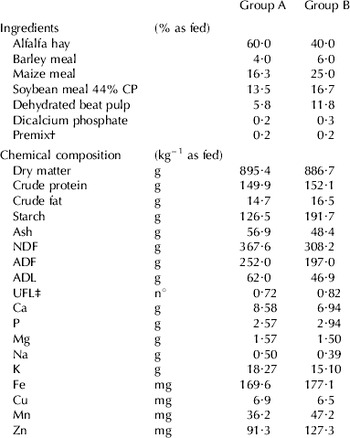
During the adaptation and experimental period the animals in the two groups were fed two equal diets differing in FC ratio: 60:40 (Group A) and 40:60 (Group B). Diets were administered twice daily and based on alfalfa hay (121·3 g crude protein (CP)/kg, 499·8 g neutral detergent fibre (NDF)/kg as fed) and two concentrates. The ingredients, chemical composition and calculated nutritive value of diets are reported in Tables 1 & 2.
Ingredients, chemical composition and nutritive value of diets

† Amount provided per kg of diet: cobalt=0·2 mg, iodine=1·4 mg, iron=40 mg, manganese=40 mg, selenium=0·12 mg, zinc=80 mg; vitamin A=7,000 IU, vitamin D3=1,000 IU, vitamin E=15 mg
‡ UFL: French Milk Feed Unit (1 UFL=7·113 MJ of Net Energy for Lactation)
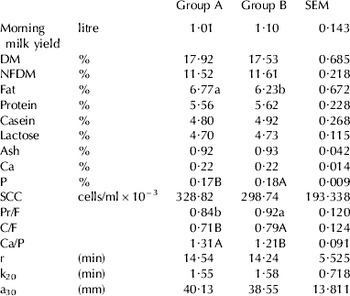
Effect of FC ratio on the quanti-qualitative and rheological characteristics of milk

DM: Dry Matter; NFDM: Non Fat Dry Matter; SCC: Somatic Cell Count; C/F: Casein/Fat; Pr/F: Protein/Fat
A, B: P<0·01; a, b: P<0·05
During the trial, the ration was offered to meet ewes' requirements for energy, protein and minerals in accordance with INRA (1988), taking into consideration a sheep body weight of about 60 kg and the evolution of daily milk production.
Feeds were analyzed for dry matter (DM), crude protein (CP) and ash (AOAC, 1995), neutral detergent fibre (NDF), acid detergent fibre (ADF) and acid detergent lignin (ADL) (Van Soest et al. Reference Van Soest, Robertson and Lewis1991), starch by enzymatic method (AOAC, 1995), phosphorus by colorimetric method (AOAC, 1975) and the other minerals by atomic absorption spectrophotometry (Perkin-Elmer, Reference Perkin-Elmer1973). Feed nutritive values, as French milk feed unit (MFU), were estimated by INRA (1988) on the basis of the chemical composition of the feeds.
Milk analysis
Every 15 d, from the morning milking and for each subject, the milk yield was recorded and individual milk samples were analyzed for the percentage of dry matter (DM), protein, fat and lactose by infrared analysis (Milko-Scan, Italian Foss Electric, Padova, Italy), and for the percentage of casein (IDF, 1964), ash (AOAC, 1995), phosphorus, calcium (Gaines et al. Reference Gaines, West and McAllister1990) and somatic cell count (SCC) (Fossomatic 360, Padova, Italy). Non fat dry matter (NFDM) was calculated as the difference between dry matter and fat content. The following parameters were also calculated: Casein/Fat (C/F), Protein/Fat (Pr/F) and Calcium/Phosphorous (Ca/P).
The milk's rheological parameters was performed on each milk sample, without pH standardization, using a Formagraph apparatus (Italian Foss Electric, Padova, Italy), recording the following parameters: r=clotting time: the time (min) from the addition of rennet to the beginning of coagulation; k20=curd firming time: the time (min) needed until the curd is firm enough to be cut, i.e., the width of the diagram equals 20 mm; a30=curd firmness (mm): measured 30 min after the addition of rennet.
Fatty acid analysis
Milk samples were stored at −20°C until fatty acid analysis. Milk fat extraction was performed according to Rose-Gottlieb's method (AOAC, 1995) modified by Secchiari et al. (Reference Secchiari, Antongiovanni, Mele, Serra, Buccioni, Ferruzzi, Paoletti and Petacchi2003). Methyl esters of fatty acids (FAME) were obtained after trans-esterification with sodium methoxide (Christie, Reference Christie1982). The composition of fatty acid was determined by gas chromatography using a Perkin Elmer Auto System apparatus (Norwolk, CT, USA) equipped with a flame ionization detector (FID) and a capillary column (FactorFour Varian, 30 m×0·25 mm; film thickness 0·25 μm, Middelburg, Netherlands). Helium carrier gas flow rate was 1 ml⋅min−1. The oven temperature program was as follows: level 1, 120°C held for 1 min, level 2, 120 to 180°C at 5 deg C⋅min−1 then held for 18 min, level 3, 180 to 200°C at 2 deg C⋅min−1 then held for 1 min, level 4, 200 to 230°C at 2 deg C⋅min−1 then held for 19 min. The injector and detector temperature were set at 270 and 300°C, respectively.
The following ratios were also calculated: unsaturated/saturated fatty acids (Uns/Sat):Atherogenic Index and Thrombogenic Index (Ulbricht & Southgate, Reference Ulbricht and Southgate1991); activity of Δ9-desaturase expressed as C14:1/C14:0 ratio.
Morphometric analysis of milk fat globules (MFG)
The number of fat globules/ml milk and diameter was measured in each milk sample according to Scolozzi et al. (Reference Scolozzi, Martini and Abramo2003); this method for the identification and morphometrical assessment of milk fat globules is simple to perform and means that the diameter of every single, visible, milk native fat globule from fresh milk can be analysed directly with the image analyzer system. Other methods use the refractive index in order to carry out an indirect analysis of the standard parameters of milk fat globules using software applications. Moreover, our method allows fat globules to be characterized without handling the milk too much. In fact, it has been demonstrated that changes in the MFG membrane (Evers, Reference Evers2004) and in the size of fat globules may result from milk-handling practices (Wiking et al. Reference Wiking, Nielsen, Bavius, Edvardsson and Svennersten-Sjaunja2006).
Statistical analysis
The frequency distribution of the total counted and measured MFG was evaluated according to their size: fat globule diameters were divided into ten classes of 1 μm class widths, from 0 to >9 μm. For each milk sample, the percentage of MFG within each size class was calculated. All ten classes were represented in all the milk samples evaluated. Each milk sample was thus characterised by a different percentage of MFG, for each diameter size class. Subsequently, the ten classes were grouped into three size categories of fat globules: small globules (SG) with a <2 μm diameter, medium-sized globules (MG) with a diameter from 2 to 5 μm, and large globules (LG) with a >5 μm diameter.
One hundred individual milk samples were analysed, and the results were elaborated using the following mixed linear model for repeated measurements:

where: Yijk=response at time k on subject j in treatment group i; M=overall mean; Ti=fixed effect of treatment group (i=A,B); Sij=random effect of subject j in treatment group i; Pk=fixed effect of sampling time k (k=1, … ,5); (T×P)ik=fixed interaction effect of treatment group i with sampling time k; εijk=random error at sampling time k on subject j in treatment group i.
The treatment group-sampling time interaction was not statistically significant and was excluded from the model. The statistical analysis was carried out using JMP (2002) software.
Results and Discussion
Table 2 highlights the statistically significant differences between the two groups in terms of the percentage of lipids, phosphorous and the C/F, Pr/F and Ca/P ratios. The higher percentage of fat in the milk of Group A (P<0·05) confirms what has been reported in the literature for ewes (Mele et al. Reference Mele, Annicchiarico, Cannas, Caternolo, Serra and Secchiari2004), cows (Andersen et al. Reference Andersen, Friggens, Sejrsen, Sørensen, Munksgaard and Ingvartsen2003) and buffaloes (Bartocci et al. Reference Bartocci, Terramoccia and Tripaldi2006), but not for goats (Tufarelli et al. Reference Tufarelli, Dario and Laudadio2009).
According to some authors, during cheese making to ensure that the incorporation between fat and casein is at its maximum, the C/F ratio should be 0·7 (Politis & Ng-Kwai-Hang, Reference Politis and Ng-Kwai-Hang1988; Sinclair et al. Reference Sinclair, Lock, Early and Bauman2007). Other authors make reference to the Pr/F ratio (Guinee et al. Reference Guinee, Mulholland, Kelly and Callaghan2007) and note that in cow milk the increase in this rate with a range from 0·7 to 1·15 leads to a significant reduction in the fresh cheese yield. From a comparison with the literature cited above, the C/F values and Pr/F values from Group A are closest to the optimal value and significantly lower than Group B (P<0·01 and P<0·05 respectively).
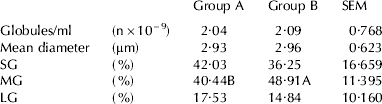
The effect of the different FC ratio in the diet on the morphometric characteristics of the MFG (Table 3) did not show significant differences relating to the number of globules/ml milk or to the average diameter, while it led to a greater (P<0·01) synthesis of globules with a diameter between 2 and 5 μm (MG) in Group B.
Effect of FC ratio on the morphometric characteristics of MFG
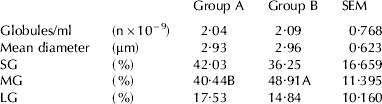
SG: Small Globules (<2 μm); MG: Medium Globules (from 2 to 5 μm); LG: Large Globules (>5μm)
A, B : P<0·01
Unlike the findings from Wiking et al. (Reference Wiking, Stagsted, Björck and Nielsen2004) in cow's milk but in accordance with Walstra (Reference Walstra1969), we did not observe an increase in the diameter of the MFG in Group A where the percentage of milk fat was greatest.
The values relating to the number of globules/ml milk and to the diameter are less than reported in our previous studies for the same breed (Martini et al. Reference Martini, Scolozzi, Cecchi and Abramo2004a; Reference Martini, Scolozzi, Cecchi, Salari and Verità2004b; Reference Martini, Scolozzi, Cecchi, Mele and Salari2008) probably due to the fact that MFG characteristics can be modified by genetic and physiological factors (Martini et al. Reference Martini, Salari, Scolozzi, Bianchi, Pauselli, Rossetti and Verità2006; Couvreur & Hurtaud, Reference Couvreur and Hurtaud2007).
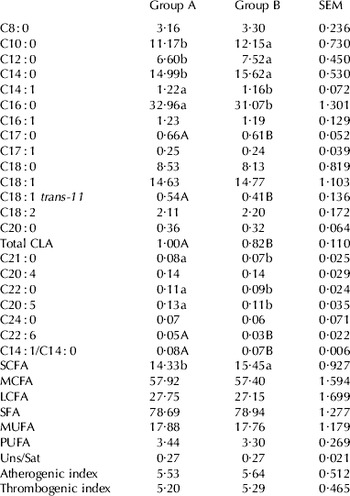
Table 4 shows the results relating to the acidic composition of the milk of the two groups: Group A had lower quantities (P<0·05) of some saturated fatty acids (SFA) such as C10:0, C12:0 and C14:0 and greater quantities of C16:0 (P<0·05), C17:0 (P<0·01), C21:0 (P<0·05), C22:0 (P<0·05). The decrease in lauric acid (C12:0) and myristic acid (C14:0), would seem to have positive effects on human health. On the other hand, higher percentages of palmitic acid (C16:0) do not appear to be favorable, since these fatty acids have hypercholesterolemic properties (Chiofalo et al. Reference Chiofalo, Liotta, Zumbo and Chiofalo2004).
Effect of FC ratio on the fatty acid composition (% of total fatty acids) of milk

SCFA: Short Chain Fatty Acids; MCFA: Medium Chain Fatty Acids; LCFA: Long Chain Fatty Acids; SFA: Saturated Fatty Acids; MUFA: Mono Unsaturated Fatty Acids; PUFA: Poly Unsaturated Fatty Acids; Uns/Sat: Unsaturated/Saturated fatty acids
A, B: P<0·01; a, b: P<0·05
It is well known that the benefits for human health of the fraction MUFA is connected to their capacity to reduce the level of serum cholesterol (Ulbricht & Southgate, Reference Ulbricht and Southgate1991). In the milk from Group A animals there were greater quantities of C14:1 (P<0·05) and of trans 11-C18:1 (P<0·01), the latter being one of the precursors of CLA. Moreover, the quantity of CLA is strictly related to the activity of the Δ9-desaturases of the mammary gland. In fact, part of vaccenic acid and of CLA are products of the action of this enzyme (Bauman & Griinari, Reference Bauman and Griinari2001; Chilliard et al. Reference Chilliard, Ferlay, Rouel and Lambert2003), whose activity can be measured by comparing the product/substrate ratio of some fatty acids and particularly that of C14:1/C14:0 (Corl et al. Reference Corl, Baumgard, Bauman and Griinari2000), where increasing values indicate an increase in enzymatic activity (Lock & Garnsworthy, Reference Lock and Garnsworthy2003). The activity of this enzyme is higher in Group A (P<0·01), where there are statistically greater percentages of some fatty acids that have important nutritional properties such as total CLA (P<0·01), EPA (P<0·05) and DHA (P<0·01). These composites have been reported to have many benefits for human health: cardiovascular and anti-inflammatory of EPA and DHA (Williams, Reference Williams2000), anticarcinogenic (Belury, Reference Belury1995), immunomodulatory (Cook et al. Reference Cook, Miller, Park and Pariza1993), antiobesity (Park et al. Reference Park, Albright, Liu, Storkson, Cook and Pariza1997), antiatherogenic (Nicolasi et al. Reference Nicolasi, Rogers, Kritchevski, Scimeca and Huth1997) and antidiabetic (Dhiman et al. Reference Dhiman, Satter, Pariza, Galli, Albright and Tolosa2000) linked to CLA.
Our results are confirmed by similar results reported for CLA by Soita et al. (Reference Soita, Fehr, Christensen and Mutsvangawa2005) in cows. Their results highlight how diets rich in concentrate compared with those with high levels of forage can decrease the concentration of CLA in milk. However, Mele et al. (Reference Mele, Annicchiarico, Cannas, Caternolo, Serra and Secchiari2004) did not find any significant differences in ewe milk.
The lower percentage of short chain fatty acids in Group A (P<0·05), in concomitance with the greater quantity of trans 11-C18:1, could be due to the fact that the trans C18:1 may act as inhibitors of the de novo synthesis of the fatty acids in the mammary gland (Pérez Alba et al. Reference Pérez Alba, De Souza, Pérez, Martìnez and Fernàndez1997).
In conclusions, the results obtained in this study show that the physico-chemical and nutraceutical quality of ewe's milk is influenced by variations in the forage/concentrate ratio in the diet. In particular, a greater proportion of forage seems to improve the milk fatty acid profile by the increase of some fatty acid identified as being beneficial for human health.