Introduction
Prebiotic chemistry experiments search to explain chemical reactions that have been involved in the early life (Eschenmoser & Loewenthal Reference Eschenmoser and Loewenthal1992; Sutherland & Whitfield Reference Sutherland and Whitfield1997; Maurel & Décout Reference Maurel and Décout1999; Powner et al. Reference Powner, Gerland and Sutherland2009). Water, carbon monoxide, sulphur dioxide, methane and dinitrogen molecules present in the atmosphere of the primitive Earth might have reacted to form the elementary building blocks of life such as ammonia, hydrogen cyanide, formaldehyde, acetonitrile, cyanogen and cyanoacetylene. Cosmic rays, ionizing reactions, electric discharges, mechanical and radioactive processes could induce ion–molecule and radical reactions. From these molecules, formation of amino acids and nucleic acid bases could be explained (Miller Reference Miller1953; Oro Reference Oro1961; Kobayashi et al. Reference Kobayashi, Kaneko, Saito and Oshima1998; Miyakawa et al. Reference Miyakawa, Murasawa, Kobayashi and Sawaoka1999; Bossa et al. Reference Bossa, Duvernay, Theule, Borget, d'Hendecourt and Chiavassa2009; Meinert et al. Reference Meinert, Filippi, Marcellus, d'Hendecourt and Meierhenrich2012). Many prebiotic molecules could have been present in comets. Oro et al. (Reference Oro, Mills and Lazcano1992) suggested that comets may have delivered life's early building blocks on Earth. Delsemme (Reference Delsemme2000) emphasized that comet bombardments have brought to Earth all the carbon compounds present in organic molecules used by life. Furthermore, nucleobases have a remarkable photo-stability in spite of their high absorption in the ultraviolet (UV) radiation (Saiagh et al. Reference Saiagh, Cloix, Fray and Cottin2014); huge amounts have been found in meteorites (Callahan et al. Reference Callahan, Smith, Cleaves, Ruzicka, Stern, Glavin, House and Dworkin2011).
The discovery of catalytic RNAs supported the RNA world hypothesis in which the earliest forms of life may have relied on RNA to store genetic information and to catalyse chemical reactions (Guerrier-Tanaka et al. Reference Guerrier-Tanaka, Gardiner, Marsh, Pace and Altman1983; Gilbert Reference Gilbert1986; Cech Reference Cech1987; Maurel Reference Maurel1992; Gesteland & Atkins Reference Gesteland and Atkins1993; Maurel & Haenni Reference Maurel and Haenni2005). The Systematic Evolution of Ligands by EXponential (SELEX) enrichment method has been developed to generate and screen large libraries of nucleic acid molecules differing in their sequences and their folding properties. The success of this method to select ribozymes, RNA-possessing catalytic properties and aptamers, RNAs that specifically bind molecules such as amino acids, ATP or enzymatic cofactors, lend experimental support to the RNA world hypothesis. The use of small exogeneous cofactors by ribozymes could have been an easy way of expanding their catalytic and metabolic properties especially in a putative ‘soup’ of small oligoribonucleotides binding with small organics and metals. Adenine is a highly plausible prebiotic organic compound (Oro Reference Oro1961; Maurel & Ninio Reference Maurel and Ninio1987; Vergne et al. Reference Vergne, Dumas, Décout and Maurel2000), and therefore adenine-binding aptamers (Meli et al. Reference Meli, Vergne, Décout and Maurel2002) could mimic structures showing primitive functionalities. We discovered the adenine-dependent hairpin ribozyme (ADHR) which requires adenine as catalytic cofactor (Meli et al. Reference Meli, Vergne and Maurel2003) and proposed that this assembly is a good candidate for early ‘ribo-organisms’. We showed that ADHR can react with a wide range of adenine analogues and acts with different catalytic strategies compared with the wild-type ribozyme. Finally, the structural properties of plausible RNA vestiges of early life were recently studied according to external perturbations (Delan-Forino et al. Reference Delan-Forino, Deforges, Benard, Sargueil, Maurel and Torchet2014; Hui-Bon-Hoa et al. Reference Hui-Bon-Hoa, Kaddour, Vergne, Kruglik and Maurel2014).
In the present study, we have investigated effect of UV solar radiation on ADHR molecules on-board the International Spatial Station (ISS) in the EXPOSE-R mission. The goal of the research reported here is to unravel the stability of these components in space conditions. The study of the effects of extreme conditions on RNA molecules and the protective effect of trapping in NaCl crystals is of crucial interest for looking for life elsewhere. Indeed, there is evidence that primitive oceans on Earth were highly saline (Knauth Reference Knauth1998) and early life might be considered in hypersaline conditions (Dundas Reference Dundas1998). Salt is also abundant on planets such as Mars and Europa, a satellite of Jupiter (Kargel Reference Kargel1998). Moreover, salt crystals have been shown to play a protective role, stabilizing RNA molecules against thermal degradation (Maurel & Zaccai Reference Maurel and Zaccai2001; Tehei et al. Reference Tehei, Franzetti, Maurel, Vergne, Hountondji and Zaccai2002; Cornée et al. Reference Cornée, Vergne, Guyot, Goffe, Rouchy and Maurel2004; Vergne et al. Reference Vergne, Cognet, Szathmáry and Maurel2006; El-Murr et al. Reference El-Murr, Maurel, Rihova, Vergne, Hervé, Kato and Kawamura2012). These arguments give interest to study the effect of solar radiation on RNA in the presence of NaCl. At last, the study of the stability of RNAs in space allows us to simulate the primitive conditions of the RNA world when there was not the protective effect of Earth's atmosphere against irradiations.
Materials and methods
RNA
Starting from the ADHR obtained in the experiment of Meli et al. (Reference Meli, Vergne and Maurel2003), the ADHR1 variant (85 nucleotides) was produced by in vitro transcription of its DNA coding sequence, by the T7 RNA polymerase in presence of the four ribonucleotides and buffer (Fermentas) followed by DNase treatment and deproteinization. After ethanol precipitation, RNA was purified by electrophoresis on 10% denaturing polyacrylamide gel.
Samples of 30 μl solution containing 0.1 mg RNA, either alone or with NaCl (0.2–2 mg) were loaded on MgF2 windows and vacuum-dried for exposed and not exposed samples to solar radiation outside the ISS. Other samples were also prepared for ground variable T°, ground constant T° and ground −20 °C controls.
Characteristics of EXPOSE-R mission
The samples were taken aboard ISS from 10 March 2009 to 21 January 2011, that is, 683 days (Rabbow et al. Reference Rabbow2014). A set of samples was exposed to the Sun (6) while a replicate of the sample was stored right below the exposed layer. The EXPOSE-R top surface was irradiated uniformly and received a total dose of 13.2×10⁹ J m−2 with a wavelength range between 100 and 1 mm including a UV dose (100–400 nm) of 1.02×10³ MJ m−2 (Beuselinck & Bavinchove Reference Beuselinck and Bavinchove2011; Cottin et al. Reference Cottin2014, personal communication). About 77% of the dose reached to the samples below the MgF2 windows.
On the ground, controls were made with six samples kept at a constant temperature of 5 °C, a sample kept at −20 °C under atmospheric pressure was used as a ‘stable reference’ and six samples were submitted to temperature variations reproducing the cycles of the temperature during the flight. These controls were maintained under vacuum in the dark. The average temperature tray close to the sample temperature is of 19 °C, knowing that the temperature could reach two extremes equal to −27 and 46 °C. Although temperatures were higher than 0 °C for most of the EXPOSE-R mission, 285 freeze–thaw cycles were identified, including 11 freeze periods with a duration longer than the 90 min orbital period.
Recovery of samples
Samples were recovered in 100 μl H2O; some insoluble aggregates were present in the exposed samples. Recovery of each sample was quantified by absorbance measurement at 260 nm absorbance units (A 260) on a NanoVue spectrometer.
Integrity analysis of the samples by electrophoresis
RNA amounts of 0.07 A 260 for each sample were preincubated at 45 °C in 50% formamide and loaded onto a denaturing 10% polyacrylamide gel for electrophoresis, pre-run for 1 h, and run at 450 V, 40 mA, 18 W, until the migration dye, bromophenol blue, reached the bottom of the gel. The running buffer was TBE (buffer: Tris base, boric acid and EDTA). RNAs were stained with ethidium bromide.
Results and discussion
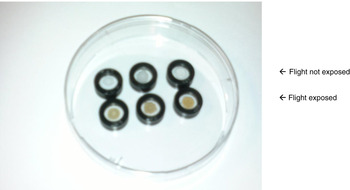
The recovered windows with the samples exposed to the Sun aboard ISS were yellow coloured, whereas those not exposed remained white (Fig. 1). This colour was most probably due to a photosensitive volatile contaminant inside the tray. This contamination issue is further discussed in Demets et al. (Reference Demets2014).
Windows recovered with samples exposed to the Sun (yellow) and non-exposed samples (white) onboard ISS.

The samples were characterized by the ratio of the absorbance at 260 over the absorbance at 280 nm (Table 1). At both wavelengths the absorption of the RNA only arised from the electronic transitions of the bases. The absorbance ratios of the samples exposed to the Sun slightly decreased. We cannot ascertain that it was only due to the presence of a contaminant. The absorption of the bases probably was slightly modified. For the in-flight samples not exposed to the Sun, for the sample on ground exposed to the same cycle of temperature as the in-flight samples and for the samples maintained at 5 °C, the fairly constant absorption ratio indicates that the bases still absorb UV radiation as in the reference samples maintained at −20 °C (Table 1). Thus, for the in-flight samples not exposed to the Sun and those on ground in the dark, under vacuum, the absorption of the bases did not show any sign of degradation as opposed to the samples exposed to the Sun during the flight. The fairly constant absorption ratio of all the samples, except the sample exposed to the Sun during the flight, shows that the bases were not affected during the experiment. The comparison between the in-flight samples, exposed to the Sun and not exposed, probably shows that the solar radiation degrades RNA bases. UV present in the solar spectral irradiations were absorbed by the bases of the RNA and can involve photo-induced processes.
Absorbance ratios, A 260/A 280 measured with a NanoVue spectrometer

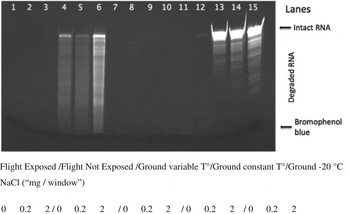
The distribution in size of the various RNA samples was characterized by denaturing polyacrylamide gel electrophoresis (Fig. 2). The samples number 1, 2 and 3 exposed to the Sun in flight showed no intact RNA bands. A weak trail indicates a large size distribution resulting from very strong damage to the RNA. Samples not exposed to the Sun in flight displayed intact RNA bands followed by well-specified trails due to large distributions of lower-sized products. Thus, the exposition to the solar radiation has a strong degradation effect on the size distribution of RNA.
Gel pattern of the 15 samples analysed by electrophoresis on denaturing polyacrylamide gel. Lanes 1–3: in-flight samples exposed to the Sun with 0, 0.2 and 2 mg/window of NaCl, respectively; Lanes 4–6: in-flight samples not exposed to the Sun with 0, 0.2 and 2 mg/window of NaCl, respectively; Lanes 7–9: samples on ground exposed to the same cycle of temperature as the in-flight sample with 0, 0.2 and 2 mg/window of NaCl, respectively; Lanes 10–12: samples on ground maintained at 5 °C with 0, 0.2 and 2 mg/window of NaCl, respectively; Lanes 13–15: reference samples on ground maintained at −20 °C with 0, 0.2 and 2 mg/window of NaCl, respectively.

On ground, the samples maintained at 5 °C or subjected to temperature cycles displayed very weak intact RNA bands, followed by weak trails. Large distributions, bushy in small size, indicate strong damaging.
The sample on ground maintained at −20 °C mainly presented strong intact RNA bands (lanes number 13, 14 and 15).
Staining by ethidium bromide results from interactions of the dye with the bases and no biological compound can interfere with such interaction (Le Pec & Paoletti Reference Le Pec and Paoletti1966). Consequently, staining by ethidium bromide of the lower-sized components indicates that the bases were still present. Thus, staining reveals that bases of RNA were conserved even in small-sized products as shown by the conservation of the absorption ratio of the samples. One notices that the prebiotic synthesis of adenine was obtained thanks to UV bombardment (Oro Reference Oro1961). The overall experiment demonstrated an important effect on the size of the RNA. We should mention that in 10% polyacrylamide gels the marker bromophenol blue comigrates with fragments of double stranded DNA of 20–45 nucleotide pairs (Molecular Cloning – Laboratory manual). Thus, electrophoresis did not reveal smaller nucleic acid fragments.
The presence of the higher content of crystallized NaCl in contact with RNA resulted in a very weak intact RNA band are shown in lanes 9 and 12. NaCl did not change the absorption ratio of the bases but induces a slight protective effect against the degradation of RNA. Thus, NaCl has protective effect on the ribose phosphate backbone.
The RNA molecules not exposed to the Sun mainly conserved the bases but were affected by a reduction of the size by degradation involving the ribose phosphate backbone. On ground the comparison between the sample at various temperatures and the sample conserved at −20 °C shows that the temperature has a strong effect on the size distribution process. This backbone is probably the most sensitive part of the molecule to the thermal agitation and can be cleaved.
The comparison between flight not exposed, and on ground at various temperatures indicates that the sample in flight was better preserved.
The humidity might lead to the degradation of the ground samples. In space, the environment is very dry and the exposed samples were subsequently damaged by UV, whereas non-exposed samples showed less degradation. From ground samples (at variable and constant temperatures), the degradation of RNA could be due to humidity during transportation and/or conditioning preparation as compared to the intact well-preserved ground samples maintained at −20 °C.
Acknowledgements
The authors would like to thank Anne-Lise Haenni for careful reading of the manuscript and Christian Zentz for his interest in this work. This study was supported by the ‘Centre National d’Études Spatiales’ (CNES). It is based on observation with the AMINO experiments embarked on EXPOSE-R.