Introduction
Pathological internet use involves a distinct pattern of behavior among a specific population.Reference Starcevic and Aboujaoude1 As specific pathological internet use, internet gaming disorder (IGD) is characterized by the chronic, recurrent pattern of indulging in specific games, which typically produces short-term rewards but long-term adverse consequencesReference Zheng, Hu, Wang, Wang, Du and Dong2, Reference Kuss, Pontes and Griffiths3 including comorbidity with other mental disorders, social deficits, and poor academic performance. In 2013, the DSM-5 listed IGD as an entity that requires further research.Reference Kuss, Griffiths and Pontes4 Recently, the World Health Organization designated IGD as an addictive disorder in the ICD-11 although there were still controversies.Reference Aarseth, Bean and Boonen5 Anyway, IGD has developed into a significant public health problem.
Regardless of whether IGD is conceptualized as an addictive disorder, impaired executive control, persistent craving, and excessive reward-seeking may be predictable risk factors for IGD and are exacerbated by playing games. Two brain networks might be primarily involved in IGD: (1) the executive control network (ECN), which involves the prefrontal cortex (PFC) that underlies self-inhibition, and (2) the basal ganglia network (BGN) involving the subcortical regions of the striatum, thalamus, and amygdala that drive craving and reward-seeking.Reference Dong and Potenza6, Reference Bechara7 Mounting neuroimaging evidence has shown that changed activity in the above regions follows long-term gaming behaviors.Reference Petry, Rehbein and Gentile8, Reference Petry, Zajac and Ginley9 For instance, individuals with IGD show hyperactivation of the prefrontal region when facing game-related cues or performing gaming behaviors. These brain regions involve the dorsolateral prefrontal cortex (DLPFC) and the orbitofrontal cortex (OFC).Reference Dong, Wang, Du and Potenza10, Reference Dong, Wang, Du and Potenza11 Similarly, the hyperactivation of reward regions including the striatum also catalyzes the individual craving to specific games, indicating a high sensitivity to reward,Reference Liu, Yip and Zhang12 which is consistent with the findings in substance use disorder (SUD).Reference Jasinska, Stein, Kaiser, Naumer and Yalachkov13
Although the ECN and the BGN are generally considered two independent structures contributing to addictive behaviors, neurobiological studies in SUD have provided clear evidence that they are functionally related, perhaps interacting with each other to trigger inappropriate or maladaptive behaviors.Reference Courtney, Schacht, Hutchison, Roche and Ray14 For example, in animal models, decreased baseline resting-state functional connectivity (rsFC) between the PFC and striatum, including the OFC, caudate putamen, prelimbic, and nucleus accumbens has been found in rats when exposed to alcohol.Reference Broadwater, Lee and Yu15 Similarly, in human subjects, a decreased rsFC between the DLPFC and striatum was observed in individuals addicted to alcohol when compared with nonaddicted individuals during a monetary reward paradigm.Reference Park, Kahnt and Beck16 Moreover, this dysfunctional coupling between the PFC and striatum also extends to other SUDs, for example, nicotine, cannabis, cocaine, and opioids.17-20 Generally, the PFC regions project towards the striatum, passing through the thalamus and pallidum and constituting the frontostriatal circuits that are considered to be associated with response inhibition, reward, and stimulus–response habits.Reference Volkow, Wang, Tomasi and Baler21, Reference Kober, Mende-Siedlecki and Kross22 The poor couplings between the ECN and BGN in addicted individuals reflect the dysfunctions within the frontostriatal circuits to some extent. Given that the dysfunction of these circuits may be a potential mechanism of addictive behavior, elucidating how these thoroughly circuit-level characteristics of the frontostriatal pathways contribute to IGD has recently become a crucial research endeavor.
Changes in information flow within the frontostriatal circuits in IGD, which may be potential risk factors contributing to dysfunctions are currently unclear. Preliminary prospective studies show that IGD individuals exhibit abnormal rsFC within the frontostriatal circuits in comparison with a healthy populations, for example, a decreased rsFC in the DLPFC–caudate, OFC–nucleus accumbens, and OFC–caudate circuits,Reference Jin, Zhang and Cai23, Reference Yuan, Yu and Cai24 suggesting that executive control deficits in IGD are correlated with an altered frontostriatal rsFC. It should be noted that although the associations between frontostriatal circuits and executive control in IGD have been initially verified by the means of the rsFC, it is difficult to characterize the causal influence between regions within circuits only by this method. In other words, it is unclear whether there are dynamic interactions (or causal influences) among the frontostriatal circuits involved in IGD and how these interactions contribute to the dysregulation between executive control and reward. Spectral dynamic causal modeling (spDCM)Reference Friston, Kahan, Biswal and Razi25 can be used to examine the model-based effective connectivity structure between regions, rather than their statistical dependencies, according to generative (state-space) models with a biologically realistic hemodynamic function. The spDCM methods may shed novel insights into the causal influence within frontostriatal circuits from a functional integration perspective.
Therefore, in the current study, the effective connectivity patterns differences of the frontostriatal circuits will be investigated between IGD individuals and healthy controls in a large sample. We performed spDCM analysis based on the results of independent component analysis (ICA) that identified brain regions, involving executive control and reward, within the frontostriatal circuits in all participants. The connectivity findings were then correlated with addiction severity. Notably, both the striatum and PFC are intermodulated via frontostriatal circuits,Reference Noel, Brevers and Bechara26, Reference Vink, Zandbelt and Gladwin27 which is consistent with the dual-process theory of addiction.Reference Bechara7 Therefore, we hypothesized that there are dysfunctional dynamic interactions within frontostriatal circuits during the resting state in IGD individuals in comparison with healthy controls. We are confident that the current study focusing on the frontostriatal circuits can provide new insights into the understanding of the accurate roles of these circuits in IGD.
Methods
Ethics
This study was approved by the Human Investigations Committee of Zhejiang Normal University. All participants provided written informed consent in accordance with the Declaration of Helsinki.
Participants
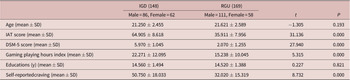
Three hundred and twenty-eight online game players from Shanghai were recruited by online advertisements, among whom 11 subjects with head motion exceeding a 2.5 mm translation and a 2.5° rotation during image acquisition were excluded. The nine DSM-5 diagnostic criteria for IGDReference Petry, Rehbein and Gentile8 and Young’s internet addiction test (IAT)Reference Chang and Law28 were used to evaluate the participant’s addiction severity. A subject categorized into the IGD group had to meet at least five of the nine DSM-5 diagnostic criteria and achieve IAT scores of more than 50, which was described elsewhere.Reference Dong, Liu, Zheng, Du and Potenza29, Reference Dong, Wang, Liu, Liang, Du and Potenza30 Participants were also asked to report their game craving scores measured by a 10-item scale (adapted from Questionnaire of Smoking Urges),Reference Albrithen and Singleton31 where each item is scored from 1 to 10, with higher scores showing stronger cravings. All participants had been assessed by a structured psychiatric interview to exclude Axis-I psychiatric disorders.Reference Sheehan, Lecrubier and Sheehan32 In addition, no participants reported a history of gambling or drug dependence (eg, cannabis, cocaine, and heroin). Finally, the sample composition of the current study included 148 IGD subjects and 169 RGUs, and the two groups matched on irrelevant variables, for example, age, sex (χ 2 = 1.923, P = .166), and education (see Table 1).
Demographic Information and Group Differences in Current Study

Abbreviations: DSM-5, Diagnostic and Statistical Manual of Mental Disorders-5; Gaming playing hours index, gaming hours per week; IAT, internet addiction test; IGD, internet gaming disorder.
Imaging acquisition
Functional magnetic resonance imaging (fMRI) was performed by a 3 T Siemens Trio MRI scanner (Siemens, Erlangen, Germany). Whole-brain resting-state fMRI images were acquired by an echo-planar imaging (EPI) pulse sequence (33 slices with thickness = 3 mm, repetition time = 2000 ms, echo time = 30 ms, field of view = 220 × 220 mm, flip angle = 90°, matrix = 64 × 64). High-resolution T1-weighted images were collected via a three-dimensional spoiled gradient recalled sequence (192 slices with thickness = 1 mm, repetition time = 2530 ms, echo time = 2.34 ms, inversion time = 1100 ms, field of view = 256 × 256 mm, flip angle = 7°, in-plane resolution = 256 × 256).
Data preprocessing
Resting-state fMRI data were preprocessed by Data Processing and Analysis for Brain Imaging (dpabi, http://www.rfmri.org/dpabi). The first 10 raw EPI volumes were removed to eliminate the nonequilibrium effects of magnetization. Slice timing and motion parameters of each brain volume were then estimated to correct artefacts. Corrected images were registered to the corresponding T1 structural image and transformed to the standard MNI coordinates with 3 × 3 × 3 mm3 voxels. After smoothing with a 6 mm FWHM isotropic Gaussian kernel, these images were used as an input for group ICA. Both the six head motion parameters and the averaged signals from the cerebrospinal fluid (CSF) and white matter were defined as nuisance covariates and regressed out. All images were detrended. Finally, resultant images were filtered with a bandpass filter of 0.01 to 0.08 Hz.
Group independent component analysis
To define the region of interest (ROI) for subsequent spDCM analysis, the components associated with the frontostriatal circuits were identified by a group ICA algorithm based on the GIFT toolbox (http://icab.sourceforge.net). First, in the present study, the number of the optimal components was estimated, which were then split into 47 spatially independent components according to the minimum description length (MDL) criteria.Reference Li, Adali and Calhoun33 Meanwhile, a gray matter template was used to mask the whole brain to exclude both the CSF and white matter regions. Following standard ICA procedures, the data set was simplified via two principal component analysis stages, and the independent components were estimated by the infomax algorithm. The ICASSO algorithm was then implemented to repeatedly verify the robustness of the independent components that were estimated. Eventually, 47 independent functional spatial maps for each subject were produced.
The frontostriatal circuits mainly consisted of the projection of the PFC to the striatum that passed through the thalamus and pallidum.Reference Kober, Mende-Siedlecki and Kross22 Therefore, in the current study, we used the templates of both the bilateral ECN and the BGN corresponding to these circuits.Reference Shirer, Ryali, Rykhlevskaia, Menon and Greicius34 To select the components of interest, a spatial correlation analysis was performed to separately calculate correlation coefficients between the three standard templates and the 47 independent components. The component with the greatest coefficient was identified as the corresponding template. After that, voxel-based inferential statistics were run with a one-sample t-test (P ≤ .01 with familywise error correction on the individual z-value maps to compute the maximum peak coordinates of the optimal components, which would be used as ROIs for subsequent spDCM analysis.
ROI selection and extraction
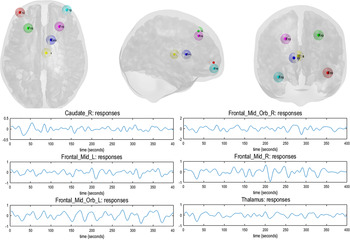
For each subject, we selected the specific ROIs based on the local maxima on the independent components corresponding to the bilateral ECN and BGN. Thus, according to the statistical results, a total of six ROIs were defined in the present study, including four ROIs in the bilateral ECN: (1) the left DLPFC [−24, 27, 48]; (2) the right DLPFC [21, 30, 45]; (3) the left OFC [−39, 5, −6]; (4) the right OFC [36, 57, −12], and two ROIs in the BGN: (1) the right caudate [12, 6, 9] and (2) the thalamus [3, −12, 12]. All ROIs were defined as 8 mm radius spheres centered on the above coordinates. Meanwhile, we created an anatomical structure mask corresponding to the above regions through anatomical automatic labeling to ensure accuracy in extracting the volume of interest (VOI).
Both VOI extraction and subsequent spDCM analysis were implemented in SPM12 (https://www.fil.ion.ucl.ac.uk/spm/software/spm12/). Following the standard SPM procedure, the residuals of a General Linear Model (GLM) were established from the preprocessed data. The principal eigenvariate of each VOI was extracted from the intersection of the spherical ROIs and the predefined anatomical structure mask and corrected for confounds. Finally, the six corresponding VOIs (ie, thalamus, right caudate, and bilateral DLPFC and OFC) were generated for each subject for subsequent spDCM analysis (see Figure 1).
Illustration of four nodes within the frontostriatal circuits. The nodes included the right caudate, the thalamus, the bilateral OFC, and DLPFC. Corresponding time-series shows the principal eigenvariates of the regions.

Spectral dynamic causal modeling
The spDCM analysis was implemented in DCM12.5. The principle description of spDCM can be found in the literature by Friston et alReference Friston, Harrison and Penny35 As a recently proposed DCM for resting-state fMRI, spDCM is considered a model-based analytical framework that allows inferring the intrinsic causal connections among specific regions through the cross-spectral density. Since spDCM is intended to simply compute the endogenous coupling among regions without any specific experimental input to task-based DCM (eg, stochastic DCM), it has higher computational efficiency and sensitivity to differences between groups, which is also a potential reason for using the spDCM approach in this study.
A fully and reciprocally connected model was specified for each subject after extracting the principal eigenvariate of each of the ROIs. This means that all six ROIs identified according to the local maxima on the independent components were connected to each other. Thus, 36 parameters were generated, including six recurrent self-connections, and estimated through the inverting model.
Second-level analysis with the parametric empirical Bayes framework
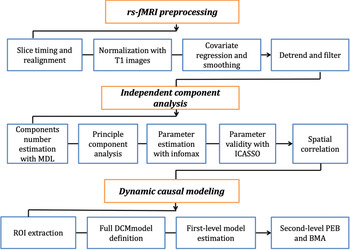
After estimating first-level (within-subject) DCM, we capitalized on the parametric empirical Bayes (PEB) framework in spDCM to structure a hierarchical model over parameters and to infer the second-level group results.Reference Friston, Litvak and Oswal36 Specifically, PEB integrates all first-level DCM parameters and uses the covariance component model to capture any unexplained between-subject variability, building a second-level GLM that contains the between-group parameters. We specified two different second-level models, including a design matrix with four regressors (commonalities across subjects, group index, sex, and age, of which sex and age are covariates) to infer differences between groups and another matrix with four regressors (commonalities across subjects, IAT scores, sex, and age) to further infer the association between addiction severity and strength of connectivity. After finishing the matrix parameter estimation, an exploratory Bayesian model reduction was implemented to automatically search over the reduced models from full models. A Bayesian model averaging of the two second-level PEB models was then performed separately to infer the effective connectivity that best describes the between-group differences, as well as associations between addiction scores and connectivity. Since the PEB framework uses Bayesian statistics, meaning that parameters have prior and posterior probability (PP) distributions and are described by their mean and covariances. Finally, the resulting parameters were thresholded to detect the between-group effects and the selecting threshold with PP > 0.99 based on free energy. The analysis flow could be seen in Figure 2.
Analysis flow of the current study. This study mainly includes three analysis steps: resting-state fMRI data preprocessing; ICA for selecting ROI, and dynamic causal modeling for exploring causality within frontostriatal circuits in IGD.

Results
Independent component analysis
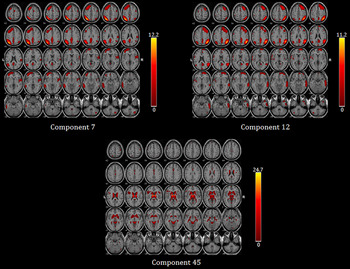
The independent spatial maps were decomposed by performing group ICA on the resting-state functional images. Forty-seven independent components were produced by the MDL criteria, and these components were sorted by their correlations with both the bilateral ECN and BGN templates. Finally, three independent components were identified to corresponding to the templates: the spatial correlation coefficient between component 7 and the left ECN was 0.653, between component 12 and the left ECN was 0.395, and between component 45 and the BGN was 0.333. Figure 3 shows the profiles of the bilateral ECN and BGN components. According to the group ICA analysis, four ROIs were defined for the bilateral ECN, including the bilateral DLPFC, OFC, and two ROIs for BGN: the thalamus and right caudate.
Executive control network (ECN) and BGN selected from the independent component analysis (ICA). Component 7 represents the left ECN; component 12 represents the right ECN; and component 45 represents the BGN.

Spectral dynamic causal modeling
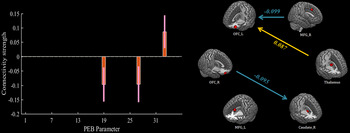
Second-level analysis with the PEB framework examined the between-group effects of effective connectivity. The parameters characterizing the difference between groups are given in Figure 4 and were described by the posterior probability and strength. Figure 4 illustrates parameters with a posterior probability greater than 0.99, in which positive values indicate excitement effects while negative values indicate inhibitory effects. Specifically, the inhibitory influence of the effective connections from the right OFC to the right caudate and from the right DLPFC to the left OFC was increased in IGD individuals compared to RGUs while the connection from the thalamus to the left OFC exhibited more excitatory regulation in IGD individuals than RGU.
Group difference inference with the PEB framework. The left plot shows parameters with a posterior probability greater than 0.99, of which parameter 19 represents the connection from the right OFC to the right caudate, parameter 27 represents the connection from the right MFG to the left OFC, and parameter 33 represents the connection from the thalamus to the left OFC. The right plot shows effective connections with significant differences between the two groups.

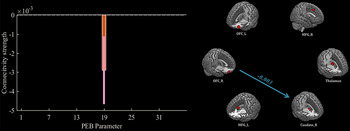
In addition, the correlation results from second-level PEB analysis showed that the directional connection from the right OFC to the right caudate was negatively associated with IAT score, that is, as the subject’s IAT score increases, the strength of this connection decreases (inhibition is increased) (see Figure 5).
Correlation analysis with PEB framework. The left plot shows parameters with a posterior probability greater than 0.99, of which parameter 19 represents the connection from the right OFC to the right caudate. The right plot shows the effective connection with a negative correlation with the IAT score.

Discussion
The frontostriatal circuits have been implicated in response inhibition, reward, and stimulus–response habits in addiction studies. A decreased rsFC between the PFC (eg, DLPFC, OFC) and striatum associated with the uncontrolled game behaviors had been detected. However, it is unclear whether and how they dynamically interact from the perspective of causal effect and contribute to dysfunction within these circuits. In the current study, we explored this issue using spDCM and found that IGD individuals showed an inhibitory effect between the regions within the ECN in comparison with RGUs, involving the pathway from the right DLPFC to left OFC. For the connectivity between ECN and the BGN, IGD seems to exhibit an abnormal quasicyclical loop, that is, an inhibitory connection from the right OFC to right caudate and an excitatory connection from the thalamus to the left OFC. Moreover, the strength of the connection from the right OFC to the right caudate was negatively associated with addiction severity. Thus, the top-down connection from the right OFC to the right caudate may be considered as a potential biomarker contributing to dysregulation within frontostriatal circuits.
Poor coupling between the ECN and BGN affects the evaluation and transmission of reward signals
As expected, the results showed an inhibitory connection from the right OFC to the right caudate in IGD and a negative association between the strength of this connection and individual addiction severity, reflecting a disordered top-down regulation. Specifically, the OFC and the caudate do not generally work in isolation but are intermodulated via the frontostriatal network, altering reward-related activity.Reference Tremblay and Schultz37, Reference Wallis and Miller38 The OFC encodes the motivational value of rewards and transmit this information to the dorsal striatum through a substantial number of monosynaptic glutamatergic inputs to influence reward-directed behavior.Reference Schultz, Tremblay and Hollerman39 The inhibitory effect of the OFC on the caudate in the present study may reflect that long-term over-gaming behavior undermines the integrity and function of the OFC–caudate neural pathway, leading to improper regulation of individual behavior by reward motivation. Our view of this potential risk is consistent with previous studies reporting that these problematic gaming behaviors may be caused by the mechanisms underlying the negative rsFC between the PFC and striatum.Reference Yuan, Yu and Cai24 Meanwhile, the present results further reveal that the PFC exhibits an inappropriately top-down modulation to the dorsal striatum and that this inhibitory effect is strongly associated with addiction scores. Thus, through a relatively large sample, we believe that effective connectivity from the OFC to the caudate may be a critical neural pathway for predicting the effectiveness of future IGD interventions.
Additionally, the second-level model inferring the difference between groups also showed an excitatory connection from the thalamus to left the OFC in IGD. The thalamus is generally thought to be a relay linking the main structures of the brain and is responsible for transmitting information from the subcortical regions or other cortex to the cerebral cortexes.Reference Greicius, Flores and Menon40 It has been verified in healthy populations that the relay function of the thalamus is subject to modulation, and the information flow to the target regions may change according to behavioral demands.Reference Sanchez-Gonzalez, Garcia-Cabezas, Rico and Cavada41 In addition, studies on obsessive–compulsive disorder indicate that the thalamus forms a cortico-striato-thalamo-cortical circuit through coupling with the striatum and the PFC, which is critical for reward processing, executive control, action selection, and habit formation.Reference Zhao, Xu and Wang42 In our previous work, the implication of an increased fractional anisotropy in the thalamus with the integration of reward information has been detected in IGD.Reference Dong, DeVito, Huang and Du43, Reference Dong, Wu, Wang, Wang, Du and Potenza44 Thus, the current results may indicate increased reward information transmission efficiency in the IGD, and the excessive reward information transmitted by the thalamus may further induce the OFC to miscode the reward value, causing the individual to pursue short-term rewards regardless of long-term adverse consequences.
Dysregulation within the ECN impairs the integrity of executive control functions
For the effective connectivity within ECN regions, compared to RGUs, IGD individuals showed increased inhibitory connectivity in the neural pathways from the right DLPFC to the left OFC. Executive control is often described as a capability to allow for flexible, adaptive behavior by suppressing inappropriate or irrelevant sensory or motor performance.Reference Kerns, Cohen, MacDonald, Cho, Stenger and Carter45 Good executive control is especially relevant within the context of IGD, as when stimuli associated with online games are involved, effectively suppressing cravings is essential to avoid excessive gaming behavior, while the DLPFC is continuously associated with the process, which has been validated in healthy individuals.Reference Cieslik, Zilles and Caspers46 Several IGD studies, however, have reported functional and structural defects in the DLPFC, indicating the implication of decreased activation and gray matter in the DLPFC with impaired executive control functions.Reference Dong, Liu, Zheng, Du and Potenza29, Reference Choi, Cho and Kim47 It should also be noted here that the OFC has been shown to encode not only reward vs punishment but also response engagement vs inhibition.Reference Fettes, Schulze and Downar48, Reference Noonan, Chau, Rushworth and Fellows49 Therefore, effective interaction between regions within the ECN is critical to functional integrity while the dysregulations within the ECN regions may induce a failure of executive control. Another rsFC study reported decreased synchrony of the ECN in IGD subjects, suggesting their executive control system was impaired by long-time online-game playing.Reference Dong, Lin, Hu, Xie and Du50 The present results are consistent with the previous research: the dynamic interaction within the ECN is impaired in IGD. Particularly, the reduction in the efferent coupling of the DLPFC may inhibit the participation of the OFC in executive control function, reflecting the profound and complex disorganization of brain regions within the ECN in IGD.
The OFC may be a key hub regulating game use during regional interaction
Interestingly, although they belong to different hemispheres, the effective connectivity changes observed in current research all involve obviously OFC regions. In fact, the OFC has been shown to be a nonhomogeneous structure composed of multiple subregions, all of which perform different functions.Reference Henssen, Zilles and Palomero-Gallagher51, Reference Kringelbach52 Thus, the specific roles in addiction played by the OFC have been increasingly revealed as complex and multifaceted. A meta-analysis showed that OFC is closely interconnected with other areas involving reward and motivation, executive control, and emotional regulation,Reference Moorman53 of which many of these anatomical relationships are bidirectional, for example, the interaction between the OFC and the amygdala.Reference Rudebeck, Ripple, Mitz, Averbeck and Murray54 In the current study, the dysfunctional effective connections of the OFC with the caudate, thalamus, and other prefrontal cortical regions in IGD strongly indicate that it should be considered a key node for regulating game use in IGD individuals. Given the complexity of the OFC’s structure, connectivity, and functions,Reference Moorman53 here we suggest that future multimodal imaging studies should attempt to establish a more detailed relationship between IGD and the OFC, which have substantial potential to explore novel details about and interventions for IGD and even SUD.
In general, in the current study, IGD individuals showed changes in the effective connectivity with OFC as the core in comparison with RGUs, including the afferent coupling from the thalamus and MFG and the efferent coupling to the caudate. Previous studies have shown that DLPFC coordinates other PFC regions to maintain the integrity of executive control functions.Reference Dong, Lin, Hu, Xie and Du50 The thalamus provides information input and output for other cortical and subcortical regions,Reference Greicius, Flores and Menon40 while the OFC is the information integration center within the frontostriatal circuits, responsible for evaluating the encoding and further projecting the information to the striatum to influence reward-directed behavior.Reference Moorman53 However, current connectivity results indicated that regional interactions within the frontostriatal circuits are abnormal in IGD, involving excessive information transmission, inappropriate reward evaluation, and impaired executive control. In fact, individuals with IGD often show a disconnection between the PFC and the striatum,Reference Yuan, Yu and Cai24 and after an intervention, the rsFC between related functional areas is improved.Reference Zhang, Ma and Li55 The frontostriatal circuits are an indispensable neural pathway for coordinating reward-seeking and executive control. As effective regulation between reward and control is known to be essential to addictive and other psychiatric disorders, the abnormalities of effective connectivity within the frontostriatal circuits, especially with the OFC, should be considered in future IGD interventions.
Limitations
First, although we used RGUs as a control for irrelevant effects (such as game frequency and familiarity), the current study lacks another control group with no gaming experience. If healthy nongaming individuals were included in the study to compare the difference among the three groups, it would better to explain the changes in effective connectivity from non-IGD to IGD. Second, there are limitations in the way to assess the severity of IGD of subjects through IAT and DSM-5 because these criteria are provisional and intended to help research efforts but not an absolute “gold standard.” Thus, it is necessary for future work to further evaluate these specific criteria and thresholding. Third, for the selection of ROI, we use ICA to determine the local maxima and used them as the coordinates to extract the VOI. Although this method has more autonomy and flexibility than selecting coordinates from previous literature, we may have ignored other meaningful areas. In addition, the radius and location of ROIs may be also nuisance variables that probably influence results, reflecting the disadvantages of the model-driven DCM approach. In future research, we need to consider the combination of both DCM and data-driven Granger causal analysis.
Conclusions
Using spDCM, the current study showed that IGD individuals present with an inhibitory effective connectivity from the right OFC to the right caudate and from the right DLPFC to the left OFC and an excitatory effective connectivity from the thalamus to the left OFC when compared with RGUs. These disordered couplings reflect dysfunction within the frontostriatal circuits of IGD, involving inappropriate reward evaluation, impaired executive control, and excessive information transmission. Although some IGD studies using rsFC have evaluated the connectivity within frontostriatal circuits, this study further revealed the improper causal effects within circuits regions through a large sample and suggested that future brain-based IGD interventions should consider the dysregulation in the right OFC–caudate pathway.
Acknowledgments
The current research was supported by the Zhejiang Provincial Natural Science Foundation (LY20C090005).
Disclosures
The authors declare that no competing interests exist.
Authorship Contributions
N.Z. analyzed the data and wrote the first draft of the manuscript. M.W., H.D., and X.D. contributed to fMRI data collection. G.D. designed this research and edited the manuscript. All authors contributed to and approved the final manuscript.