1. Introduction
A deeper integration of the world food supply chain is leading to an increased trade in food and agriculture. Here, a small weak link can lead to unsafe food, posing not only serious health risks to consumers, but also considerable costs to the suppliers (FAO, 2017; OECD, 2019). There are increasing concerns for better food quality along with new demands as a result of consumer expectations, one aspect of which is the surge in domestic Sanitary and Phytosanitary (SPS) measures as a minimum criteria to protect health and safety. However, such measures are followed by a parallel increase in the independently established SPS measures on potential imports from abroad (Webb et al., Reference Webb, Gibson and Strutt2018; Crivelli and Groeschl, Reference Crivelli and Groeschl2016; Disdier et al., Reference Disdier, Fontagne and Mimouni2008) and the resulting trade-barrier effects. This can lead to higher international trade tensions.
International standards are vital in guaranteeing safety in the global food supply system while avoiding possible trade-barriers that may come from heterogeneous domestic SPS measures. The WTO SPS Agreement sets a framework of rules for countries to internationally harmonize standards with potential effects on trade (e.g. Article 3). It officially recognizes the multilateral international standard-setting bodies – the FAO/WHO's Codex Alimentarius Commission (Codex), the International Plant Protection Convention (IPPC), and the World Organization for Animal Health (OIE) – as three sister organizations that act as reference bodies for the Agreement. Harmonization in the food and agricultural sector can also be evidenced in private standard development activities taking place worldwide, many of which have been successfully diffused in a wide range of countries, for example the British Retail Consortium (BRC), the Global GAP (Good Agricultural Practice), and Safe Quality Food (SQF) standards.
In between the reference bodies of the SPS Agreement and private standard developers exists the hybrid organization, the International Standard Organization (ISO). The ISO is composed of both public and private national standard setting bodies, representing governments, industries, and consumer organizations. The World Bank also collaborates with the ISO on activities to help developing country firms use standards to participate better in trade. The ISO first developed its food-safety management system standard in 2005, the ISO22000, to help identify and control hazards related to food safety, notably with the participation from the Codex Alimentarius Commission responsible for the development of the HACCP (Hazard Analysis and Critical Control Point) system for food hygiene. The standard is based on the Codex Alimentarius principles, or the ‘Food Code’,Footnote 1 which enables authorities to refer to ISO22000 in national requirements and government inspections to ensure that all the criteria for food safety are met (ISO, 2018). Other organizations such as the CIAA (Confederation of the Food and Drink Industries of the European Union) and WFSO (World Food Safety Organization) also worked in partnership with the ISO in the standard development. The ISO22000 is an internationally harmonized standard with a broad coverage of regions compared to other third-party standards. It covers the overall food chain, going further in managing the production processes and structures than the agricultural product itself.Footnote 2 It is important to note that the ISO22000 was developed as a comprehensive standard for the food-related sectors, harmonizing the HACCP and GMP (Good Manufacturing Practices) that are requirements from a technological aspect.
Although not technically bound by the multilateral trade rules that apply to the mandatory technical regulations set by government bodies, the ISO22000 shares the essential aim of such rules which is to harmonize uneven levels of food safety requirements across countries and to improve clarity in those requirements. However, whether such harmonization efforts have any empirical implications for export performance have not been sufficiently examined yet. The findings in previous empirical studies on the impact of food-related international standards are hard to generalize beyond a certain country or region level (Czubala, et al., Reference Czubala, Shepherd and JS2007; Escannciano and Santos-Vijande, Reference Escannciano and Santos-Vijande2014; Mohammed and Zheng, Reference Mohammed and Zheng2017). Under such circumstances, the academic void in the food and agricultural sector must be filled starting from a more general empirical assessment of the international standard harmonization efforts. In this sense, examining the ISO-developed standard that brings with it a comprehensive and well-organized database on the international diffusion status can be a good starting point.
This study conducts a macro-level analysis of the impact of one of the most widely used food-related standards in the world, the ISO22000 on agricultural exports based on an unbalanced panel dataset covering 10 years of export data across 177 countries. There are five main strong points to the analysis employed in this study. First, it takes into account the most recent developments in the gravity literature regarding estimation challenges related to multilateral resistances, zero trade flows, possible endogeneity of trade policies (or voluntary standards adoption, in our case), and heteroskedasticity of trade data in a country-level analysis (Anderson and Yotov, Reference Anderson and Yotov2012; Piermartini and Yotov, Reference Piermartini and YV2016). Thus, the Poisson Pseudo Maximum Likelihood (PPML) estimator proposed in Santos Silva and Tenreyro (Reference Silva JMC and Tenreyro2006), along with directional time-varying fixed effects and country-pair fixed effects are successively employed in this study.
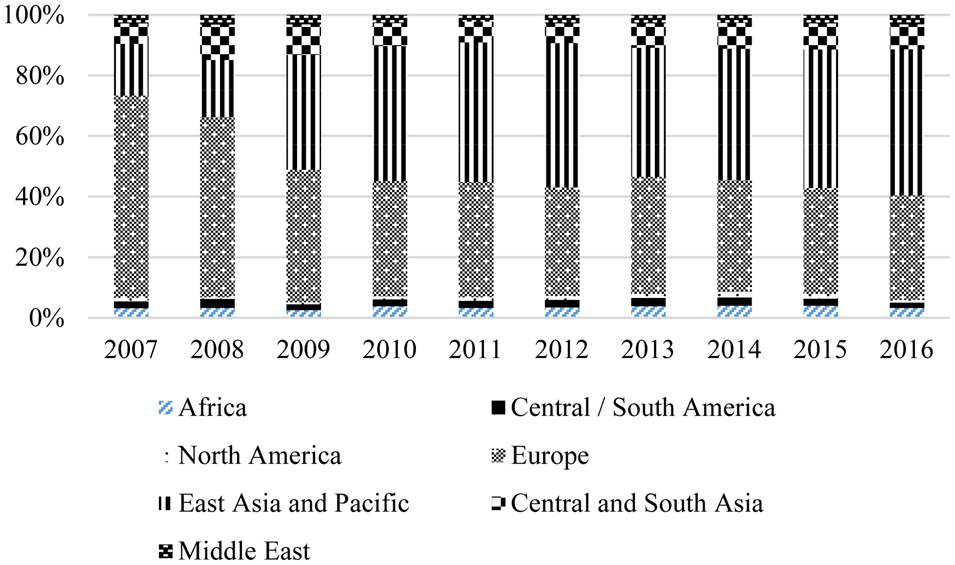
Second, it considers the different characteristics of exported products by separately examining three different sub-sectors of agricultural products: primary, semi-processed, and processed products. Since ISO22000 applies to the production process as well as to the product, it may have different implications depending on the degree of processing the products are exposed to in the exporting country. Third, this study implements separate analyses of developed and developing countries’ exports,Footnote 3 thus taking into account the distinct export patterns and conditions related to production facilities or technology of the two exporting country groups. To some extent, it allows differentiation between processed and primary/semi-processed products based on the fact that the developed countries tend to export a much higher share of processed products in agricultural exports compared to the developing countries that rely much more on primary and semi-processed products (FAO, 2004; FAO, 2013). The two country groups also differ in the degree of ISO22000 adoption. Figure 1 shows how the regional share of the standard adoption is considerably tilted towards Europe and East Asia, where a majority of developed nations in the world are located. In sum, implementing individual examinations of each group will account for the different trade effects of the standard depending on the differing levels of production processes as well as distinct infrastructural and technological situations between countries. Fourth, the study observes both exporting country and importing country channels as well as their interaction through which standardization may affect trade. Fifth, it takes into account the specific trade settings in which the potential effects of the importing country standardization would be manifest; ‘the compliance-cost effect’ and ‘the information-provision effect’ that do not realize equally throughout all trade relationships, but rather, are likely to better manifest in country-pairs where the importing country's domestic standardization level is higher than that of the exporting country. Previous studies do not account for such specifications which may lead to bias in the impact estimations.
Regional share of ISO22000 adoption (in %)
Source: Constructed by the author with data from the ISO Survey (2018).

2. Trade Effects of Internationally Diffused Food Standards
There are three particular channels through which standardization may affect export flows: (1) standardization in the exporting country that enhances competitiveness of the firms certified by the standard while incurring implementation costs; (2) standardization in the importing country that provides information to exporting firms while also incurring compliance costs; and (3) interaction between the standardizations of the two trading countries that various studies (e.g. Claugherty and Grajek,2014; Liu and Yue, Reference Liu and Yue2012) refer to as a ‘common language effect’. In their country-level empirical models, this effect is estimated using the interaction term between the standardization level variables of the exporting and importing country.
Standard diffusion in the ‘exporting country’ can bring about internal efficiency and enhanced demand for exports through improvement of product quality that positively influences their exports (Liu and Yue, Reference Liu and Yue2012). This can be referred to as the ‘competitiveness-enhancing effect’. However, implementing the standard incurs implementation costs that have countervailing negative effects on exports (Terziovski et al., Reference Terziovski, Power and Sohal2003; Blind, Reference Blind2004), which may be referred to as the ‘implementation-cost effect’. Standard diffusion in the ‘importing country’ may also be projected as countervailing incentives on exports. Costs incurred on exporting firms when complying with the standards of the importing country creates a negative pull on exports, referred to as the ‘compliance-cost effect’. In contrast, standardization in the importing country disseminates its local knowledge and market information to the exporters, creating a positive push on exports referred to as the ‘information-provision effect’ (Claugherty and Grajek, Reference Clougherty and Grajek2014; Swann et al., Reference Swann, Temple and Shurmer1996). Which opposing influence prevails over the other will be examined empirically in this paper.
Previous studies on the impact of food-related standard diffusion within the ‘exporting country’ have had mixed results. Some find no evidence of any significant effect of certification on export performance (Schuster and Maertens, Reference Schuster and Maertens2015), while others find positive effects on exports (Henson et al., Reference Henson, Masakure and Cranfield2011; Zheng et al., Reference Zheng, MK and J2013). Regarding studies on the impact of food-related standard diffusion within the ‘importing country’, some find positive effects on trade (Karandagoda et al., Reference Karandagoda, Udugama and Jayasinghe-Mudalige2014; Liu and Yue, Reference Liu and Yue2012), while some papers point to differing effects depending on the exporting countries’ economic development status (Anders and Caswell, Reference Anders and Caswell2009). However, these studies are mostly based on a firm-level, specific region-level, or a specific product-level analysis. Not enough comprehensive macro-level studies are found on the impact of internationally diffused food-related standards on agricultural trade in general. This is in part due to the difficulties in overcoming the various country-level estimation challenges regarding which some meaningful breakthroughs have only recently been provided. This research aims to contribute in filling the gap by employing these latest developments to draw some general conclusions on the effects of the ISO22000 on agricultural export values.
In examining the three principal channels through which standards can impact export flows, this study also takes into account certain specifications necessary to improve accuracy in the estimations, especially for the ‘importing country’ standardization effects. Expecting the compliance-cost effect and information-provision effect to manifest unilaterally in all trade relationships can be misleading and can result in a bias in the estimations. For example, the compliance-cost effects are less likely to take place for exporting countries that are already equally or better diffused with the standard than the importing country. By definition, compliance becomes burdensome when the exporter faces new standard requirements from the importing market that they are not already equipped with. That is, a matter of compliance is more likely to be raised if the importer implements the standard system whereas the exporter does not. At a country-level analysis, this situation can arise more often when the exporting country is less diffused with the standard compared to the importing country. Similar reasoning can be applied to information-provision effects. There is less, if not no, local knowledge or market information to be disseminated specifically through the standardization channel to the exporting countries if the importing country is not as diffused with the standards to begin with. The importing country is expected to diffuse new knowledge and more information about its domestic market to the exporter when the country is further along in its implementation of the standard system. Hence, both compliance-cost effects and information-provision effects come into force mainly in trade relationships where the importing country is better diffused with the standard relative to the exporting country, which is why specific conditions in which the effects are likely to occur when analyzing the impacts of international standards should not be ignored. In sum, this research increases accuracy of the impact estimations of ISO22000 by considering for the basic trade settings where the two major effects of the importing country channel may actually be realized. If the information-provision effect embedded in the importing countries’ adoption of ISO22000 overwhelms the countervailing compliance-cost effect, it would result in a net positive influence of the importing country's standardization, supporting existing arguments that the diffusion of international standards disseminates local knowledge and provides necessary information to exporters. If the compliance-cost effect overwhelms the information-provision effect, the result would be a net negative influence, implying that getting certified to the standard can be more burdensome than helpful in terms of export performance.
In this regard, a dummy variable with a value of 1 for trading pairs where the importing country has a higher ISO22000 diffusion level than that of the exporting country (ISO dummy) is applied in this study to verify the two countervailing effects. Each of the trading partner's standard diffusion level is interacted with the ISO dummy to form two interaction terms that will be examined in addition to the three impact channels explained above. This will better expose the potential effects of the importing country's standardization (the existence and relative size of the compliance-cost effect and the information-provision effect) compared to examining only the simple importing country standardization level. The interaction term with the exporting country standardization level is added for potential unexpected effects.
3. Data and Descriptive Statistics
This research employs unbalanced panel data for the period 2007–2016 for 177 countries exporting agricultural products to the rest of the world, which is a considerably larger coverage compared to existing empirical works on the impacts of standards on trade. The period covered was decided given the circumstances in data provision for ISO standard variables. Products considered are all agricultural products defined in the HS code system (HS 01-24) to which ISO22000 may apply. The products are categorized into three subsectors for individual analysis and comparison: primary products (HS 01-10), semi-processed products (HS 11-14), and processed products (HS 15-24). Data for ISO22000 standard variables were retrieved from the ISOTC's ISO Survey.Footnote 4
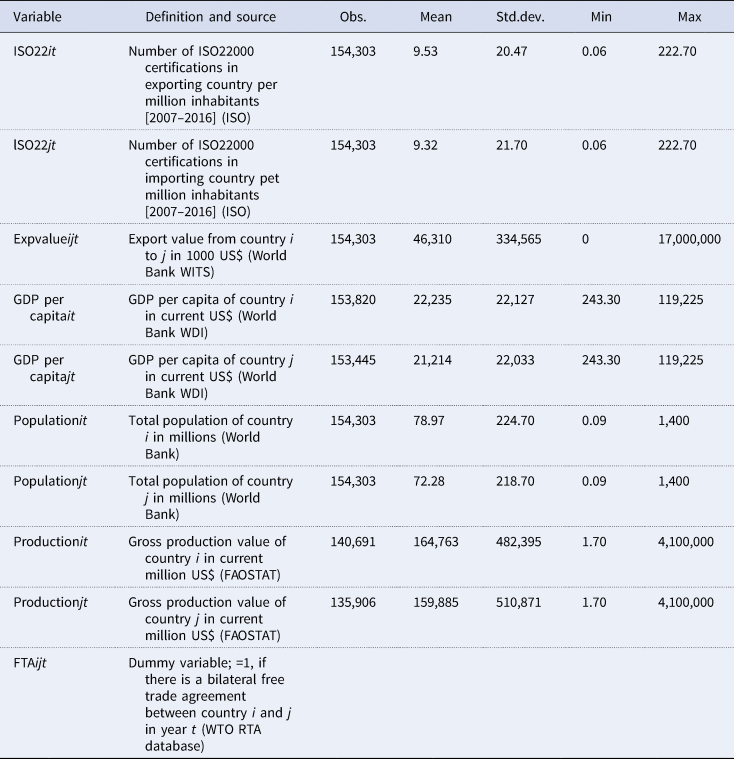
The number of certifications was used to indicate the ISO standardization (standard-diffusion) level in each country rather than the number of certified-sites among the two types of data provided by the ISO Survey, as the ISO itself has diagnosed the latter as incomplete and inconsistent.Footnote 5 The main explanatory variables regarding ISO22000 certification are presented in continuous constructs rather than dichotomous constructs to address the measurement error as a source of endogeneity, based on existing literature that point out how dichotomous constructs are often more exposed to such errors (Baier and Bergstrand, Reference Baier and Bergstrand2007; Claugherty and Grajek, Reference Clougherty and Grajek2014). The ISO22000 variables representing domestic standard diffusion levels for each trading partner are scaled with the total population of each country, thereby constructed as the number of certifications given to each country per million people. Data used in the main estimations are summarized in Table 1. Bilateral trade flow data (in nominal trade values) come from the World Bank's WITS database (WITS, 2019). Data on GDP per capita and population come from the World Bank Development Indicators database, while domestic agricultural production levels are from FAOSTAT. Data on common language, border adjacency, and distance come from the Centre d'Etudes Prospectives et d'Informations Internationales (CEPII, 2019). The WTO Regional Trade Agreements database is the main source for FTA data. These control variables include those typically found to account for the trade costs in existing gravity literature (WTO/UNCTAD, 2012), while agricultural production was additionally controlled for in order to account for the correlation between the domestic production size and the ISO22000 standardization.
Summary of the data for the main estimations (2007–2016)

4. Estimation of the Trade Effects of ISO22000
4.1 Estimation Issues and Model Selection
This study performs an extended gravity model analysis of agricultural trade at a sector-level, categorizing products into three different groups depending on the extent of processing the products are exposed to: primary products (HS 01–10), semi-processed products (HS 11–14), and processed products (HS 15–24). This takes into consideration that the ISO22000 has its strength in the management of production processes, which implies a possible heterogeneous impact of the standard across the three product types that go through different degrees of processing. Also, we distinguish between the developing and the developed countries, taking into account their distinct trade patterns regarding the type of exported products and the differing levels of standard adoption.
In addition to the above two considerations, we must also contemplate the challenges in the estimation of the gravity model. Recent academic developments have drawn attention to the problems that need to be addressed in order to obtain reliable estimates in examining the impact on trade using this model. The main challenges are as follows: (i) multilateral resistances which are not directly observable since they are theoretical constructs (Anderson and van Wincoop, Reference Anderson and van Wincoop2003; Olivero and Yotov, Reference Olivero and Yoto2012; Feenstra, Reference Feenstra2004); (ii) zero-trade flows that clearly show the drawbacks of utilizing the OLS estimator for gravity equations (Helpman, et al., Reference Helpman, Melitz and Rubinstein2008; Santos Silva and Tenreyro, Reference Silva JMC and Tenreyro2006); (iii) heteroskedasticity of trade data that leads to biased and inconsistent estimates of effects when using the log-linear form of the OLS estimator (Santos Silva and Tenreyro, Reference Silva JMC and Tenreyro2006; Anderson and van Wincoop, Reference Anderson and van Wincoop2003); (iv) bilateral trade costs that need proper specification; (v) endogeneity in estimating the effects of trade policy (Baier and Bergstrand, Reference Baier and Bergstrand2007); (vi) the time it takes for trade flows to adjust in response to changes in trade policy (Trefler, Reference Trefler2004; Baier and Bergstrand, Reference Baier and Bergstrand2007; Olivero and Yotov, Reference Olivero and Yoto2012).
In this study, we review the solutions proposed in the literature and combine the best solutions to address the above-mentioned obstacles, as well-summarized and recommended in the WTO Working Paper of Piermartini and Yotov (Reference Piermartini and YV2016). Hence, we apply the following recommended methodologies:
(1) panel data method, for improved estimation efficiency and to allow for various fixed effects;
(2) Poisson pseudo maximum likelihood estimator, to account for heteroskedasticity and zero trade flows;
(3) directional time-varying fixed effects (exporter-time and importer-time fixed effects), to control for unobservable multilateral resistances and other observable/non-observable characteristics that vary across time for each exporter and importer;
(4) country-pair fixed effects, to account for endogeneity of ISO standard adoption and FTAs, as well as for all time-invariant bilateral trade costs;
(5) panel data with intervals, to allow for the adjustment period of bilateral trade flows in response to changes in the ISO standard adoption. Three-year intervals are used in this study considering that the dataset contains 10 consecutive years of ISO22000 adoption data. Olivero and Yotov (Reference Olivero and Yoto2012) finds how 3-, 4-, and 5-year intervals give similar estimates of standard gravity variables.
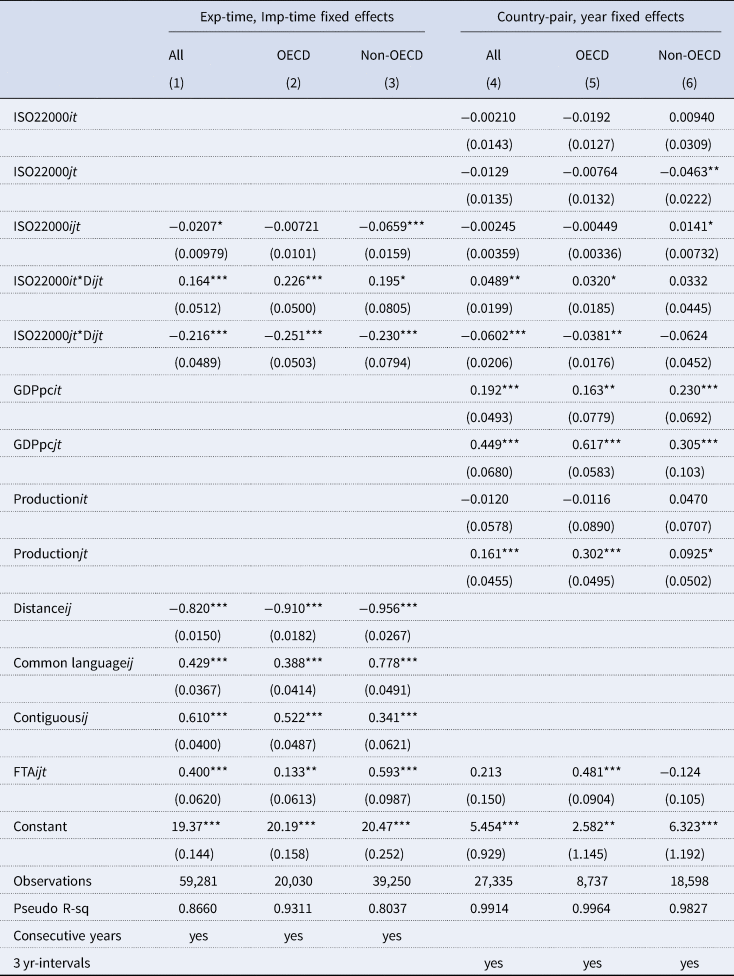
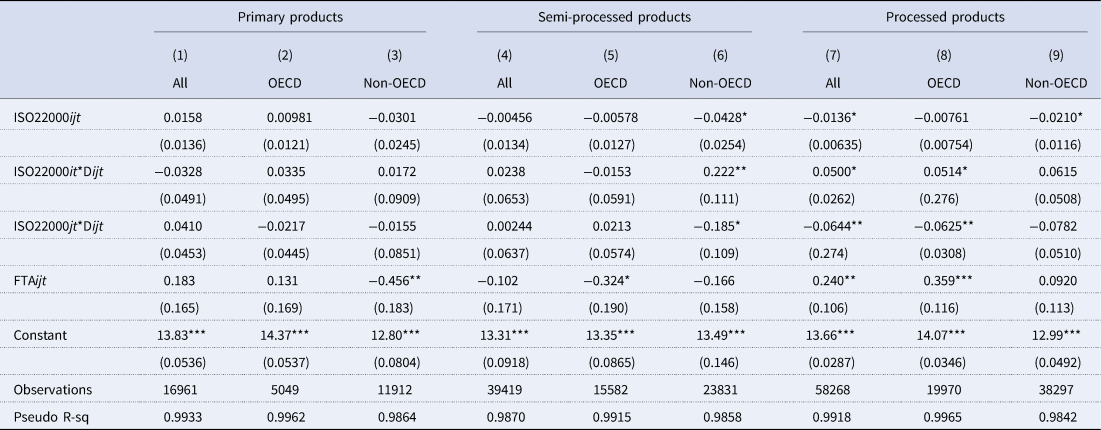
Whereas (1) and (2) are applied throughout the analysis, the different fixed effects of (3) and (4) are initially applied in a separate analysis in order to show the coefficient estimations for two of the five main standard variables, ISO22000it and ISO22000jt, and for control variables that would be dropped out when both fixed effects are applied together. Then, a final estimation including both fixed effects are added in the last stages as the most robust form of specification as proposed by Baier and Bergstrand (Reference Baier and Bergstrand2007). Hence, the estimations are implemented in three forms with a combination of (1) + (2) + (3) with consecutive 10 years of data (Specification 1), with a combination of (1) + (2) + (4) + (5) with 3-year interval data and time-fixed effects (Specification 2), and finally with a combination of (1) + (2) + (3) + (4) to recheck the robustness of the results in estimation forms 1 and 2 (Specification 3) employing both directional time-varying fixed effects and country-pair fixed effects. Specifications 1 and 2 will also complement each other since the former gives coefficient estimates for time-invariant bilateral control variables which are dropped in the latter form as well as in Specification 3 (distance, common language dummy, and common border dummy), while the latter gives estimates for exporter and importer time-variant control variables that are dropped in the former as well as in Specification 3 (GDP per capita, agricultural production level). Overall, we perform three individual estimations for each primary, semi-processed, and processed product types. For each product type, we successively employ Specification 1 and Specification 2, and for each of these specifications we draw three estimation results, that is for the developing countries, the developed countries, and all countries. These results are organized in Tables 2, 3, and 4. Finally, additional results for each of the product types and country groups using Specification 3 will be added in Table 5.
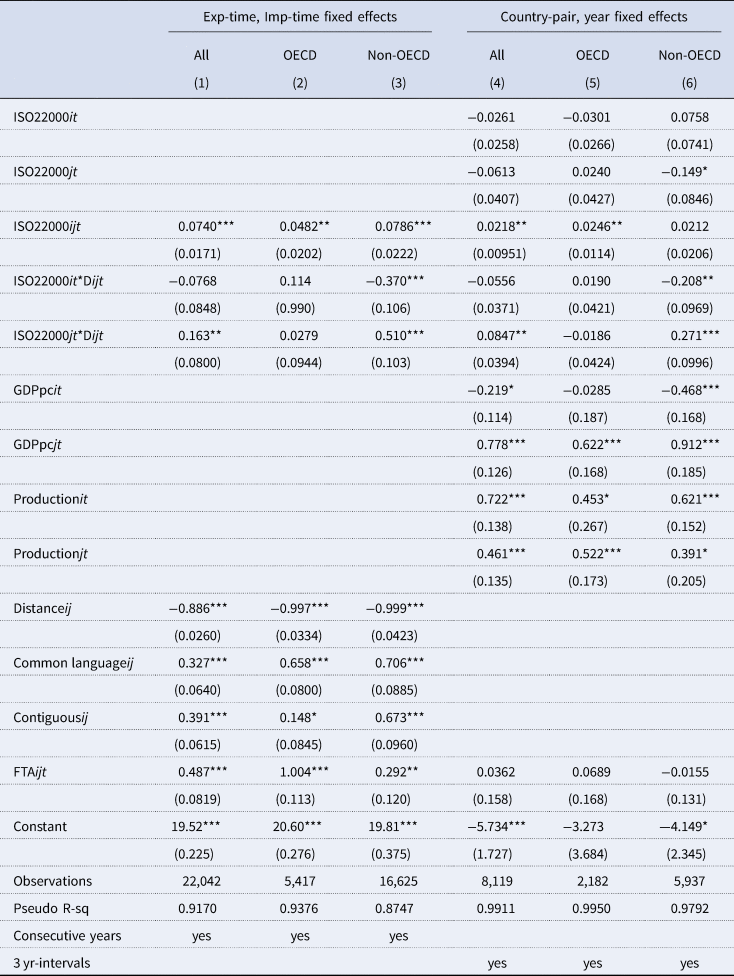
Impact on primary agricultural product exports (PPML)

Notes: All variables except for export values and dummy variables are in logs. Cluster robust standard errors are in parentheses, where clusters are defined as country pairs. ‘All’, ‘OECD’, and ‘non-OECD’ countries all refer to exporting country groups.
* p < 0.10, ** p < 0.05, *** p < 0.010.
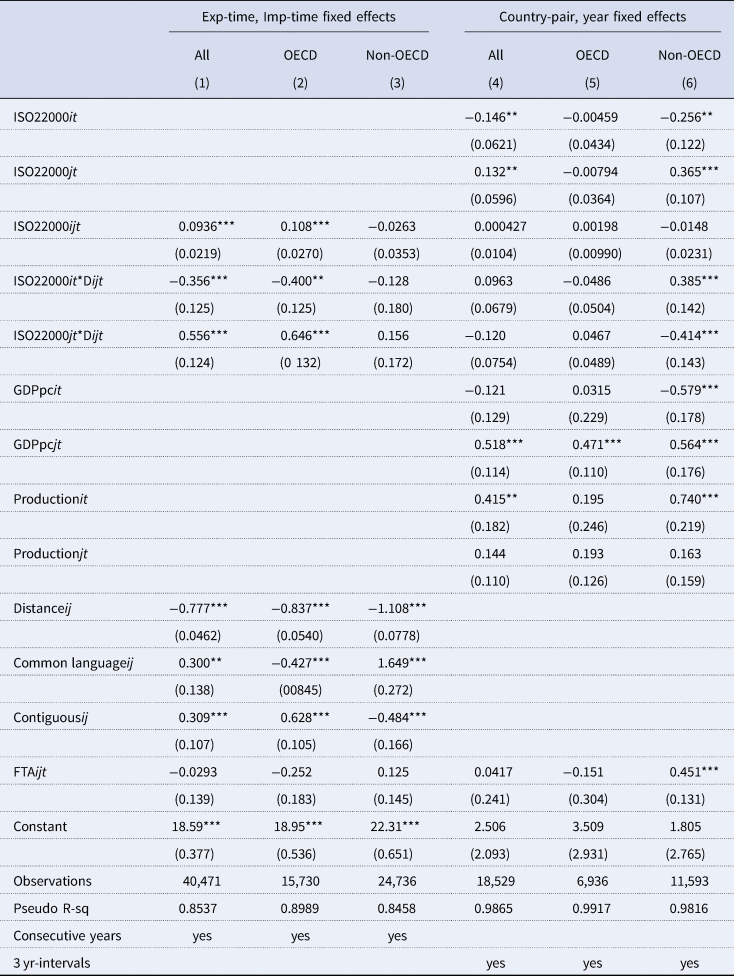
Impact on semi-processed agricultural product exports (PPML)

Notes: All variables except for export values and dummy variables are in logs. Cluster robust standard errors are in parentheses, where clusters are defined as country-pairs. ‘All’, ‘OECD’, and ‘non-OECD’ countries refer to exporting country groups.
* p < 0.10, ** p < 0.05, *** p < 0.010.
Regarding our main explanatory variables related to the ISO22000 diffusion, we examine both the exporting country channel (ISO22000it) and the importing country channel (ISO22000jt) of impact, along with the interaction of the two; the common language effect of the ISO22000 standardization between bilateral trading partners. Here we add two more specification variables by interacting each of the former two channels with the ISO dummy (Dijt; with a value of 1 for bilateral trade relationships where the importing country is more diffused with ISO22000 than the exporting country), for reasons explained in the previous part of this paper. We will find justification for inserting these two interaction terms with the ISO dummy (ISO22000it *Dijt, ISO22000jt *Dijt) in the country-pair fixed effect model estimations (Specification 2), where the results will show the coefficients for the simple exporting and importing country channels as well as the interaction terms. This will not be possible in the analysis with the directional time-varying fixed effects (Specifications 1 and 3) where the two simple channels will be automatically dropped.
First, equation (i) will be examined with the exporter-time and importer-time fixed effects PPML model, where the two simple ISO standard variables (ISO22000it, ISO22000jt) are omitted because the directional fixed effects will control for the characteristics that vary over time for each exporter and for each importer. Only the two interaction terms with the ISO dummy (ISO22000it *Dijt, ISO22000jt *Dijt) and the common-language channel (ISO22000ijt) are inserted. The control variables here are time-constant bilateral characteristics variables as well as the FTA dummy that will not be eliminated in the model. Expvalueijt is the value of exports from country i to j in year t. ISO22000it is the simple certification diffusion level of the exporting country i in year t, whereas ISO22000jt is that of the importing country j in year t. The ISO dummy (with a value of 1, if ISO22000it<ISO22000jt) denoted Dijt is interacted with each of these standard diffusion levels. ISO22000ijt is the interaction term of the two simple standard variables ISO22000it and ISO22000jt, to examine the common-language effect as explained in the previous section of this paper. FTAijt is a dummy variable with a value of 1 if there is a free trade agreement between the two countries in year t, and with a value of 0 if otherwise. Cij is a set of time-constant control factors composed of the distance, common language, and common border between country i and j, and ɛijt is the error term.
 $$Expvalue_{ijt} = \alpha _0 + \alpha _1ISO22000_{it}\ast D_{ijt} + \alpha _2ISO22000_{\,jt}\ast D_{ijt} + \alpha _3ISO22000_{ijt} + \alpha _4C_{ij} + \alpha _5FTA_{ijt} + \varepsilon _{ijt}\;$$
Then in equation (2), Xit is the vector of observable characteristics of the exporting country that vary across time, while Mjt is the vector for the importing country characteristics. They include the GDP per capita and the level of domestic agricultural production.
 $$Expvalue_{ijt} = \beta _0 + \beta _1ISO22000_{it} + \beta _2ISO22000_{\,jt} + \beta _3ISO22000_{ijt} + \beta _4ISO22000_{it}\;\ast\; D_{ijt} + \beta _5ISO22000_{\,jt}\;\ast\; D_{ijt} + \beta _6X_{it} + \beta _7M_{\,jt} + \beta _8FTA_{ijt} + \delta _{ijt}$$
4.2 Expected Results
We form expectations of the analysis results based on the two statistical facts mentioned previously in this paper. First, the regional share of ISO22000 adoption shown in Figure 1 allows us to expect developed countries to have a generally higher adoption rate of ISO22000. Hence, the ISO Dummy (Dijt) is likely to reflect conditions in which the export flow occurs from a relatively less developed to a more developed country regarding the two trading partners even within the developed or developing country group. Second, FAO statistics show that there is a correlation between a country's development status and the type of agricultural product the country exports. That is, developed countries tend to export a considerably higher proportion of ‘processed’ products while developing countries export more ‘primary’ or ‘semi-processed’ products. With these two facts, we anticipate different effects of ISO22000 adoption depending on the exporting country's development status and the product type exported. Expected results based on previous discussions are organized from (a) to (d) below.
(a) The impact of ISO22000 through the importing country channel will be more significant for the interaction term (ISO22000jt*Dijt) than the simple term (ISO22000jt).
(b) The impact of ISO22000 will be more significant for processed exports than for semi-processed and primary product exports, as they are more likely to be exposed to longer and more complex production processes.
(c) For the processed products exported to a more standardized country(Dijt = 1) the exporting country standardization will have a positive impact on exports by enhancing competitiveness, while the importing country standardization will have a negative impact on exports by incurring higher compliance costs.
(d) The common language effect between the exporting and importing country standardization will have a positive effect on exports regardless of development status or product type.
4.3 Results and Discussion
The results are discussed in two stages. First, results for Specifications 1 and 2 for each of the three product types (refer to Tables 2, 3, and 4, respectively) will be reviewed. Next, the estimations will go through a final robustness check with Specification 3 in Table 5 for all three product types.
Results in Table 2 show a potential net positive impact on primary product exports from developing countries. Although the exporting country channel (ISO22000it and ISO22000it*Dijt) has a consistent negative effect on exports from developing countries, the importing country channel has a consistent positive effect on their exports exceeding in size the mentioned negative effects. This suggests the positive information-provision effect of the importing country standardization may be bigger than the negative compliance-cost effect for exports from the developing countries. However, we find no impact through either the exporting or importing country channel for the developed countries unlike in the case of the developing countries. This may be related to the relatively more stringent quality regulations and standards domestically applied within the OECD countries regarding the primary industry (e.g. mandatory EU regulations as well as private standards such as GlobalGAP) compared to the quality requirements of the ISO22000 (Olper et al., Reference Olper, Curzi and Pacca2014).
Results in Table 3 show that for semi-processed products, the coefficients suggest an overall net negative effect through the exporting country channel and net positive effect through the importing country channel, but these results are doubtful as the effects are not found consistently for either of the specific country groups. This provides little or no evidence of the existence of any systematic impact of standardization on semi-processed product exports.
Results in Table 4 show that for processed products, the exporting country channel of ISO22000 standardization has a significant positive effect on exports from the developed countries, but not on those from the developing countries. This suggests that the competitiveness-enhancing effect of the standard overwhelms the implementation-cost effect for major exporters of processed agricultural goods in the developed country group. In contrast, the importing country channel has significant negative effects on exports from both the developed and developing countries. For developed countries, this indicates that the negative compliance-cost effect is generally higher than the positive information-provision effect. However, unlike developed countries that only show significant coefficients for ISO22000 variables interacted with the ISO dummy as can be seen in column (5) of Table 4, developing countries do not show significant coefficients for the interacted terms. This implies that the existence of the compliance-cost effect through the importing country standardization channel is dubious for the developing countries. Here, the results in the country-pair, year fixed effects models (Specification 2) also provide justifications for the insertion of the interaction terms with the ISO dummy. For example, comparisons of the columns (2) and (5) of Table 4 show that the coefficients for the interaction terms are significant even when the simple channel variables (ISO22000it and ISO22000jt) are controlled for. In fact, the coefficients of the simple channel variables in column 5 are found insignificant as opposed to those of the interaction terms, indicating that the standardization impact is indeed most likely to occur through the compliance-cost and information-provision effects of the importing country channel. Overall, the net result of the countervailing effects through the exporting and importing country channel is a negative impact on the processed products from developed countries.
Impact on processed agricultural products exports (PPML)

Notes: All variables except for export values and dummy variables are in logs. Cluster robust standard errors are in parentheses, where clusters are defined as country pairs. ‘All’, ‘OECD’, and ‘non-OECD’ countries refer to exporting country groups.
* p < 0.10, ** p < 0.05, *** p < 0.010.
The above comparison of the results in each product type provides evidence that the impact of ISO22000 diffusion has meaningful effects on agriculture and food-related exports around the world. The impact is particularly evident for processed product exports that are negatively influenced by the standard diffusion. No impact on semi-processed products are found, but results based on Specifications 1 and 2 suggest certain possibilities of a positive impact on primary product exports from the developing countries through the importing country channel, whereas no common language effect is found consistently throughout the different product types and country groups. The final estimations of Table 5 using both directional and country-pair fixed effects reassert the existence of the negative impact on the processed products as well as the non-existence of any consistently significant impacts on primary or semi-processed products as can be seen in columns (2), (5), and (8). Column (8) shows that the compliance-cost effect overwhelms the information-provision effect through the importing country channel, creating a net negative impact on the processed product exports of the developed countries, whereas this impact is not shown for the developing countries.
Impact on agricultural products exports (PPML)

Notes: Both directional fixed effects and country-pair fixed effects are applied. Cluster robust standard errors are in parentheses, where clusters are defined as country pairs. All variables except for export values and dummy variables are in logs. ‘All’, ‘OECD’, and ‘non-OECD’ countries all refer to exporting country groups.
* p<0.10, ** p<0.05, *** p<0.010.
In summary, robust to any gravity specification employed, the findings show that the agriculture and food-related export performances of the developing countries at the country-level are not significantly affected by adoptions of the international standard developed by the representative international standardizing body. This may be partially explained by the statistical fact that the developing countries tend to have comparative advantages in primary and semi-processed products that are less affected by the standard, while having comparative disadvantages in processed products against the more developed countries. On the other hand, the findings show otherwise for the developed country group where major exporters of processed products are located. The negative impact coming from the importing country channel cancels out the positive impact coming from the exporting country channel for their processed product exports. We can see that the estimations give general evidence supporting the expectations (a), (b), and (c). Nevertheless, (d) in which we expected a significant common language effect to exist across all country groups and products was not supported by the results.
The findings support an interesting aspect of the international standard diffusion on agriculture and food-related products. The compliance burdens of standard certification may be imposed, not depending on the development status of a country, but depending on the degree of processing that the exported goods are exposed to. This is to say that the compliance concerns for the developing countries regarding the standard adoption may be overrated considering their dominant export patterns. In fact, there were even signs of a net positive influence on the primary product exports coming from the developing countries through the information-provision effect as was shown throughout the estimations of Specifications 1 and 2.
5. Conclusion and Implications
This study provides evidence of the impact of ISO22000 standardization on agricultural exports, analyzing both the exporting and importing country channels and their interactions. It provides comprehensive macro-level estimations on 177 countries, while specifically considering for differences among distinct product types and country groups.
First, the findings reveal that a meaningful standardization effect exists only on processed product exports, while the effect on primary and semi-processed products is unclear. Second, the negative effects are consistently significant only for the developed countries. This is likely to be explained by the export patterns across borders where processed product exports tend to be relatively concentrated in the developed economies. Third, decomposing this effect on processed exports of developed countries, the negative compliance-cost effect is found to be greater than the positive information effect, and this net negative influence surpasses the net positive influence coming from the exporting country standardization channel. Put together, the negative impact through the importing country channel overwhelms the positive impact through the exporting country channel, resulting in a net negative impact of ISO22000 adoption on the processed agricultural exports of the developed countries. However, meaningful evidence is not found for the impact of ISO22000 through the common-language channel.
The ISO22000 was developed with the cooperation from the Codex Alimentarius Commission and with participation of ISO members representing government bodies. Thus, it is generally considered an internationally harmonized standard in the current trade system. This suggests that it acts as a basic justification for exporters in entering foreign markets while guaranteeing minimum quality and safety of the globally traded agricultural products. However, the implications on export flows can only be examined empirically. The findings in this research provide evidence of the significant impacts the standard has on international trade, but shows how the impact differs mainly depending on the degree of processing of the exported products. It is especially encouraging that the standard diffusion was found not to have discouraging effects on developing countries’ exports of the primary and semi-processed products which take up a considerable part of their total export goods. This alleviates existing concerns for the standards acting as trade barriers against the less developed countries (Trienekens and Zuurbier, Reference Trienekens and Zuurbier2008), and provides some perspectives on the actual role that widelydiffused international standards can play in improving the minimum quality of global agricultural trade while not imposing heavy burdens on smaller economies: a practical implication on the multilateral standard harmonization efforts.