Disasters are known as the results of events caused by natural, technological, or human factors that interrupt human activitiesReference Varol and Gültekin1 and normal life and cause2 physical, social, and economic losses.Reference Quarantelli3 Disasters can affect human activities in the areaReference Cutter4 where they occur and can bring many problems.Reference Thomas, Mitchell and Scott5 Regardless of the source of disasters, all components of society can be affected by this situation.Reference Quarantelli6 Especially, individuals in vulnerable groups such as women, children, the elderly, pregnant women, and peopleReference Gündüz7 with disabilities may experience the negative effects of disasters more and the level of disaster response of these groups may differ.Reference Thurairajah, Haigh and Thurairajah8, Reference Neumayer and American9 Women, who are among the aforementioned groups and constitute the population of our study, are more affected by disasters due to factors related to gender roles such as their education level,Reference Hemachandra, Amaratunga and Haigh10 the behaviors they have developed due to their upbringing,Reference Neumayer and American9 and the skills they have acquired throughout their lives.Reference Ikeda11, Reference Enarson and Meyreles12 Although the behaviors women have developed due to their upbringing and the skills they have acquired throughout their lives vary depending on sociocultural factors, they recognize risks and are the first to adopt safety behaviors, correctly evacuate individuals and animals under their care, and direct individuals using appropriate instructions; women climb, drive, ride bicycles, and use tools in combination with their leadership skills.Reference Gündüz7, Reference Neumayer and American9, Reference Ikeda11, Reference Enarson and Meyreles12
StudiesReference Clissold, Westoby and McNamara13, Reference Smyth and Sweetman14 indicate that women’s vulnerability to disasters and their capacities are different. The characteristicsReference Wood and Eagly15 that women spontaneously developed to overcome problems arising from gender differences enabled them to develop organizationalReference Sandmeyer, Kohn and Driscoll16 and coordinational skills.Reference Ruducha, Hariharan and Potter17 Moreover, if these skills are supported by training, women may become major actors in disaster management processes.Reference Hemachandra, Amaratunga and Haigh10 The psychological empowerment of women supports this situation.Reference Işık, Özer and Sayın18 This is because psychological empowerment refers to women’s ability to make and implement choices.Reference Brody, De Hoop and Vojtkova19 Through psychological empowerment,Reference Batool and Batool20 women not only overcome patriarchal taboos and traditional social responsibilitiesReference Cerna and Wallace21 but also transform themselves.Reference Chandra Mandal22 The psychological empowerment of women allows them to increaseReference Diener and Biswas-Diener23 their self-confidence and participate in new groups.Reference Hibbs24 Therefore, this may contribute to disaster risk mitigation and disaster management.Reference Yıldırım and Gül25 Psychologically empowered women believe that they have more ability to control their environment, emotions, and actions to achieve desired outcomes.Reference Mahato, Jha and Nayak26 Because women generally develop psychological resilience against the problems they manage in their daily lives, they can perform better in disaster situations.Reference Işık, Özer and Sayın18, Reference Bonanno, Galea and Bucciarelli27 In order to strengthen women psychologically, they need to be visible in the public arena, participate in decision-making mechanisms, be represented in the political arena, increase their ability to act independently, achieve economic prosperity, access training, use the conditions brought by technology, eliminate inequalities, protect their self-esteem, eliminate the oppression of the female body, and make their voices heard.Reference Gündüz7, Reference Bhat28–Reference Francina and Joseph30
Although there is evidence in the literature that the gender factor affects disaster risk perception,Reference Bronfman, Cisternas and López-Vázquez31, Reference Usta32 it remains unclear whether psychological empowerment has a direct impact on disaster risk perception.Reference Moreno and Shaw33 Although the evidence in the literature is unclear that psychological empowerment directly affects disaster risk perception, it suggests that psychological empowerment may be indirectly related to the change in individuals’ negative thoughts, risk perceptions, and their consequences.Reference Emery, Booth and Michaelides34, Reference Ma, Zhou and Deng35
In this regard, the Sendai Framework for Disaster Risk Reduction also emphasizes the gender factor in increasing community disaster resilience. The Sendai Framework for Disaster Risk Reduction (2015-2030) calls for “empowering people disproportionately affected by disasters and ensuring inclusive, accessible and equitable participation. Include gender, age, disability, and cultural perspectives in all policies and practices, and promote women and youth leadership.”36 Therefore, in a gender context, women, with their leadership and strong roles in integrated disaster management, can be major actors in disaster risk mitigation and crisis management processes by utilizing both their individual and societal capacities.Reference Gündüz7, Reference Gündüz37 Eliminating gender inequalities can pave the way for women to participate more in disaster preparedness and disaster response processes.Reference Bradshaw38
In this regard, this study aimed to examine the impact of psychological power perceptions of gender roles on disaster risk perception of women, who are at risk of becoming more vulnerable in disasters but have a high potential to become major actors in disaster risk mitigation and crisis management processes if they are empowered.
Methods
Study Design
This study, which examined the effect of women’s psychological power on disaster risk perception, was planned in a cross-sectional, descriptive, and correlational design.
Universe and the sample of the study
The study universe consisted of women living in Türkiye. Living in Türkiye, being over 18 years of age, being able to read and write, women who can use social media communication tools, and volunteering to participate in the study were determined as inclusion criteria. The criteria other than these are considered as exclusion criteria. Considering the large size of the study universe, the difficulty of reaching the entire universe, and time and cost issues, sampling was chosen. In determining the study group, the non-probabilistic convenience sampling method was preferred.Reference Malhotra39 The sample size required for valid, reliable, and accurate scientific results was calculated before the study using G*Power (3.1.9.7) software with 95% theoretical power.Reference Faul, Erdfelder and Buchner40 The sample size of the study was determined as a minimum of 166 people with a power of 80% at an effect level of 0.5 at a 95% CI. Although the minimum sample size for the study was 166 people, data were collected from 272 participants, considering the expectation of missing data and erroneous responses.
Data collection tools
The study data were collected using the “Personal Information Form” prepared by the researchers to identify the personal and professional characteristics of the participants, the ”Women’s Psychological Power Scale," and the “Disaster Risk Perception Scale.”
Personal information form. The form created by the researchers consists of 8 closed-ended questions regarding the personal and professional characteristics of the participants (marital status, age, education level, occupation, disaster training status, disaster experience, psychosocial support service receipt status, etc.).
Women’s Psychological Power Scale (WPPS). The “Women’s Psychological Power Scale” (WPPS) was developed by Bozkur (2020). Focusing on the psychological aspect of empowerment, the WPPS measures women’s perception of psychological power to challenge traditional gender roles arising from culture or context. The 5-point Likert-type WPPS consists of 4 sub-dimensions and 31 items. These sub-dimensions are strength/advocacy, self-esteem, approach to education, and restrictiveness. Cronbach’s Alpha value for overall WPPS was found to be 0.84. In this study, Cronbach’s Alpa value was found to be 0.71.Reference Bozkur41
Disaster Risk Perception Scale (DRPS). The Disaster Risk Perception Scale (DRPS) developed by Çelik and Kılıç (2023) consists of 21 items and 4 sub-dimensions. The sub-dimensions of the scale are “threat,” “fatalism,” “controllability,” and “anxiety.” The “threat” sub-dimension of the scale consists of 7 items, the “fatalism” sub-dimension consists of 3 items, the “controllability” sub-dimension consists of 6 items and the “anxiety” sub-dimension consists of 5 items. The items in the scale are in 5-point Likert format as “1- Strongly Disagree,” “2- Disagree,” “3-Partially Agree,” “4-Agree,” and “5-Strongly Agree.” The lowest score that can be obtained from the scale is 21 and the highest score is 105. As the score obtained from the scale increases, the level of disaster risk perception increases. The Cronbach’s Alpa value of the scale was found to be 0.86. In this study, Cronbach’s Alpa value was found to be 0.84.Reference Çelik and Kılıç42
Data Collection Process
The study was completed with 272 people who met the inclusion criteria. The data of the study were collected between February 21, 2024 and March 07, 2024 through an online survey. The data collection tool has been prepared electronically using the interface in the “https://www.google.com/forms/about/” system. Google Forms was limited to 1 response per participant to prevent repeated responses. Participants were contacted via social media tools such as email, WhatsApp, etc. As of February 21, 2024, posts were made via Instagram, Facebook, and WhatsApp status. These posts were repeated continuously every day and ended on March 7, 2024.
In the first part of the questionnaire form, the purpose of the study, contact information of the researchers, information on voluntary participation, and consent for voluntary participation were included. Following the information provided, those who wanted to participate in the study voluntarily checked the voluntary participation confirmation icon and had access to answer the “Women’s Psychological Strength Scale” and “Disaster Risk Perception Scale” questions on the following pages. Individuals who voluntarily participate in the survey are required to answer all the questions in the relevant questionnaire to access the questions on the next page. Therefore, there were no questionnaires with missing responses in the study. The average time to answer the questionnaire is 10-15 minutes for each respondent. The number of questionnaire responses was limited so that each respondent could answer the questionnaire only once.
Statistical Analysis
All data were saved on the computer and analyzed using SPSS 22 (statistical package for social sciences) software for Windows. In the analysis of the data, firstly, the assumptions to be met to decide which tests (parametric/nonparametric tests) to apply were tested. The normal distribution of the data was determined by examining the Kolmogorov-Smirnov and skewness and kurtosis coefficients. In addition, Kolmogorov-Smirnov, kurtosis and skewness values, which are other assumptions of the normal distribution, and histogram graph, were used to decide the distribution normality. As can be seen in Table 1, because the kurtosis and skewness values of the data obtained from the Kolmogorov-Smirnov test with a significance level less than 0.05 are between ± 2.0,Reference Mallery and George43 it is accepted that the values do not differ excessively from the normal distribution and statistical analyzes were performed with parametric tests. An Independent sample t test was used to compare two independent groups, and a one way analysis of variance was used to compare two or more unrelated groups. A Pearson correlation analysis was used to examine the relationship between numerical variables. The data were evaluated with a 95% confidence interval and α = 0.05 significance level. Summary statistics for the overall and sub-dimension scores of the scale are presented in Table 1.
Summary statistics for overall scale and sub-dimension scores

Results
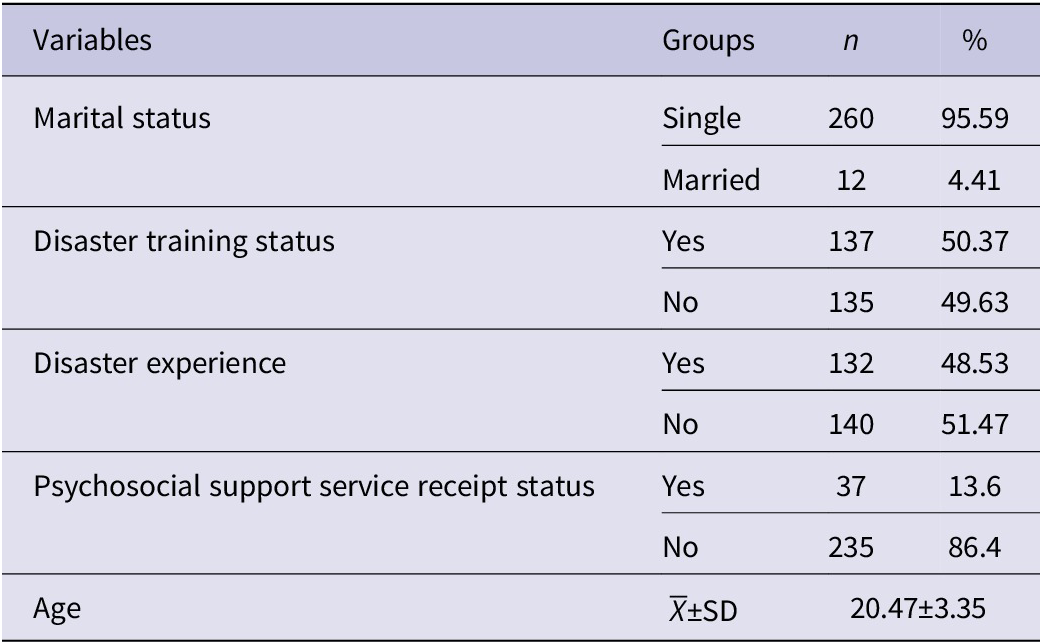
In this section, firstly, the socio-demographic characteristics of the participants are presented. 95.59% (n: 260) of the participants were single, 50.37% (n: 137) had received disaster training, 51.47% (n: 140) had not experienced a disaster, and 86.4% (n: 235) had not received psychosocial support services before. The mean age of the participants was 20.47 ± 3.35 years (Table 2).
Distributions on demographic characteristics

Fatalism scores showed a statistically significant difference according to the status of receiving disaster training (P < 0.05). When the mean scores were examined, it was determined that the fatalism scores of the participants who received disaster training (2.63 ± 0.94) were lower than those who did not receive disaster training (2.90 ± 1.06). Other scale scores did not show a statistically significant difference according to the status of receiving disaster education before (P > 0.05). The strength/advocacy, threat, anxiety, and disaster risk perception scale scores show a statistically significant difference according to the previous disaster experience of the participants (P < 0.05). When the mean scores were examined, it was determined that the strength/advocacy, threat, anxiety, and disaster risk perception scale scores of the participants who had disaster experience were higher than those who did not experience. Other scale scores did not show a statistically significant difference according to the status of experiencing a disaster (P > 0.05) (Table 3).
Comparison of scale scores according to demographic characteristics

F: One-way analysis of variance t: Independent sample t test.
There was a low, positive, and significant (r: 0.227; P < 0.05) correlation between restrictiveness scores and threat scores; a low, negative, and significant (r: -0.263; P < 0.05) correlation between fatalism scores; a moderate, positive, and significant (r: 0.448; P < 0.05) correlation between the controllability scores; a low, positive, and significant (r: 0.277; P < 0.05) correlation between anxiety scores; and a low, positive, and significant (r: 0.293; P < 0.05) correlation between disaster risk perception scale scores. There was a low, negative, and significant correlation between the approach to education scores and fatalism scores (r: -0.243; P < 0.05), and a moderate, positive, and significant correlation between controllability scores (r: 0.155; P < 0.05). There was a low, negative, and significant correlation between self-esteem scores and fatalism scores (r: 0.215; P < 0.05). There was a moderate, positive, and significant (r:0.345; P < 0.05) correlation between strength/advocacy scores and threat scores; a low, negative, and significant (r: -0.192; P < 0.05) correlation between fatalism scores; a moderate, positive, and significant (r: 0.505; P < 0.05) correlation between controllability scores; a low, positive, and significant (r: 0.292; P < 0.05) correlation between anxiety scores; and a moderate, positive, and significant (r: 0.396; P < 0.05) correlation between disaster risk perception scale scores. There is a moderate, positive, and significant (r: 0.339; P < 0.05) correlation between the women’s psychological power scale scores and threat scores; a low, negative, and significant (r: -0.177; P < 0.05) correlation between the fatalism scores; a moderate, positive, and significant (r: 0.483; P < 0.05) correlation between the controllability scores; a moderate, positive, and significant (r: 0.391; P < 0.05) correlation between anxiety scores; and a moderate, positive, and significant (r: 0.425; P < 0.05) correlation between the disaster risk perception scale scores (Table 4).
Findings on the correlation between scales

** P<0.01.
When the regression analysis assumptions were analyzed, it was found that the Durbin-Watson value was 1.80 and there was no autocorrelation. The variance inflation factor (VIF) was around 1 and it was observed that there was no multicollinearity problem. Multiple regression analysis was conducted by including the sub-dimension scores of the women’s psychological power scale, which were found to be significant and related to the disaster risk perception scores, in the model. It was determined that the model established for the prediction of disaster risk perception scores was statistically significant [F (4.267) = 19.92 P < 0.05]. Restrictiveness, self-esteem, and strength/advocacy scores were found to be significant predictors of disaster risk perception scores (P < 0.05). A 1-unit change in the restrictiveness sub-dimension scores will cause a 0.14-fold change in the disaster risk perception score, a 1-unit change in the self-esteem sub-dimension scores will cause a 0.16-fold change in the disaster risk perception score, and a 1-unit change in the strength/advocacy sub-dimension scores will cause a 0.39-fold change in the disaster risk perception score. The scores of restrictiveness, self-esteem, and strength/advocacy sub-dimensions, which were found significant in the model, explained 23% of the variance in disaster risk perception scores (R2: 0.23) (Table 5).
Findings on the prediction of disaster risk perception score

F(4.267)=19.92; P:0.01 R:0.479 R2:0.230 Durbin-Watson:1.80.
Discussion
In this study, we aimed to examine the effect of women’s perceptions of psychological power related to gender roles on their disaster risk perceptions. This study determined that the psychological strength of women with disaster experience positively affects disaster risk perception, that women who received disaster training have lower fatalistic beliefs, and that women’s psychological strength affects threat perception, controllability, and anxiety levels. In addition, the study reveals that important parameters affecting women’s perception of disaster risk are restrictiveness, self-confidence, and power/advocacy.
This study, which examined the effect of women’s perceptions of psychological power regarding gender roles on disaster risk perception, found that the scores of strength/advocacy, threat, anxiety, and disaster risk perception scale were higher in women who experienced disasters compared to those who did not. A previous study conducted in Portugal determined that the disaster experience affects individuals’ disaster risk perception.Reference Domingues, de Jesus and Ferreira44 Individual perception and experience of a natural hazard can influence risk perception.Reference Vitek and Berta45 Exposure to an event and experience affects individuals’ risk perception.Reference Lima, Barnett and Vala46 Another study determined that factors such as gender, age, and disaster experience affect risk perception.Reference Fernandez, Tun and Okazaki47 Similarly, there is evidence in the literature that disaster risk perception is influenced by various factors, particularly experiences.Reference Sjöberg48, Reference Kung and Chen49 When the data of our study are evaluated together with the existing literature, it is concluded that disaster experiences of individuals affect disaster risk perception. This can be explained by the fact that having experienced a disaster makes people aware of their vulnerabilities and thus affects their risk perception.Reference Terpstra50 Therefore, it can be said that creating systems that will directly include people with disaster experience in the process of creating disaster plans will contribute to disaster management processes.
This study found that the fatalism scores of women who had received disaster training were lower than those who had not received disaster training before. In the study conducted by Aksa et al. (2020) in Indonesia, it was found that participants’ fatalistic beliefs had a negative and significant correlation with earthquake risk perception.Reference Aksa, Utaya and Bachri51 In another study conducted in Florida, Kusenbach (2018) reported that although there was a partial link between female gender and fatalism, no other distinct clusters based on demographic characteristics were observed.Reference Kusenbach52 In their study conducted in Lebanon, Baytiyeh and Naja (2016) reported that belief in fatalism affects risk perception and has a negative impact on disaster preparedness.Reference Baytiyeh and Naja53 This can be explained by the fatalistic belief that people have no control over dangers.Reference Gierlach, Belsher and Beutler54 Fatalistic understanding should be considered in efforts to increase the disaster resilience of societies because it has been found that fatalistic approaches reduce disaster resilience.Reference Pathirage, Seneviratne and Amaratunga55 Yari et al. (2019) stated in their research that fatalistic beliefs affect disaster preparedness behavior.Reference Yari, Zarezadeh and Ostadtaghizadeh56 Lindell and Perry (1992) stated that individuals with fatalistic beliefs believe that disasters cannot be prevented.Reference Lindell and Perry57 Therefore, it can be assumed that it is a natural result that disaster training affects fatalism score.
In this study, it was determined that there was a moderate and positive correlation between women’s perceptions of psychological power and threat perception, controllability, anxiety levels, and disaster risk perceptions, while there was a low and negative correlation with their perceptions of fatalism. Although psychological strength is usually associated with lower threat perception, in this study higher WPPS was associated with higher threat perception. A possible explanation for this is that women who perceive themselves as psychologically strong are more aware of the dangers around them, which leads to higher threat perception. Marceron and Rohrbeck (2019) found a significant negative correlation between perceived threat and self-efficacy regarding disasters.Reference Marceron and Rohrbeck58 A study in Taiwan reported that women feel more prepared than men for possible future hazards.Reference Roder, Ruljigaljig and Lin59 Another study found that women were more prepared for hazards.Reference Lindell and Whitney60 These situations may indicate that women’s threat perception and controllability affect disaster risk perception. Cvetković et al. (2019) determined that men have higher perceptions of flood disaster preparedness and women have low self-confidence in flood disaster preparedness.Reference Cvetković, Öcal and Ivanov61 In the aforementioned study, this was attributed to women’s gender roles and linked to women’s low participation in community networks, their status within the family, and cultural influence. Kung and Chen (2012) determined that women feel more anxious and threatened by earthquakes and are more sensitive to risk.Reference Kung and Chen49 It can be stated that threat perception affects disaster risk perception and makes women more sensitive.
Restrictiveness, self-esteem, and strength/advocacy scores were found to be significant predictors of disaster risk perception scores. The psychological power of women affects their disaster risk perception. Rodriguez-Llanes et al. (2013) determined that strong social support received after a disaster is associated with increased psychological resilience, while the women’s resilience result is associated with decreased probability.Reference Rodriguez-Llanes, Vos and Guha-Sapir62 Öztekin and Örki (2023) reported that conscious societies have higher psychological resilience in disasters and higher disaster risk perceptions.Reference Öztekin and Örki63 Killgore et al. (2020) determined that psychological resilience in the face of disaster risks is related to alterable factors.Reference Killgore, Taylor and Cloonan64 Nishimi et al. (2023) reported that psychological resilience is associated with a lower probability of disaster risk over time.Reference Nishimi, Tan and Scoglio65 Altınova and Adıgüzel (2014) found positive results in terms of self-esteem, gender roles, and perceptions.Reference Altınova and Adıgüzel66 Rodriguez-Llanes et al. (2013) determined that women are at higher risk of experiencing a worse state of psychological resilience after a disaster.Reference Rodriguez-Llanes, Vos and Guha-Sapir62 Xi et al. (2020) concluded that resilience mediates various problems after disasters.Reference Xi, Yu and Yao67 In a study conducted in Erzincan, Tercan (2023) determined that the level of disaster risk perception of female individuals was higher than male individuals.Reference Tercan68 In their study conducted at Gümüşhane University, Mızrak and Aslan (2020) found that women’s perception of disaster risk was higher than that of men.Reference Mızrak and Aslan69 Ayvazoğlu et al. (2020) in their study conducted at Mustafa Kemal University, determined that the disaster risk perception levels of women were higher than men.Reference Ayvazoğlu, Çekiç and Yücel70 Similarly, numerous studiesReference Bronfman, Cisternas and López-Vázquez31, Reference Kung and Chen49, Reference Lindell and Hwang71–Reference Gökçay, Çevirme and Küçük73 revealed that women have higher disaster risk perceptions than men. Therefore, it can be stated that the psychological empowerment of women can have significant effects on disaster risk management. It is considered that women have higher disaster risk perceptions than men due to their physiological, cognitive, psychological, social network, and social roles. This may significantly affect the idea of empowering women and supporting a collective approachReference Drolet, Dominelli and Alston74 to create disaster-resilient societies and achieve sustainable development goals.
Limitations
Collecting the study data online via Google form is a limitation of the study. While this method provides the convenience of collecting participants’ responses in real-time, it may make it difficult to observe significant contexts of the participants, such as social or demographic factors. It was observed that disaster training affected the fatalism score. However, considering that the perception of fatalism may be affected by different factors, the fact that the perception of fatalism in disasters was not examined in terms of different variables is considered as a limitation of the study. In this study, only the effect of women’s psychological resilience on disaster risk perception was examined. Therefore, it is considered important to conduct further studies with a mixed design, considering women’s psychological experiences and other environmental factors. In this study, it was determined that income level affects self-esteem. Therefore, it is recommended that future studies investigate environmental and personal characteristics that may affect self-esteem.
Conclusion and Recommendations
As mentioned in our study, it has been determined in many scientific studies that disaster risk perception is affected by various factors. A high level of disaster risk perception may increase individuals’ tendency to be more prepared for disasters and thus reduce their vulnerability. Therefore, in this study, the effect of psychological power of women living in Türkiye on disaster risk perception was examined in terms of various variables. This study determined that women with disaster experience had higher disaster risk perceptions. For this reason, it is considered important to ensure the leadership of women with disaster experience and their participation in disaster risk and disaster crisis management stages. It was determined that receiving disaster training was a significant factor in disaster preparedness and affected the fatalism score. It can be said that disaster training is an important tool for empowering women and building capacity against their vulnerabilities. It was determined that there was a moderate positive correlation between women’s perceptions of psychological power and their perceptions of disaster risk. In addition, the restrictiveness, self-esteem, and strength/advocacy scores were found to be significant predictors of disaster risk perception scores. It is considered that psychological empowerment of women and conducting women-based disaster studies are essential in reducing disaster risks, ensuring sustainable disaster resilience, building a disaster-resilient society, and conveying this information to future generations.
Finally, according to the results of our study, women’s psychological strength affects their perception of disaster risk. It is thought that psychological empowerment of women can play an important role in increasing their resilience against disasters and reducing their vulnerability. However, vulnerability to disasters is a multidimensional phenomenon, and because it cannot be explained only by psychological strength, it is recommended that different perspectives be developed in future studies based on this study.
Data availability statement
The data created within the scope of the study can be accessed from the authors upon appropriate request, provided that legal and ethical rules are respected. The data will be stored securely on a password-protected computer.
Funding statement
No support received.
Competing interests
No conflict of interest has been declared.
Ethical standard
The Helsinki guidelines were followed during the study’s execution. Participants participated in the study voluntarily and with their consent. Informed consent was obtained from each participant. Permission was obtained from Artvin Çoruh University Scientific Research and Publication Ethics Committee before the study started (Ethics Committee No: E-18457941-050.99-121593- 22.01.2024).